
A published certificate of analysis for one Maui Wowie concentrate puts terpinolene at 1.450% and beta-myrcene at 0.289%, so the compound that most strain charts call the base of this profile ran a distant second in that batch (VABL00002 Maui Wowie COA). That result isn't a lab error. It's what a real lot looks like when you measure it instead of copying a product page.
For a formulator, the Maui Wowie terpene profile is not a fixed recipe. It's a written target: a short list of aroma descriptors, a set of compound ranges, and a record of how each lot you accept compared against them.
Maui Wowie Terpene Profile at a Glance
Maui Wowie is usually described with myrcene as the base, and limonene, caryophyllene, pinene and terpinolene doing the citrus, spice, pine and tropical work. Measured certificates support that description on average, with a wide spread between samples.
Here are four published reference points side by side.
| Sample | Myrcene | Caryophyllene | Limonene | Pinene | Terpinolene |
|---|---|---|---|---|---|
| Verified COA database mean, all Maui Wowie products | 0.71% | 0.67% | 0.53% | Mean not published | Mean not published |
| Flower COA sample, ten compounds, 2.67% total | 1.721% | 0.341% E-caryophyllene | 0.252% D-limonene | 0.044% alpha-pinene | 0.147% |
| Concentrate COA sample, about 2.5% total | 0.289% | 0.144% trans-caryophyllene | 0.192% S(-)-limonene | 0.092% beta-pinene | 1.450% |
| Extract sample, 28.4% total terpenes | 8.3% | 3.1% | 2.9% | 3.1% alpha-pinene | Grouped with other compounds in the remaining 11.0% |
The first row comes from an aggregated database of verified certificates of analysis, reporting means of 0.71% beta-myrcene, 0.67% beta-caryophyllene and 0.53% limonene, which together total 1.91% by weight (the published Maui Wowie COA summary). The second row is a single flower COA where ten reported compounds summed to roughly 2.67%, including alpha-phellandrene, alpha-humulene, ocimene, linalool and beta-pinene.
Why a flower number can't become a cartridge number
The fourth row explains the trap. One tested extract reported 28.4% total terpenes, with myrcene alone at 8.3% (same COA summary). Nothing about the plant changed. The product type did. Percentages get concentrated, diluted or redistributed by processing, so a flower figure never transfers straight into an oil figure.
Turning the table into your own spec
Use the table as a reference range, then read your own batch COA against it. Compare two things, not one: the absolute percentages, and the ranking of compounds. Ranking is what the nose notices first.
Practical rule: if your lot's top compound is terpinolene and your specification says myrcene must lead, the spec is wrong, not the oil.
What Each Terpene Adds to the Aroma
Every compound in the profile has one sensory job. Once you know the jobs, a blend becomes a set of levers rather than a mystery.
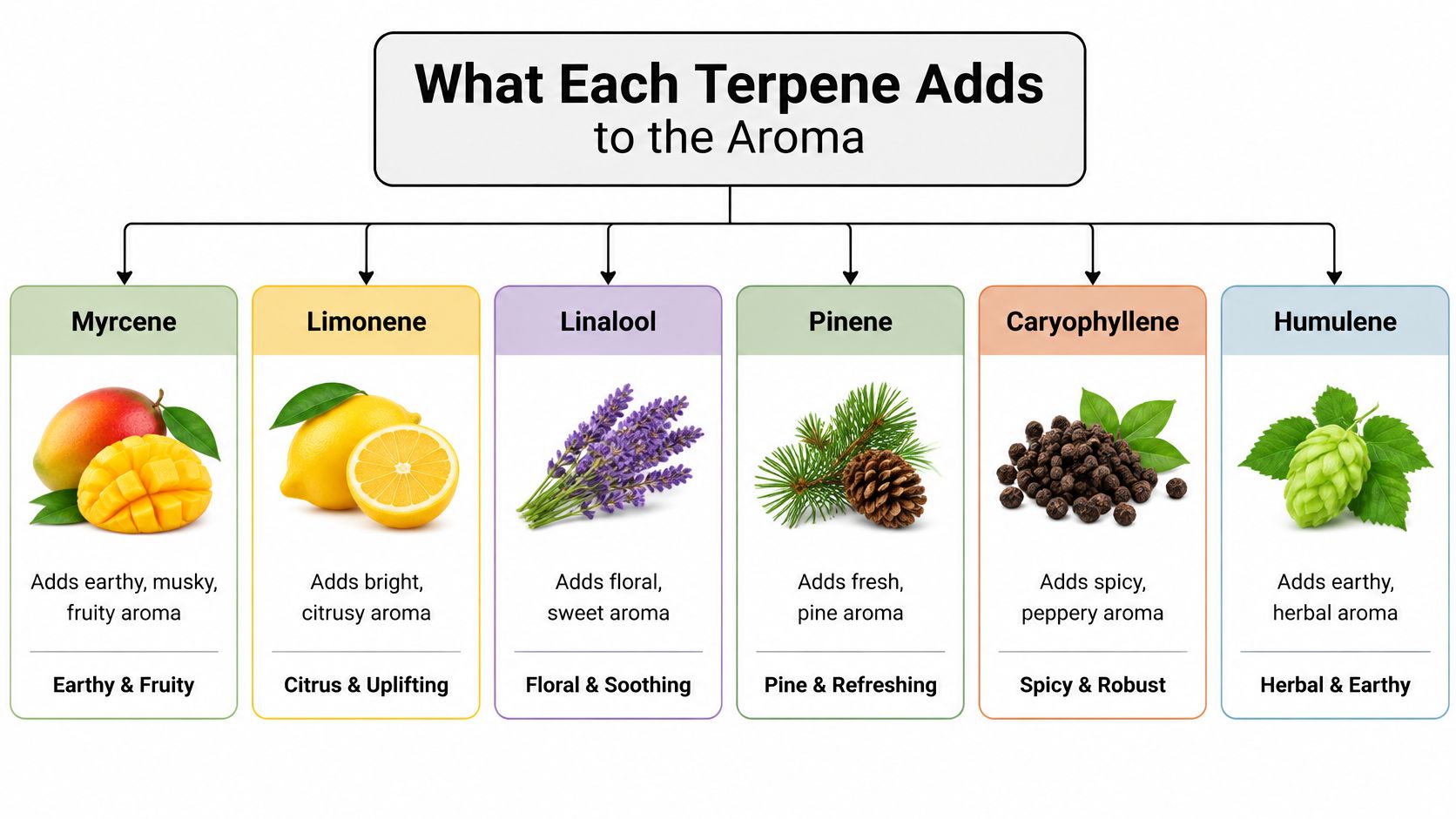
Myrcene is the base. It gives herbal depth and holds the fruit notes together. Drop it too low and the blend reads sharp and thin. Limonene supplies the citrus lift and sharpens the top note, so small increases brighten the whole profile. Terpinolene brings a sweet, floral, fresh-herbal lift and often carries much of the tropical character people recognize.
Beta-caryophyllene adds dry, peppery depth. Keep it restrained, or the pepper walks over the fruit. Alpha-pinene and beta-pinene add the fresh resin note, and beta-pinene accounts for the familiar cannabis odor often linked to pine trees and turpentine. Alpha-humulene contributes the hoppy edge that rounds the herbal side out.
The three compounds to adjust first
A sensory-chemistry study found that myrcene, terpinolene and limonene together explained more than 80% of terpene variation in its principal-component analysis (cannabis aroma research published in PMC). That makes those three your control points. Get their ratio right and the remaining compounds are fine-tuning.
The same body of work shows that non-terpenoid volatiles also shape cannabis aroma, so a terpene label alone won't guarantee a sensory match. Compare terpene percentages and flavor descriptors together, using a reference like our terpene flavor chart so the whole team works from the same words.
Terpene expression isn't fixed, either. Phenotype, growing conditions, maturity, plant tissue, curing, storage and the lab method all shift a measured profile, which is why a name can't promise one blend (the cultivar's Hawaiian history).
One variable per trial: raise limonene by a few points, hold everything else, and taste against the same written target. Change two compounds at once and you learn nothing.
Why Maui Wowie Blends Vary and How to Qualify Each Lot
Not every Maui Wowie lot is myrcene-first. The concentrate sample in the comparison above ran terpinolene at the top of its list, several times higher than myrcene. A formulation built on a generic "Maui Wowie equals myrcene-heavy" assumption would miss the volatile, floral-citrus character of that batch entirely.
Three reasons two lots disagree
- The plant. Phenotype, growing conditions and harvest maturity change which compounds the material carries into the jar.
- Handling. Plant part, curing, storage and heat exposure all move the numbers before the material reaches you.
- The lab method. Different extraction and analysis methods report different totals from the same starting material.
The label problem runs deeper than one strain. A study of nearly 90,000 samples found three broad terpene groupings, including myrcene-pinene and caryophyllene-limonene combinations, and those groups did not align cleanly with indica, sativa or hybrid labels (coverage of the 90,000-sample study). Which profile should you copy? Not a catalog average.
Write the ranges, then hold lots to them
Define the target by aroma and by range. For a Maui Wowie-style brief, the descriptors are citrus, tropical fruit, pine and soft herbal, and the spans below cover the published samples, flower through concentrate:
- Myrcene, 0.29 to 1.72%. The anchor. Its share decides how much body the blend has.
- Limonene, 0.19 to 0.53%. The citrus edge. Higher lifts the top note.
- Beta-caryophyllene, 0.14 to 0.67%. The pepper. Stay near the low end to keep fruit forward.
- Terpinolene, 0.15 to 1.45%. The wildcard. A high-terpinolene lot needs a different trial, not a rejection.
What belongs in a purchase specification
USP treats chromatographic methods as part of establishing the identity of botanical materials, and its cannabis standards work includes analytical methods and acceptance criteria for differentiating varieties (USP cannabis standards). Build that principle into your purchasing document. Require botanical-source information, lot identification, a current COA with terpene concentrations, contaminant testing appropriate to your market, and written confirmation that the material carries no undeclared carrier ingredients.
That last point matters most when the blend goes into distillate or cartridge oil, because the finished product is judged under the rules of the market you sell into. If you want to see what a method-verified report looks like before you write the spec, our guide to chromatography testing walks through the fields worth checking.
Our terpenes are extracted from fresh plants and are free of mixtures, chemicals and additives, and the blends are free of VG, PG, PEG and MCT. Product terpene data comes from SC Labs, and current records sit on our Terpene Safety & Documents page. Request them with every order anyway.
Keep the trail: blend lot, batch ratio, mixing record and finished-product test results. When a batch drifts, that file is how you find the cause instead of guessing.
How to Build a Maui Wowie-Style Blend
Start with a target you can taste, not a name. For a bright tropical profile, the descriptors are pineapple-tropical, citrus, pine and soft herbal, with pepper sitting underneath. Then set starting shares, mix small, and test at the cartridge.
Take a hypothetical 100 g blend toward that target: about 35 g myrcene, 20 g limonene, 15 g terpinolene, 8 g beta-caryophyllene and 8 g alpha-pinene, leaving 14 g unassigned for adjustments after the first panel. Those shares are test points, not specifications.
| Compound | Starting share of total terpene load | Sensory role |
|---|---|---|
| Myrcene | 30-40% | Herbal base and structural anchor |
| Limonene | 15-25% | Citrus lift and bright top note |
| Terpinolene | 10-20% | Sweet, floral, fresh-herbal lift |
| Beta-caryophyllene | 5-10% | Dry peppery depth, keep restrained |
| Alpha-pinene | 5-10% | Fresh pine character |
| Ocimene or linalool | 0-5% | Optional floral lift, test first |
The flow below runs the same sequence from target to approved lot.
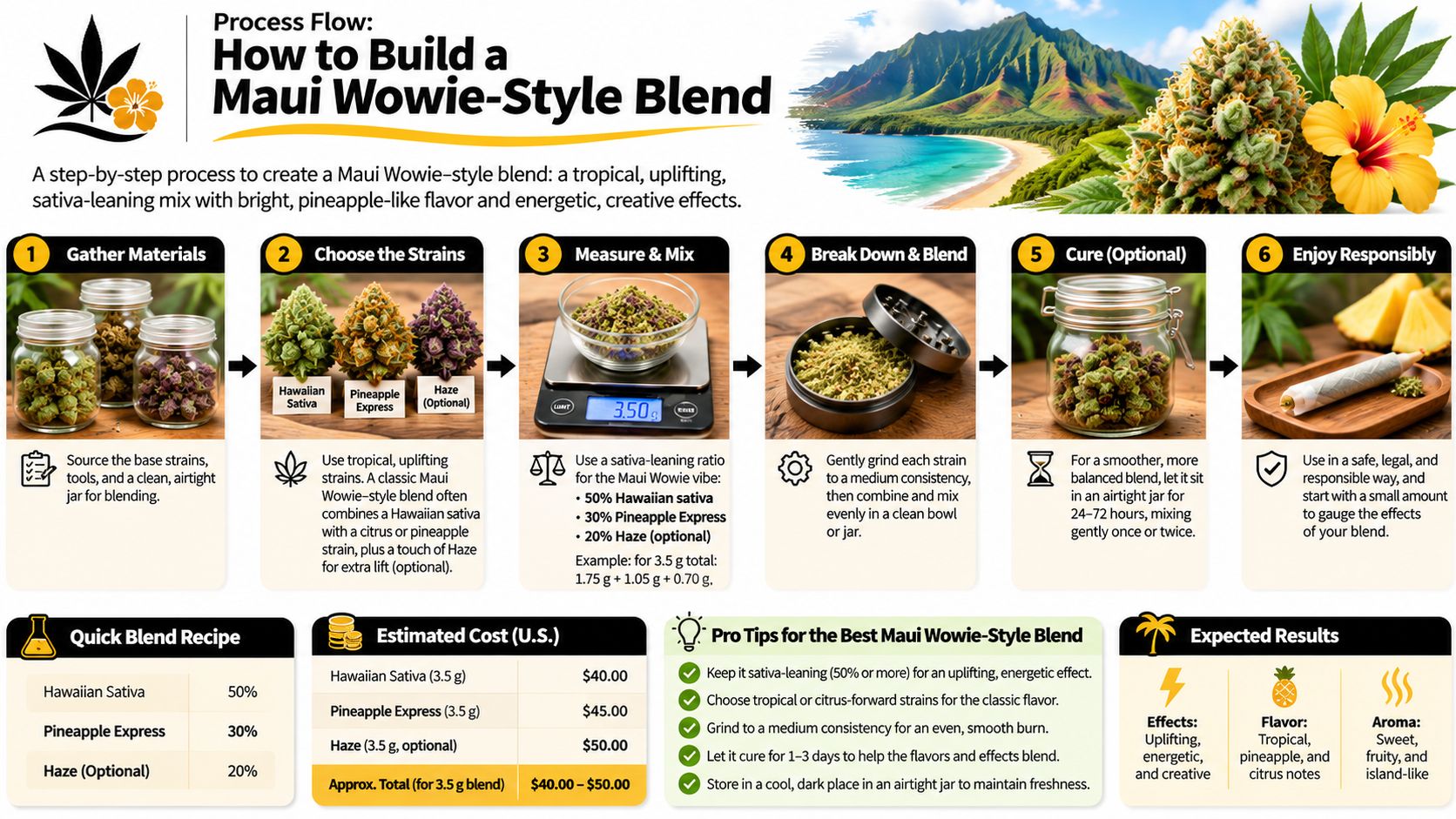
Seven steps from target to approved lot
- Write the target in three to five descriptors before you open a single bottle.
- Pick the anchor. Myrcene sets the body for most Maui Wowie-style builds.
- Set the starting shares from the table, then convert them to grams for your batch size using the ratio method in our guide to mixing terpene strains.
- Weigh each component on a scale fine enough for your batch size and log the actual weight, not the target.
- Add the blend to distillate at a low loading and mix until uniform. Run two or three load levels side by side, from light to heavy, so you can compare them.
- Test the finished product after heat cycling, not just the concentrate in the flask.
- Adjust one compound at a time and record every change with its date.
Hold the loading rate constant while you adjust compound shares, expressed as grams of blend per 100 g of distillate or cartridge oil. Otherwise you can't tell whether an aroma shift came from the blend or the dose.
Test at the cartridge, not the flask
Terpinolene and the other monoterpenes are volatile. Aggressive distillation, long heat exposure or poorly sealed hardware will pull the top note down and leave a flatter product than the one your GC-MS approved. That's why the sensory panel scores the finished cartridge, not the blend.
Document the dose: "4 g per 100 g of distillate, strong citrus score on the panel" is a record you can repeat. "A few drops" is not.
Aroma Claims and Label Language for Maui Wowie Blends
A Maui Wowie-style blend can carry an aroma story. It can't carry an effect promise. Perceived effects depend on dose, cannabinoids, inhalation conditions and individual response, so the blend should never be written up as reliably energizing, creative or uplifting (a review of Maui Wowie terpene data).
Build the paper trail in five moves.
- Write a descriptor sheet with three to five aroma and flavor words. Pineapple-tropical, citrus, pine, soft herbal, peppery. Use only those words on the label and in the product brief.
- Build a panel sheet that scores each descriptor from 1 to 5 on the finished cartridge after heat cycling.
- Split the language. Aroma words describe smell and taste. Structure or function words go to regulatory review for your destination market.
- Keep a claim file holding the descriptor sheet, the panel scores and the current COA for the blend lot.
- Route the effect question back to the aroma brief whenever someone asks whether myrcene, terpinolene or limonene can stand in for an effect claim.
That file is also what a regulator or a distributor will ask for first. Our regulatory compliance checklist covers the documents to have ready. The same descriptor sheet then becomes the brief a custom blend is written from.
Say what you can measure: "tropical, citrus-forward, pine finish" is a claim you can support with a panel and a COA. Anything about mood is not.
Request Samples and Start Your Blend
Three moves take this from reading to shipping.
First, request a sample of a Maui Wowie-style blend and run it in your own distillate or cartridge formula. Test it at your intended loading rate, heat cycle it, and score it against your descriptor sheet. A blend that shines in a sample vial and fails in a sealed cart tells you the problem is hardware or dose, and you'll only learn that in your own process.
Second, check the catalog for a matching Maui Wowie terpene blend and confirm the current lab records before you place an order. We carry over 50 strains of terpenes across indica, sativa and hybrid categories, with new profiles added each month, so a closer match may already exist.
Third, go custom if nothing on the shelf fits your target. Build the mix from isolates such as myrcene, limonene, terpinolene and beta-caryophyllene, and choose the combination that matches your own sensory brief rather than a strain name.
Send us three things with your first inquiry: your target descriptors, your loading rate in grams per 100 g of oil, and the compliance requirements for the market where the finished product sells. That's enough to match a blend, quote a bulk volume, or write a custom profile against your brief.
Gold Coast Terpenes supplies botanically derived terpene blends, strain-specific profiles and individual isolates for cartridges, concentrates and formulation work, all THC-free and free of VG, PG, PEG and MCT. If you're building a Maui Wowie-style product, start with a sample, run it through your own distillate and heat cycle, then scale once the panel agrees. Visit Gold Coast Terpenes to shop blends, request samples, or send your descriptor sheet for a bulk or custom quote.