
If a liquid terpene blend smells right in the bottle, what proves it will mix, fill, heat, and age correctly in your product? Aroma is only the starting point. For manufacturers, liquid terpenes are a formulation-control decision, with form, dose, heat exposure, storage, and supplier records all affecting whether a sample becomes a repeatable production ingredient.
Liquid Terpenes Compared With Other Terpene Forms
Liquid terpenes are aromatic compounds from botanical sources, sold as a liquid you can weigh and mix into a base such as distillate or cart oil. The term describes a physical form, not one specific substance. The category can include monoterpenes, sesquiterpenes, and oxygenated compounds, either isolated or combined into a profile.
Liquid terpene forms compared, with the finished base shown separately
| Form | What it is | Where it fits | Main handling need |
|---|---|---|---|
| Liquid terpene blend | Several terpenes mixed to a target profile | Flavor-matched carts and distillate | Sealed, dark, cool storage |
| Single isolate | One compound such as limonene or myrcene | Building blocks for custom profiles | Same storage, plus lot documentation |
| Botanical full-spectrum extract | Complex mix from plant material, with natural variation | Products that need a natural aroma with some batch variation | Batch testing for consistency |
| Terpene-infused distillate (finished base, not a terpene form) | Refined distillate with a blend mixed in | Standard cart base needing a finished profile | Correct dosing and mixing order |
The fourth row is deliberately separate. Terpene-infused distillate is what you make after choosing a terpene form, not another kind of terpene ingredient.
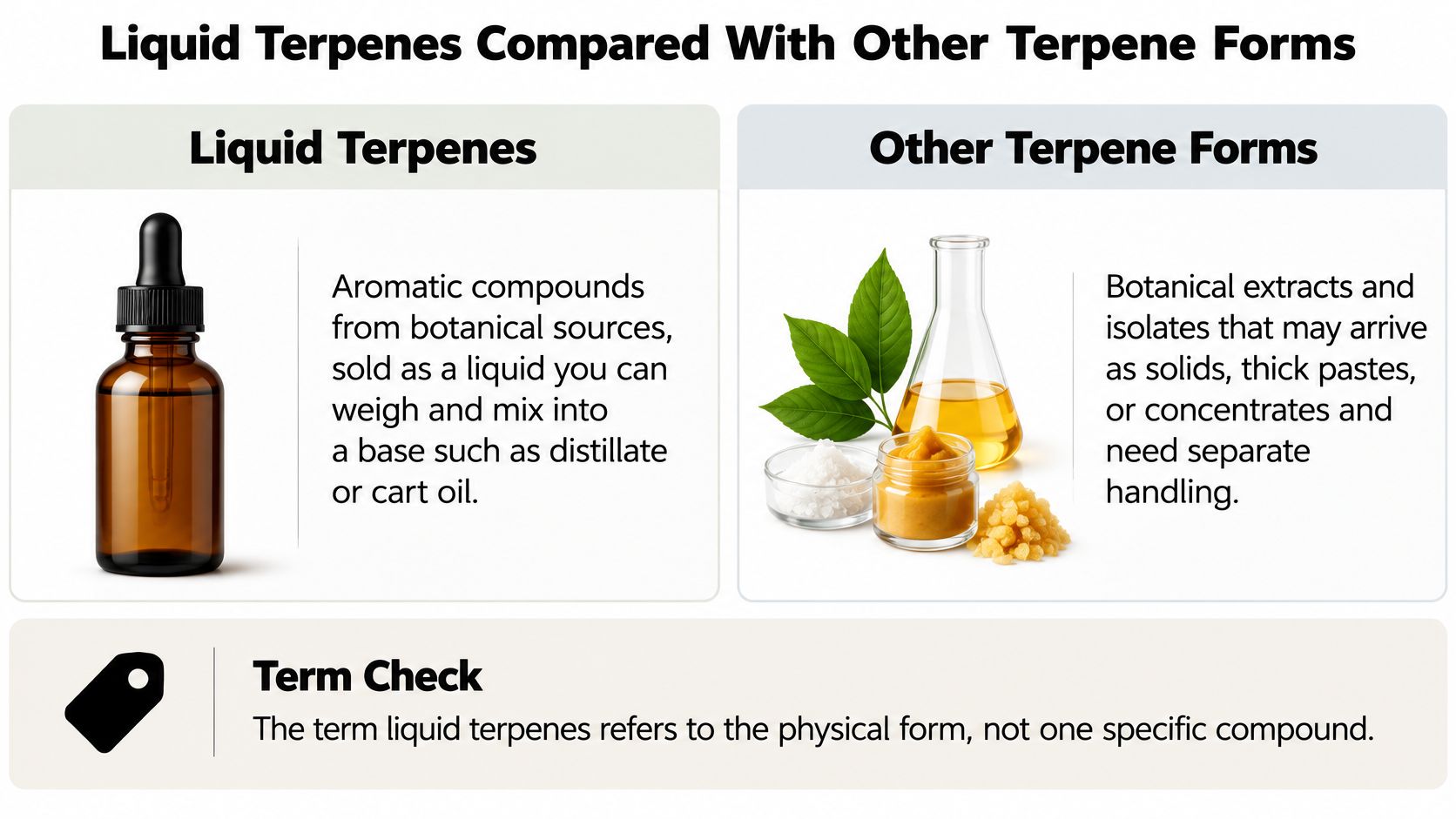
Choose the ingredient, not just the bottle
A blend is like a pre-mixed spice rack with the balance already set. An isolate is one jar of cumin, useful when you need precise control over one note. A full-spectrum botanical extract is closer to a pot of stock, with many connected notes that aren't as easy to adjust separately.
These distinctions matter when purchasing. A liquid isolate and a liquid blend may both pour easily, but they solve different problems. Replacing one with the other changes the formula, even if the purchase description calls both liquid terpenes.
The global terpenes market was valued at approximately USD 1.1975 billion in 2024, according to Credence Research, whose report includes liquid terpenes as a market form. That broad category isn't a purchasing specification, so buyers still need a clear description of the material inside the package.
Answer these questions before choosing a form
- Aroma complexity: Does the product need a single clear note or a layered profile?
- Batch control: Must every production lot closely match an approved reference, or can the specification allow botanical variation?
- Plant handling: Can your team weigh, store, and mix the ingredient with the equipment and packaging already in use?
Choose the form that your team can control, not just the one with the most appealing aroma description. A complex ingredient isn't automatically the best fit for a simple product.
Dosing Liquid Terpenes in Distillate and Carts
Dose to the functional and sensory target rather than a supplier maximum. For the hypothetical bench series below, use 1% to 5% by weight as exploratory loadings, with production setpoints chosen only after repeats. Higher stress loadings are a laboratory reference for failure boundaries, not a routine target for stronger flavor.
U.S. food-flavoring regulations require natural flavoring substances to be used at the minimum quantity needed for their intended physical or technical effect, under good manufacturing practice. That rule applies to food flavoring and gives no inhalation-safe percentage, yet minimum-effective-use is a useful discipline for vapor formulas.
Run a controlled bench series
Use separate, labeled samples from the same base lot. This prevents repeated additions from confusing the comparison and lets the team evaluate each loading under matching conditions.
Bench dosing steps for distillate and cart oil
| Bench step | Loading by weight | What to record | Pass check |
|---|---|---|---|
| Step 1, low flavor touch | 1%, hypothetical trial | Aroma, mix time, temperature | Flavor matches target without harsh notes |
| Step 2, mid-range trial | 3%, hypothetical trial | Viscosity, flow and fill | Fills without an unapproved change to the base |
| Step 3, upper trial | 5%, hypothetical trial | Taste panel and thermal check | Flavor balanced, no harsh notes; thermal markers at baseline |
| Step 4, stress reference | Laboratory-only high loading above the bench range | Carbonyl and degradation markers after heat test | Stop before degradation markers rise |
The stress row belongs in a qualified laboratory program, where heat exposure and emissions are measured under controls. A sensory pass also does not replace an emissions assessment.
- Condition the base. Start mixing at room temperature if the base is workable. If it is too viscous, use controlled warming under an approved procedure.
- Prepare the low-loading sample. Add the weighed terpene portion and record aroma, mixing time, and temperature.
- Prepare the middle sample. Check viscosity, transfer through filling equipment, and fill consistency.
- Prepare the upper sample. Use a qualified sensory panel under the appropriate product protocol, then complete the thermal checks. Never taste neat terpene ingredients.
- Verify the lowest passing dose. Repeat it with fresh material and compare it against the approved reference.
- Document the process. Record concentration, lot identities, mixing order, equipment, and temperature exposure.
Calculate against the finished batch
Loading by weight means terpene mass divided by total finished mass. In a hypothetical batch of 100 grams, a 3% loading means 3 grams of terpenes plus 97 grams of base. Adding 3 grams of terpenes to 100 grams of finished base would overshoot the target because the denominator changes after the addition.
Use a calibrated balance rather than counting drops. For more calculation guidance, use our guide to how much terpenes to add to distillate.
Add terpenes after the base has cooled to its validated working temperature. Stir gently without pulling a vortex, and recheck viscosity after each formulation change at a consistent measurement temperature.
Production rule: Approve the lowest dose that repeatedly passes sensory, filling, stability, and device checks. A pleasant aroma alone is not a release specification.
Heat and Oxidation Trade-Offs in Vapor Products
More terpene doesn't automatically make a better vapor product. Additional liquid terpenes can improve fluidity and aerosol transfer, but a blend that fills well can still behave poorly when heated. Manufacturers need to evaluate the oil and device together.
Research published in Scientific Reports found that myrcene-containing mixtures showed less degradation of the starting cannabinoid and evidence consistent with more efficient aerosolization at higher terpene content. Thermal work discussed in this context found that alpha-pinene and terpinolene can undergo oxidative reactions across approximately 100 to 300 degrees Celsius, with oxidation products detectable at 100 to 200 degrees Celsius.
The result isn't a simple instruction to add more or less. It means that improved transfer and increased oxidation can be competing outcomes.
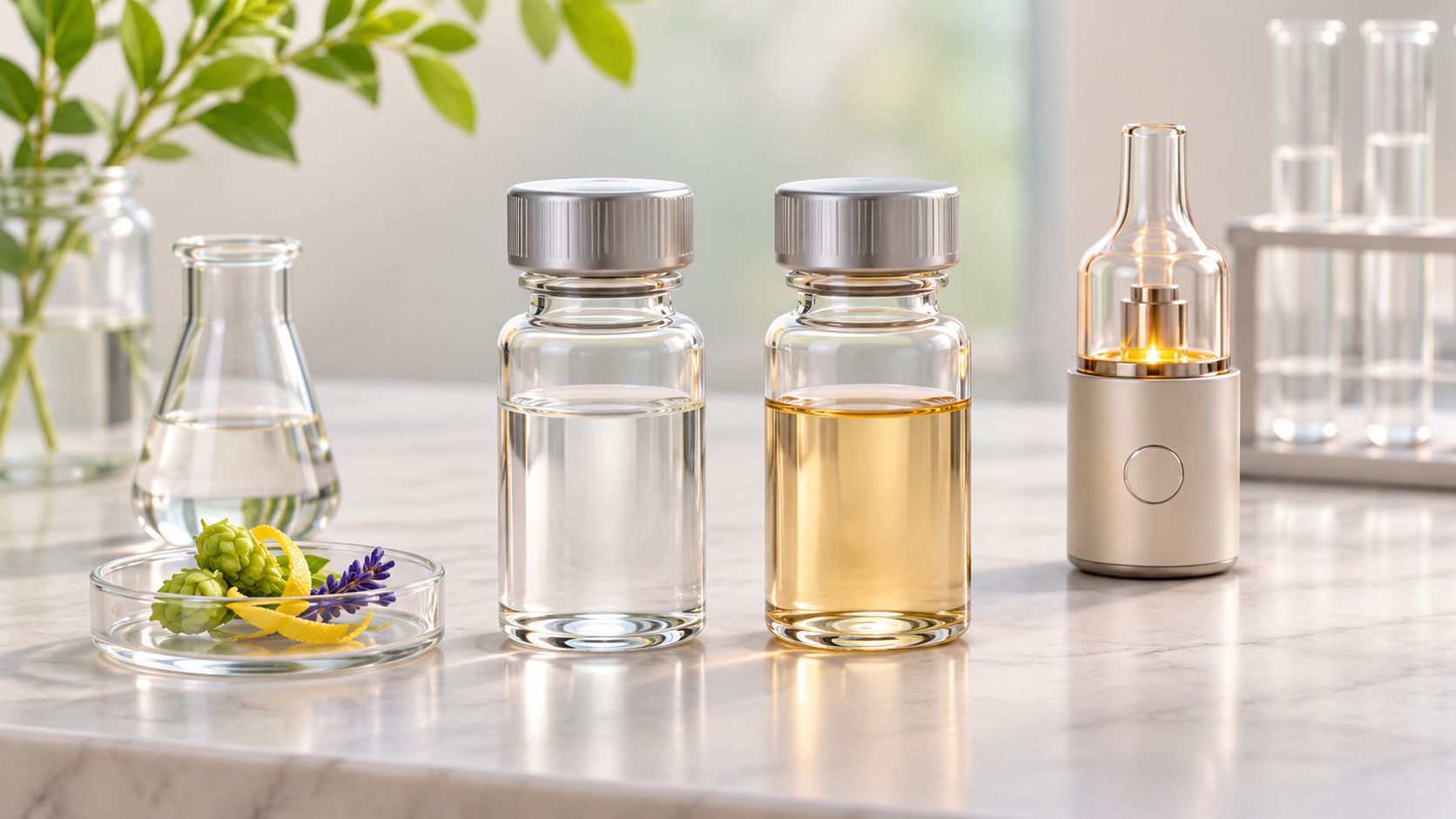
Treat the device and formula as one system
A later aerosol-emissions study found that adding commercial terpene mixtures at 7.5% or 15% by mass to the tested cannabinoid distillates increased carbonyl emissions by as much as ninefold, largely through terpene oxidation. Those findings don't establish a universal safe or unsafe loading for every formula.
Loading, viscosity, coil temperature, power, airflow, and residence time must be considered together. If an engineer changes the cartridge hardware, the formulation team shouldn't assume the previous test results still apply.
Use terpene boiling-point information to understand volatility, not to choose a supposedly safe coil setting. A compound's boiling point isn't an emissions clearance.
Test what production will actually use
Build the validation plan around the intended oil, cartridge, and operating profile:
- Viscosity: Measure at controlled temperatures that reflect filling and use.
- Leak resistance: Check the filled device after handling and conditioning.
- Aerosol output: Confirm repeatable delivery under the defined test cycle.
- Terpene transfer: Measure which compounds reach the aerosol rather than judging bottle aroma.
- Carbonyl markers: Compare heated samples with appropriate controls and predefined action limits.
A food-grade or aromatherapy-grade label doesn't establish that an ingredient is suitable for inhalation.
For purchasing, this boundary matters as much as flavor. An ingredient document describes the supplied material. Your validation program must address what happens when that material passes through your manufacturing process and finished device.
Storage and Stability for Blends in Production
Liquid terpenes are volatile and oxidation-sensitive, so the blend tested at release may not match the blend used later in production. A familiar aroma doesn't prove that the original compound ratios remain intact.
A stability study of flavored vaping liquids identified oxidation, hydrolysis, and condensation as degradation pathways, with limonene among the compounds that degraded within one month after formulation. That finding isn't a universal shelf-life limit for every terpene blend, but it shows why storage needs validation.
Use packaging that protects the material during everyday production handling.
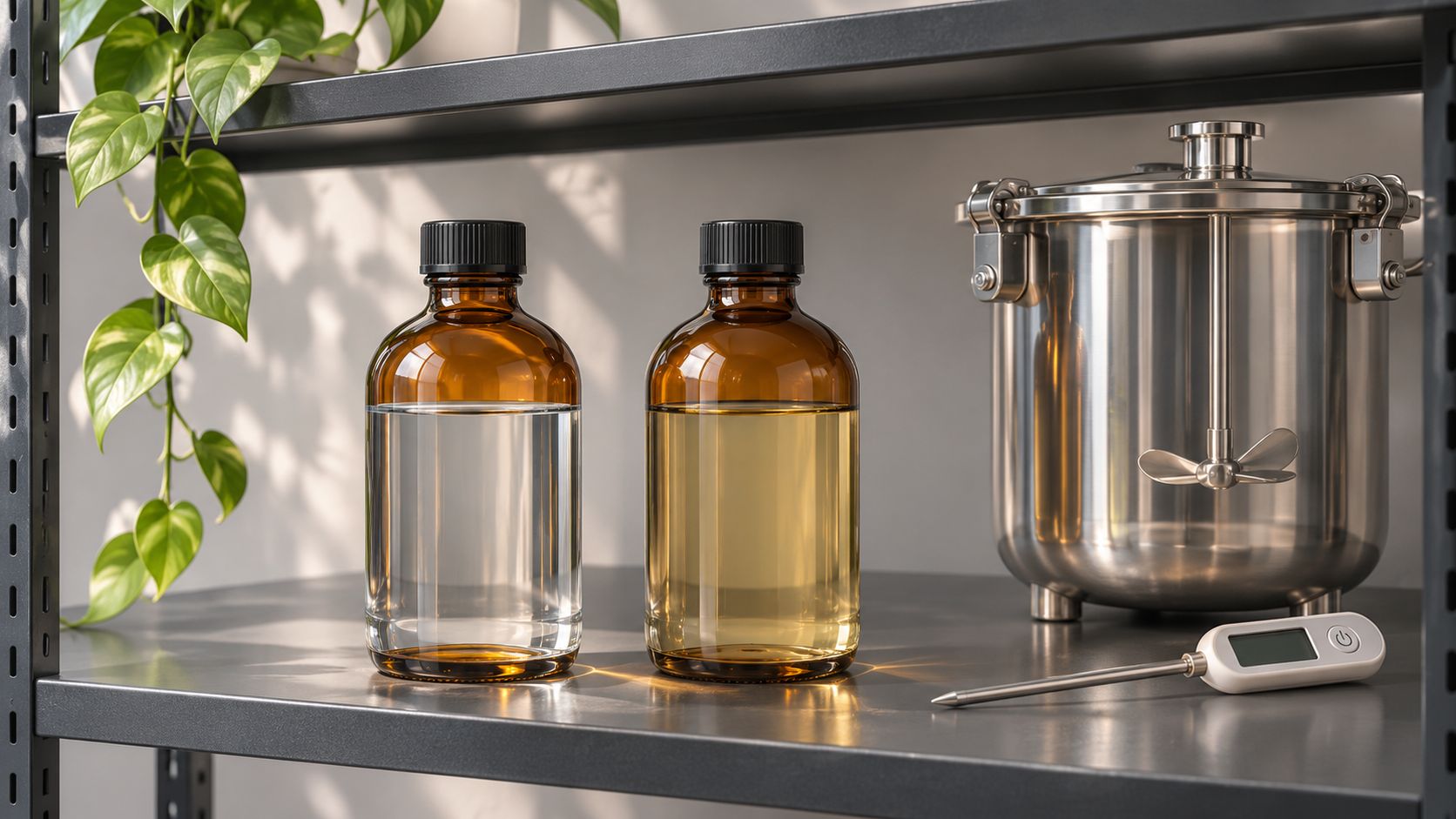
Control exposure during routine handling
- Keep containers sealed and limit headspace. Choose a container size suited to the amount being stored, while allowing appropriate space for handling and expansion.
- Confirm chemical compatibility. Check the bottle, cap liner, seal, and transfer equipment, not just the container body.
- Store dark and cool. Validate the temperature for the specific blend and package rather than assigning one storage condition to every material.
- Use smaller working bottles. Separate daily-use material from reserve stock so operators don't repeatedly open the main container.
- Log every opening. Record the lot, opening date, storage location, and any unusual exposure.
- Schedule analytical checks. Run GC-MS at release and defined intervals during real-time or accelerated stability testing.
GC-MS helps separate and identify the compounds in a blend. Ask the laboratory to compare the profile against the approved reference, including meaningful changes in relative amounts, not merely report a total terpene value.
Our terpene storage guide can support a written handling procedure. Assign someone to check closures, labels, and storage conditions during routine inventory reviews.
For an additional storage resource, use the video below.
Don't treat nitrogen as a freshness guarantee
In a 2024 nitrogen-modified-atmosphere storage study, monoterpenes decreased 62% more, while sesquiterpenes increased 50% more, than under atmospheric storage. The finding concerns the tested material and conditions, not every liquid terpene bottle.
Nitrogen flushing is therefore a packaging variable to validate, not proof of uniform preservation. Closure quality, repeated opening, light exposure, and the product matrix still need attention.
The quality benchmark is retention of the intended compound profile across the labeled shelf life. Set acceptance limits before aging begins, then use the results to approve packaging and storage practices.
Matching Liquid Terpene Blends to Product Goals
Start with the product's aroma target, then choose how much formulation work your team needs to own. A ready blend can shorten development. Isolates give more room to adjust individual notes, but every adjustment creates another formula to document and test.
Starting points by product goal
| Product goal | Starting point | Check before scale-up |
|---|---|---|
| Fruit-forward cart oil | Flavor-matched blend from a range such as blueberry, peach, or grape | Aroma match against a reference sample in the real base |
| Citrus-led distillate | Limonene isolate with a small share of myrcene | Flavor balance at hypothetical 1% and 3% trial loadings |
| In-house custom profile | Isolates such as myrcene, linalool, and alpha-pinene | Batch-to-batch match to the logged ratios |
Compare the options in the actual base
For a fruit-forward cart oil, begin with an approved reference sample rather than a loose description such as sweet fruit. Compare the proposed blend in the actual base, because the base's own aroma can change the finished impression. Review flavor eligibility for the destination market before spending time on optimization.
For a citrus-led distillate, limonene can serve as the main building block, with a smaller myrcene share explored as a balancing component. Keep the internal blend ratio fixed while comparing the hypothetical trial loadings. Otherwise, the team won't know whether a change came from the recipe or the total dose.
For an in-house profile, weigh myrcene, linalool, and alpha-pinene separately and record each component's mass. Save a retained reference and a written aroma description, so the next operator isn't matching from memory.
Our botanically derived options include isolates such as Alpha Pinene, Beta Caryophyllene, Limonene, Linalool, Myrcene, and Terpinolene, alongside profiles and terpene flavors ranging from blueberry, lemon, and strawberry to grape and peach. Buyers can choose isolates or profiles according to their preferred aroma direction.
Sample before committing to bulk
Request a small sample for bench trials before placing a bulk order. Evaluate it with the intended base, process, and packaging, not only on a fragrance strip.
Buying criterion: Pick the simplest form that reaches the target aroma in the real base at the lowest workable dose.
A custom isolate recipe is worthwhile when it solves a defined problem. If an approved blend already meets the specification, added complexity may only create more weighing, inventory, and change-control work.
Sourcing Liquid Terpenes and Verifying Supplier Documents
Liquid terpenes can be separated from fresh plant material by steam distillation, water distillation, dry distillation, or mechanical methods that avoid heat. A review of terpene chemistry and extraction describes these routes and notes that essential oils can contain more than 300 compounds.
The botanical source and separation route help explain what you're buying. A complex extract may retain natural variation from the plant material, while a profile assembled from purified compounds gives the blender more direct control over component ratios.
Use the sourcing workflow to connect the ingredient's origin with its production identity.
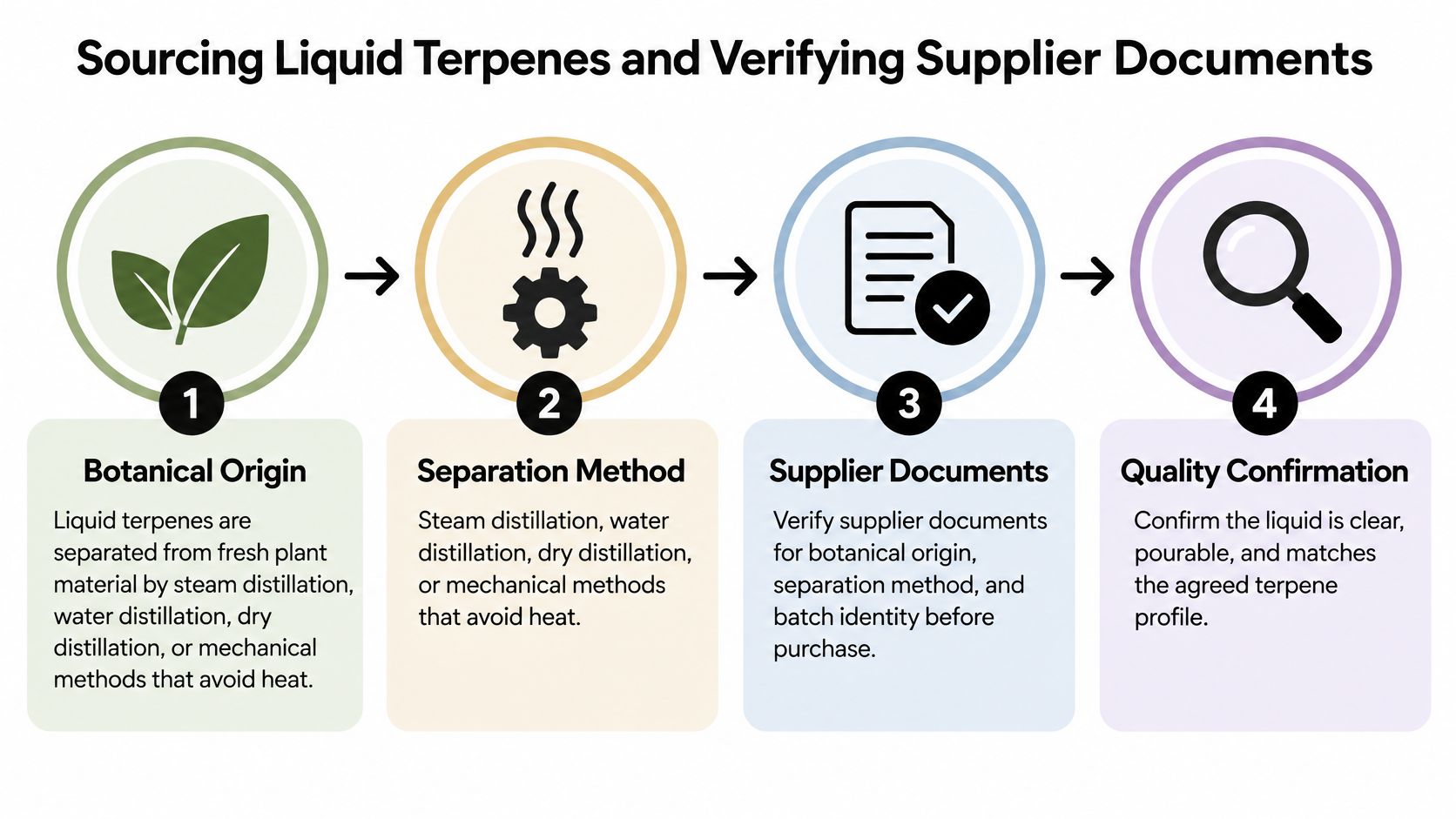
Build a traceable approval record
- Identify the botanical material. Record the declared plant source and supplier identity.
- Confirm the separation route. Establish whether the supplied material is an extract, an isolate, or a formulated profile.
- Test the lot by GC-MS. Compare identity and composition against the purchasing specification.
- Confirm any blending stage. Record the target profile and the controls used to approve it.
- Retain the batch documents. Connect the lot number, composition statement, and certificate of analysis to the received container.
Our terpenes are extracted from fresh plants, and our cartridge materials are SC Lab-tested. Statements about being free of added chemicals or mixtures should be understood as absence-of-additive claims, not as a claim that terpenes aren't chemical compounds.
Our certificate of analysis guide explains how to approach this document. A COA is most useful when the tested lot matches the material being received and the test panel covers the purchasing requirements.
Check the finished product's rules
For inhalable hemp products, California Health and Safety Code section 111929.2 states that an inhalable product must not contain flavorings other than natural terpenes. Botanical origin and full composition therefore belong in the approval file, not just the marketing description.
Separately, California Department of Cannabis Control guidance limits inhalation ingredients to cannabis, cannabis concentrate, terpenes, rolling paper, leaf, pre-roll filter tips, and FDA-listed inactive ingredients for inhalation. It also prohibits artificial or synthetic terpenes and requires added terpenes to contribute to cannabis's natural flavor or aroma.
Keep the approval checklist specific:
- Botanical origin declaration: Identify where the terpene material comes from.
- Full composition statement: Account for every ingredient, including carriers or flavoring agents.
- Lot number and COA: Match the paperwork to the shipment.
- Natural-source confirmation: Obtain lot-specific documentation supporting the absence of synthetic terpenes.
- Change-control notice: Require review before a source, recipe, or process substitution.
- Destination-market verification: Check the finished product category and current local requirements.
Our cartridge materials are free of VG, PG, PEG, MCT, and added diluents. Testing and ingredient purity don't replace jurisdiction-specific review, and a worldwide legality description shouldn't be treated as blanket authorization for every finished formulation. Approve the supplier and the finished product separately.
Gold Coast Terpenes offers botanically derived blends and isolates for controlled flavor matching and product formulation. Visit Gold Coast Terpenes to shop blends, request bench samples, or contact us about bulk and custom orders with your base, target aroma, and manufacturing requirements.