
The most common advice about a hemp vape cartridge is to choose good oil and check its certificate of analysis. That's a starting point, not a finished specification. A production team also needs to qualify the botanically derived terpene blend, the cartridge materials, and the emissions produced when that formula meets the heater.
Buying terpenes by aroma alone leaves too many gaps. The blend has to match your flavor target, stay within the rules for your market, and work in the hardware you'll fill. Treat the oil and device as one manufacturing system, with one controlled specification.
What a Hemp Vape Cartridge Is Made Of
A hemp vape cartridge is a sealed unit that holds hemp-derived oil and a heating element, so the oil can be heated and inhaled. Think of it as a small sealed tank with oil and a heater. For a manufacturer, the important point is that the liquid and hardware work together.
The distillate carries the cannabinoid load. The botanically derived terpene blend supplies the chosen aroma and flavor, while the hardware controls how the oil reaches the heater and moves through the aerosol path.
This diagram shows the main parts your purchasing and production teams need to specify.
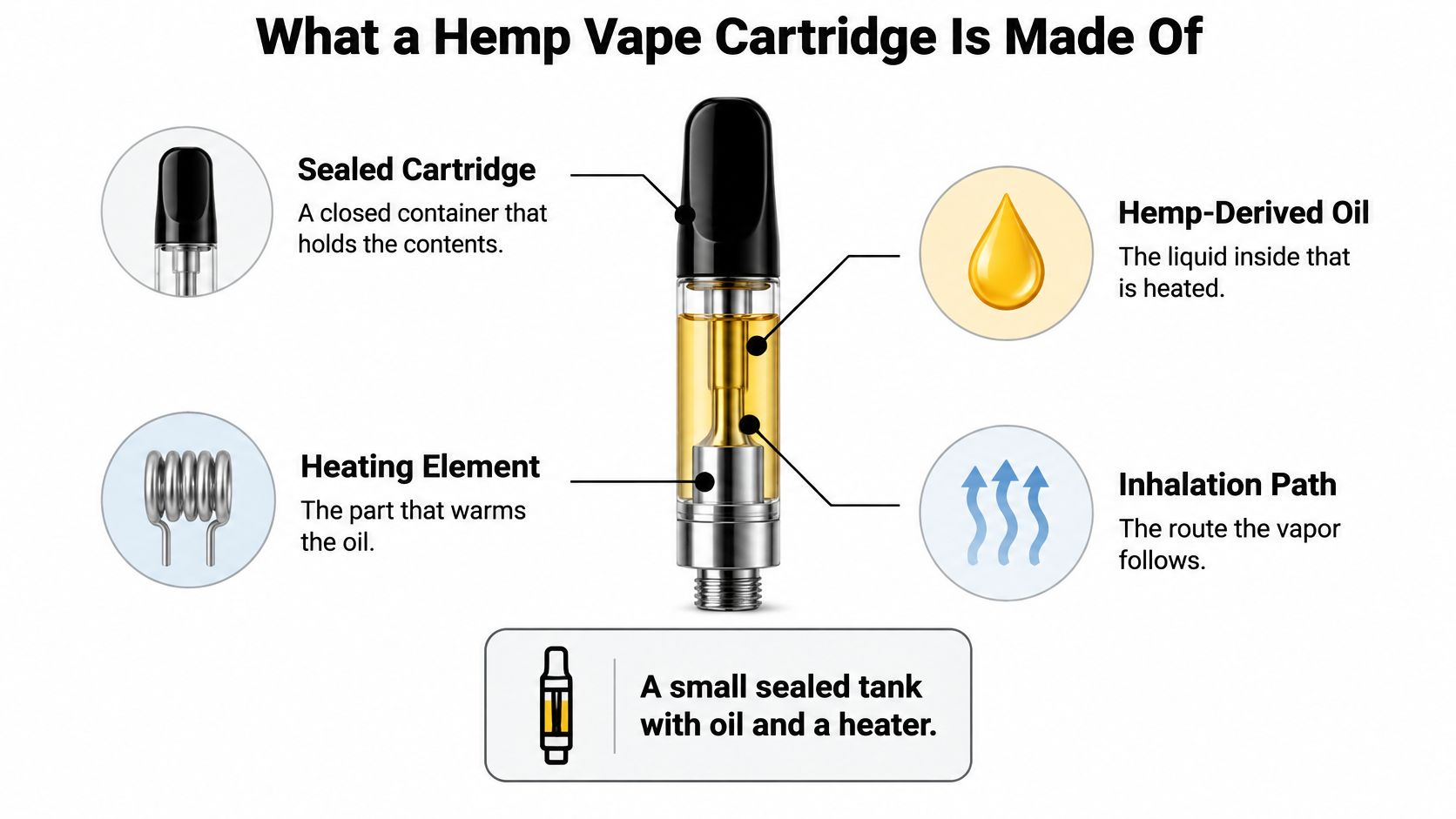
Cartridge components, their role and the buyer's decision
| Component | Role in the cartridge | Your decision |
|---|---|---|
| Hemp distillate base | Carries the cannabinoid load and forms most of the oil | Source, certificate of analysis and batch consistency |
| Botanically derived terpene blend | Sets aroma, flavor and sensory identity | Blend choice, loading percentage and supplier |
| Diluent or carrier | Adjusts viscosity and flow in the oil | Whether to use one, and its documented identity |
| Additives | Any processing or functional aid added to the oil | Keep the list short and disclose every item |
| Hardware (tank, coil, mouthpiece) | Holds and heats the oil | Metal types, coil design and operating power range |
Specify the finished combination
Terpenes are added back to the base, so flavor depends on the blend the brand chooses. A distillate name doesn't define the finished sensory profile. Purchasing needs a blend code and a written loading target, not just a description such as citrus or sweet.
A diluent isn't an automatic requirement. Before adding another ingredient to improve flow, check whether the base, terpene loading, and cartridge feed design can work together without it. Don't solve a hardware mismatch by expanding the formula.
Before production, document these decisions:
- Base source: Identify the approved extract supplier and lot acceptance criteria.
- Terpene blend and loading: Fix the blend code and dosing basis.
- Diluent choice: Record its identity, or explicitly state that none is used.
- Full additive list: Include processing aids, not just label-facing ingredients.
- Hardware materials: List the tank, heater, seals, mouthpiece, and oil-contact parts.
Keep that specification attached to the bill of materials. If purchasing substitutes a cartridge or production substitutes a blend, the team should be able to identify exactly what changed.
Terpene Limits and How to Blend Within Them
Start with the applicable cap, not the flavor intensity you hope to reach. State rules can set a concentration ceiling, a reporting format, or a tolerance around a label claim. They aren't interchangeable, and a rule for a state-regulated cannabis category shouldn't be assumed to establish nationwide hemp compliance.
Terpene limits and what they mean for a blend
| Jurisdiction | Terpene rule | What it means for your blend |
|---|---|---|
| Nevada | The Nevada Cannabis Compliance Board terpene guidance limits terpene content to no more than 10% of the final product. | Write the exact target percentage in your standard operating procedure. |
| New York | The New York testing limits document sets total terpenes at 10% or less by weight, with a plus-15% testing variance allowing a reported result up to 11.5%. | Keep the nominal recipe below the cap to leave room for weighing and lab variation. |
| Minnesota | The Minnesota Cannabis Technical Authority requires a laboratory result to differ from a terpene label claim by no more than 15%. | Set the weight or volume basis before mixing so the claim can be verified. |
Minnesota also requires terpene analysis when terpenes are added or a terpene-content claim appears on the label. The reporting format includes percentage plus milligrams per gram for weight-based testing, or milligrams per milliliter for volume-based testing.
Use the cap as a boundary, not a production target.
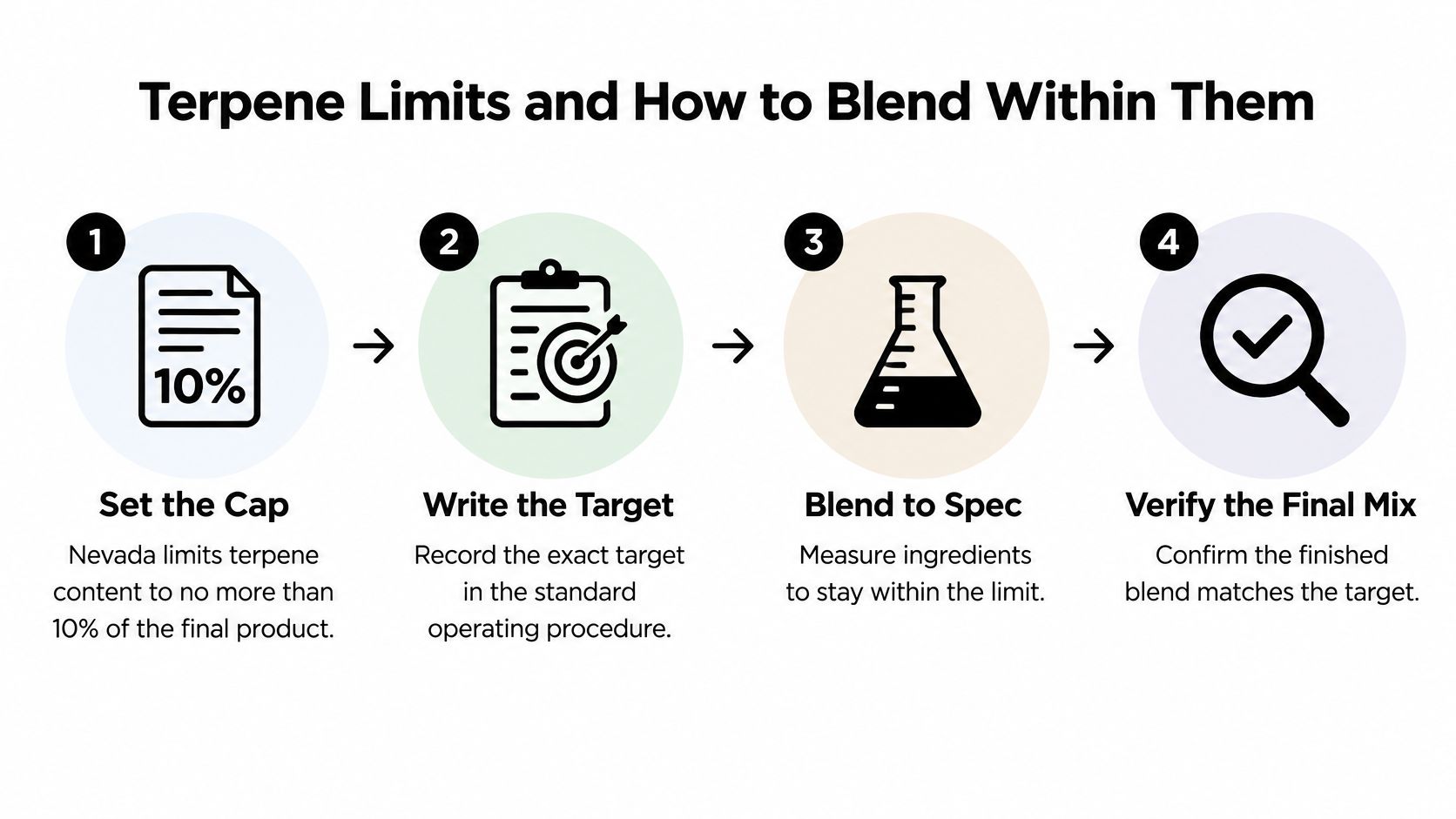
Calculate against final batch weight
For a hypothetical development trial, you might compare 6% to 8% by weight, provided that range fits the product's applicable rules and qualification plan. That's a trial range, not a universal cartridge recipe.
For example, a 10 g finished batch at 7% added blend by weight contains 0.7 g of botanically derived terpene blend and 9.3 g of base. Adding the blend to an already weighed full batch of base would change the denominator and produce a different concentration.
Also distinguish added blend loading from total terpene content. If the base already contains terpenes, the added percentage alone won't establish the finished total.
Practical rule: Calculate terpene loading from the final mixture, and account for terpenes already present in the base.
Follow a controlled mixing sequence
- Weigh the winterized distillate. Use a calibrated balance, tare the mixing vessel, and record the base lot.
- Calculate before mixing. Write the planned base weight, blend weight, and final batch weight on the batch sheet.
- Weigh the botanically derived blend. Don't substitute drops or pipette volume for a weight-based recipe. Different densities can shift the loading between SKUs.
- Mix with gentle warmth. Use the lowest workable heat within the ingredient handling guidance. Mix until uniform and streak-free, while limiting unnecessary open-vessel time and heat exposure.
- Compare with the approved sample. Check color and viscosity before releasing the mixture to filling.
- Record the actual result. Enter final weights, calculated loading, mixing time, and any approved adjustment.
Use the guide to how much terpenes to add to distillate to organize the calculation, then verify the finished batch through the applicable laboratory process. The nominal recipe is the number your team controls. A laboratory tolerance isn't permission to formulate beyond the stated cap.
Matching Flavor Across Cartridge SKUs
Flavor drift often starts with a missing reference. A purchasing description such as bright citrus isn't enough for production to reproduce an approved SKU. Keep a physical reference sample and a written sensory record before the first commercial run.
The reference should identify the blend code, base lot, target loading, preparation date, and storage conditions. Retain an oil sample for comparison and qualify the finished cartridge separately. Those checks answer different questions.
Run a repeatable comparison
- Keep an approved sample for each SKU. Store it in a suitable closed container under controlled conditions, with a defined replacement policy.
- Compare the new batch and reference on the same day. Where possible, use the same base lot during blend development so you're not changing the base and terpene profile together.
- Use a simple scoring sheet. For example, a three-point scale can mark each attribute as below target, on target, or above target. Have two or three trained assessors evaluate aroma, flavor intensity, and aftertaste through an approved workplace protocol.
- If the batch falls short, investigate before adding more blend. Check the weighing record, mixing completeness, and base identity first.
- Check color and viscosity too. A correct blend weight doesn't guarantee the same cartridge performance when the base changes.
Use consistent sample preparation and descriptive terms from the sensory evaluation methods guide. Don't let assessors replace recorded scores with broad comments such as better or stronger.
A flavor adjustment is a formula adjustment. Record it before anyone fills the next batch.
Separate blend drift from base drift
Say a new distillate lot produces a flatter aroma with the approved blend. Make a small comparison batch using the retained base before changing the terpene recipe. That helps distinguish a base-lot issue from a blend-lot issue.
Record each comparison on the batch sheet, including rejected trials. Route customer flavor complaints through formal change control rather than letting an operator make an unrecorded correction. Quiet tweaks make future flavor matching harder and can undermine the registered formula.
Supplier Documents and Change Control to Lock In
A terpene supplier is a documentation partner as much as a source of aroma. Before you buy terpenes for production, establish what purchasing must receive and what quality control must approve. A pleasant sample can't replace an identifiable, repeatable ingredient.
Keep the cartridge specification and ingredient records together, as shown in this production-document workspace.
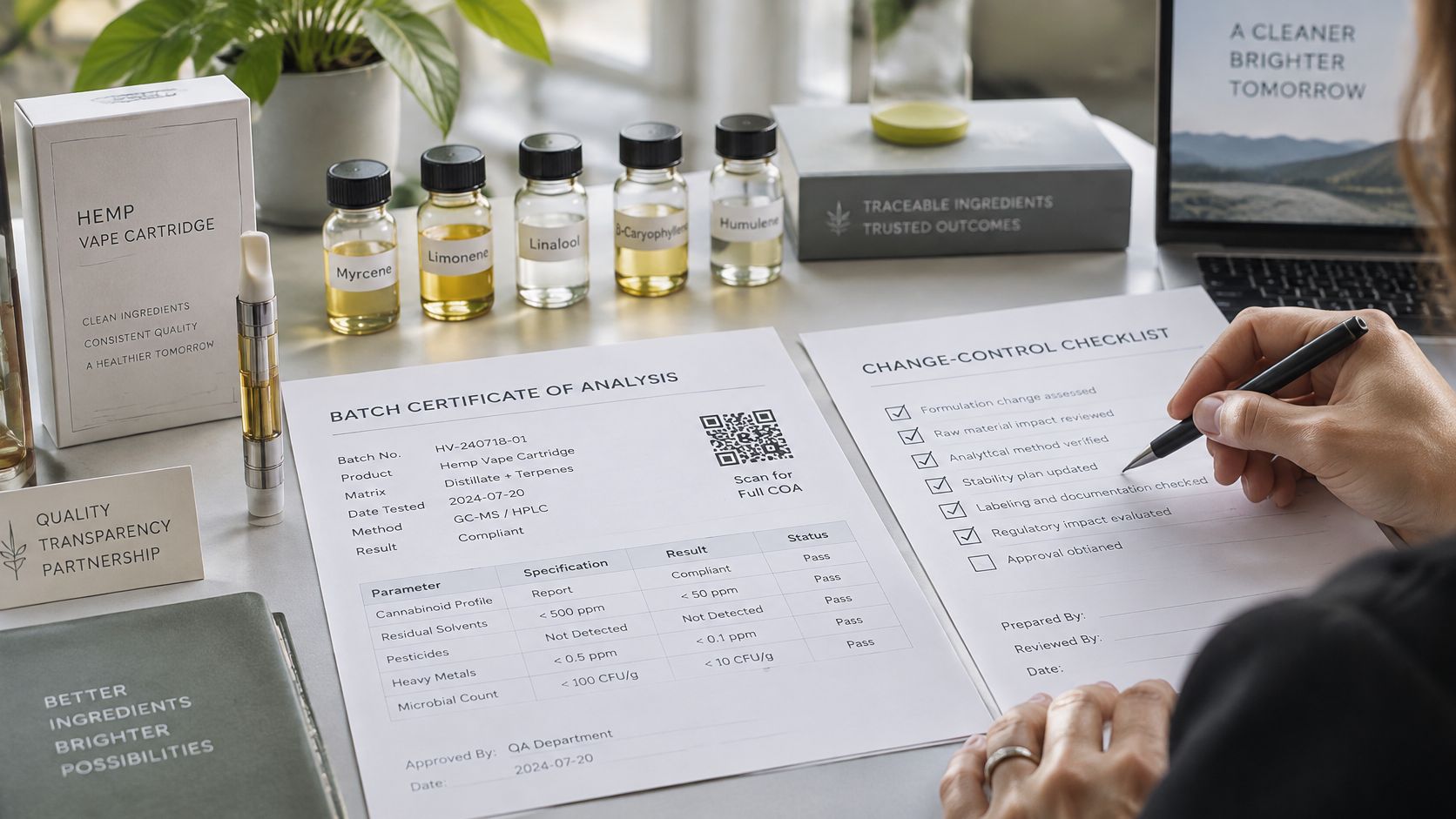
Build an ingredient acceptance file
- Batch-specific certificate of analysis: Require the lot identity and a terpene breakdown naming each reported terpene and its percentage.
- Full ingredient disclosure: Include carriers, processing aids, and solvents. Don't accept a flavor name as an ingredient list.
- Defined laboratory scope: The report should identify the laboratory, analytes, detection limits, and acceptance criteria. A blank result and a result below detection aren't the same statement.
- Review consistency across lots. Compare the actual composition with the written acceptance range, not just with the previous bottle's aroma.
- Controlled specification sheet: Fix the blend identity, revision, handling requirements, and approval owner.
Our safety documentation requirements guide can help organize the document review. Keep the approved version accessible to purchasing, quality control, and the people preparing the batch.
Freeze the supplier and formula
The Oregon inhalable hemp registry guide treats hemp extract mixed with botanically derived terpenes as an inhalable hemp cannabinoid product containing a non-cannabis additive, requires additive documentation in registration, and requires resubmission and approval for changes to the additive supplier, ingredients, or new additives before compliant use.
Use a short change-control sequence:
- Freeze the specification: Lock the supplier, blend code, ingredient list, and approved revision.
- File every ingredient record: Connect each received lot to the production batches that use it.
- Review substitutions before use: Hold a new blend or supplier pending the required regulatory and quality approvals.
Use the video alongside the written document review, not as a replacement for batch records.
Oregon also treats products containing squalene, squalane, vitamin E acetate, triglycerides such as MCT oil, or propylene glycol as adulterated. Screen those ingredients out of formulas for that market.
A substitute sold as a general-purpose diluent isn't automatically suitable for an inhalable hemp product. Product availability and permission to use it in a specific formula are separate decisions.
Hardware Risk and the Testing Stages That Prove a Cartridge Is Clean
A clean oil certificate doesn't prove a finished hemp vape cartridge is clean. Hardware can introduce contaminants after the extract leaves the supplier, and liquid testing doesn't necessarily describe what reaches the aerosol.
An analysis published in Chemical Research in Toxicology examined 13 commercially purchased cannabis cartridges and found chromium, copper, and nickel migrating from device components into both oil and inhaled aerosol, with smaller amounts of lead, manganese, and tin. The study supports qualifying the complete oil-device assembly rather than relying only on incoming extract results.
Contact between oil, the heater, and metal components matters throughout storage and repeated heating. Request documented materials and examine the complete oil-contact path. A ceramic component doesn't establish that the whole cartridge is metal-free or suitable for every formulation.
Test each stage for its own failure modes
Testing stages, what each catches and when to run it
| Testing stage | What it catches | When to run it |
|---|---|---|
| Raw hemp extract | Potency, residual solvents and base contaminants | On receipt of every batch |
| Additive and terpene screen | Unlisted or unsuitable additives such as vitamin E acetate | Before a new blend enters production |
| Filled cartridge elemental test | Metals that migrate from hardware into the oil | After filling, for each production run |
| Aerosol or emissions test | Metals and compounds that reach the inhaled aerosol | During hardware qualification and after any design change |
Treat these timings as a production verification framework, not a claim that every jurisdiction mandates the same schedule. Set acceptance criteria with the laboratory before submitting samples.
For incoming extract, confirm that the report matches the received lot. For the botanically derived terpene blend, verify ingredient identity and analytical scope. Our terpenes for cartridges are SC Lab-tested, and terpene information for our products is provided by SC Labs. That credential applies to the terpene ingredient, not to your finished hardware or aerosol.
Filled-cartridge testing then checks what happened after assembly and filling. Include a defined storage interval in qualification so the team doesn't evaluate only freshly filled units.
Validate power and read reports narrowly
A Scientific Reports study of legal Canadian cannabis vape liquids detected metal-containing aerosol particles associated with cartridge components and inferred that lower-power operation likely reduces inhaled particulate-metal exposure, while noting that lower-temperature closed-pod systems may require more puffs to aerosolize the same liquid mass.
That trade-off needs measurement. Too little heat can leave poor aerosol output or inconsistent delivery; more power isn't a reliable fix for poor feeding. Botanically derived terpene loading can change viscosity and wetting, so qualify the approved blend in the intended cartridge.
Run standardized machine puffing at minimum, nominal, and maximum output. Measure:
- Aerosol mass per puff: Check output consistency across the operating range.
- Delivered composition: Track cannabinoid and terpene consistency.
- Pressure drop: Identify airflow and draw changes.
- Metal emissions: Evaluate the aerosol, not just the reservoir oil.
Use the 510 cartridge guide when organizing compatibility requirements, then document the actual battery settings, puff duration, and overheating cutoffs.
A review in The Scientific World Journal identifies device age, storage, liquid properties, temperature, and design as relevant variables, while discussing a Canadian assessment that found low population-level metal-related risk for most consumers but retained uncertainty. That conclusion doesn't establish zero risk for an individual cartridge, and a laboratory detection alone doesn't establish harm at typical exposure.
Report-reading rule: State what was tested, under which conditions, and against which acceptance criteria. Don't turn a limited result into a blanket safety claim.
Attach jurisdiction, sampling date, batch identity, detection limits, and usage assumptions to every test claim.
Confirm Your Blend Specs and Request a Sample
A purchase order is a specification, not a shopping trip. Before you place one, confirm the target percentage, weight or volume basis, full ingredient list, and required documents, and name the cartridge hardware the blend was qualified in. Oil and device behave as one system, so a blend approved in one cartridge is not automatically approved in another. Those details let purchasing order the intended ingredient and let production recognize an unauthorized substitution.
A sample order should answer a manufacturing question. You might need to compare flavor options in one base, check whether an approved blend feeds through a selected cartridge, or establish a reference for a new SKU. Write that question on the trial sheet before the sample arrives.
Take the next production steps
- Write the nominal target into your standard operating procedure. Identify the calculation basis, approved blend code, and person authorized to approve adjustments. Keep development trials separate from released production recipes.
- Request a sample and test it in your own base. Our 3ml Strain Picker Pack lets customers select any three different terpene profiles from the catalog in 1.5ml or 3ml sizes. Run those samples side by side in the same winterized distillate so the only variable is the profile, then confirm the blend is free of VG, PG, PEG, and MCT on the ingredient listing.
- Request the batch certificate and terpene documentation before production. The terpene information for these profiles is provided by SC Labs, so match those documents to the received lot and complete your ingredient approval before issuing material to the mixing team.
Make the bulk order match the approved trial
Once a sample passes your acceptance process, use its exact blend identity in the purchasing record. Don't order against a sensory nickname that another employee could interpret differently. Keep the approved trial sheet with the order so quality control can compare the incoming material against the intended specification, including the THC-free status your compliance file depends on.
Our website has a Terpene Safety & Documents page to support document review. Customers can also call Gold Coast Terpenes at 929-356-6086 about bulk orders.
Buy terpenes against a controlled specification, not just a catalog description. The right ordering record connects the botanically derived blend to the base, the cartridge, and the finished-product acceptance plan, which gives your team a clear route from sample evaluation to repeatable production.
Gold Coast Terpenes offers botanically derived terpene blends for cartridge formulation, with options for sampling and bulk purchasing. Visit Gold Coast Terpenes to shop blends or request samples for testing in your own distillate and hardware. Bring your target loading and documentation needs so the next order supports your approved hemp vape cartridge specification.