
A kilogram of myrcene lists at USD 373 in a 1 kg pack and USD 132 in a 20 kg pack from the same 2025 Vigon catalog. Identical molecule, identical supplier, close to three times the unit price. That spread tells you what buying myrcene is really about. You aren't shopping for a chemical. You're shopping for a quantity of documented, fit-for-purpose material, and the label on the drum matters more than the name on the certificate.
Buyers get this wrong in two directions. Some chase the cheapest per-kilogram quote and discover the lot can't clear their own spec. Others pay premium rates for paperwork they never read. The work sits in the middle: know what your product needs, price the material per usable gram, and treat the certificate of analysis as one document among several.
This guide covers the price benchmarks, what the compound is, how grade follows intended use, how to dose it, how to verify and store a lot, and where a certificate stops being useful.
Myrcene Prices by Source and Pack Size
Four listings set the range buyers compare. The table keeps them side by side, with the pack size and listing date attached to each figure.
| Source | Pack size | Price | Note |
|---|---|---|---|
| Vigon | 1 kg pack | USD 373 per kg | 2025 listing |
| Vigon | 5 kg | USD 183 per kg | 2025 listing |
| Vigon | 10 kg | USD 150 per kg | 2025 listing |
| Vigon | 20 kg | USD 132 per kg | 2025 listing |
| Made-in-China listings | 1 kg minimum order | USD 1-10 per kg | 2026 listings |
| Made-in-China natural myrcene oil | 1 kg | USD 18-20 per kg | 2026 listing |
| Gold Coast Terpenes myrcene | Sold by variant | $27.00 to $220.00 | Brand price range, no per-kg figure listed |
Two different markets are showing up in that grid. The Vigon rows price a documented single-source material that steps down as pack size grows. The bulk listings are a different animal: in 2026 they showed myrcene at USD 1 to 10 per kilogram on some 1 kg minimum orders, plus USD 18 to 20 per kilogram for a 1 kg natural myrcene oil (Made-in-China myrcene price listings). A USD 1 kilogram and a USD 373 kilogram are rarely the same product once you ask what testing came with it.
Our myrcene isolate runs from $27.00 to $220.00 across its variants. That span reflects the option you choose rather than a flat per-kilogram rate, so ask for a quote at the size you need before stacking it against the rows above. Larger volumes follow a separate wholesale pricing structure that steps down as the order grows.
Here's the math I'd run before clicking buy. Five kilos at USD 183 per kilogram costs USD 915 before you pay for any confirmatory testing. If 1 kilogram fails your specification on arrival, you've paid for 4 kilograms of usable material, which lands near USD 229 per usable kilogram. That's worse than buying smaller at a higher unit rate.
The number that matters: price per gram of documented, lab-tested material that suits your product. Sticker price per kilogram answers a question nobody in formulation is asking.
What Myrcene Is and Where Its Aroma Comes From
Think of myrcene as the base note in a perfume. The bright top notes get the attention, but the base gives the composition its character and holds everything above it in place. In a hop-forward beer or an earthy fruit blend, myrcene is usually doing that job: low, round and structural, sitting under the citrus and spice.
Myrcene is a monoterpene, one of the small aromatic molecules plants assemble from isoprene units. It shows up at commercial scale in hops and in Cannabis sativa, and at meaningful levels in lemongrass, thyme and mango. Concentration is the part buyers underestimate. A 2016 analysis of 12 Romanian hop samples put myrcene at an average of 37.90% of total volatile compounds, with individual samples running from 23.29% to 52.63% (NCBI review of myrcene occurrence and toxicology). A separate Austrian analysis of five Cannabis sativa essential-oil samples averaged 28.41%, ranging from 21.08% to 35.02%.
Those aren't trace numbers. Myrcene is a dominant aroma compound in several important botanical sources, not a rounding error on a spec sheet. The same review reports hops can hold as much as 10 grams of myrcene per kilogram of dry plant material, which explains why brewing has leaned on this molecule for centuries to build green, resinous, herbal character.
If you're choosing between profiles, our myrcene terpene page lays out the aroma notes and pairing options before you commit to a size.
Composition isn't fixed, and that's the practical lesson. Cultivar, plant part, growing conditions, harvest timing, extraction method and storage all move the number, so no percentage from a botanical oil is a formula for a finished product. Decide which aroma note your product needs, then buy from a source that documents it. Our isolates are botanically derived and extracted from fresh plants, which means you should expect batch-to-batch variation inside a stated range, and plan your sensory panel around that.
Match the Grade to Your Intended Use
The first question isn't which supplier. It's what the myrcene will go into, because the answer changes the specification, the documents and sometimes the legal status of the order.
| Intended use | Regulatory point | Document to request |
|---|---|---|
| Food or beverage flavor | FDA removed synthetic myrcene from food-additive rules in 2018 (21 CFR 172.515) | Legal status memo and ingredient identity |
| Vape cartridge or concentrate blend | No blanket approval; state rules and lot testing apply | Certificate of analysis and safety data sheet for each lot |
| Cosmetic or fragrance | Concentration and exposure must be assessed for the finished product | Safety data sheet and identity record |
| Australian non-industrial flavor or fragrance | Total flavor concentration capped at 5% | Concentration calculation and supplier declaration |
| Industrial or research use | No single rule covers every market; grade and purity set the spec | Purity specification and GC-FID or GC-MS report |
The US position depends on the source and the use. Under 21 CFR §172.515, myrcene was permitted as a synthetic flavoring substance and adjuvant in food, and in 2018 the FDA amended the regulation to remove synthetic myrcene from the authorized food-additive list under the Delaney Clause (Federal Register notice on synthetic flavoring agents). That rule addresses food flavoring. It doesn't hand you an answer for a cartridge, a candle or an industrial solvent blend.
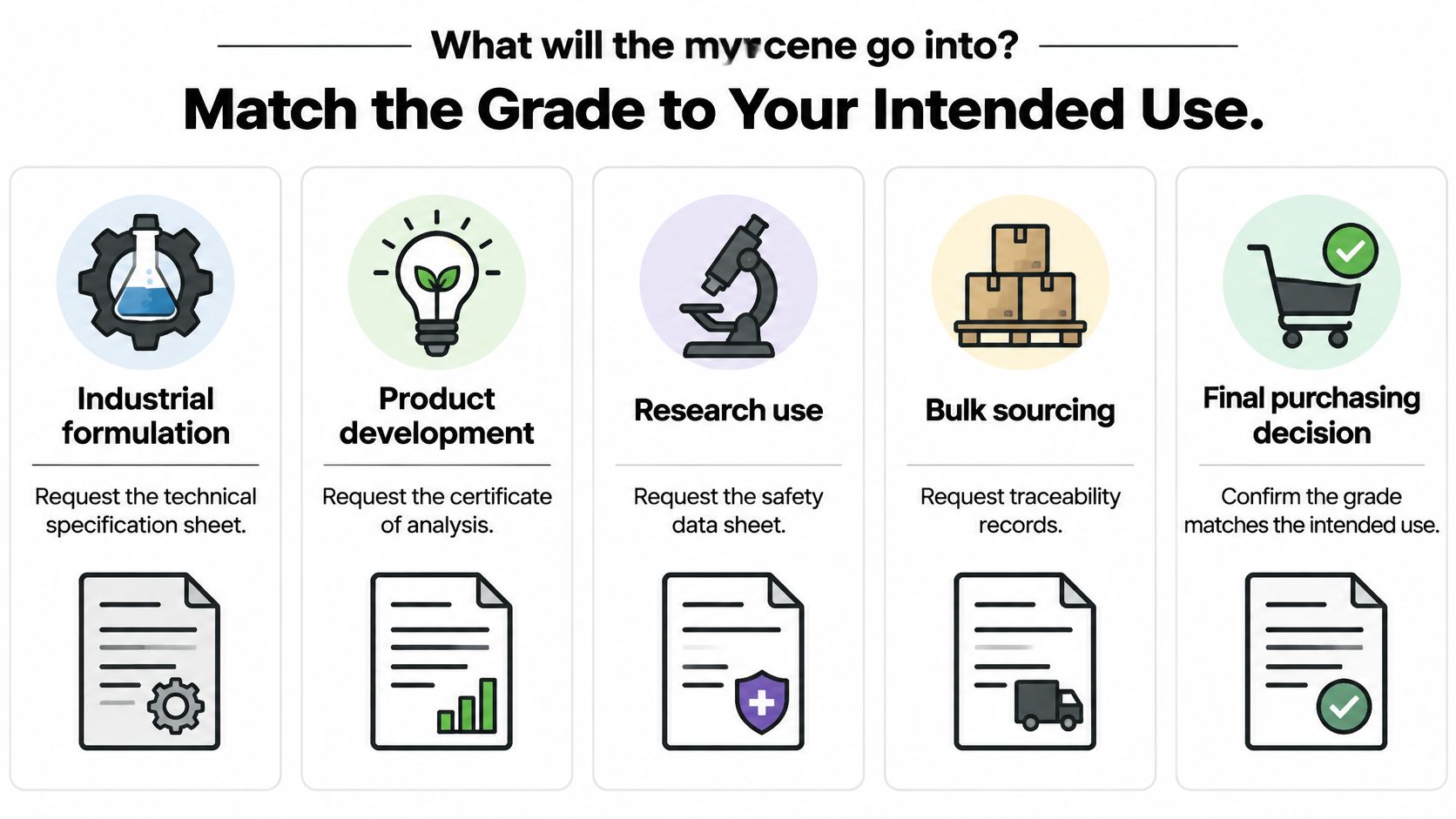
Grade is the other half. Technical-grade myrcene may be about 75% pure, while rectification can take it above 90%, and composition is characterized by GC-FID or GC-MS (Australian Industrial Chemicals Introduction Scheme evaluation statement). Australia also perlimits non-industrial flavor and fragrance use, capping total flavor concentration at 5%. Buy the grade your finished product can legally carry, not the grade with the friendliest price.
A three-step check before you order
- Name the product and the market. "Myrcene" isn't a category. A CBD tincture, a fragrance oil and a research standard sit under different rules.
- Write down the route of use. Inhaled, ingested, applied to skin or used industrially. Each one pulls a different document set.
- Request matching documents before payment. Certificate of analysis, safety data sheet, ingredient identity and traceability records, for the lot, not the catalog page.
Skip step one and you'll spend the next month reverse-engineering a spec from a label.
Dose Myrcene in Your Formulation
Set the batch weight first. Everything else follows from it, and the math stays honest when you write the numbers down on the bench sheet.
Set the batch and run three bench doses
Pick a working batch, say 1 kg. Then run three trials at 0.25%, 0.5% and 1.0% of batch weight so you can taste or smell the change at each step. At 0.5%, a 1 kg batch takes 5 g of myrcene. At 1.0%, it takes 10 g. Weigh to 0.01 g, mix into a small aliquot of your base first, then combine, because a neat drop of myrcene in a liter of distillate will streak before it disperses.
Check each dose against the legal ceiling your market sets for flavor concentration before you fall in love with a ratio. The ceiling, not the sensory result, sets the top of the range.
Match the ratio to the rest of the profile
Myrcene rarely works alone. Pair it with the other terpenes in your target profile and move one ratio at a time, so you know which change did what.
Change three numbers at once and the blend teaches you nothing. Log every ratio next to the sensory note, and keep a control sample of the previous version for the side-by-side.
For distillate and cartridge work, blend in small batches, mix until the material is even, then let it rest before the final sample. Myrcene is volatile, so mixing temperature and open time shift the result. Record both on the batch sheet. Our guide to how much terpenes to add to distillate walks the same calculation for the full blend.
Scale up without changing the ratio
Convert the bench percentage to production weight and keep the percentages identical. A 20 kg batch at 1.0% needs 200 g, not "a bit more for safety margin." Then retest after storage rather than assuming the bench result held.
The expensive mistake is carrying a food flavor dose into a cartridge blend. The matrix, the heat and the packaging all differ, so the same percentage can read as muted in one product and harsh in the other. Start from your own bench curve every time.
Verify Each Lot and Keep It Stable
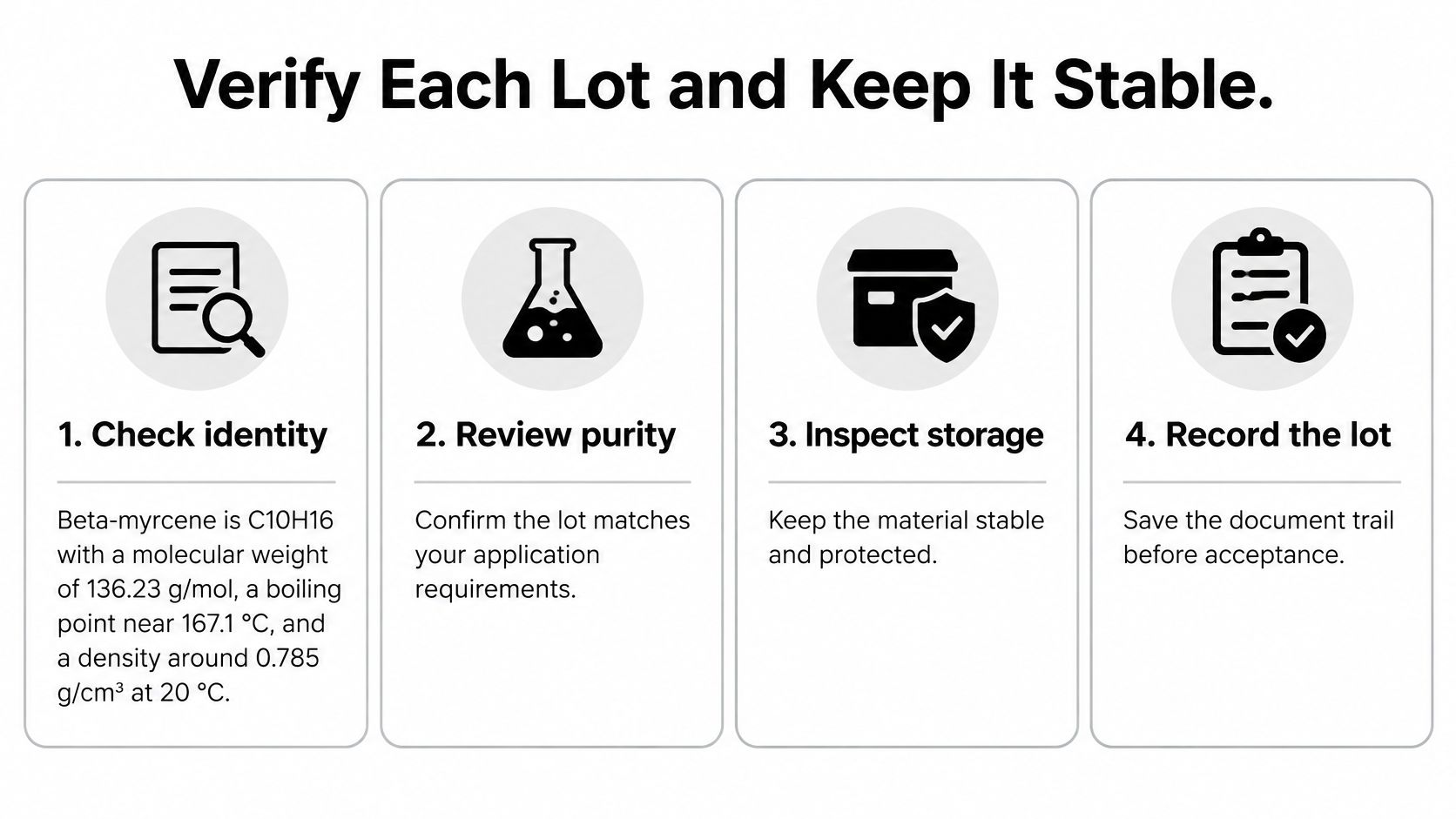
A certificate is only worth the checklist you run against it. Run these five checks before you accept a delivery.
- Confirm identity. Beta-myrcene is C10H16 with a molecular weight of 136.23 g/mol, a boiling point near 167.1 °C at atmospheric pressure, density around 0.785 g/cm³ at 25 °C, a refractive index of 1.4660 to 1.4710, and practical insolubility in water while staying soluble in alcohols and several organic solvents (published stability and handling data on beta-myrcene). If the report's numbers don't line up, stop there.
- Check the scope of the testing. The report should cover myrcene concentration, residual solvents, heavy metals, pesticides and oxidation-related specifications. A potency number alone tells you nothing about what else is in the drum.
- Match the lot. The lot number and test date on the certificate have to match the batch that arrived, not a sample from last spring.
- Ask for your lot's report. We publish SC Labs data for our terpenes and our cartridge blends are SC Lab-tested and legal worldwide, but the general statement on a website isn't the document you file with a batch. Use the lot report. Safety documents sit on our Terpene Safety & Documents page before you order.
- Reject and record. Any lot missing one of the items above gets refused, and the certificate you accepted gets filed with the batch formula.
Storage controls that protect a verified lot
Myrcene is volatile and oxidation-sensitive. Packaging, storage time, headspace, heat, oxygen and light all feed into whether your next production run smells like the last one.
| Factor | Risk | Control |
|---|---|---|
| Heat | Faster volatility and oxidation | Store cool and follow the supplier's dangerous-goods shipping class |
| Oxygen | Oxidation changes aroma and consistency | Keep headspace small and reseal right after each use |
| Light | Breakdown of the sensory profile | Use airtight, light-resistant containers |
| Repeated opening | Each opening adds air and moisture | Split stock into working aliquots |
| Storage time | Aroma and potency drift over long holds | Date each container and retest before long holds |
| Shipping | Dangerous-goods requirements may apply | Ask for the safety data sheet and shipping class before ordering |
Handling limits belong to the supplier's paperwork, not to guesswork. Take the flash point, storage temperature range and shelf-life guidance from the safety data sheet that ships with your lot, and let the dangerous-goods shipping class set the terms for transport. Warm shipping lanes, a hot warehouse dock and any thermal step in your process all deserve a second look against those limits.
Two habits do most of the work. Split incoming stock into small working aliquots so the bulk container gets opened three times instead of thirty, and date every container the day it arrives. A pale yellow tint or a sharper solvent note in a stored sample is a signal to retest before you blend.
Validate the finished blend after storage, not only at receipt, and record that result alongside the batch formula. A lot that passed on day one can still drift by week six, and the retest is what tells you whether your shelf-life claim survives.
What a Certificate Cannot Prove About Myrcene
A clean certificate of analysis does real work. It verifies identity, concentration, contaminants and batch consistency, the four things a purchasing specification needs. What it cannot establish is a safe heating temperature, a consumer dose, a predictable psychoactive outcome or an entourage effect in your finished product.
The regulatory record shows why the distinction matters. Published safety-assessment literature reports that the FDA concluded myrcene was not genotoxic and unlikely to induce tumors in humans at the exposure level considered for its former synthetic food-flavoring use, and the agency still removed it from the food-additive regulations because the Delaney Clause required action after laboratory-animal tumor findings (International Journal of Toxicology safety assessment). A toxicology conclusion and a legal authorization for your finished product are two different documents.
The inhalation picture is just as unsettled. Published evidence on inhaled myrcene and airway effects is limited and unresolved, and the degradation products that form when terpenes are heated remain an open question. No supplier paperwork settles any of it.
Even the effect claims sit outside the certificate's reach. The 0.5% myrcene line that separates a more sedative profile from an energizing one is a formulation heuristic drawn from the strain, not a result a lab report can promise for a cart, gummy or topical.
A certificate describes a lot. It doesn't describe a dose, a device or a result, and no supplier document can close that gap for you.
Write product copy around flavor, aroma and verified composition. Skip medical, health and outcome language, and keep the certificate and safety data sheet on file with each batch formula so the claim you make is the claim you can back.
Pick a Lab-Tested Myrcene Supplier
A cheap kilo of undocumented myrcene costs more than a documented one the first time a lot fails inspection. Ordering follows a sequence, and running it in this order avoids most of the expensive surprises.
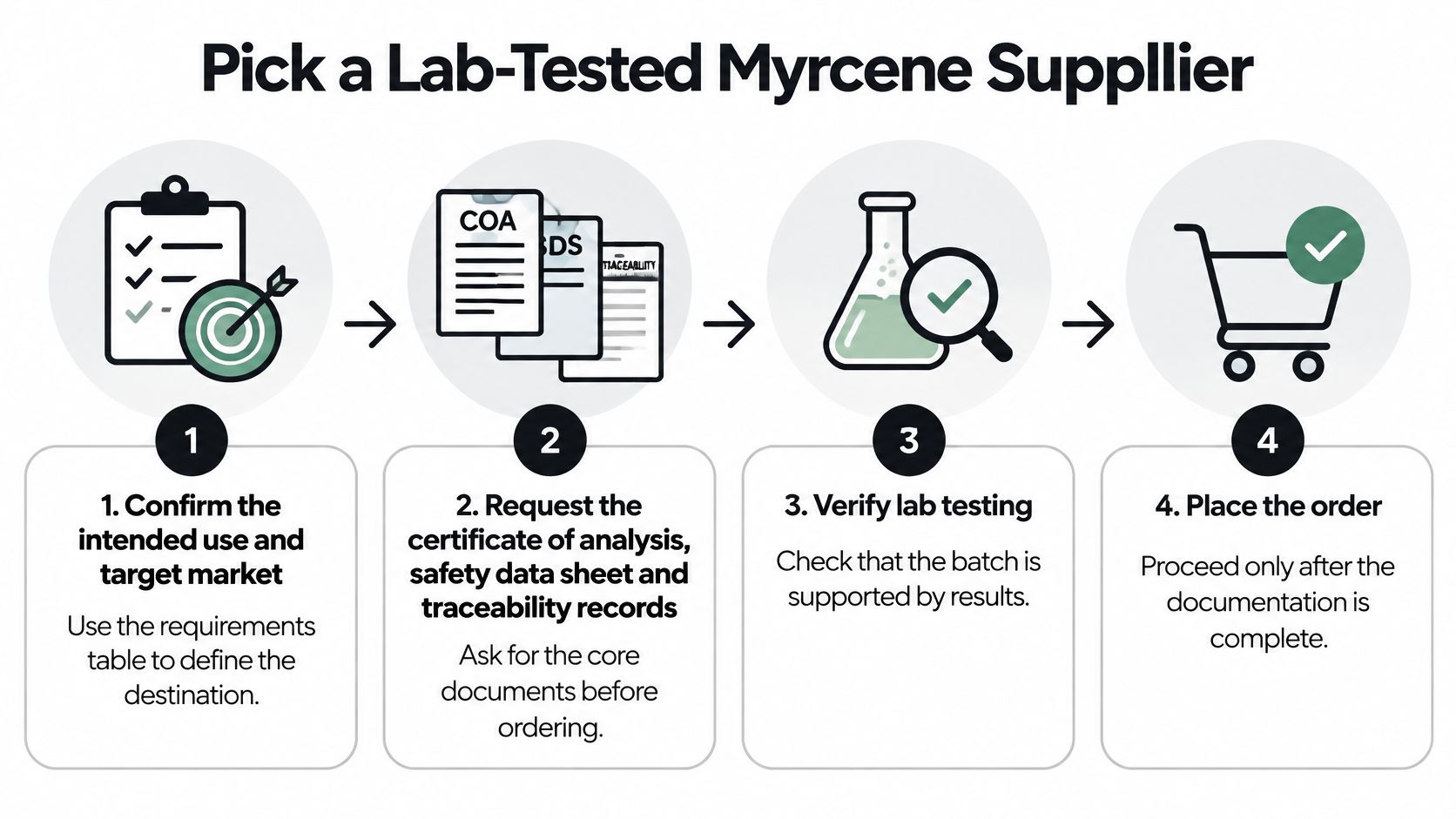
- Confirm intended use and market against the requirements table, so you know which grade and which documents the order needs.
- Request the certificate of analysis, safety data sheet and traceability records for the specific lot you'll receive, not a representative lot from last quarter.
- Check the certificate against the five-point checklist: identity, concentration, contaminants, oxidation specs and a matching lot number.
- Compare price per gram of documented material, not sticker price per kilogram. A bulk listing with no certificate can carry a lower sticker and a higher cost per usable gram once a failed batch, a reformulation and a reorder are counted.
- Start with the smallest pack that fits your base and test it there. Bench results in your own matrix beat any spec sheet written for someone else's.
- Retest after storage and reorder against the same specification, so the next batch is measured against the same numbers as the first.
Gold Coast Terpenes is a practical place to start. The Pioneer Pack ships one bottle each of Beta Caryophyllene, Limonene, Myrcene, Linalool, Alpha Pinene and Terpinolene, which lets you run myrcene against five neighboring isolates in your own base before committing to a larger volume. The wholesale terpenes program covers larger volumes, shipping is free on US orders above $100, and you can reach the team at 929-356-6086 with a spec question before you order.
The myrcene isolate and the strain-specific blends are extracted from fresh plants and SC Lab-tested, in sizes that fit a bench trial or a production run. If you buy myrcene on price alone, you'll eventually pay for it in rejected lots. Buy on documentation and intended use, and the price takes care of itself. Shop the isolates and blends at Gold Coast Terpenes.