
One Jungle Cake certificate reports 16.1% total THC and 0.812% total terpenes, according to the Trulieve laboratory record, a useful warning against treating the cultivar name as a fixed formula. For Gold Coast Terpenes, a supplier of 100% botanically derived, THC-free terpene blends, the practical formulation target is a documented chemical profile, not the name printed on the package.
A Jungle Cake strain-inspired terpene blend needs a defined reference certificate, a controlled carrier, and a cartridge test that measures flavor beyond the initial draw. Without those controls, a developer can reproduce the bottle aroma and still miss the finished product.
Which Terpenes Define Jungle Cake and What Does Each Tier Do in a Cartridge?
Caryophyllene supplies the spicy center, limonene supplies citrus brightness, and supporting floral, herbal, and woody compounds give the blend depth. For cartridge development, those compounds need to work as a layered profile rather than as isolated flavor additions.
The CannMenus Jungle Cake profile reports the database means below and cautions that harvest and cultivation methods can change them. These are reported concentrations in source samples, not percentages to copy directly into a neat terpene blend.
Reported Jungle Cake terpene means and formulation roles
| Compound | Reported mean share | Formulation role |
|---|---|---|
| Beta-caryophyllene | 1.04% | Mid note, spicy body |
| Limonene | 0.73% | Top note, citrus lift |
| Beta-myrcene | 0.49% | Mid note, herbal bridge |
| Humulene | 0.32% | Base note, woody and earthy depth |
| Linalool | 0.26% | Mid note, floral lift |
| Nerolidol | 0.21% | Base note, woody depth |
| Alpha-pinene | 0.16% | Top note, pine brightness |
| Beta-pinene | 0.14% | Top note, resinous brightness |
| Guaiol and other minor terpenes | Individual means not reported | Base or trace accents |
The smaller reported contributors include bisabolol, terpinene, eucalyptol, guaiol, caryophyllene oxide, terpinolene, camphene, and ocimene. Don't assign them invented values to make a spreadsheet look complete. Keep an explicit unresolved fraction until the target certificate or supplier analysis identifies it.
A perfume pyramid is a useful starting analogy. Top notes establish the first impression, mid notes create recognizable character, and base notes provide depth. The analogy stops being sufficient when the blend enters a heated cartridge, because the developer must also account for carrier behavior, airflow, wick delivery, and changing liquid composition.
Build the body before polishing the opening
Limonene and the pinenes provide bright citrus and coniferous accents. They can make a bottle sample smell convincing quickly, which makes them easy to overweight during early development.
Caryophyllene, myrcene, and linalool create the central aromatic body. In a Jungle Cake formulation guide for vape cartridges, the spicy, herbal, and floral components need to remain connected. Too much floral emphasis can separate the citrus opening from the earthy finish instead of joining them.
Humulene, nerolidol, and trace woody contributors provide the lower register. They shouldn't be treated as leftover ingredients added after the attractive notes are finished. Their proportions help determine whether the blend reads as a layered cultivar-inspired profile or a simple citrus flavor.
Practical rule: Match the profile's structure before adjusting its intensity. More aroma isn't the same as better flavor accuracy.
Cartridge heating doesn't produce a perfectly ordered sequence in which each compound evaporates separately. Lightweight, volatile components can become disproportionately prominent early, but partitioning in the carrier and device conditions also influence what reaches the aerosol.
That's why a limonene-heavy blend may resemble lemon soda in the bottle yet lose its intended identity during use. Adding still more limonene can improve the opening while making the imbalance worse. The mid and base tiers must support the character after the bright opening has changed.
For a new reference batch, verify caryophyllene, limonene, myrcene, and humulene first. Then inspect the floral and pinene balance. This sequence gives the developer a practical way to distinguish a different Jungle Cake expression from a blending or handling error.
Why Does the Same Jungle Cake Name Produce Different Chemistry?
Two Jungle Cake lots can share a name and still miss each other on the compounds that define the cartridge. The cultivar is an identity with a moving chemical target. Parentage points toward a sensory family. The certificate of analysis for one lot is the formula.
The Graswiese Jungle Cake record associates the cultivar with Seed Junky Genetics and the cross of White Fire #43 with Wedding Cake, describes its commonly clone-only status, and credits the Jungle Boys collective with helping popularize it commercially. White Fire #43 is identified there as a White Fire OG phenotype. Wedding Cake is commonly traced in that record to Cherry Pie and Girl Scout Cookies.
That lineage is why developers expect dessert sweetness beside pungent, OG-derived fuel. A caryophyllene-to-limonene ratio, a terpene total, and a potency unit still have to come from the analytical report for the lot you intend to match. Breeding history helps you choose which samples to pull. Release criteria live on that certificate.
What one certificate locks, and what the name leaves open
Potency labels on Jungle Cake paperwork describe different reporting choices. THCA, delta-9 THC, total THC, and total active THC should stay in the units the laboratory printed. Collapsing them into one potency figure hides the mismatch.
| Locked by one certificate | What you record | What a second Jungle Cake lot can still change |
|---|---|---|
| Potency reporting | The exact label and result printed for that sample (THCA, delta-9 THC, total THC, or total active THC) | A different potency label, so the figures are not the same measurement |
| Terpene total | The reported total for that sample, in the laboratory's units | A higher or lower total that does not scale every compound by the same factor |
| Leading compounds | The named leaders and their order on that report | A different lead order, so the strain name now points at another chemical target |
A higher terpene total can hold aroma strength while the identity shifts, because the same compounds need not rise in proportion. I treat a formula that cites “Jungle Cake” without a certificate identifier as a house interpretation. That product can be legitimate. It is a documented replication only when the revision names the reference lot.
Split the brief before you chase a mismatch
The chemical target names the reference certificate, the analytical units, the listed compounds, and the unresolved fraction. The sensory target names citrus brightness, pepper intensity, floral prominence, woody finish, and residual carrier character. Write both against that one report so a sensory note cannot stand in for a missing compound.
The same reference can move after it leaves the plant. Use the guide to environmental influences on terpene flavor to separate storage, oxygen, and heat from cultivar variation. A team that skips that split will rewrite the blend around an oxidized sample and call the drift a new Jungle Cake expression.
A systematic review in the Journal of Cannabis Research concluded that indica, sativa, and hybrid labels do not reliably predict composition, terpene profile, or effects, and that current evidence does not support terpene-based prescribing rules. For manufacturing, publish a sensory and chemical specification. Keep effect language out of the flavor-matching spec, and review finished-product labeling on its own. Concentrated cartridges can deliver THC quickly. Aroma is not evidence of a therapeutic result.
Put the certificate identifier on the formula revision, not only in a purchasing folder. When the reference lot changes, open a new evaluation under a new formula name.
How Do You Build a Strain-Inspired Terpene Blend for Vape Cartridges?
Start with the relative proportions from one certificate, then validate the blend in the intended carrier and hardware. Normalizing a flower result gives you a starting composition, not an automatically suitable cartridge loading.
Convert the certificate into a controlled pilot
- Select the reference. Record the laboratory, sample identifier, total terpenes, analytical units, and leading compounds. Preserve the laboratory's compound names.
- Choose a pilot loading. Establish the loading through your product-development and safety process. Don't treat a worked example as an inhalation-safety limit.
- Calculate component masses. Divide each reported compound concentration by the reported total terpene concentration, then multiply by the pilot's terpene mass.
- Establish the core. Weigh caryophyllene and limonene using a calibrated balance suitable for the smallest addition.
- Build the supporting body. Add linalool, myrcene, and humulene, recording actual masses rather than nominal dispenser volumes.
- Complete the accents. Add nerolidol and the pinenes through controlled additions. Minimize open-vessel time for the whole mixture rather than assuming only the last ingredients need protection.
- Mix and evaluate. Use a compatible glass vessel with a suitable closure, homogenize, and allow a defined equilibration period before filling. Keep the procedure consistent across trials.
This process diagram summarizes the conversion from reference certificate to cartridge pilot.
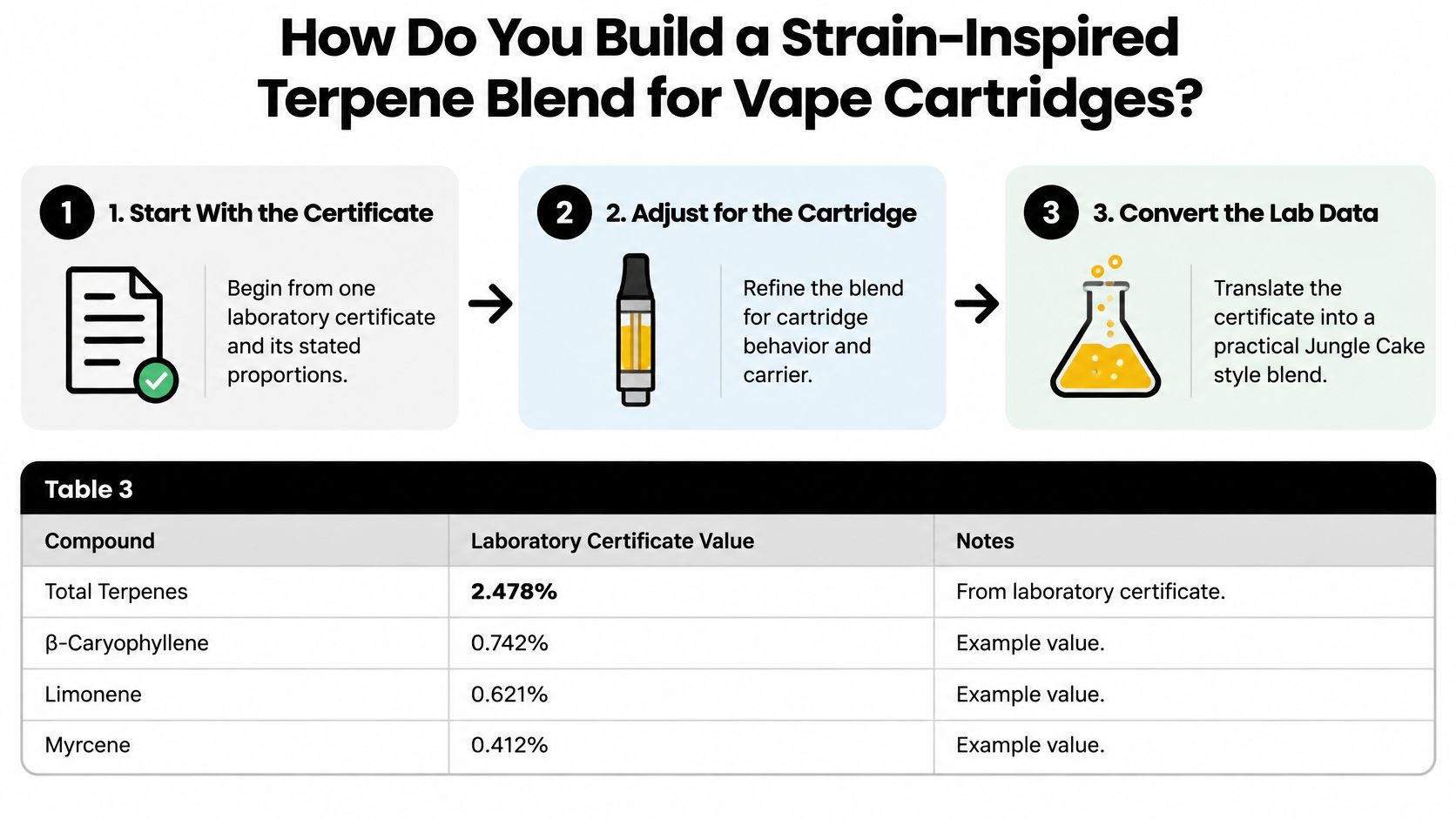
Jungle Cake laboratory certificate shares and blend roles
The Trulieve laboratory certificate reports 2.478% total terpenes; Table 3 converts its listed concentrations into approximate shares of that total.
Table 3
| Compound | Blend role |
|---|---|
| Trans-caryophyllene, 37.81% of reported total | Spicy body |
| R-limonene, 25.22% | Citrus lift |
| Trans-nerolidol, 7.79% | Woody depth |
| Linalool, 6.58% | Floral accent |
| Beta-myrcene, 6.42% | Herbal bridge |
| Alpha-humulene, 6.30% | Earthy depth |
| Beta-pinene, 3.43% | Resinous brightness |
| Alpha-pinene, 2.50% | Pine top note |
| Other compounds, approximately 3.95% by difference | Remainder not itemized in this calculation |
Hypothetical arithmetic example: a 10 g finished pilot at 5% total terpene loading contains 0.5 g terpene blend and 9.5 g carrier. Using the calculated caryophyllene share gives approximately 0.189 g caryophyllene.
Those example quantities illustrate mass balance only. They don't establish a recommended loading, and the unresolved remainder shouldn't be filled arbitrarily with whichever isolate is convenient.
Use the guide to mixing terpene strains to keep formula scaling separate from sensory adjustment. Change one compositional variable at a time, and retain the unmodified pilot as a control.
For an additional mixing reference, use this video alongside the written batch procedure.
A close analytical reconstruction can still miss aroma because a routine terpene panel doesn't describe every odor-active constituent. Call the result strain-inspired unless the analytical and sensory evidence supports a stronger replication claim.
Why Does Flavor Drift in a Cartridge, and How Do You Fix It?
Flavor drift usually requires checking handling, device behavior, and composition before changing the formula. Diagnose the cause with a retained control so you don't compensate for damaged stock by adding more terpene.
Match the correction to the symptom
- Bright notes fade during storage. Compare the stored sample with a protected retain and correct sealing, light exposure, and storage conditions before increasing citrus or pine.
- The profile becomes flat after heating. Evaluate a body-forward trial with a modest redistribution toward caryophyllene or linalool, keeping total loading unchanged.
- The aerosol tastes harsh or metallic. Quarantine the suspect material and compare fresh stock in qualified hardware. Don't assume oxidation is the only possible cause.
- A replacement batch misses the approved flavor. Compare its leading-compound ratios with the approved raw-material specification before rescaling the formula.
Oxidation is one possible contributor, not a diagnosis made from taste alone. This visual outlines the handling questions to investigate.
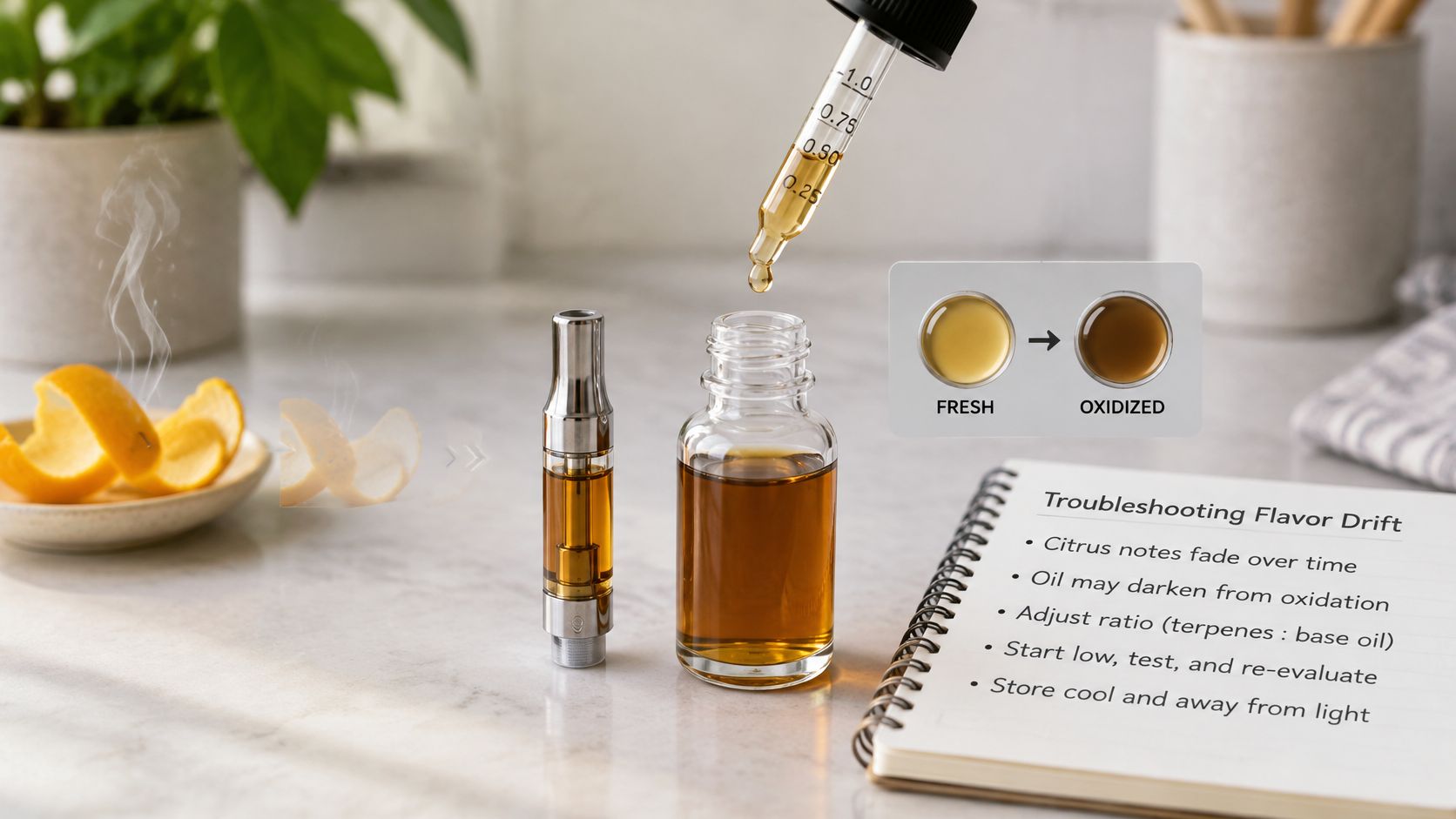
Keep dessert character connected to the body
Say a pilot smells sweet in the vial, but its dessert character disappears in the cartridge. If the mid-tier compounds were reduced to make room for a brighter opening, restore the caryophyllene-led body toward the reference before adding another sweet accent.
Caryophyllene isn't a sweetener. The purpose is to restore the surrounding profile that made the sweet impression coherent, not to manufacture sweetness by increasing pepper intensity.
Troubleshooting check: A fresh bottle sample and an aged cartridge aren't a controlled comparison.
For a practical internal screen, log sensory observations at three draws and ten draws using the same hardware, voltage, draw procedure, and cooling interval. These are proposed test checkpoints, not published performance thresholds.
Record opening character, body, finish, harshness, and visible changes. Where device resistance or power delivery differs, nominally matching voltage alone won't make the comparison equivalent.
Keep the certificate identifier, raw-material lot, filling date, and formula revision beside those notes. Approve a correction only when the revised sample outperforms the retained control without introducing another defect.
How Do Botanical and Cannabis-Derived Terpenes Differ for Jungle Cake Blends?
A strain name is not a recipe. Jungle Cake is a cultivar identity with a moving chemical target, so the formula has to follow one certificate of analysis, not the words printed on a bottle.
Botanical and cannabis-derived describe sourcing. A certificate describes the measured composition. Either route still needs analytical verification and cartridge validation against that certificate, because two lots sold under the same name can diverge in the same listed compounds.
Gold Coast Terpenes describes its blends as 100% natural, so ask for the feedstock category and batch documentation before making any origin claim in your formulation file. Record that category separately from any statement that the finished blend resembles a cannabis cultivar.
Compare the procurement routes
| Decision point | Botanical route | Cannabis-derived route |
|---|---|---|
| Source material | Terpenes obtained from botanical feedstocks outside cannabis | Terpenes recovered from cannabis material |
| Batch traceability | Document feedstock category, ingredient lots, and blending record | Document cannabis input, extraction lot, and processing history |
| Compliance paperwork | Verify identity, contaminants, cannabinoid status, and intended-use documentation | Verify the same items plus applicable cannabis sourcing requirements |
| Flavor matching | Assemble and adjust reference-compound ratios to the target COA | Select a suitable extract and verify how closely its profile matches that same COA |
The trade-off is practical. A botanical build gives more room to restore a ratio when the reference certificate changes. A cannabis-derived extract can start closer to plant material and still miss the certificate locked for this SKU. Neither route, by itself, produces better cartridge performance.
Nature-identical is a separate distinction. It describes a manufactured compound intended to match a naturally occurring molecule, not proof that the ingredient was extracted from a botanical feedstock. Do not use natural, botanical, and cannabis-derived interchangeably.
The comparison of synthetic, botanical, and cannabis-derived terpenes provides terminology for supplier qualification. Source wording should state origin accurately rather than imply that one route guarantees a closer Jungle Cake match.
Qualify the documents before the purchase order
Request a batch-specific COA with third-party testing, a cannabinoid-status declaration where relevant, and a clear statement about carriers or other added ingredients. Check the analytical scope and reporting limits rather than treating a THC-free declaration as proof of finished-product compliance. Tie the accepted lot number to the formula revision so the next batch is judged against the certificate you bought.
- Label wording: Have regulatory staff review origin claims and ingredient declarations for the destination market.
- Commercial terms: Confirm the minimum order quantity, pack size, availability, and lead time before locking the production schedule.
- Change control: Establish how substitutions, specification changes, and revised documentation will be communicated.
The supplier that fits a vape line is the one whose documents match the formula and whose change-control process supports the next production run. A favorable bottle aroma answers neither question.
How Do You Confirm the Blend Before You Buy Terpenes?
Approve a pilot in the actual cartridge before committing to bulk volume. Make the buying decision from documented flavor matching, source-category review, and supplier qualification rather than a strain name or a bottle sniff.
Use a purchase gate, not a preference vote
Compare the pilot with the reference in matched hardware. Confirm that the opening, body, and finish remain acceptable through the defined draw sequence, then review the raw-material documentation against the intended product category.
The approval record should identify who accepted the sensory result and who accepted the compliance file. Don't let a successful flavor test substitute for either analytical review or device qualification.
Gold Coast Terpenes offers 50+ profiles across Indica, Sativa, and Hybrid categories, adds profiles monthly, and supplies isolates including Limonene, Myrcene, and Beta-Caryophyllene. Its Signature Strains are made by Master Terpologists who increase selected rare and exotic terpenes to emphasize fruity and flavorful nuances; those modifications should be evaluated as deliberate flavor interpretations rather than assumed certificate replicas.
For pilot procurement, review the terpene sample-pack resource and select the closest available profile or isolate-based route. If you need a specific Jungle Cake product, confirm current availability instead of substituting an undocumented profile.
Scale only the approved version
Gold Coast Terpenes permits multiple strains in a bulk order, with wholesale pricing available on strain orders totaling over 64 oz. That flexibility matters when separate components or profiles serve different development programs, but it isn't a reason to increase an unapproved purchase.
Start with a pilot quantity and fill three pilot cartridges as an internal development screen. Log their results against the reference certificate, retain a control, and scale only after the formulation and sourcing checks pass.
Frequently Asked Questions About Jungle Cake Terpenes
A useful Jungle Cake purchasing specification identifies the reference chemistry, the batch documentation, and the intended cartridge application. Settle those points before a production order.
Is there one fixed terpene formula for Jungle Cake?
No. Tie each formula to a specific certificate of analysis. The cultivar name does not set a fixed compound ratio or a total terpene concentration, so two lots sold under the same name can still need different formulas.
Which terpenes should a vape blend prioritize?
Start by checking beta-caryophyllene and limonene against the selected reference. Evaluate linalool, myrcene, and humulene as supporting body components, then validate the balance in the finished cartridge rather than on the strain name alone.
Does Gold Coast Terpenes sell terpenes for bulk formulation?
Yes. Customers can order multiple strains at one time through bulk ordering. Keep the production quantity tied to the approved certificate and the cartridge that passed compatibility testing.
Are Gold Coast Terpenes blends free of carriers?
Gold Coast Terpenes blends are free of VG, PG, PEG, and MCT. Carrier choice stays with the formulator. That absence does not replace finished-product compatibility testing in the target cartridge.
What should the formulation file record about Gold Coast Terpenes blends?
Gold Coast Terpenes blends are 100% natural and THC-free, lab-verified and SC Lab-tested. Check each batch’s documentation to confirm its origin for the formulation file before you lock the Jungle Cake interpretation to that lot.
Gold Coast Terpenes offers strain profiles and isolated compounds for a certificate-led Jungle Cake interpretation. Visit Gold Coast Terpenes to review available profiles, Terpenes 101, and the Mixing Calculator. Select a pilot quantity and validate it in your carrier and cartridge before ordering bulk material.