
A terpene blend can pass a liquid-phase aroma check and still fail cartridge development because heating changes the chemistry you're delivering. Gold Coast Terpenes supplies SC Lab-tested terpenes for cartridges, but ingredient testing doesn't replace finished-device testing, especially when beta caryophyllene is part of a flavor system rather than a standalone ingredient.
What Is Beta Caryophyllene and Why Do Formulators Use It?
Beta caryophyllene (BCP) is a bicyclic sesquiterpene that behaves like a formulation variable. Its 15-carbon structure delivers warm, peppery, woody character, and its sensitivity to oxidation means handling history is part of what you are buying. Gold Coast Terpenes offers it as one of its terpene isolates, alongside Alpha Pinene, Limonene, Linalool, Myrcene and Terpinolene.
The pepper note is the easy part. BCP's real contribution is weight beneath brighter citrus, pine or fruit notes, giving a strain-inspired blend a finished base instead of leaving it sharply aromatic and empty.
If limonene is the bright melody of a blend, beta caryophyllene is the bass line that gives it weight and finish. The analogy is useful during sensory development, provided you don't mistake a note's perceived weight for a prediction of cartridge performance.
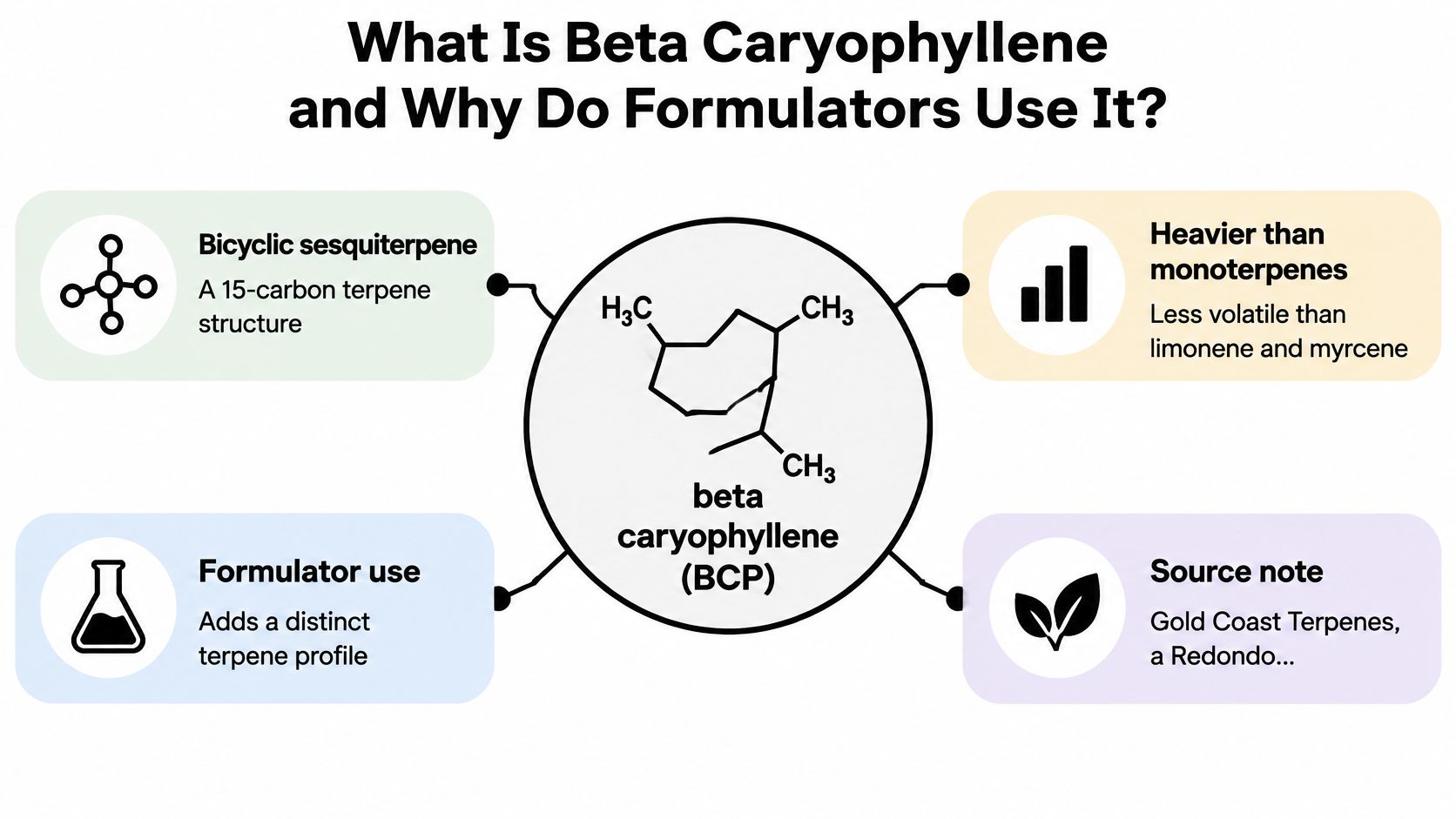
Treat the molecule as a specification
Track the ingredient through three practical lenses:
- Chemical integrity: BCP's structure is oxidation-sensitive, so handling history matters when you accept incoming material.
- Processing exposure: Light and oxygen exposure belong in the batch record, because what happens during blending and filling matters as much as storage conditions.
- Matrix compatibility: BCP is lipophilic and poorly water-soluble, so an oil-based formulation and a water-based product need different development approaches.
An isolate's name covers only part of its specification. Purchasing needs an identity and purity requirement; production needs a controlled addition and mixing procedure; quality assurance needs a method that distinguishes acceptable material from degraded material. Each role works from a different document: an ingredient certificate for purchasing, a batch record for production, a release method for QA.
Practical rule: Buy against a specification, formulate against a measured target, and release against finished-product results.
For beta caryophyllene for vape cartridges, the useful questions stay concrete. Where should its peppery character sit in the blend? What does its receptor activity establish? Which controls preserve its chemical identity through filling, storage and use?
Each question points to a different test. A sensory panel can't establish receptor effects, and an ingredient certificate can't establish aerosol performance.
Where Does Beta Caryophyllene Sit Among Top, Mid and Base Notes?
Beta caryophyllene functions as a mid-to-base note, providing body and finish rather than the first bright impression. Its heavier structure and lower volatility relative to monoterpenes such as limonene and myrcene support that role, as described in Abstrax's discussion of terpene properties.
Beta caryophyllene versus common blend terpenes
| Terpene | Chemical class | Volatility | Typical note role | Aroma |
|---|---|---|---|---|
| Limonene | Monoterpene | High | Top | Citrus, bright |
| Myrcene | Monoterpene | High | Top | Earthy, musky |
| Alpha Pinene | Monoterpene | High | Top | Pine, fresh |
| Linalool | Monoterpene alcohol | Moderate | Mid | Floral, lavender |
| Beta Caryophyllene | Sesquiterpene | Lower | Mid to base | Peppery, warm, woody |
Use these classifications as a sensory-development map, not a device-emission model. Relative volatility helps explain aroma progression, but it doesn't tell you precisely how a compound will transfer through a particular wick and heater.
Top notes establish the opening impression. Mid notes connect that opening to the fuller character underneath, while base notes provide the depth that remains as the brighter impression fades.
- Top-note work: Use limonene or alpha pinene to establish citrus or pine direction without making the opening excessively sharp.
- Base-layer work: Use BCP to support peppery, woody continuity instead of trying to create fullness by adding more bright material.
Myrcene illustrates why sensory vocabulary needs care. Although it's a relatively volatile monoterpene, its earthy, musky aroma can contribute perceived body; calling that contribution “body” doesn't make myrcene chemically equivalent to a lower-volatility base ingredient.
A useful pairing is limonene or alpha pinene above BCP, with myrcene contributing earthy character. Linalool can soften the transition when a floral bridge belongs in the target.
Don't assume a blend that smells complete from a freshly opened vial will remain balanced during device use. Evaluate the opening, the developed profile, and the finish separately, then set BCP's share against the analytical target rather than a preferred aroma in isolation.
How Do You Match a Strain-Inspired Terpene Profile for Distillate?
Match a strain-inspired terpene profile for distillate by translating the target's analytical panel into a note map before making sensory adjustments. Measure the receiving oil too, because you're formulating the finished product, not an isolated terpene concentrate.
- Obtain the target panel. Rank the reported compounds by concentration and record the sample identity. A strain name alone isn't a reproducible formulation specification.
- Assign limonene and alpha pinene to the bright opening, linalool to the middle, and BCP to the mid-to-base layer. Record myrcene's earthy-body contribution separately from its volatility classification.
- Set the BCP share. Start from its relative contribution in the target, then assess whether the peppery layer is recognizable without masking the intended citrus, floral, or pine character.
- Analyze the actual receiving distillate after processing. Don't substitute a pre-winterization or pre-distillation result for the oil entering the blend vessel.
- Record target and achieved panels. Keep the analytical comparison, sensory decision, ingredient lots, and final formula together.
Cannabis goods commonly contain approximately 1% to 5% terpenes, while some concentrated products have been reported as high as 25%, according to the National Cannabis Industry Association's manufactured-product safety discussion. Those observations aren't recommended formulation ranges or proof that a particular load is appropriate for inhalation.
Separate ratio matching from total loading
A blend can reproduce the relative terpene ratios and still deliver the wrong overall intensity. Set both specifications: the composition of the terpene blend and its concentration in the finished oil.
Use the strain terpene profile resource to organize flavor-matching work. Terpenes 101 can support role definitions, while the Mixing Calculator handles ratio arithmetic.
A calculator can balance a recipe. It can't establish homogeneity, flavor fidelity, or suitability for a particular cartridge.
Keep a retained reference of the accepted target. Without that reference, successive sensory adjustments can move a repeat order away from the profile the brand originally approved.
Which Health Claims Can Beta Caryophyllene's CB2 Activity Support?
BCP's CB2 activity doesn't, by itself, support a therapeutic claim for a finished cartridge. It establishes a pharmacological mechanism, not proven human benefit from your formulation or delivery device.
Keep the distinction between scientific explanation and product promises explicit.
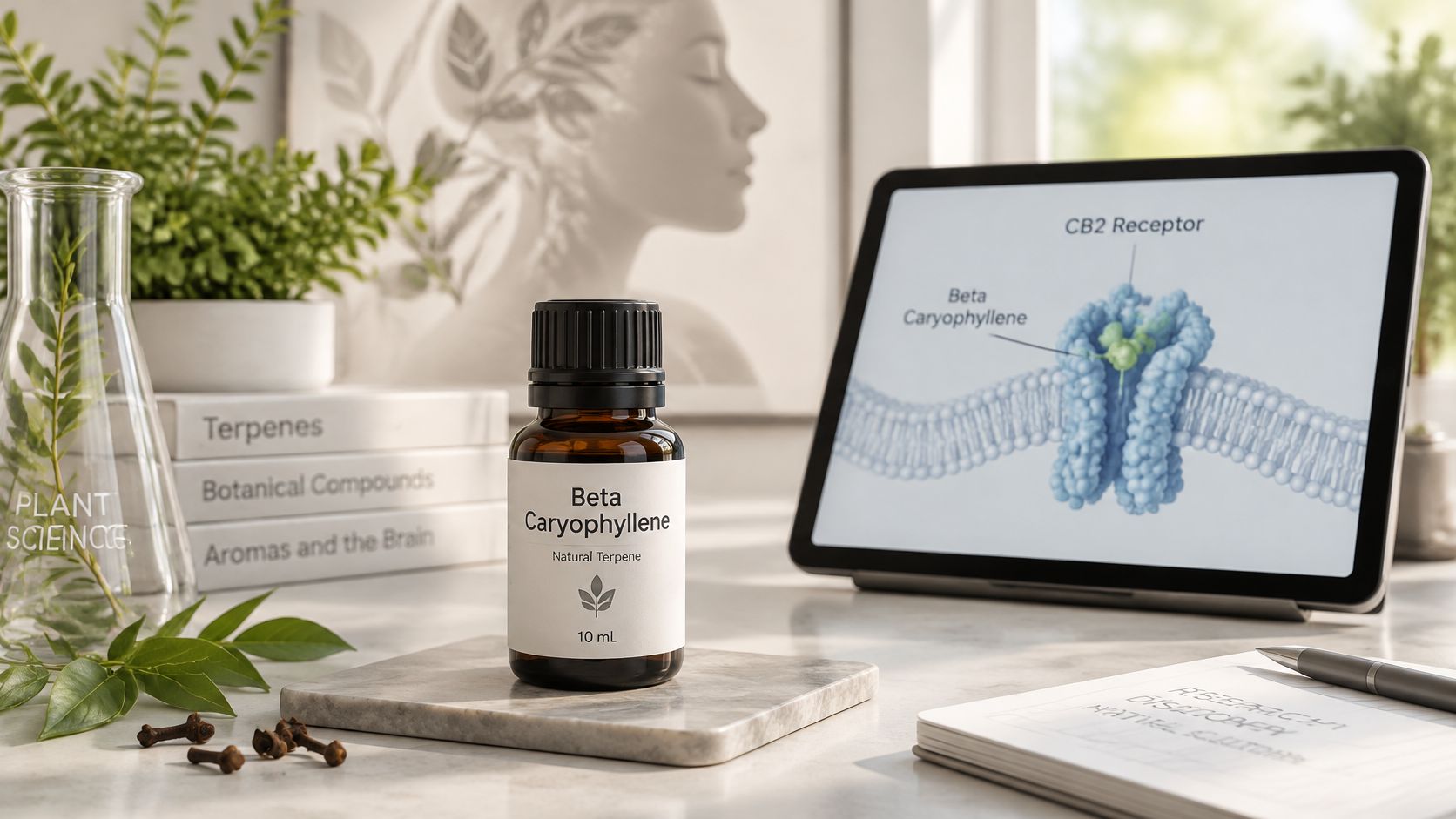
Separate mechanism from outcome
The focused review of BCP's CB2-selective pharmacology describes BCP as a full, functionally selective CB2 agonist with negligible CB1 affinity, and associates its activity with Gi/o signaling, suppression of adenylyl cyclase, and reduced cyclic-AMP/PKA signaling. It also discusses downstream associations involving NF-κB, PPARγ, and TRP-linked pathways.
CB2 signaling is associated primarily with immune-cell and peripheral inflammatory processes. Substantial CB1 activation is associated with central psychoactive effects, but those distinctions shouldn't become a blanket claim about the effects of a cannabinoid-containing cartridge.
Think of receptor selectivity as a key fitting one lock better than another. That explains binding preference; it doesn't establish what a finished product does in a person.
For development and labeling, separate the evidence into distinct categories:
| Evidence tier | What it establishes | What it doesn't establish |
|---|---|---|
| CB2 mechanism | Receptor interaction and signaling | A clinical outcome |
| Preclinical findings | Responses in experimental models | Reliable benefit in humans |
| Human pharmacokinetics | Exposure after a defined formulation | Symptom improvement |
| Human efficacy | Outcomes in an appropriately designed human study | Automatic transfer to another route or product |
Human exposure isn't human efficacy
A review discussing BCP translation and delivery reports that a 100 mg self-emulsifying system increased exposure approximately 2.2-fold for AUC0–12h, 2.0-fold for AUC0–24h, and 3.6-fold for peak concentration versus neat oil in healthy adults; it also describes a 2025 dermatology review finding no peer-reviewed efficacy data for isolated topical BCP. These are different findings answering different questions.
The pharmacokinetic result measures delivery, not therapeutic effect. It also isn't a basis for predicting inhaled exposure from a vape cartridge.
Rodent findings require similar restraint. Differences in metabolism and lipid regulation can prevent an experimental result from translating into a dependable human outcome.
Use the accompanying video as context, not as substantiation for packaging claims.
Avoid therapeutic wording:
- Treatment language: Treats inflammation, relieves pain, or heals skin.
- Outcome promises: Reduces anxiety or delivers clinically proven wellness effects.
Prefer verifiable descriptions:
- Composition: Contains beta caryophyllene, supported by finished-product analysis.
- Origin: Botanically derived, supported by sourcing documentation.
- Sensory role: Peppery, woody flavor component, supported by the accepted profile.
These descriptions still need a market-specific compliance review. Gold Coast Terpenes's product statements haven't been evaluated by the Food and Drug Administration; that disclaimer doesn't authorize otherwise unsupported claims.
The unresolved questions remain dose-to-effect, duration, population differences, and delivery format. Until those questions are answered for the relevant product, describe what the batch contains and how it performs sensorially, not what it supposedly treats.
Which Supplier Checks Should I Complete Before Blending Beta Caryophyllene?
Buy against a lot-matched certificate and documented acceptance criteria, then settle supply terms before scaling. A supplier's general testing statement is useful, but it doesn't replace the documents attached to the material you're receiving.
Gold Coast Terpenes's terpenes for cartridges are SC Lab-tested. For purchasing, that credential should lead to a review of the applicable results rather than an assumption that every possible contaminant or use condition has been evaluated.
Use a receiving checklist
- Match the lot. Confirm that the certificate identifies the shipment and reports compound identity and concentration.
- Review purity and residual-solvent results against your written acceptance limits. Missing information should hold the material out of production.
- Verify carrier composition. Check the applicable documentation for additives, VG, PG, PEG, and MCT rather than relying on the oil's appearance.
- Establish minimum order quantity, available lot size, reorder terms, and change-notification expectations before approving routine purchasing.
- Preserve traceability. Tie the ingredient lot to each finished cartridge batch and retain the corresponding certificate.
For botanical versus cannabis-derived terpenes, compare documented origin separately from analytical composition. Nature-identical labeling isn't interchangeable with botanically derived labeling, and matching a molecule's identity doesn't establish its extraction source.
The terpene supplier selection resource can help organize that evaluation. Terpenes 101 and the Mixing Calculator are useful formulation aids, but neither substitutes for purchasing specifications.
Gold Coast Terpenes describes its cartridge terpenes as legal worldwide. Treat that as an ingredient statement, not authorization for every finished cannabis product, shipment, label, or inhalation application in every jurisdiction.
How Do I Formulate Beta Caryophyllene into Vape Cartridges?
Build the blend at the terpene load you intend to sell, using characterized winterized distillate and a validated mixing process. Then test the aerosol in the intended device rather than approving the formula on taste or liquid appearance alone.
Control the blend before filling
- Pull the distillate certificate. Record cannabinoid and terpene composition so the formulation calculation starts from the actual receiving oil.
- Set the finished-product terpene target and any label declaration. Keep the calculation on a consistent mass basis.
- Add BCP under controlled exposure. Start with a covered vessel at room temperature if the oil is workable; don't force a room-temperature process when viscosity prevents uniform mixing.
- Mix thoroughly and sample the finished oil for terpene content. Where practical, compare samples from different vessel locations before releasing the blend to filling.
- Fill under reduced light. Record processing conditions, transfer exposure, hardware identification, and the time between blending and closure.
- Run device-specific aerosol testing at the intended load against an unmodified distillate control. Hold the hardware and operating conditions consistent enough to make the comparison meaningful.
The practical guide to using terpenes supports process planning. Your production procedure still needs defined mixing equipment, an endpoint for homogeneity, and acceptance criteria for the finished oil.
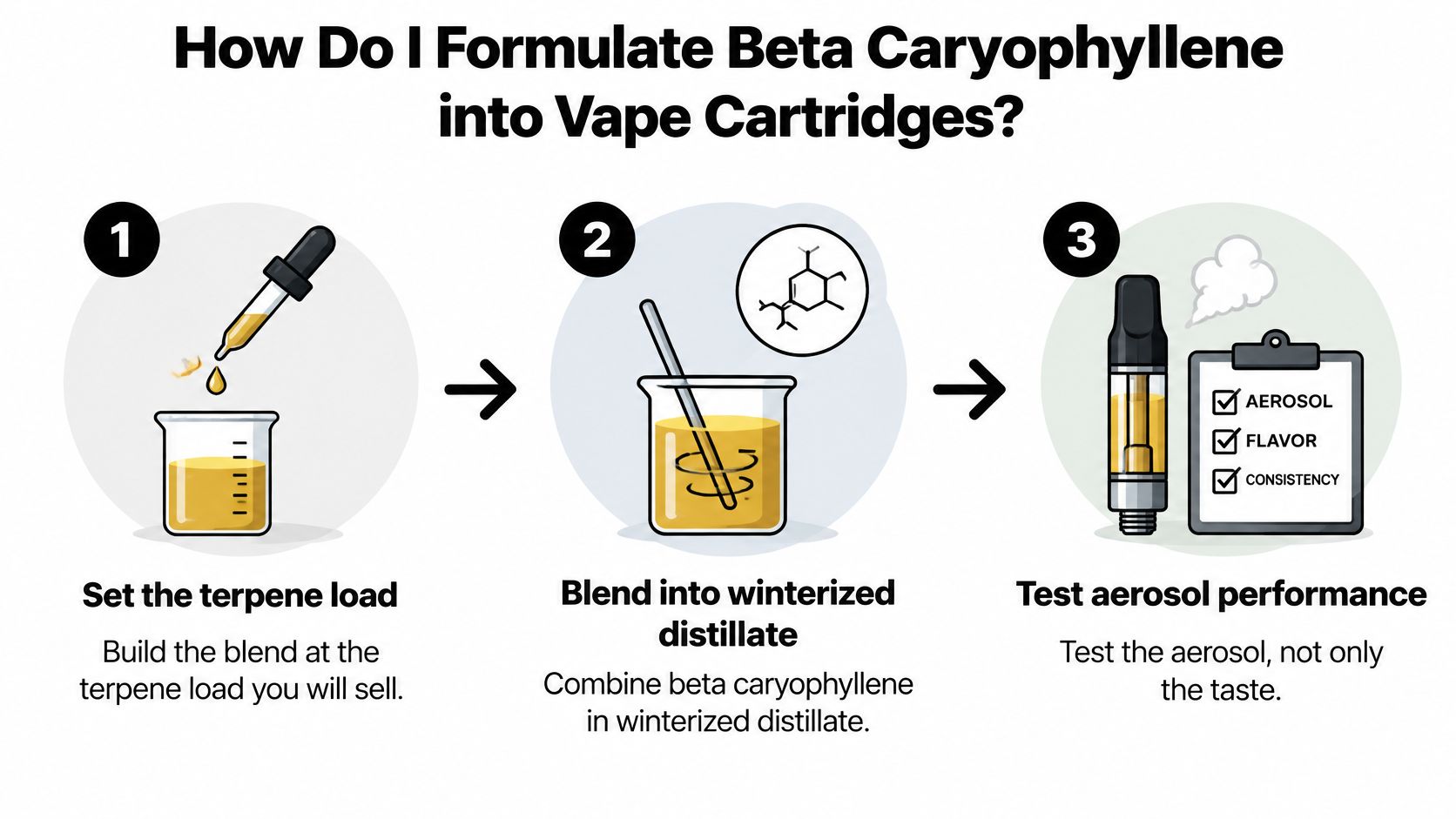
Evaluate what the heater produces
A California study of terpene-containing cannabinoid distillates tested 0%, 7.5%, and 15% added terpene by mass and found significantly increased carbonyl formation, reaching as high as ninefold under the study conditions. That's a formulation constraint, not a prediction that every BCP-containing cartridge will show the same increase.
Higher terpene loading changes more than flavor intensity or apparent viscosity. It changes the mixture presented to the heater, so testing a lower-load prototype doesn't validate a higher-load commercial formula.
Record device power settings, puffing conditions, hardware lot, and the laboratory method with the results. If you change the heater, wick, or formulation, assess whether the previous aerosol result still represents the product.
Release boundary: A good liquid-phase sensory result isn't proof of inhalation performance.
How Should I Test and Store Beta Caryophyllene Without Losing Potency?
Store BCP under low-oxygen, low-light conditions, and use chromatography to verify parent compound and oxidation products. For a formulation ingredient, preserving potency means preserving measured composition, not merely retaining a recognizable smell.
BCP's exocyclic double bond is susceptible to autoxidation into beta caryophyllene oxide, a chemically distinct product associated with increased sensitization risk, as discussed in the review of BCP chemistry and dermatological considerations. That makes oxidation a chemical-quality concern as well as a sensory concern.
Quality checks for beta caryophyllene batches
| Check | What It Confirms | How Often |
|---|---|---|
| Batch certificate of analysis | Compound identity and concentration | Every batch |
| Oxidation products (BCPO) | Degradation from air exposure | Every batch and after storage |
| Homogeneity after dilution | Even terpene distribution in the oil | Each blend run |
| Residual solvents | Clean extraction and processing | Each batch |
| Container compatibility | No interaction between oil and packaging | Each new packaging specification |
| In-use opening simulation | Quality after repeated opening | Each new packaging specification and at set opening intervals |
Treat this table as a proposed control plan, then establish validated methods and acceptance criteria with your laboratory. A chromatographic method must separate the parent ingredient from relevant degradation products; a single total-terpene result won't answer that question.
A review of BCP delivery and formulation emphasizes formulation-dependent performance and the importance of homogeneity, packaging compatibility, and stability controls. Translate that into a program with defined temperature, light, and headspace conditions, scheduled analysis, and an opening simulation that resembles actual bulk handling.
An identical starting BCP percentage doesn't guarantee identical composition at the point of use. Compare retained samples from sealed storage with material subjected to the planned opening and dispensing cycle.
Give the warehouse an executable procedure
- Seal and shield: Use validated containers with suitable oxygen and light barriers.
- Limit headspace: Select container sizes that reduce unnecessary air volume without compromising safe handling.
- Control storage: Use cool, defined conditions supported by the stability program rather than an assumed universal temperature.
- Log openings: Record opening dates, dispensing events, and closure checks.
- Record test status: Keep the analytical test date alongside the manufacturing date.
Use the terpene storage guide when writing handling instructions. Assign shelf life from the finished formulation's stability results, not from the ingredient's production date alone.
Beta Caryophyllene Questions Formulators Ask Next
The most useful purchasing questions concern source documentation, claim boundaries, stability, and supplier qualification. These answers help convert a flavor-development decision into a release specification.
Is beta caryophyllene cannabis-derived or botanical?
Beta caryophyllene occurs in cannabis and other plants, including black pepper and cloves, so its name alone doesn’t establish commercial origin. For Gold Coast Terpenes material, retain the source documentation and use botanically derived labeling only when it matches the purchased lot.
Will beta caryophyllene make a cartridge psychoactive?
BCP’s negligible CB1 affinity isn’t a basis for calling an entire cartridge non-intoxicating, particularly when the oil contains THC. Describe its sensory role without making an intoxication guarantee or therapeutic promise.
How long does beta caryophyllene stay stable in a cartridge?
There’s no universal shelf life established for every BCP-containing cartridge. Set the expiry period using chemical stability, packaging compatibility, and finished-device results under your intended storage conditions.
How do I choose between suppliers?
Use the supplier checklist to compare lot documentation, analytical scope, carrier declarations, packaging, and supply terms. Apply the same acceptance criteria to Gold Coast Terpenes’s lab-verified, THC-free material rather than treating a brand name as a substitute for qualification.
Gold Coast Terpenes offers terpene isolates and strain-specific profiles for developing peppery depth, balanced flavor, and repeatable distillate formulations. Visit Gold Coast Terpenes to review the available formulation options, then bring your target panel, intended terpene load, and cartridge specification into the purchasing discussion.