
Adding more watermelon concentrate won't necessarily make a cartridge taste more like fresh fruit. Gold Coast Terpenes supplies botanically derived, not cannabis-derived, terpene blends for cartridges and concentrates, with lab-tested ingredients and cartridge terpenes free of VG, PG, PEG, and MCT. For formulating artificial watermelon flavor for vape cartridges, the useful target isn't maximum fruit intensity. It's a balanced profile that remains recognizable after storage and heating in the finished oil.
What Makes Watermelon Flavor Recognizable?
Watermelon recognition comes from a combination of sweet-fruit aroma and restrained green, freshly cut notes. A convincing profile needs both, but the compounds responsible for fresh-fruit character aren't necessarily easy to stabilize.
A peer-reviewed watermelon volatile analysis identified 27 aroma compounds: 17 aldehydes, 9 alcohols, and 1 ketone. That inventory explains why treating watermelon as a single universal flavor molecule doesn't work. Developers are reconstructing a sensory relationship among compounds, not just increasing one ingredient.
(Z,Z)-3,6-nonadienal contributes characteristic watermelon aroma, while (Z)-3-hexenal supplies green, freshly cut character. A Molecules review of watermelon aroma chemistry also identifies the C9 aldehydes listed below as contributors to fresh, waxy, and green impressions.
Watermelon aroma components and their formulation notes
| Compound or group | Aroma role | Formulation note |
|---|---|---|
| C6 aldehydes, including (Z)-3-hexenal | Green, freshly cut notes | Break down readily; difficult to maintain consistently |
| (Z,Z)-3,6-nonadienal | Core watermelon aroma, cucumber-like and fatty | Unstable; breaks down readily |
| C9 aldehydes: 4-nonenal, (Z)-2-nonenal, (E,E)-2,6-nonadienal, 2,4-nonadienal | Waxy, fresh, and green | Evaluate as a controlled, low-dose accent |
| Alcohols and ketone within the identified volatile mixture | Supporting complexity in fresh fruit | Assess individually; their presence doesn't establish finished-product stability |
The table is an aroma map, not an inhalation ingredient list. Finding a compound in edible fruit doesn't establish that adding it to a cartridge is appropriate.
Build recognition without copying every volatile
For a watermelon strain-inspired terpene blend, separate the target into a durable fruit impression and a restrained green dimension. Make the sweet-fruit foundation recognizable before evaluating whether an additional accent is necessary or supportable.
Practical rule: Fresh-fruit authenticity and chemical durability are separate specifications. A blend must satisfy both in its intended application.
Increasing the total flavor loading can amplify candy character without restoring the missing rind impression. The practical task is to preserve the relationship between aroma dimensions while keeping every ingredient within a documented, application-specific assessment.
Should You Use a Single Note or a Layered Blend?
Choose among a single-note concentrate, a layered blend, or a watermelon core with complementary notes. For cartridges and distillate, I would prioritize a layered candidate, then compare it against a simpler control in the finished matrix.
A single-note product is quick to meter and easy to reproduce. Its limitation is sensory flexibility: if the opening reads as generic fruit, increasing the dose may produce a stronger version of that same impression.
Single-note, layered, and pairing options scored on four criteria
| Option | Sensory match | Stability through heat and storage | Dose efficiency | Documentation burden |
|---|---|---|---|---|
| Single-note concentrate | Can read one-dimensional and opening-heavy | Track the full composition, not just the product name | Simplest to meter | One purchased material, potentially many constituents |
| Layered top, mid, and base blend | Designed to retain recognition through the finish | Track each role and any green accent | More adjustment and testing | Several components or a documented premix |
| Watermelon core with citrus, mint, cucumber, or floral notes | Can suggest fresh fruit rather than candy | Test every added note for drift | Additional dosing and balancing | Potentially the largest constituent review |
A single-note concentrate isn't necessarily a single chemical. Ask for composition and specifications rather than assuming that one bottle means one volatile family.
A layered blend gives the formulator control over opening, body, and finish. Complementary pairing offers another route, but citrus can turn the target toward lemonade, mint can dominate the identity, and cucumber can exaggerate rind character.
Choose against the product brief
Use the terpene blend resource to frame candidate selection around the required sensory target, not a flavor name alone. A simple fruit SKU may justify a simpler concentrate, provided it passes the actual shelf-life requirement.
For a more demanding cartridge, compare layered candidates on sensory match, stability, dose efficiency, and documentation. The deciding cost is the cost of a passing finished formulation, not the price of the neat blend.
Which Terpenes Build a Watermelon Blend?
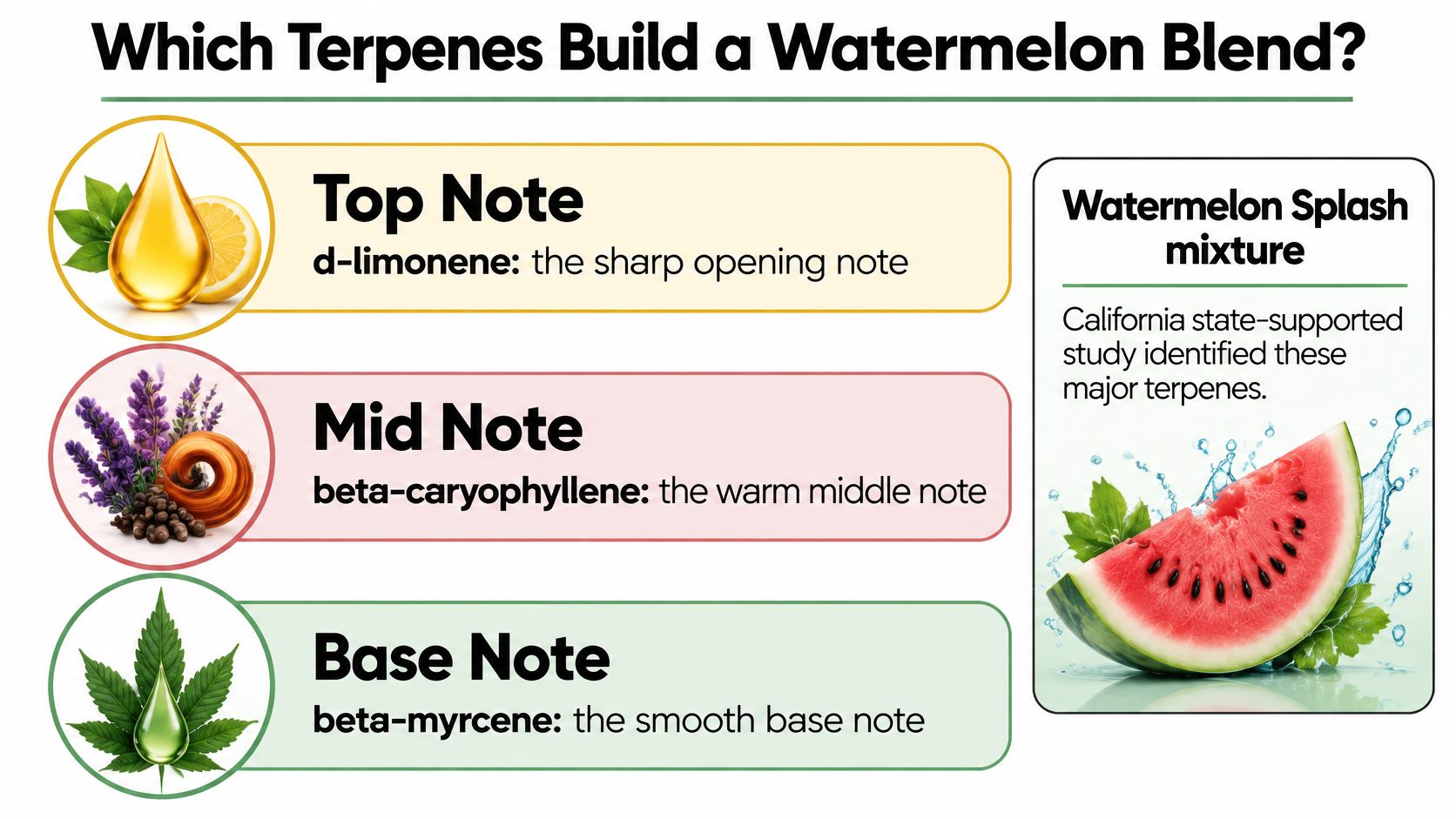
d-Limonene, beta-caryophyllene, and beta-myrcene provide a useful top, mid, and base framework, but they don't independently reproduce fresh watermelon. Their job is to organize the profile around opening lift, sustained body, and finish.
A California state-supported cannabis aerosol study included a Watermelon Splash mixture whose reported major components included these terpenes. That finding supports a practical architecture, not a universal watermelon recipe or proof of inhalation safety.
Top, mid, and base terpene roles for a watermelon blend
| Role | Component | Contribution | Where it shows |
|---|---|---|---|
| Top | d-Limonene | Rapid citrus-like lift | Opening puff |
| Mid | beta-Caryophyllene | Peppery, woody body | Mid-puff flavor |
| Base | beta-Myrcene | Heavier, earthy depth | Residual finish |
| Green accent, not a terpene | C9 aldehyde layer, if application assessment supports it | Green, rind-like note | Evaluated separately at low dose |
Set the roles in a controlled order
- Set the top share first to match the opening impression, because excess citrus lift can move the target away from watermelon.
- Adjust the mid share until the body carries beyond the opening. Keep the peppery or woody contribution subordinate to the fruit target.
- Set the base last, checking that earthy depth supports the finish rather than masking the top.
These are sensory roles, not rigid boiling-point categories. A compound can influence more than one stage of the draw, and the oil and hardware can change its apparent contribution.
Keep the green layer separate in the formula record. It isn't a terpene, and its use requires its own ingredient review rather than inclusion under a general terpene specification.
The isolated components let a developer diagnose which role needs adjustment. A prebuilt strain-inspired blend can reduce handling work, but it also limits how independently those roles can be changed.
Don't assign production percentages from aroma descriptions alone. Establish the internal balance through controlled comparisons, then validate the candidate at the intended total loading in the finished oil and hardware.
Why Does Sweet Watermelon Taste Flat?
A sweet-only watermelon blend often tastes candy-like because it lacks green, rind-like, and contrasting fresh dimensions. More fruit intensity won't reliably replace those missing cues.
The Los Angeles Times explanation of watermelon aroma chemistry describes how unstable aroma compounds complicate the reproduction of fresh watermelon. For formulators, the useful distinction is between too much sweetness and too little aromatic contrast.
Watermelon blend symptoms, likely gaps, and adjustments
| Symptom | Likely gap | Adjustment to test |
|---|---|---|
| Tastes like sweet candy | Green and rind impressions missing | Evaluate a controlled, application-reviewed green accent before raising overall dose |
| Smells like cucumber or grass | Green accent too strong | Reduce the green layer while preserving the fruit impression |
| Bright opening that fades fast | Top dominates; supporting body is insufficient | Adjust mid and base shares, then retest at intended loading |
| Flat at higher dose | Increasing one dimension hasn't restored balance | Compare a layered build instead of escalating the same note |
| Profile shifts after storage or heating | Possible volatile degradation or other formulation change | Compare retained samples and investigate chemically |
Diagnose before changing the formula
Say the neat blend smells fresh, but the finished cartridge reads as sweet candy. First compare an unflavored oil control and the diluted candidate. If the missing character appears only after aerosolization, changing the neat aroma alone may not solve the problem.
Citrus, mint, cucumber, or light floral notes are candidates for contrast, not automatic corrections. Evaluate their aromatic contribution without assuming that adding acid, a cooling agent, or another food ingredient is suitable for inhalation.
A lower-intensity blend with complementary dimensions can seem more natural than a stronger blend built around the same fruit note.
Heat exposure, oxygen, packaging, and storage history belong in the investigation. Don't attribute every shift to aldehydes without analytical support.
Change one formulation variable at a time. Retest at the intended loading so the comparison identifies an improvement in balance, not just a difference in concentration.
How to Test and Scale a Watermelon Blend
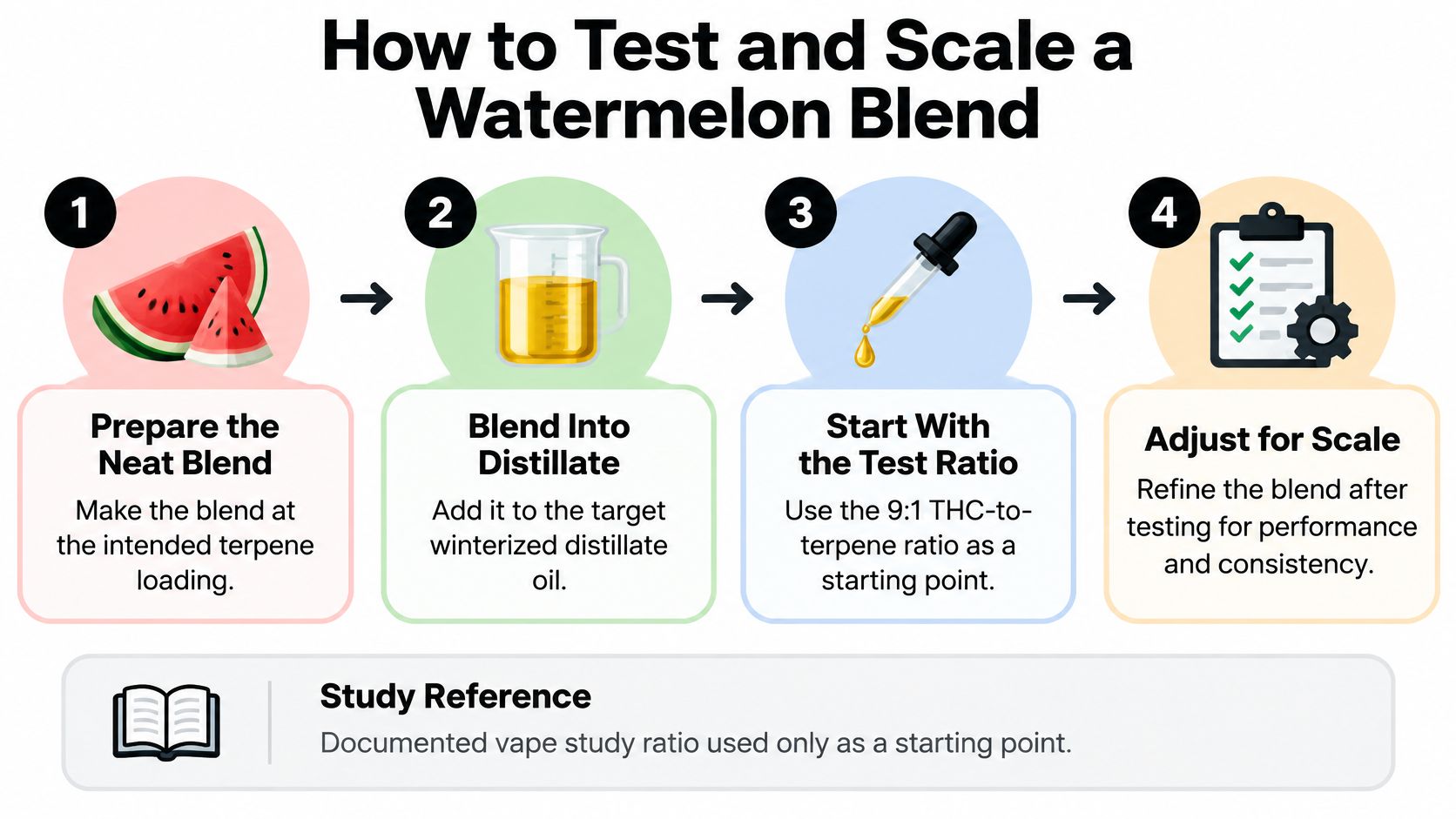
Test the candidate in the actual oil and intended hardware before scaling. A neat aroma evaluation can reject obvious mismatches, but it can't establish finished-cartridge performance or emissions suitability.
A Frontiers in Toxicology cannabis-concentrate vaping study used a 9:1 THC-to-terpene ratio and reported that terpenes can react during heating and aerosolization to produce toxic emissions. Treat that ratio as an experimental reference, not a recommended production loading or a safety limit.
Run a controlled evaluation sequence
- Prepare and record the candidate. Make a homogeneous neat blend, then add it to the target winterized distillate at the separately specified test loading. Record component lots, actual weights, mixing conditions, and oil identity.
- Score the pre-vape aroma against a written target. Distinguish fruit identity, green character, citrus lift, woody body, and earthy finish rather than recording only overall liking.
- Evaluate the first-puff top note using a documented hardware setting and draw protocol. Record device identity, coil specifications, fill conditions, and conditioning history.
- Assess the mid-puff body. Determine whether watermelon remains identifiable when the initial brightness subsides.
- Record the residual base note. Flag an earthy, peppery, or generic sweet finish that replaces the intended fruit identity.
- Repeat the sensory checkpoints after defined storage and heat-exposure conditions. Retain a control, document container and headspace conditions, and use analytical testing to investigate meaningful changes.
- Commission thermal and emissions testing. Use the intended device and operating range, including relevant foreseeable variation, rather than treating sensory acceptance as a toxicological result.
Qualified personnel should design and conduct aerosol evaluations under an appropriate safety protocol. Human puff testing isn't a substitute for chemical characterization.
Define the pass criteria before the pilot
The candidate should retain recognizable watermelon character at the opening and finish. Its supporting roles should remain balanced after the specified conditioning, without a new off-note or unacceptable analytical change.
Documentation is a separate gate. Confirm that the certificate of analysis covers the received batch and that the ingredient specifications, intended use, and assessment match the production application.
Gold Coast Terpenes states that its cartridge terpenes are added to winterized distillate oils, are free from additives, VG, PG, PEG, and MCT, and are SC Lab-tested. Those statements give the purchasing team concrete attributes to check against the supplied batch records; they don't replace finished-aerosol evaluation.
Before releasing a purchase order, resolve:
- Matrix fit: Identify the actual winterized distillate and its relevant incoming specifications.
- Composition: Confirm what the flavor system contains and whether any additional material falls outside the stated additive-free claim.
- Testing scope: Check what the laboratory measured, the methods used, and which lot the results cover.
- Scale control: Fix weighing tolerances, mixing order, hold conditions, and acceptance criteria in the production record.
Use the recipe-scaling resource to support batch calculations, but scale only the candidate that passes the pilot. Larger quantities won't correct an unstable sensory balance.
Does an Artificial Label Settle Inhalation Safety?
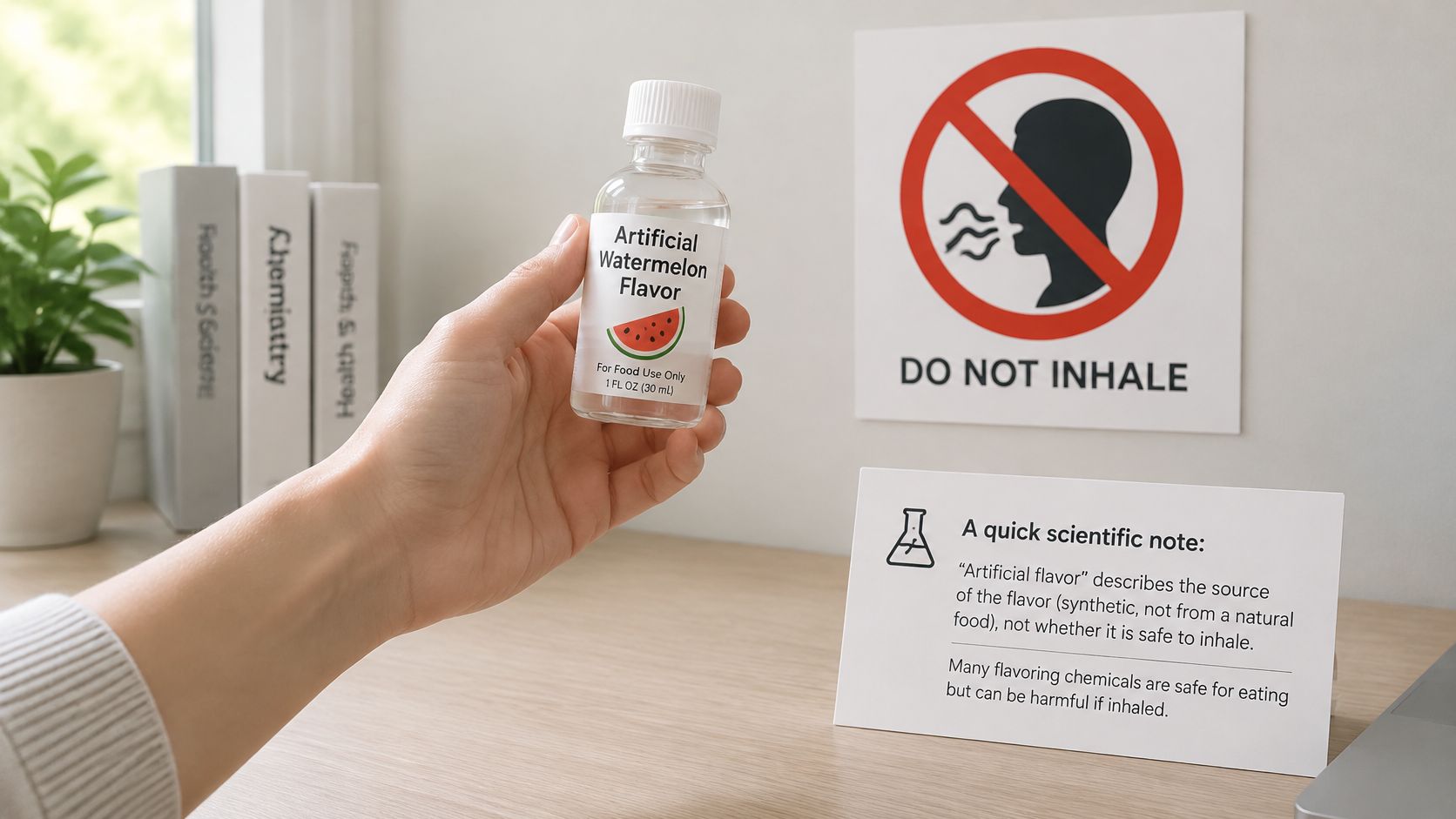
No. An artificial label doesn't establish inhalation suitability, and a natural label doesn't establish it either. Origin, food labeling, ingredient purity, and aerosol safety answer different questions.
The U.S. flavor-labeling regulation defines artificial flavor by source, distinguishing it from flavor derived from specified natural materials. It isn't a classification of relative danger.
A regulatory submission discussing the flavor-safety framework explains the intended-use basis of generally recognized as safe status. That intended-use qualification matters: a food-use determination doesn't automatically cover a heated cartridge formulation.
Separate origin from application
Botanical and cannabis-derived describe source. Nature-identical describes a relationship to a naturally occurring molecule, but it isn't a shortcut around the applicable labeling rules or an inhalation assessment.
Don't put an origin claim on a specification sheet unless the supplier's documentation supports it. Don't convert a purity result into a claim that the complete heated product is safe.
For each purchased batch, request:
- Application-specific specifications: Identity, composition information, relevant impurity limits, and the supported use.
- Certificate of analysis: Matching lot identification, test methods, results, and acceptance limits.
- Allergen information: A documented statement rather than an assumption based on the flavor name.
- Intended-use limits: Restrictions and conditions relevant to the proposed formulation.
Gold Coast Terpenes states that its terpenes are extracted from fresh plants. That origin claim can be verified independently of the cartridge assessment.
Use the terpene vaping safety guide to organize supplier questions. Before approval, confirm the intended use, the oil matrix, and the batch covered by the certificate.
How to Choose a Terpene Supplier for Vape Brands
Choose a supplier whose origin claims, batch documentation, and application fit can be verified. For artificial watermelon flavor for distillate, a memorable sample aroma isn't enough to justify production approval.
Compare botanical versus cannabis-derived terpenes first. Neither source category guarantees a closer watermelon match, better thermal performance, or a simpler compliance review. Select the origin that fits the product specification, then evaluate the actual composition.
Gold Coast Terpenes's lab-testing and cartridge-application statements provide a starting point for qualification. Procurement still needs the current documents, a representative sample, and written commercial terms.
Use a purchasing checklist
- Origin and labeling: Require a clear source statement and review botanical, cannabis-derived, natural, artificial, or nature-identical terminology against the applicable rules.
- Batch evidence: Check certificate coverage, traceability, relevant analytical methods, and the supplier's process for communicating composition or specification changes.
- Application experience: Confirm that the proposed material is intended for the target oil and that available documentation addresses the cartridge application.
- Commercial fit: Obtain minimum order quantities, sample availability, lead times, packaging formats, and reorder terms in writing before committing to the pilot.
A supplier may offer an attractive strain-inspired profile without providing enough information to approve it for a particular device. Conversely, a well-documented material may need substantial sensory adjustment before it matches the target.
Buying criterion: Approve the supplier and the formulation separately. A qualified supplier doesn't make every blend suitable for every cartridge.
Use the terpene supplier selection resource alongside the purchasing checklist. Compare the landed cost of the approved formulation, including testing and handling, rather than ranking suppliers by bottle price.
For flavor matching, provide a written reference that distinguishes fresh watermelon, rind-forward watermelon, and candy watermelon. Require a documented specification and change-notification process so a successful pilot remains reproducible on reorder.
Watermelon Terpene Questions Answered
The best starting material is the one whose origin, sensory fit, and documentation match the finished product specification. These purchasing and pilot decisions matter more than the watermelon name on the bottle.
Should a watermelon blend use botanically derived or cannabis-derived terpenes?
Choose the source that matches the brand’s origin specification, then assess the actual blend rather than assuming either source performs better. Gold Coast Terpenes identifies its terpene origin as botanical, so buyers should align that claim with the batch documentation and finished-product labeling.
How do I verify a supplier's lab claims for a cartridge batch?
Request the batch-specific certificate, confirm the lot number, and review the analytes, methods, results, and specification limits. For Gold Coast Terpenes’s SC Lab-tested cartridge materials, verify the scope of the supplied report rather than treating the laboratory name as complete application approval.
Can a strain-inspired profile serve as a starting point for a watermelon blend?
Yes, provided the candidate already supports the intended fruit direction and doesn’t require excessive correction of woody, earthy, or citrus notes. Select a documented reference, tune only what needs changing, and repeat finished-matrix evaluation before adopting it as the production standard.
What should I test first before scaling?
Run a small, traceable pilot in the target oil and intended hardware, with acceptance criteria set before evaluation. Confirm opening identity, sustained body, finish, storage performance, and the required analytical results before committing to production volume.
Gold Coast Terpenes offers botanically derived blends, strain-specific profiles, and individual isolates for developing a balanced watermelon formulation. Visit Gold Coast Terpenes to compare starting materials and formulation resources, then request the batch documentation and sample needed for a controlled pilot in your target distillate.