
A published Lemon Tree test profile lists limonene and beta-caryophyllene at 2.81% each, with myrcene at 1.23% and pinene at 0.3%, for approximately 7.15% total terpenes, according to the This Is Why I'm High Lemon Tree profile.
Gold Coast Terpenes makes 100% natural terpene blends for formulators who need a repeatable starting point instead of a moving cultivar target. The Lemon Tree name points to lineage and aroma direction. It does not hand you a chemical specification you can paste onto a production sheet.
For cartridge or distillate work, I would treat the terpene profile for Lemon Tree as a range problem. Set batch bands, build a layered trial, and run it in the hardware you fill. Lock only the ratio your own panel and leak checks confirm.
What Lemon Tree Terpene Ranges Look Like on COAs
Lemon Tree has no single fixed terpene profile, so a formulator works from batch ranges rather than one recipe. Gold Coast Terpenes lists terpene information for its 100% natural terpene blends and isolates that is provided by SC Labs, which means you can judge a batch document instead of a strain story.
The spread is wide enough to change a formula. A laboratory-COA aggregation lists terpinolene at 0.73%, β-caryophyllene at 0.59%, limonene at 0.52%, and β-myrcene at 0.49% as statistical means across verified product certificates, according to the CannMenus Lemon Tree aggregation. A separate laboratory-aggregated review reports 0.85% myrcene, 0.35% β-caryophyllene, 0.30% pinene, and 0.18% limonene, alongside roughly 17% THC, 0.03% CBD, and 0.53% CBG, according to the Cannigma Lemon Tree review.
Lemon Tree terpene levels across aggregated data sets
| Terpene | Aggregated COA mean | Compiled review mean | Working band for a trial |
|---|---|---|---|
| Myrcene | 0.49% | 0.85% | 0.5% to 0.85% |
| Limonene | 0.52% | 0.18% | 0.18% to 0.52% |
| Beta-caryophyllene | 0.59% | 0.35% | 0.35% to 0.59% |
| Alpha-pinene | Not listed | 0.30% | about 0.3% |
| Terpinolene | 0.73% | Not listed | up to 0.73% |
| Total terpenes | 2.55% for the listed five | 1.68% for the listed four | 1.7% to 2.6% |
Read that table as a warning, not as two competing recipes. Limonene sits at 0.52% in one set and 0.18% in the other. Terpinolene shows up only in the aggregated COA set, at 0.73%, and appears nowhere in the compiled review. A lemon aroma therefore doesn't confirm limonene dominance, and a myrcene-forward lot won't smell or blend like a terpinolene-forward lot.
That gap shows up fast in the oil. Terpinolene- or limonene-forward lots push bright citrus, floral, and woody notes. Myrcene-forward lots give you a rounder herbal body, with caryophyllene and pinene supplying more of the peppery and pine structure underneath.
Bench rule: If a supplier can't tie a number to a named batch, you don't have a specification. You have marketing copy.
How to check an incoming lot
Use the Terpenes 101 definitions for major and minor terpenes when your team needs shared language, then run the same check on every lot. The Gold Coast Terpenes guide to reading a certificate of analysis helps because a COA only works when your buyer, formulator, and QA lead read it the same way.
- Confirm batch identity: The GC-based certificate names the batch, not only the strain.
- Check date and laboratory: Record who tested it and when, so old data doesn't approve new material.
- Record the full panel: Write down total terpenes and each target terpene in your intake sheet.
- Compare against your bands: Judge each value against bands built from three to five prior batches.
- Flag band breaks: Hold any lot where terpinolene or limonene leaves its band for review.
- Confirm cannabinoid fit: THC and CBD must match the product category you're making.
If a lot fails, hold it. Don't blend it away, don't average it against a stronger lot on paper, and don't send it to a sensory panel to rescue a paperwork problem. Request a replacement COA or a replacement lot first, because a panel can judge aroma but it can't verify identity, content, or batch traceability.
Keep phenotype, harvest, and database method in the intake notes whenever a supplier provides them. Two lots can carry the same Lemon Tree name and still sit far apart because cultivation and harvest conditions moved the chemistry. Your accepted bands are what turn that natural spread into a purchasing decision your production team can repeat.
Which Terpenes Build the Top, Mid and Base Notes
Limonene gives Lemon Tree its lemon opening, but the finished aroma is built in three layers, top, mid, and base. Build only the opening and you'll get a bright citrus oil that reads thin, generic, and short on the finish.
The top note sells the first sniff, the base note sets the aftertaste.
A short piece of music provides a good comparison. Citrus is the melody the nose hears first, myrcene is the body that fills the middle, and beta-caryophyllene is the bass line that holds the finish after the bright notes fade. Remove the middle and the bass, and the melody has nothing to sit on.

Terpene roles in a Lemon Tree aroma
| Note Role | Terpene | Sensory Job in the Blend |
|---|---|---|
| Top | Limonene | Immediate citrus lift; the first note the nose reads |
| Top | Alpha-pinene | Fresh resinous lift under the citrus |
| Mid | Myrcene | Earthy-herbal body that rounds the citrus |
| Mid | Terpinolene | Floral and woody note tied to high-terpinolene lots |
| Base | Beta-caryophyllene | Peppery depth and a persistent finish |
| Base | Alpha-humulene | Woody, earthy anchor for the aftertaste |
A technical description of aroma architecture separates volatile top notes from longer-lasting structural notes, describing limonene, myrcene, and alpha-pinene as immediate top-note materials and beta-caryophyllene and alpha-humulene as base-note anchors, in the Gold Coast Terpenes guide to terpenes in CBD. That supports a citrus-led opening, a softer herbal or earthy middle, and a peppery, persistent finish.
You'll notice the table places myrcene and terpinolene in the middle. That's a formulator convention for this strain-inspired terpene blend, based on the job each one does in the blend rather than a rigid volatility rank. Terpinolene sits there because its contribution reads floral and woody in this profile, not as the first bright hit.
Don't maximize limonene to make the lemon louder. A limonene-heavy blend smells clean in the bottle, but it lacks the herbal body and peppery depth that make buyers recognize the profile as Lemon Tree rather than lemon candy or cleaner. If your panel says "lemon, then nothing," the problem usually isn't too little citrus, it's too little structure.
Gold Coast Terpenes sells single isolates for each layer, so you can test each role alone before you commit to a blend. Smell limonene and alpha-pinene for lift, myrcene and terpinolene for body, and beta-caryophyllene for finish, then score them separately. That single-variable discipline saves you from the common bench mistake of fixing a weak base by adding more top note.
For replicating flavor of Lemon Tree in distillate, judge the progression, not just the bottle odor. The first sniff, the middle of the draw, and the aftertaste need three separate scores on your panel sheet.
How Much Terpene to Load for Vape Cartridges
Start at a 9:1 THC-to-terpene ratio, about 10% terpene in the oil, and treat it as your default trial point. A peer-reviewed cannabis-concentrate vaping study used a 9:1 THC-to-terpene ratio as a practical model because higher terpene loading made the material excessively fluid and prone to leaking from the vape pen, as described in the peer-reviewed cannabis-concentrate vaping study.
Loading is a hardware question as much as a flavor question. Terpenes thin the oil, thinner oil moves faster through intake holes and seals, and faster movement raises leak risk. Push loading up to chase flavor without checking viscosity and you may solve an aroma problem by creating a returns problem.
Terpene loading levels for cartridge trials
| Terpene Load (% of oil) | THC to Terpene Ratio | Fluidity and Leak Risk | Use in Lemon Tree Trials |
|---|---|---|---|
| 5% | 19:1 (calculated) | Lower fluidity, lower leak risk | Light citrus trial; may read thin |
| 10% | 9:1 (study model) | Validate on target hardware | Default starting point |
| 15% | 5.7:1 (calculated) | Higher fluidity; leak check required | Stronger flavor trial only |
| 20% | 4:1 (calculated) | Excess fluidity expected; test leak rate | Only with hardware data |
The 19:1, 5.7:1, and 4:1 ratios are calculated from loading, while the 9:1 figure is the study model. Don't present the calculated rows to your team as tested specifications. They're trial brackets that tell you where to look, not proof that a given cartridge will hold the oil.
Run the test on the hardware you intend to sell. Fill a set of cartridges at each level, keep fill temperature and fill speed consistent, then run a leak check and record fill consistency and oil flow for every set. If one level needs a different fill process to behave, write that down, because production will inherit that constraint.
The Gold Coast Terpenes guide on how much terpene to add to distillate gives you a practical cross-check before you scale a trial. Use it to sanity-check your math, then let your own hardware data make the final call.
I would keep 10% as the default for a Lemon Tree formulation guide until your data says otherwise. Cartridge geometry, oil viscosity, fill process, and intended flavor intensity all change the result, so a ratio that works in one device can fail in another. A lower load that ships without leaks beats a louder profile that arrives in the packaging.
How Heat Changes Each Terpene in a Cartridge
Myrcene keeps close to its full amount through heating, while terpinolene can lose most of its mass, so you have to judge a Lemon Tree blend after heating. Reported heating experiments on twelve cannabis terpenes found survival rates from approximately 97–98% for myrcene to 11–28% for terpinolene at the higher temperatures tested, with beta-caryophyllene, humulene, and myrcene showing comparatively strong survival, as summarized in the Entour summary of terpene heating experiments.
That's why a blend can smell correct in the bottle and taste wrong in the vapor. The lighter, more fragile parts leave or break down first, and the profile your customer gets is the one that survives the coil, not the one your panel approved at room temperature.
Heat survival and what it means for a Lemon Tree blend
| Terpene | Reported Heat Survival | Lemon Tree Implication |
|---|---|---|
| Myrcene | approx. 97–98% | Holds the earthy body through heating |
| Terpinolene | approx. 11–28% | Floral lift can fade; test before committing |
| Beta-caryophyllene | Comparatively strong; no exact % reported | Keeps the peppery finish |
| Humulene | Comparatively strong; no exact % reported | Supports the base anchor |
| Limonene | No figure reported; confirm in your own test | Top note; confirm citrus survives |
| Alpha-pinene | No figure reported; confirm in your own test | Resinous lift; confirm in your own test |
Don't fill those gaps with guesses. Run the blend at your real hardware temperature and puff conditions, then compare pre-fill and post-puff sensory notes side by side. The Gold Coast Terpenes reference on terpene boiling points helps you plan those test conditions, but it doesn't replace a draw test on your device.
Pay closest attention to the citrus opening. Limonene supplies that first lemon read, so if the citrus fades in the hardware test, raise the limonene share in small steps and retest. Don't add more terpinolene to fix a fading top note, because the heating data tells you terpinolene is the part most likely to disappear.
Heat rule: Approve the vapor, not the bottle. A pre-fill sniff is a screening step, never a release decision.
That approach also protects your base. Since beta-caryophyllene and humulene hold up comparatively well, a blend that's balanced in the bottle can taste more peppery and woody after heating because the fragile notes dropped out. Score the finish after the puff test and trim the base only if the heated profile, not the raw blend, reads heavy.
How to Build a Lemon Tree Strain-Inspired Terpene Blend
The worked trial ratio is limonene 2, myrcene 1, beta-caryophyllene 1, alpha-pinene 0.5, and terpinolene 0.5 by weight. It's a starting trial for formulating a Lemon Tree profile, not a specification, and it only earns production status after your panel and hardware tests agree.
At 10% terpene loading, each part equals 2% of the oil. That gives you 4% limonene, 2% myrcene, 2% beta-caryophyllene, 1% alpha-pinene, and 1% terpinolene in the finished oil, which makes the math easy to audit on a bench sheet.
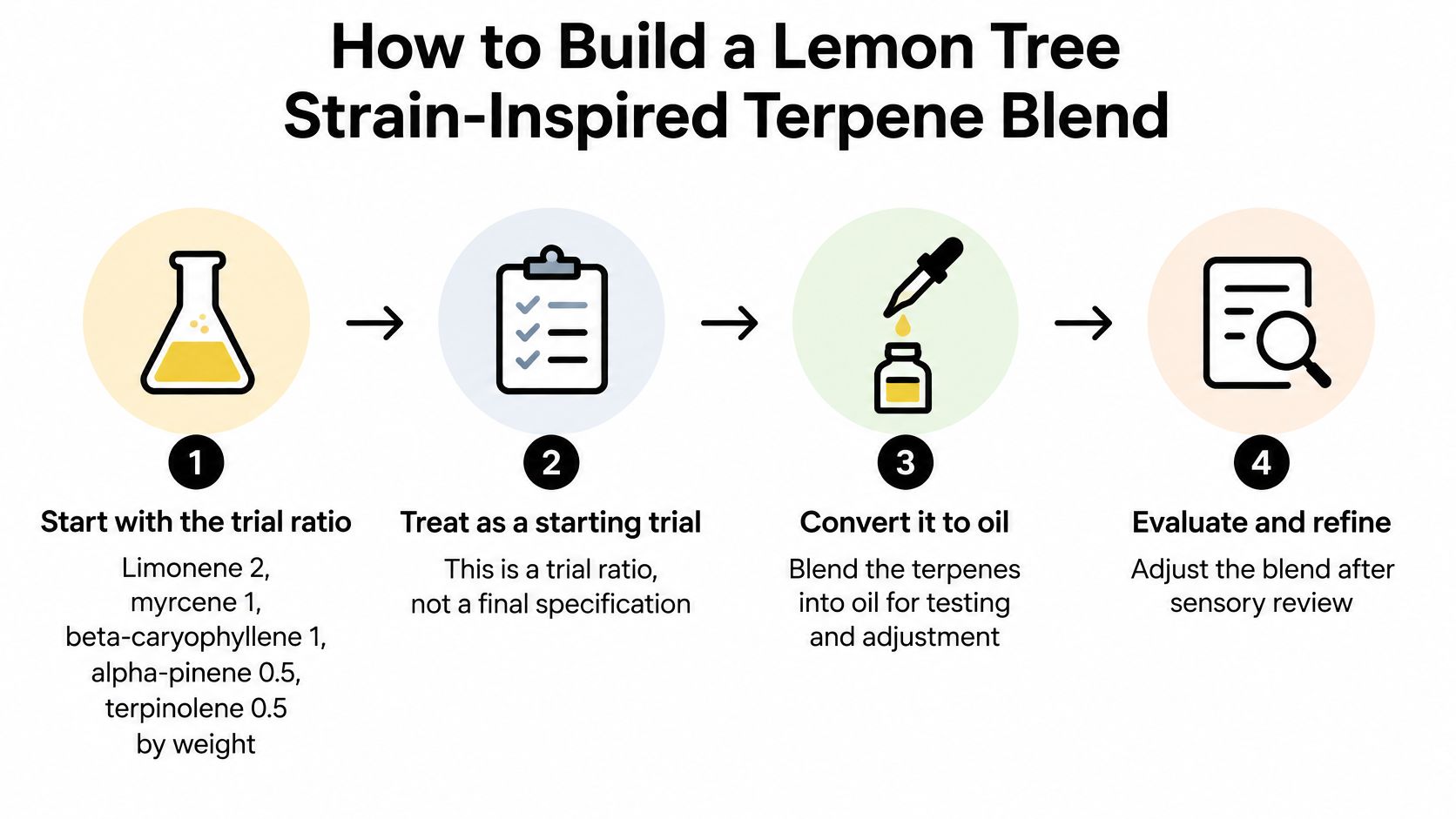
Bench sequence
- Set target bands first: Build your acceptable ranges from three to five batch certificates, so the trial has a defined target instead of a strain name.
- Set the trial ratio: Use the 2 : 1 : 1 : 0.5 : 0.5 ratio above as trial one, because it gives citrus the lead without deleting the herbal and peppery structure.
- Convert to oil loading: Translate the ratio into percentages of finished oil at 10% total terpenes, so the cartridge team and the flavor team are reading the same numbers.
- Weigh a small test batch: Make a 10 g test batch and weigh to 0.01 g, then mix until uniform, since a small weighing error shifts a five-part ratio fast.
- Panel against a reference lot: Score top, mid, and base separately against your chosen reference, so a weak finish doesn't hide behind a strong opening.
- Adjust one variable at a time: Move in 0.5-part steps and change one terpene per trial, so each sensory change is attributable to one decision.
- Run the hardware test: Check the heated profile for terpinolene fade and citrus loss on your target device, because bottle aroma doesn't predict vapor aroma.
- Lock and document: Record the certificate for each component, freeze the formula version, and set a retest rule for every new lot.
Keep each trial sheet brutally simple. Write the ratio, the oil percentage, the hardware, the panel scores, and the one change you'll make next. If your sheet can't tell a second formulator exactly what changed between trial two and trial three, it's a diary, not a development record.
Say your first panel scores the opening as correct, the middle as thin, and the finish as correct. You don't add limonene. You raise myrcene by 0.5 part, hold everything else, and rerun the same panel and hardware test, because the missing layer is body, not brightness.
Say the vapor loses its floral lift but keeps its lemon opening. That's the terpinolene problem the heating data predicts, so you decide whether that floral note is essential to your target or whether it's a bottle-only feature you can drop. Chasing a fragile note with ever-higher loading usually costs you viscosity control without buying you a stable vapor profile.
I would lock a formula only after two consecutive trials hit the same panel scores on the same hardware. One good fill can be luck, a warm room, or a fresh coil. Two matching runs with documented component lots give production something it can reproduce, and they give QA a clear retest trigger when a new isolate lot arrives.
Botanical vs. Cannabis-Derived Terpenes for Vape Brands
Botanically derived terpenes come from plant sources other than cannabis. The label wording decides how you can describe the finished product, so settle the source claim before you approve artwork, not after. Gold Coast Terpenes sells 100% botanically derived blends, not cannabis-derived ones, which suits brands whose labels keep those two source claims separate.
Price is the last variable you should sort on. Start with the Gold Coast Terpenes comparison of cannabis-derived and botanically derived terpenes, then judge a supplier for terpenes for vape cartridges on five checks you complete before a trial.
- Label wording: get the exact source wording for each terpene type confirmed by brand counsel before any claim is printed.
- MOQ: fix minimum order quantity per isolate and per blend with the sales team before you design the trial.
- COA format: settle the COA format and testing laboratory for each lot, so QA isn't translating a new layout every order.
- Flavor match: judge the match on your hardware test, not on bottle aroma.
- Nature-identical review: complete a compliance review of any nature-identical label language before artwork approval.
Then add one more question: does the supplier state the chemical composition of each lot, or only a strain name? A strain name is a starting point. A component list with percentages is a specification.
Score every candidate on those points in writing. A cheap isolate with unclear batch documents or unusable label language stops being cheap once reprints, retesting or a reformulation land on the invoice. For vape brands, the supplier question is a documentation question with a flavor test attached.
Start Your Lemon Tree Blend With a Tested Terpene Set
A strain name is an aroma target, not a chemical specification. Lemon Tree has no single profile, so start with a tested set: isolates you can weigh, then a finished blend only after the sensory panel matches the target.
Gold Coast Terpenes sells isolates including Alpha Pinene, Beta Caryophyllene, Limonene, Linalool, Myrcene, and Terpinolene. Those six cover every terpene in the trial ratio. Singles let you correct one note at a time. They also add weighing error on a small batch. A finished blend removes that error and also hides which note drifted, so hold it until the panel agrees.
Gold Coast Terpenes offers 50+ strains from the Indica, Sativa and Hybrid categories, giving the bench trial finished profiles to sit beside rather than one universal Lemon Tree formula. Specialty Strains, made by the Master Terpologists, increase levels of certain rare and exotic terpenes to bring out fruity and flavorful nuances. That makes them a useful citrus-forward reference. Pink Lemonade, with flavor notes of lemon, strawberry, and sweet, is a bright lemon point for panel calibration when the trial smells flat or candy-sweet instead of citrus.
- Request each COA: Confirm every isolate batch sits inside its band before you weigh anything.
- Confirm MOQ and lead time: Ask the sales team for both, per isolate, before you promise a launch date.
- Build the 10 g test batch: Run the trial ratio at bench scale first.
- Test on hardware: Complete the heat, puff, and leak checks before any production order.
Scale through the wholesale and bulk programs only after panel and hardware results agree. That order keeps you from buying production volume of a profile that only worked at bench scale.
Frequently Asked Questions About Lemon Tree Terpene Formulation
Does Lemon Tree have one fixed terpene profile
No. Published data show limonene ranging widely across sources, so set your target bands from three to five batch certificates. Treat the strain name as an aroma direction and the batch COA as your specification.
Is a botanically derived terpene the same as a cannabis-derived terpene
No. Botanically derived terpenes come from non-cannabis plant sources. Gold Coast Terpenes sells 100% natural terpene blends, and you should confirm the exact source wording for each product before printing any label claim. Source claims and product claims are not interchangeable, so have counsel review the wording before it goes on packaging.
What terpene loading should I start with for vape cartridges
Start at 10% terpene, the 9:1 THC-to-terpene ratio used as a study model. Validate that load on your target hardware with leak and flow checks before you raise it for stronger flavor. A higher load buys intensity and costs you viscosity, so move up in steps rather than in one jump.
Does heat change a Lemon Tree blend
Yes. Myrcene holds up far better through heating than terpinolene, which can lose most of its mass at higher tested temperatures. Judge the blend on your hardware temperature and puff conditions, not from the pre-fill bottle.
Which isolates should I order first
Order single isolates of limonene, myrcene, beta-caryophyllene, alpha-pinene, and terpinolene from Gold Coast Terpenes. Confirm MOQ and lead time with the sales team, then build the small test batch before ordering blend volume.
Gold Coast Terpenes offers isolates and strain-specific profiles you can use to build, test, and document a Lemon Tree trial from bench scale to bulk production. Start with the five isolates in the trial ratio, request the batch COA for each one, and confirm MOQ and lead time before your first fill. Visit Gold Coast Terpenes to set up your tested terpene set and get your formulation moving.