
Stop treating the Mint Cookie strain name as a specification. Gold Coast Terpenes makes 100% botanically derived terpene blends, not cannabis-derived blends, and that distinction matters because a replicable terpene profile for Mint Cookie has to be built from measured compounds, ratios and lot records, not from a cultivar page. The label tells you what the blend should taste like. It tells you nothing about what is in the bottle.
If you're formulating for vape cartridges or for distillate, define the target first, verify every lot against it, then prove the flavor survives heating in your actual hardware. A blend that reads correctly on a scent strip can still fail in the inhaled aerosol, so the cartridge is where the profile earns its name.
Which terpenes define the Mint Cookie profile for formulation?
Beta-caryophyllene supplies the base, limonene provides the top note and alpha-humulene adds herbal body. Linalool can sit in the middle, while myrcene can deepen the base in some Mint Cookies references. Treat these compounds as a hierarchy to verify, not as a formula to copy.
The Hytiva Mint Cookies strain overview reports 23.17% THC, with 0.554 mg/g beta-caryophyllene, 0.349 mg/g limonene and 0.200 mg/g alpha-humulene, and puts average THC in the high teens with some batches reaching 24%. The cannabinoid value describes the tested material, not a blending input. The terpene results establish the rank order for that sample.
Reference terpene values for Mint Cookie by role
| Terpene | Role | Reference value | Note |
|---|---|---|---|
| Beta-caryophyllene | Base | 0.554 mg/g | Leading terpene in the reference profile |
| Limonene | Top | 0.349 mg/g | Bright citrus lift |
| Alpha-humulene | Base | 0.200 mg/g | Herbal body |
| Linalool | Mid | Not reported in this source | Listed in some Mint Cookies references; set from your lot COA |
| Myrcene | Base | Not reported in this source | Listed in a Kush Mint Cookies reference; set from your lot COA |
A missing value does not prove that the compound is absent from every Mint Cookie lot. It means this reference cannot support a percentage or ratio for that role. When linalool or myrcene matters to the sensory target, pull the measured concentration from the COA for the lot in front of you and keep the reporting units consistent.
Practical rule: Use published rankings to assign terpene roles. Use lot-level COAs to set the actual ratios.
Before blending, record the compound, its measured concentration and the source or lot identifier for every target. Caryophyllene, limonene and humulene can be benchmarked against the linked profile, while linalool and myrcene need lot-specific confirmation. Gold Coast Terpenes supplies 100% natural terpene blends and isolated compounds, so each role can be adjusted independently without changing the underlying sensory structure.
Why does a Mint Cookie blend need layered notes instead of a mint additive?
A Mint Cookie blend needs layered notes because the mint impression is composite. It comes from terpene combinations working together, not from one mint compound you can dose in at the end. Add a mint flavor on top of a thin base and you'll get cooling without the cookie character that makes the profile recognizable.
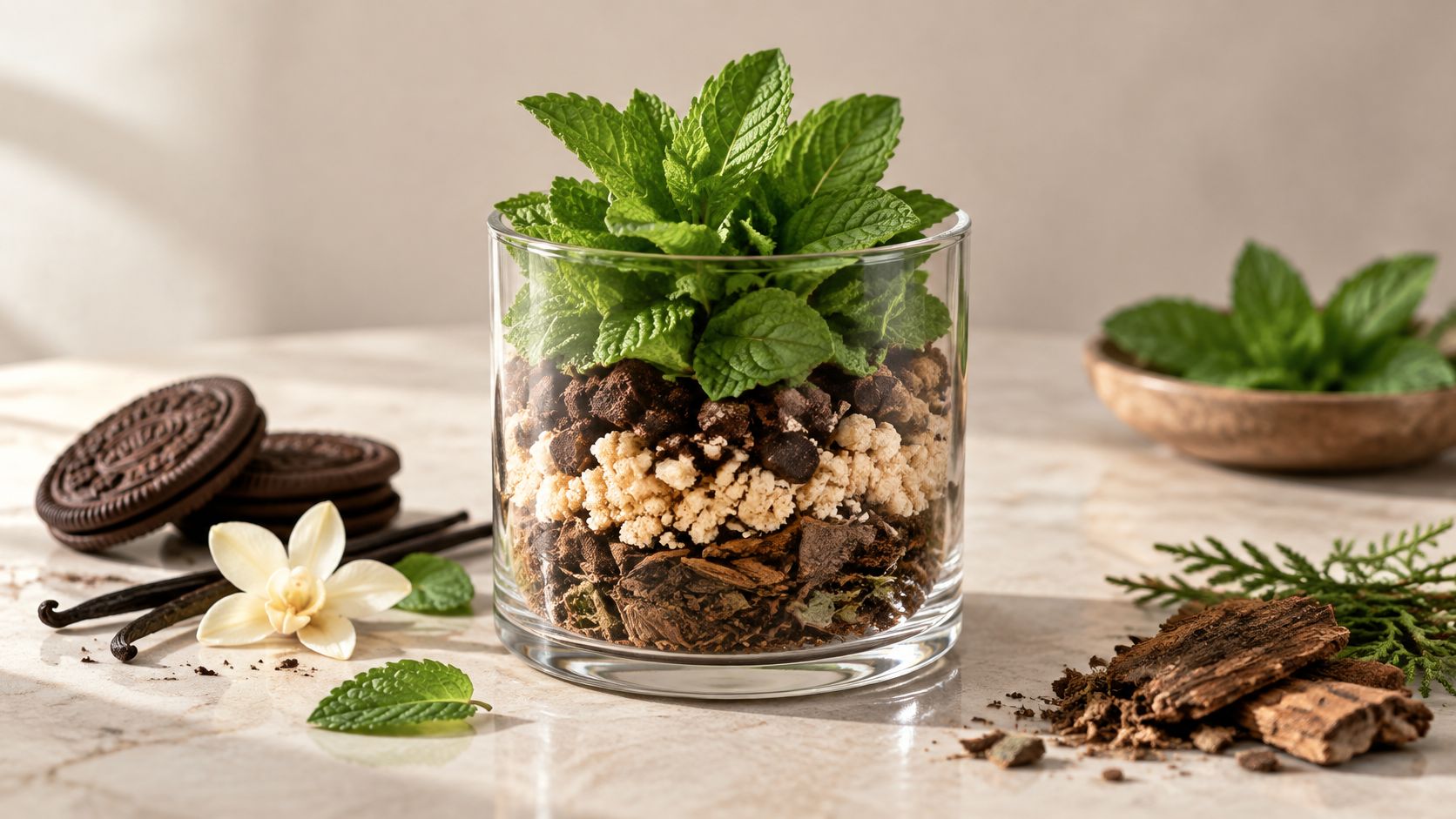
Available references support that layered reading. The BudAbout Mint Cookies profile identifies caryophyllene as dominant, followed by limonene, linalool and humulene, while a Kush Mint Cookies profile lists caryophyllene first, then limonene and myrcene. Those are relative rankings, not a validated percentage formula.
How the layers stack
- Base, beta-caryophyllene: This supplies spicy, peppery weight. It's the dry, woody foundation that keeps the blend from reading as candy or toothpaste, and it's the layer that persists after the volatiles lift off.
- Top, limonene: This gives bright citrus lift on the first impression. It's also the most fragile layer, so it's the first thing you lose if the blend sits warm or the device runs hot.
- Mid, linalool: This softens the transition between citrus top and peppery base with floral character. Without a mid note, the profile reads as two disconnected halves.
- Body, humulene or myrcene: These reinforce the deeper herbal side. They fill out the base so caryophyllene doesn't stand alone as raw spice.
Volatility changes what you smell
Top notes evaporate first. A blend that smells balanced neat in the bottle can lose its lift once it's diluted into oil, filled, stored and heated, because limonene leaves the matrix faster than the heavier sesquiterpenes stay. That's why neat evaluation misleads formulators. You're judging a ratio that won't exist at the coil.
Botanical peppermint oil makes this worse, not better. It can mask the cookie base, dominate the mid notes and push the finished profile away from the cannabis-derived reference you're trying to replicate. I wouldn't use it to create cooling in a Mint Cookie trial unless the measured target explicitly calls for it and your sensory panel confirms it in the finished oil.
Set ratios from a lot COA or reference chromatogram first. Then judge the blend after dilution in the finished oil at device heating temperature, in the cartridge you'll sell. If the top note disappears there, adjust the ratio or the load. Don't just add more mint.
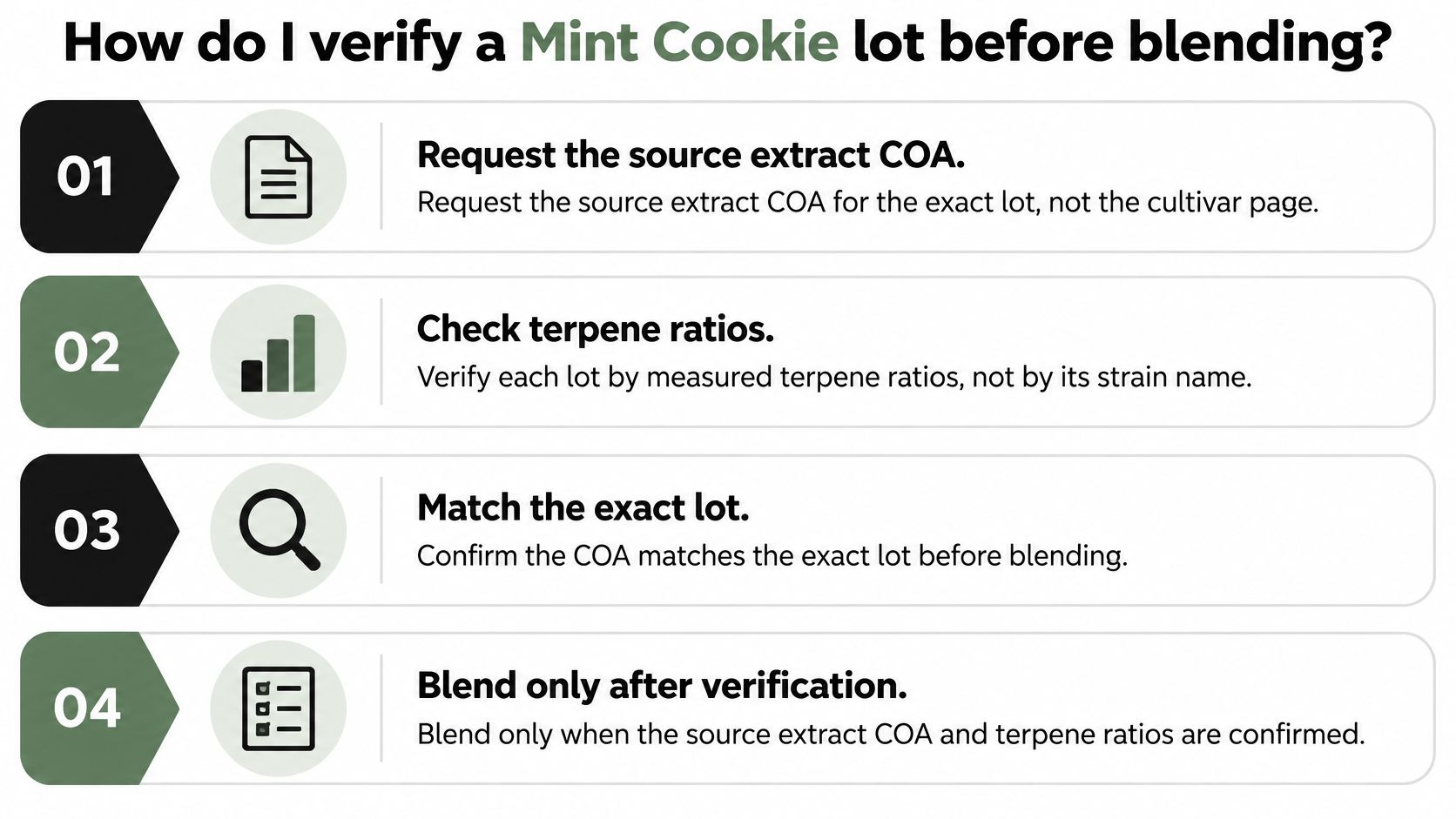
How do I verify a Mint Cookie lot before blending?
Verify each lot by its certificate of analysis and measured terpene ratios, not by its strain name. Names don't guarantee identical aroma or cannabinoid composition, and terpene percentages shift between lots within one cultivar.
Lot verification steps
- Request the source extract COA for the exact lot. Don't accept a cultivar page or a COA from a previous harvest. If the document doesn't match the lot number on the container, you don't have verification. Review what a complete document should contain in the Gold Coast Terpenes COA certificate of analysis guide before you approve suppliers.
- Confirm THC and minor cannabinoids. Reference profiles cluster in the high teens to mid-20% THC range, so a lot far outside that band needs an explanation before you blend. You're checking for identity drift, not chasing potency.
- Quantify dominant terpenes in mg/g or percent by mass. A ranked list without numbers can't be reproduced. You need values you can do arithmetic with.
- Calculate caryophyllene, limonene and linalool as ratios to the lot total. Ratios travel across batches better than raw values because total terpene content moves with extraction and storage. The ratio is what your sensory target depends on.
- Compare ratios with your target and set a tolerance band before testing. Decide acceptance limits in advance. If you set the band after you see results, you'll rationalize drift.
- Reject or re-blend lots outside the band. Do the same for lots showing unlisted additives. Correcting a drifted lot with isolates is legitimate, but only when you recalculate the full ratio set afterward.
- Record lot number, COA date and ratios in the batch record. Your next production run depends on this paper trail. Without it, a successful trial can't be repeated.
Set your tolerance band before you open the COA. A band written afterward isn't a specification, it's an excuse.
Treat reference values from single published reports as a starting benchmark for formulating, not as acceptance criteria for every lot. Your criteria come from the target you validated in finished product. Once that target exists, every incoming lot either matches it within tolerance or gets adjusted, re-blended or rejected. That's the whole system.
Which Gold Coast isolates build each Mint Cookie role?
Beta Caryophyllene, Limonene, Linalool and Myrcene map directly onto the Mint Cookie roles, and Gold Coast Terpenes offers isolates including Alpha Pinene, Beta Caryophyllene, Limonene, Linalool, Myrcene and Terpinolene. Four of the six have a documented link to Mint Cookie reference profiles. The other two don't, and that distinction should drive your trial design.
Gold Coast isolates mapped to Mint Cookie roles
| Isolate | Role in blend | Mint Cookie link | Use in trial |
|---|---|---|---|
| Beta Caryophyllene | Base | Dominant in all reference profiles | Anchor the spicy, peppery base |
| Limonene | Top | Listed in reference profiles | Set citrus lift |
| Linalool | Mid | Appears in some batches | Soften the blend |
| Myrcene | Base | Listed in Kush Mint Cookies profile | Add herbal body |
| Alpha Pinene | Top | Not in reference profiles | Test only against a measured target |
| Terpinolene | Top | Not in reference profiles | Test only against a measured target |
Isolates give you control a pre-blended strain profile can't. When the base is too thin, you raise Beta Caryophyllene without touching the top note. When the citrus lift fades in the finished oil, you adjust Limonene alone and retest. When a lot arrives with linalool already present, you reduce or skip the Linalool addition instead of stacking floral character the target doesn't call for.
That control only works if you handle concentration correctly. Every isolate is highly concentrated and must be diluted before use, so weigh additions by mass, record them against the total batch and never dose by drops. Drop dosing makes your ratio math fictional. The Gold Coast Terpenes guide on how to use terpene isolates covers handling and dilution practice for these inputs, and it's worth standardizing before your first trial run.
For Alpha Pinene and Terpinolene, be strict. They aren't in the Mint Cookie reference profiles, so they don't belong in a replication trial by default. If your own reference chromatogram shows one of them at a meaningful level, test it against that measured target. If it doesn't, adding either one is flavor invention, not replication, and your panel results won't tell you whether you've matched Mint Cookie. I would keep both out of the first trial entirely and add complexity only after the three core roles hold in the cartridge.
How Terpene Load Affects Cartridge Performance
Terpene load changes viscosity, leakage and aerosol behavior, and a higher percentage does not guarantee more flavor or more output. Treat load as a hardware variable. For a Mint Cookie blend, the goal is the lowest load that carries the target mint, cookie and base notes into the finished cartridge without making the oil too thin.
Terpene loads to test in cartridge trials
| Terpene load | Source model | What to verify |
|---|---|---|
| 0% | Control, cannabinoid matrix only | Baseline aerosol mass and draw |
| 7.5% | Illustrative bench test point | Aerosol mass, sensory intensity |
| 10% | 9:1 THC-to-terpene concentrate model | Viscosity and leakage |
| 15% | Illustrative high-load bench point | Leakage, viscosity and flavor balance |
A review of cannabis concentrate vaping in PMC used a 9:1 THC-to-terpene ratio as a practical study model, which makes 10% a documented experimental starting point; the same review notes that excessive terpene ratios can make concentrate too fluid and cause leakage from a vape pen. It also states that cannabinoids and terpenes are thermally labile and can react during heating and aerosolization.
Read that 10% figure carefully. It is a starting point for bench trials, not a universal commercial specification. Cartridge geometry, oil temperature, cannabinoid composition, terpene molecular weight and coil operating conditions all shift leakage and aerosol behavior. A load that holds in one cartridge platform can weep in another with larger intake holes, and a load that is stable at room temperature can fail in a warm warehouse or a customer's car.
Separate the variables when you test. Measure aerosol output, sensory intensity, viscosity and emissions as distinct outcomes, because they do not move together. Flavor intensity can rise while output stays flat, and viscosity can fail while the panel score improves. If you only track taste, you can select a Mint Cookie load your hardware cannot contain.
Bench rule: Pick the lowest load that hits the sensory target. Every extra point of terpene is viscosity and leakage risk you chose on purpose.
Run this protocol before you lock a specification. Fill your production cartridge at 7.5%, 10% and 15%, record viscosity at fill temperature, run accelerated leak and draw testing, and score flavor under your standard puff protocol. The Gold Coast Terpenes guide on how much terpenes to add to distillate is a useful cross-check for your dilution math. Document terpene percentage by mass, cannabinoid matrix, hardware, power setting and analytical results for every trial lot so the Mint Cookie label stays tied to a measured batch rather than a recipe someone remembers.
How do I confirm flavor survives into the inhaled aerosol?
Test flavor in the finished cartridge, because the liquid profile isn't the inhaled profile. Compounds partition, evaporate and transform during heating, so a blend can match your liquid-phase target and still deliver a different aroma in aerosol. Approving a Mint Cookie blend from the bottle is approving a product nobody will experience.
Published cartridge analysis shows why the phases have to be separated. A peer-reviewed analysis of cannabis vape oils in PMC examined 12 cartridges purchased in California between September 2018 and December 2019 and identified more than 100 terpenes and natural extracts, 19 cannabinoids, and potential additives including vitamin E acetate, polyethylene glycols and medium-chain triglycerides. The researchers analyzed the liquid, vapor and aerosol phases rather than treating the formulation as unchanged during use.
Aerosol confirmation protocol
- Analyze the neat blend. This confirms your isolates were combined at the intended ratios before dilution masks an error.
- Analyze the finished oil. Dilution into distillate changes concentration and can reveal solubility or separation problems the neat blend hides.
- Capture aerosol under a fixed puff protocol. Puff volume, duration and interval change coil temperature, which changes what volatilizes. Lock the protocol or your comparisons mean nothing.
- Run GC-MS or an equivalent validated method where feasible. Sensory panels detect difference, but chromatography tells you which compound moved.
- Confirm no non-target diluents or additives appear. Additives alter viscosity, coil wetting, vapor composition and flavor fidelity, so an unlisted diluent invalidates your ratio work.
- Compare aerosol results against the liquid target and the reference. Score the sensory panel against the same reference you used for the chemical target, not against memory.
Record hardware, power setting and puff protocol in the batch record alongside the analytical results. If your panel approves a blend on one device at one voltage and production ships a different cartridge, you haven't validated replicating flavor of Mint Cookie for vape cartridges. You've validated a bench setup. Validate in the actual platform you'll sell, at the settings your customers will use, and revalidate when either changes.
Is botanical or cannabis-derived terpene the right label for a Mint Cookie blend?
The right label is the one your supplier documentation proves. Match the Mint Cookie reference profile on chemistry first, then confirm the origin claim behind it. Gold Coast Terpenes supplies 100% natural, botanically derived terpene blends, so a Mint Cookie blend built from its isolates carries a botanical origin claim your packaging has to match word for word.
Flavor words offer no legal cover. Washington State regulatory research notes that terms such as natural, artificial, botanical and synthetic carry no consistent legal definition, and the same Washington State Liquor and Cannabis Board research brief on flavored cannabis vape products identifies mint as a flavor restricted in New York cannabis products. A Mint Cookie flavor therefore needs a state-by-state compliance review before any label goes to print.
Work through this checklist before you buy. First, confirm origin and extraction method on the supplier certificate. Second, confirm your label wording against each target state's flavor rules, using the Gold Coast Terpenes comparison of cannabis-derived and botanical terpenes to keep terminology straight. Third, verify documented THC content and carrier composition: Gold Coast lists its terpenes as THC-free and free of VG, PG, PEG and MCT. Fourth, confirm minimum order quantities against pilot needs before scaling.
Natural does not automatically mean inhalation-safe. Document ingredient identity, run contaminant testing and keep batch-specific COAs on file. Origin claims belong on packaging only after the paperwork supports them.
How do I start a Mint Cookie trial with Gold Coast isolates?
Start with a three-isolate trial from a COA-verified lot and scale only after the ratio band and aerosol results both hold. Pick one isolate per role: Beta Caryophyllene as base, Limonene as top and Linalool as mid. That structure tests the whole profile without confounding variables.
The Coast Pack and Strain Picker Pack are sold as strain-profile sets, so confirm with Gold Coast Terpenes which pack or isolate size fits your three-role design before ordering. The 3ml Strain Picker Pack lets customers select any three different terpene profiles from the catalog in 1.5ml or 3ml sizes, which suits early bench work. Wholesale pricing is available on strain orders totaling over 64oz, so confirm current thresholds directly before quoting production volumes.
Coast Pack sizes and prices
| Pack option | Per strain | Total volume | Price |
|---|---|---|---|
| 3ml per strain | 3ml | 9ml | $40 |
| 0.5oz per strain | 0.5oz | 1.5oz | $180 |
| 1oz per strain | 1oz | 3oz | $360 |
Run the trial in order. Choose your three isolates, order the trial pack, complete lot verification and cartridge load trials, then scale to bulk once results hold. Book the trial batch and file its COA alongside the flavor results.
What do formulators still ask about Mint Cookie terpene blends?
Is Mint Cookie a standardized cultivar with one terpene profile? Treat the name as a label to verify, not a fixed chemotype. Set the target from lot-level COA ratios, then hold that ratio band with Gold Coast Terpenes isolates across lots.
Does Gold Coast Terpenes supply botanical or cannabis-derived terpenes? Gold Coast Terpenes makes 100% natural terpene blends and isolates, so check that the origin wording on your label matches the supplier documentation on file. If a specification calls for cannabis-derived input, require documents for that exact claim before approval.
Which isolate should a first trial start with? Keep one variable moving. Use Beta Caryophyllene as the base and Limonene as the top note, then add Linalool as a separate iteration after the first lot passes verification so sensory shifts remain attributable.
What's the highest terpene load to test? Stay inside the load table and choose the lowest load that meets your target while holding viscosity and leakage limits. Judge mint, cookie and finish in the inhaled aerosol, because neat terpenes can read sharper than the cartridge.
Gold Coast Terpenes supplies the Beta Caryophyllene, Limonene, Linalool and Myrcene isolates used to build a Mint Cookie profile by role, ratio and lot. Set the target from a COA, confirm the blend in cartridge trials and visit Gold Coast Terpenes to order the isolates for your first three-role Mint Cookie batch.