
Don't copy a strain page and call it a specification. That is the most common shortcut for the Blue Airheadz strain, and it is the fastest way to build a terpene profile for vape cartridges that drifts from lot to lot. A repeatable result has to start from measured chemistry, not a name.
Gold Coast Terpenes supplies 100% natural terpene blends and strain-specific profiles, so formulators have a consistent component base to work from.
Treat Blue Airheadz as a sensory target, a flavor and effect you are matching rather than a formula you are inheriting. Then prove the target with a batch certificate of analysis, a controlled loading screen, and aerosol testing on your actual hardware.
Which Terpenes Define the Blue Airheadz Target Profile?
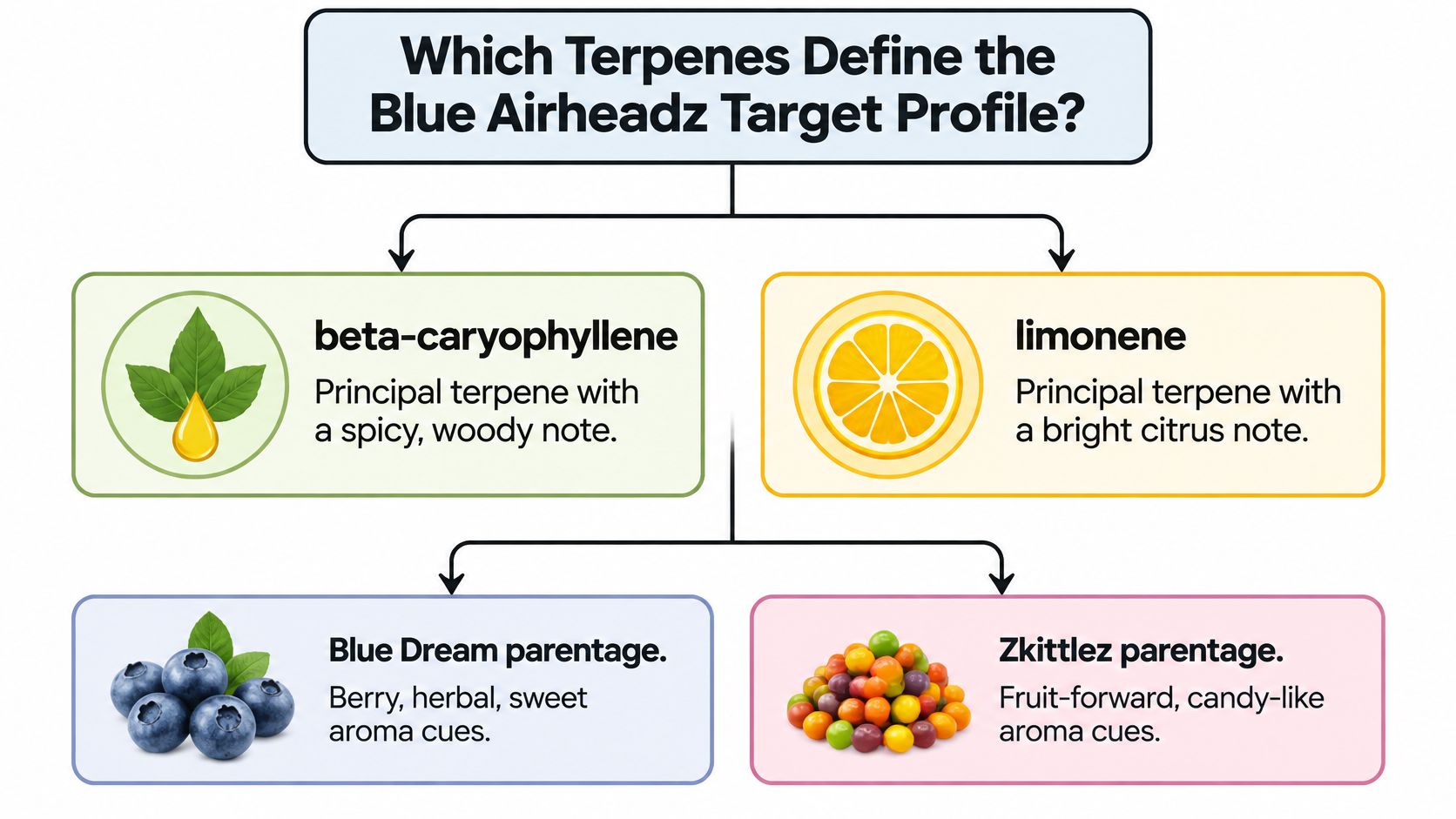
No published lab panel fixes a terpene order for Blue Airheadz, so the stack has to be inferred from the flavor description and confirmed against lot data. The target reads as berry, herbal, sweet, and confectionery, which points to a citrus-bright top over a peppery base rather than a single dominant compound. Gold Coast Terpenes sells SC Lab-tested, THC-free terpene blends across over 50 strains from the Indica, Sativa and Hybrid categories, which gives formulators a reproducible component base for testing that target.
The Crop King Seeds Blue Airheads listing identifies that version as Blue Dream × Zkittlez, with a reported THC range of 23% to 27% and low CBD. Blue Dream contributes berry and herbal traits, while Zkittlez contributes sweet, tropical, and confectionery characteristics. That four percentage point THC span is your warning. Phenotype, cultivation, harvest timing, curing, and laboratory method can move the result, so don't apply those values to every product sold under the name.
How the Notes Are Layered
Top notes set the first impression in headspace. Limonene carries the citrus brightness, and alpha-phellandrene can add a peppermint edge with a slight citrus tone. Both are volatile, so judge them after dilution and after heating, not only from the neat blend.
Mid notes carry fruit and herbal body through the middle of the puff. Myrcene supports that body, alpha-humulene contributes a hoppy aroma that rounds sweetness, and linalool can add soft floral lift. Base notes give persistence, and beta-caryophyllene is the anchor here with peppery warmth that remains later in use.
| Note position | Terpene | Sensory role in the target | Formulation handling |
|---|---|---|---|
| Top | Limonene | Citrus brightness and first-impression lift | Dominant fraction; monitor volatility loss over time |
| Top | Alpha-phellandrene | Peppermint edge with a citrus tone | Small share; volatile, so check after heating |
| Top to mid | Myrcene | Fruit and herbal body | Confirm share against each lot COA |
| Mid | Alpha-humulene | Hoppy aroma that rounds out sweetness | Add to balance the fruit notes |
| Mid | Linalool | Soft floral lift | Reference value only; verify per lot |
| Base | Beta-caryophyllene | Peppery warmth and persistence | Carries the profile after heating |
Treat every entry in that table as a candidate, not a confirmed share. Limonene and beta-caryophyllene fit the flavor description as lead compounds, and alpha-phellandrene, alpha-humulene, and linalool are supporting candidates for a strain-inspired terpene blend. None of them counts as native flower chemistry until a GC-MS report or supplier COA verifies the lot.
Practical rule: Start with two top notes, one or two mid notes, and one base note, then record the blend as sensory until GC-MS data confirms the shares.
I'd start narrow. A short target list is easier to correct after aerosol testing than a long list built to match a flavor description.
Why Does the Strain Name Not Prove a Repeatable Profile?
Blue Airheadz is a market label. It does not define chemistry. The name gives a sensory panel a direction to judge, while measured terpene fractions tell production what to reproduce.
Lineage notes can differ across breeder, seed, and retail descriptions, and similar genetics can still express different terpene shares after cultivation and extraction. A strain-specific profile from Gold Coast Terpenes provides a consistent formulation input, but the approved specification still has to come from lot data.
What Drives Drift
Terpene composition changes with cultivar identity, phenotype, harvest timing, curing, storage, oxygen exposure, temperature, and UV light. A published chemical analysis of cannabis samples in PMC reports significant time-dependent decreases for many terpenes, while p-cymene showed comparatively greater stability under UV exposure.
That pattern matters in inventory. Oil that meets its potency target can still lose aromatic intensity as volatile fractions decline, so an acceptable sensory result at intake does not guarantee the same result after storage.
Use amber, oxygen-limited packaging. Minimize heat and headspace. Record storage conditions on the batch record so a sensory miss can be traced to a likely cause instead of being blamed on the blend.
| Record field | Why it matters | Example entry |
|---|---|---|
| Lot number and extraction date | Ties the blend to one source batch | Lot ID and extraction date from the COA |
| Dominant terpene percentages | Sets the replicable target | Limonene and beta-caryophyllene shares from GC-MS |
| Total terpene concentration | Sets the loading ratio for distillate | Total terpene percentage from the lot COA |
| Total THC and minor cannabinoids | Confirms the potency basis | THC and minor cannabinoid values from the lot COA |
| Water activity or moisture | Flags drift risk in storage | Water activity or moisture result from the lot COA |
| Storage conditions | Explains profile loss over time | Amber, oxygen-limited packaging; cool storage; minimal headspace |
Build these specification fields before comparing catalog options. The strain terpene profiles archive is useful for selecting a profile direction, while the lot COA defines the chemistry of the oil in your tank.
Write the specification from GC-MS data on the actual batch. Without a batch-specific COA, claims about exact aroma, potency, or signature ratios aren't technically defensible.
I would not approve label copy, retailer sell sheets, or a production formula from the name Blue Airheadz strain alone. Use the name to brief the sensory panel. Use GC-MS data to lock the blend, and reserve approval until the batch result matches the target.
Does Blue Airheadz Flavor Come From the Plant or an Additive?
Flavor origin is a compliance question for cartridges. Label and document the product as a strain-inspired terpene blend unless the specific source lot has been chemically characterized and your labeling matches that source.
California's 2025 cannabis academic research grants announcement notes California funded a 2025 UCLA project to establish natural concentration ranges for cannabis flavor compounds and help regulators distinguish authentic plant flavors from prohibited additives. That is the direction of travel. Regulators and retailers will ask whether a flavor compound came from the plant, from other botanicals, or from a nature-identical ingredient, and they will expect records that match the label.
Botanical, Cannabis-Derived, and Nature-Identical Labels
A botanical label means the terpenes come from non-cannabis plant sources. Gold Coast Terpenes supplies 100% natural terpene blends, and the supplier declaration should state the sourcing category so your COA and label describe the same thing. A cannabis-derived label means the compounds were extracted from cannabis, which changes sourcing, chain of custody, and state handling expectations.
A nature-identical label means the molecule matches a naturally occurring compound but was produced synthetically. That changes disclosure again. Keep these categories separate in marketing copy, because the COA, supplier declaration, and finished product label have to tell the same story.
Independent lab comparisons have found gaps between labeled terpene content and measured content across cannabis product categories. Concentrates carry the same documentation burden as any other product form. Retain current, lot-specific laboratory records for every production run.
Disclosure Checklist
- Verify source and purity: Confirm identity and purity for each terpene input before blending.
- State the category clearly: Use strain-inspired language rather than identical to the plant.
- Document every blend ratio: Record shares, lot numbers, and dilution math.
- Test the finished oil: Input COAs alone do not clear the product.
- Link profile to production lot: Preserve records for each Blue Airheadz run.
- Avoid medical wording: Keep product copy free of implied outcomes.
Gold Coast Terpenes states its terpenes are THC-free and free of VG, PG, PEG, and MCT, which simplifies the ingredient side of disclosure. For background on category language, review the guide to strain-specific terpenes and flavor types before finalizing labels.
How Do You Build a Blue Airheadz Blend for Distillate?
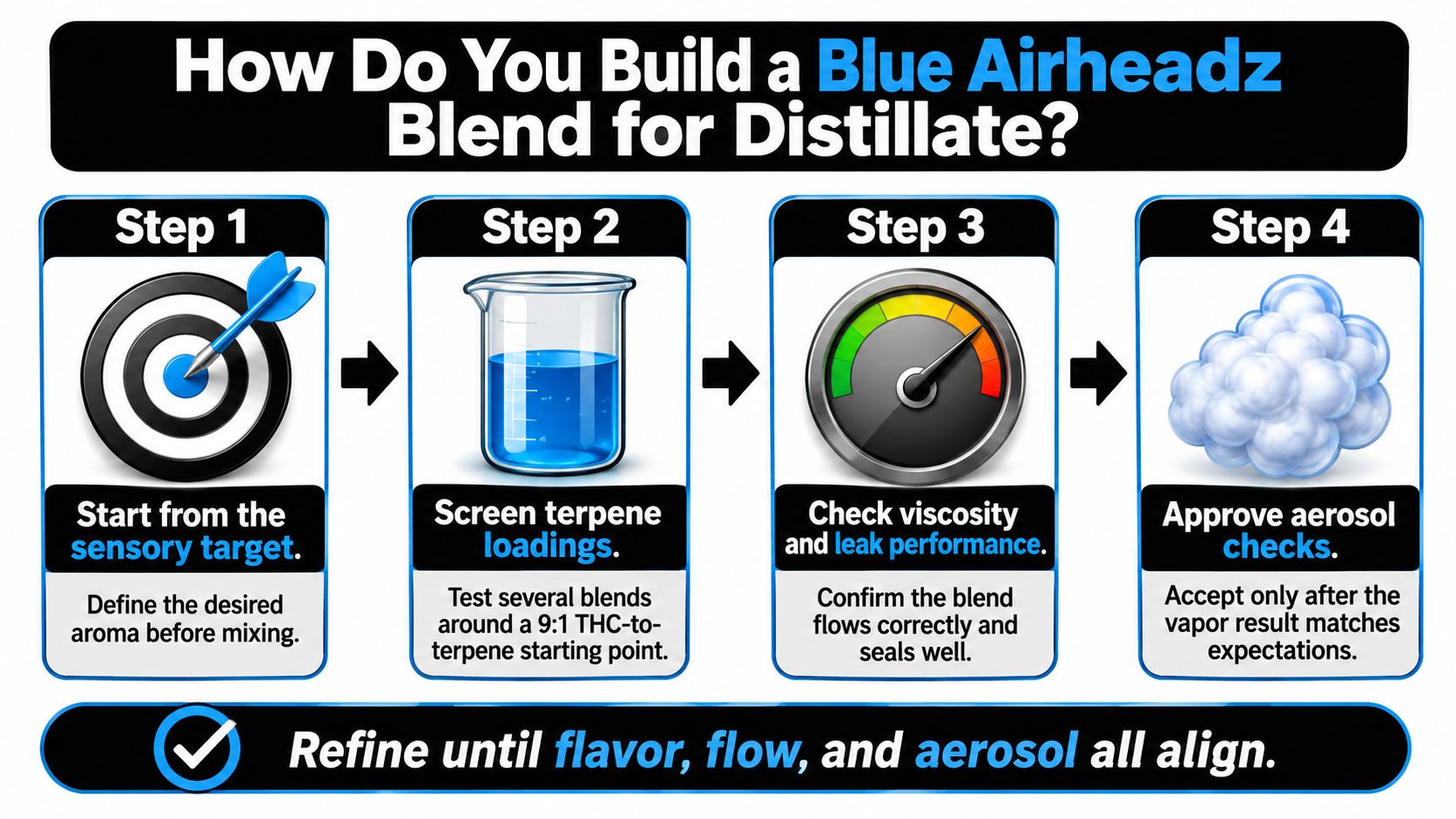
Build from the sensory target outward, screen several loadings around a 9:1 THC-to-terpene starting point, and approve only after viscosity, leak, and aerosol checks pass. The most aromatic bench blend often isn't the best production blend for distillate.
The build sequence below turns the opening terpene table into a testable formula.
Numbered Build Procedure
- Set the sensory target: Use the opening terpene table and define top, mid, and base roles before mixing. A common slip is writing flavor adjectives with no note positions.
- Pull the lot COA: Reproduce measured dominant terpenes rather than the strain name. Skipping this step locks supplier variation into your formula.
- Blend in note order: Add top notes, then mid notes, then the base note, recording each share. Adding too much top note first can skew the oil and make early puffs sharp.
- Screen three loadings: Start from 9:1 THC-to-terpene, about 10% terpene by weight, and bracket it. Check dilution math against that starting point using the lot COA.
- Measure viscosity: Test at controlled temperature and record fill temperature and settling. A blend judged only warm at the bench can fail at room temperature filling.
- Run leak and clog tests: Use the actual cartridge hardware, not a substitute device. Passing in a lab rig doesn't prove wicking in production hardware.
- Compare puff stages: Test first, middle, and end-of-life puffs, and record device power, coil temperature, and airflow. Missing those fields makes a flavor miss impossible to reproduce.
Watch the mixing demonstration before your first trial fill so your team uses the same handling sequence.
A cannabis-concentrate vaping study in PMC selected a 9:1 THC-to-terpene ratio because it produced material that was neither excessively viscous nor excessively fluid for vaporization. The same study reports overly high terpene ratios can make concentrate fluid enough to leak from a vape pen. Treat 9:1 as a research benchmark, not a universal prescription.
| Loading point | Expected behavior | Next action |
|---|---|---|
| 9:1 THC-to-terpene (about 10% terpene by weight) | Workable viscosity; neither too thick nor too fluid in the research model | Use as the first screen point |
| Higher terpene share | Fluid enough to leak from a vape pen | Run leak testing before raising top-note load |
| Lower terpene share | Thicker oil with weaker aroma | Check flavor retention after heating |
| Two loadings either side of target | Brackets the viscosity window; both must pass leak and sensory checks | Screen with GC data and a sensory panel |
For handling detail, use the guide on how to mix distillate with terpenes alongside your internal SOP. Approve a loading only when viscosity, leakage, and puff-by-puff sensory results all stay within target.
Why Does the Vape Aerosol Differ From the Cartridge Oil and How Do You Fix Flavor Drift
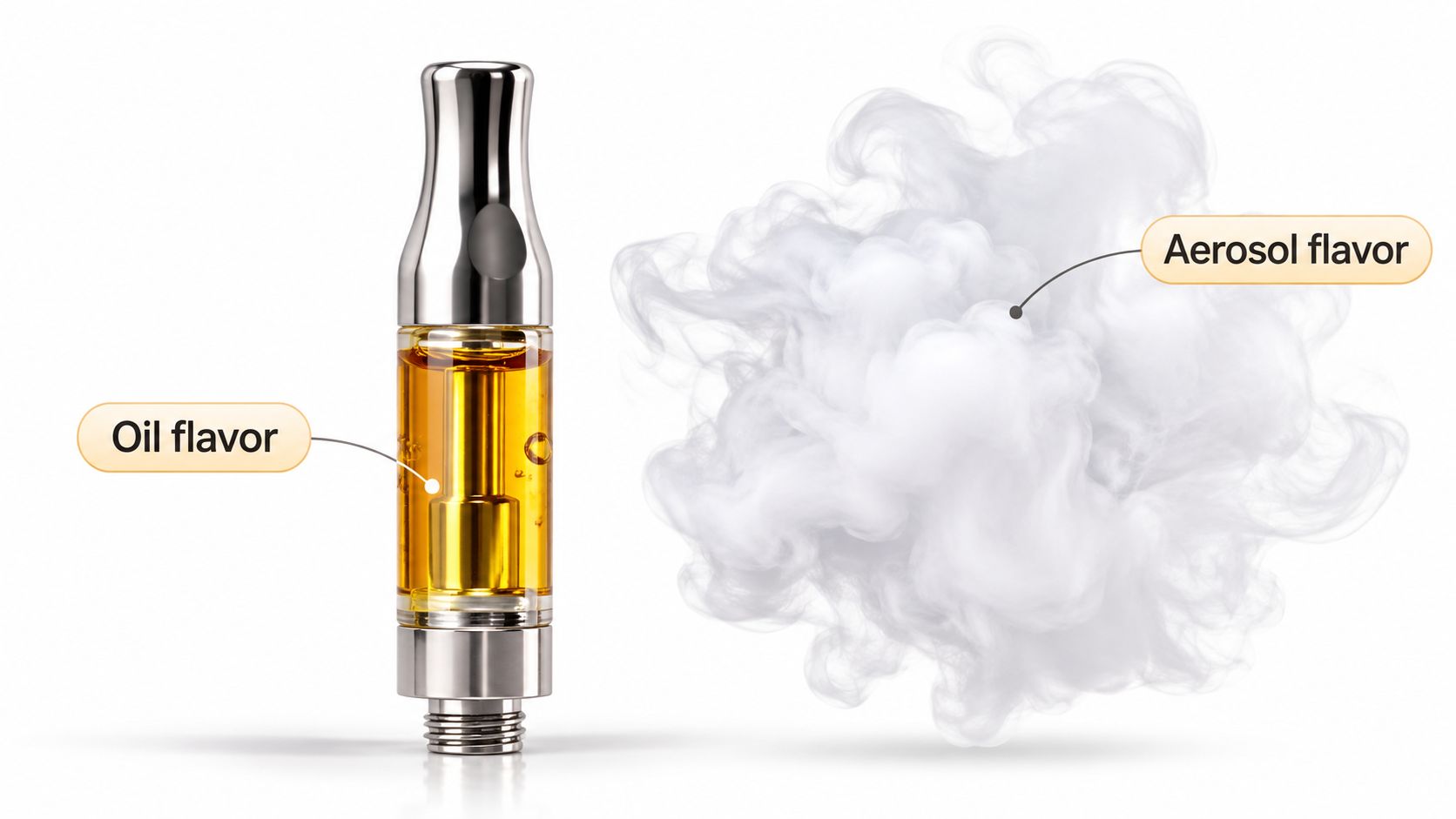
The Blue Airheadz flavor in the aerosol differs from the flavor in the oil because volatile compounds evaporate at different rates during heating. Type 1 to 4 cartridge formulations may contain approximately 10 to 20% terpenes by weight in the cannabis oil, corresponding to roughly 2,500 to 5,000 ppm total terpenes in the aerosol, according to a review of cannabis vaping systems in PMC.
That same review describes terpene-amended vacuum-distilled extract as particularly amenable to electronic-cigarette vaporization because neutral THC distillate remains a viscous liquid at room temperature. Treat those figures as a commercial boundary rather than your formula. Your strain-inspired terpene blend for vape cartridges still has to pass at its actual loading and device power.
The cartridge and vapor view below shows why liquid appearance can't stand in for aerosol performance.
Why Early Puffs Taste Different
Monoterpenes and monoterpenoids evaporate before substantial THC evaporation, so early puffs run disproportionately terpene-rich while later puffs show sensory depletion. Limonene-like citrus top notes dominate the initial headspace. Mid and base components determine persistence and perceived body.
Heat compounds the problem. Atomizer temperatures climb across sequential puffs, and a coil can run far hotter than its nominal setting once the wick begins to dry. That instability is why cartridge brands should test their own hardware directly, since a stable-looking oil can still deliver shifting chemistry on every puff.
Check Gold Coast Terpenes blends at the actual oil loading and device power you'll sell. A blotter test can't reveal evaporation order, coil heating, airflow effects, or wicking limits.
Test Sequence Before Approval
Start with a prefill oil GC reference. Record compound identity, relative percentages, total terpene concentration, fill temperature, and hardware identifiers. That reference becomes the denominator for every aerosol comparison.
Collect first-puff aerosol and judge top-note intensity, sharpness, and fruit accuracy. Then collect middle and later-puff aerosol and compare body, pepper persistence, and any flat or burnt character. Comparing all three samples on the same device separates flavor drift from evaporation loss and thermal degradation, and each cause calls for a different fix.
Use the resource on optimal vaping temperature to set test conditions your team can repeat. Record resistance, voltage, puff duration, and airflow for every run.
Symptoms, Causes, and Fixes
| Symptom | Likely cause | Fix |
|---|---|---|
| Flavor fades after a few puffs | Top-note heavy blend with volatile loss | Add mid and base notes; retest later puffs |
| Cartridge leaks | Terpene share too high for the oil | Reduce loading; retest viscosity and leak |
| Jar smells right, vape tastes flat | Liquid and aerosol profiles differ | Run puff-by-puff aerosol sampling |
| Fruit note too sharp | Excess volatile top note | Rebalance with a mid note; rescreen the loading |
| Batch-to-batch drift | Specification written from the strain name | Rewrite the spec from each lot COA |
Match the retest to the cause. Adding mid and base notes for fade needs a later-puff retest on the same hardware. Reducing loading for leaks needs viscosity and leak retesting, plus a sensory check since aroma will drop with the lower terpene share.
A sharp fruit note needs more than a single sniff test. Rebalance the top note, rescreen the loading, and repeat first-puff sampling until headspace intensity lands on target. Batch drift needs a full loading and hardware screen after you rewrite the spec from the new lot COA, because the target itself has changed.
Approval standard: Prefill oil, first-puff aerosol, and later-puff aerosol must all support the same Blue Airheadz target before production locks the formula.
I'd reject a blend that only passes in the jar. Replicating the flavor of Blue Airheadz means replicating the delivered aerosol, and that's where customers judge the product.
Confirm the Blue Airheadz Spec Before You Order
Lock the spec only when the target profile, lot COA, and aerosol results agree, then order the components needed to build it. Don't reverse that order to meet a launch date.
Order File Checklist
- Lot COA for each component: Record dominant terpene shares and lot numbers for every strain profile or isolate in the blend.
- Source class stated: The COA and label identify the blend as botanically derived.
- Sample run ordered: The 3ml Strain Picker Pack lets you select any three different terpene profiles from the catalog in 1.5ml or 3ml sizes, enough for screening before a bulk commitment.
- Terms confirmed: Minimum order quantities and wholesale pricing settled with the supplier, with bulk ordering available when a production run needs several strains at once.
- Spec linkage filed: Target shares, approved loading, hardware model, and test date tied to the COA lot numbers on the purchase record.
The order file shows the decision trail, not just a parts list. When a later batch drifts, that record is what tells you whether the incoming lot changed or your process did.
Gold Coast Terpenes offers isolates and terpene profiles that customers choose based on personal preference. Every strain ships highly concentrated and needs proper dilution before use, so the batch record has to carry a dilution step rather than treating the concentrate as ready to blend. The Elevated Strains line raises levels of certain rare and exotic terpenes to bring out fruity nuances, one example of how a fruit-forward profile is presented for formulation work.
Approve the Blue Airheadz spec only after test data agree. A purchase order isn't validation.
Frequently Asked Questions About Blue Airheadz Formulation
Is Blue Airheadz a Standardized Cultivar
It functions as a market label rather than a fixed cultivar, so the repeatable spec comes from the batch COA and your aerosol results, not the name. Treat Blue Airheadz as a sensory direction for cannabis product formulation and lock the chemistry at approval.
Does Gold Coast Terpenes Sell Terpenes Suitable for Vape Cartridges
The blends are THC-free, SC Lab-tested, and free of VG, PG, PEG, and MCT, with strain profiles and isolates built for cartridges and concentrates. Suitability for your oil still has to be proven in hardware, so qualify the profile on your own cartridge before release.
How Do You Screen Candidate Profiles Before a Run
Use the 3ml Strain Picker Pack, which lets you select any three different terpene profiles from the catalog in 1.5ml or 3ml sizes. Run each candidate at the same loading in the same cartridge hardware and choose by aerosol, not by bottle aroma.
How Do You Hold the Profile Steady Across Lots
New terpene strains are added each month, so treat a restock as a requalification trigger. When the new lot COA arrives, set it beside the approved lot and compare the dominant share and the next few lines. If the lead compound or the note order shifts, rerun the loading screen and a short aerosol check before filling.
What Does Bench Screening Cost Relative to Production
Strain products run from $15.00 to $2,999.00, so keep candidate work in the smallest format until the data pick a winner. A 1.5ml or 3ml screen costs far less than reclaiming a filled batch that drifted.
Screen candidates in small formats, qualify the winner on real hardware, and tie the released spec to the COA lot and the aerosol data. When you are ready to source components, visit Gold Coast Terpenes to select profiles for your next formulation run.