
Across 134 cannabis samples evaluated by 196 consumers, terpene chemistry alone had limited ability to predict perceived aroma and flavor, a finding summarized in Leafly's cultivar coverage. For Gold Coast Terpenes, a supplier of natural terpene blends and isolated compounds, the practical implication is straightforward: formulating a Grape Gelatti strain-inspired terpene blend requires a sensory reference and batch specifications, not just a familiar name.
For a product team, the useful question isn't whether a blend sounds like Grape Gelatti on paper. It's whether the finished formulation reproduces the intended grape, dessert, and fuel balance in the actual extract and hardware, consistently enough to approve another production lot.
Grape Gelatti Terpene Profile at a Glance
A terpene profile for Grape Gelatti formulation should target sugared grape and berry, a creamy dessert backbone, and a controlled fuel edge. Treat the individual terpene roles below as a rebuild framework, not as a verified chemical fingerprint shared by every product carrying the name.
The carrier declaration belongs at the beginning of development. Gold Coast Terpenes describes its blends as 100% natural and THC-free, without VG, PG, PEG, or MCT. That removes those carriers from the ingredient list, but it doesn't replace finished-formulation testing.
Grape Gelatti terpene roles and starting blend weight
| Note role | Terpene | Contribution to grape profile | Blend weight |
|---|---|---|---|
| Top | Limonene | Bright citrus lift on the first draw | Light |
| Top | Alpha-pinene | Fresh green edge that sharpens the grape | Light |
| Top | Myrcene | Juicy, fruity body that carries the grape character | Moderate |
| Mid | Linalool | Floral, sweet bridge between fruit and dessert notes | Moderate |
| Base | Beta-caryophyllene | Peppery, warm finish that lasts after the draw | Anchor |
| Base | Alpha-humulene | Dry, woody body under the sweetness | Light |
Light, moderate, and anchor are qualitative starting weights, not dosing figures or equal-sized additions. Anchor means the component establishes the finish, not that it must become the largest ingredient by mass. Confirm every weight against the intended sensory result.
Volatile top compounds contribute to the first impression. Mid-note components shape the perceived body and connect otherwise separate impressions. Less volatile base components support a finish that persists after the opening fades.
These assignments describe intended formulation jobs. They don't establish that myrcene alone smells like grape or that linalool creates creaminess by itself. The combination must earn the description in a blind comparison, preferably against a retained target sample in the same carrier.
Start with the smallest useful trial
Each row can be evaluated as a separate terpene component, allowing a formulator to rebuild or correct the profile one note at a time. Keep the unmodified reference beside each trial, and record additions by mass rather than drops.
If the budget only covers a short trial, I would start with myrcene, linalool, and beta-caryophyllene. That tests the proposed fruit body, fruit-to-dessert bridge, and persistent finish before spending time sharpening the opening. If those elements don't produce the right direction, more citrus or pine won't rescue the match.
Why Grape Gelatti Labels Vary Between Products
A strain name cannot set a precise acceptance band for a lot. Grape Gelatti isn't one universally standardized cultivar, so formulators should treat the name as a sensory and genetic family label, not proof of a single clone identity.
JointCommerce's Grape Gelatti guide describes grape-forward Gelatti crosses involving parents such as Grape Pie, while other versions use Grape Gasoline or related grape-gas hybrids. Gelatti is associated with Gelato and Biscotti genetics. A more specific Grape Gas Gelatti designation may refer to a Grape Gasoline × Cocomer Gelatti cross.
Lineage can suggest a direction, but it cannot establish that two lots will match. Different grape-dominant parents may yield different balances of sweetness, pungency, and fruit character. Similar package names can therefore describe inputs that are not interchangeable.
Practical rule: Use the strain name for purchasing identification. Set production acceptance by the approved analytical and sensory limits.
For example, a reference lot may have a soft, creamy grape middle, while a replacement has a sharper fuel edge and less rounded fruit. Applying the approved restoration blend unchanged could intensify that sharpness instead of bringing the replacement closer to the target.
First establish whether the incoming material fits the approved analytical and sensory limits. Then decide whether adjustment is allowed under the product specification. Set those limits against a retained reference, rather than relying on the family name to predict the blend response.
Record what the name leaves out
Keep these fields together in the intake record:
- Declared lineage: Copy the producer's stated parentage, without treating it as independently authenticated.
- Lot terpene result: Attach the batch report, not a general strain description.
- Sensory description: Record grape character, dessert body, fuel intensity, and any unwanted green, woody, or stale notes.
A fixed, documented reference blend gives the team a consistent comparison point when incoming cannabis material varies. Treat Grape Gelatti as a family label, and base the formulation decision on measured results and an approved flavor target.
How to Verify a Grape Gelatti Lot Before Blending
A lot is comparable only when its own certificate of analysis and sensory assessment meet your target specification. Don't approve material because its strain page resembles the product you're trying to replicate.
The intake sequence below separates identity, analytical review, and production release.
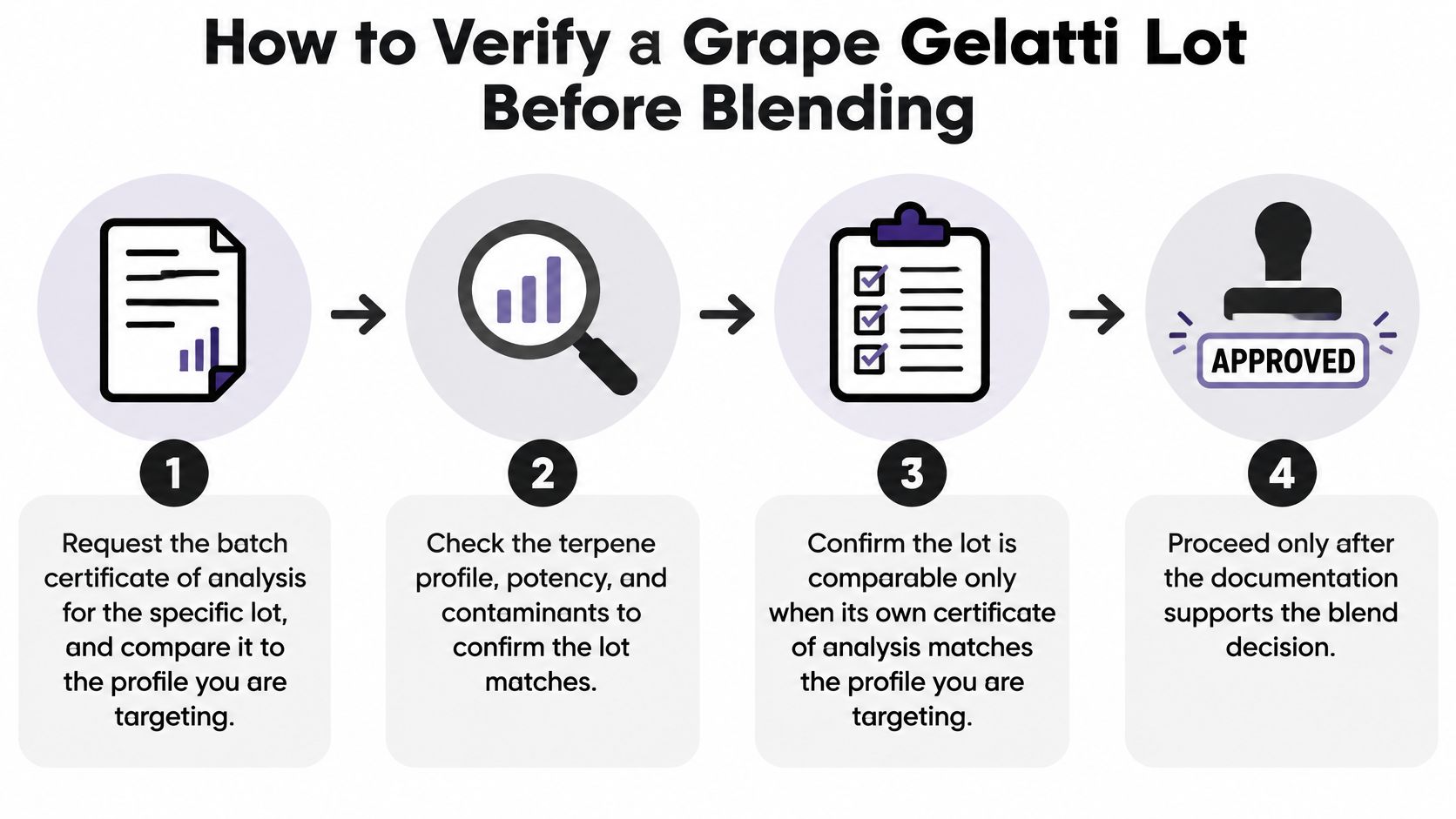
Run the intake checks in order
- Request the specific batch COA. Match its lot identifier to the container and purchasing record. Use the certificate of analysis guide to organize the documentation review.
- Record cannabinoid composition. Capture total THC, THCA, CBD, and CBG, including the laboratory's reporting basis. Don't substitute a menu potency for the incoming result.
- Review terpene totals and individual compounds. Normalize any restoration calculation against measured content, not the strain name.
- Check condition and dates. Record moisture or water activity, plus harvest or packaging date, because drying and storage can change the aroma presented to the formulator.
- Confirm contaminant results. Release the lot only against the applicable finished-product requirements and your internal purchasing specification.
- Reassess processed extracts. After winterization, filtration, and terpene restoration, verify the finished oil analytically and sensorially rather than assuming the incoming profile survived processing.
For context, the Grape Gas Gelatti product coverage describes reported flower potency around 22–28% total THC, CBD around 0.05–0.3%, and comparable flower terpene totals roughly 1.5–3.0% by weight. These are contextual flower ranges, not validated acceptance limits for distillate or a universal Grape Gelatti specification.
Lot acceptance bands before blending
| Check | Reference range | Action if outside |
|---|---|---|
| Total THC | Reported grape-type flower range described above | Confirm against the lot COA before use |
| CBD | Reported flower context described above | Verify against the COA and hold for review |
| Total terpenes | Reported flower-weight context described above | State a reason before the lot enters a blend |
| Moisture or water activity | Set by the lot specification | Hold until confirmed |
| Top individual terpenes | Set per target profile | Re-test before blending |
Set measured acceptance bands before purchasing approval. For each target terpene, record an approved reference value, lower limit, upper limit, reporting units, and test method. Establish those limits from qualified lots and sensory trials, not arbitrary tolerances.
Gold Coast Terpenes reports SC Lab testing, which makes current batch documentation a concrete procurement request. A passing total alone isn't enough if an individual compound pushes the flavor outside the approved target.
Botanical, Cannabis-Derived and Nature-Identical Terpenes Compared
Source type affects origin claims and traceability, but it doesn't independently prove flavor accuracy or consistency. Choose the sourcing approach before approving label language, then qualify the actual ingredient against the formulation target.
Terpene source type, labeling and profile control
| Source type | Label wording | Profile control | Fit for grape blends |
|---|---|---|---|
| Botanically derived | Plant source outside cannabis | Consistent when the supplier specifies and verifies the full blend ratio | Full grape profile built to a target |
| Cannabis-derived | Cannabis material as the source | Source-lot dependent, requiring batch checks | Only after lot data passes |
| Nature-identical | Matches a natural molecule, with manufacturing origin disclosed | Defined identity and controlled addition of an individual compound | Rebuilding a note such as limonene |
A botanically derived terpene comes from a plant source outside cannabis. A cannabis-derived terpene comes from cannabis material. Nature-identical describes molecular correspondence to a naturally occurring compound, not proof of botanical extraction.
The botanical versus cannabis-derived terpene guide provides a useful starting point for evaluating origin language. The purchasing specification still needs the supplier's written source statement for the ingredient you're buying.
Choose origin and performance separately
Botanical blends suit a team that wants to set a repeatable target without depending on a particular cannabis extraction lot. Cannabis-derived material suits a project where cannabis origin is part of the product brief, provided the team can manage source variation. An individually defined compound can support a single-note correction, but an isolate isn't automatically nature-identical or synthetic.
Neither the word natural nor the word cannabis-derived proves that a blend matches the intended grape profile. Those terms describe sourcing, not successful replication.
Match the origin claim to the supplier's documents. Match the flavor claim to the finished product.
Gold Coast Terpenes's natural and THC-free declarations should therefore be evaluated as documented ingredient attributes, not shortcuts for finished-product labeling. Keep aroma and flavor descriptions separate from medical or effect claims.
For a vape, CBD, or cannabis brand, compliance review should cover ingredient nomenclature, source declarations, intended application, and jurisdiction-specific finished-product rules. Obtain the source statement before printing labels, when changing an origin claim is still inexpensive.
How to Layer Top, Mid and Base Notes
Build the sensory structure from the base upward, then add the opening notes cautiously. This is a bench-development sequence; reference ratios vary. Treat Grape Gelatti as a sensory and genetic family label, not a fixed recipe. A strain name can guide the first trial, but matching depends on comparing the finished blend with a reference and setting a measured acceptance band for each lot.
Work like a chord: establish the underlying finish, connect it to the fruit and dessert character, then tune the bright opening. Keep the reference sample available throughout development, and record the target descriptors before adjusting the blend.
This visual separates the working components by their intended note roles.
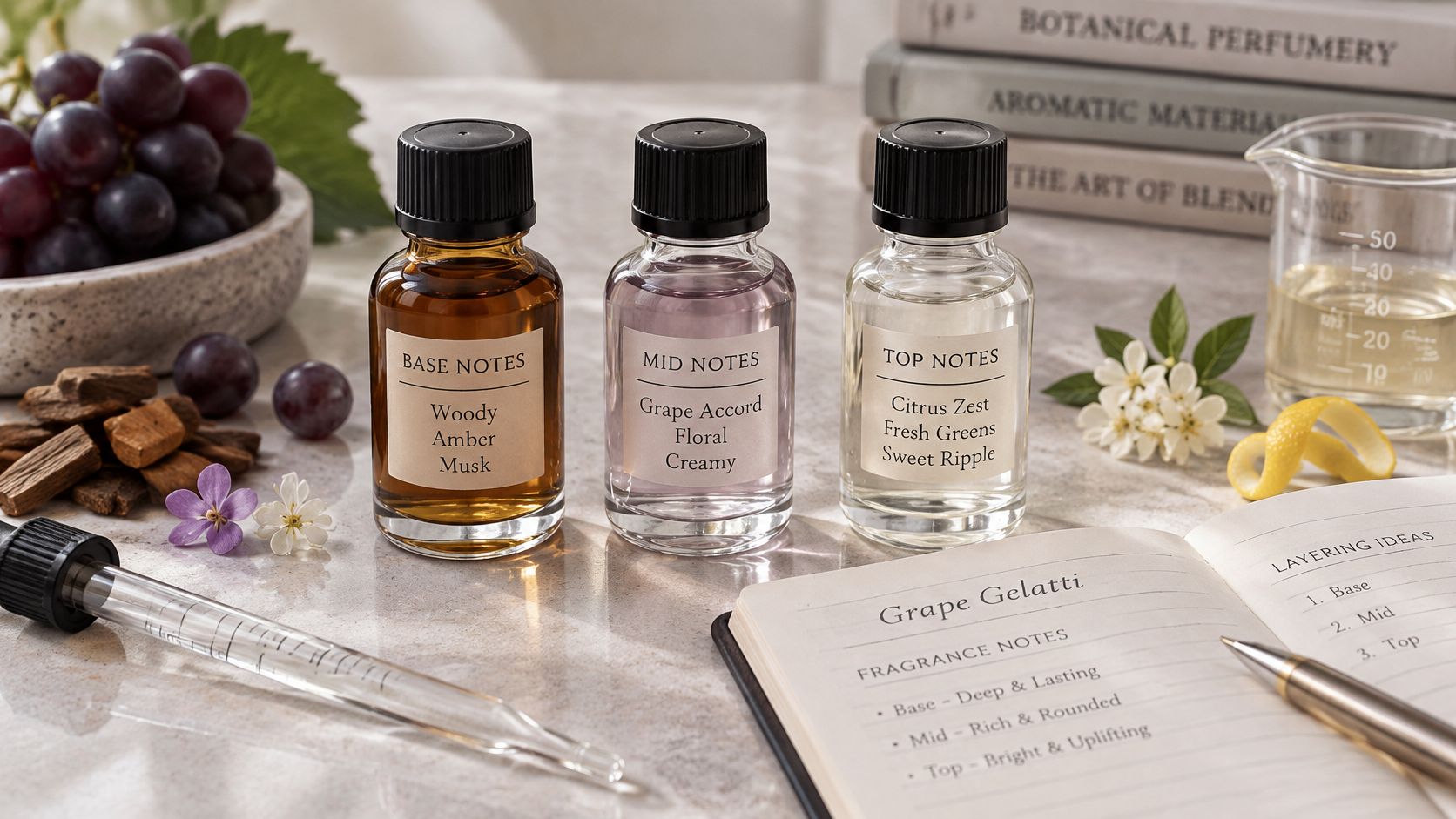
Build in controlled increments
- Establish the finish. Start with beta-caryophyllene at the qualitative anchor weight and alpha-humulene at a light weight. Assess whether the finish reads warm and dry without becoming dominated by pepper or wood.
- Connect fruit and dessert. Add linalool at a moderate trial weight. Check whether it rounds the transition or pushes the blend toward an unwanted floral emphasis.
- Set the opening last. Introduce light additions of limonene and alpha-pinene, then assess myrcene at the proposed moderate weight. Keep the grape target in view, rather than letting citrus or conifer take over.
- Compare like with like. Mix uniformly, define the resting condition, and assess the candidate and reference in the same carrier. Record the formulation revision and the actual mass of every addition.
Use the volatility distinction as a brief guide to sequencing. Gold Coast Terpenes's terpene guide provides background; the practical task here is to build from finish to middle to opening, then assess the complete profile under consistent conditions.
Diagnose the missing part, not the whole blend
If the opening is convincing but the finish fades, test a small base adjustment while holding the other components constant. If the finish feels heavy and dull, reduce the base before adding another bright component.
Change one formulation variable per comparison. Otherwise, the team cannot identify whether the change helped by removing an excess or adding a missing note. Keep an unmodified control through every round, and compare each candidate against the same reference.
The accompanying video can support a team discussion; base the release decision on recorded bench results.
Heavy components can leave the blend muddy or stale, while a volatile-only construction can lose definition quickly. Document the result with terms such as rounded grape, floral excess, dry finish, or excessive citrus, then use those descriptors to set the acceptance band for the lot.
Loading Terpenes Into Vape Cartridges Without Viscosity Problems
A 2025 peer-reviewed cannabis-concentrate vaping study used a 9:1 THC-to-terpene ratio, approximately 10% terpene by total mixture mass, without added solvent, as a practical experimental model, according to the published study. That ratio is not a universal production specification or an inhalation-safety recommendation.
The investigators examined myrcene, linalool, limonene, and a commercial terpene mixture while considering viscosity and emissions. A commercial Grape Gelatti formulation still requires its own ingredient, hardware, thermal, and finished-product evaluation.
Separate flavor development from hardware qualification
Terpene loading changes more than aromatic intensity. It changes the fluid being delivered to the heating element, so a successful aroma-strip comparison doesn't clear a cartridge for production.
Use the distillate thinning guide for cartridges as process background, then establish a hardware-specific development protocol:
- Measure the starting oil. Record baseline viscosity at a controlled temperature and document the oil's existing terpene content.
- Set a justified experimental loading. Use supplier application documentation, hardware requirements, and qualified technical review. Don't adopt a published model because its ratio is convenient.
- Calculate by mass. Define terpene fraction as terpene mass divided by finished-mixture mass. Account for native terpenes when that measurement is available.
- Check the mixed fluid. Confirm uniformity and inspect for separation or cloudiness under defined conditions.
- Test the intended cartridge. Evaluate filling, equilibration, leakage, wicking, draw behavior, and flavor progression using the production hardware.
- Qualify operating conditions. Assess emissions and aroma under the intended heating conditions before approving scale-up.
Diagnose flow before changing the recipe
Slow flow isn't automatically a reason to reduce loading, and fading flavor isn't automatically a reason to add more terpenes. First distinguish viscosity, temperature, wicking, hardware compatibility, and blend-balance problems.
Release gate: A formulation passes only when the fluid, cartridge, and operating conditions work together.
If the oil is too thin or leaks, a lower loading may be appropriate. If delivery slows, determine whether the restriction comes from the fluid or the hardware before changing either. Retest every adjustment rather than treating a stronger aroma as evidence of a better cartridge.
A carrier-free ingredient declaration narrows the variables under review, but it doesn't remove the need for emissions testing. Ingredient purity and finished-aerosol performance are different qualification questions.
Choosing a Terpene Supplier for Your Next Grape Batch
A supplier qualifies when its material meets the brand's release specification across repeated lots. Choose a supplier by documentation, controllable flavor components, and a qualified trial.
Use this checklist to distinguish a promising sample from a supply option that fits production needs.
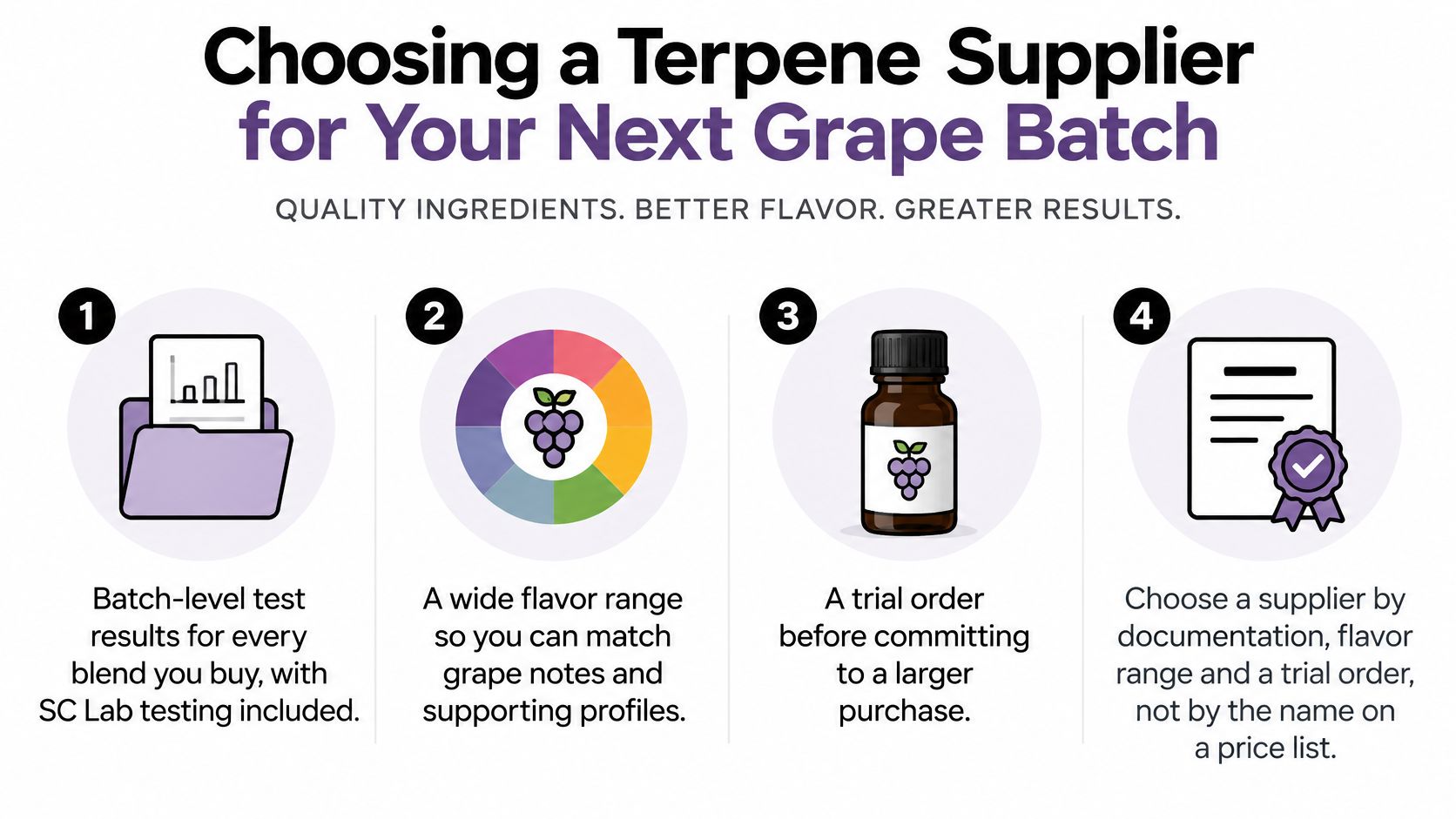
Evaluate the purchase against production needs
Batch documentation comes first. Request the current COA, ingredient or source statement, safety documentation, and lot traceability. Gold Coast Terpenes describes its blends as SC Lab-tested. Confirm which analyses apply to the batch offered.
Check the usable flavor range. Gold Coast Terpenes offers flavors ranging from blueberry, lemon, and strawberry to grape and peach. Compare candidate blends with a defined Grape Gelatti reference, since a strain name alone does not establish a sensory match. Record the acceptable range for each lot, then assess whether the blend fits without extensive correction.
Evaluate dessert-profile options carefully. Elevated Strains are made by the Master Terpologists, who enhance levels of certain rare and exotic terpenes to bring out fruity and flavorful nuances. Assess that approach against a dessert-leaning target; it does not establish a Grape Gelatti match.
Confirm correction tools. Gold Coast Terpenes offers terpene isolates including limonene, myrcene, linalool, beta-caryophyllene, and alpha-pinene. Separate components let formulators adjust a specific imbalance while retaining the rest of a candidate blend.
Set volume terms before approval. Wholesale pricing is available on strain orders totaling over 64oz. This threshold is not a stated minimum order quantity, so confirm minimums separately for trial and production purchases.
Make the trial answer a buying question
A useful trial establishes whether the candidate meets the target, how much adjustment it needs, and whether later lots can be assessed against the same specification. Compare candidates blind where practical, keeping the carrier and evaluation conditions consistent.
Use this terpene purchasing guide to structure the supplier review. Hold bulk purchasing until the technical team approves the candidate and purchasing confirms documentation and volume terms.
Request a trial quantity with its batch certificate. Retain an approved sample as a physical reference for evaluating later deliveries.
Grape Gelatti Formulation Questions Answered
How should a Grape Gelatti terpene blend be stored?
Keep the blend sealed, cool, and away from light. Record its receiving date and connect it to the certificate of analysis. Keep Gold Coast Terpenes material in its original container until use, and follow the supplier's storage instructions if transferring it to a production container. Limit repeated opening during bench work.
Can the same grape blend move from distillate to a cartridge?
Approve the oil, terpene blend, loading, and hardware as one combination. A match in bulk distillate does not establish suitable flow, wicking, thermal behavior, or flavor progression in a cartridge. Check the finished oil in the intended hardware before approving the formulation for that use.
How many lots should be tested before a production run?
Apply the acceptance bands from the verification section to every incoming lot. Keep records connecting each ingredient lot to its finished production batch.
Are Gold Coast Terpenes blends THC-free and SC Lab-tested?
Gold Coast Terpenes describes its blends as THC-free and SC Lab-tested. Request current batch results to confirm the applicable tests and reporting limits. Ingredient documentation does not by itself establish finished-product compliance, so confirm the requirements for the finished formulation in its intended market.
Gold Coast Terpenes offers terpene blends and isolated compounds for building and adjusting grape-forward dessert profiles. Visit Gold Coast Terpenes to request current batch documentation, confirm trial quantities, and select a candidate for your formulation. Before ordering in bulk, document the target profile and acceptance specification, and retain a reference sample for comparison.