
The common advice to add more sweet bubble-gum flavor is the wrong starting point for an Original Dubble Bubble formulation. Gold Coast Terpenes supplies 100% botanically derived, THC-free terpene blends, offering a botanical starting point for product development. Flavor accuracy still depends on a dated sensory specification, not just a familiar candy name.
For vape, CBD, and cannabis manufacturers, the target is a structured confectionery impression: cooling lift, restrained spice, and a rounded candy body. Translating that impression into an extract requires separate decisions about aroma, ingredient suitability, hardware, and labeling. Recognizing a flavor says nothing about whether a formulation is suitable for inhalation.
What Flavor Target and Reference Date Should a Terpene Profile for Original Dubble Bubble Copy?
Copy a dated confectionery sensory reference, not a cannabis cultivar or an assumed historical chemical formula. For an illustrative development program, begin with a 5% by-weight terpene trial in winterized distillate, subject to ingredient and hardware review, and establish the note map before selecting the blend.
Original Dubble Bubble strain-inspired note map
| Layer | Target impression | Botanical stand-in | Formulation role |
|---|---|---|---|
| Top | Sweet cooling, wintergreen-like mint | Limonene with a bright mint-adjacent fraction | First sniff and first inhale; fades fastest |
| Mid | Light cinnamon-like spice and candy floral | Linalool | Bridges sweetness into spice without harsh heat |
| Base | Chewy sweet body | Beta-caryophyllene | Warmth and persistence after the top note drops |
| Support | Round fruit-candy fullness | Myrcene | Softens citrus so the blend doesn't read as lemonade |
| Do not treat as a terpene | True wintergreen chemical identity | Methyl salicylate, if used at all, is a separate flavor compound | Requires its own inhalation and labeling review |
These are sensory stand-ins, not chemical equivalents. Limonene supplies bright lift, not wintergreen identity; linalool supplies floral softness, not cinnamon identity. Beta-caryophyllene contributes a warm, spicy impression, while myrcene can help round a blend that otherwise reads as citrus-heavy.
Methyl salicylate, the characteristic wintergreen flavor material, isn't a standard terpene isolate. Don't insert it into a terpene recipe merely because the historical target suggests wintergreen. Any proposed non-terpene ingredient needs its own identity, exposure, inhalation-suitability, and labeling assessment.
Fix the historical reference before matching flavor
The Frank H. Fleer historical account places commercialization in December 1928, describes an approximately 1,000-piece initial commercial test, and identifies wintergreen and a dash of cinnamon in the flavor history. By contrast, the Dubble Bubble historical overview describes a 100-piece local test.
Don't turn those conflicting accounts into a precise reconstruction claim. Record which account supports the development target, and describe the result as a historical sensory interpretation unless authenticated analytical evidence supports something stronger.
The Houston Home Journal history reports that production ended in 1942 and returned for the general public in 1951. That interruption provides a useful boundary for version control, but it doesn't establish exactly how the formula changed.
Use a clearly identified reference on the development sheet:
- Late-launch sensory interpretation: A reconstruction based on historical descriptions.
- Prewar commercial reference: A target supported by a documented period reference.
- Postwar commercial reference: A target based on a later commercial product.
Separate the sensory specification from the COA
A certificate of analysis documents the tested material and reported analytical results. It doesn't authenticate a historical candy recipe or establish sensory equivalence.
Keep the sensory brief, ingredient specification, and lot COA as separate, cross-referenced documents. Include the reference identity, supplier lot, blend revision, base oil, hardware, and assessor comments.
Practical rule: Match a documented sensory target. Don't claim to reproduce an unavailable historical formula.
Can the Dubble Bubble Name Go on a Label for Vape Cartridges?
Don't put Dubble Bubble, Fleer, or Tootsie on a vape, hemp, or cannabis label without appropriate authorization and legal review. These names identify confectionery businesses or products, not a cultivar or flavor identity that a formulator automatically owns.
Use an independently cleared descriptor such as classic bubble gum or pink bubble gum instead. A strain-inspired bubble-gum description is only useful when it doesn't falsely imply documented cultivar ancestry.
Candy-associated branding creates another practical problem: a buyer may interpret the cartridge as an authorized extension of the confectionery product. Avoid copying packaging colors, typography, mascots, or wrapper layouts that reinforce that impression. An internal historical reference doesn't justify consumer-facing brand imitation.
Distinguish component claims from cartridge claims
Gold Coast Terpenes describes its terpene components as THC-free, botanically derived, and formulated without VG, PG, PEG, or MCT. Those statements describe the supplied component, not every ingredient in the finished cartridge.
Build the finished-product disclosure review around:
- Cannabinoid content: Use the finished-product results and requirements applicable to the sales jurisdiction.
- Terpene percentage: If disclosed, define the basis and support the claim with formulation records.
- Terpene origin: Distinguish botanical material from cannabis-derived material.
- Other flavor ingredients: Identify non-terpene additives and determine the applicable disclosure requirements.
- Claim scope: Don't transfer a supplier's component claim to the entire cartridge without verification.
Not every jurisdiction requires identical label wording. Have the responsible compliance reviewer approve the actual market-specific label rather than treating this checklist as a universal legal template.
Keep confectionery claims out of inhalation copy
Sugar, dextrose, and corn syrup belong to the gum's food matrix, not to an inhalation formulation strategy. Describing a sweet aroma doesn't justify adding sugars or making sugar-free, dental-care, or medical comparisons.
Use supplier formulation resources and Terpenes 101 education to establish terminology, then have qualified reviewers assess the finished product. General education isn't a substitute for ingredient-specific documentation.
If a buyer could reasonably read the cartridge as a product from the gum brand, rewrite the name and redesign the presentation.
How Much Terpene Profile for Distillate Should a First Cartridge Trial Use?
For an illustrative bench screen, start at 5% terpenes by finished-blend weight and compare 3%, 5%, and 8% only where supplier documentation and hardware compatibility support those trials. These are proposed development levels, not established inhalation-safety limits or universal supplier recommendations.
Use the trial sequence below as a screening framework, not an automatic production release.
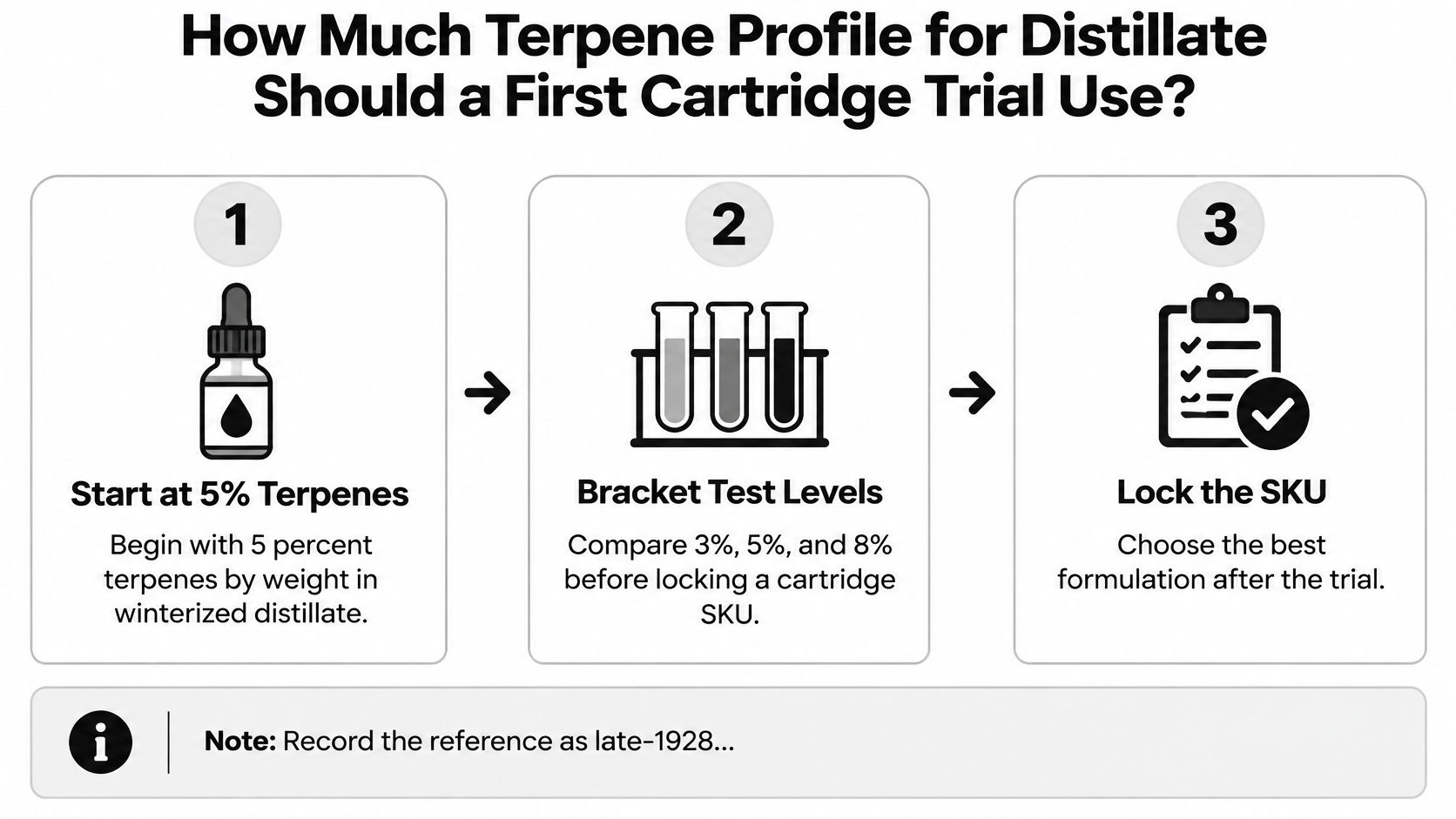
Run a controlled formulation screen
- Record the reference. Identify the dated bubble-gum sensory target and its documentary basis. Assign a blend revision before making samples.
- Prepare the oil. Warm the distillate only enough to achieve uniform mixing within its validated processing conditions. Keep the terpene container closed between additions to limit unnecessary volatile loss.
- Weigh the addition. Use a suitable balance and a documented botanical blend. Gold Coast Terpenes describes its components as lab-verified and free of the listed carrier glycols, but the actual lot documentation still belongs in the batch record.
- Mix and equilibrate. Confirm uniformity and evaluate after a consistent, documented rest. Don't compare a freshly mixed sample against a rested sample and attribute every difference to composition.
- Evaluate consistently. Assess opening aroma, then device performance through an approved evaluation protocol. Score cooling, spice, candy body, and irritation separately; don't continue exposure to investigate an irritating sample.
- Adjust the appropriate variable. Consider a higher screened load only when the profile remains balanced but weak. Reduce load or reformulate when cooling or cinnamon-like bite dominates rather than trying to cover it with more flavor.
Define percentage consistently. Finished-blend weight percentage means terpene mass divided by total finished-blend mass, not terpene mass divided by starting oil mass.
The terpenes-for-distillate formulation guidance can support the dosing workflow. A mixing calculator is useful for checking arithmetic, but mass-to-volume conversion requires the relevant material density; milliliters aren't interchangeable with grams.
Why the gum isn't a direct dosing model
The Tootsie Twist Gum ingredient disclosure lists sugar, dextrose, corn syrup, gum base, flavor, corn starch, and BHT. That sugar-based, elastomeric matrix delivers flavor differently from an aerosolized oil.
Gum base and coatings can restrain volatile release during chewing. A cartridge exposes the formulation to heating and aerosol formation, so matching the candy's apparent flavor strength doesn't establish an appropriate cartridge concentration.
Keep methyl salicylate outside this terpene dosing exercise. A familiar aroma doesn't supply the missing ingredient-specific inhalation assessment.
For supplementary process context, review the accompanying video.
What Load Starting Points Work for Vape Cartridges, Distillate, and Concentrates?
A single note map needs different evaluation loads for each format. Use this proposed comparison matrix to structure trials, not as a set of verified operating limits.
Load starting points by finished format
| Format | Start load by weight | Main risk | Pass check |
|---|---|---|---|
| 0.5–1 g vape cartridge | Illustrative 5% trial | Heating produces harsh mint or weakens the top note | Cooling present, spice behind it |
| Bulk distillate for later fill | Illustrative 5–8% screen | Sweetness reads thin after dilution | Candy body holds after rest |
| Concentrate or dab SKU | Illustrative 3–5% screen | Limonene reads sharp when heated | No solvent-like bite |
| Flavor reference only, not inhaled | Neat on a scent strip | Strip overstates top notes | Matches the note map, not a cart |
Test cartridges in the actual device configuration. Fill mass alone does not define heater behavior, wicking, or compatibility; a satisfactory aroma also does not establish acceptable emissions.
For bulk distillate, the final filling operation is a separate control point. Evaluate the oil after its intended handling and holding conditions, then confirm it in production hardware. Bulk aroma alone is not a sufficient basis for approval.
Use the right reference for each decision
A scent strip helps distinguish citrus, floral, spicy, and rounded notes without using the formulation. It can identify the aroma structure, while heated profile, irritation potential, and cartridge performance require separate evaluation.
The Kiddle history of Dubble Bubble describes the confection's central breakthrough as reduced stickiness combined with bubble-forming extensibility. Those properties are useful for understanding the original gum's texture and function, not for setting extract performance criteria.
Set acceptance criteria for the intended format:
- Cartridge: Assess compatibility, leakage, delivery consistency, sensory balance, and required analytical review.
- Bulk oil: Confirm homogeneity and profile retention through the actual production workflow.
- Concentrate: Evaluate under its intended use conditions; cartridge results do not establish concentrate performance.
- Scent reference: Check whether the aroma matches the note map.
For a separate dessert-oriented comparison, the Elevated Strains flavor page offers a catalog reference. It does not document a historical gum formula.
Botanical sourcing gives formulators control over a constructed flavor target, including its fuel notes. Choose by documented composition and sensory result, rather than by origin alone.
Why Does a Bubble Gum Cartridge Taste Wrong and What Should Change?
An overloaded cooling impression is the first problem to check when a bubble-gum cartridge tastes like mint rather than candy. Reduce the total load in a controlled comparison before adding more base material or another flavor compound.
Use a fault-specific correction rather than changing the entire recipe.
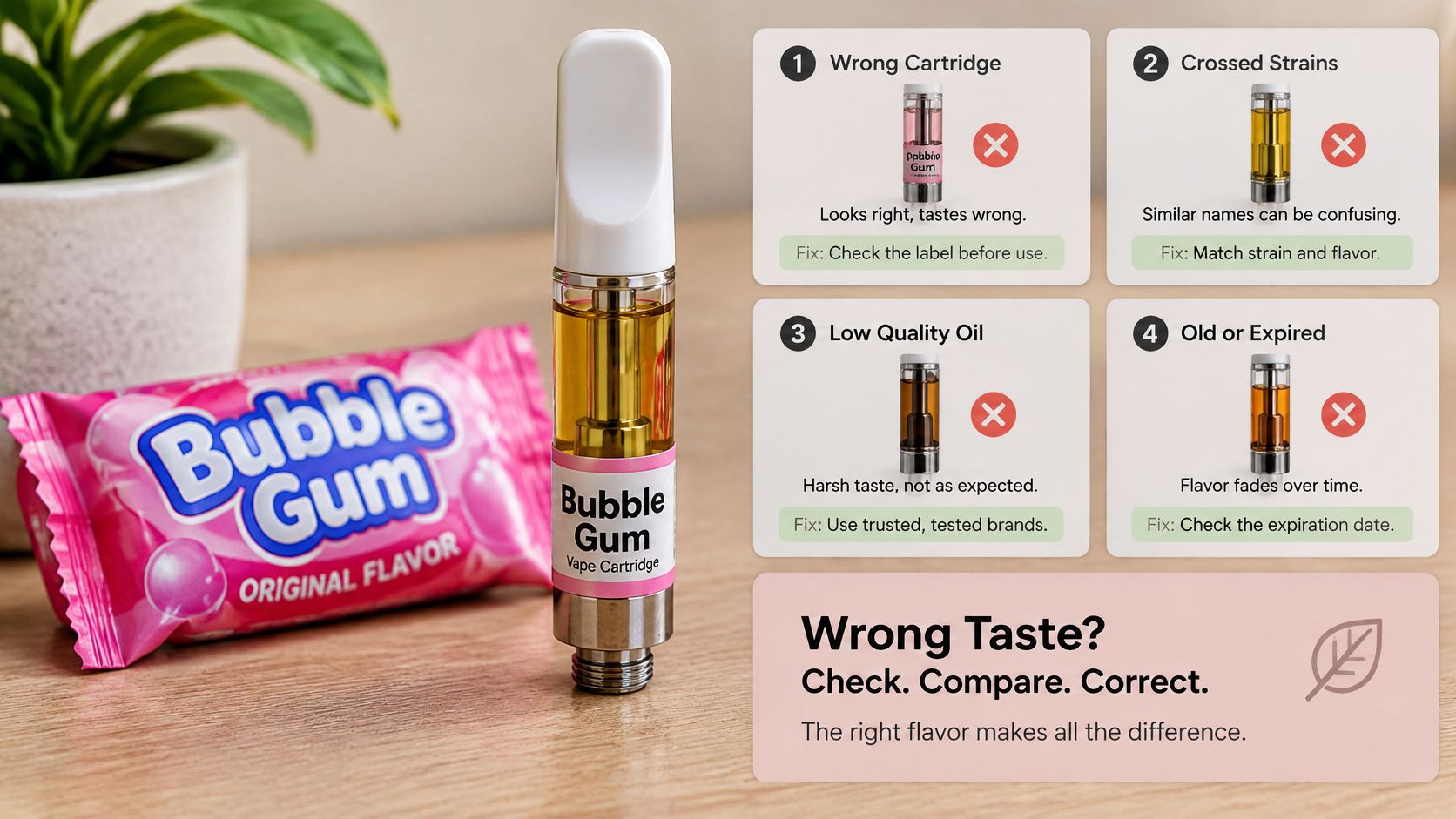
Diagnose the dominant fault
| Observed fault | Working diagnosis | Next controlled change |
|---|---|---|
| All mint, little candy body | Cooling fraction or total load is too prominent | Compare a lower total load |
| Perfume-floral character | Floral contribution masks the target | Reduce linalool contribution before evaluating added spice body |
| Gas or rubber impression | Raw-material profile, contamination, or device interaction | Quarantine and investigate; replace a mismatched lot |
| Sweet impression disappears immediately | Insufficient rounded body or excessive top-note contrast | Evaluate a restrained myrcene adjustment |
| Irritation or persistent harshness | Possible ingredient, concentration, or hardware problem | Stop exposure and investigate before further sensory testing |
These are diagnostic hypotheses, not analytical findings. A gas-like impression doesn't prove cannabis origin, and a botanical blend can deliberately contain fuel-like notes.
Gold Coast Terpenes states that its materials are botanically derived and SC Lab-tested. Those credentials help define supplier documentation, but they don't eliminate contamination, formulation error, or device-related causes.
Change one variable and preserve the evidence
Hold the oil, hardware, mixing process, and evaluation conditions constant while changing the chosen formulation variable. Label samples so assessors can compare them without seeing the expected result.
Use the sensory evaluation methods guide to support a repeatable scoring process. Record cooling, floral intensity, warm spice, rounded body, and off-notes separately instead of assigning only an overall preference score.
A stronger aroma isn't necessarily a closer match. Approve the sample only when assessors can distinguish the intended layers without one masking the others.
Retain the dated reference identity throughout troubleshooting. Otherwise, a panelist's memory of a later gum product can replace the actual development target.
How Do You Choose a Botanical Terpene Supplier for Vape Brands?
Compare suppliers across four practical criteria: origin documentation, analytical scope, labeling support, and order requirements. Then assess whether the profile suits the intended formulation. Flavor variety alone does not establish that a material is suitable for a particular product.
Botanical versus cannabis-derived terpene supplier criteria
| Criterion | Botanical blend (Gold Coast Terpenes) | Cannabis-derived lot | Buyer check |
|---|---|---|---|
| Origin | 100% botanically derived | Derived from cannabis material | Request an origin statement for each material |
| Harvest variation | Formulation-controlled; source-lot variation still requires management | Harvest-dependent composition possible | Ask for lot-to-lot data and how variation is managed |
| Fuel or gas notes | Profile-dependent, not excluded by origin | Possible in some lots | Compare the material in a controlled sensory trial |
| Lab documentation | Supplier states SC Lab-tested | Obtain the actual lot's test documentation | Review the scope of the COA for each lot |
| Minimum order quantity | Ask which quantities are available for the intended order | Ask for the minimum purchase quantity by lot | Request the MOQ and any applicable order tiers in writing |
| Sample size | Check the current trial-pack configuration | Request a sample quantity sufficient for comparison | Ask whether the sample and production material share specifications |
Gold Coast Terpenes supplies botanical terpene blends, strain-specific profiles, and isolated compounds. Its stated SC Lab-tested status describes the supplier's materials, while a buyer still needs to assess the documentation relevant to the ingredient and finished formulation.
Ask what the laboratory report actually covers
A COA is only as useful as its scope. Check the sample identity, lot number, test methods, reporting limits, and measured analytes. A terpene composition report does not, by itself, establish testing for residual solvents, contaminants, or aerosol emissions. Likewise, SC Lab-tested does not mean every possible hazard has been evaluated.
- Botanical versus nature-identical: Botanical describes sourcing. Nature-identical describes chemical identity and does not, on its own, establish botanical extraction.
- Blend versus isolate: Identify whether the purchase is a complete flavor profile, an individual compound, or a mixture that includes non-terpene flavor materials.
- Component versus finished product: Supplier documentation supports ingredient review. The manufacturer remains responsible for the actual formulation and device.
- Sample versus bulk: Ask whether specifications, documentation, and commercial terms remain consistent at production scale.
Resolve commercial terms before the pilot fill
Use the terpene company selection guide to structure a written purchasing checklist. Ask the supplier to state the minimum order quantity, bulk tiers, replacement terms, and how specification changes will be communicated. Record the answers before planning a pilot fill.
A successful small sample does not establish production readiness. Retain an approved reference sample, then compare the production lot with its documentation and the accepted sensory specification.
For a confectionery target, botanical blending allows the formulator to construct the intended note balance. Cannabis-derived material may suit a different project. Cultivar authenticity and confectionery accuracy are distinct purchasing objectives, so choose the material category according to the profile being developed.
Which Pack Should a First Bench Run Order and What Do Buyers Ask?
Start with a small botanical trial, then check the flavor in the intended formulation before ordering for a production run. Gold Coast Terpenes' 3ml Strain Picker Pack currently costs $40.00, down from $45.00. The Tropic Pack costs $40 for 3ml per strain, 9ml total. The terpene sample pack guide describes the sample-pack options.
Available packages include Gold Pack, Coast Pack, Tropic Pack, Dessert Pack, Pack Pack, and 3ml Strain Picker Pack. Popular profiles include Blackberry Kush, Forbidden Fruit, Piña Colada, Pink Lemonade, Rainbow Sherbet, and Vanilla Root Beer. Use these names to shortlist comparison options, then confirm the match in a sensory trial. A confectionery reference may call for a different balance of top, middle, and sweet notes than a strain profile provides.
Free U.S. shipping applies to orders over $100. Bulk pricing and shipping concern terpene purchases, not a finished cartridge. Confirm current minimum order quantities and bulk terms before the production review.
Buyer FAQs
How should a team compare candidate profiles?
Evaluate each sample in the intended formulation, using the same conditions and a written sensory target. Record which notes lead, which persist, and where the profile departs from the dated confectionery reference. This keeps the comparison focused on the target rather than the product name.
What should accompany the approved profile at SKU review?
File the dated sensory specification with the lot COA, approved formulation revision, and hardware evaluation record. Keep those records together so the selected sample and the reviewed production formulation can be compared consistently.
Gold Coast Terpenes supplies botanical terpene components for developing flavor profiles in extracts and cartridges. Select a small trial, review the relevant documentation, and assess the bubble-gum interpretation against the sensory specification before scaling.