
Blueberry Cookies is a sensory brief, not a formula. A strain name cannot specify a terpene ratio, a cartridge's loading limit, or how the aroma will hold after filling and storage. Gold Coast Terpenes supplies 100% natural, THC-free terpene blends, but the name alone does not define the profile a formulator should order.
Start with a written target: describe the berry, bakery, and supporting notes you want, then translate those into measurable blend specifications. Set a loading benchmark for the distillate and use batch data to check whether the finished blend matches the target after storage. A strain description can suggest a direction; it cannot replace a specification.
What Terpene Profile Does a Blueberry Cookies-Style Blend Target?
A Blueberry Cookies-style blend aims for bright berry and citrus at the top, sweet floral notes in the middle, and a bakery-like, earthy base. A practical starting palette is myrcene, limonene, beta-caryophyllene, linalool, and humulene. Gold Coast Terpenes offers strain-specific profiles and isolated compounds, but the strain name alone does not specify their proportions.
Blueberry Cookies-style terpene profile by note position
| Terpene | Note position | Sensory cue | Formulation watch point |
|---|---|---|---|
| Myrcene | Base | Ripe berry, earthy fruit | Use as a backbone; balance it against brighter notes |
| Limonene | Top | Bright citrus lift | Volatile; can fade with heat and light |
| Beta-Caryophyllene | Base | Peppery, warm spice | Supports the bakery note |
| Linalool | Mid | Sweet floral lift | Check whether the note remains balanced after storage |
| Humulene | Base | Woody, hoppy edge | Keep restrained so it does not dominate |
Why the Name Doesn't Set the Target
Coverage commonly describes Blueberry Cookies as a Blueberry Tahoe × Thin Mint GSC cross, while other versions are described as Blueberry × Girl Scout Cookies or as different breeder selections. The name does not identify one standardized profile. The AskGrowers Blueberry Cookies strain review reports THC ranges from about 15–18% in one review to approximately 20–30% in another, while breeder material lists 18% THC and 0.1% CBD. Flower THC can vary between batches, so those figures do not define a terpene specification.
The breeder description can still inform the sensory brief. A Dinafem breeder account describes Blueberry Cookies as a cross between Blueberry and Girl Scout Cookies, selected to add sweeter, fruitier aromas to the Cookies family's earthy, Kush-like profile. Those descriptors suggest a direction, not a fixed recipe.
How Each Layer Earns Its Place
Myrcene provides the earthy-fruit foundation. Too much can blur the distinction between berry and earth; too little may leave the brighter notes without enough depth.
Limonene supplies the first citrus impression. Because it is volatile, a blend that relies on a strong opening may lose its balance as the aroma changes during handling and storage.
- Beta-caryophyllene supports the base: Its peppery warmth can connect the earthy and bakery-like cues.
- Linalool fills the middle: Its sweet floral note can bridge fruit and spice. Check the blend's sensory balance after storage rather than assuming the initial impression will hold.
- Humulene adds a restrained woody edge: Alpha humulene contributes to cannabis's hoppy aroma. Too much can pull a dessert brief toward a more herbal profile.
Keep beta-pinene low if the target is sweet berry and bakery. Its familiar cannabis odor is often associated with pine and turpentine, notes that can distract from the brief unless a sharper forest edge is intended.
A blend with prominent limonene and too little caryophyllene may smell bright at first, then seem thin as its top note fades. The base needs enough weight to keep the profile coherent.
A test lot can smell convincing when fresh, yet lose its berry lift during storage and leave the cookie note unsupported. That is why the target should describe how the layers relate, rather than list desirable aromas.
Compare berry candidates against the blueberry terpene profile guide and record which measured compounds correspond to each sensory cue. Use batch data to check whether the blend matches that profile.
How Much Terpene Can a Vape Cartridge Blend Carry?
Start development at 10% terpene in distillate, a 9:1 mix, and treat anything above that as a leak risk until your hardware proves otherwise. That benchmark comes from cartridge research, not from flavor preference, and it's the right anchor for a strain-inspired terpene blend for vape cartridges.
Terpene loading in distillate for cartridge development
| Terpene loading | Viscosity and fill behavior | Development use |
|---|---|---|
| 10% terpene in distillate (9:1) | Balanced for vaporization | Starting benchmark for flavor and fill tests |
| Above 10% terpene | Too fluid; can leak from a pen | Only with leak and fill testing |
| Below 10% terpene | Not established; test before use | Test flavor retention and hardware compatibility |
What the 9 to 1 Benchmark Actually Proves
Cannabis-concentrate vaping research used a 9:1 THC-to-terpene mixture without additional solvent, and the cannabis-concentrate vaping study in PMC reported that the ratio balanced viscosity for vaporization, while higher terpene proportions produced material that became too fluid and could leak from a vape pen. The study also examined myrcene, linalool, limonene, and a commercial terpene mixture, which makes it directly relevant to this profile.
That doesn't mean 10% is your final specification. It means 10% is a controlled starting point where the oil still behaves like a cartridge oil. Move down from there to test flavor retention, and move up only if you have a specific reason and the fill data to support it.
Loading Changes More Than Aroma
Terpene share shifts viscosity, fill behavior, leak risk, and aerosol-generation conditions. A formulator who raises the dose to fix a weak berry note is also thinning the oil, changing how it wicks, and changing how it aerosolizes. More terpene doesn't create a more accurate strain profile. It creates a different physical product.
I would correct a weak note by adjusting the ratio inside the blend first. Raise the responsible layer, hold total loading constant, and rerun the fill test. That isolates the variable you're trying to change.
- Ceramic resistance changes delivery: The same oil can run hot in one core and muted in another.
- Airflow changes perception: A tighter draw concentrates vapor and can make a balanced blend read harsh.
- Temperature changes loss: Hotter hardware drives off top notes faster during use.
- Distillate composition changes viscosity: A thinner starting oil reaches the leak point at a lower terpene share.
Practical rule: Lock total loading during ratio work. Change one variable at a time or you won't know what fixed the problem.
Gold Coast Terpenes blends are free of VG, PG, PEG, and MCT, so viscosity changes in your test lots come from the terpene and distillate rather than added carriers. Confirm that carrier-free status on each batch document before it appears on a label, because it's a supplier claim and not a property of the research. Use the distillate terpene dosing guide to calculate test lots, then confirm the number on your own hardware with a filled, rested, and inverted leak check.
How Do You Choose a Terpene Supplier for a Blueberry Cookies Blend?
Treat “Blueberry Cookies” as a sensory brief, not a guaranteed chemical profile. Select a supplier that can document the specific lot, disclose its ingredients, and provide data relevant to how the profile changes during storage. A strain name alone cannot establish what is in the bottle.
Supplier criteria for a Blueberry Cookies blend
| Criterion | What to verify | Why it matters |
|---|---|---|
| Batch GC-MS report | Individual terpene values for each lot | Strain name does not fix aroma |
| Source statement | Stated source and whether the profile is cannabis-derived | Supports accurate product and compliance records |
| Carrier content | Presence or absence of VG, PG, PEG or MCT | Carriers affect viscosity and flavor |
| Aging data | GC-MS or sensory results after storage | Shows whether the profile changes over time |
| Order terms | Minimum order and bulk tiers | Confirm terms before committing to a larger order |
Batch Data Beats Strain Data
Commercial products with the same strain name can differ by product type and batch. A 2025 Raw Garden certificate for a 1-gram Blueberry Cookies cartridge reported 93.35% total cannabinoids, including 87.756% total THC, 0.198% total CBD, 3.684% total CBG, and 0.45% total THCV. That certificate describes a cartridge, so its figures are not directly comparable with historical flower medians of approximately 17.6% THC.
The practical point is that a shared name does not ensure a shared composition. Ask for lot-specific data, then compare the measured profile with the sensory target you have written.
Botanical, Cannabis-Derived, and Nature-Identical
Check the stated source and supporting lot documents before making a sourcing claim. Botanical terpenes come from plant material; cannabis-derived terpenes come from cannabis. Nature-identical terpenes are chemically matched but made synthetically. Source can affect labeling requirements, cost, and supply consistency.
Gold Coast Terpenes describes its blends as 100% natural, lab-verified, and THC-free. Check the source statement on each batch document against the lot record, and keep the documentation with that lot.
- Individual values, not totals: Request separate readings for myrcene, limonene, caryophyllene, linalool, and humulene.
- Carrier disclosure in writing: Confirm whether VG, PG, PEG, or MCT is present before comparing viscosity or flavor.
- Aging results, not just fresh results: Ask for storage data as well as the initial profile.
For a fair comparison, assess both suppliers against the same written brief, loading, and storage conditions. Fresh samples may seem similar while their profiles change differently over time. Review the terpene company overview and confirm minimum order and bulk terms before selecting a profile you may need to reorder.
How Do You Build and Verify a Blueberry Cookies Blend Step by Step?
Build the blend in seven steps, from written brief to bulk order, and verify each test lot before it scales. Skipping the verification steps is how a blend that smelled right in a beaker becomes a returns problem in finished cartridges.
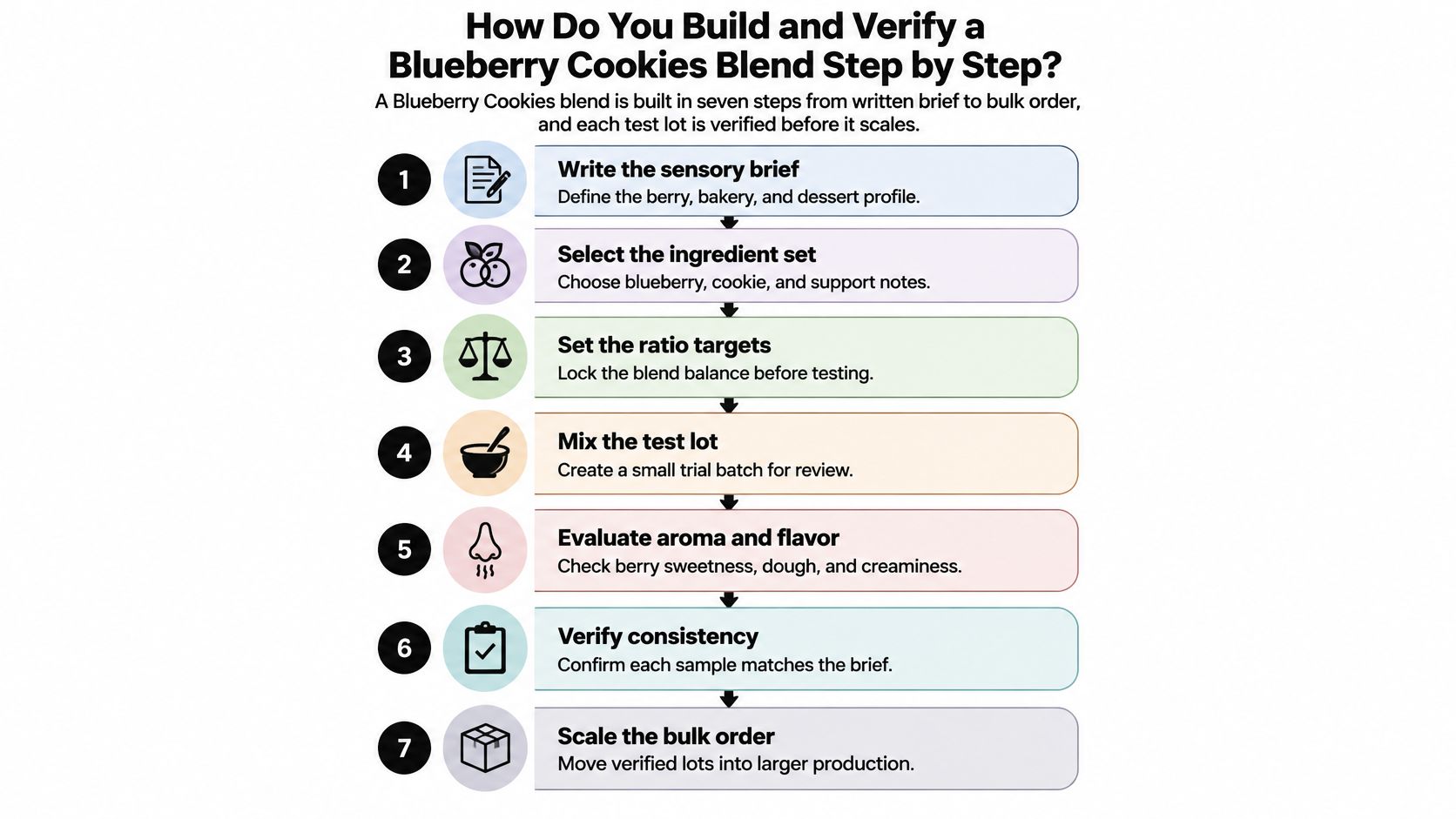
Steps 1 to 3 Set the Target
- Write the sensory brief. Score berry, bakery, earth, and a mint or nut edge separately, with a target intensity for each. The common slip is writing "sweet blueberry cookie" and calling it a brief. That's a mood, not a target a panel can score against.
- Order two or three candidate profiles with batch GC-MS. Choose by measured terpenes rather than by name alone. Gold Coast Terpenes offers 50+ strains from the Indica, Sativa and Hybrid categories, so order adjacent berry and dessert profiles alongside the Blueberry Cookies candidate and compare them blind. The slip here is sampling one bottle and building the whole SKU around it.
- Set the ratio with the base as the largest share. Keep the top note small. Limonene added first tends to overshoot because it's the loudest compound in a fresh sample, so build the base, add the mid, and finish with the top.
Steps 4 to 6 Prove the Blend
- Dose the test lot in distillate at 10% terpene. Mix at low heat with small headspace, because heat drives off the top note first. Warm the distillate only enough to move it, add the blend, mix until uniform, and cap it. Holding a warm, open vessel while you prepare hardware is where a lot of top note leaves.
- Run GC-MS on a pre-fill sample and a post-storage sample. Track individual compounds rather than total terpene percentage. A stable total can hide limonene dropping while heavier compounds hold. Keep both reports with the lot record so you can show what changed and when, and check what a complete document set looks like in the COA certificate of analysis guide.
- Run a sensory panel against the brief. Score each layer separately and adjust one layer at a time, so every change has a traceable cause. If berry reads low and earth reads high, fix one, refill, and rescore. Adjusting both at once gives you a new blend and no explanation for it.
If your team needs the fundamentals before ratio work, start with Terpenes 101 and use the Mixing Calculator for test-lot dosing rather than scaling by eye. Small arithmetic errors at test scale become expensive ones at fill scale.
The pass test is simple. The finished oil matches the brief at fill and after storage, and the batch record shows it.
Step 7 Scales Only What Passed
- Move to bulk only when the test lot matches the brief. Get minimum order and bulk tier terms in writing first. Wholesale pricing is available on strain orders totaling over 64oz, and customers can order multiple strains at one time through bulk ordering, which lets you bring in the approved Blueberry Cookies profile with the adjacent profiles you tested against it.
Don't scale a blend you approved on fresh aroma. Approve the aged sample, in your hardware, at your loading, against the written brief. That's the product your customer will open.
Why Do Blueberry Cookies Notes Fade After Filling?
Notes fade because terpenes evaporate, oxidize, and thermally transform at different rates, so the blend you filled isn't the blend that reaches the customer. The limonene top note degrades first and should be tracked separately from the heavier myrcene and caryophyllene.
Blueberry Cookies blend symptoms, causes and fixes
| Symptom | Likely cause | Fix |
|---|---|---|
| Flavor fades within weeks | Top-note loss from heat, light or air | Low-oxygen fill; cool, dark storage |
| Berry note turns flat or stale | Oxidation of fruit and base layers | Compare aged GC-MS with fresh batch |
| Cookie notes muted | Base share too low or diluted | Raise base-note share and re-test |
| Oil thin and leaks in hardware | Terpene loading above 10% | Reduce loading and re-test fill |
| Earthy edge grows over time | Redistribution among compounds | Set specs on individual terpenes, not total percentage |
The Mechanism Behind the Fade
A recent stability review identifies cultivar, drying, extraction, oxygen, light, temperature, moisture, and particle size as factors that redirect volatile profiles, and the Springer stability review on cannabis volatiles notes that vapor exposure can degrade terpenes and cannabinoids depending on time and temperature. The same review puts a cited Blueberry Cookies batch at approximately 4.4% total terpenoids, which works as an analytical benchmark, not a universal dosing recommendation.
Adding a nominal percentage to distillate doesn't guarantee that aroma survives. Heat during mixing, headspace in the tank, oxygen during filling, and light on a retail shelf each remove or transform compounds at different rates. The blend doesn't get uniformly weaker. It gets unbalanced.
Controls That Actually Slow the Loss
- Low-oxygen handling: Cap vessels between steps and minimize the time finished oil sits open.
- Minimal heat and headspace: Warm only enough to mix and fill, and size the vessel to the lot so you're not storing oil under a large air gap.
- Cool, light-protected storage: Store finished oils cool and away from light, and avoid long warm holds between mixing and filling.
- Pre-fill versus post-storage GC: Compare both results compound by compound before you release the lot.
Watch for aging markers in the aged report, not just losses. When a fresh, bright profile turns flat and slightly earthy, the top has usually dropped and the base share has effectively risen, even though nobody added base compounds. That's redistribution, and a total terpene percentage will hide it.
I would write storage limits into the formulation specification rather than leave them to logistics. Name the maximum hold temperature, the maximum hold time between mixing and filling, the headspace limit, and the individual terpene ranges the aged oil must still meet. If those limits aren't in the spec, the warehouse decides your flavor for you.
What Labeling and Compliance Rules Apply to a Blueberry Cookies Cartridge?
Your label is accurate only when the source statement, the carrier list, and the batch documents support every claim on it. Check all three before the product name goes on a pack, because artwork is expensive to reprint and a retailer audit won't accept a strain name as evidence.
Match Each Claim to a Document
Describe the terpene source as botanical or nature-identical only when the supplier's documents support that exact wording. Those terms aren't interchangeable, and swapping one for the other in marketing copy creates a labeling problem you didn't need.
List every carrier in the formulation, including VG, PG, PEG, MCT, or none, on the spec sheet. The carrier list drives both viscosity and the ingredient declaration, so an incomplete carrier list is a formulation error and a compliance error at the same time.
- Source claim: Supported by the supplier source statement for that lot.
- Carrier claim: Supported by the batch document listing carriers present or absent.
- Profile claim: Supported by the batch GC-MS report showing individual terpene values.
- Stability claim: Supported by aging data comparing fresh and stored samples.
Use the Name as a Descriptor, Not a Promise
Use Blueberry Cookies only as a sensory descriptor in marketing, and only when the batch profile matches the brief you approved. If the aged oil no longer reads as berry and bakery, the name on the pack is describing a product you aren't shipping.
Avoid any health or effect claim that the batch data can't support. Terpene blends shape aroma and flavor, and that's what your documents prove. Consumer-facing effect language, indica and sativa claims, and relaxation or creativity promises aren't supported by a GC-MS report, so keep them off the pack and out of the product page.
Compliance rules vary by state and country. Confirm labeling, testing, and ingredient-disclosure requirements for each target market before printing, including how botanical and nature-identical sources must be declared there. A label that's compliant in one market can be wrong in the next, and that's a print and inventory cost, not just a paperwork issue.
Store the batch GC-MS report, the source statement, and the aging data together so a regulator or retailer can trace every claim to a document. Where the batch documents identify the supplier, name Gold Coast Terpenes on the batch record, a 100% botanically derived supplier whose blends are described as natural and THC-free. Build the file as you formulate. Reconstructing it after a retailer asks is slower and usually incomplete.
Common Questions About Blueberry Cookies Terpene Blends
Is Blueberry Cookies One Standard Strain?
No. Breeder versions differ, including a Blueberry Tahoe and Thin Mint GSC lineage and a Blueberry and Girl Scout Cookies cross, so the name alone doesn't fix aroma. Gold Coast Terpenes builds Blueberry Cookies-style blends from a sensory brief and measured terpene roles rather than a strain label.
What Terpene Loading Should a Vape Cartridge Start At?
Start at 10% terpene in distillate, the 9:1 benchmark in published cartridge research, then test lower loadings for flavor retention and hardware compatibility. Don't go much higher without leak and fill testing on your specific cartridge.
Do Terpenes Change the Effects of a Product?
This guide doesn't make effect claims, because terpene blends shape aroma and flavor and batch data is what you can verify. Gold Coast Terpenes supplies blends for flavor and formulation use, so build your product claims on documented sensory performance.
Does the Source Statement Affect Labeling?
Yes, label accuracy depends on the source statement, the carrier list, and the batch documents for the lot you filled. Gold Coast Terpenes describes its blends as 100% natural and free of VG, PG, PEG, and MCT, which you should confirm on each batch document before printing.
What Is the Difference Between Botanical and Cannabis-Derived Terpenes?
Botanical terpenes are sourced from non-cannabis plant material, while cannabis-derived terpenes come from cannabis, and that difference affects cost, supply consistency, and label wording. Gold Coast Terpenes is a 100% botanically derived terpene supplier, not cannabis-derived, and the source statement and batch documents determine your labeling and compliance obligations.
Order the Blueberry Cookies-style profile and the adjacent berry and dessert candidates you'd test it against, run them at the same loading in your own distillate, and approve the aged sample against your written brief before you scale. Gold Coast Terpenes supplies 100% natural, THC-free, botanically derived terpene blends free of VG, PG, PEG, and MCT, with strain-specific profiles and isolates for cartridge and distillate formulation. Visit Gold Coast Terpenes to request batch documentation, compare candidate profiles, and get bulk terms for your next test lot.