
Hot dog bubblegum didn't taste like a hot dog, and that's the point formulators miss. Gold Coast Terpenes, a supplier of lab-verified, THC-free terpene blends free of VG, PG, PEG and MCT, treats this kind of request as a flavor target for cannabis product formulation, not as a cultivar to copy. Build it that way and the blend has a chance in a cartridge.
Is Hot Dog Bubblegum a Strain or a Flavor Target?
Hot dog bubblegum is a candy flavor brief with a novelty name, not a cultivar to replicate. Its history helps explain the distinction: the name came from the shape, while the original gum's taste was sweet and spicy.
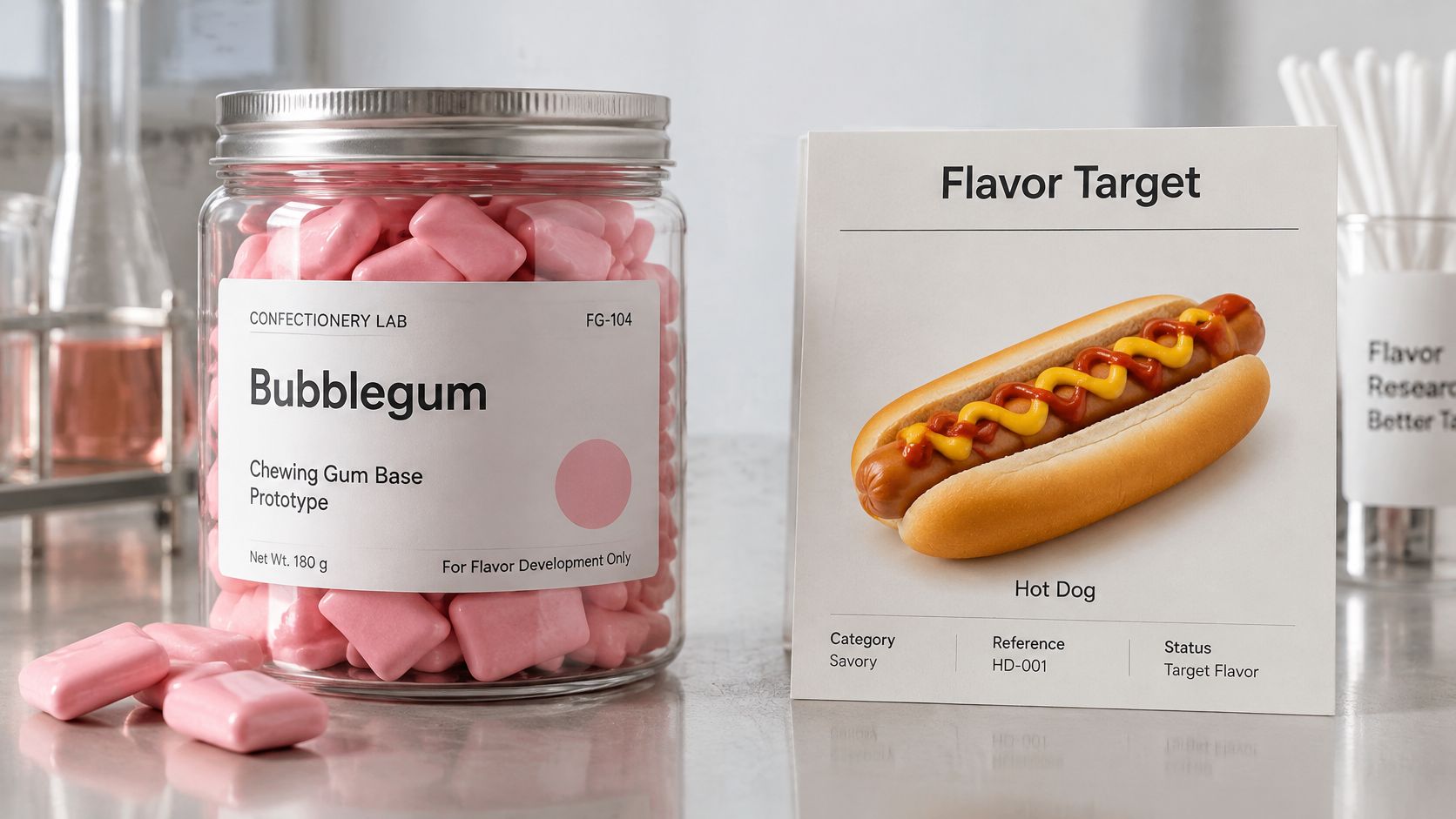
A 2004 Snack and Bakery product listing describes Hot Dog! bubblegum as cinnamon-flavored gum, sold in a 48-count display tray at two pieces for 25 cents. That history points to candy and warm spice, not meat, mustard, or relish.
For formulation, write the brief around the intended sensory result. Gold Coast Terpenes supplies terpene blends for cartridge and concentrate applications, but terpenes alone rarely provide the full bubblegum identity. The brief should distinguish among three different targets:
- Literal savory hot dog: Roasted, smoky, meat-like aroma leads. In an inhaled product, that direction needs careful evaluation in finished hardware and clear, accurate labeling.
- Candy bubblegum with warm spice: Bubblegum leads, with a restrained savory or spice accent. Flavor compounds supply the candy character; terpenes can contribute supporting aroma and body.
- Strain-inspired terpene blend: A named cultivar fingerprint is the target. A candy name does not provide the profile or analytical reference needed for strain matching.
The test depends on the brief. For a savory target, assess whether the note remains acceptable after heating. For candy bubblegum, ask whether tasters identify bubblegum first. For a strain-inspired blend, compare the finished profile with the cultivar reference rather than relying on a pleasant aroma.
Write those priorities into the brief before selecting materials. Treat hot dog bubblegum as a flavor-first target with a restrained savory accent, and avoid promising strain replication without a documented cultivar reference.
Which Top, Middle and Base Notes Build the Profile?
Hot dog bubblegum needs a clear bubblegum lead and a restrained savory accent. Build it in three note tiers: fruity esters and aroma compounds establish the candy identity, while terpenes add body, brightness, or warmth.
The Chowhound explanation of bubblegum flavor supports a layered approach: volatile fruity notes create the first impression, and less volatile components carry character longer. Keep the fruity sweetness recognizable before adding savory, roasted, or spice notes.
Note Roles in a Hot Dog Bubblegum Blend
| Note tier | Relative persistence | Materials for a bubblegum-savory concept | Sensory role |
|---|---|---|---|
| Top | Short-lived | Isoamyl acetate, ethyl butyrate, ethyl acetate | Bubblegum-banana lift at first impression |
| Middle | Longer-lasting than top notes | Methyl anthranilate, beta-caryophyllene, limonene | Grape-gummy bridge with warm spice |
| Base | Most persistent | Vanillin, ethyl maltol, alpha-humulene | Sweet, woody body that keeps the finish from thinning |
These are qualitative tiers, not predictions for heated vapor. Temperature, carrier matrix, and hardware affect how a cartridge releases each note, so assess persistence in the finished device.
Vanillin and ethyl maltol supply sweet, persistent flavor character. Account for them in the formula and label draft. A botanical-terpene-only brief cannot promise the same bubblegum base without those flavor materials.
The middle tier determines whether the profile reads as bubblegum or generic fruit. Methyl anthranilate supports a grape-gummy character. Beta-caryophyllene adds warm spice, while limonene keeps the blend bright. Keep the savory accent restrained so it supports, rather than displaces, the candy profile.
For context on a candy note in a spray-style format, see the bubble gum spray reference. It can inform the flavor direction, but cartridge performance still needs to be assessed in the intended oil and hardware.
Assign each descriptor to a tier before selecting materials: bubblegum to the top and middle, savory to a controlled accent, spice to the middle, and lasting sweetness to the base. Give every material a defined sensory role.
Which Source Fits Your Blend, Botanical or Cannabis-Derived?
Choose materials by their documented origin and the job each one needs to do. Botanical terpenes come from non-cannabis plants; cannabis-derived terpenes are associated with cannabis cultivars; nature-identical flavor esters provide confectionery notes that terpenes alone rarely create. A blend can use more than one source, provided the ingredients and origin claims are clearly stated.
Source Types for a Bubblegum-Savory Blend
| Source type | Typical role in the blend | Label to verify | Fits when |
|---|---|---|---|
| Botanical terpene (plant-derived, non-cannabis) | Body and middle notes such as limonene and beta-caryophyllene | Botanical origin statement and lot COA | The brand needs a non-cannabis origin claim |
| Cannabis-derived terpene | Matching a named cultivar's terpene fingerprint | Cannabis origin statement and lot COA | The brief is a strain replication |
| Nature-identical flavor ester | Top-note bubblegum lift from isoamyl acetate and ethyl butyrate | Nature-identical or flavor-grade wording and lot COA | The brief needs confectionery identity the terpenes do not supply |
Check three items on each quote: the origin statement, the lot COA, and any nature-identical or flavor-grade wording. If the supplier will not identify each category in writing, do not base a label claim on the material.
A botanical body paired with an ester top layer can suit a hot dog bubblegum flavor target. State the source of each component clearly. The customer-facing origin claim must match the documentation for every ingredient.
Gold Coast Terpenes describes its offerings as premium, 100% natural terpene blends, strain-specific profiles, and isolated compounds. For vape and distillate work, check these criteria before selecting a supplier:
- Origin clarity: Each component is identified as botanical, cannabis-derived, or nature-identical.
- Testing: Request lot-specific testing documentation and confirm what it covers.
- Minimum order quantity: Get the MOQ in writing before committing to a material.
The CDT vs BDT comparison can help clarify source claims. Match the material to the brief: a flavor target may call for a botanical body plus declared flavor compounds, while strain replication calls for cannabis-derived material matched to a fingerprint. Label each accurately.
How to Build a Hot Dog Bubblegum Blend for Vape Cartridges
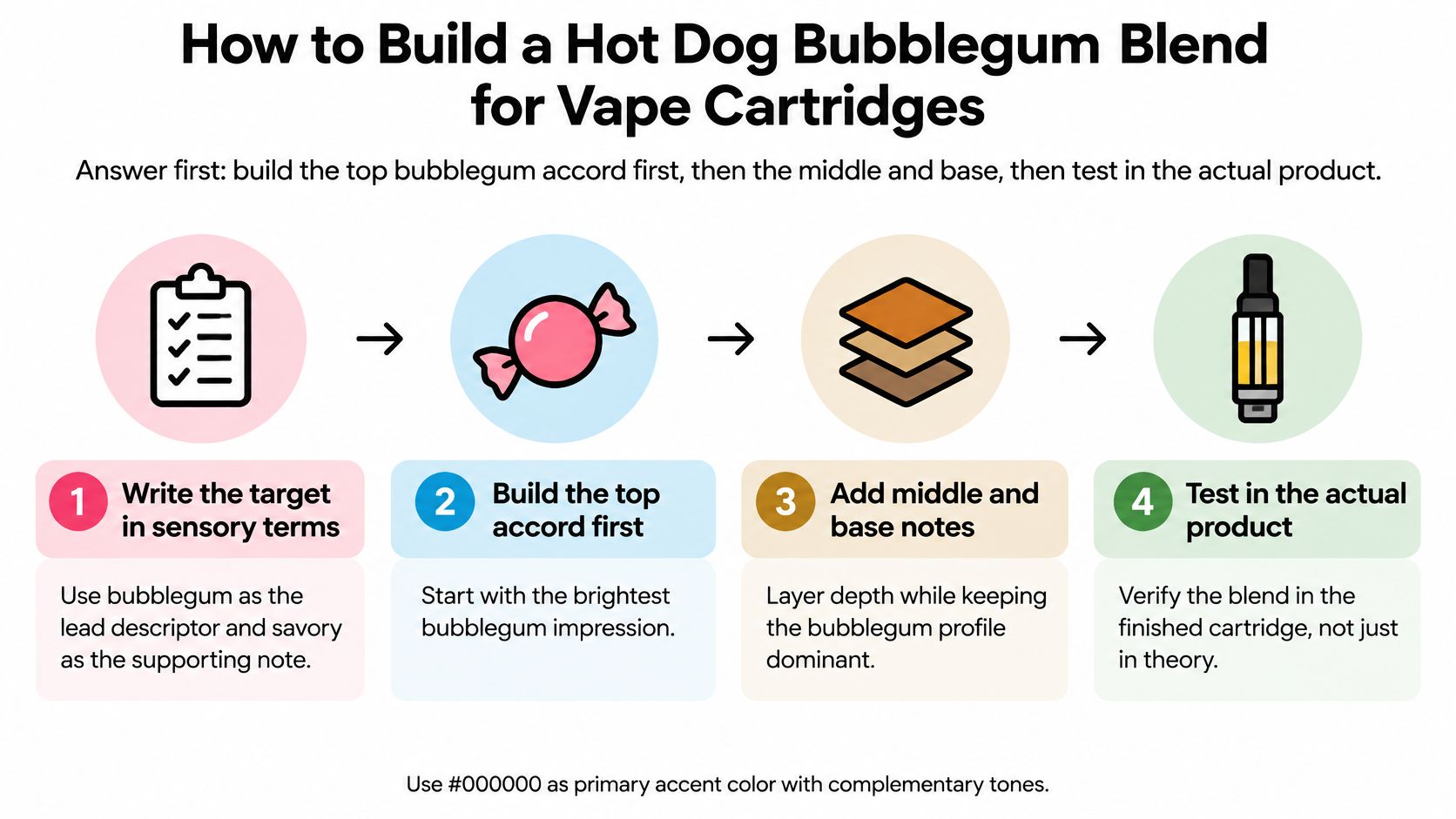
Build the top bubblegum accord first, then the middle and base, then test in the actual product. Reversing that order is how teams end up with a sweet oil that never reads as bubblegum.
Building the Blend in Order
- Write the target in sensory terms. Put bubblegum as the lead descriptor and savory as a secondary accent. If your panel sheet doesn't force that ranking, your bench work won't either.
- Build the top as one coordinated accord. Don't dose esters one at a time and hope. Isoamyl acetate supplies banana-candy lift, while ethyl butyrate and ethyl acetate add sharper, volatile fruit brightness, and the ratio decides whether you get bubblegum or generic fruit.
- Add the middle bridge. A Flavorist guide to candy flavor materials describes classic bubblegum as built from isoamyl acetate and/or ethyl butyrate, methyl anthranilate, vanillin, and ethyl maltol. Use methyl anthranilate as the grape-gummy bridge, then add a botanical body such as limonene or beta-caryophyllene for warmth.
- Add the base before you judge the top. Vanillin gives a soft vanilla backbone and ethyl maltol reinforces cotton-candy sweetness. Without that layer, the profile smells thin after volatilization even when the neat blend smells right.
- Set every load by weight and log every change. Convert bench targets to batch weights with the Mixing Calculator on goldcoastterpenes.com. Volume guesses at bench scale become expensive errors at production scale.
- Screen at three stages. Smell it neat, diluted in your oil, and in finished cartridge hardware. The guide to mixing distillate with terpenes covers the dilution discipline, and you'll need it because heat and airflow rewrite the top note.
- Retest after storage. Hold filled units and recheck at set intervals. You're watching whether the savory accent and candy identity hold together, not just whether the oil still smells sweet.
Adjust with intent. Increase the ester portion to sharpen the opening. Adjust methyl anthranilate to change candy identity. Use the vanillin and ethyl maltol layer to fix a thin finish. Those are three different levers, and pulling the wrong one wastes a bench cycle.
Bench rule: If it only works neat in the vial, it doesn't work.
Name the main risk in your batch record. An overloaded volatile savory accent dominates the first impression, disappears quickly, and leaves only a sweet base behind. Keep it restrained, keep inhalation suitability assessed separately for the finished product, and don't let a novelty brief talk you into a load your hardware can't carry.
This is the practical route to a strain-inspired terpene blend for vape cartridges when the brief is really flavor-led. Gold Coast Terpenes can supply the terpene body for that work, but the ester accord and the hardware test are what make it recognizable.
Why Does the Bubblegum Note Fade or Overpower?
A blend can open as fruit, then lose its bubblegum identity or finish harsh. Diagnose the change by symptom, and adjust one material at a time. If the profile reads as generic fruit, check the ester balance and the grape-gummy bridge. Methyl anthranilate sets much of the candy identity, so adjust it before raising the overall load.
Blend Symptoms, Causes and Fixes
| Symptom | Likely cause | Fix to test first |
|---|---|---|
| Reads as generic fruit, not bubblegum | Ester ratio too low or methyl anthranilate missing | Raise the isoamyl acetate and ethyl butyrate share, then add methyl anthranilate in small steps |
| Savory accent fades first | Top notes too volatile for the base layer | Add a vanillin-type base layer and reduce the top-note load |
| Profile thins after heating | Base layer too light | Add ethyl maltol and vanillin, then retest in finished hardware |
| Sweet note turns harsh | Ester load too high | Lower the ester load and retest the diluted blend |
For a finish that collapses, strengthen the vanillin and ethyl maltol layer rather than adding more top note. For a sharp sweet note in diluted oil, lower the ester load before adding base materials. Otherwise, the blend can become heavy and dull while retaining its harsh opening.
The previous section covers top-note overload and the savory accent's first impression. Here, focus on what happens after that opening: whether the candy identity holds, the finish thins, or the sweetness turns harsh. Record the material, weight change, hardware and panel response for each adjustment so the result can be reproduced.
Hot dog bubblegum still needs bubblegum to define the profile. Keep the savory accent in a supporting role; if it takes over, the blend no longer meets the flavor brief.
How to Test, Verify and Scale a Hot Dog Bubblegum Blend
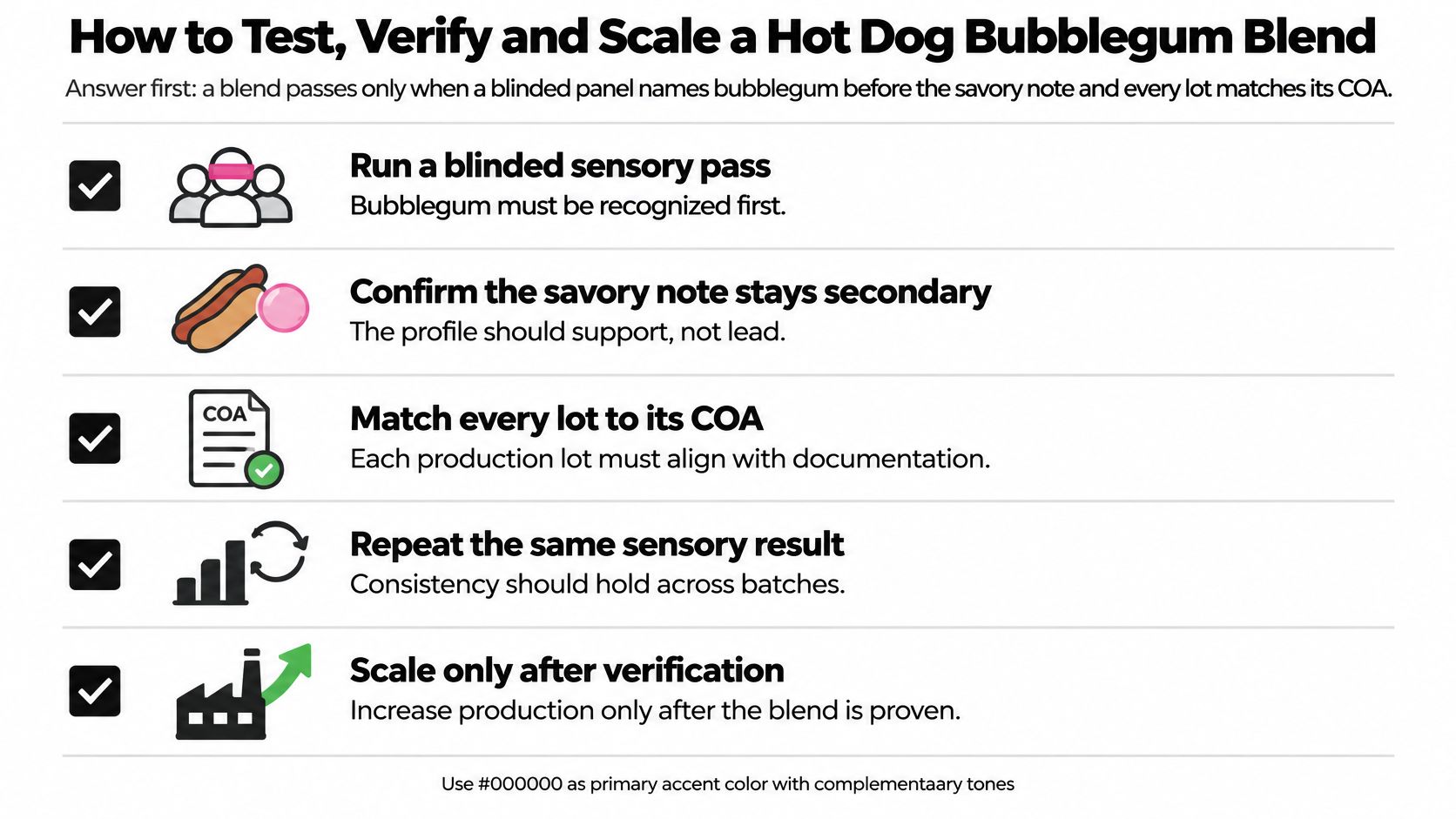
A blend passes when a blinded panel identifies bubblegum before the savory accent and each production lot meets its written specification. Anything less is an unverified sample.
Verification Path
- Run a blinded sensory pass. Keep the product name out of view. Record whether panelists recognize bubblegum first and whether the savory accent remains acceptable after repeated heating.
- Screen the blend at three stages. Assess the concentrate, diluted oil and finished cartridge hardware. A paper on savory flavor construction distinguishes an appealing aroma from a flavor that carries through tasting, so a raw blend alone cannot establish performance.
- Match each lot's COA to the specification. Check terpene and flavor content against the written target, not just against a previous lot. Gold Coast Terpenes describes its terpene blends as SC Lab-tested; keep the applicable lot documentation with the batch record.
- Confirm source and carrier details. Use origin wording that matches supplier documentation, and check the materials in the specific formulation before drafting product copy.
- Review product copy. Avoid medical and effect claims such as “relax” or “uplift.” Describe the intended flavor and formulation use without implying an outcome the product cannot guarantee.
- Recheck during storage. Retain samples and repeat the sensory assessment at planned intervals. Compare results across batches to confirm the profile holds over time.
Use the earlier troubleshooting guidance to diagnose a profile that changes during heating. Here, the verification question is whether the approved blend still meets its sensory target in the finished product.
Start with a small sample before committing to bulk. Gold Coast Terpenes offers package options including Gold Pack, Coast Pack, Tropic Pack, Dessert Pack, Pack Pack and 3ml Strain Picker Pack. Gold Pack prices range from $40.00 to $360.00. Confirm the minimum order quantity, test the sample in your oil and hardware, then scale only after sensory and COA checks pass. The guide to scaling recipes and the Mixing Calculator can help convert the approved formula to a larger batch.
For another catalog reference, review the Apple Fritter flavor profile alongside your custom accord. Compare its presentation with your own descriptors, not as a substitute for testing the bubblegum blend.
Before increasing batch size, lock the formula, mixing order and approved fill hardware. Weigh and record each ingredient, then require a fresh panel pass on the first scaled lot.
What Labeling and Allergen Rules Apply to a Hot Dog Bubblegum Blend
The package label, not the product name or molded shape, decides what you can claim and must disclose. A hot dog shape tells a buyer nothing reliable about ingredients.
Follow these rules when you draft the finished label.
- Name the flavor directly. Describe it as bubblegum with a savory accent. Never imply a meat ingredient unless one is present and declared.
- List ingredients by quantity. Flavor esters, nature-identical compounds, terpenes and carriers belong on the ingredient statement in descending order where that format applies to your product category and market.
- Declare origin exactly as verified. Botanical, cannabis-derived and nature-identical wording must match your supplier documents. Don't upgrade the wording for marketing.
- Check ingestible use separately. If any version is intended for ingestion, confirm food-use authorization and maximum-use limits in the target market before sale. An inhalation assessment doesn't cover food use, and a food flavor history doesn't cover inhalation.
- Add age and choking warnings for novelty formats. Round or molded pieces need clear age guidance on packaging, with supervision language where your market requires it. Don't let party positioning soften that warning.
- Track allergen and cross-contact statements by lot. Keep them current alongside the COA file. If a component supplier changes, the statement gets reviewed before the next fill, not after.
Gold Coast Terpenes supplies the blend base and documentation for its materials. Your brand carries final label responsibility for the finished product, the market you sell into, and every claim on the pack.
If the document file and the label disagree, the label is wrong. Fix the label.
Hot Dog Bubblegum Formulation Questions Answered
How Should You Compare Lots of the Same Blend?
Compare them against a retained reference sample, using the same dilution, hardware, and evaluation conditions. Record the lot number, blend version, component proportions, and sensory results together. A change in aroma can then be traced to a specific lot or formula revision instead of being mistaken for normal variation.
What Belongs in a Failed-Batch Record?
Log the batch ID, ingredient lots, actual weights, mixing sequence, cartridge hardware, and test conditions. Describe the failure precisely: for example, “gum note drops after heating” is more useful than “weak flavor.” Keep the original sample and the revised sample, then change one variable per bench run so the result points to a cause.
How Should a Blend Revision Be Named?
Use a version identifier tied to the formula and its records. If a component or proportion changes, create a new version rather than overwriting the prior entry. This keeps sensory notes, lot documents, and production instructions aligned when a blend moves from bench work to a larger run.
Gold Coast Terpenes supplies lab-verified, THC-free terpene blends and isolates for cartridges, concentrates, and product formulation. Its materials are described as free of VG, PG, PEG, and MCT. For a hot dog bubblegum concept, treat those terpene materials as part of the profile, not as proof that terpenes alone supply the confectionery character.