
The main shortcut for natural watermelon flavor for vape cartridges is to add sweetness or increase the total flavor load. Neither guarantees a clearer watermelon note. Gold Coast Terpenes supplies botanically derived terpene blends, rather than cannabis-derived material, and a watermelon profile is an aroma accord, not pressed juice.
In a cartridge, the oil may contribute little fruit identity of its own, so the flavor has to establish it. Set the sensory target first: fresh-cut watermelon, ripe pink fruit, and candy-like watermelon are distinct briefs, not interchangeable names for one formula.
What Is Natural Watermelon Flavor for Vape Cartridges Built From?
Natural watermelon flavor for vape cartridges is a constructed accord, not necessarily watermelon juice. The formulation task is to add recognizable watery freshness, mild sweetness, and bright fruit character without letting the profile tip into cucumber, rind, or confectionery.
Watermelon is a familiar flavor reference, not a niche regional note. The United Nations Food and Agriculture Organization's fruit-production report says global fruit production reached 952 million metric tonnes in 2023. Watermelon ranked second at approximately 105 million tonnes, behind bananas at 139 million and ahead of apples at 97 million. China accounted for about 60.8% of global watermelon output. Those figures help explain why the word watermelon communicates a broadly recognized combination of watery freshness and gentle fruit sweetness.
Set the sensory target before choosing materials
Keep these targets distinct:
- Fresh-cut: green, watery, and bright, with restrained sweetness.
- Ripe pink: rounder fruit body and a sweeter impression, with less emphasis on green notes.
- Candy-like: pronounced sweetness and a confectionery character, rather than a fresh-cut impression.
That distinction gives a formulator a useful brief for both blending and evaluation. A fresh-cut target that gets judged against a candy profile can be rejected for the wrong reason.
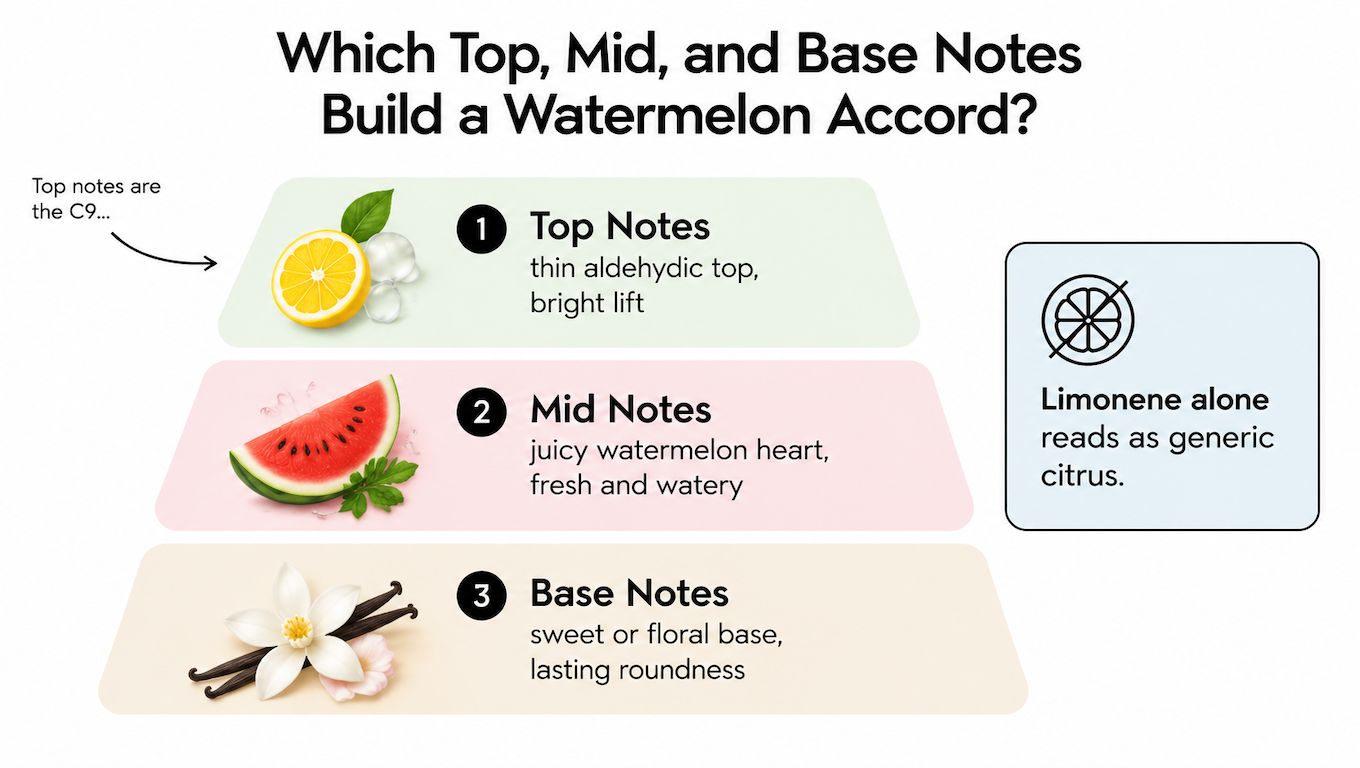
The accord also needs clear note roles. Top notes create the first inhale and tend to fade quickly. Mid notes carry the recognizable watermelon body. Base notes help the profile stay rounded through drydown rather than disappearing after the initial aroma.
Practical rule: Lock the sensory target before adjusting the flavor load. More flavor won't fix a mismatch between a fresh-cut brief and a candy-like formula.
For shared team vocabulary when defining note roles, Gold Coast Terpenes provides a terpene formulation guide. The compounds and marker table below turn that vocabulary into a working spec for replicating watermelon flavor for vape cartridges.
Which Compounds Carry Watermelon Aroma and Which Only Add Bulk?
Natural watermelon flavor is a dosed ratio of potent aroma compounds, not a high total of volatile material. Odor activity value, or OAV, compares a compound's concentration with its odor-detection threshold. High-OAV compounds can shape the aroma at trace levels, while adding more low-impact volatiles may raise the measured load without strengthening the watermelon impression.
Watermelon aroma markers by impact
| Compound | Reported marker | Odor read | Role in the accord |
|---|---|---|---|
| (E,Z)-2,6-nonadienal | OAV about 8,282 | Cucumber, watery green | Trace top note; overdose reads as rind |
| (Z,Z)-3,6-nonadienol | Major watermelon contributor | Characteristic watermelon | Fruit body; not interchangeable with the aldehyde |
| (Z,Z)-3,6-nonadienal | Threshold 0.79 µg/L | Fresh-cut watermelon | Fresh top note |
| Hexanal | About 798 µg/L in cited cultivar data | Green, fatty, fruity, woody | Supporting green note; easy to overbuild |
| (E,E)-2,4-hexadienal | OAV 24 | Muskmelon, floral, green | Floral-green mid support |
| (E)-2-octenal | OAV 14 | Citrus and green | Bright top support |
| 6-Methyl-5-hepten-2-one | Low-impact volatile | Low sensory impact despite presence | Not an identity driver |
| Geranyl acetone | Low-impact volatile | Low sensory impact despite presence | Adds volatile load with limited authenticity gain |
The watermelon-aroma study in PMC reports an OAV of 8,282 for (E,Z)-2,6-nonadienal in fresh watermelon juice. It also identifies (Z,Z)-3,6-nonadienol as a major contributor to characteristic watermelon aroma. Their roles differ: the aldehyde can push the profile toward cucumber or rind, while the nonadienol supports recognizable watermelon body.
A separate cultivar and processing analysis reports a threshold of 0.79 µg/L for (Z,Z)-3,6-nonadienal, with a fresh-cut watermelon character. The analysis also reports hexanal at 798 µg/L, describing its character as green, fatty, fruity, and woody. Hexanal can add a green edge, but excess can make the accord feel fatty or woody instead of juicy.
The watermelon-juice aroma analysis reports OAVs of 24 for (E,E)-2,4-hexadienal and 14 for (E)-2-octenal. These provide floral-green and citrus-green support, respectively. The figures describe the study's juice sample; use them as evidence of relative odor impact, not as a cartridge dosing recipe.
A GC-MS study of fresh-cut watermelon juice identified 68 volatile compounds, with alcohols and aldehydes accounting for approximately 48.27% of the detected profile. For a cartridge specification, prioritize potent C9 aldehyde and alcohol character, control each dose against the target aroma, and treat sweetness as a separate adjustment. Total volatile concentration alone does not establish authenticity or show that a flavor is suitable for inhalation.
Which Top, Mid, and Base Notes Build a Watermelon Accord?
A strain-inspired terpene blend for watermelon needs a restrained aldehydic top, a juicy mid, and a soft base. Limonene alone reads as generic citrus because brightness without watermelon body doesn't establish the fruit identity.
Make the layers work together
The top layer supplies first-inhale freshness. C9 aldehydes and green materials such as cis-3-hexenal-type notes can suggest freshly cut fruit, but they fade quickly and can skew toward rind if pushed too far. A clean citrus lift can brighten the opening without replacing the watermelon note.
The mid layer is the accord's identity. Nonadienol character helps carry the watermelon impression, while fruitier alcohols and light esters can keep the body from collapsing into cucumber water. The base layer should be a modest sweet, floral, or soft tropical support that rounds the drydown without burying the green freshness.
| Layer | Fresh-cut build | Ripe pink build |
|---|---|---|
| Top | Trace (Z,Z)-3,6-nonadienal and cis-3-hexenal-type green notes, with clean citrus lift from (E)-2-octenal | Trim green aldehydes and use a lighter citrus lift |
| Mid | (Z,Z)-3,6-nonadienol body with (E,E)-2,4-hexadienal floral-green support | Nonadienol body with fruitier alcohols and light esters |
| Base | Limited soft sweet support | Sweet, floral, or soft tropical support for drydown |
A fresh-cut build should keep its green top restrained and let the juicy middle do most of the recognition work. A ripe pink build can lean more on sweet fruit support, but if the base dominates, it will read as candy or drink rather than ripe fruit.
Gold Coast Terpenes offers botanical blends and fruit-forward directions that can provide a compatible supporting note without using a cannabis-derived input. For example, a developer can compare a bright citrus direction with fruit references such as Pineapple Express, Tangie, or Sour Mango, while keeping the watermelon target distinct. The right comparator helps tune brightness or sweetness; it shouldn't become a substitute name for the finished accord.
Judge both builds in the intended oil, at initial impact and after drydown. A blend that smells convincing from the bottle but loses its watermelon body in the cartridge needs a better balance of layers, not more top note.
What Does Natural Mean on a Label Versus in a Cart?
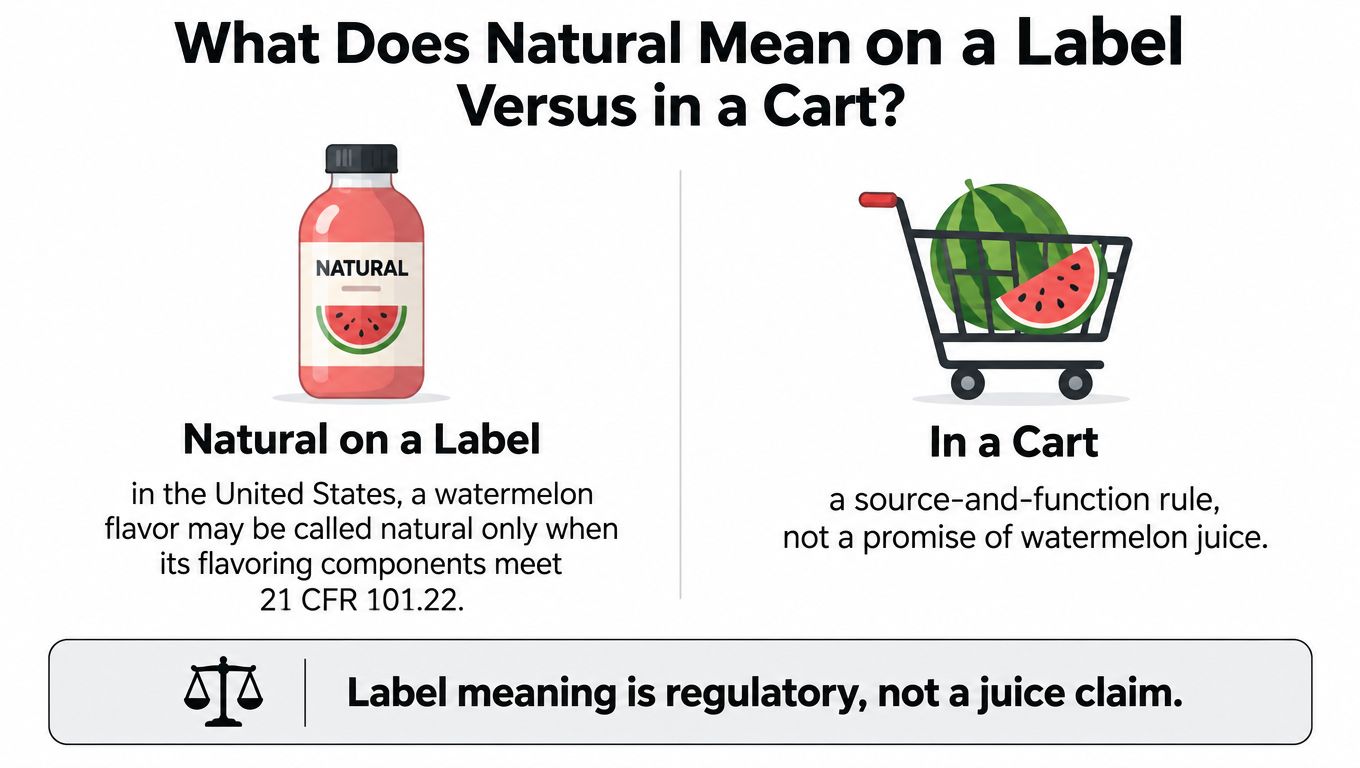
In the United States, a watermelon flavor may be labeled natural only when its flavoring components meet the definition in 21 CFR 101.22. That's a source-and-function rule for food flavoring, not a promise that the ingredient is watermelon juice or that it's suitable for inhalation.
The FDA-related regulatory material on natural flavor describes qualifying sources that include fruits and other plant and animal materials. Recognized forms include essential oils, extracts, distillates, and products made through processes such as heating or enzymolysis. The regulatory classification depends on eligible source materials and their flavoring function, not on whether the final blend smells like fresh watermelon.
Label language and cartridge suitability are separate decisions
A constructed blend of natural extracts or isolates may support a food-label natural claim, but that claim doesn't establish that the blend is watermelon-only, solvent-free, additive-free, or appropriate for a cartridge. A flavor made for food use isn't automatically cleared for a different application. The formula, carrier, intended-use limits, and applicable safety documentation all matter.
Before a claim reaches a SKU, the manufacturer should hold a documentation pack that includes:
- Raw-material identity and traceability, so the sources can be checked.
- Process description and specification, including the information needed to assess the flavoring components.
- Certificate of analysis and allergen status, tied to the material being purchased.
- Carrier identity and intended-use limits, so the team can evaluate compatibility and use conditions.
- Batch-consistency records, so production can compare incoming lots against the approved spec.
In the EU, natural-flavor wording follows a separate set of requirements. A U.S. label decision doesn't travel unchanged across markets, so regulatory review should match the market and product category.
For a sourcing comparison, botanical versus cannabis-derived terpenes is a useful starting point. The key decision isn't whether “natural” sounds reassuring. It's whether the exact material, documents, and intended use support the product you're making.
How Do You Blend and Dilute Natural Watermelon Flavor into Distillate?
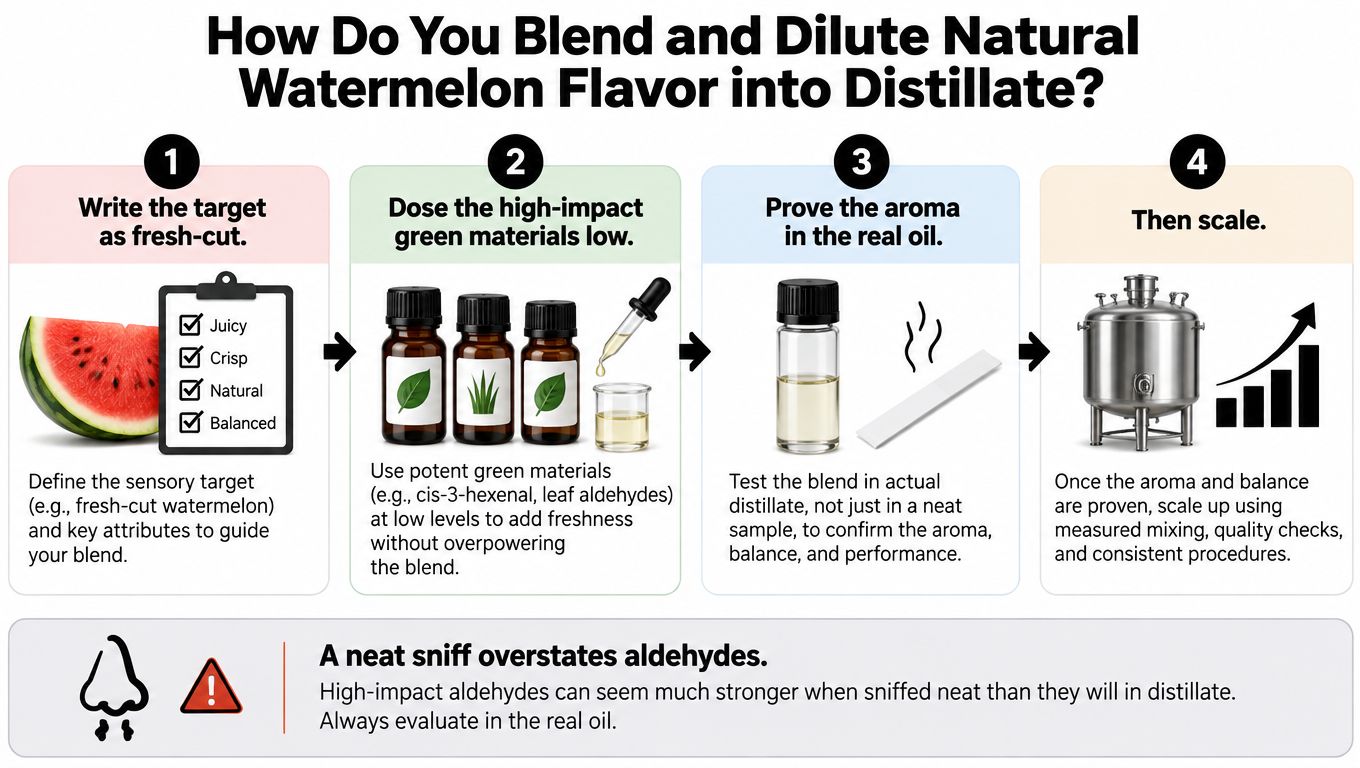
A fresh watermelon profile depends on proportion, not a heavy flavor load. Trace, high-odor-activity C9 aldehydes can add a fresh-cut edge, but too much shifts the impression toward cucumber or rind. Set the target in the actual distillate, where the matrix can change how each note reads.
A controlled blending sequence
Define the sensory target. Choose fresh-cut, ripe, or candy-like watermelon and keep that target fixed through the trial. Otherwise, a formula change may shift the profile rather than improve it.
Build the fruit body first. Start with a botanical fruit base, then add cucumber-like aldehydic character in small increments. A potent green note can dominate before the blend has enough watermelon body.
Add C9 aldehydes sparingly. Stop when the fresh edge is clear. If the blend reads as cucumber or rind, reduce the aldehydic contribution instead of increasing the overall flavor load.
Develop the middle and base. Add watermelon-alcohol body, followed by restrained sweet or floral support. This gives the opening note a fuller profile rather than leaving the rest of the puff hollow.
Compare three loads in the intended oil. Test the planned cartridge load, one step below, and one step above. Weigh materials rather than counting drops, and use a terpene mixing guide for distillate to inform the blending workflow.
Rest sealed, then assess after processing. Check the aroma after the blend has rested. Where company policy permits, evaluate the filled product after a short heated hold to see whether processing changes the balance.
Tie the approved result to its lot and records. Keep the formulation, lot identifier, certificate of analysis, and sensory result together. That makes it easier to distinguish a material change from a formula change.
Sweetness can also affect perceived aroma intensity. In a watermelon-juice aroma analysis, the odor-threshold ratio in a 2.5% fructose solution compared with water was 2.82 for (E,E)-2,4-hexadienal and 1.52 for (E)-2-octenal, as reported in the watermelon-juice aroma study. Neat-material intensity alone therefore won't predict the balance in every formulation.
Keep carriers compatible with the hardware specification, and don't infer effects from aroma performance.
How Does Heat Change Natural Watermelon Flavor?
Approve the watermelon profile after it has encountered the heat relevant to the product, not by cold sniff alone. Heat can change the balance of aldehydes, alcohols, and sulfur compounds, shifting a fresh fruit impression toward cooked or savory notes.
In heated watermelon juice, methional reached an OAV of 218.10 and dimethyl sulfide an OAV of 25.50, according to thermal-treatment research published in Bioscience, Biotechnology, and Biochemistry. The study of heat-related watermelon aroma changes identifies these sulfur-derived notes as contributors that can move the profile away from clean, freshly cut watermelon.
Keep process changes from masquerading as formula failures
The same study identifies (Z)-3-nonen-1-ol, (E)-2-nonen-1-ol, 1-nonanal, (E)-2-nonenal, and (E,Z)-2,6-nonadienal among the representative aroma compounds whose abundance changes with processing. That makes the process part of the flavor target.
Blend cool, limit open-air holding, and keep oxygen exposure low where the process allows. Minimize unnecessary heat during blending, and don't copy juice-processing conditions as a cartridge setpoint. The product must be evaluated under its own relevant handling and thermal conditions.
Extraction or processing changes can also alter the aroma benchmark. If a lab method changes, the resulting sensory shift can look like terpene-batch inconsistency. Lock the sensory target and analytical method before assigning blame to the blend. If the thermal check leaves the top flat, rebalance the C9 character rather than increasing total flavor load.
Gold Coast Terpenes also offers a guide to terpene boiling points. Use that information as formulation context, not as a substitute for testing the finished product under its intended process.
Why Does a Watermelon Blend Taste Candy, Rind, or Flat?
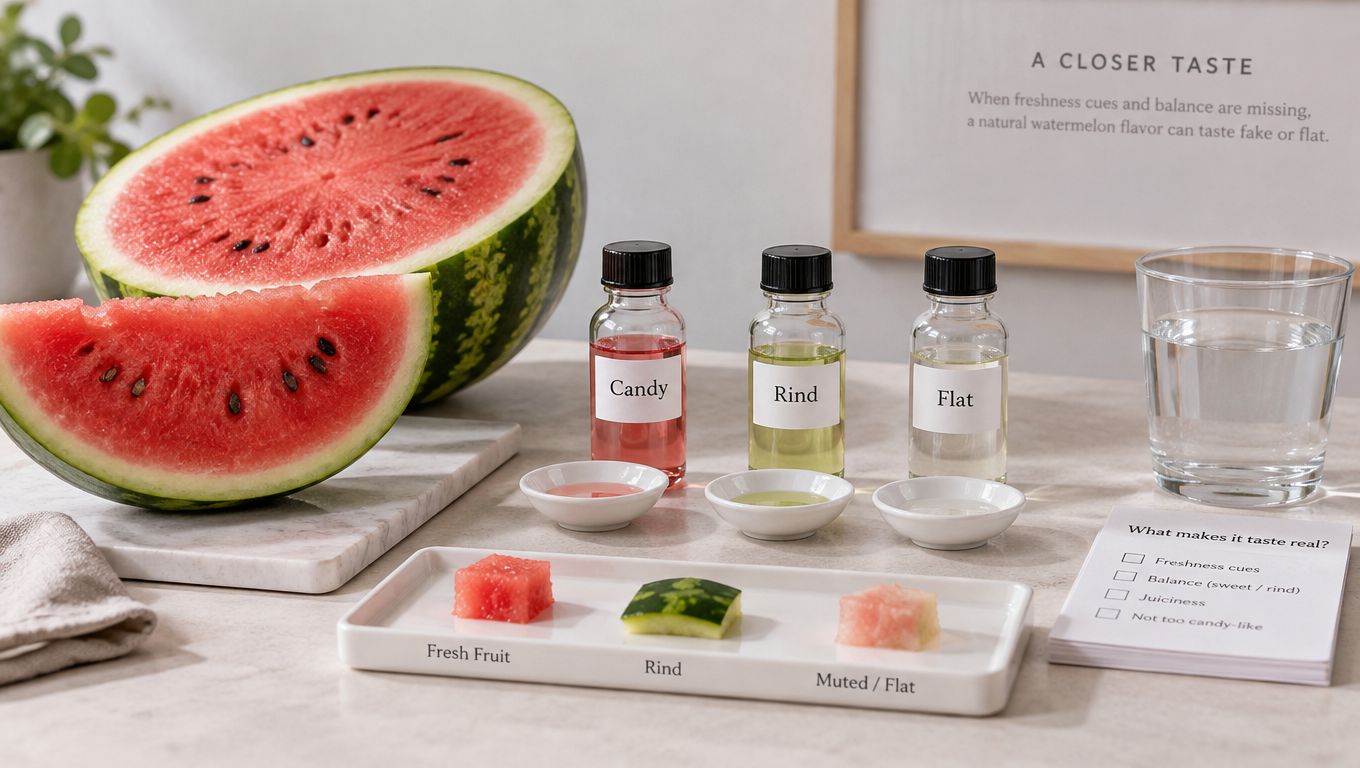
A watermelon blend can taste flat or candy-like because its freshness cues and note balance are wrong, not because the total percentage is too low. Change one lever at a time so the next trial tells you what caused the difference.
| What you smell | Likely cause | Adjustment |
|---|---|---|
| Fresh-cut watermelon | C9 top and nonadienol are in balance | Hold the ratios; confirm in oil after rest |
| Ripe pink fruit | Green aldehydes are trimmed and sweet mid support is present | Don't add more hexanal |
| Cucumber or rind | High-OAV aldehyde is ahead of the watermelon alcohol | Cut the aldehyde; keep the alcohol body |
| Candy or watermelon drink | Esters and sweet base cover the freshness | Reduce sweet support; restore a trace green top |
| Cooked or savory | Sulfur notes appear after heat | Rebalance after the thermal check; don't raise total load |
| Flat despite a high percentage | Low-impact ketones were added for concentration | Remove bulk volatiles; dose by odor activity |
Fresh-cut watermelon needs a restrained green top and enough body to keep it juicy. If the profile reads as rind, reduce the aldehyde first. If it reads as candy, ease the sweet support before rebuilding the fresh edge.
A flat result at a high load is a different failure. Adding more low-impact bulk volatiles can increase intensity without making the aroma more recognizably watermelon. Resmell at two dilutions and after storage before changing the formula, then adjust just one component group.
For a visual comparison of sensory checkpoints, use the clip below after reviewing the fault table.
How Do You Choose a Botanical Supplier and Lock the Spec?
Lock one sensory target, one dilution plan, and one document pack before ordering production material. A supplier decision is useful only if the delivered material matches the formulation and compliance requirements you've approved.
Botanical and cannabis-derived terpenes are different sourcing choices. A documented botanical input can support a THC-free product path where the supplier's records support the claim, while cannabis-derived material can raise licensing and residual-cannabinoid questions. Similar aroma doesn't make the materials or their paperwork interchangeable.
Gold Coast Terpenes supplies botanically derived blends for formulators. Its terpenes for cartridges are SC Lab-tested, and the company states that its products contain no VG, PG, PEG, or MCT. Terpenes are added to winterized distillate oils to give the product a distinct flavor. Those facts help define the material offering, but they don't replace review of the specific product's intended use or regulatory obligations.
Put the supplier checks in the purchase process
Before moving from bench trial to a production order, confirm:
- Lot-level documentation: Match the certificate of analysis and specification to the material and lot being purchased.
- Traceability: Keep lot identity with the formula, sensory result, and production record.
- MOQ by SKU: Get the minimum order quantity quoted for each specific item rather than assuming one minimum applies across the catalog.
- Regulatory fit: Confirm that raw-material identity, processing, carrier information, and intended-use documents support the planned product and market.
- Sensory match: Compare the material in the approved distillate and hardware context, not just from the bottle.
Tropical fruit references can help calibrate sweetness or brightness without renaming the product. Pineapple Express offers a pineapple, sweet, and tropical reference; Tangie offers citrus, orange, and sweet; Sour Mango offers mango, diesel, and citrus notes. Treat them as comparison points beside a watermelon accord, not as substitutes for a watermelon spec.
Gold Coast Terpenes has a wholesale terpene ordering resource for purchase planning. Request the certificate of analysis for the candidate lot, lock the target and intended dilution, then run the three-dilution check before approving package artwork.
Frequently Asked Questions
Is natural watermelon flavor one molecule?
No. It is a ratio of trace C9 aldehydes and alcohols, supported by fruit, floral, or sweet notes. These high-odor-impact compounds carry much of the watermelon character; supporting volatiles shape the balance.
Can a food-natural flavor go straight into a cart?
A natural designation does not establish suitability for inhalation. Check the material's intended use, carrier, and safety documents for the application, then assess the finished blend under relevant heat conditions.
Why does the same percentage smell different in distillate?
The oil matrix and perceived sweetness affect how aroma materials register. A neat sniff may not predict the finished balance, so evaluate the dose in the actual oil using the three-dilution check.
Should I choose botanical or cannabis-derived terpenes for a watermelon blend?
Choose a documented sourcing path that fits the product's labeling, shipping, and compliance needs. Gold Coast Terpenes offers botanical terpene blends and strain-specific profiles for formulation.
Does Gold Coast Terpenes offer wholesale and bulk programs?
Gold Coast Terpenes offers wholesale and bulk programs, and it also provides a mixing calculator and safety documents to support formulation and purchasing review; check the site for current order terms before planning a purchase.
{ “@context”: “https://schema.org”, “@type”: “FAQPage”, “mainEntity”: [ { “@type”: “Question”, “name”: “Is natural watermelon flavor one molecule?”, “acceptedAnswer”: { “@type”: “Answer”, “text”: “No. It is a ratio of trace C9 aldehydes and alcohols, supported by fruit, floral, or sweet notes. These high-odor-impact compounds carry much of the watermelon character; supporting volatiles shape the balance.” } }, { “@type”: “Question”, “name”: “Can a food-natural flavor go straight into a cart?”, “acceptedAnswer”: { “@type”: “Answer”, “text”: “A natural designation does not establish suitability for inhalation. Check the material’s intended use, carrier, and safety documents for the application, then assess the finished blend under relevant heat conditions.” } }, { “@type”: “Question”, “name”: “Why does the same percentage smell different in distillate?”, “acceptedAnswer”: { “@type”: “Answer”, “text”: “The oil matrix and perceived sweetness affect how aroma materials register. A neat sniff may not predict the finished balance, so evaluate the dose in the actual oil using the three-dilution check.” } }, { “@type”: “Question”, “name”: “Should I choose botanical or cannabis-derived terpenes for a watermelon blend?”, “acceptedAnswer”: { “@type”: “Answer”, “text”: “Choose a documented sourcing path that fits the product’s labeling, shipping, and compliance needs. Gold Coast Terpenes offers botanical terpene blends and strain-specific profiles for formulation.” } }, { “@type”: “Question”, “name”: “Does Gold Coast Terpenes offer wholesale and bulk programs?”, “acceptedAnswer”: { “@type”: “Answer”, “text”: “Gold Coast Terpenes offers wholesale and bulk programs, and it also provides a mixing calculator and safety documents to support formulation and purchasing review; check the site for current order terms before planning a purchase.” } } ] }Gold Coast Terpenes supplies botanical terpene blends and strain-specific profiles for cartridge and distillate formulation. Its cartridge terpenes are SC Lab-tested, and its products contain no VG, PG, PEG, or MCT. Request the certificate for your candidate lot, run the three-dilution watermelon check in your intended oil, and visit Gold Coast Terpenes to explore formulation resources and wholesale options.