
Fruit punch flavor is a multi-component aroma system built from complementary citrus, tropical, red-fruit, and floral terpenes, and Gold Coast Terpenes supplies 100% botanically derived blends that replicate that direction without cannabis-derived inputs. For vape cartridges, the job is to reproduce the recognizable aroma without compromising distillate viscosity, hardware performance, or finished-product compliance.
You've got a flavor reference, a base oil, and a cartridge selected for a new SKU. The concentrate smells convincing on a blotter, but that doesn't establish how it will perform after dilution and heating. A workable fruit punch flavor terpene profile for vape cartridges starts with a sensory target and ends with a validated finished product.
What a Fruit Punch Flavor Terpene Profile Actually Is
A fruit punch terpene profile is a coordinated aroma architecture, not a single fruity ingredient. Define what the buyer should recognize before deciding which compounds belong in the blend.
At the bench, translate the reference into bright citrus, red-fruit body, sweet-floral lift, and a clean finish. Those are formulation targets, not promises that the cartridge contains fruit, sugar, or juice. Gold Coast Terpenes supplies botanical blends and isolated compounds for cartridges and concentrates, giving developers options for both a prepared profile and component-level adjustment.
Start with a written sensory specification. “Sweet and fruity” is too broad to distinguish a tropical punch from a citrus-heavy blend with a candy-like finish.
Define the recognition cues
- Opening impression: Identify whether citrus should lead immediately or sit behind the fruit body.
- Central character: Decide whether the reference is tropical, red-fruit-forward, or a balanced mixed-fruit direction.
- Finish: Specify acceptable floral and earthy depth, then identify unwanted pepper, peel, or chemical notes.
- Product identity: Separate matching a familiar punch aroma from replicating a documented cannabis reference.
The historical beverage reference helps explain why the name is broad. In 1934, A.W. Leo, Tom Yeats, and Ralph Harrison created Leo's Hawaiian Punch in Fullerton, California, initially as an ice-cream topping, using orange, pineapple, passion fruit, guava, and papaya juices, according to the Hawaiian Punch product history. That mixed-fruit origin is useful context, not a cartridge recipe.
The illustration below maps potential aroma roles alongside taste contributions. Treat it as a concept map, not a verified composition or a list of ingredients required in every blend.
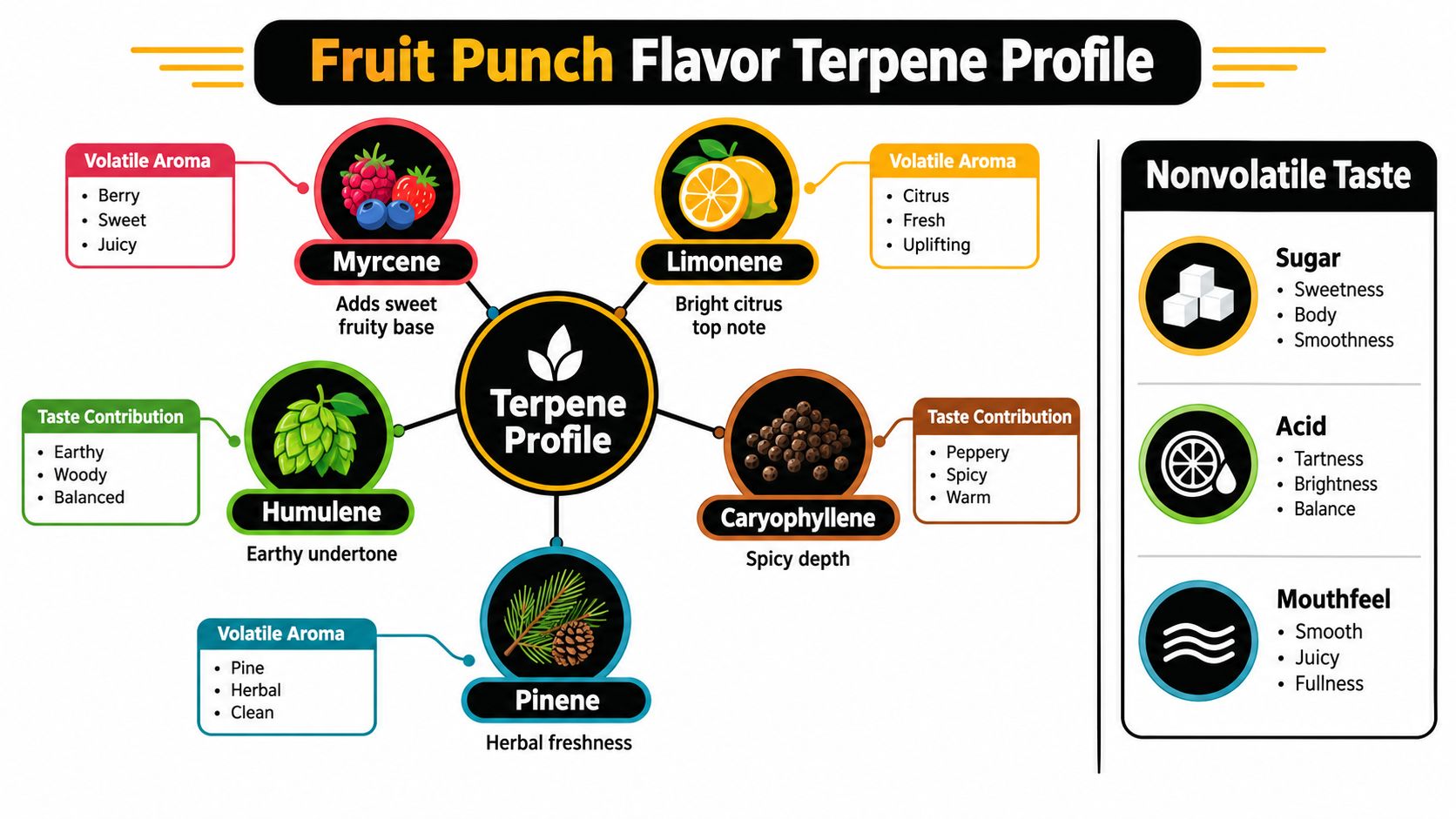
Practical rule: Write the sensory specification before adjusting the formula. Otherwise, each attractive addition can move the blend farther from the reference.
Why Fruit Punch Is a Sensory System Rather Than One Note
Fruit punch perception depends on interacting aroma, taste, mouthfeel, and chemesthetic cues. A cartridge formulation must distinguish the cues it can reproduce through aroma from the beverage characteristics it cannot transfer into oil.
Fruit volatiles include esters, terpenes, aldehydes, and phenols. Esters are especially associated with fruity notes, while terpenes can contribute citrus, floral, and sweet character; not every detected volatile is odor-active, as explained in this review of fruit flavor chemistry and sensory evaluation.
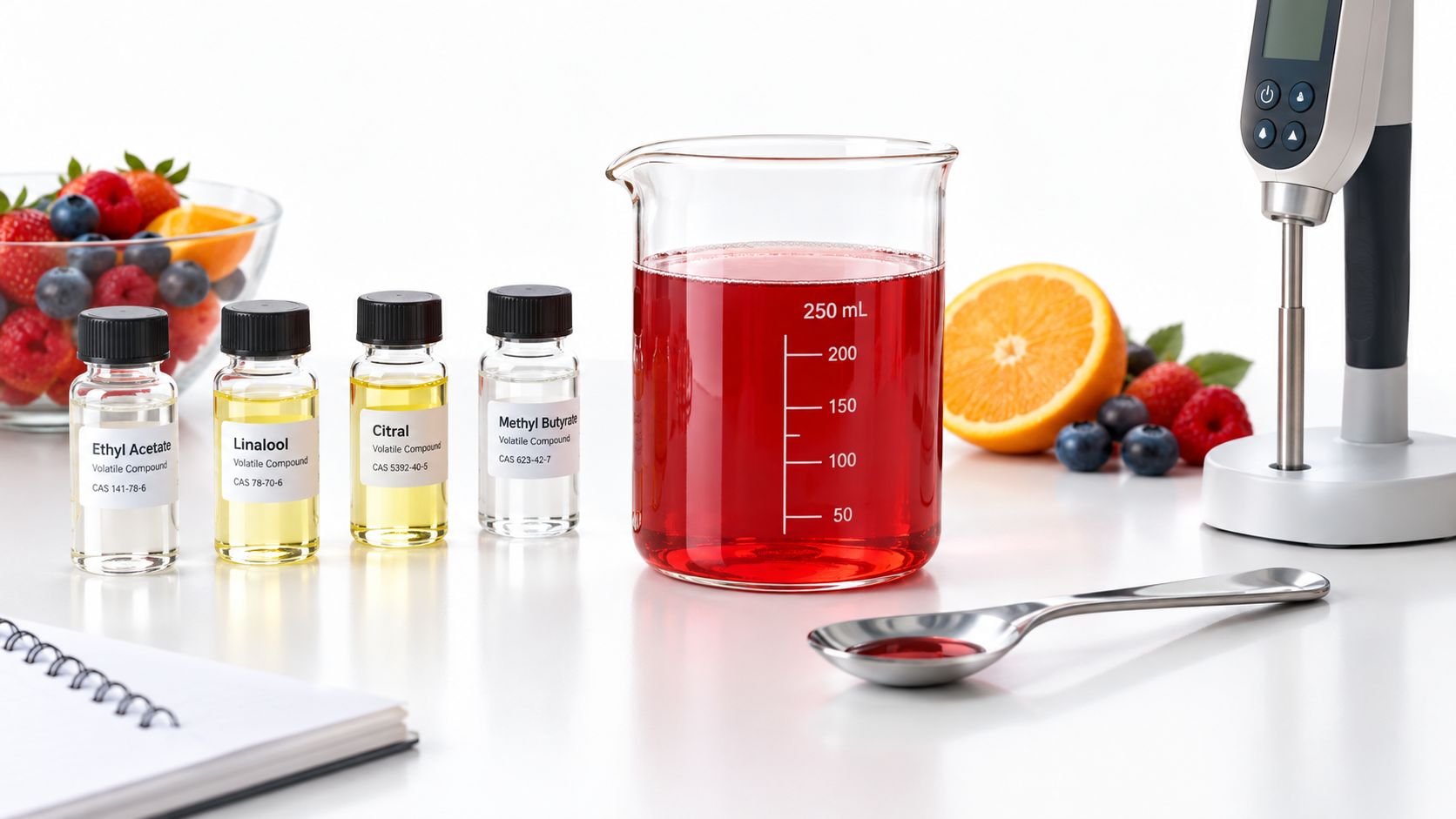
That distinction changes how developers read analytical results. A long compound list doesn't establish flavor accuracy. Gas chromatography–mass spectrometry can identify candidate components, but sensory assessment must determine which combinations matter in the intended matrix.
The laboratory image illustrates the separation between analytical work and sensory development.
Translate the reference rather than copying it
A sweet-smelling blend isn't equivalent to dissolved sugar. Likewise, a citrus aroma isn't the same as beverage acidity. Don't use a drink's ingredient list as an inhalable formulation specification.
Gold Coast Terpenes' fruit terpene guide provides a relevant starting point for exploring fruit-oriented aroma components. Use that vocabulary to describe the reference, then evaluate the actual blend in the target distillate.
For development, separate the assessment into two questions:
- Recognition: Does the diluted profile still read as mixed-fruit punch rather than isolated citrus or floral perfume?
- Execution: Does it deliver that identity without an objectionable finish in the intended device?
Aroma accuracy requires both answers. Increasing total aroma content won't resolve a missing sensory role, and an impressive analytical fingerprint won't compensate for a blend that loses its identity after dilution.
Top, Mid, and Base Notes for a Fruit Punch Terpene Blend
Assign limonene to citrus brightness, myrcene to fruit-earth body, and beta-caryophyllene to restrained spice and depth. These are practical sensory roles, not interchangeable ingredients or a fixed formula.
Limonene contributes lemon- and orange-like character and can increase perceived sweetness; myrcene contributes musky, earthy, and fruity notes; beta-caryophyllene contributes black-pepper and clove-like spice with a potentially bitter edge, as described in this review of terpene sensory characteristics.
Terpene Sensory Roles in a Fruit Punch Blend
| Terpene | Sensory Role | Fruit-Punch Function | Overuse Risk |
|---|---|---|---|
| Limonene | Bright top note | Establishes citrus recognition and lifts perceived sweetness | Citrus dominance that obscures the mixed-fruit target |
| Myrcene | Fruit-earth mid note | Adds ripe-fruit and musky body | An earthy emphasis that no longer matches the reference |
| Beta-caryophyllene | Restrained base or finish | Adds depth beneath brighter notes | Peppery bitterness instead of fruit |
Build the opening first, but don't approve it in isolation. A convincing citrus top note needs enough body underneath it to read as punch rather than a citrus-only profile.
Gold Coast Terpenes offers limonene, myrcene, and beta-caryophyllene isolates alongside prepared blends. Use isolates to correct an identified gap, not to add complexity for its own sake.
Adjust for sensory impact
Controlled beverage research found that aroma concentration changed descriptors including citrus, fruity, sweet, pungent, woody, and chemical notes, while sweetness, bitterness, aroma, and color jointly influenced liking. Its practical development benchmark is to evaluate at least three concentration levels around the intended use rate under standardized conditions, as discussed in the aroma concentration and beverage perception study.
That beverage evidence supports structured sensory screening, not an inhalation safety conclusion. In cartridge work, record whether an adjustment improves recognition or merely increases intensity.
For broader context, HempWell USA's terpenes for pain explained addresses a different terpene discussion. It isn't a substitute for sensory specifications, emissions testing, or evidence supporting product claims.
More citrus isn't necessarily more fruit punch. Stop an adjustment when the reference becomes less recognizable, even if the aroma becomes stronger.
Botanical Versus Cannabis-Derived Terpenes for Formulators
Choose terpene origin according to documented sourcing, the product brief, and destination-market rules. Botanical and cannabis-derived inputs shouldn't be treated as interchangeable documentation categories.
Botanically derived terpenes come from non-cannabis plant sources; cannabis-derived terpenes come from cannabis material. For procurement, that distinction must appear in supplier records rather than being inferred from the profile name.
Gold Coast Terpenes describes its blends as botanical and THC-free, crafted without VG, PG, PEG, or MCT, and SC Lab-tested. Its botanical versus cannabis-derived terpene guide is relevant background, but the buyer should still obtain documents covering the material being purchased.
Separate origin from marketing terminology
| Documentation Question | What the Buyer Should Establish |
|---|---|
| Botanical or cannabis-derived? | The actual source of the supplied ingredients |
| Botanical or nature-identical wording? | Whether the terminology accurately reflects sourcing and production records |
| THC-free claim? | The applicable analytical result and reporting limits |
| Carrier-free claim? | The ingredient declaration and supporting supplier documentation |
| Suitable for the destination market? | Compliance of the finished product, not just the raw material |
Don't use nature-identical as a casual synonym for botanical. An identity description alone doesn't resolve how an ingredient was produced or whether a market permits it.
New York provides a concrete example: its published requirements permit botanically derived terpenes but prohibit synthetic terpenes in vaporized or inhaled adult-use cannabis products, regardless of flavored-product marketing, according to the New York requirements for flavored inhaled cannabis products.
Keep flavor naming separate from composition
FDA beverage guidance allows fruit punch naming for qualifying mixed characterizing flavors and doesn't require punch to contain juice when appropriately labeled, as explained in the FDA Food Labeling Guide.pdf). That distinction helps explain flavor expectations, but beverage naming rules don't authorize cannabis labeling.
For a cartridge, describe the aroma directly. Don't imply juice content, cannabis extraction, or a specific fruit ingredient unless the formulation and documentation support it.
Formulating Fruit Punch Flavor for Distillate and Carts
Treat terpene loading as a physical and chemical control variable, not just a flavor adjustment. The finished oil must pass sensory, viscosity, leak, and device-performance checks together.
A cannabis-concentrate vaping study used a 9:1 THC-to-terpene ratio because the research formulation was neither excessively viscous nor so fluid that it leaked; the authors also describe how increased terpene content can affect fluidity, heat transfer, and emissions in the concentrate formulation and vaping study. This is a research reference, not a universal production recipe.
The process illustration summarizes the development sequence. Its ratio callout must be read in that research context.
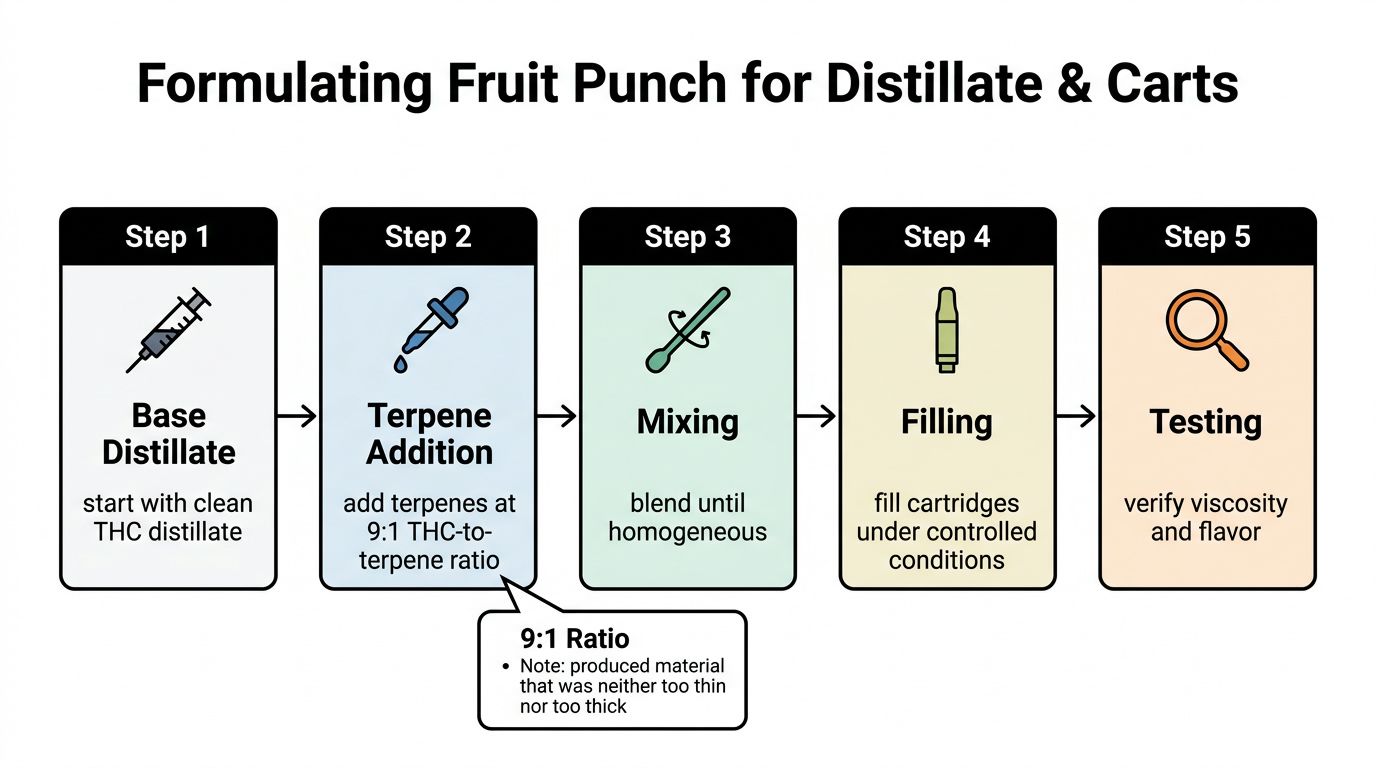
Control the finished formulation
- Calculate total terpenes: Include the base oil's terpene contribution, not only the added blend.
- Standardize mixing: Document mass, temperature, mixing conditions, and homogeneity.
- Validate hardware: Check filling behavior, leakage, and sensory performance in the intended cartridge.
- Set acceptance criteria: Define what fails before choosing the preferred sample.
New York's published requirement cited above sets a 10% total-terpene ceiling for the relevant inhaled adult-use products. That's a market-specific limit, not a global standard or a recommended target.
Gold Coast Terpenes' distillate and terpene mixing resource can support preparation and calculation. Supplier guidance doesn't replace validation of the actual base oil and device.
Include aerosol chemistry in approval
A University of California study reported carbonyl formation increasing by as much as ninefold when tested terpene mixtures were added to THC distillates under its aerosol-generation conditions. Separate work discussed in the report found myrcene-related isoprene increases during dabbing but not during CCELL vaping-device testing, illustrating hardware and heating dependence in the University of California terpene emissions report.
Release criterion: Pleasant aroma is not evidence of acceptable aerosol chemistry. Validate the intended formulation under the intended operating conditions.
Worked Example Using a 24k Gold Punch Strain-Inspired Profile
Use a named strain-inspired profile as a candidate to test against your reference, not as proof of an exact terpene composition. A worked evaluation should establish what the product delivers before anyone claims flavor replication.
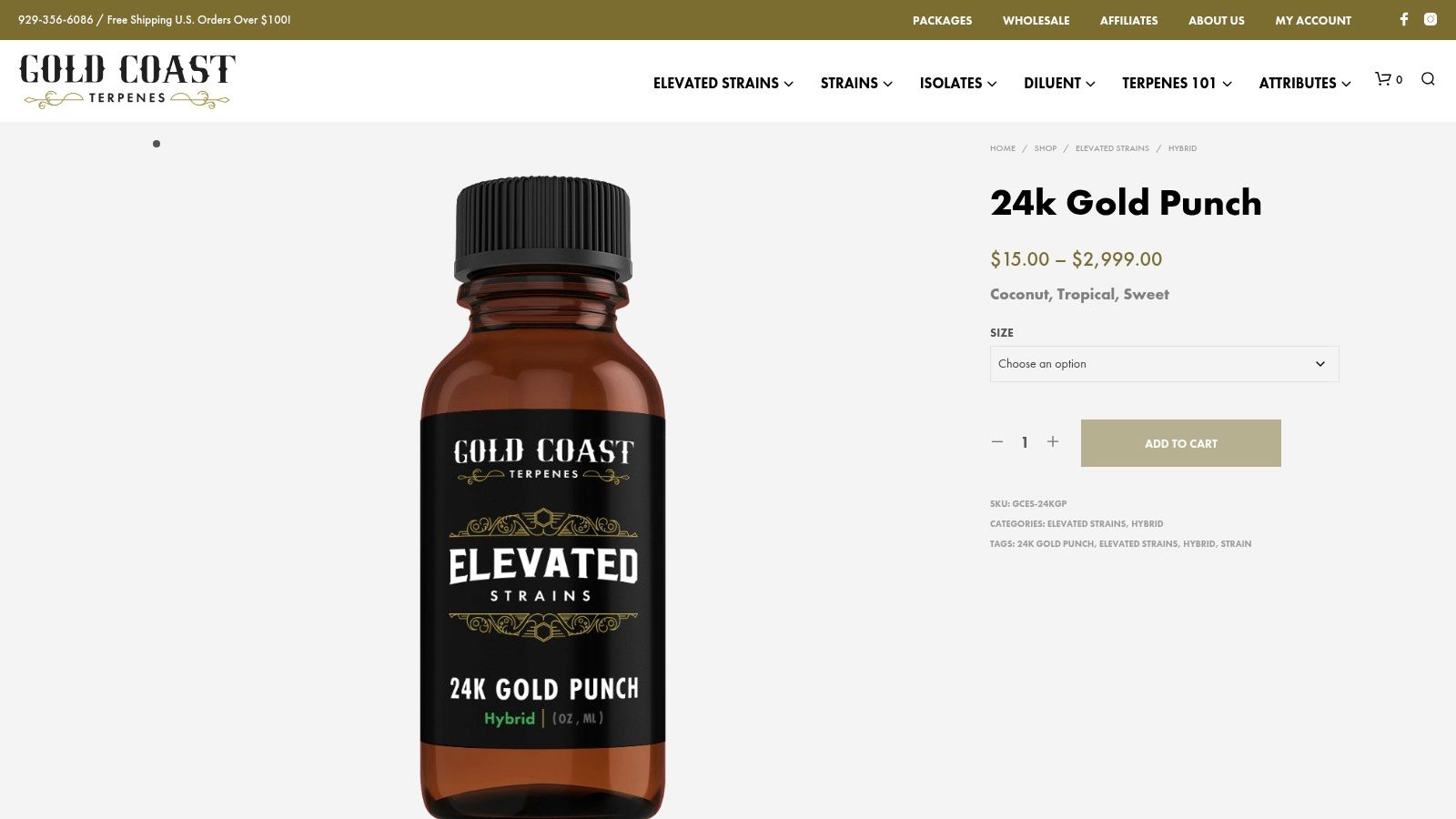
Gold Coast Terpenes lists 24k gold punch as a flavor product. The listing identifies the candidate, but it doesn't establish a quantitative composition or measured cartridge performance.
The supplied product-page screenshot gives the purchasing team a shared reference.
Run a controlled comparison
Prepare lower, middle, and higher loading candidates within the approved development range. Keep the distillate, cartridge, mixing procedure, and evaluation conditions consistent so loading is the variable being compared.
This is a proposed screening exercise, not a claim that those samples have already been tested. Don't assume the higher-loading candidate will produce the most accurate flavor.
| Candidate | Evaluation Question | Decision |
|---|---|---|
| Lower loading | Is the punch identity recognizable without excessive intensity? | Retain if it meets the reference and physical requirements |
| Middle loading | Does added aroma improve the missing sensory cues? | Compare directly against the lower-loading candidate |
| Higher loading | Does intensity improve accuracy or expose off-notes? | Reject if sensory or hardware acceptance criteria fail |
Record opening character, central fruit identity, finish, and reference similarity separately. If the opening improves while the finish becomes peppery, that's a trade-off requiring a formulation decision, not an automatic improvement.
The accompanying video is an additional reference asset, not analytical evidence for composition or cartridge suitability.
Decide whether to retain or customize
Approve the candidate only if it preserves the intended strain-inspired identity while meeting the fruit-punch target. If matching the reference requires repeated corrective additions, compare a custom blend instead of continually modifying the original.
Retain the selected sample and document the approved formulation. Purchasing should order against that specification, not just the flavor name.
Wholesale Checklist for Buying Fruit Punch Terpenes
Buy against an approved specification and a documented commercial agreement. A bulk order isn't ready because a sample smells good or the supplier offers a volume price.
Gold Coast Terpenes provides wholesale, bulk, and affiliate programs. Keep those functions separate: manufacturing procurement needs material specifications and supply terms, while affiliate participation concerns referrals rather than batch release.
Confirm purchasing terms
- MOQ: Ask for the minimum order quantity for the chosen profile, sample purchases, and any custom work. Don't assume one minimum applies across formats.
- Bulk tiers: Obtain a written quote covering quantity breaks, packaging, lead time, and reorder terms.
- Shipping: Confirm the current free U.S. shipping threshold, eligible destinations, and any exclusions before issuing the purchase order.
- Program eligibility: Establish whether the order belongs under wholesale or bulk terms rather than assuming an affiliate arrangement provides manufacturing pricing.
Use Gold Coast Terpenes' wholesale terpene resource as the starting point for those commercial questions. Request current terms rather than building a production budget around an unconfirmed website offer.
Confirm release documentation
Ask for a lot-specific COA, ingredient declaration, safety documentation, source statement, and relevant testing information. Match the lot identifier on the documents to the material received.
Clarify what the laboratory tested, which methods it used, and what the results establish. A general lab-tested statement isn't equivalent to a complete finished-product approval package.
Finally, retain the evaluated sample and define how incoming material will be compared with it. That gives quality control a practical acceptance reference when a larger shipment arrives, without relying on recollection or a marketing description.
Key Takeaways and Buyer Questions on Fruit Punch Flavor
Before scaling, lock the sensory specification, the validated oil-and-hardware combination, and the supplier documentation. Those decisions determine whether a recognizable fruit punch flavor becomes a repeatable commercial product.
Don't approve them separately. A purchasing team needs the same formulation identity that development tested, and quality control needs acceptance criteria that match the approved sample.
Why choose a botanical blend for a flavor-first SKU?
Gold Coast Terpenes supplies botanical, THC-free blends for developers who want to build an aroma direction without cannabis-derived inputs. Confirm those attributes through the current ingredient and analytical documents for the material you're buying.
When should a brand choose a custom blend instead of a strain-inspired profile?
Choose a prepared profile when it meets the reference without substantial correction. Consider custom development when preserving the starting profile conflicts with the target aroma or requires repeated adjustments that complicate procurement.
What MOQ should a wholesale buyer expect?
There isn't a substantiated universal minimum for the profiles discussed here. Ask Gold Coast Terpenes for written MOQ and bulk terms covering the selected product, packaging, and reorder requirements.
How should a buyer verify laboratory and labeling claims?
Request lot-specific results, source documentation, ingredient declarations, and an explanation of the tests performed. Compare Gold Coast Terpenes' supplied records with destination-market requirements and the proposed finished-product label before release.
For purchasing, return to the linked product listing with your approved sensory specification. Use the formulation and terpene guides linked above to prepare technical questions, then request the documents and sample quantities needed for your own validation.
{ “@context”: “https://schema.org”, “@type”: “FAQPage”, “mainEntity”: [ { “@type”: “Question”, “name”: “Why choose a botanical blend for a flavor-first SKU?”, “acceptedAnswer”: { “@type”: “Answer”, “text”: “Gold Coast Terpenes supplies botanical, THC-free blends for developers who want to build an aroma direction without cannabis-derived inputs. Confirm those attributes through the current ingredient and analytical documents for the material you’re buying.” } }, { “@type”: “Question”, “name”: “When should a brand choose a custom blend instead of a strain-inspired profile?”, “acceptedAnswer”: { “@type”: “Answer”, “text”: “Choose a prepared profile when it meets the reference without substantial correction. Consider custom development when preserving the starting profile conflicts with the target aroma or requires repeated adjustments that complicate procurement.” } }, { “@type”: “Question”, “name”: “What MOQ should a wholesale buyer expect?”, “acceptedAnswer”: { “@type”: “Answer”, “text”: “There isn’t a substantiated universal minimum for the profiles discussed here. Ask Gold Coast Terpenes for written MOQ and bulk terms covering the selected product, packaging, and reorder requirements.” } }, { “@type”: “Question”, “name”: “How should a buyer verify laboratory and labeling claims?”, “acceptedAnswer”: { “@type”: “Answer”, “text”: “Request lot-specific results, source documentation, ingredient declarations, and an explanation of the tests performed. Compare Gold Coast Terpenes’ supplied records with destination-market requirements and the proposed finished-product label before release.” } } ] }Gold Coast Terpenes offers botanical terpene blends and isolates for cartridge, concentrate, and flavor development. Visit Gold Coast Terpenes with your fruit-punch reference, base-oil specification, and intended hardware, then request a candidate sample, current wholesale terms, and supporting documentation before committing to a bulk order.