
A commercial THC terpenes chart is most useful when it starts with chemistry, not strain folklore. In commercial concentrates, the dominant terpene usually makes up about 35% of the total profile, the top four compounds cover roughly 72%, and the leading nine compounds account for more than 86% of measured profiles, so formulators should match the leading cluster first and treat the name on the jar as a hint, not a spec.
Gold Coast Terpenes, a Redondo Beach, CA supplier, publishes 50+ lab-verified, THC-free botanically derived blends, which makes it a practical reference point when a brand needs repeatable flavor work instead of guesswork. For R&D teams building carts and distillate SKUs, the right chart is a lab-report-first tool that helps you identify the dominant cluster, manage load rates, and keep the chemistry aligned with hardware behavior.
What a Modern THC Terpenes Chart Actually Shows
A modern THC terpenes chart should show which compounds dominate a batch, how those compounds stack into a usable profile, and where the limits of that profile begin. The best version doesn't just list a strain name, it shows the leading cluster, the supporting notes, and the fact that a chart is only as good as the certificate of analysis behind it. Gold Coast Terpenes, the Redondo Beach, CA supplier with 50+ lab-verified blends, uses that practical framing in its terpene reference materials and strain-specific offerings.
A useful chart starts with the dominant chemistry, not the marketing label. In commercial flower, the strongest compounds often sit in repeatable clusters, and the major contributors do most of the sensory work, while the minors fine-tune the finish. A lab-report-first chart should therefore compare the expected archetype against actual percentages, show total terpene content versus relative ranking, and note that batch variation, growing conditions, post-harvest handling, and extraction can all shift the profile.
Practical rule: when a cart formula misses the target, the problem is usually not the strain name. It's the wrong dominant cluster, the wrong load rate, or the wrong hardware assumption.
For formulators, that means a chart is a decision tool, not decoration. If you're working on a terpene profile for cannabis product formulation, you want to know whether the blend is built to mimic a flower report, reconstruct a distillate aroma, or deliver a stable cartridge fill. Gold Coast Terpenes keeps that distinction clear in its terpene temp chart, which is the kind of working reference a bench team can use.
A strong chart also needs to tell you what to do next. The rest of this article breaks that down into clusters, top, mid, and base notes, cartridge load rates, supplier choice, evidence limits, and a bench checklist so product teams can move from reading to blending.
Why Strain Names and Indica or Sativa Labels Fall Short
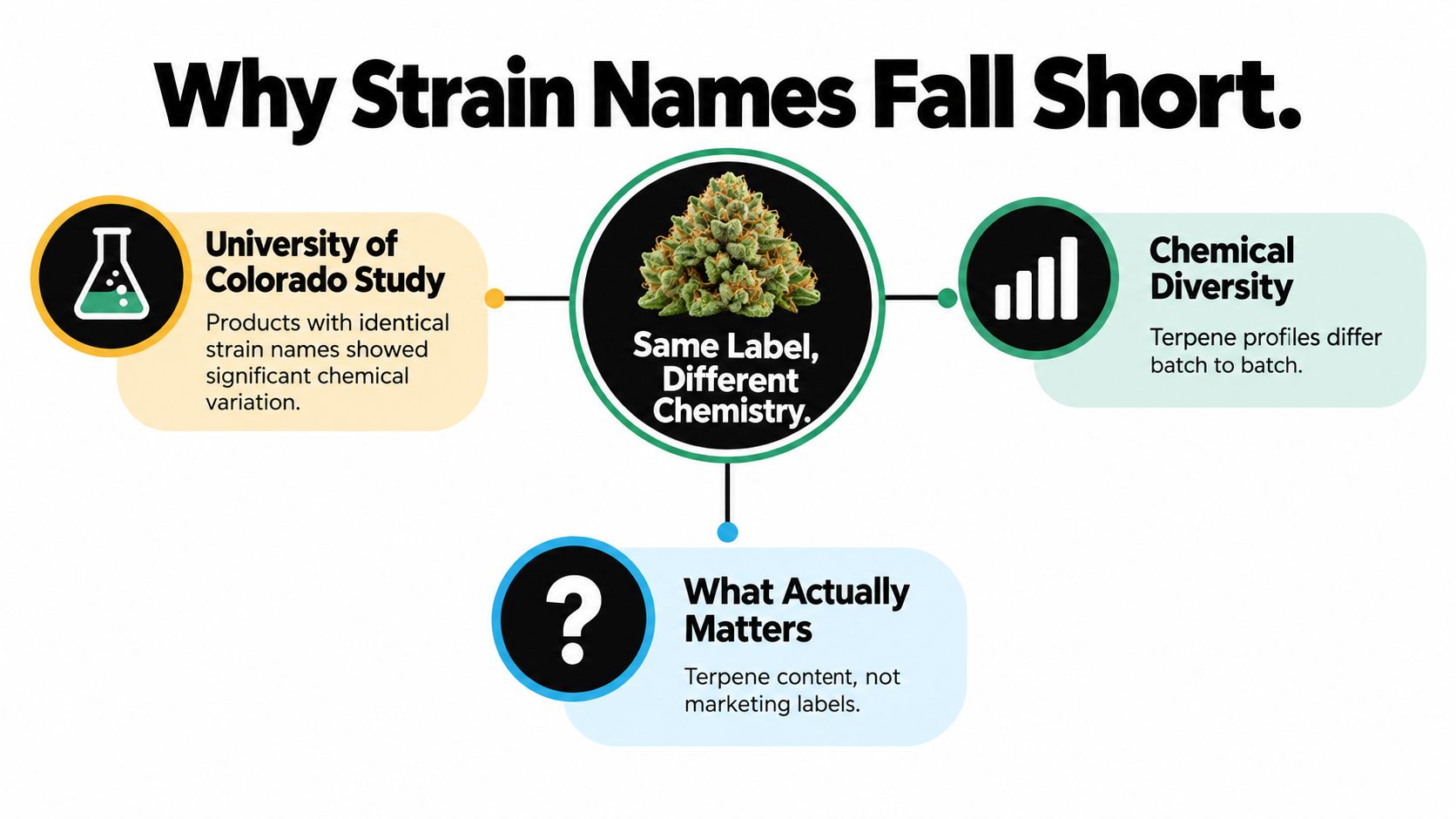
Strain names and indica or sativa labels are unreliable as formulation specs because the same commercial label can hide very different chemistry. A large University of Colorado analysis found that industry labels didn't consistently align with observed chemical diversity, and products grouped more meaningfully by dominant terpene patterns than by the name on the package.
What changes from batch to batch
The problem starts upstream. Cultivar, grow conditions, harvest timing, cure, extraction, and post-processing can all shift the profile enough that two batches of the same named material land in different chemical buckets. For B2B buyers, that means a label like “Blue Dream” can't be treated as a complete formulation spec, especially when the product is heading into a cartridge or a distillate-based SKU.
A current certificate of analysis is the decision point. It tells you the dominant cluster, the support compounds, and whether the material behaves like the batch you're trying to reproduce. The data-backed clusters that show up again and again are caryophyllene-limonene, myrcene-pinene, and terpinolene-myrcene, so those are the families worth comparing before you lock a flavor target.
What to ask a supplier
Ask for the dominant terpene, the secondary anchors, and the date of the lab report. Ask whether the source material is flower, extract, or a post-processed distillate blend. Ask whether the supplier can match a current cluster instead of pointing to a familiar name.
For a buyer comparing a named flavor page, a useful reference is the Bull Moose Blend Cherry Hill page, because it illustrates how a profile can be framed around sensory expectation while still needing chemistry to verify the fit.
If the chemistry and the label disagree, trust the chemistry.
That approach keeps a terpene profile for cannabis product formulation grounded in actual inputs, which is exactly where R&D teams need it.
The Three Dominant Terpene Clusters Every Formulator Should Know
The three clusters most worth tracking are caryophyllene–limonene, myrcene–pinene, and terpinolene–myrcene. They don't just smell different, they give you different blending behavior, different note structure, and different starting points for cartridge work.
Cluster comparison at a glance
| Cluster | Dominant Anchor | Secondary Compound | Sensory Cues | Typical Ratio | Example Gold Coast Terpenes Profile |
|---|---|---|---|---|---|
| Caryophyllene–limonene | Beta-caryophyllene | Limonene | Spicy, bright, gas-forward | Base-led with citrus lift | OG Kush style profile |
| Myrcene–pinene | Beta-myrcene | Alpha-pinene or beta-pinene | Earthy, pine, herbal | Heavy base with sharper top note | Blue Dream style profile |
| Terpinolene–myrcene | Terpinolene | Beta-myrcene | Fruity, resinous, sweet-herbal | Top and mid leaning with depth | Green Crack style profile |
How to read the clusters
The caryophyllene–limonene family tends to give brands the fastest route to a gas, spice, or dessert-adjacent profile. It's useful when the brief calls for a profile that needs a warm backbone without losing brightness. Myrcene–pinene is the cleaner structural cluster, with a heavier base and a more obvious pine or herbal top note. Terpinolene–myrcene gives you a fruitier or more resinous profile, and it often reads softer at the front while holding a deeper body underneath.
For a formulator, the job is to map the target SKU to the cluster first, then adjust the top, mid, and base composition. If you're building a strain-inspired terpene blend, the cluster is the shortcut that keeps you from overfitting to the name on the package.
A practical example is a cart line that needs a Cherry Hill style flavor target. Instead of forcing a literal strain match, a team can start from the cluster, confirm the dominant anchor, and then tune sweetness, pine, or spice until the profile feels right on hardware. That's a faster path than chasing every minor terpene.
Top, Mid, and Base Notes in a Strain-Inspired Terpene Blend
A strain-inspired blend works best when you treat terpenes like a note structure, not a flat list. Top notes give first impression, mid notes carry body, and base notes hold the finish, which is the same logic perfumers use when they build stable aroma.
Build the blend by function
Top notes usually come from Limonene and Alpha-Pinene. They bring citrus, pine, and a sharp opening that reads fast on the inhale. Mid notes often come from Linalool and Terpinolene, which carry floral, herbal, and lightly sweet character into the middle of the draw. Base notes come from Beta-Caryophyllene and Alpha-Humulene, which anchor spice, wood, and a fuller gas finish.
For fruit-forward SKUs, let the top note stay bright and keep the base restrained. For dessert or heavier profile work, the base can carry more weight, while the mid note softens the transition. Gold Coast Terpenes' Elevated Strains line is built to highlight rare, exotic terpenes that support nuanced fruit and dessert targets without flattening the rest of the profile.
Formulation rule: if a blend smells right in the beaker but goes dull after processing, the top note was probably underbuilt.
The note structure protects you from winterization losses. Lighter compounds are the first to disappear or soften, so if the target aroma depends on them, they need to be reintroduced with intention rather than assumed to survive. The most reliable approach is to protect the top note separately, then check that the mid and base still read correctly once the blend is in oil.
For teams building a formulation guide around flavor accuracy, the terpene flavor chart is the kind of practical reference that helps isolate those note decisions before the first fill run.
From Flower Profile to Cartridge Flavor
A flower profile rarely survives extraction, winterization, and storage unchanged. By the time a product gets into cart format, the aroma can shift because the lighter compounds don't behave the same way in oil, on hardware, or after time on shelf.
What changes after extraction
Extraction changes the balance first, then storage compounds it. Winterization can strip or mute parts of the aromatic top end, and storage can further flatten a profile if the blend wasn't built with that loss in mind. The result is common in cartridge R&D, a flower chart that looked good on paper but lands softer, flatter, or more generic once it's diluted into distillate.
That's why Gold Coast Terpenes' formulation tools matter to development teams. Their botanically derived blends are THC-free and built without VG, PG, PEG, or MCT, which makes them better suited to standardization work than a loose, unverified flavor add-in. The practical value is consistency, not nostalgia.
How to standardize a SKU
Use a repeatable profile source, then decide whether the target needs an Elevated Strains style accent or a more literal reconstruction. If the brand needs exact batch-repeatability, a nature-identical flavoring compound may be the tighter fit. If the brand needs a fruit or dessert target that stays readable on hardware, a botanical blend with strong top-note support is usually easier to control.
Production teams should keep the mixing calculator, safety documents, and lab paperwork in the same workflow, not in separate folders. That shortens approval cycles and gives QA a clean trail from source material to final fill. Gold Coast Terpenes keeps those resources together on its site, which is useful when the bench team needs to reconcile flavor, compliance, and repeatability in one pass.
Terpene Load Rates for Vape Cartridges and Distillate
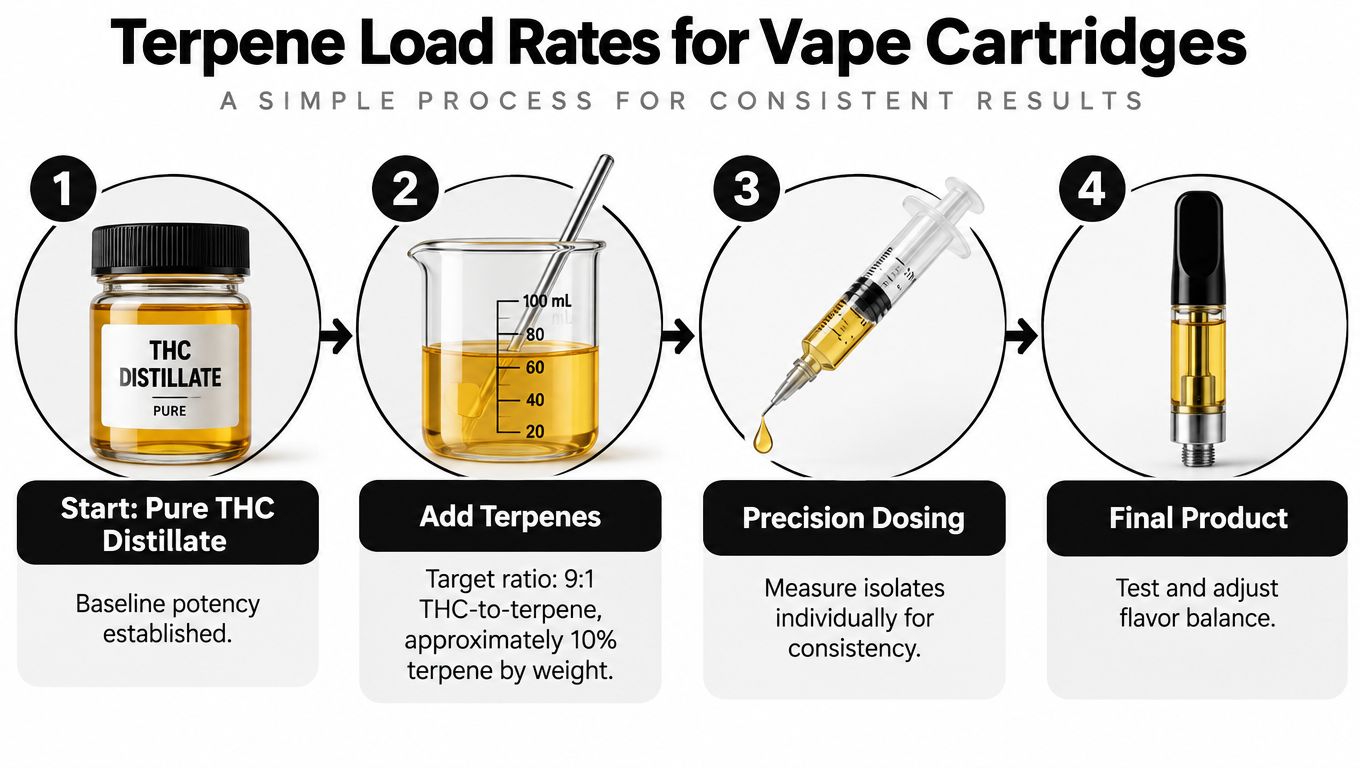
The most practical development benchmark is a 9:1 THC-to-terpene ratio, which comes out to about 10% terpene by mass in the finished THC-terpene mixture. That level was selected in a peer-reviewed concentrate vaping study because it balanced vaporization behavior and viscosity without added solvents or diluents.
Why load rate changes the hardware outcome
Terpene percentage doesn't just change aroma. It changes rheology, fill behavior, aerosol output, and whether the cartridge behaves cleanly under normal use. Excess terpene loading can make concentrate too fluid and can contribute to leakage from a vape pen, which is a hardware problem as much as it is a flavor problem.
That matters because modern cannabinoid cartridges are often filled with distillate in the 700 to 2,000 mg/mL range, and the terpene addition has to be calculated against actual cannabinoid-oil mass, not just poured in by eye. A fill that looks fine in a beaker can behave very differently once it hits a specific cartridge and wick geometry.
How to think about load bands
| Load band | Practical use | Trade-off |
|---|---|---|
| Under 6% | Lean aroma work, tighter viscosity | Less flavor lift, more muted top note |
| 7 to 10% | Balanced cartridge development | Better flavor and manageable flow |
| Over 12% | Aggressive aroma or experimental work | Higher leakage risk and softer hardware fit |
Under 6% usually keeps the fill conservative, but the profile may read underpowered on inhale. Seven to 10% is the development range to pressure-test first because it tends to keep flavor and handling in balance. Above 12%, the blend can become too loose for some hardware, so the cartridge, oil, and seal design all need validation before scale-up.
For distillate work, the safest approach is to measure against batch mass, test viscosity, and validate fill performance before committing to production. If your team is setting up a terpene profile for cannabis product formulation, the how much terpenes to add to distillate guide is a useful bench reference.
Botanical vs Cannabis-Derived Terpenes for B2B Buyers
For most wholesale buyers, botanical terpenes are the easier operational choice because they're simpler to source, easier to ship, and more consistent from batch to batch. Cannabis-derived terpenes can be useful for certain sensory goals, but they usually bring more legal and supply friction.
Gold Coast Terpenes' blends are 100% botanically derived, which puts them in the category most B2B teams can plan around. That doesn't make cannabis-derived material irrelevant, it just means the workflow is different and usually narrower.
Supply options compared
| Source Type | Legal Status | Batch Consistency | Best Use Case | Key Caveat |
|---|---|---|---|---|
| Botanical | Broadly practical for wholesale and shipping | Stronger repeatability | Cartridge flavor, distillate formulation, scale production | May need careful tuning for exact strain mimicry |
| Nature-Identical | Useful for flavor standardization | Very high when specified well | Repeatable flavor correction and profile repair | Can feel less “whole profile” than a full botanical blend |
| Cannabis-Derived | More friction in handling and movement | Varies with source lot | High-fidelity cannabis-adjacent sensory work | Supply, cost, and compliance complexity |
The middle lane matters too. Nature-identical compounds can be the best choice when a brand needs repeatability more than a romantic source story. That's why many formulators use a hybrid approach, botanical for the base blend, isolate or nature-identical adjustments for the top note, and a final sensory pass before fill.
For teams evaluating supplier structure, the CDT vs BDT guide is a practical comparison point. Gold Coast Terpenes also supports wholesale and bulk programs, with free U.S. shipping on orders over $100 and tiered discounts above 64 oz, which can matter once a SKU moves from pilot work into production planning.
Isolate-Led Flavor Adjustments for Formulators
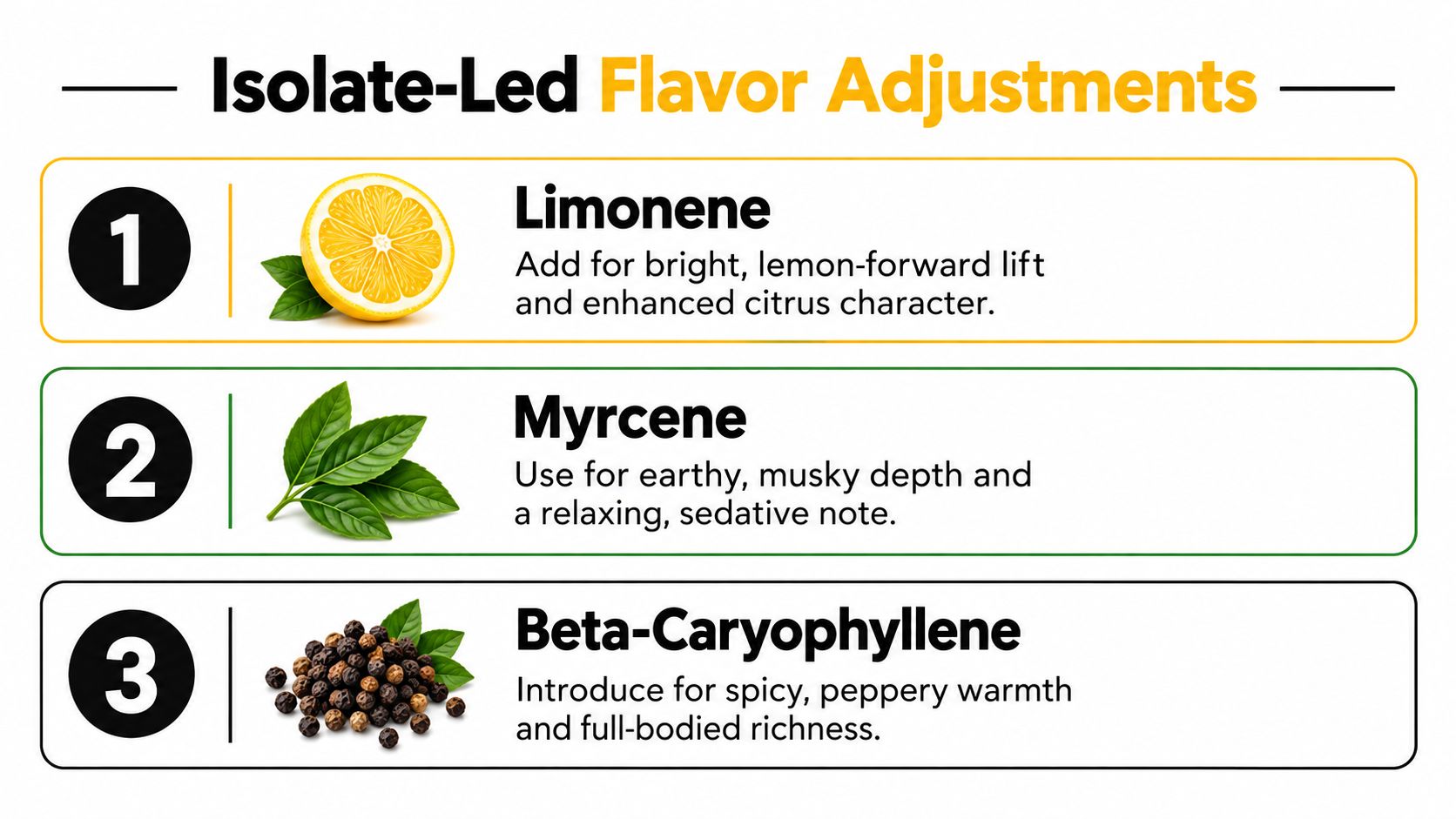
The fastest way to tune a profile is to adjust the most obvious note first. For many teams, that means Limonene for citrus lift, Myrcene for earthy depth, and Beta-Caryophyllene for spice and body.
Quick tuning grid
- Limonene: Use when the top note needs brighter citrus lift. A small correction can make a dull cart read cleaner and more open on the inhale.
- Myrcene: Use when the base needs more earthy or musky depth. It helps when a blend feels thin after dilution.
- Beta-Caryophyllene: Use when the finish needs spice, pepper, or a fuller body. It's the easiest way to strengthen the lower register without rebuilding the whole formula.
Isolate-led adjustment is faster than re-blending an entire profile, especially when the issue is obvious and narrow. It underperforms when the target depends on minor-note complexity, rare fruit nuance, or dessert layering, because one compound can only solve one part of the problem.
If the SKU needs a more specific repair, that's when a custom blend makes more sense than isolated correction. Gold Coast Terpenes keeps named isolates in the lineup, so a formulator can use a single compound for targeted tuning instead of changing the whole terpene base.
Effect Claims, Dose, and What the Evidence Actually Supports
Effect labels should stay conservative unless the evidence is specific, current, and relevant to the actual dose and delivery method. A 2025 controlled human study found that inhaled alpha-pinene, at doses up to 15 mg, did not mitigate THC-related memory impairment or significantly change common acute effects, and alpha-pinene alone produced no significant pharmacodynamic effects versus placebo.
That makes broad effect copy risky. Sensory descriptors are one thing, but claims about relaxation, focus, anxiety reduction, or cognitive effects need much tighter support than a flavor chart usually provides.
What the evidence does and doesn't say
A separate vaporization study reported lower anxiety and paranoia ratings with THC plus d-limonene, but that doesn't prove every limonene-rich product will do the same thing. Another line of research found no synergistic effect between cannabis-derived terpenes and THC on tested alveolar macrophage functions, which undercuts the habit of treating entourage claims as settled fact.
The aerosol side matters too. A 2025 vaping study reported volatile organic compounds including benzene, methacrolein, and isoprene from THC and terpene-containing aerosols, and it flagged cardiovascular concerns tied to nonlinear dose-response behavior. That's why formulation, device temperature, and load rate belong in the same conversation as labeling.
Safe copy says what the product is and how it tastes. Unsafe copy says what it will do to the user.
For product pages, stay with sensory language, formulation context, and hardware notes. Avoid medical or psychotropic promises unless they're supported by a documented, product-specific data package.
A Formulation Checklist for the Bench
A THC terpenes chart is a starting point, not a spec sheet. The fastest bench workflow is to identify the dominant cluster, set the load band, choose the source type, and make sure the effect language stays inside the evidence.
Bench checks to run every time
- Pull the current COA. Confirm the dominant terpene and secondary anchors before you mix.
- Map the cluster. Decide whether the target is caryophyllene–limonene, myrcene–pinene, or terpinolene–myrcene.
- Set the load band. Keep the first pass in a conservative range, then test hardware behavior.
- Choose the source. Use isolate, botanical blend, or a custom mix based on the target profile.
- Verify the copy. Keep claims sensory and formulation-based unless the evidence is specific enough to support more.
Gold Coast Terpenes' Terpenes 101, mixing calculator, and state information pages are the right internal references when a brand needs to move from chart reading to compliant production work. For teams that need a working reference tied to a real order path, those resources keep formulation, labeling, and sourcing in the same system.
If the chemistry changes, the chart changes with it. That's why the best R&D teams treat a terpene chart like a live formulation document, not a marketing asset.
Gold Coast Terpenes offers lab-verified, THC-free botanically derived terpene blends, named isolates, and formulation tools that fit cart, distillate, and flavor-matching work. If you're turning a THC terpenes chart into a real bench formula, visit Gold Coast Terpenes to compare profiles, review resources, and start building against a current COA instead of a strain name.