
If you're trying to build a Pineapple Upside Down profile for carts or distillate, the first mistake is treating the name like a fixed recipe. Gold Coast Terpenes, a Redondo Beach, CA supplier, makes 100% botanically derived, THC-free terpene blends, and that matters here because pineapple upside down functions as a market-style flavor target, not a single chemistry package.
The practical move is to start with a certificate of analysis, not with folklore. For brand teams working on a new SKU, Gold Coast Terpenes gives you a formulation reference point, while a tool like analyze competitor visibility gaps can help you see how crowded the flavor conversation is before you commit to a launch angle. If you want the basic chemistry primer first, the internal guide on what are terpenes is the right baseline.
What Formulators Should Know About Pineapple Upside Down
Pineapple Upside Down works best as a sensory target, not a fixed chemical standard. For carts and distillate, the name gives direction, while the batch COA tells you what can be rebuilt.
Start with the label, then verify the batch
A product page can say Pineapple Upside Down, Pineapple Upside Down Cake, or something close to it, and still leave you with a different genetics story, a different terpene fingerprint, or a different extraction matrix. Public breeder and strain records generally place it as a modern California cultivar tied to Humboldt Seed Company, with parentage commonly described as Pineapple Trainwreck × Cookie Monster. That points toward pineapple, caramelized sugar, cake, and sometimes vanilla or light fuel, but those are aroma cues, not a working formula.
Practical rule: if the product page does not include a batch-level COA, you do not have enough information to build a reproducible flavor.
A usable COA should at least show the batch ID, the test date, and the terpene panel. Without that, you cannot tell whether you are reconstructing a bright tropical note, a sweeter baked profile, or a heavier finish that will push the cart out of balance. The same name can cover more than one batch, so the chemistry has to lead the decision.
The formulation team also needs a shared vocabulary for what the chemistry means. A basic primer like What Are Terpenes helps separate aroma targets from raw chemistry without turning the brief into strain folklore.
Why the market name is not the chemistry
Batch-level data is the only part that holds up in production. Flower and distillate versions can diverge sharply, so a strain name alone cannot tell you potency, aroma strength, or the terpene load you should build around. For a brand owner, the workflow is simple, choose the sensory target, verify the chemistry, then build to the measured profile.
Gold Coast Terpenes supplies 100% botanically derived terpene blends, which makes that reconstruction work practical once the target is set. If you are comparing how crowded the flavor space is before a launch, you can analyze competitor visibility gaps and use that read alongside the COA, not instead of it.
Lineage and Phenotype-Dependent Chemistry
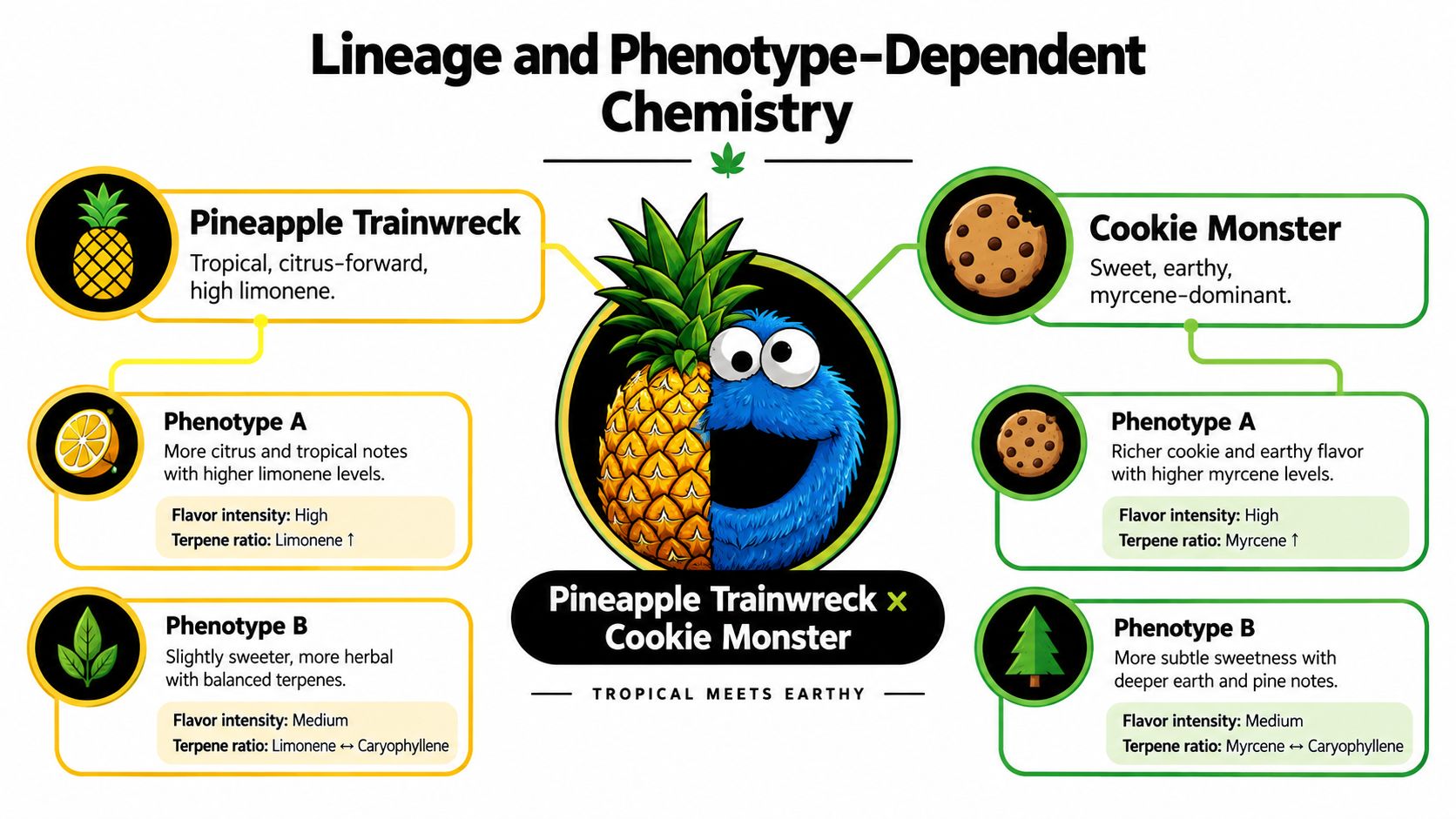
Pineapple Upside Down Cake is usually described as Pineapple Trainwreck × Cookie Monster. That parentage matters because it combines a tropical, Trainwreck-derived aromatic line with a Cookies-family cultivar known for dense resin and dessert sweetness. For formulators, the label only defines the starting point, because phenotype variation changes the actual output.
Parentage explains the flavor direction, not the final ratios
Reported flower data place THC broadly around 18%–26%, with CBD generally below 1%, CBG often around 0.1%–0.6%, and total terpenes near 1.5%–3.0% in well-grown, properly cured material see the strain guide. That range is wide enough to matter in production, because two batches with the same name can still pull in different directions.
Practical takeaway: the cultivar name sets the expectation, but the COA sets the blend.
A citrus-leaning phenotype can justify a higher limonene emphasis and a softer caryophyllene base, while a heavier, dessert-leaning batch may call for more resinous support and less bright top-note lift. Those choices are made from the measured chemistry, not from the strain name alone.
The strain guide gives a useful market reference, but the same principle applies to commercial flavor lines. For a cross-reference point, Elevated Strains shows how a named flavor target can be organized commercially without pretending every batch is identical.
What phenotype variation means in practice
A tropical phenotype usually reads brighter and more citrus-forward, while a dessert-heavy phenotype can come across richer, denser, and more resinous. In a distillate cart, that difference changes the rebuild strategy, since the terpene balance has to carry flavor without making the finish sharp or muddy.
If you are developing against a portfolio instead of a single batch, Gold Coast Terpenes gives you a structured strain library to work from. Use it as a reference system, then verify each batch before you set the final ratio.
Comparing Two COA Fingerprints for Pineapple Upside Down
A Pineapple Upside Down label can cover two very different COA stories. One batch can read like a caryophyllene-led flower profile, while an extract report can be dominated by ocimene, which changes the rebuild plan in carts and distillate.
Two fingerprints, two reconstruction paths
Before comparing fingerprints, make sure the team can read the document itself. The guide on COA certificates of analysis covers the panel structure and helps separate cannabinoid totals from terpene emphasis.
One Florida flower batch reported 30.2% total active THC, 0.0800% total active CBD, 1.14% CBG, and 35.7% total cannabinoids, with the batch weighing 872.4 grams and containing 27 units COA report. The same document also covers a Pineapple Upside Down Cake distillate product that reported 68.0% delta-9 THC, 0.180% CBD, 0.850% CBN, 0.449% THCV, and 74.773% total active cannabinoids. Those figures do not translate one-to-one, because flower and distillate are different matrices and extraction changes what remains measurable.
The terpene contrast is more useful for formulation. The flower report lists 2.64% total terpenes, led by beta-caryophyllene at 0.598%, myrcene at 0.394%, 3-carene at 0.300%, phellandrene at 0.184%, and humulene at 0.171%. The extract report shows 8.62% terpenes, with ocimene at 6.62%, beta-caryophyllene at 1.07%, and limonene at 0.93%.
| Terpene | Flower COA normalized % | Descended COA normalized % |
|---|---|---|
| beta-caryophyllene | 22.65% | 12.41% |
| myrcene | 14.92% | 0.00% |
| 3-carene | 11.36% | 0.00% |
| phellandrene | 6.97% | 0.00% |
| humulene | 6.48% | 0.00% |
| ocimene | 0.00% | 76.80% |
| limonene | 0.00% | 10.79% |
What to copy, and what to ignore
The dominant-to-secondary ratio matters more than the headline total, because it determines how the blend reads on device. An ocimene-forward extract needs a different support structure than a flower profile built around caryophyllene and myrcene. If you chase total terpene percentage, you can miss the flavor geometry entirely.
For a formulation team, that means COAs should be compared after normalization. Match the hierarchy first, then decide whether to preserve fruit brightness, add body, or round off the finish. Gold Coast Terpenes uses that same logic across a strain library when a brand needs a named profile rather than a generic sweet blend.
What Are the Top, Mid, and Base Notes for a Pineapple Upside Down Blend
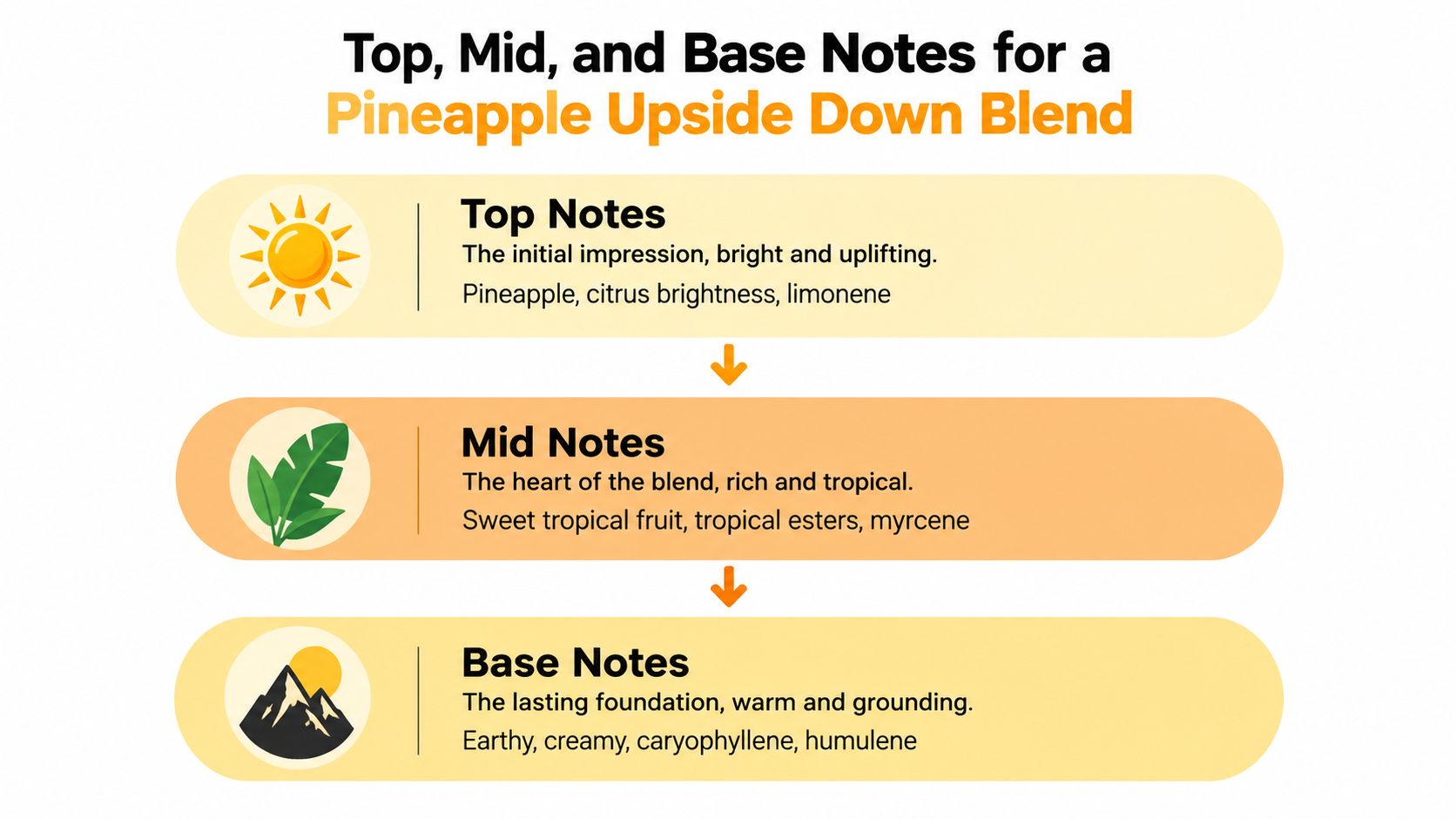
A Pineapple Upside Down profile works best as a market target, not as a fixed recipe. The job is to rebuild the way the flavor opens, develops, and finishes in a cart, using COA data to guide the balance.
Top notes carry the first hit. For this style, limonene usually gives the bright citrus lift, while alpha-pinene adds a cleaner edge that keeps the opening from reading heavy or jammy.
The middle layer carries the fruit body. Ocimene supports tropical lift, and terpinolene can add a sharper floral-herbal line when the batch needs more cut. For a reference map of which terpenes sit in which layer, see the terpene flavor chart. The mid layer should bridge the pineapple top note into the dessert finish without taking over the blend.
Let the base carry the cake finish
The base layer does the work that gives the profile weight. beta-caryophyllene, humulene, and a touch of linalool can round out the finish, add structure, and keep the profile from collapsing into straight candy. Caryophyllene brings peppery depth, humulene keeps the blend grounded, and linalool softens the edges when a smoother dessert note is needed.
COA variability matters here. A terpene set that reads bright in one extract can feel flatter in another, so the hierarchy has to survive heating and hardware, not just smell right in the jar.
Gold Coast Terpenes' mixing tools and isolate options, including Limonene, Myrcene, and Beta-Caryophyllene, give formulators practical building blocks for this kind of work. Preserve the hierarchy instead of adding every sweet terpene available.
How Do You Translate the Profile Into a Distillate Cartridge Blend
A Pineapple Upside Down cart should start with the hardware, not the flavor room. For distillate, a 9:1 THC-to-terpene ratio is a practical experimental reference, but the final load still has to be adjusted for viscosity, wick saturation, and cold-flow behavior in the actual device.
Start with a tested loading point
The safest way to handle a 1-gram or 5-gram batch is to calculate terpene percentage against the finished oil weight, then convert that target into the actual mass for blending. A cart that smells right on the bench can still clog, leak, or mute the top notes once it hits hardware, so the test run has to happen in the cartridge you plan to ship.
For a small launch, that means a pilot batch first, then a hardware check, then scale-up. Gold Coast Terpenes keeps that workflow simpler because its blends are THC-free and free of VG, PG, PEG, and MCT, which reduces formulation variables before you start tuning viscosity.
Match the cartridge to the blend
Different hardware changes how fast the aroma opens and how long the base note hangs on. A ceramic-core cart at 3.3V will mute ocimene faster than a wick-based cart, while coil material and oil port diameter change wicking speed and draw consistency. Log voltage, draw count, and fill behavior during the pilot run, because a terpene-heavy mix can overperform in one device and underperform in another.
The process page for how to mix distillate with terpenes is a useful companion when your team is moving from profile selection to batch execution. If you are building a product line rather than a one-off run, supplier consistency starts to matter.
What Should You Test Before Shipping a Heated Pineapple Upside Down Blend
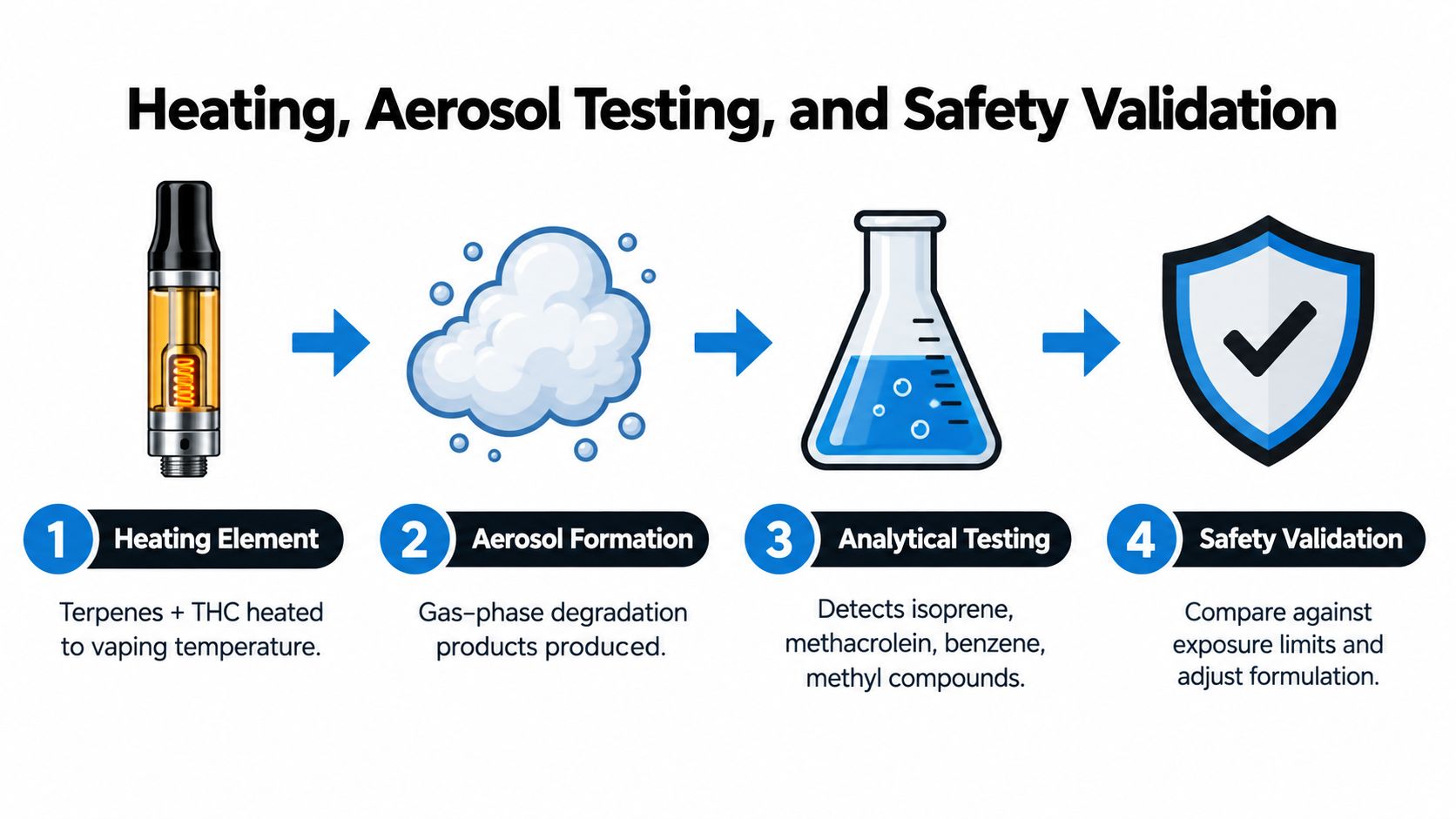
A Pineapple Upside Down cart can smell right on the bench and still fail once it is heated in real hardware. You need cartridge-based testing, because the finished aerosol can differ from the jar note in ways that matter for safety and consistency.
Check the aerosol, not just the aroma
Heating THC with added terpenes can change the gas-phase output. The available evidence reports higher levels of degradation products, including isoprene, methacrolein, benzene, and methyl vinyl ketone, compared with THC alone. The practical takeaway is simple, the result depends on the device, the load, and the heat profile, so a bench-top approval is not enough.
Validation rule: if you haven't run the actual hardware, you haven't validated the blend.
Keep sensory and pharmacological claims separate
A fruity or uplifting aroma does not prove a predictable effect, and it does not support a medical claim. That separation matters for brand credibility and for compliance, since consumers may respond to the flavor while regulators focus on label language and test records.
For safety work, Gold Coast Terpenes publishes documents that support formulation decisions. Final verification should include a post-aging sensory panel and a retained sample tied to the batch COA, so the product you ship matches the material you approved.
How Should You Choose a Supplier and Label the Product for Compliance
For this kind of flavor build, botanical terpenes are usually easier to manage than cannabis-derived ones because they simplify sourcing, shipping, and bulk planning. The main job is to confirm the supplier's testing, carrier-free status, and labeling discipline before you put the blend into a commercial SKU.
What to demand from a terpene vendor
Gold Coast Terpenes is a Redondo Beach, CA supplier of 100% botanically derived, THC-free terpene blends, and that packaging profile is commercially useful because it avoids the extra variables that come with VG, PG, PEG, and MCT. The brand also notes SC Lab testing, which gives a cleaner paper trail when your team is preparing product files.
A practical vetting checklist looks like this:
- Testing documents: Ask for current COAs and keep them tied to each batch.
- Carrier profile: Confirm the blend is free of VG, PG, PEG, and MCT if you're building carts or concentrates.
- Label language: Use accurate flavor and formulation terms, not implied cannabis potency.
- Volume planning: Check MOQ expectations before you finalize your launch calendar.
- Commercial terms: Gold Coast Terpenes notes free U.S. shipping over $100 and bulk discounts on orders over 64 oz, which matters when you're planning scaled production.
Botanical versus cannabis-derived terpene choices
Botanical sourcing gives you a more stable procurement path, especially if you're shipping into multiple markets or building a repeatable bulk program. Cannabis-derived material can be useful in some product lines, but it also brings more complexity around supply continuity and documentation.
For brand owners, the question isn't ideological. It's whether the source fits your compliance framework, your hardware, and your target price structure. If the answer is yes, then the blend can be tuned to match the profile without overcomplicating the supply chain.
Frequently Asked Questions for Pineapple Upside Down Formulators
What Gold Coast Terpenes profile is closest to a Pineapple Upside Down cart?
A profile with bright citrus on top, tropical middle notes, and a caryophyllene-supported base is the closest starting point. Gold Coast Terpenes can be used as the botanical terpene source for that style of reconstruction.
How can I validate a batch without a full panel on every run?
Use the COA from the source batch, then confirm the finished cart on the actual hardware with a small pilot run. Gold Coast Terpenes still gives you a cleaner baseline because the blends are THC-free and SC Lab-tested.
What's a sensible MOQ approach for a small launch?
Start with the smallest volume that lets you test your cart hardware and flavor retention without overbuying. Gold Coast Terpenes also notes bulk pricing support, so you can move from pilot to production without switching suppliers.
What label claims are safe on a THC-free terpene blend?
Stick to truthful flavor and formulation claims, like botanically derived and THC-free, and avoid implying pharmacological effects. Gold Coast Terpenes fits that style of labeling because the product framing is about formulation, not cannabis potency.
Can I match one exact Pineapple Upside Down fingerprint from a dispensary batch?
You can get close, but only if you work from the actual COA and mirror the dominant-to-secondary terpene ratio. Gold Coast Terpenes is useful for that kind of iteration because the blend can be tuned without changing the source logic.
If you're building a Pineapple Upside Down cart, concentrate, or flavor-led SKU, Gold Coast Terpenes can give you a clean terpene base for the job. Visit Gold Coast Terpenes to review strain-style blends, isolates, and formulation resources before you lock your next production run.