
Gold Coast Terpenes, a Redondo Beach, CA supplier, makes 100% botanically derived terpene blends for formulation work, which matters because “sativa” is not a chemically stable shortcut. In practice, sativa terpenes are better treated as a reproducible fingerprint for flavor and batch control than as a guarantee of how a product will smell or behave.
Most brand teams still start with the label. That's the problem, because commercial samples sold as sativa can differ a lot in terpene composition, while the aroma goals for vape cartridges and distillates stay highly specific. If the target is a bright citrus, pine, or herbal profile, the formulation has to start with measurable compounds, not lineage language.
What Sativa Terpenes Mean for Product Formulation
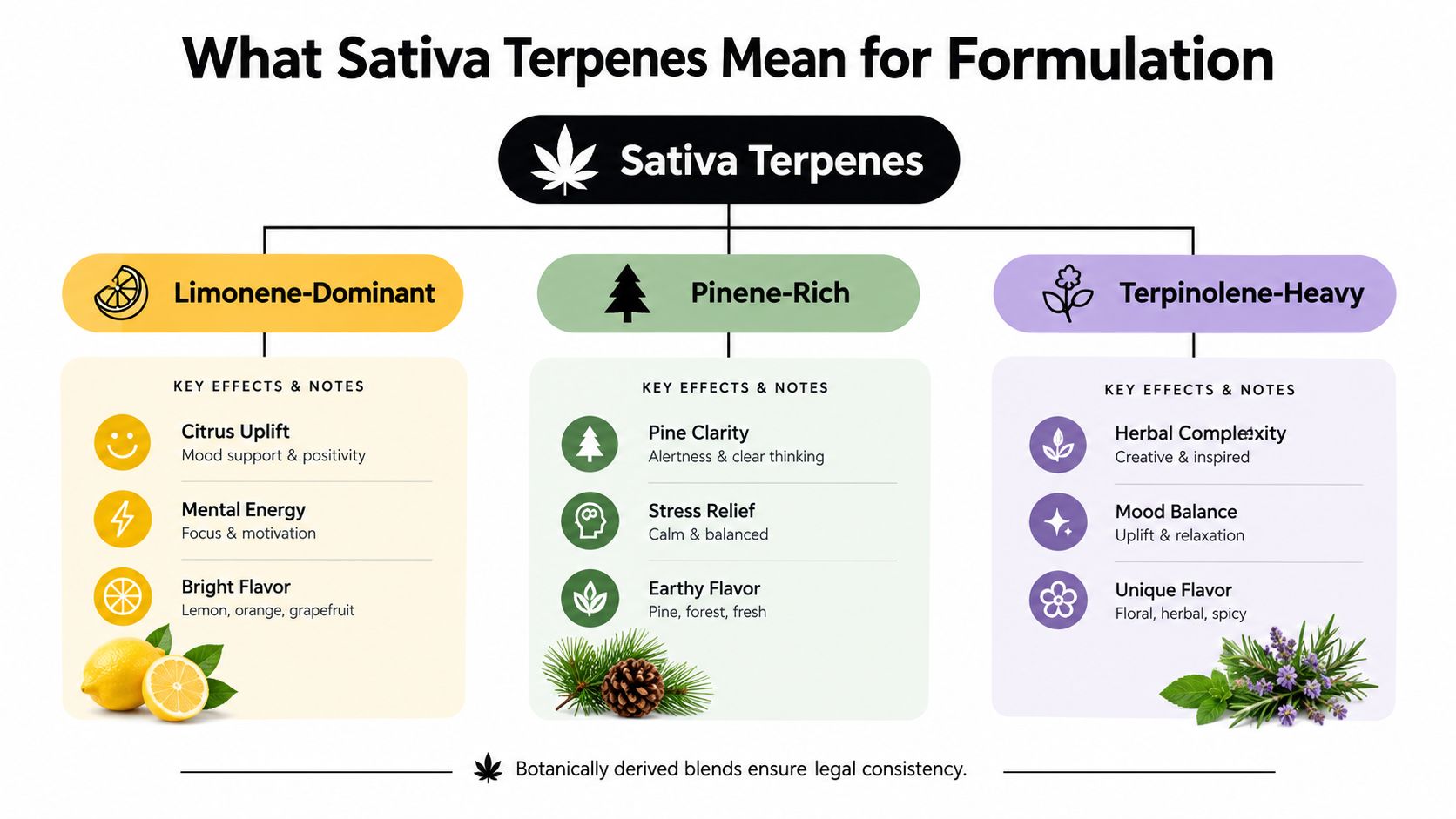
Sativa terpenes are a formulation target, not a botanical promise. For product teams, that means the core job is to define a chemical fingerprint, then build to it with dominant monoterpenes and selected sesquiterpenes.
The label is not the recipe
Scientific reviews report more than 200 volatile compounds across cannabis genotypes, including 58 characterized monoterpenes and 38 sesquiterpenes, with terpenes concentrated in glandular trichomes that drive much of the aroma PMC7763918. That matters for formulation because a “sativa” SKU cannot be assumed to have fixed chemistry, even when the strain name sounds familiar.
For a buyer or formulator, the practical translation is a four-part specification. A sativa-style profile should be set as limonene-forward, pinene-forward, terpinolene-heavy, or caryophyllene-anchored, depending on the sensory target and the limits of the hardware. Gold Coast Terpenes works in that language because a strain-inspired blend only helps if the batch can be reproduced.
Practical rule: If the profile cannot be described in measurable compounds, it cannot be reproduced reliably in distillate or cartridge production.
What to specify instead of strain names
Use the strain name as shorthand, then convert it into measurable targets. Commercial sample studies have found that products labeled sativa can lean toward terpinolene, 3-carene, and several sesquiterpenes, while indica-labeled samples can lean more toward myrcene and hydroxylated terpenes PMC8517044. That does not make the label wrong, it just means the label is incomplete.
| Aroma Role | Representative Compounds | Formulation Target Use |
|---|---|---|
| Citrus lift | Limonene | Top-note brightness, faster sensory impact |
| Pine clarity | Alpha-pinene, beta-pinene | Freshness, sharper first impression |
| Herbal complexity | Terpinolene, ocimene | Mid-note lift and layered aroma |
| Spiced base note | Beta-caryophyllene | Anchoring and roundness |
For teams comparing reference material, Gold Coast Terpenes' cannabis terpene archive is a useful starting point for turning a strain name into a reproducible blend target. The practical move is not to “find a sativa.” It is to match a fingerprint.
Common Sativa Terpene Profiles and Strain Flavor Matches
The most useful sativa-style profiles are built around limonene, alpha-pinene, and terpinolene, then rounded with a base-note terpene when needed. That combination usually reads as citrus, pine, and herbal complexity, which is why buyers keep asking for it in vape and concentrate SKUs.
Top, mid, and base notes actually matter
Aroma architecture is easier to control when you think in notes instead of strain mythology. Limonene usually behaves like a top note, pinene adds lift and freshness in the mid range, and terpinolene broadens the profile with herbal and fruity edges. Beta-caryophyllene can serve as a base note that keeps the blend from feeling thin.
That structure helps when you're matching a reference flower or a customer-approved profile. It also explains why a product can smell “sativa-like” without relying on one terpene alone.
| Dominant Terpene | Aroma Profile | Example Strain-Inspired Blend |
|---|---|---|
| Limonene | Citrus, bright peel, clean lift | Green Crack-style citrus blend |
| Alpha-pinene | Pine, sharp, fresh | Pine-forward daytime profile |
| Terpinolene | Herbal, fruity, lightly floral | Hazy, layered sativa-style blend |
| Beta-caryophyllene | Pepper, spice, woody base | Rounded custom blend |
Why one dominant terpene rarely does the full job
A review of commercial samples reported that sativa-labeled material can skew toward specific terpenes, while another summary noted that some sativa-associated profiles contained eucalyptol, carene, phellandrene, and terpinolene almost exclusively PMC8517044. The same literature also shows that some indica-labeled products can contain myrcene at very high proportions, which is why the label alone is a weak formulation tool.
That's where curated strain-inspired options become useful. Gold Coast Terpenes offers sativa-leaning profiles such as Green Crack and Forbidden Fruit, plus isolated limonene and alpha-pinene for adjustment. The value isn't novelty, it's the ability to move from a rough aroma idea to a controlled blend.
Gold Coast Terpenes' sativa terpene guide is a practical reference for teams choosing between a ready-made profile and a custom blend. Use it as a flavor map, not as a promise that every batch will smell identical.
How to Build a Strain-Inspired Terpene Blend for Distillate
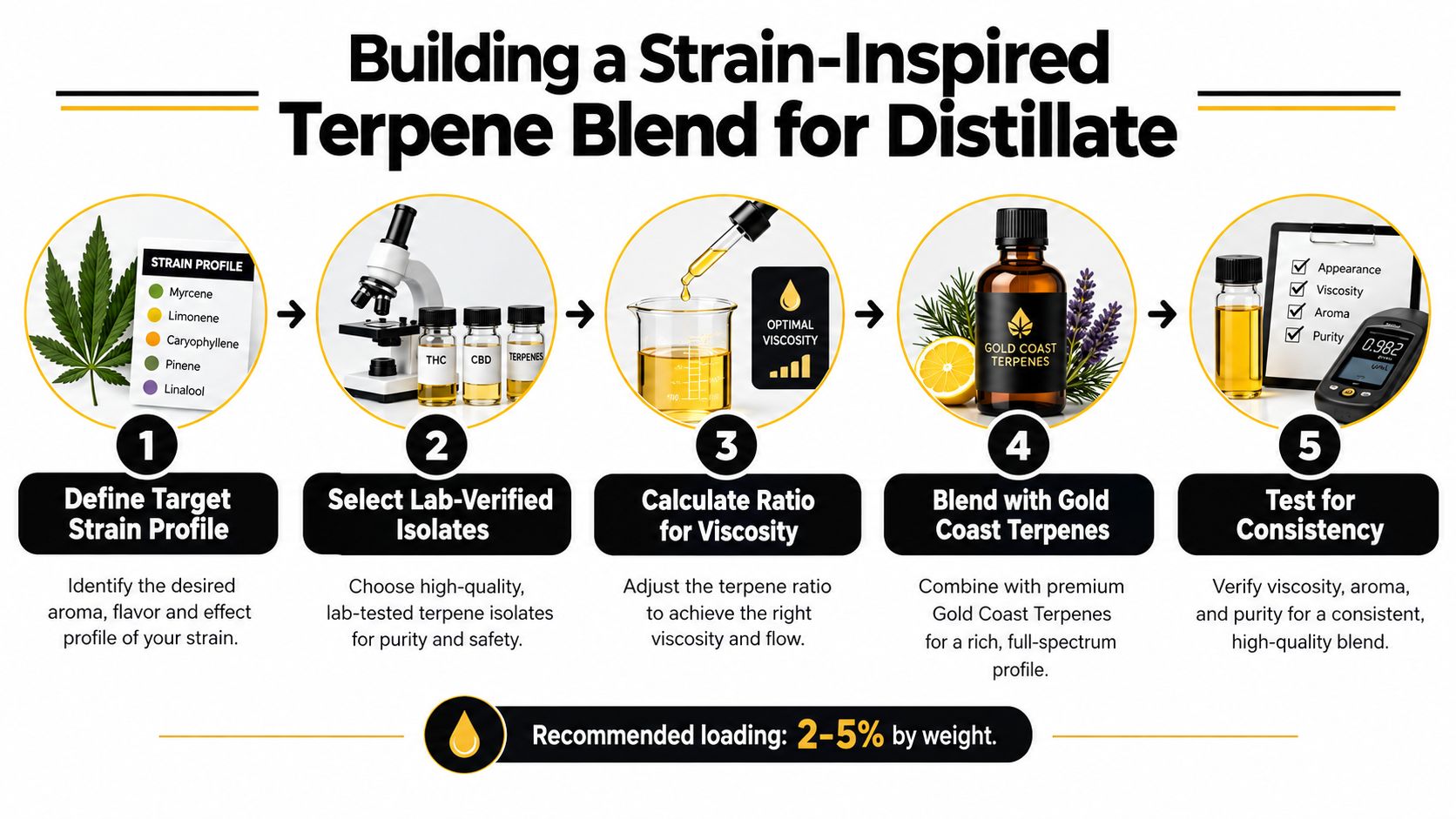
A strain-inspired terpene blend for distillate works best when you build around the dominant compounds first, then tune the minor notes after the main aromatic shape is stable. Trying to recreate every trace compound at once adds complexity without improving consistency.
Match the major compounds first
A study of 140 medicinal cannabis flowers found that the primary terpene represented about 35% of total terpene content, the four most abundant terpenes together accounted for about 72%, and nine terpenes explained more than 86% of the variation in measured terpene profiles SAGE. For formulators, that is a clear signal to spend time on the dominant compounds before chasing fine detail.
The practical takeaway is simple. If the core aroma is off, the blend will read wrong even if the minor notes are technically close.
| Workflow Step | Key Action | Verification Method |
|---|---|---|
| Define target strain profile | Translate the strain name into terpene targets | Reference COA or lab profile |
| Select lab-verified isolates | Choose the dominant compounds first | Supplier spec sheet and assay |
| Calculate ratio for viscosity | Test blend behavior in distillate | Bench viscosity and fill trial |
| Blend with Gold Coast Terpenes | Use a controlled small-batch mix | Pilot sample comparison |
| Test for consistency | Compare aroma and assay across batches | Same analytical method each time |
Keep the analytical method consistent
Recovery rates vary by compound, which is why raw numbers mislead without method context. A quantitative GC method tested terpene spikes at 0.05, 0.25, and 0.50 mg/g, with reported average recoveries ranging from 89% for beta-caryophyllene to 104% for beta-pinene PMC10589468.
For distillate teams, that means the same blend can look different on paper depending on the method, matrix, and calibration approach. Define the fingerprint, match the majors, then compare the reference profile, isolate specs, and finished assay with the same method and units.
Gold Coast Terpenes also provides formulation tools such as a terpene calculator, which is useful when the goal is repeatable batch math rather than guesswork.
Stop blending when the profile reads correctly, not when the ingredient list looks more complete. Overbuilding minor notes is a common distillate mistake, and it usually shows up later as batch-to-batch drift.
Botanical Versus Cannabis-Derived Sativa Terpenes for Vape Brands
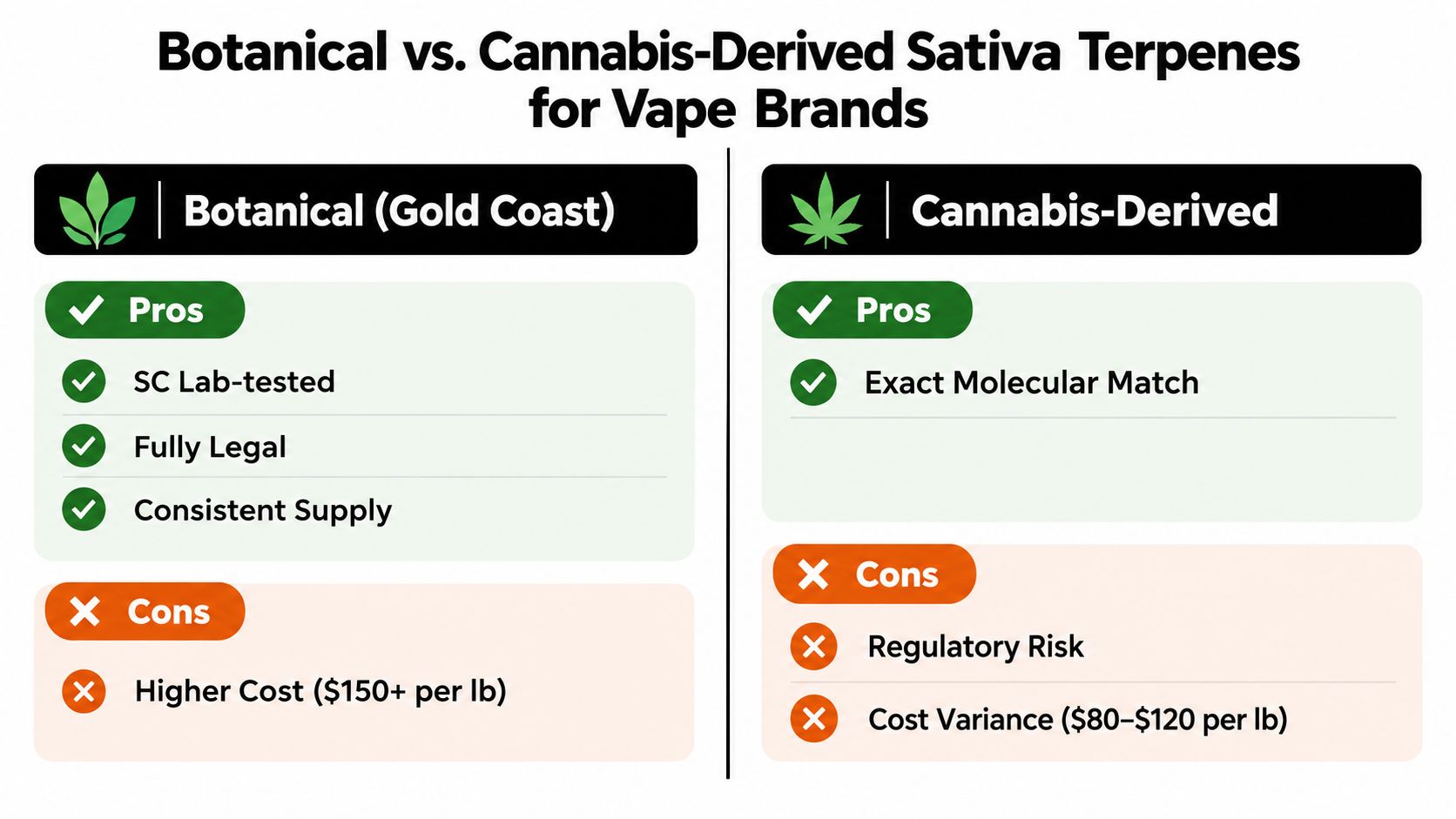
Botanical terpenes are usually the cleaner choice for brands that need stable supply, simpler documentation, and broader regulatory flexibility. Cannabis-derived terpenes can offer a closer molecular match to flower, but the sourcing and compliance burden is heavier.
What actually changes between the two
A botanical blend can be built from isolated and naturally derived components to hit a repeatable flavor target. A cannabis-derived source may better mirror a flower's native fingerprint, but that doesn't automatically make it easier to scale, label, or defend across suppliers and jurisdictions.
Gold Coast Terpenes supplies 100% botanically derived terpene blends that are SC Lab-tested, crafted without VG, PG, PEG, or MCT, and positioned for legal distribution across markets. That kind of sourcing is attractive when a vape brand wants consistency and a cleaner carrier background rather than a direct plant-extract origin story.
| Factor | Botanical Derived | Cannabis Derived |
|---|---|---|
| Supply stability | Easier to standardize | More dependent on crop and extraction source |
| Labeling flexibility | Usually simpler | Often more constrained |
| Flavor matching | Highly controllable | Can be closer to source flower |
| Regulatory complexity | Lower in many cases | Higher in many cases |
How to choose the source path
If the product brief emphasizes repeatability, botanical sourcing is usually the practical route. If the brief emphasizes source fidelity and the supply chain can support it, cannabis-derived material may be worth testing.
For brands comparing sourcing options, Gold Coast Terpenes' botanical terpene resource is a good reference point for the documentation side of the decision. The point is not which source is “better” in the abstract. It's which one fits the product claims, hardware, and QA system.
Terpene Loading and Vape Cartridge Formulation Guidelines
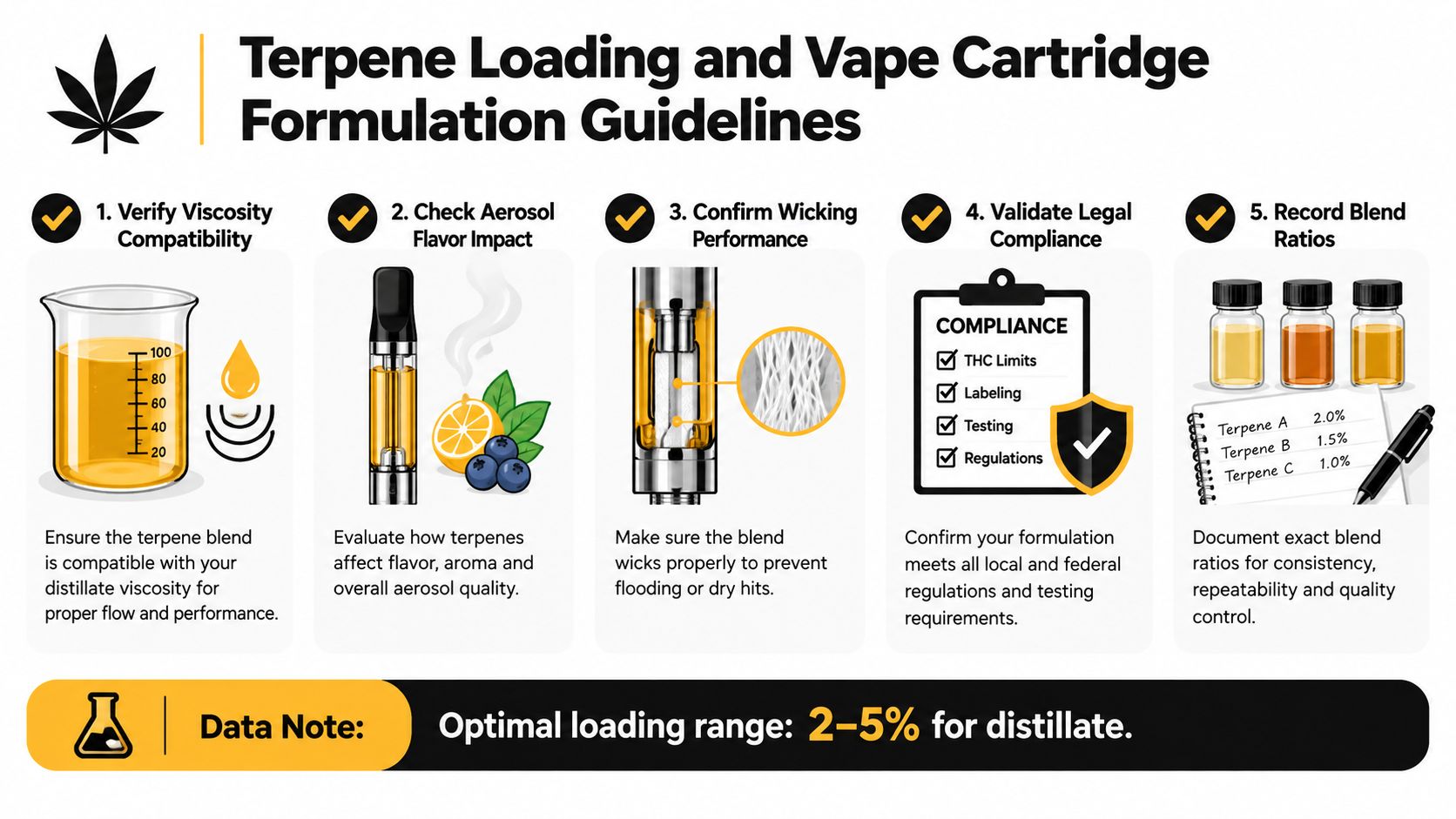
Terpene loading needs to be treated as a controlled formulation variable, not a casual flavor splash. A blend can smell right in bulk oil and still behave differently once heat, wicking, and aerosolization enter the cartridge.
Start with loading, not aroma strength
A California-funded study evaluated THC distillates after terpene additions at 0% and 7.5%, then measured aerosol and carbonyl emissions California cannabis research PDF. That matters because the fill liquid and the heated aerosol do not behave the same way.
Practical rule: A good-smelling fill liquid is not a finished cartridge. The aerosol still has to hold up under test.
For distillate work, conservative loading and verification usually make more sense than chasing maximum flavor intensity. Recent safety guidance notes that cannabis products commonly contain about 1% to 5% terpenes, while some products have exceeded 25%, and warns that high terpene exposure plus uncontrolled heating can create safety concerns PMC12805879. The same source also notes that prefilled cannabinoid cartridges commonly contain distillate in the 700 to 2,000 mg/mL range and may include naturally occurring or added terpenes. One citation covers the full operating range, from loading to finished cartridge concentration.
Validate the hardware, not just the blend
Cartridge formulation needs a short checklist:
- Verify viscosity compatibility. Check whether the distillate and terpene ratio feeds cleanly through the chosen hardware.
- Confirm wicking performance. A blend that saturates too slowly will fail even if the aroma is strong.
- Test aerosol flavor impact. Heated vapor often tastes different from the prefill liquid.
- Record the actual ratio. Batch notes matter when you need to reproduce the run later.
| Validation Step | Measurement Focus | Acceptance Criterion |
|---|---|---|
| Viscosity check | Flow through hardware | Stable feed and fill |
| Aerosol test | Flavor and output | No harsh mismatch |
| Wicking check | Saturation behavior | No dry-hit pattern |
| Compliance review | Label and ingredient record | Matches batch record |
| Blend logging | Ratio and lot traceability | Reproducible documentation |
Gold Coast Terpenes' quality control testing resource fits this workflow because cartridge success depends on what survives aerosolization, not just what looks right in the tank.
Sativa Terpene Effects and Responsible Claims for Product Labels
The safest way to describe sativa terpene effects is through aroma, sensory position, and formulation intent. Buyers may connect these blends with uplift, focus, or daytime use, but label language turns risky fast if it implies a guaranteed outcome.
Keep claims tied to what can be measured
Consumer content still flattens terpene effects into simple rules, while the evidence stays more limited. A 2025 preclinical study reported that geraniol, linalool, beta-caryophyllene, and alpha-humulene reduced pain behaviors in mouse models, with geraniol showing the strongest effect. Another 2025 study reported pain reduction in mice from terpene blends involving adenosine A2A receptors ScienceDaily summary. Those findings help frame research interest, but they do not prove the same outcome in humans or in inhaled retail products.
That keeps formulation copy anchored to sensory language. Citrus lift, pine clarity, herbal complexity, and bright finish are defensible. “Energizing,” “focusing,” or “relaxing” should stay out of the label unless the legal and scientific review supports that wording.
Don't turn terpene names into medical claims. The label should describe the blend, not promise a result.
Separate anecdote from formulation data
Two products can share a strain label and still differ in dominant terpenes, batch age, and oxidation state. The better selling point is the measured fingerprint, not the historical name.
Brand teams should keep label copy aligned with batch records, COAs, and the intended flavor target. If the product is built as a terpene profile for formulation consistency, say that plainly. If the goal is a strain-inspired terpene blend for distillate, state that directly and stop there.
QC Steps for Consistent Sativa Terpene Batches and SKUs
Batch consistency comes from method discipline, not from hoping the next lot smells like the last one. A SKU built on a sativa-style fingerprint needs the same testing logic every time, or flavor drift will show up fast in both aroma and cartridge performance.
Lock the method before you lock the SKU
Recovery and precision matter because small concentration errors can shift top, mid, and base notes. The problem shows up quickly when a profile depends on a narrow balance of limonene, pinene, terpinolene, and a base-note terpene.
A practical QC flow looks like this:
- Review supplier COAs. Check the stated terpene percentages and lot identifiers.
- Compare the same analytical method. Do not mix measurement systems across reference samples and finished product.
- Check finished-product assay. Confirm the blend survived manufacturing intact.
- Trigger change control on drift. If the fingerprint shifts, document the reason before release.
Method context matters because recovery can vary by compound, as shown in GC work that reported different recoveries for alpha-pinene, limonene, linalool, beta-caryophyllene, and caryophyllene oxide. Raw values without that context can mislead a development team.
| QC Step | What to Watch | Why It Matters |
|---|---|---|
| Incoming COA review | Terpene identity and units | Prevents bad comparisons |
| Pilot batch check | Aroma balance | Catches formulation drift early |
| Finished assay | Assay vs target | Confirms repeatability |
| Hardware feedback | Fill and wick behavior | Protects cartridge performance |
Gold Coast Terpenes' quality control testing resource is useful here because it reinforces the same point from a production perspective. The reference profile, isolate spec, and finished batch all need to speak the same analytical language.
Next Steps for Sativa Terpene Formulation and Product Launch
The shortest path to a dependable launch is to turn the strain idea into a measured target, then test that target in the actual hardware. From there, sample a small batch, confirm the assay, and only then scale the SKU.
Gold Coast Terpenes supports that workflow with strain-specific profiles, curated packs, isolates, and practical tools such as Terpenes 101 and a terpene calculator. For teams building cartridge or distillate lines, the useful move is to compare profiles, document the ratios, and keep the label aligned with what the lab shows.
If you're building a sativa-inspired cartridge or distillate SKU, start with a measured terpene fingerprint and lock the batch notes before you scale. Gold Coast Terpenes offers strain-specific profiles, isolates, and formulation resources that fit this workflow, and you can review them directly at Gold Coast Terpenes when you're ready to move from concept to sample.