
GSC is a caryophyllene-led profile with limonene and myrcene contributing at near-equal weight, which is why a single-dominant-terpene approach fails when replicating it. One commercial certificate reported limonene at 5.648 mg/g, trans-caryophyllene at 5.606 mg/g, and beta-myrcene at 4.65 mg/g, a near 1.22:1.21:1 relationship rather than a caryophyllene-only formula.
For product developers, that distinction matters. A recognizable GSC direction depends on the interaction between peppery caryophyllene, citrus-forward limonene, earthy myrcene, and supporting humulene or linalool. Gold Coast Terpenes, a Redondo Beach, California supplier, offers 100% botanically derived terpene blends, not cannabis-derived terpenes, alongside isolated compounds and strain-specific profiles. The practical question is not whether a label says “GSC.” It's whether the finished formulation reproduces the aroma architecture consistently in distillate, concentrates, or vape cartridges.
What a GSC Strain Terpene Profile Looks Like for Formulators
The most defensible starting point is a β-caryophyllene-led profile supported by limonene and humulene, with myrcene and linalool used as adjustable secondary notes. A 2017 peer-reviewed study of California dispensary samples placed Girl Scout Cookies among β-caryophyllene-dominant cultivars, reporting approximately 6.7 ± 1.3 units of β-caryophyllene, 3.4 ± 1.0 units of limonene, and 3.2 ± 0.6 units of humulene (peer-reviewed terpene analysis of California cultivars).
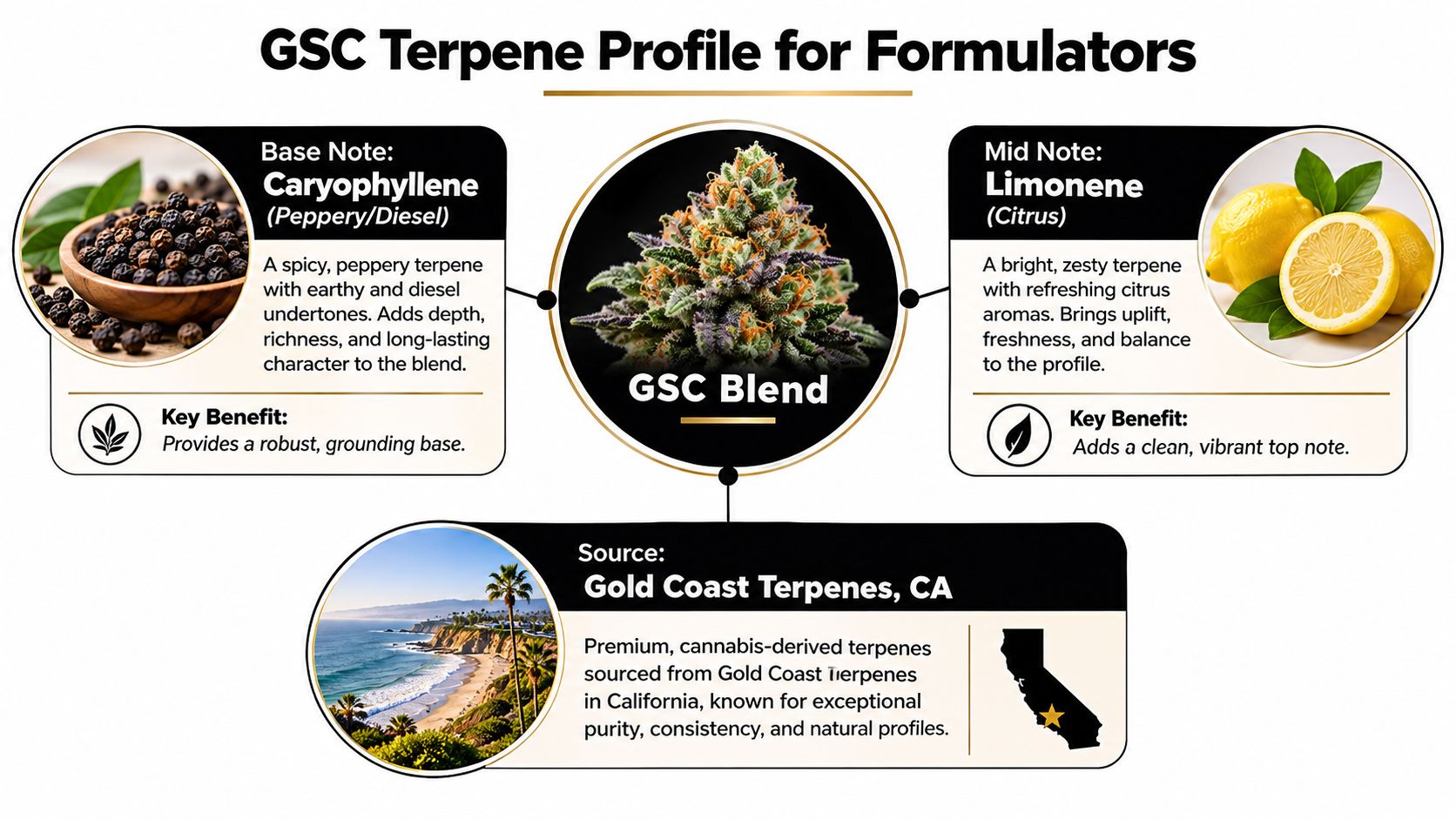
That result gives formulators a useful direction, not a universal commercial recipe. The sample came from one California medical dispensary, and the researchers used gas chromatography with flame-ionization detection, confirming peak identities with gas chromatography-mass spectrometry. Their clustering work placed GSC with other Cookie cultivars that shared β-caryophyllene dominance, while limonene and humulene appeared at roughly comparable levels after the primary terpene.
Four decisions define a workable replication
A formulation guide for a GSC-inspired terpene blend should answer four questions:
- Which compounds create the identity? Caryophyllene supplies the warm pepper and spice foundation. Limonene provides citrus lift. Humulene adds woody, hop-like depth, while myrcene and linalool modify the earthy and floral balance.
- What ratio should the bench team start with? The commercial COA discussed below offers a defensible top-three relationship, but it must remain a batch-specific reference rather than a fixed strain specification.
- Which notes belong at the top, middle, and base? Sensory mapping helps QA teams describe a deviation precisely. “Too sharp” usually points to top-note intensity, while “thin” may indicate insufficient base support.
- How does the profile behave in distillate? Flower percentages cannot be copied directly into a concentrated oil matrix. The final specification needs a clear denominator, loading basis, and analytical method.
Gold Coast Terpenes' strain terpene profile resources are useful for comparing strain-inspired directions, but a product developer still needs lot-specific certificates and sensory validation. This is a formulation brief, not a strain review. Effects, consumer slang, and dispensary descriptions don't replace compound ratios, matrix testing, or finished-product analytics.
Comparing Published GSC Data With Commercial Certificates of Analysis
Commercial certificates sharpen the published GSC picture. Research points to a profile anchored by β-caryophyllene, with limonene and humulene recurring near the top. A commercial certificate from a separate GSC sample shifts the balance and shows why formulators should treat "GSC" as a target range, not a single numeric profile.
The cited certificate reports 5.648 mg/g of (R)-(+)-limonene, equal to 0.565%, 5.606 mg/g of trans-caryophyllene, equal to 0.561%, and 4.65 mg/g of beta-myrcene, equal to 0.465% (GSC certificate of analysis). That yields a near 1.22:1.21:1 limonene-to-caryophyllene-to-myrcene relationship. For distillate cart development, that matters. It means a batch sold as GSC can present as nearly co-dominant in citrus, spice, and earthy-musky support, instead of reading like a simple caryophyllene-forward build.
The numbers are reference points, not a recipe
| Terpene | Published data, relative units | Commercial COA, mg/g | Formulation role |
|---|---|---|---|
| β-Caryophyllene | Approximately 6.7 ± 1.3 | 5.606 | Structural base, peppery spice, warmth |
| Limonene | Approximately 3.4 ± 1.0 | 5.648 | Bright top note, citrus lift |
| Humulene | Approximately 3.2 ± 0.6 | Not reported in the cited COA | Woody, earthy, hop-like mid support |
| Beta-myrcene | Approximately 1.8 ± 0.5 | 4.65 | Earthy, musky modifier |
Those tables are not interchangeable. The published values are relative units from plant samples. The COA gives mass concentration for one authenticated sample. If a bench team averages them directly, the result can look precise on paper and still fail in the cart because the denominator changed.
Use the comparison the way a formulator uses any mixed-source dataset. Set one analytical basis, normalize every lot to it, and write the spec so production can execute it without guessing. The document should state whether each value refers to relative terpene abundance, flower mass, extract mass, or finished-product mass. Teams that need a cleaner template can find product data examples and adapt that structure for terpene identity, lot tracking, and method notes.
Keep the source certificate with the formula file and use this COA and certificate resource to check what buyers and QA teams usually expect in supporting paperwork. For commercial benchmarking, related strain-style catalogs such as Elevated Strains are useful for directional comparison, but they are not a universal specification for GSC.
Top, Mid, and Base Notes for a GSC-Inspired Blend
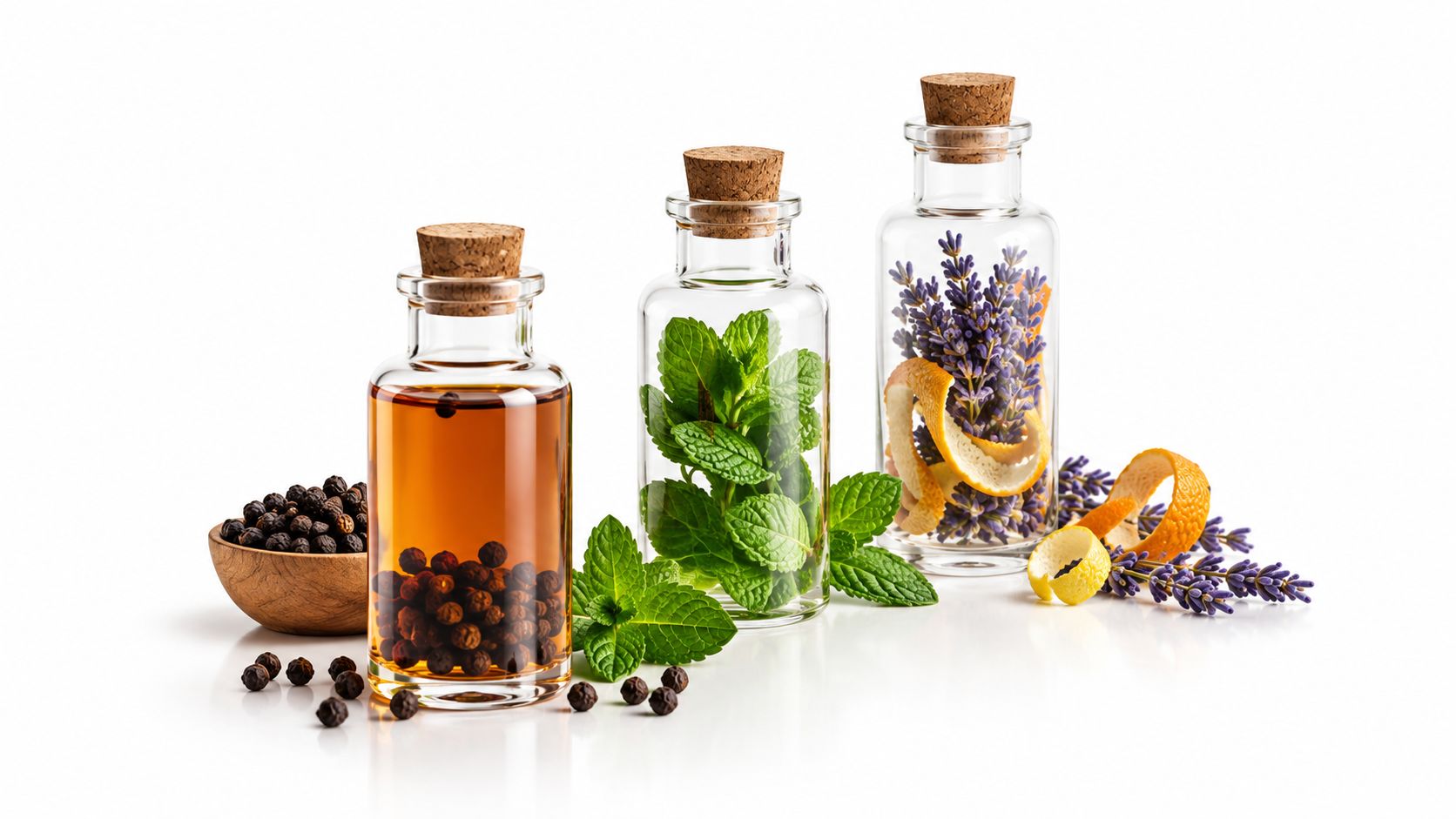
A practical GSC sensory map places limonene at the top, humulene and myrcene through the middle, and β-caryophyllene in the base, with linalool available for a softer floral adjustment. Published GSC profile data list beta-caryophyllene, limonene, humulene, myrcene, and linalool as recurring constituents, including one illustrative profile near 0.5% limonene, 0.4% caryophyllene, 0.2% linalool, 0.2% myrcene, and 0.1% humulene (published GSC profile data).
Top note
Limonene controls the first impression. It brings citrus brightness and can make the blend feel more open, energetic, and immediately identifiable in a sensory panel. Too little limonene makes the profile feel dense and muted. Too much can push the blend toward a generic citrus direction and erase the warm pastry, spice, and earth foundation associated with GSC-inspired products.
Mid note
Humulene supplies woody, earthy, and hop-like continuity. It connects the sharpness of limonene to the heavier caryophyllene base without competing for attention. Myrcene sits nearby as a more earthy, musky modifier. The commercial COA's near-equal presence of limonene, caryophyllene, and myrcene shows why myrcene shouldn't automatically be treated as a negligible trace component.
Base note
β-Caryophyllene anchors the profile. Its peppery, warm-spice character gives the blend persistence after the citrus opening fades. Depending on the surrounding compounds and the oil matrix, formulators may describe the base as peppery, woody, diesel-adjacent, or resinous. Those descriptors are useful for QA because they identify direction without making consumer or medical claims.
Linalool should be treated as a controlled modifier rather than a defining pillar. Small changes can move the profile toward a softer floral edge, while excessive use can make the blend feel less faithful to the intended pepper-citrus-earth structure. Gold Coast Terpenes presents strain profiles and isolates that can be evaluated using the same top-mid-base logic. Its terpene flavor chart can also give a sensory panel a shared vocabulary when comparing prototype lots.
Entourage-Style Interactions Without Medical Claims
An entourage-style formulation claim should describe sensory and compositional interaction, not a health outcome. In a GSC-inspired blend, caryophyllene, limonene, humulene, myrcene, and linalool contribute different volatility patterns and aroma impressions, so the finished result depends on their relationship rather than on one isolated molecule.
The strongest commercial lesson comes from the COA's top-three balance. Limonene, trans-caryophyllene, and beta-myrcene were present at closely matched concentrations in that sample. Removing or sharply reducing any one of them can change the sensory shape, even if the remaining compounds still appear on a label.
What changes when the balance shifts
A caryophyllene-heavy formula can deliver the expected pepper and warmth but may smell closed, dry, or overly forceful if it lacks enough top-note lift. A limonene-heavy formula may smell bright at first but lose the deeper GSC direction during the dry-down. A myrcene-heavy version can become earthier and heavier, which may work for a particular extract but no longer match the reference profile.
Humulene and linalool provide additional control. Humulene can reinforce the woody middle, while linalool can soften rough edges with a floral accent. Neither should be used automatically. The right choice depends on the source lot, the distillate matrix, and whether the target is a flower-like profile or a cleaner commercial flavor.
Formulation principle: Preserve the architecture before chasing the aroma peak. A blend that smells impressive immediately can still fail if its mid and base notes disappear after dilution or heating.
Gold Coast Terpenes lists isolated compounds such as Limonene, Myrcene, and Beta-Caryophyllene alongside strain-inspired profiles, which gives product developers the option to tune a premade direction or build from individual materials. Its entourage-effect guide can support internal education, but finished labels and marketing copy still need to stay within applicable regulatory boundaries. Avoid medical claims, receptor-based promises, or statements that imply therapeutic outcomes unless the product and jurisdiction support them.
Building a GSC-Inspired Blend for Distillate and Carts
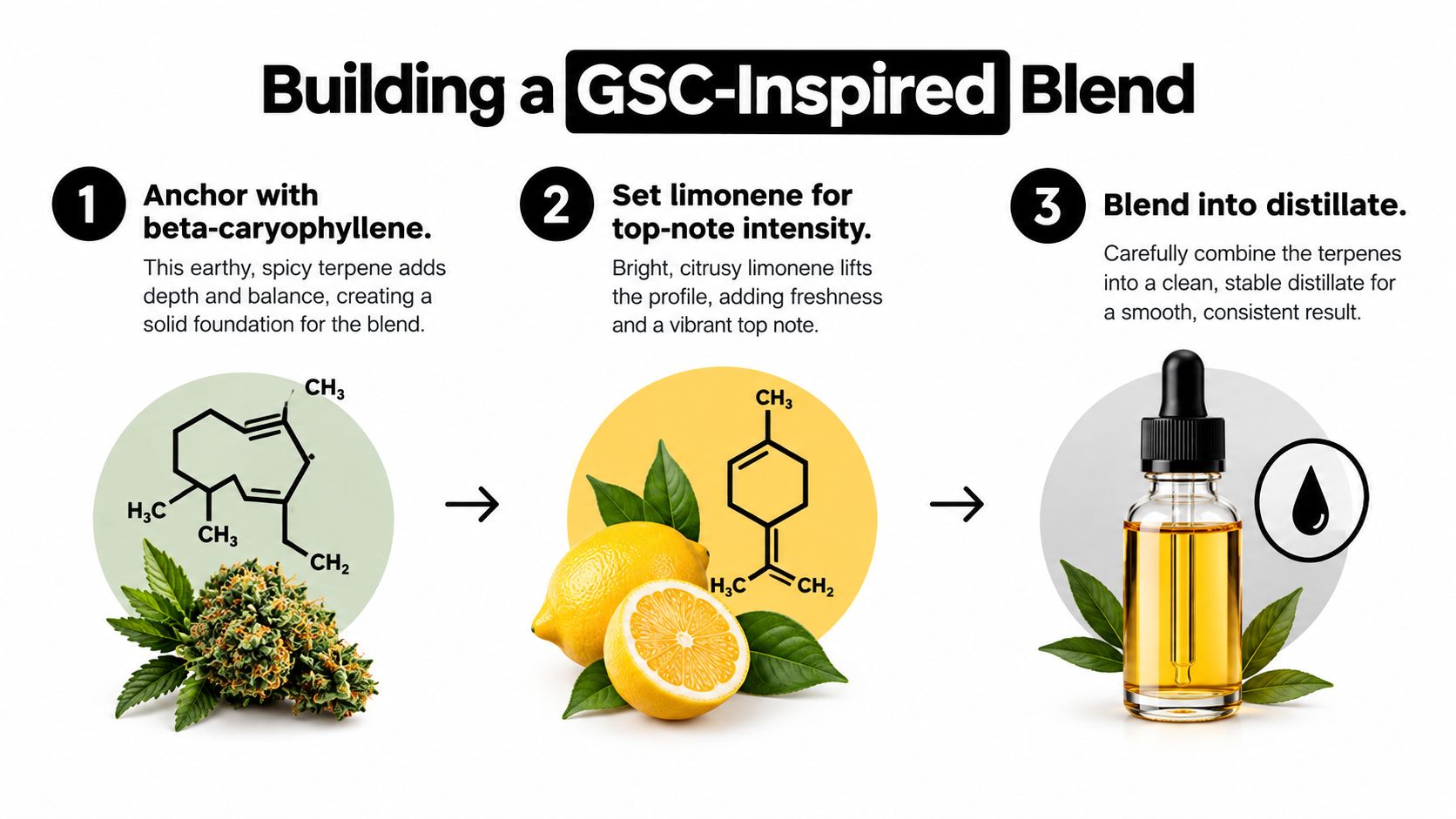
A usable GSC cart formula starts as a controlled terpene concentrate, not as a flower percentage copied into distillate. For this profile, treat β-caryophyllene as the frame, set limonene against it for lift, and use myrcene, humulene, and linalool as correction tools tied to the reference lot. The commercial COA gives a practical starting relationship of approximately 1.22 parts limonene to 1.21 parts caryophyllene to 1 part myrcene, but that ratio is only a starting point for bench work, not a finished loading spec.
Build the concentrate before diluting
Make the terpene premix first and judge it on its own. That step exposes imbalance early, while corrections are still cheap and fast.
A practical sequence works well in development. Start with β-caryophyllene and check whether the base already feels too pepper-forward, dry, or heavy. Add limonene until the top note opens without turning the profile into a generic citrus blend. Bring in myrcene only if the body needs more earthy depth, and use humulene if the midrange needs a drier woody link between top and base. Keep linalool in reserve for edge control. It can soften roughness, but too much pulls the profile away from the tighter cookie, spice, and wood direction that makes a GSC target recognizable.
Use the same dilution conditions for every sensory check. If one sample is smelled neat and another is compared after dilution into oil, the read is no longer useful.
The matrix matters here. Distillate suppresses some notes, stretches others, and changes how a blend shows up after filling and heating. That is why a defensible GSC build-out needs more than a strain name and a terpene list. Write the formula as a product spec with cannabinoid concentration, terpene loading, target ratios for the named compounds, and the analytical basis used to approve the batch.
Use staged loading tests
Published work on terpene additions to THC distillate compared 0% and 7.5% terpene conditions, treating loading as a test variable rather than a universal recipe (terpene emissions study). Use that setup the same way in development. It is a comparison model, not an automatic production target.
Run the unmodified distillate, a lower-loading prototype, and a higher-loading prototype under the same hardware, power, temperature, and puffing conditions. Keep a retained sample of each premix and filled unit. If the commercial goal is a proprietary GSC direction, document the exact composition and approval standard instead of relying on the strain name alone.
Botanical Versus Cannabis-Derived Terpenes for Strain Replication
Botanical terpenes usually offer the cleaner commercial path, while cannabis-derived terpenes may be appropriate when chemotype fidelity and provenance justify added complexity. The choice should be made against supply, labeling, analytical, and distribution requirements, not aroma alone.
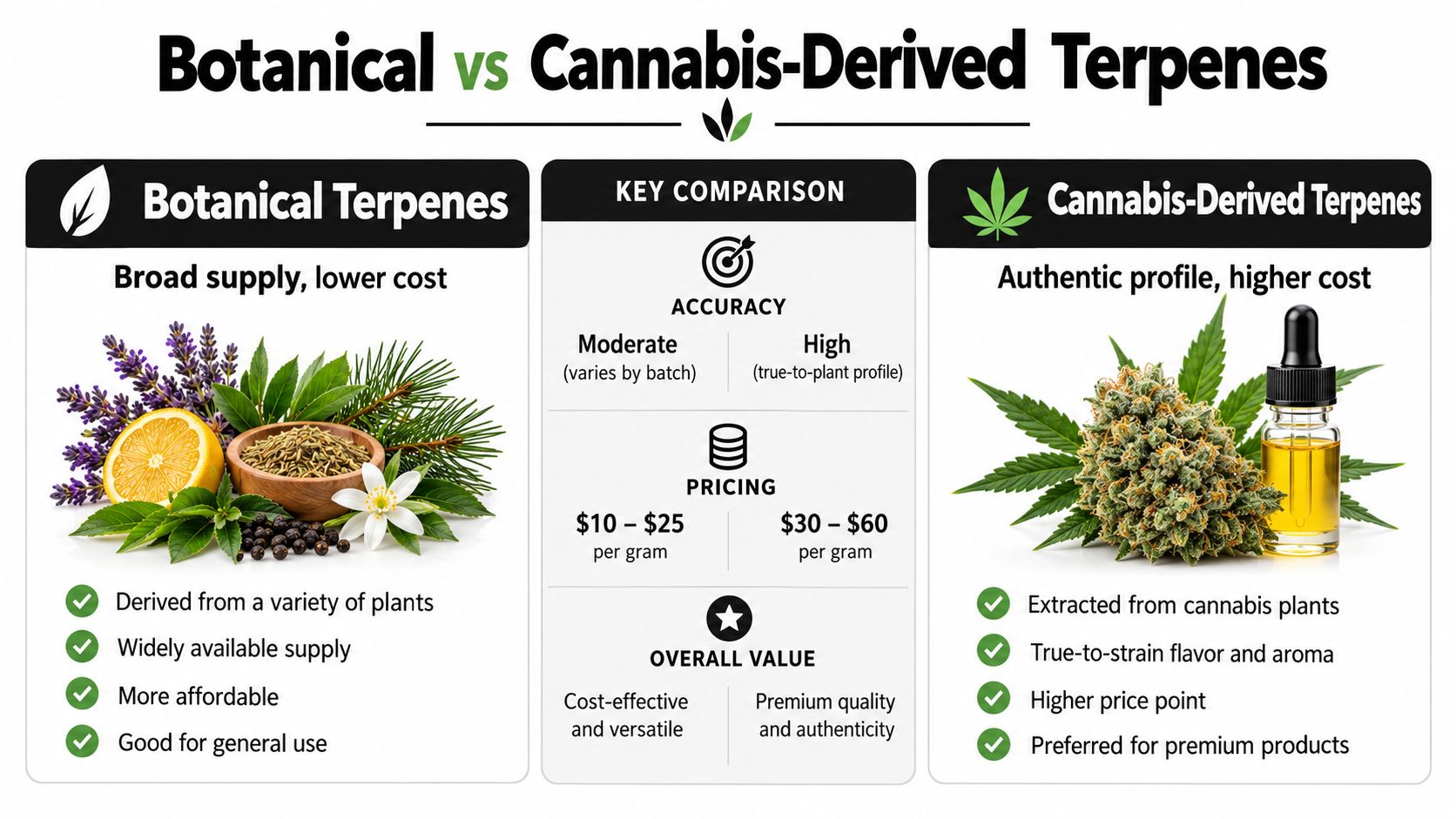
Gold Coast Terpenes describes its blends as 100% botanically derived, THC-free, free of VG, PG, PEG, and MCT, SC Lab-tested, and legal worldwide. Those product attributes can simplify a multi-market vape program, but a buyer should still verify the current certificate, intended use, and jurisdiction-specific requirements for every lot.
Cannabis-derived material can offer a closer relationship to a particular cannabis chemotype, but it may also introduce THC contamination concerns, variable feedstock, and more complicated labeling. The apparent authenticity advantage doesn't remove the need for finished-product testing. A cannabis-derived fraction that matches one flower lot may drift from another phenotype or harvest.
Compare the materials by commercial job
| Decision point | Botanical isolates and blends | Cannabis-derived fractions |
|---|---|---|
| Composition control | Easier to tune individual compounds | Depends more heavily on source material |
| Distribution | Often simpler for products requiring THC-free inputs | May require additional jurisdiction and batch review |
| Strain replication | Can reproduce the main sensory architecture | May offer closer source-lot character |
| Documentation | Requires identity, purity, and batch records | Requires source, cannabinoid, and batch records |
| Product positioning | Suitable for strain-inspired flavor work | Suitable for specialty provenance claims where supported |
Independent strain-profile reporting notes that beta-caryophyllene, humulene, limonene, and myrcene recur in GSC across sources, but percentage shares vary because sources calculate from different wholes (analysis of GSC reporting bases). That makes the denominator a commercial specification, not a footnote.
For most distillate cartridge programs, botanical isolates provide the more controllable starting point. Cannabis-derived material makes more sense when the brand can support the added sourcing, testing, and labeling work and can demonstrate why that choice matters to the product.
Hardware, Viscosity, and Loading Checks Before Production
A GSC terpene blend is not ready for scale-up because it smells right on the bench. It is ready when the target ratio still behaves correctly after dilution into distillate, filling, storage, and aerosolization in the exact cart you plan to ship.
For this profile, I treat hardware as part of the formulation spec. The same terpene package can run clean in one cartridge and show slow wicking, seepage, muted top notes, or harsh output in another because oil viscosity, inlet size, coil geometry, and operating temperature all shift together. That is why loading decisions belong to the finished matrix, not to the isolate bottle or a flower-style terpene percentage.
Bench checks that catch avoidable failures
- Clarity and homogeneity: Inspect the filled oil after mixing and again after rest. Look for haze, phase separation, sediment, or visible crystallization.
- Viscosity behavior: Check flow at the intended filling temperature, then re-check after colder storage. A blend that fills cleanly while warm can still wick poorly or leak after thermal cycling.
- Cartridge compatibility: Test leakage, seepage, clogging, and wicking with the actual cartridge, center post, and seal materials. Results do not transfer cleanly across hardware platforms.
- Aroma retention: Compare fresh and stored samples under the same handling conditions. Limonene-led top notes often flatten first, even when the main analytes remain present.
- Analytical confirmation: Compare the finished oil against the target COA on the same reporting basis. Confirm identity and the relative relationship of the principal compounds.
- Aerosol testing: Hold power, temperature, puff duration, and puff interval constant across the control and terpene-loaded samples.
A staged loading design gives cleaner answers than a single pass/fail trial. Run a zero-terpene control, a lower-loading blend, and a higher-loading blend, then document the exact blend, loading percentage, device, temperature, and puffing regime for each condition. That setup shows whether a sensory gain is still acceptable once viscosity and aerosol behavior are measured under fixed operating conditions.
Production gate: Approve the formula only when sensory, analytical, viscosity, leakage, and aerosol results agree. Bench aroma alone is not a release criterion.
GSC Strain Terpene Profile Questions Buyers Actually Ask
Can GSC be built from isolates instead of a proprietary blend?
Yes. Start with β-caryophyllene, limonene, and myrcene using the near 1.22:1.21:1 relationship from the cited commercial COA, then adjust humulene or linalool against an authenticated reference. Gold Coast Terpenes offers isolated compounds alongside strain-inspired profiles, so a developer can compare an isolate build with a premade direction.
How should botanical and nature-identical compounds be labeled?
Use the supplier's current technical and regulatory documentation to identify the material accurately. Gold Coast Terpenes should be asked for the applicable batch documents and labeling guidance before a SKU is finalized, especially when botanical and nature-identical materials are being evaluated side by side.
What minimum order quantities or bulk programs apply?
Minimum order quantities depend on the product, account, and current wholesale terms. Ask Gold Coast Terpenes for current MOQ, bulk, and documentation requirements rather than placing an assumption in the product specification.
Can the GSC profile be paired with diluents?
It can be evaluated with a compatible diluent, but the finished matrix must be tested for clarity, viscosity, leakage, and aroma retention. A terpene blend that behaves well in one distillate or hardware system may need adjustment in another.
What should a buyer request before approving a lot?
Request the current certificate of analysis, ingredient identity, recommended use information, and storage guidance. Match the supplier's reporting basis to your internal specification before comparing lots or approving a production blend.
Gold Coast Terpenes offers botanical strain-inspired blends, isolated compounds such as limonene, myrcene, and beta-caryophyllene, and formulation resources for cartridge and distillate development. Review the available profiles and technical materials at Gold Coast Terpenes, then request the batch documentation needed to build and validate your GSC-inspired product.