
Two distillate lots arrive at the filling room under the same Tropical Dream label. One smells like orange sherbet. The other leans toward ripe mango, pine, and dry earth. Before choosing a flavor concentrate, the product team has to accept the central formulation problem: the name doesn't identify one universal chemical formula.
Gold Coast Terpenes, a Redondo Beach, California supplier, produces 100% botanically derived terpene blends rather than cannabis-derived blends, giving formulators one possible route to a repeatable, THC-free sensory target. For a strain-inspired product, the important decisions are reference selection, terpene source, load rate, and batch verification. Get the reference wrong, and every later adjustment can make the cart more polished without making it more accurate.
Why Tropical Dream Is Harder to Formulate Than It Looks
Tropical Dream is best treated as a chemotype target, not a fixed genetic specification. The name has been used for multiple crosses, and the same label can therefore represent different cannabinoid ratios, aromatic compounds, and sensory impressions. A formulation team should define the desired profile in sensory and analytical terms before it orders a blend.
A practical starting brief might read: bright citrus opening, tropical fruit body, berry lift, light pine, and an earthy or peppery finish. That description gives purchasing and quality teams something they can verify. “Tropical Dream” alone doesn't.
Practical rule: Choose the reference sample first. Choose the strain name second.
The source also matters. A cannabis-derived profile may reflect the variability of the harvest from which its compounds were isolated. A botanical profile can be built around defined aromatic inputs, but it still requires documentation, sensory approval, and compatibility testing with the intended oil. Neither source category removes the need for a certificate of analysis or aerosol evaluation.
Four decisions control the outcome
Reference selection: Decide whether the target is a specific flower lot, a verified distillate, or a house sensory standard. Record aroma, flavor, finish, and any analytical data available.
Source choice: Compare botanical, cannabis-derived, nature-identical, and other permitted labeling categories against the product's market, documentation requirements, and supply model.
Load rate: Treat terpene concentration as a formulation variable that affects flavor, viscosity, aerosol behavior, and emissions. A stronger blend isn't automatically a closer match.
Batch verification: Recheck the incoming terpene blend, distillate, finished oil, cartridge performance, and label language. A sensory match that fails on viscosity or documentation isn't production-ready.
The documented ambiguity around the Tropical Dream strain makes this workflow more important, not less. Product developers who lock onto a single online strain description may create a product that is internally consistent but commercially inconsistent with the reference customers expect.
Tropical Dream Lineage and Why the Name Is Not Standardized
The best-documented Tropical Dream lineage is Astrul's Blue Dream crossed with Tropicana Cookies, but other products use the same name for different crosses. SeedFinder records the Astrul creation with an approximate flowering period of 63 days and lists indoor, outdoor, and greenhouse cultivation as possible production settings (the documented Tropical Dream lineage).
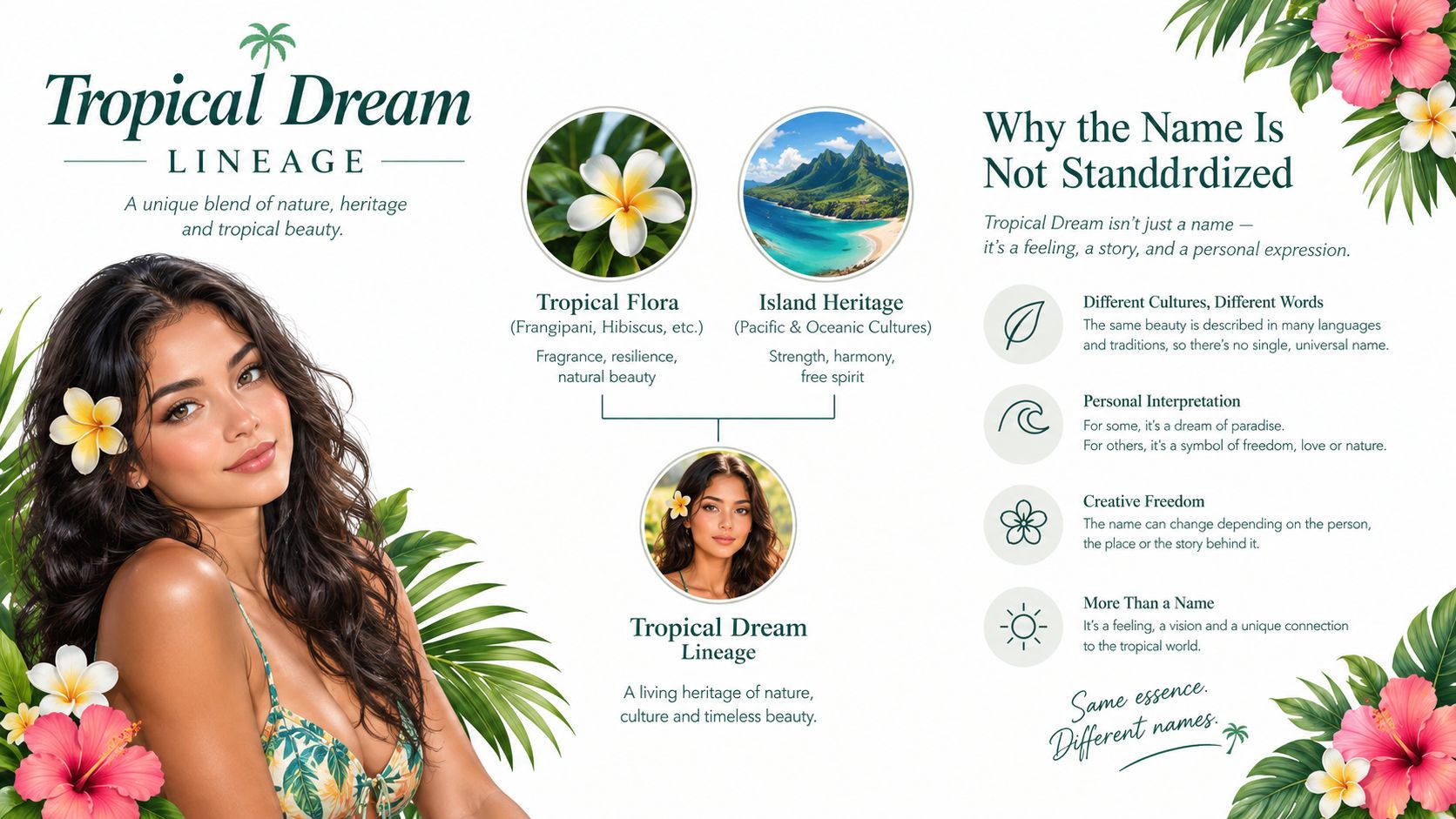
That lineage is useful because it gives a formulator a plausible sensory starting point. Blue Dream is associated with a recognizable berry and sweet fruit direction, while Tropicana Cookies contributes a citrus-forward influence used in modern hybrid breeding. Those parent descriptions can guide the first bench brief, but they still don't replace a reference sample.
Marketplace and strain-directory records also associate Tropical Dream with combinations involving Apples & Bananas, Sour Crack, and other tropical-fruit genetics (the documented naming variation). This is why a buyer should ask the upstream supplier what exact material the name describes. If the answer is a house blend, request the blend specification and COA. If it is tied to flower or extract, request the source lot and batch-level analytical data.
Build the profile around observable attributes
Document the target using five fields:
- Opening: citrus, orange peel, sherbet, or bright fruit
- Body: tropical fruit, berry, mango, or rounded herbal notes
- Finish: pine, pepper, dry spice, or earth
- Cannabinoid context: total THC, CBD, and minor cannabinoids shown on the COA
- Aromatic context: limonene, myrcene, beta-caryophyllene, pinene, and relevant minor compounds
A supplier such as Gold Coast Terpenes can provide a stable reference profile for comparison, but the buyer still needs to approve that profile against the intended product standard. The commercial objective isn't to prove genetic ancestry. It's to create a repeatable flavor that survives reorders, scale-up, and hardware changes.
The parent cultivars matter because they frame the sensory building blocks. They don't turn the Tropical Dream name into a universal chemical specification.
The lineage is easier to interpret when paired with a visual reference.
Tropical Dream Terpene Profile and the Three-Note Architecture
A practical Tropical Dream architecture starts with limonene on top, myrcene in the middle, and beta-caryophyllene in the base. Reported cultivar guides place indicative values around 0.4%–0.9% limonene, 0.3%–0.7% myrcene, and 0.2%–0.5% beta-caryophyllene by weight, but those figures are formulation benchmarks rather than guarantees for every batch (reported Tropical Dream terpene ranges).
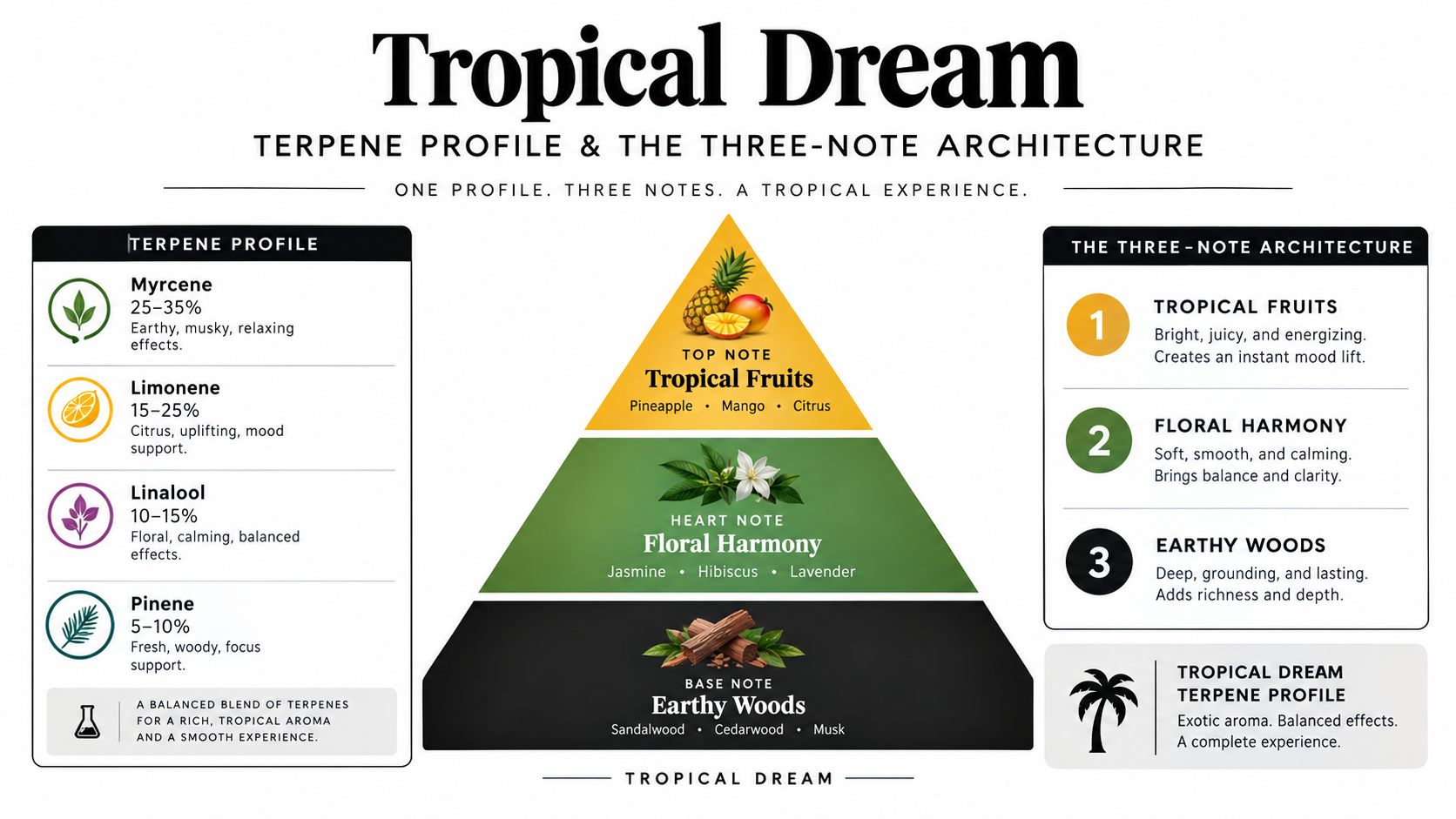
Top note
Limonene provides the initial citrus lift. In a bench sample, it can establish orange peel, lemon, and bright tropical fruit impressions. Too much can pull the blend toward candy, household citrus, or a thin one-note opening, especially when the distillate already contains a sweet aromatic character.
Middle note
Myrcene rounds the profile into a fruit-herbal body. It can connect the sharp citrus opening to deeper mango, ripe fruit, and soft herbal impressions. It's also useful for preventing the blend from smelling like a flavor concentrate sitting on top of the oil.
Base note
Beta-caryophyllene supplies pepper, dry spice, and persistence. It gives the finish more structure and helps keep the flavor from collapsing after the first part of the puff. Humulene can be screened as an additional dry, woody contributor when the reference calls for more earthy depth.
The three compounds are a starting architecture, not a complete reconstruction. A peer-reviewed commentary reports that researchers have identified more than 100 cannabis terpenes, and profiling of eight cultivars found 48 terpenes, with myrcene, alpha-pinene, limonene, beta-caryophyllene, and alpha-humulene present across all eight (cannabis terpene diversity and cultivar aroma). A limonene, myrcene, and beta-caryophyllene blend may capture the direction while missing the minor compounds that make one reference feel more floral, resinous, or tropical than another.
For bench work, create a written three-tier target and use a terpene flavor chart to document sensory roles. Gold Coast Terpenes' THC-free isolates and Strains profiles can serve as adjustable inputs when a core blend needs a minor-compound correction. The useful output is not a fixed recipe. It's a target profile that your team can tune against the COA and sensory standard.
Replicating the Flavor of Tropical Dream in a Bench Sample
A bench sample can smell promising in the vial, then flatten into sweet citrus on the first heated puff. That gap usually shows up when the team treats Tropical Dream as a fixed strain recipe instead of a chemotype target that has to survive oil, hardware, and temperature. Replicating the flavor of Tropical Dream works best as a staged sensory exercise, not a single mixing event. Build the blend in layers and compare each stage against a frozen reference flower or a matched distillate sample.
For early screening, use a 5%–7% total terpene load, with an approximate 45/35/20 split across limonene-led top notes, myrcene-led middle notes, and beta-caryophyllene-led base notes. Treat these figures as a development example. The finished concentration still needs validation in the actual oil and cartridge, because the same blend can read bright in one base and muted in another.
I usually set the first pass up in three additions rather than one full combine. Start with the limonene-led portion and score the opening as citrus peel, orange sherbet, tropical fruit, or candy. Then bring in the myrcene-led material in small steps and watch the center of the profile. The goal is a rounded fruit-herbal body with enough lift left in the top. If brightness drops, trim the middle before pushing the top higher, because more limonene can sharpen the aroma while still leaving the heated flavor diffuse.
Finish with the beta-caryophyllene-led base to give the puff shape and staying power. If the reference carries a drier resin edge, a small humulene or pinene screen can help close that gap.
Then run the sample blind. Put the bench blend beside the reference without identifying either one, and use the same panel sheet each round. Informal approval tends to favor the loudest sample in the room. A written panel keeps attention on opening, mid-palate, finish, and aftertaste.
If the result turns candy-sweet instead of citrus-forward, check balance before increasing total terpene load. Residual sweetness in the distillate, too much middle material, or a top note that is flashy in aroma but weak under heat can all push the profile off target. In practice, a lower load with tighter proportioning often lands closer to the Tropical Dream chemotype the team is trying to reproduce.
Gold Coast Terpenes' botanical isolates and curated strain profiles are workable inputs for this kind of bench development. Its Mixing Calculator can translate a target mass into volume estimates for different diluent choices, but the production batch sheet should stay mass-based wherever the process allows. Record supplier lot, target load, oil lot, mixing conditions, rest period, cartridge geometry, and panel result.
Botanical vs Cannabis-Derived Terpenes for Strain-Inspired Blends
A Tropical Dream cart is usually sold as a strain-inspired flavor, but the formulation choice starts earlier than branding. The team has to decide whether it is matching a chemotype target with controlled aroma materials, or trying to preserve cannabis-origin character with all the lot variation that comes with it. That choice affects purchasing, labeling, and how tightly a reference profile can be held from pilot run to production.
Botanical-derived and cannabis-derived terpenes solve different procurement problems. Botanical inputs are often easier to scale when the SKU needs THC-free positioning and repeatable sensory output. Cannabis-derived material can make sense when the product claim depends on cannabis origin and the brand is prepared to manage harvest, extraction, and lot-to-lot variation.
For Tropical Dream, I would review the decision in a matrix, not as a simple quality ranking.
| Decision area | Botanical-derived inputs | Cannabis-derived inputs |
|---|---|---|
| Labeling | Requires accurate botanical or nature-identical terminology according to the finished product and jurisdiction | Requires accurate cannabis-origin documentation and market-specific review |
| Consistency | Defined plant inputs can make sensory specifications easier to reproduce | Source cultivar, extraction process, and harvest lot can influence the profile |
| Scalability | Generally suited to repeatable purchasing and larger production planning | May depend more heavily on available cannabis material and extraction capacity |
The botanical versus nature-identical distinction also needs to be settled before artwork, COA review, or retailer paperwork is drafted. Those terms do not mean the same thing, and they should not be swapped casually across a label, customs file, or sales sheet. A supplier should state identity, purity, allergen status, safety, and origin clearly enough that the marketing team is not left guessing from the product name.
Purchasing can keep this clean by asking for five things up front: exact ingredient identity and source category, batch COA and any relevant residual solvent or contaminant support, application guidance for use conditions and diluent compatibility, supply terms for pilot and bulk ordering, and label wording that matches the supplier documentation in the destination market.
Gold Coast Terpenes describes its profiles as SC Lab-tested and THC-free, with botanical blends and isolated compounds available for formulation. Treat that as a documentation example to compare against other suppliers, not as a replacement for finished-product compliance review. Their botanical versus cannabis-derived terpene comparison is also useful for internal alignment when brand, regulatory, and operations teams are deciding which source category fits the product claim and supply plan.
Formulating Tropical Dream for Distillate and Cartridges
Screen terpene loading at 0%, 7.5%, and 15% by mass before selecting a production target. A California-supported study found substantially increased carbonyl formation at higher terpene levels, with emissions rising by as much as ninefold in some conditions, so terpene concentration must be validated as a process variable rather than treated as a flavor-intensity dial (terpene loading and emissions study).
The three-point screen gives the team a control, an intermediate condition, and a high-load challenge. It doesn't establish a universal safe threshold. Device power, coil temperature, airflow, cartridge geometry, terpene identity, oil composition, and puff behavior can all change the result.
A practical development sequence
At 0%, evaluate the oil and hardware without added terpene. Record baseline viscosity, fill behavior, aerosol output, flavor, and any available emissions data. This tells the team what the distillate contributes before the Tropical Dream profile changes the system.
At 7.5%, examine the balance between flavor and handling. Check whether the oil fills consistently, saturates the wick, and produces the expected opening and finish. Compare the citrus lift with the reference, then assess whether myrcene and beta-caryophyllene remain perceptible after aerosolization.
At 15%, use the result as a stress point, not an assumed target. The higher loading can reveal flavor expansion, viscosity changes, aerosol differences, and emissions behavior that a lower screen may not expose. If the profile becomes harsh, overly volatile, or operationally unstable, a lower load with a more concentrated aromatic architecture may be the better direction.
For a 510 cartridge filled with winterized oil, a 5%–8% total terpene range can serve as a working development window, but it must be treated as a starting point rather than a release specification. The actual product may need a different level after viscosity, wick saturation, and device testing.
A guide to adding terpenes to distillate is useful for process planning. Gold Coast Terpenes offers bulk terpene purchasing and free U.S. shipping over $100, which can support iterative bench work, but procurement should still confirm MOQ, lot documentation, and reorder consistency before committing to a production schedule.
A flavor win at 8% can become a wicking failure at 12%. Test the cartridge, not just the beaker.
Thermal Behavior of Tropical Dream Top, Middle, and Base Notes
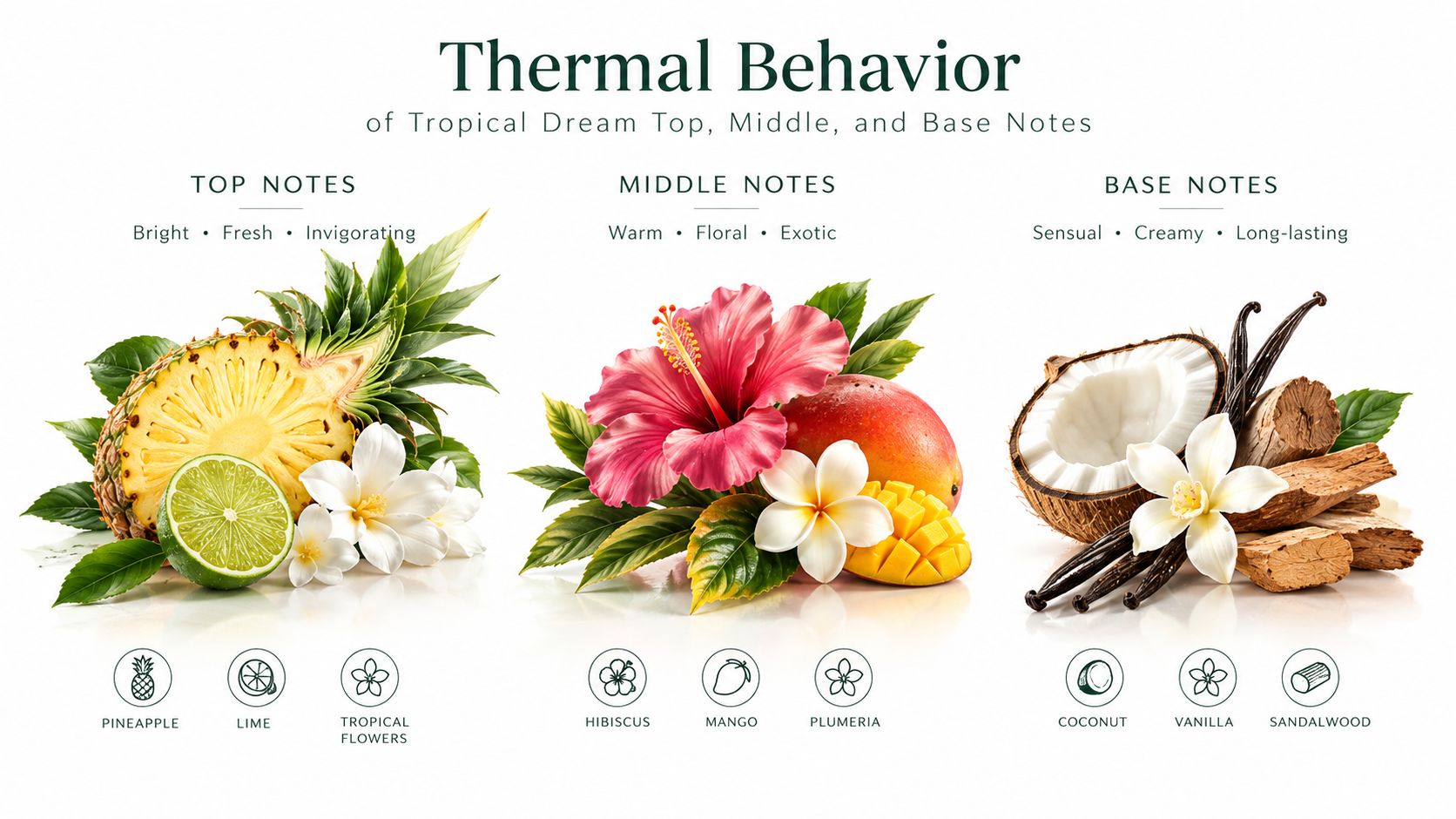
A Tropical Dream liquid that smells right in a warm beaker can still miss the target once it is run through a cartridge. The reason is simple. This profile behaves like a chemotype target, not a fixed recipe, and its citrus top, fruit body, and dry peppery finish do not tolerate heat in the same way.
Heating data summarized from Korzun and colleagues compared 12 cannabis terpenes from 100°C to 500°C. At the higher temperatures tested, reported survival ranged from about 97%–98% for myrcene to about 11%–28% for terpinolene (reported terpene heating behavior). For a Tropical Dream profile, that spread matters before release. A blend that looks balanced on paper can aerosolize with a thinner citrus opening, a flatter tropical middle, or a finish that takes over too early.
I handle this by treating the three-note structure as a heat-stability problem, not only a flavor problem.
Start with the top note. Limonene and any terpinolene-leaning accent usually create the first impression, but they are also the first place a device can distort the profile. If the opening disappears under the intended power and puff conditions, adding more top note in the liquid may help, but only if the adjustment does not make the cold fill too sharp or unstable.
The middle needs a different read. Myrcene can hold the fruit body together after aerosolization, yet too much can make the profile feel soft, herbal, or heavy instead of tropical. The base then has to do restraint work. Beta-caryophyllene and humulene can preserve dry structure and pepper, but if they persist too strongly after the first puff, the blend stops reading as bright and starts reading as woody or harsh.
Use a terpene temperature chart for cartridge development as a screening tool, then verify the finished hardware. Coil temperature is not uniform, and wick condition, geometry, dilution, and puff duration all change the effective thermal load. Gold Coast Terpenes isolates are useful here because they let formulators correct specific losses instead of rebuilding the whole blend.
Verifying Each Batch and Answers to Common Buyer Questions
A Tropical Dream batch is ready for release only after analytical, sensory, hardware, and labeling checks agree. The strain name is the starting reference, while the COA and finished-cart evaluation determine whether the product matches the intended chemotype target.
Use this release checklist:
- COA match: Confirm the incoming terpene blend and distillate correspond to the approved reference.
- Total load: Verify the target terpene concentration by mass, not by taste alone.
- Viscosity: Check the oil at the actual fill temperature and confirm consistent wick saturation.
- Aerosol panel: Compare the finished cartridge with the reference for citrus opening, tropical-fruit body, and peppery or earthy finish.
- Emissions review: Evaluate the selected load and hardware under the intended operating conditions.
- Label language: Confirm that botanical-derived, cannabis-derived, or nature-identical terminology matches the documentation and market requirements.
- Reorder control: Retain an approved sensory standard and compare every incoming lot against it.
How can a supplier prove the profile is reproducible?
Ask for a batch-specific COA, a written composition or specification, and a retained reference sample. Reorder testing should compare the new lot against the same sensory standard instead of relying on the product name.
What MOQ should a vape brand expect?
MOQ depends on the supplier, blend complexity, packaging, and whether the order is a pilot or bulk production run. Ask for pilot quantities, bulk pricing, lead times, and the point at which the supplier can reserve the same profile for repeat orders.
Can the blend work for hemp-derived or non-cannabis SKUs?
A strain-inspired blend can be reformulated for a different cannabinoid product, but the team must recheck labeling, jurisdiction, COA requirements, and oil compatibility. A botanical, THC-free input may simplify the sourcing conversation, but the finished product still needs its own compliance review.
Gold Coast Terpenes' wholesale and bulk programs, lab documentation, and strain-specific profiles are operational options a purchasing team can compare with other suppliers. The decision should rest on documented identity, consistent sensory performance, hardware validation, and workable supply terms.
Gold Coast Terpenes offers botanical strain-inspired blends, isolated compounds, bulk purchasing, and formulation tools for teams developing Tropical Dream profiles for distillate and vape cartridges. Compare the available profile with your approved reference, then visit Gold Coast Terpenes to source the inputs and documentation needed for controlled bench testing.