
The most popular advice about the White Runtz strain is to copy a dominant-terpene list and call the job finished. That approach fails in production because published profiles disagree, and the same strain label can describe noticeably different sensory outcomes. Gold Coast Terpenes supplies botanical strain profiles and isolated compounds, which gives formulators a way to treat White Runtz as a measurable flavor target rather than a fixed recipe.
For vape brands, extractors, and cannabis product developers, the useful question isn't “What does White Runtz smell like?” It's which terpene architecture will reproduce the candy, citrus, cream, spice, and fuel character in a finished cartridge. The workflow below covers lineage, COA interpretation, botanical versus cannabis-derived inputs, top/mid/base construction, distillate mixing, hardware testing, labeling, and repeatable production.
What the White Runtz Strain Means for Formulators
White Runtz should be treated as a strain-inspired terpene target, not as a guaranteed chemical specification. A name on a package only has technical value when the underlying blend consistently delivers the dessert-forward opening, citrus lift, peppery body, and rounded finish buyers associate with the profile.
Gold Coast Terpenes offers a dedicated White Runtz-style blend alongside individual compounds such as beta-caryophyllene, limonene, linalool, and humulene. That combination matters because a pre-blended profile can shorten development time, while isolates let a formulator correct a batch that is too sharp, too sweet, too floral, or too thin.
Practical rule: Match the sensory structure first, then refine the percentages against the COA. Don't treat a strain name as a substitute for analytical data.
A practical formulation roadmap looks like this:
- Define the target. Write down the desired opening, mid-palate, and finish. For White Runtz, that usually means citrus candy at the front, creamy fruit and spice through the middle, and a soft fuel or earthy finish.
- Read the source COA. Identify which compounds lead the customer-supplied flower, live resin, or distillate. Record whether the laboratory reports percentages, milligrams, or both.
- Choose the terpene source. Botanical inputs may offer consistent supply and easier scale. Cannabis-derived terpenes may support a strain-specific positioning, but they still need batch documentation and sensory validation.
- Build the note hierarchy. Limonene works as a bright top note. Beta-caryophyllene supplies the peppery body. Linalool rounds the blend, while humulene or myrcene can add depth.
- Test in the intended hardware. A blend that tastes balanced in a glass vial can become harsher or flatter in a ceramic cartridge, cotton wick, or all-in-one pod.
- Lock the production formula. Record the source, lot, COA, order of addition, mixing conditions, resting period, and hardware result.
The label is only commercially useful when the formula behind it survives this process. A different fruit-forward profile, such as Elevated Strains, should be treated as a separate sensory target rather than a substitute for White Runtz.
Where White Runtz Came From and Why It Matters
White Runtz emerged in California as a follow-up to the original Runtz line, which the Runtz Crew first developed in 2017. Multiple strain histories place White Runtz's public debut at the 2017 Emerald Cup in Santa Rosa, an event widely recognized as a major U.S. cannabis showcase. SeedFinder's White Runtz strain history describes the cultivar as part of the original Runtz family, with lineage links to Gelato and Zkittlez.
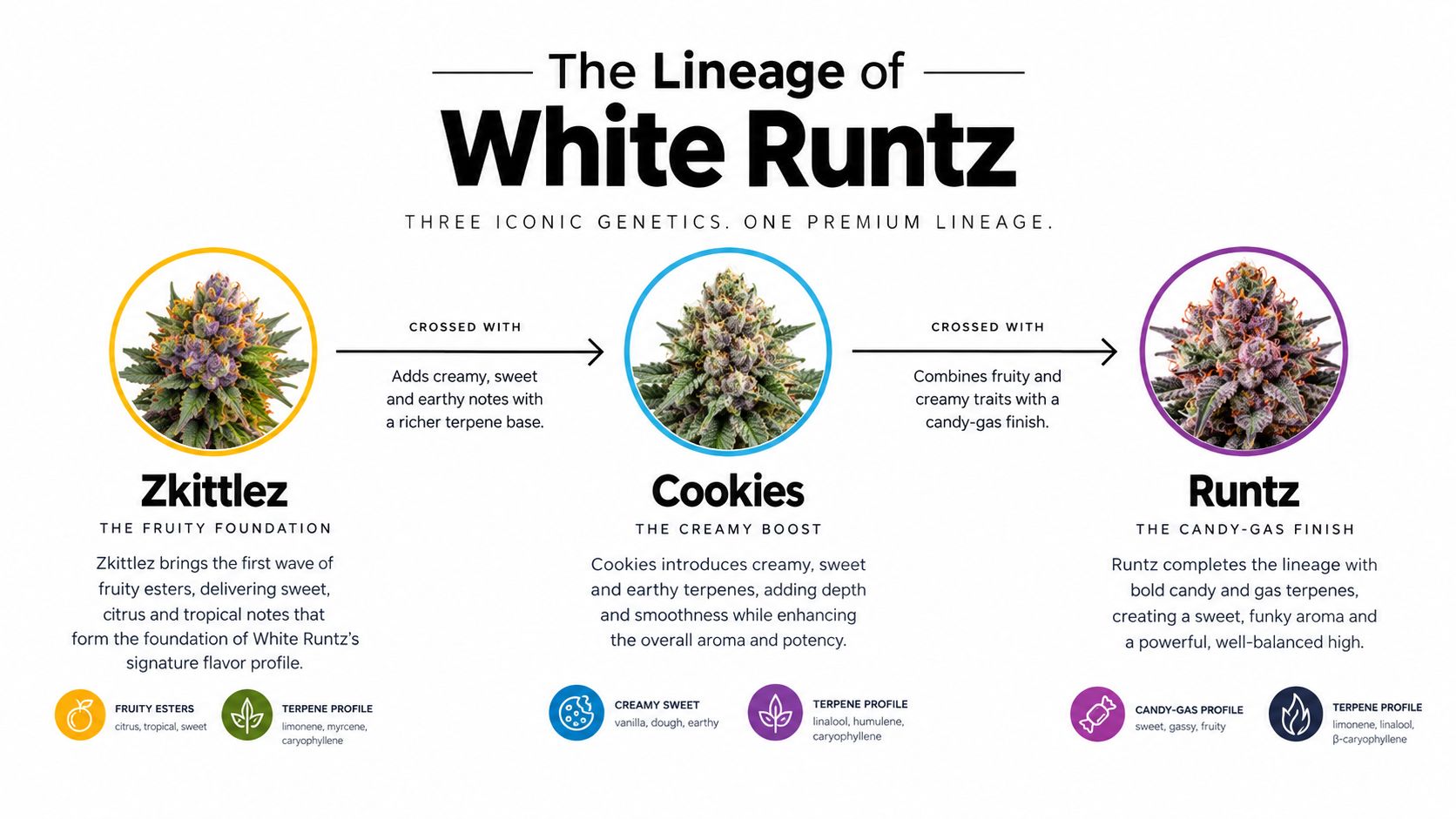
For a formulator, that history matters less as a breeding lesson than as an explanation of why the profile became commercially useful. The Runtz family helped establish a recognizable candy-dessert category, combining fruit sweetness with cream, spice, and a more pungent underlying note. That contrast gives the finished flavor enough structure to remain identifiable after extraction and dilution.
Lineage can suggest a direction, but it can't replace a COA. Gelato and Zkittlez are commonly associated with creamy and fruity sensory cues, while White Runtz batches can still vary in their balance of caryophyllene, limonene, linalool, myrcene, and pinene. The practical conclusion is simple: use lineage to create the first brief, then use batch data and blind sensory testing to decide whether the blend is accurate.
Why the dessert and fuel contrast survives as a product concept
A purely citrus blend may smell bright in a concentrate but lose the recognizable Runtz character in a finished vape. A purely peppery blend can become dry, woody, or harsh. White Runtz works as a formulation target because the sweet and pungent elements pull in opposite directions.
That duality also creates a useful product-development test. If the first inhale is candy-like but the finish disappears, the blend needs more body. If the finish dominates immediately, the top note is underpowered or the caryophyllene component is too aggressive. The goal isn't to reproduce every compound from a flower sample. It's to reproduce the perceived flavor arc with a formula that remains stable across lots.
What the White Runtz Terpene Profile Shows in Lab Data
Published White Runtz data conflicts enough that the strain name should not dictate a formula. A defensible working brief is a caryophyllene-forward profile with limonene lift and linalool rounding, then the batch COA decides how far that brief can go. One White Runtz profile from CannaConnection reports beta-caryophyllene at 8.424 mg, followed by limonene at 4.152 mg and linalool at 3.657 mg, with total measured terpenes of 2.213%. A separate 2024 review reports 0.44% caryophyllene, 0.40% limonene, 0.25% linalool, 0.24% myrcene, 0.21% pinene, and 0.21% humulene. The published White Runtz terpene review provides that measurement set.
Those results establish a useful direction, not a universal recipe. Independent profiles commonly place caryophyllene, limonene, and linalool near the front, while other listings emphasize limonene, myrcene, and alpha-pinene. Leafly's White Runtz profile follows the caryophyllene, limonene, and linalool ordering. Abstrax Tech's White RNTZ profile emphasizes d-limonene, beta-myrcene, and alpha-pinene. The Gold Coast Terpenes Runtz strain terpene archive is useful for comparing that broader naming and profile context, but it does not replace a lot-specific COA.
A practical COA reference table
Separate reported readings from formulation assumptions. The table does not create universal low, mid, and high ranges from limited samples. Use the values as orientation, then replace them with the customer or supplier COA before setting a blend ratio.
| Terpene | Low COA % | Mid COA % | High COA % | Formulation Role |
|---|---|---|---|---|
| Caryophyllene | 0.44% | Not established from the supplied percentage data | Not established from the supplied percentage data | Peppery body, dry spice, fuel structure |
| Limonene | 0.40% | Not established from the supplied percentage data | Not established from the supplied percentage data | Citrus lift and candy brightness |
| Linalool | 0.25% | Not established from the supplied percentage data | Not established from the supplied percentage data | Floral softness and finish rounding |
| Myrcene | 0.24% | Not established from the supplied percentage data | Not established from the supplied percentage data | Herbal depth and softer base |
| Pinene | 0.21% | Not established from the supplied percentage data | Not established from the supplied percentage data | Sharp, green, pine-like definition |
| Humulene | 0.21% | Not established from the supplied percentage data | Not established from the supplied percentage data | Earthy, woody support |
A breeder listing and strain databases place White Runtz THC broadly around 19% to 29%, depending on cut, cultivation, and laboratory sample, while one retail listing reports 20.85%. Those potency figures help with product positioning, but they do not show how to rebuild the flavor. Barney's Farm's White Runtz profile also reports terpene concentrations of 1.5% to 2.5% by weight in published strain data.
Formulator's note: Do not chase an exact flower COA percentage in the final cartridge. Translate the measured ratio into a sensory structure, then validate the finished oil, hardware, and storage condition.
For distillate, the final terpene load can change viscosity, vapor delivery, and perceived intensity. Set the target from the base, hardware, and applicable product requirements. A small pilot is more reliable than copying a flower percentage directly. Use the COA to set the caryophyllene body, add enough limonene for lift, and use linalool to round the finish without allowing the label to substitute for sensory validation.
How Botanical and Cannabis-Derived Terpenes Compare for White Runtz
Botanical and cannabis-derived terpenes may contain the same named molecules, including limonene, beta-caryophyllene, and linalool. For a White Runtz-style formula, the practical differences are source documentation, batch consistency, supply continuity, formulation cost, and labeling requirements. The source alone does not prove that a cartridge will taste more authentic.
Gold Coast Terpenes describes its inputs as 100% natural and plant-derived, with product documentation and formulation resources intended for terpene blending. That route suits a White Runtz-style cartridge when the brand needs a repeatable sensory profile and can describe the product without suggesting that the blend was recovered from the named cannabis cultivar.
Botanical inputs also give the formulator more direct control over a caryophyllene-forward structure, limonene lift, and linalool rounding. Isolates can correct a batch that reads too sharp, too sweet, or too thin. The trade-off is that the finished product should be labeled accurately as strain-inspired rather than presented as cannabis-derived material.
Cannabis-derived terpenes can support a stronger connection between the source extract and the strain name. That positioning requires closer review of the source material, contaminants, pesticide and heavy-metal screening, residual solvents where relevant, and lot-specific composition. State rules and product-labeling expectations may differ by market, so the compliance team should approve the intended claim before production.
| Factor | Botanical (GCT) | Cannabis-Derived |
|---|---|---|
| Molecular identity | Uses plant-derived terpene molecules | Uses terpene molecules recovered from cannabis material |
| Batch control | Supports a defined blend when lot data is reviewed | Can vary with cultivar, extraction process, and source lot |
| Scale | Suited to consistent wholesale supply | Depends on compliant cannabis inputs |
| Sensory strategy | Allows direct adjustment with isolates | May retain broader extract character, but can be harder to standardize |
| Documentation | Review COA, SDS, allergen, and labeling information | Review the same documents plus source and jurisdiction requirements |
| Best fit | Controlled strain-inspired formulation | Products where cannabis-derived sourcing supports the claim |
The botanical versus cannabis-derived terpene guide can help product teams classify and describe the input category. For scaled White Runtz cartridges, botanical inputs provide a practical starting point because they support repeatability and isolate-level corrections. Cannabis-derived material fits when its source story has commercial value and the added documentation and compliance work are acceptable.
How to Build the White Runtz Flavor Arc with Isolates and Blends
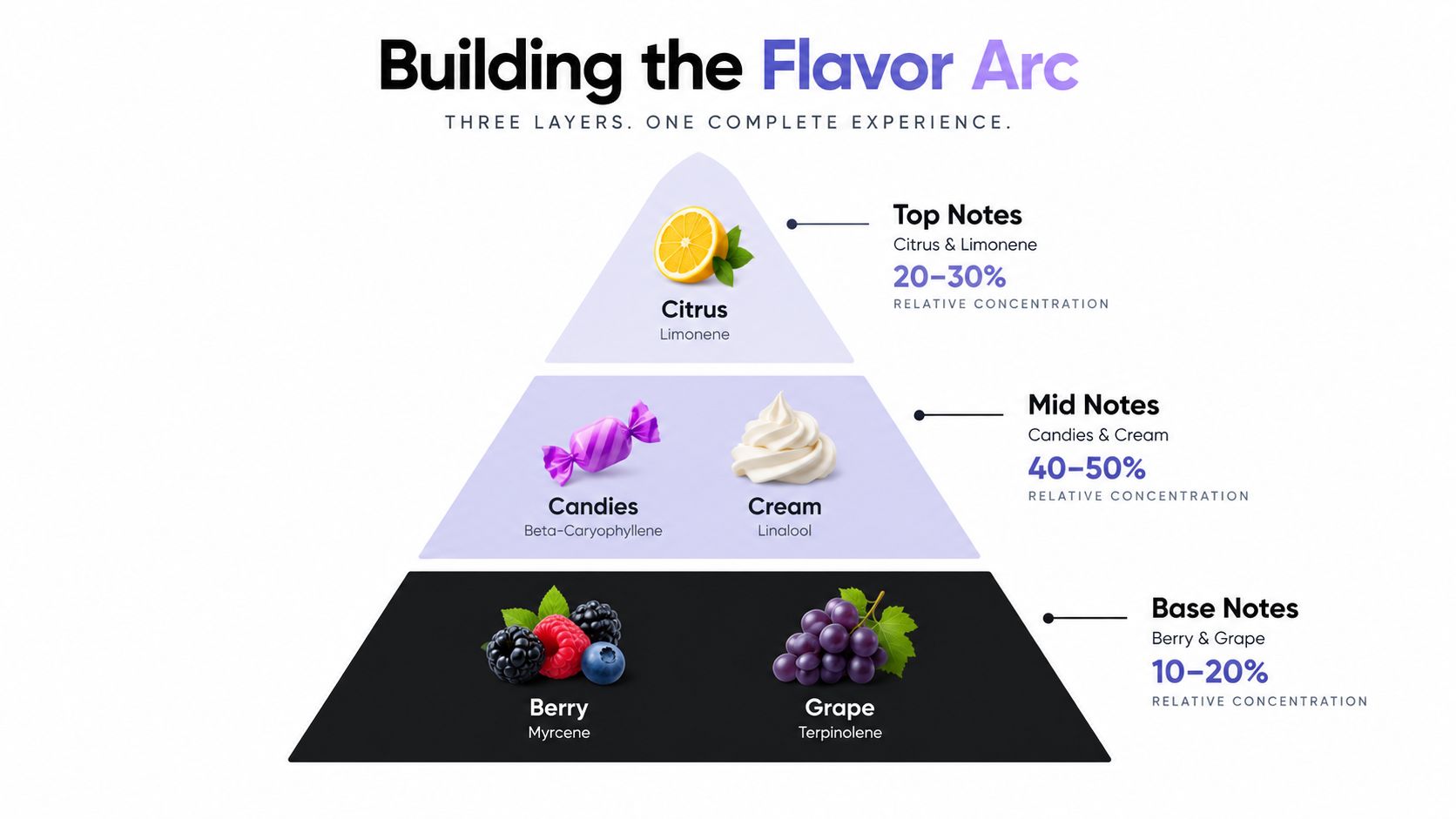
A reliable White Runtz-style blend needs three layers, not one dominant isolate. Start with limonene for the citrus-candy opening, use beta-caryophyllene as the main structural note, add linalool to soften the finish, and introduce a restrained amount of myrcene or humulene for depth.
A dedicated Gold Coast Terpenes White Runtz blend is the efficient first pass when the goal is to get close to the published caryophyllene, limonene, and linalool architecture. Isolates then become correction tools. Add limonene if the blend feels dull, beta-caryophyllene if it lacks fuel and body, linalool if the finish is too angular, or humulene if the profile needs a drier earthy edge.
Build the blend by sensory function
Top note, limonene. This is the first impression. It supplies brightness and helps the profile read as citrus candy instead of generic herbal cannabis. Too much can make the cartridge smell like cleaner or peel, especially when the base is already thin.
Mid note, beta-caryophyllene. This is the backbone. It contributes pepper, dry spice, and the fuel-like edge that keeps the sweetness from becoming confectionery-only. It should lead the structure, but it shouldn't bury the citrus opening.
Rounding note, linalool. Linalool softens the transition from the bright opening to the heavier finish. It can create a floral or lavender impression when overused, so the purpose here is smoothing, not turning the blend into a floral profile.
Base support, myrcene or humulene. Choose myrcene when the formula needs a softer herbal body. Choose humulene when it needs earthy, woody dryness. Use one as a supporting note first rather than adding both automatically.
For practical mixing math, calculate each component from the total terpene portion, not from the total finished oil. If the planned terpene portion is represented as T, and the target share of limonene is L, the limonene mass is T × L. Repeat that calculation for beta-caryophyllene, linalool, and the selected base support, then verify that the component masses add back to T.
Add the heavier structural components to the blend first, then incorporate the brighter top note and mix until uniform. Avoid judging immediately after blending. Let the sample rest under controlled conditions, then evaluate it in the actual oil base and intended hardware. The candy impression comes from interaction between citrus, floral softness, and spice. No single isolate can create that complete effect.
How to Mix White Runtz Terpenes for Carts and Distillate
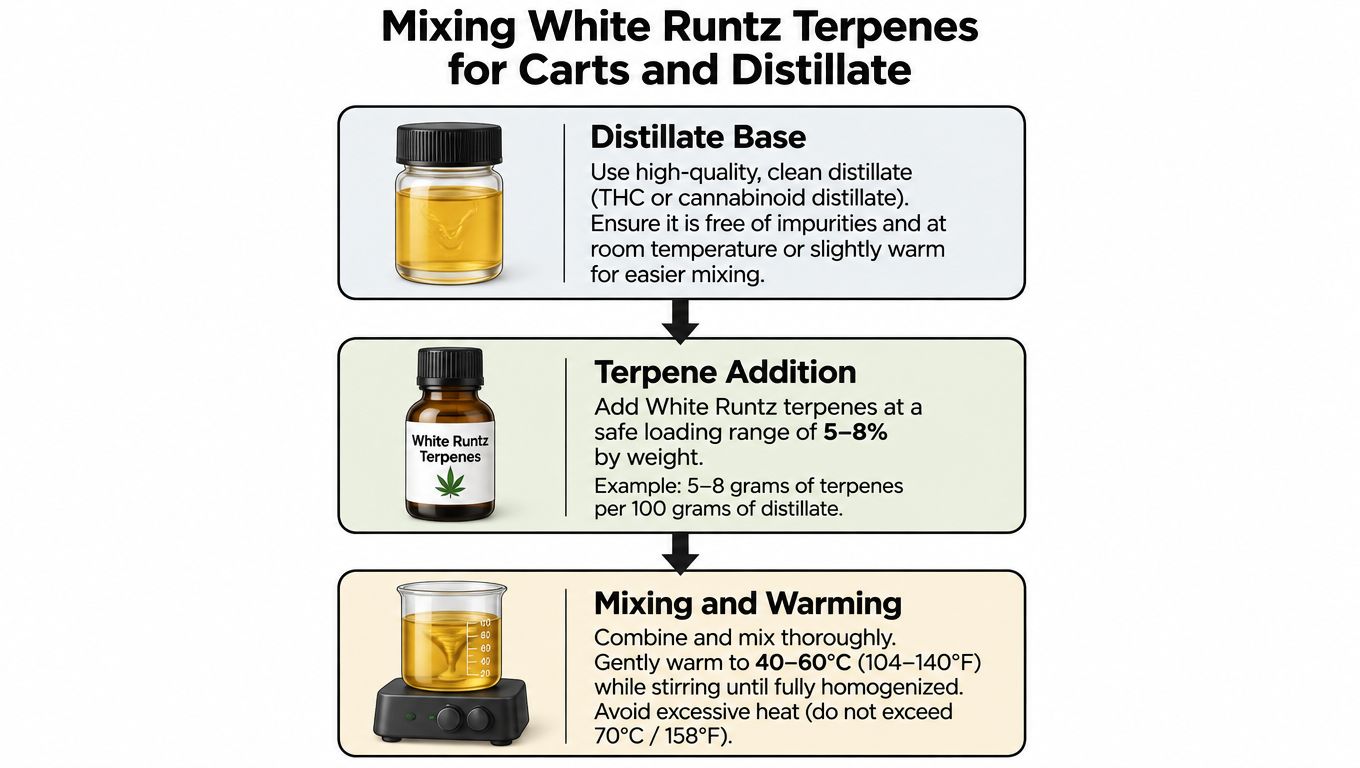
For a first distillate pilot, use a conservative supplier-validated loading range and adjust only after reviewing viscosity, aerosol behavior, flavor intensity, and hardware performance. The correct amount isn't universal, and a high-terpene live resin or sauce base usually needs a different approach from neutral distillate.
Start with the base and the hardware
Measure the distillate by weight and record its viscosity, color, residual aroma, and cannabinoid COA. A terpene blend can make a neutral base more expressive, but it won't reliably hide oxidized oil, residual processing odor, or an unstable extract.
Ceramic cartridges often present a different flavor and flow profile from cotton-wick hardware. A 510 cartridge may deliver a sharper first impression than an all-in-one pod, while a high-viscosity tank can expose poor homogenization through inconsistent wick saturation. Test the blend in the exact hardware planned for production.
Use a validated terpene mixing calculator to convert a desired finished-oil percentage into grams. For a one-gram cartridge, the arithmetic should be based on the total finished mass, not an assumption that the base remains exactly one gram after addition. If the target is expressed in milligrams per milliliter, confirm the density and fill volume before converting it to weight.
Mixing order and pilot controls
Warm the distillate only as much as the approved process requires. Excess heat can alter aroma and create a misleading first-pass result. Add the terpene blend gradually, mix until uniform, and inspect the batch for separation, haze, bubbles, or unexpected thinning.
A first pilot should check:
- Appearance: Confirm that the oil remains uniform after resting.
- Flow: Test fill behavior and wick saturation in the selected cartridge.
- Aroma: Compare the oil before and after hardware exposure.
- Taste: Evaluate the opening, mid-palate, and finish at the intended operating conditions.
- Stability: Recheck after storage in amber glass and after the planned hold period.
- Documentation: Save the formula, lot numbers, COAs, SDS files, mixing record, and evaluator notes.
For storage, use amber glass with minimal headspace. Refrigeration may be appropriate for some terpene materials, and nitrogen headspace can reduce oxygen exposure where the facility has a validated handling process. Keep the final storage protocol aligned with the supplier's SDS and the product's stability program.
A useful procedural reference is how to mix distillate with terpenes. The Gold Coast Terpenes mixing calculator can help with dosing conversions, but it doesn't replace a compatibility study or finished-product testing.
What a Reproducible Strain Profile Does for a Commercial SKU
A documented White Runtz-style formula turns a one-off flavor match into a repeatable SKU. The commercial advantage comes from controlling the ratio of caryophyllene, limonene, linalool, and supporting notes across production lots, not from using the strain name alone.
When biomass, distillate, or live resin changes, a fixed correction strategy gives the product team a way to bring the sensory result back toward target. The team can compare the incoming COA against the reference profile, decide whether the base needs more citrus or body, and record the adjustment instead of improvising during filling.
A strain-style description may also be easier to manage than an unsupported claim that the cartridge contains terpenes recovered from a specific cultivar. The regulatory result depends on the market and label language, so compliance review remains necessary. Product teams should keep the formula, source documentation, COAs, SDS files, and label rationale together.
Choosing between a pre-blended profile and isolates
A pre-blended White Runtz-style profile can reduce weighing and batch-prep work. An isolate stack offers more control, but it creates more opportunities for scale error, lot variation, and incomplete mixing.
| Approach | Per-mL Terpene Cost | Batch Prep Time | Batch-to-Batch Variance | Recommended For |
|---|---|---|---|---|
| Pre-blended profile | Confirm from the current supplier quote | Lower preparation burden | Lower when the blend and lot are controlled | Pilot runs and repeatable production |
| DIY isolate stack | Calculate from each isolate's current cost | More weighing and verification | Depends on operator accuracy and isolate lots | Custom matching and corrective formulation |
| Hybrid approach | Blend cost plus selected isolates | Moderate preparation burden | Controlled when corrections are documented | COA matching and profile refinement |
Gold Coast Terpenes provides strain-style blends and isolates in formats that can support both pilot work and larger purchasing programs. A smaller brand should confirm current minimum order quantities, pack sizes, wholesale terms, and documentation directly with the supplier rather than assuming a fixed catalog policy.
Hardware decisions also become easier when the flavor is stable. If a blend performs consistently, the team can compare ceramic and cotton-wick systems on flow, vapor, and flavor carry-through rather than changing both the formula and the cartridge at the same time. Reproducibility is the moat because it protects the customer experience, reduces avoidable rework, and gives the brand a defensible production record.
What Buyers Ask About the White Runtz Strain Terpene Profile
Which blend should a first-time formulator start with?
Start with a dedicated White Runtz-style blend, then compare its COA with the target material. Published strain pages often disagree on dominant terpenes, so use the label as a starting point, not a specification. Build around caryophyllene, add limonene for lift, and use linalool to round the finish. Gold Coast Terpenes offers the blend plus beta-caryophyllene, limonene, linalool, and humulene isolates for measured corrections.
What terpene percentage should a 510 cartridge use?
There is no defensible percentage for every 510 cartridge. Follow the supplier's guidance for the specific distillate and hardware, then run a small pilot. Check flow, taste, aerosol behavior, and stability before setting a production target.
Does White Runtz work in live resin or sauce?
Yes, as a strain-inspired flavor target. Live resin and sauce already contain native terpenes, so review the base COA first. Add only enough external blend to correct the profile. Excess addition can bury the extract's character and make the result harder to reproduce.
Will the candy top note fade before the caryophyllene base?
Citrus notes can seem less prominent after oxidation or heat and air exposure. Store terpene materials in suitable sealed amber containers, then assess filled cartridges across the intended shelf-life program. Record the sensory change alongside stability results rather than judging the blend immediately after filling.
Can Gold Coast Terpenes match a customer-supplied COA?
A supplier can use the COA to begin a matching discussion, but an exact match requires review of the sample, analytical method, source lot, and sensory target. Send the relevant data and request current COAs and SDS files before approving a corrective blend.
Where should buyers check ordering requirements?
Confirm current minimum order quantities, pack sizes, and wholesale terms before ordering. The terpene purchasing guide provides a starting point, followed by direct confirmation of the White Runtz-style blend and selected isolates.
Formulators testing this profile should begin with supplier COA documentation and the mixing calculator, then confirm the blend in a pilot batch before production.