
You've got a Lime Cake reference flower, a clean distillate, and a cartridge that tastes like sharp lime on the first pull, followed by almost no cake character. That failure usually comes from treating the profile as a single citrus flavor instead of rebuilding its citrus, spice, and dessert layers. Gold Coast Terpenes supplies botanically derived, THC-free terpene blends for cartridge and extract formulation, which makes it a practical reference point when you need repeatable Lime Cake flavor work rather than a one-off sensory approximation.
For product developers, the useful question isn't what the Lime Cake strain feels like. It's how to reproduce its lime-forward opening, vanilla-cake body, and grounded finish across winterized oil, distillate, live resin, and different cartridge formats without overdosing limonene or losing the dessert base.
What Defines the Lime Cake Strain Profile
Lime Cake is generally treated as a balanced hybrid, and one documented strain profile lists it at 50% indica and 50% sativa, with an average THC level of 20%–21% and a Black Lime Reserve x Wedding Cake lineage (AllBud's Lime Cake strain profile). That combination gives formulators a useful commercial brief: a high-potency flower target with enough aromatic contrast to support a premium, extract-friendly flavor system.
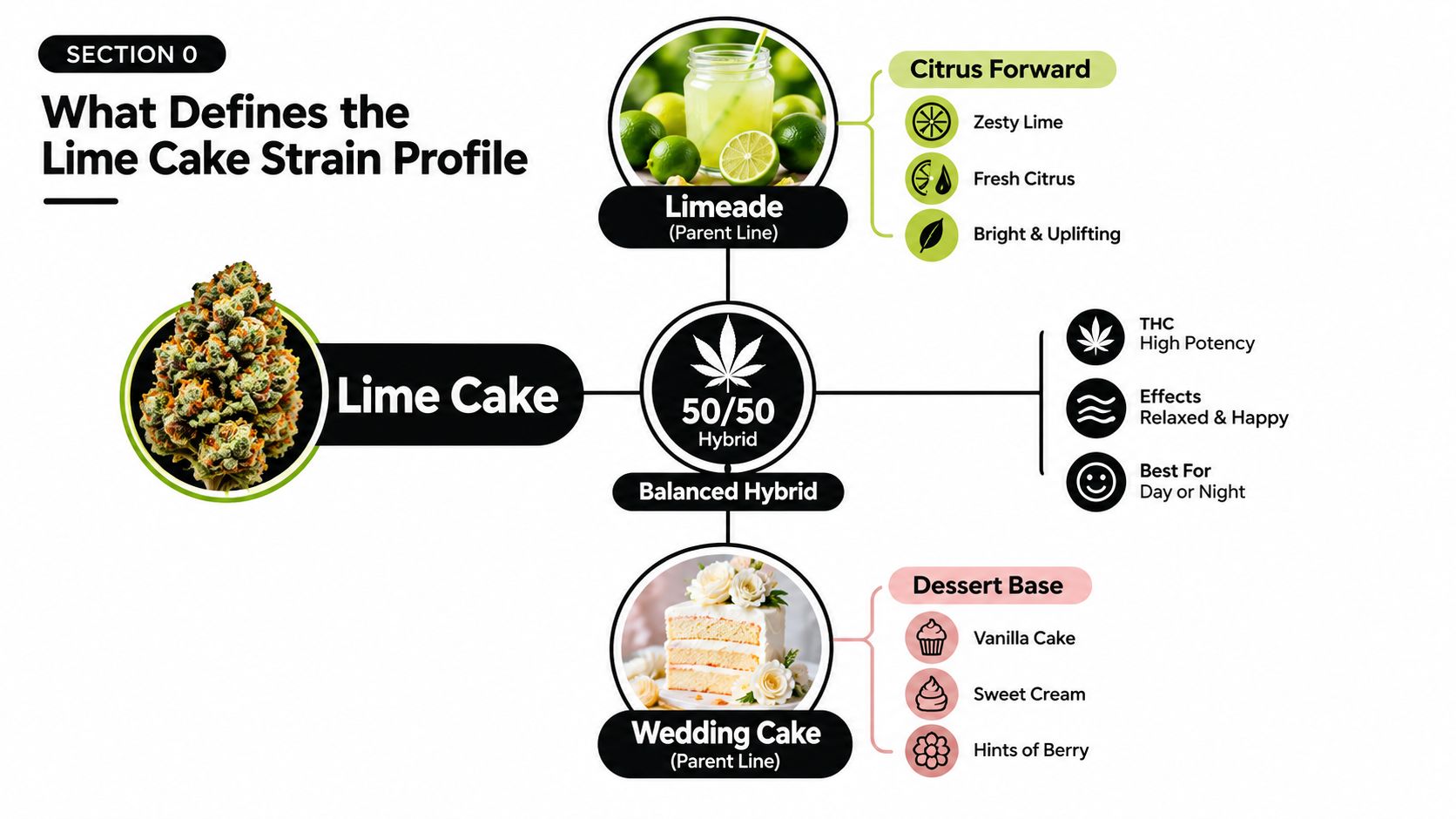
Start with the sensory architecture
The Lime Cake label can refer to more than one documented breeder line. Independent catalog data connects one release to Lime Kush x Triangle Mints, while other profiles place the name within a broader Cake-family and lime-forward framework (SeedFinder's Lime Cake profile). That variability matters because a reference lot may lean toward lime zest, cookie dough, resin, or a softer vanilla finish.
Treat the profile as a three-part target:
- Opening: sharp lime and citrus lift, led by limonene.
- Body: pepper, resin, and confectionery warmth, supported by beta-caryophyllene and myrcene.
- Finish: soft floral creaminess and cake depth, where linalool and the underlying extract matrix matter most.
A separate Lime Cake description reports a cake-like aroma with citrus overtones and identifies limonene and myrcene as dominant terpenes at approximately 1.2%–2% by weight in some samples (JointCommerce's Lime Cake by Swamp Boys Seeds guide). Those figures describe sample flower, not a finished cartridge formula, so they shouldn't be copied directly into distillate.
Why potency and lineage affect the build
The reported 20%–21% THC range helps explain why Lime Cake is positioned as a concentrated-flower and extract target rather than a low-potency, CBD-led profile. The cannabinoid load doesn't create the aroma by itself, but it affects the product brief, the expected strength of the base oil, and the amount of sensory contrast needed from the added terpene system.
The Cake family also gives the profile its reason to exist. A plain lime formulation is easy to recognize, but it doesn't necessarily read as Lime Cake. The formulator has to preserve the contrast between citrus brightness and a richer, slightly peppered dessert base. For background on the cake-family side of the profile, see this guide to Wedding Cake strain effects.
Terpene Breakdown for Lime Cake Flavor Replication
A workable strain-inspired terpene blend for Lime Cake needs three sensory tiers. Limonene creates first recognition, beta-caryophyllene and myrcene provide the middle structure, and linalool supplies the softer base that stops the cartridge from tasting like generic lime candy.
The most useful starting point is a formulation grid, not a rigid recipe. The percentages below are derived from a closely related lime-cake formulation reference and should be evaluated in the actual oil matrix, because winterized distillate can make the same blend smell brighter and finish thinner than the reference flower (Gold Coast Terpenes' Key Lime Pie terpene breakdown).
Lime Cake Terpene Tier Reference
| Terpene | Layer | Target % by Weight | Sensory Role |
|---|---|---|---|
| Limonene | Top | 0.4%–0.6% | Lime zest, brightness, first-pull recognition |
| Beta-caryophyllene | Mid | 0.2%–0.3% | Pepper, resin, warmth, bridge into the cake note |
| Myrcene | Base | 0.15%–0.25% | Weight, roundness, earthy support |
| Linalool | Support | Below 0.1% | Floral creaminess and softness |
| Alpha-pinene | Support | Qualitative trace | Green lift and aromatic definition |
The exact role matters more than chasing a terpene name. Limonene is the attention layer, but it's also the easiest material to overuse. Beta-caryophyllene gives the profile enough warmth to move away from lime soda, while myrcene keeps the middle from collapsing into a thin top-note burst.
Linalool is where many dessert builds go wrong. It can add a creamy, floral impression, but too much can mute the lime opening and make the cartridge feel dull. In winterized distillate, the cake impression often depends on how the blend interacts with the carrier, so a COA provides the starting evidence and sensory review provides the decision.
Formulation rule: Build the lime first, then add enough mid and base structure to make the finish identifiable. Don't use linalool to compensate for a weak cake architecture.
For an adjacent catalog reference, Elevated Strains offers a separate flavor profile that can help a developer compare dessert-forward aromatic direction without treating it as a Lime Cake substitute. The comparison is useful during A/B work, but the final blend still needs to match the selected Lime Cake reference lot.
A citral formulation guide can also help distinguish a clean citrus lift from a harsher, more aggressively lemon-cleaner character. That distinction becomes important when the finished oil is evaluated after heating rather than only in the bottle.
Botanical Versus Cannabis-Derived Terpenes for Lime Cake
For Lime Cake cartridge work, botanical terpenes offer tighter control and easier scale, while cannabis-derived terpenes can provide a closer connection to a specific flower lot. The right choice depends on whether the priority is exact lot authenticity or repeatable flavor, compliance, and manufacturing control.
Cannabis-derived terpenes extracted from a verified Lime Cake lot may preserve the source flower's chiral signature and minor aromatic compounds. The trade-off is variability. A different harvest, phenotype, extraction process, or storage history can shift the ratio enough to change the cartridge from lime-and-cake to lime-and-fuel. Cannabis-derived material may also introduce THC carry-over, which complicates documentation and product release.
Botanical inputs are fractionated from non-cannabis plants and then combined to reproduce a target sensory profile. They don't automatically recreate every nuance of a flower lot, but they let the formulator control the limonene-to-linalool relationship, the caryophyllene bridge, and the overall addition rate more consistently. That's valuable when the same SKU must remain recognizable across production runs.
The practical trade-off
| Consideration | Botanical terpenes | Cannabis-derived terpenes |
|---|---|---|
| Repeatability | Easier to standardize | More dependent on source lot |
| THC carry-over | THC-free when properly sourced | Requires verification |
| Lot authenticity | Reconstructed target profile | Closer to the source flower |
| Scale | Better suited to repeat production | Often more limited by source material |
| Compliance workflow | Simpler cannabinoid documentation | More complex testing and traceability |
Gold Coast Terpenes positions its Lime Cake work on the botanical side, supplying 100% botanically derived, THC-free terpene profiles intended for extracts and cartridges. The company's comparison of CDT and BDT materials is useful when a brand is deciding whether lot fidelity or manufacturing consistency carries more weight.
The compromise is that botanical blends still need validation. Use the reference COA to identify the source profile, then evaluate the blend in the actual matrix. A botanical reconstruction that smells accurate in a vial can lose its dessert base after dilution into winterized distillate, so sensory review must happen after homogenization and heating.
Formulating Lime Cake for Distillate Cartridges
A practical starting formula for a Lime Cake distillate cartridge uses limonene at 1.8%–2.2%, beta-caryophyllene at 0.9%–1.1%, myrcene at 0.4%–0.6%, and linalool at 0.2%–0.3% by weight. Keep total added terpenes between 4% and 5% for this starting build, then confirm performance in the selected hardware before production.
Starting ratio table
| Terpene | Role | Starting % by Weight | Correction Range | Failure Mode if Over-Dosed |
|---|---|---|---|---|
| Limonene | Citrus top note | 1.8%–2.2% | Pull back by 0.3% if harsh | Cleaning-product sharpness, thin finish |
| Beta-caryophyllene | Cake warmth and bridge | 0.9%–1.1% | Increase by 0.15% if flat | Pepper, dryness, excessive spice |
| Myrcene | Body and grounding | 0.4%–0.6% | Adjust within the starting band | Heavy, muddy, earthy profile |
| Linalool | Floral creaminess | 0.2%–0.3% | Keep restrained | Muted lime and blurred definition |
A controlled bench workflow
Weigh every component. Use a balance rather than a pipette. Volume measurements become unreliable when terpene density and temperature vary, and small errors can push the top note out of balance.
Warm the distillate to 40–45°C. This lowers viscosity enough for incorporation without treating heat as a flavor-development tool. Add the botanical blend under a fume hood and use a magnetic bar for 90 seconds of mixing.
Pull vacuum for 30 minutes at 28 inHg. The purpose is to remove residual ethanol and entrained air, not to strip the volatile profile. Watch for foaming, because a violent vacuum step can create handling and fill-weight problems.
Age the homogenized blend for 24 hours at room temperature. This gives limonene and beta-caryophyllene time to equilibrate with the lipid matrix before filling. A bottle that smells correct immediately after mixing may present differently after resting.
Run a sensory pull against a 0.5 gram COA reference before scaling beyond 200 grams. Compare the first pull, mid-palate, and finish. Don't judge only from the open bottle.
The correction method should be small and directional. If the cake note feels flat, increase beta-caryophyllene by 0.15%. If the lime tastes like cleaning product, reduce limonene by 0.3% rather than adding more base materials to cover the problem. The distillate terpene formulation guide provides additional context for working with concentrated oil systems.
Matching Lime Cake to Extract Type and Carrier
The same Lime Cake blend won't present identically in every extract. Winterized distillate makes limonene bright but can leave the cake finish thin, live resin carries more native aromatic context, and a controlled botanical blend in distillate gives the developer the clearest route to repeatability.
Winterized distillate
Winterized distillate is clean and predictable, but its stripped aromatic background can expose weaknesses in the dessert base. Limonene arrives quickly, while the mid-palate may disappear before the second part of the pull. If the formulation relies on a heavy limonene dose to create recognition, the result can become sharp without becoming more accurate.
Beta-caryophyllene and restrained myrcene matter here. They don't make the profile taste like cake on their own, but they supply the warmth and weight needed for the citrus opening to feel attached to something.
Live resin
Live resin often gives the most faithful translation when the source material fully expresses Lime Cake's citrus and dessert character. Its native terpene mixture can provide complexity that a reconstructed blend has to build manually. The trade-off is less control over the final aromatic balance, especially when the native oil already carries a strong limonene load.
A live resin system also needs its own separation and hardware evaluation. A ratio that performs well in distillate shouldn't be copied without checking viscosity, stability, and sensory persistence in the resin base.
Controlled botanical blending
Distillate plus a botanical blend sits between the two options. The carrier is clean, the aromatic inputs are measurable, and the dessert layer can be adjusted without depending on a specific harvest. Gold Coast Terpenes describes its blends as lab-verified free of VG, PG, PEG, and MCT oil, which helps brands keep the formulation focused on extract and terpene components rather than adding carrier materials that can affect hardware behavior.
For a brand, that control makes it easier to compare formats, including pods and all-in-one cartridges. It still doesn't eliminate validation. Each device should be tested for fill behavior, leakage, vapor character, and post-use residue before the ratio becomes a production standard.
How Gold Coast Terpenes Supports Lime Cake Builds
Gold Coast Terpenes gives a formulator two catalog paths: a 37-profile strain reference catalog for benchmarking, and a smaller line of selectively amplified dessert and citrus profiles for targeted definition. The choice matters because Lime Cake can lose its cake character when citrus intensity becomes the only clear signal.
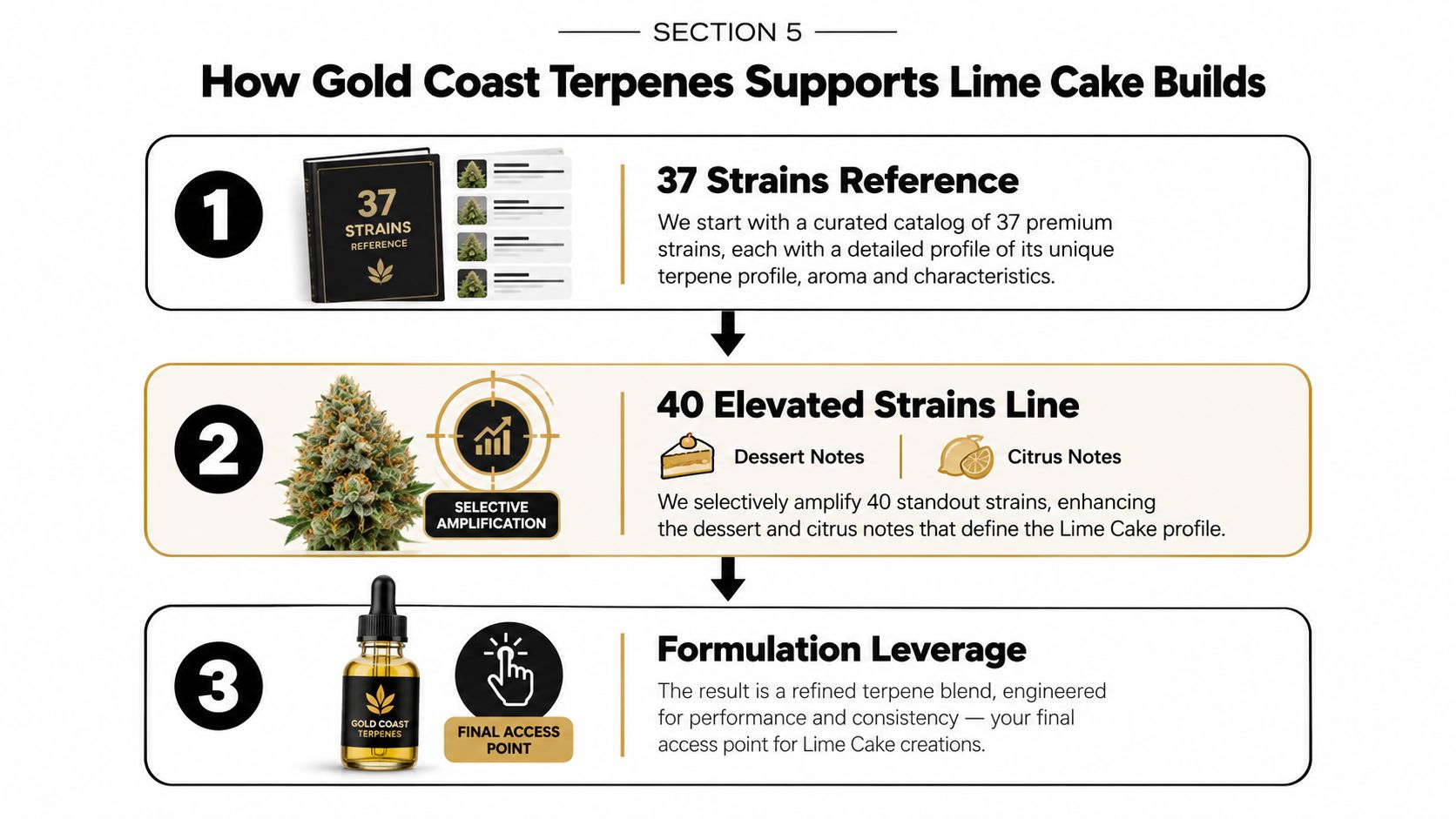
Use the catalogs as formulation references
At the same 4% total terpene load in winterized distillate, a strain-style reference profile usually gives the bench a recognizable Lime Cake starting point. Its citrus, floral, and dessert notes may read as a connected profile, leaving room to adjust limonene without rebuilding the whole formula.
An amplified profile behaves differently at that same load. It can make lime and sweet top notes register faster, but it may also push limonene forward enough to thin the cake impression or create a sharper vapor. That version suits a brief calling for stronger definition, provided sensory checks confirm that the dessert base remains present.
The comparison should happen in the actual distillate, not only on a blotter or flavor strip. Record first impression, mid-pull character, finish, and any solvent-like edge before selecting the reference for scale-up.
Gold Coast Terpenes presents its inputs as 100% botanically derived and THC-free. Its lab documentation and batch-matched COAs can connect the selected input to the formulation record, while the developer still verifies identity and performance independently.
What to validate before ordering at production scale
Review these points before approving a production purchase:
- The matching COA: Confirm terpene identity and batch information for the selected reference.
- Matrix compatibility: Test it in the exact distillate, resin, or concentrate planned for production.
- Hardware performance: Check fill behavior, leakage, vapor character, and residue in the selected cartridge.
- Labeling support: Verify the documents required for the intended state or hemp-market release.
- Procurement terms: Confirm minimum order quantities, lead times, and bulk pricing directly.
Gold Coast Terpenes' practical role is to provide a consistent botanical starting point and documentation for repeat sourcing. The formulator still owns the sensory standard, matrix test, and release decision.
Potency, Safety, and Labeling for High-THC Profiles
Treat a Lime Cake base reported at 20%–21% THC as high-potency starting material. The finished cartridge label must come from the final product COA, as noted earlier, rather than the strain name or an assumed dilution result. Terpene percentages do not replace cannabinoid testing, and a strain-inspired flavor description cannot replace required regulatory disclosures.
Set a hard sensory stop before production trials. Pushing limonene above roughly 8% by weight in distillate can strip out the cake mouthfeel and produce a sharp, solvent-like pull. Use that level as a failure screen, not a formulation target. A practical working band for added limonene is 1.8%–2.2%, adjusted only after testing the complete terpene system in the actual distillate.
Cartridge safety and potency reference
| Parameter | Working Check | Failure Mode |
|---|---|---|
| THC potency | Confirm with a finished-product COA | Incorrect label or failed release testing |
| Added limonene | Start in the 1.8%–2.2% working band; screen for sensory failure at higher levels | Sharp, solvent-like vapor and collapsed cake mouthfeel |
| Terpene identity | Match the input COA to the batch record | Traceability gap or inaccurate disclosure |
| Residual solvents | Pass the applicable third-party panel | Product held or rejected |
| Pesticides and heavy metals | Pass the applicable independent laboratory panels | Contaminated product release |
| Packaging | Use compliant child-resistant packaging | Safety and regulatory failure |
| Allergen information | Review the complete formulation and labeling requirements | Incomplete consumer disclosure |
Use a short sensory rubric during development. Score the opening for lime clarity, the middle for cake and pepper balance, and the finish for softness and persistence. If the opening is vivid but the finish disappears, do not automatically increase limonene. The base layer may be under-supported, or the matrix may be suppressing the dessert notes.
Record those observations alongside the batch and COA, then repeat the check after filling. Cartridge hardware can change vapor sharpness, finish length, and perceived potency even when the formula remains unchanged.
Each production batch should receive independent third-party testing for cannabinoid potency, pesticides, heavy metals, and residual solvents. Label the actual finished product for the jurisdiction where it will be sold. State requirements differ, so compliance review belongs beside formulation review and before filling.
Frequently Asked Questions for Brand Buyers
What should a brand ask before buying Lime Cake terpenes?
Ask for the applicable COA, batch traceability, ingredient identity, recommended use information, and documentation supporting the intended market. Gold Coast Terpenes supplies strain-style and isolated terpene materials, but the brand still needs to confirm that the selected input fits its carrier, hardware, and state testing requirements.
Are minimum order quantities and lead times published for every blend?
They may vary by profile, format, and order size, so confirm them directly before building a production schedule. For a new Lime Cake SKU, request a bench sample first, then approve a larger lot only after sensory and hardware testing match the reference.
Does Gold Coast Terpenes offer bulk ordering?
Gold Coast Terpenes provides bulk and wholesale purchasing options, with terms that should be confirmed for the specific blend and quantity. Its catalog includes 37 Strains and 40 Enhanced Strains, so procurement teams can compare a reference profile with a more selectively amplified dessert or citrus direction.
Is U.S. shipping free for qualifying orders?
Gold Coast Terpenes lists free U.S. shipping on orders over $100, with the current terms subject to change. The company also lists discounts on orders exceeding 64 ounces, so buyers should verify the active structure before placing a bulk order.
How should a brand A/B test a Lime Cake blend?
Prepare the same distillate batch with the candidate blend and a control, then evaluate both in the intended cartridge hardware after the blend has rested. Compare first-pull lime, mid-palate cake character, finish persistence, vapor harshness, and any separation or fill issues before choosing the production ratio.
What reorder cadence works for an established SKU?
Reorder before the remaining inventory forces a rushed substitution, and use the batch COA and sensory reference to compare each incoming lot. A documented retain sample, fixed mixing method, and approval panel will make it easier to decide whether a new batch is equivalent or needs a small correction.
Gold Coast Terpenes offers botanically derived, THC-free strain profiles and isolated compounds for Lime Cake cartridge development, with COA-based sourcing and wholesale options for larger production needs. Start with a small matrix and hardware test, compare the citrus opening against the cake finish, then visit Gold Coast Terpenes to review the available formulation resources and terpene options.