
Gold Coast Terpenes supplies 100% botanical terpene blends and isolated compounds for cartridge, concentrate, and product formulation work. That makes the brand relevant to a Lemon Truffle project, but the popular advice to “match the strain” misses the central problem: Lemon Truffle doesn't have a consistently verified public chemotype.
For a product developer, that uncertainty isn't a reason to abandon the profile. It's a reason to treat Lemon Truffle as a strain-inspired terpene blend built from documented Truffle-family chemistry, sensory targets, and bench validation. The practical question isn't just what Lemon Truffle tastes like. It's what citrus, dessert, spice, and earthy notes need to do in a formulation for vape cartridges or distillate.
Why Does the Lemon Truffle Strain Have No Standard Chemotype?
Lemon Truffle shouldn't be treated as a fixed genetic reference unless the supplier can provide a flower COA, breeder record, and consistent lineage documentation. Public listings identify it as a hybrid, but the breeder and exact origin remain unknown or inconsistently documented, while reported THC information varies by grower and batch. AskGrowers' Lemon Truffles review reflects that documentation gap.
That distinction matters in commercial replication. A familiar name can circulate through catalogs and product menus before its genealogy, phenotype selection, and lab profile are standardized. Leafly's Lemon Truffles page describes lemon, apple, and sweet flavor notes, while Weedmaps' profile characterizes the available information as limited and generally presents the cultivar as a balanced hybrid with citrus notes.
What the available evidence supports
The safest working description is a citrus-forward, sweet hybrid direction with uncertain provenance. Public descriptions support lemon, apple-like sweetness, and a broader dessert character, but they don't establish whether every batch shares the same terpene balance.
The closely related Truffle reference is more useful for formulation than the Lemon Truffle name itself. One COA-based profile reports beta-caryophyllene at 0.90%, limonene at 0.66%, myrcene at 0.38%, humulene at 0.37%, linalool at 0.24%, and alpha-pinene at 0.12%. CannMenus' Truffle profile shows a stack with spicy base, citrus lift, earthy body, and floral rounding.
Another Truffles reference reports beta-caryophyllene at 0.5% to 1.0%, limonene at 0.3% to 0.8%, linalool at 0.1% to 0.4%, myrcene at 0.2% to 0.8%, and ocimene or pinene at 0.05% to 0.2% each. Joint Commerce's Truffles guide is useful as a range reference, not as proof of a Lemon Truffle chemotype.
Truffle-family COA reference ranges
| Cultivar | Total Terpenes % | Limonene % | Dominant Supporting Terpenes |
|---|---|---|---|
| Truffle family reference | Not consistently established | 0.66% in one COA-based profile | Beta-caryophyllene, myrcene, humulene |
| Truffles range reference | Not consistently established | 0.3% to 0.8% | Beta-caryophyllene, linalool, myrcene |
| Lemon Truffles | Not consistently documented | Not fixed | Citrus, sweet, apple-like notes reported |
For a deeper comparison point, formulators can review the London Truffle strain profile, while keeping the same discipline: use related Truffle data as a scaffold, not as a substitute for a Lemon Truffle COA.
Practical rule: If the raw material has no reliable batch COA, formulate toward a sensory specification rather than claiming genetic authenticity.
What Terpene Profile Sits Behind the Citrus and Dessert Notes?
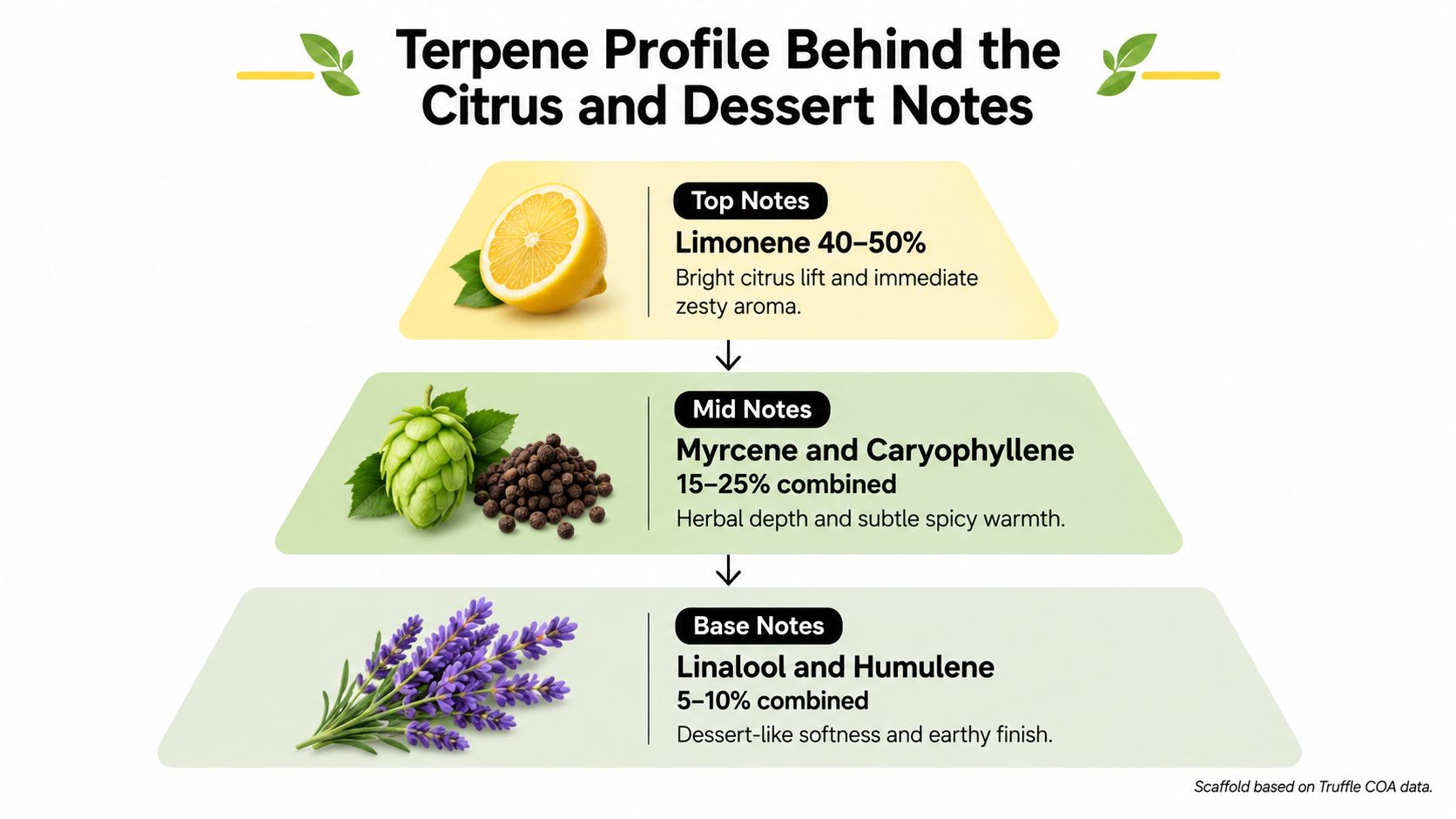
A workable Lemon Truffle-inspired profile needs a bright citrus opening, a soft sweet middle, and a peppery, earthy finish. The most useful approach is to assign each terpene a sensory job, then adjust the blend against a reference rather than treating every reported flavor note as a direct chemical identity.
Top notes create the first impression
Limonene supplies the principal lemon-peel lift. In a strain-inspired terpene blend, it should lead the opening, but excessive limonene can make the profile read as cleaner or sharper than lemon dessert.
Valencene can add a rounder citrus impression, closer to orange pulp than dry lemon zest. Terpinolene should remain restrained when the target is creamy citrus, because a strong floral or herbal direction can pull the blend away from the intended dessert character.
Mid notes build the edible impression
Myrcene provides body and helps prevent the citrus from feeling hollow. The Truffle-family data places myrcene below limonene in the cited profiles, which supports using it as a body note rather than allowing it to dominate the opening.
Beta-caryophyllene contributes peppery warmth and a baked-spice impression. It's one of the most important tools for avoiding a generic lemon flavor, because the target needs contrast between citrus brightness and a deeper Truffle-style base.
Linalool rounds the center with soft floral sweetness. Its reported range in the related Truffles profile is broad, so the right level depends on whether the batch should lean toward gas and spice or toward cream and pastry.
Base notes keep the blend from collapsing
Humulene contributes woody, earthy depth. Alpha-pinene can add lift and definition, but it should be evaluated carefully because a pine-forward finish can make the formulation feel less confectionary.
Minor terpenes should round the composition to the final formulation total. Don't chase a single dominant molecule. The commercial objective is a stable sensory arc that begins with lemon, develops into sweet apple and dessert, and finishes with restrained spice and earth.
For a separate citrus reference, the lemon terpene profile guide can help formulators distinguish bright zest from sweeter citrus body before building the Truffle base.
Which Is Better for Replication, Botanical or Cannabis-Derived Terpenes?
Botanical terpenes generally offer the stronger operational fit for scalable vape SKUs, while cannabis-derived terpenes can make sense when the product claim depends on a closer flower-derived aroma. The decision should follow the intended label language, testing program, and need for lot-to-lot consistency.
Botanical material gives a formulator a more controllable starting point. Gold Coast Terpenes describes its blends as botanical and THC-free, which can simplify development for brands managing multiple product categories. The supplier's botanical versus cannabis-derived terpene comparison is relevant when deciding how much weight to place on source identity versus sensory repeatability.
| Formulation priority | Botanical-derived terpenes | Cannabis-derived terpenes |
|---|---|---|
| Batch consistency | Usually easier to standardize against a blend specification | Can vary with cultivar, extraction method, and source batch |
| THC carryover | Can be selected without cannabis-derived THC | Requires careful material and compliance review |
| Flower authenticity claim | Less direct | More aligned with a flower-derived positioning |
| Cost and supply planning | Often more predictable | May involve greater supply volatility |
| Multi-state SKU work | Supports a defined documentation program | Requires closer review of source and jurisdiction |
For a Lemon Truffle-style product, botanical terpenes are practical when the goal is a repeatable citrus-dessert aroma. Cannabis-derived terpenes may be more appropriate when the brand is explicitly selling the sensory identity of a particular flower lot and can support that claim with documentation.
Neither source automatically guarantees a match. A poor botanical blend can taste generic, while an inconsistent cannabis-derived input can make every production run smell different. Source selection should follow the product specification, not the assumption that one category is naturally superior.
What Mixing Ratios Work for Cartridges and Distillate?
A sensible starting point is to select the total terpene load by sensory objective, then validate viscosity and hardware performance. Gold Coast Terpenes' mixing ratios calculator provides a useful framework, but the final ratio still needs bench testing with the actual distillate, cartridge, and heating system.
A flavor-forward live-resin-style cartridge may begin around 5% to 7% total terpenes. A broad-market 510 cartridge can start around 3% to 4%, while a function-leaning high-potency formulation may begin at 2% when the developer wants less flavor intensity. These are development starting points, not universal production limits.
Dilution order matters
Add the terpene blend to the distillate. Don't reverse the order by pouring distillate into a small volume of terpenes, because that can make mixing less controlled and increase the chance of local concentration differences.
Warm the distillate gently, generally within a 40°C to 60°C development window, and avoid unnecessary heat that can drive off volatile top notes. Keep the total terpene load under 10% unless the applicable formulation and safety review supports another approach.
MCT, PG, and VG aren't interchangeable carriers. Gold Coast Terpenes' catalog materials describe its terpene components as free of VG, PG, PEG, and MCT, so the formulator must confirm compatibility with the chosen base rather than assuming the terpene blend supplies the carrier system.
Hardware changes the result
Ceramic and cotton cartridges can respond differently to viscosity. A blend that looks correct in a beaker may wick slowly, flood, or produce a thin first impression in hardware. Allow the finished mixture to steep for 48 hours at ambient temperature before filling, then evaluate draw performance, flavor progression, and leakage.
| Product Tier | Total Terpene Load | Carrier Recommendation | Hardware Fit | Steep Time |
|---|---|---|---|---|
| Flavor-forward cartridge | 5% to 7% | Distillate-compatible base | Ceramic or validated 510 hardware | 48 hours |
| Balanced 510 cartridge | 3% to 4% | Neutral distillate base | Hardware-specific validation required | 48 hours |
| Function-leaning distillate | 2% | High-potency distillate base | Low-flow hardware assessment required | 48 hours |
Which Gold Coast Terpenes Blends and Isolates Fit the Profile?
The closest off-the-shelf options should be treated as starting scaffolds, not confirmed Lemon Truffle replicas. A citrus dessert blend may capture the direction while missing the peppery Truffle base, so isolate adjustment is usually more reliable than selecting a stock profile by name alone.
Citrus Cake is a logical starting direction when the brief emphasizes lemon and vanilla-like dessert overlap. Its likely limitation is brightness. If the finished aroma feels too clean or confectionary, add depth through beta-caryophyllene, myrcene, or humulene instead of just increasing the citrus component.
Lemon Drop is more useful when the opening note is the priority. It can supply the immediate lemon impression, but it may need a softer middle and a spiced base before it reads as Lemon Truffle-inspired rather than a straightforward lemon profile.
Isolate-led development
A practical isolate strategy assigns each compound a role:
- Limonene establishes the citrus opening.
- Linalool softens the center and supports a dessert impression.
- Beta-caryophyllene creates peppery warmth.
- Myrcene supplies body, but should remain controlled when the blend must stay bright.
- Humulene or valencene adds finish complexity, depending on whether the target needs earthy depth or rounded citrus.
The related Truffle references support beta-caryophyllene as a major structural component, with limonene, myrcene, humulene, linalool, and pinene contributing complementary layers. Those values are useful for direction, but they shouldn't be presented as the Lemon Truffle formula.
For brands comparing strain-inspired options, Elevated Strains is one catalog example of a named flavor profile, but it isn't a substitute for a custom Lemon Truffle brief.
No single stock blend should be expected to reproduce an undocumented cultivar exactly. The opportunity lies in specifying the sensory target, selecting a botanical base, and using isolates to correct the top, mid, and base notes after a blind bench evaluation.
How Can You Build Two Lemon Truffle Style Formulations?
Two useful development paths are a flavor-forward 510 cartridge and a higher-potency distillate pen. Both should be treated as iterative recipes, with viscosity, sensory balance, and lab results controlling the next adjustment.
SKU one, flavor-forward 510 cartridge
Start with 90% distillate and a 6% terpene load, using limonene for citrus lift, linalool and beta-caryophyllene for the dessert-spice middle, and myrcene for body. The remaining 4% cutting agent should be selected only after compatibility and hardware review.
The intended arc is lemon peel on inhale, soft sweet fruit through the middle, and restrained spice on exhale. If the citrus is too sharp, reduce the limonene share within the terpene fraction and increase the rounded citrus or floral component. If the base feels cloying, reduce myrcene or linalool before adding more top-note material.
SKU two, higher-potency distillate pen
A second option uses 2.5% total terpenes in a distillate-forward pen. Keep myrcene and humulene more prominent for depth, while retaining valencene or another rounded citrus component so the Lemon Truffle identity doesn't disappear.
This version should feel less aromatic than the flavor-forward cartridge, with a slower movement from citrus into earthy dessert notes. Test the blend in the intended CCELL hardware and record fill temperature, draw resistance, oil movement, and flavor after the steep period.
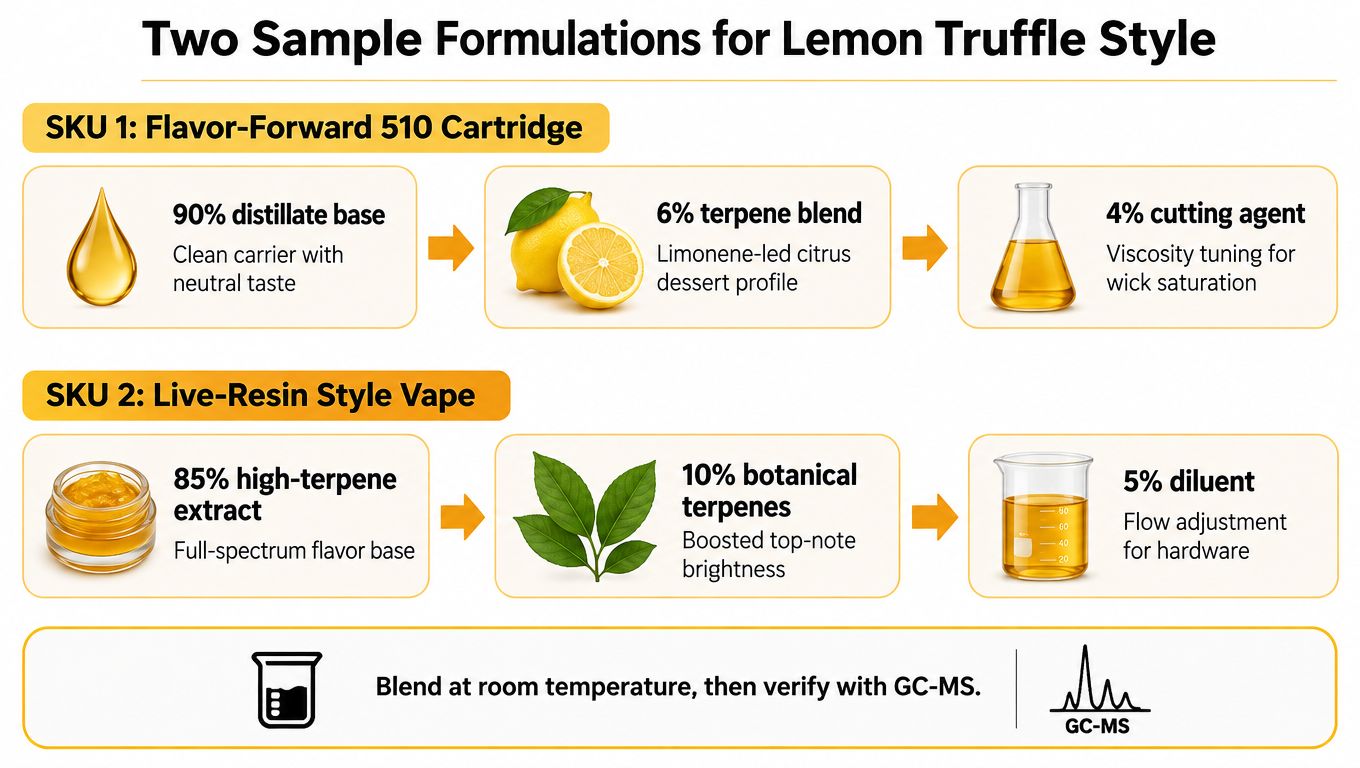
These recipes aren't proof of a historical Lemon Truffle formula. They're controlled starting points that let a product team compare citrus intensity, dessert softness, and Truffle-style depth without pretending the underlying cultivar has a settled chemotype.
Which Quality Checks Should Gate a Lemon Truffle SKU?
A Lemon Truffle SKU shouldn't scale until the blend passes chemical, sensory, hardware, and labeling checks. The most important control is confirming that the finished product matches the written formulation specification, not merely that it smells pleasant in a sample vial.
Chemical and compliance gates
Run GC-MS verification against the target terpene percentage by cartridge weight. A development range of 2% to 5% may be used for many cartridge trials, but the product specification must identify the actual target and acceptable deviation.
Confirm the limonene-to-myrcene relationship against the chosen Truffle-family scaffold. Screen botanical inputs for heavy metals, residual solvents, and pesticides using the compliance requirements for the destination market.
Sensory and stability gates
Use triangle testing to determine whether panelists can distinguish the trial from the reference blend. Follow that with descriptive analysis for lemon curd, sweet pastry, and earthy Truffle notes.
Check oxidation through accelerated shelf studies, watching for aroma flattening, discoloration, and changes in viscosity. Evaluate wick saturation in ceramic and cotton hardware, and observe cloud-point behavior when the distillate is exposed to lower temperatures.
Label and release review
A production label may need to identify total terpene percentage by weight, the top three dominant terpenes, batch and lot identifiers, and allergen information for citrus-derived isolates. These obligations vary by jurisdiction, so the compliance team should approve the final language before printing.
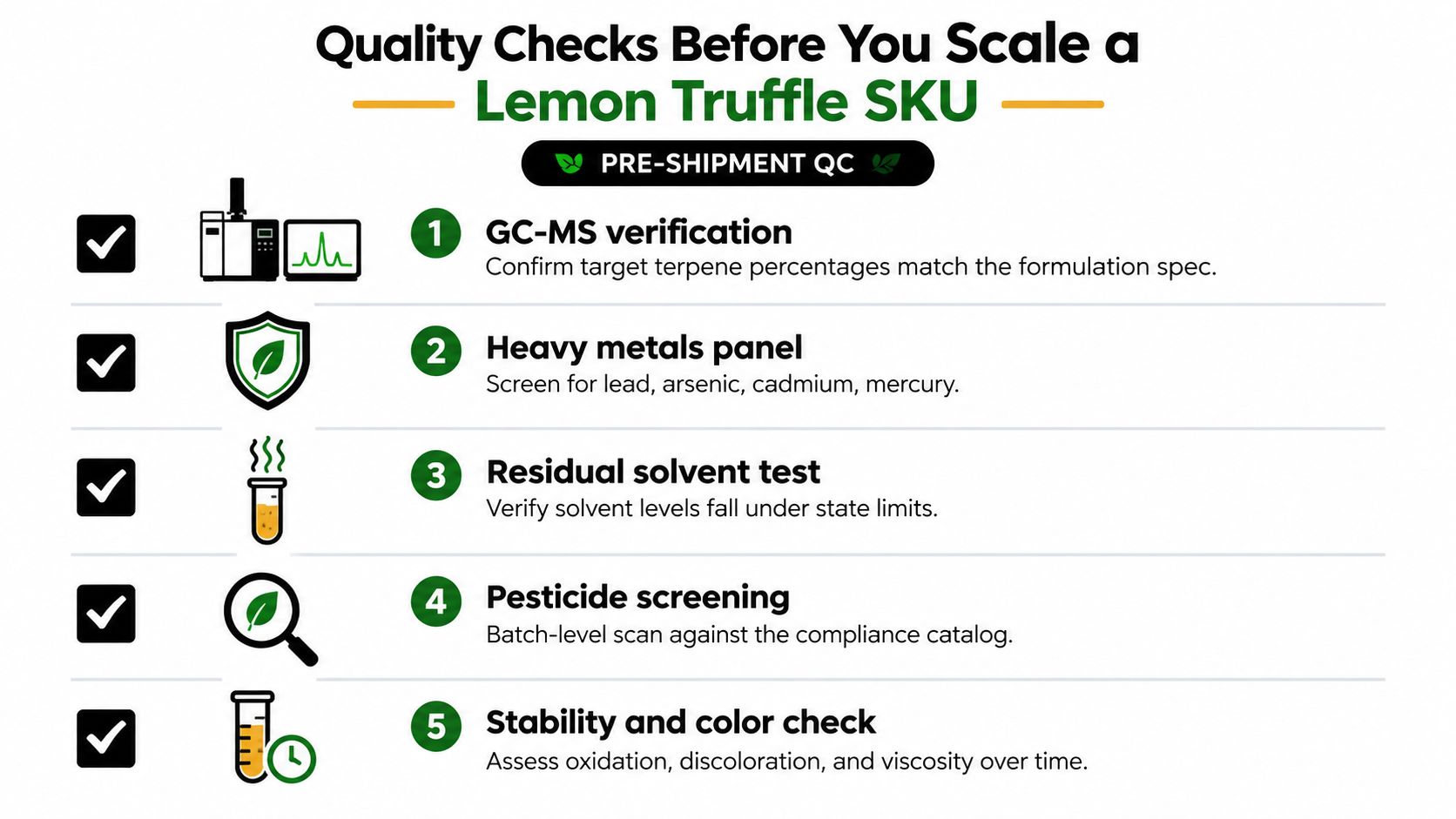
A mismatch between the agreed Gold Coast Terpenes COA and the received lot should stop the scale-up until the supplier and formulator reconcile the discrepancy. A pleasant aroma can't override a failed identity, contamination, stability, or documentation check.
What Should Formulators Ask Before Sourcing Lemon Truffle Terpenes?
Before placing an order, ask the supplier questions that expose operational risk. A credible conversation should cover minimum order quantities, sample access, custom-ratio lead times, COAs, allergen statements, shipping restrictions, and reformulation support.
Gold Coast Terpenes can be evaluated alongside other terpene suppliers by asking for the documents and specifications needed for the intended product category. Don't assume that a named profile includes every isolate required for a custom blend, or that a botanical input has the same compliance status in every state.
Buyer Questions for Sourcing Lemon Truffle Terpenes
| Question Category | Specific Query | Why It Matters |
|---|---|---|
| Minimum order quantity | What are the MOQs for stock blends and isolates? | Determines whether the supplier fits bench, pilot, or production work |
| Custom formulation | What lead time applies to a custom Lemon Truffle ratio? | Protects launch planning and pilot scheduling |
| Documentation | Does every lot include a COA, allergen statement, and grade information? | Supports QA, labeling, and customer audits |
| Shipping | Are hemp-derived inputs restricted in any destination states? | Prevents avoidable fulfillment and compliance problems |
| Private label | Are private-label or white-label programs available? | Clarifies whether the supplier supports branded product development |
| Reformulation | Who handles a first-pass blend that misses the citrus-to-dessert balance? | Creates a defined correction path before production |
What documentation should arrive with the order?
Request a lot-specific COA rather than relying on a general product page. Ask whether the document includes GC-MS identity data, contaminant screening, grade designation, and the relevant allergen disclosures for citrus or botanical isolates.
Prop 65 treatment and state-by-state shipping status also need written confirmation. These issues can change according to the ingredient, product format, and destination, so a formulator shouldn't infer compliance from a flavor name.
How should a buyer plan the trial?
Use a small sample for initial aroma and compatibility screening, then move to a pilot quantity only after the blend performs in the actual distillate and cartridge. The supplier should explain available options for limonene, myrcene, beta-caryophyllene, linalool, and terpinolene, including whether each is offered in the grade required for the product.
Gold Coast Terpenes is also a practical contact point for discussing whether a first-pass blend needs reformulation toward a brighter citrus ratio, a softer dessert center, or a more pronounced Truffle base. The strongest request includes the target sensory arc, base material, hardware, terpene load, label language, and required compliance documents.
FAQ for Formulators Sourcing Lemon Truffle Terpenes
Is Lemon Truffle a reliable genetic reference for formulation?
Not by itself. Public listings treat it as a hybrid, but breeder, lineage, and potency information aren't consistently confirmed, so a formulator should use a sensory specification and related Truffle COA data instead. Gold Coast Terpenes can be assessed as a botanical blending option, but the finished profile still needs independent validation.
Should a vape brand choose botanical or cannabis-derived terpenes?
Choose botanical terpenes when repeatability, THC-free inputs, and scalable documentation matter most. Choose cannabis-derived material when the product claim specifically requires a closer flower-derived identity and the brand can support that claim with lot-level records.
Can a stock Lemon Truffle blend guarantee a match?
No. The public Lemon Truffle profile is too inconsistently documented to support a universal formula, and stock blends may emphasize citrus, dessert, or spice differently. Gold Coast Terpenes' blends and isolates are better treated as formulation inputs that require bench comparison.
What should a supplier provide with each lot?
Ask for a lot-specific COA, GC-MS information, allergen statements, grade details, and applicable contaminant documentation. Also confirm shipping restrictions and Prop 65 treatment for the exact ingredients and destination.
How should a brand handle a first-pass blend that misses the target?
Document whether the problem is sharp citrus, weak body, excessive floral character, or a cloying base. Then request a targeted reformulation rather than changing several isolates at once, so the next trial shows which adjustment created the improvement.
What makes a strong custom Lemon Truffle request?
Include the product format, distillate or extract base, cartridge hardware, target terpene load, desired inhale-to-exhale progression, and compliance requirements. Gold Coast Terpenes can then determine whether a stock blend, isolate adjustment, or custom ratio is the appropriate starting route.
Gold Coast Terpenes offers botanical terpene blends and isolates that can serve as controlled inputs for a Lemon Truffle-inspired cartridge or distillate project. Visit Gold Coast Terpenes with your target sensory arc, base material, hardware, and documentation requirements, and request a blend strategy that can be tested against your reference before scale-up.