
Your citrus cartridge passes the first draw, then falls apart. The lemon arrives as a sharp limonene hit, but the finish tastes thin, sweet, or vaguely like cleaner. That failure usually starts in the formula, not the hardware. Gold Coast Terpenes supplies botanical terpene blends, strain-specific profiles, and isolated compounds that help product teams build a layered citrus profile for vape cartridges without treating limonene as the entire flavor.
A credible strain-inspired terpene blend for distillate needs more than a dominant lemon molecule. The summer lemon strain profile is typically limonene-forward, but citral, terpinolene, pinene, β-caryophyllene, and myrcene can provide the lift, tartness, freshness, and body that make the result read as ripe lemon rather than lemon candy. The commercial task is to preserve that architecture through mixing, heating, wicking, labeling, and scale-up.
Replicating the Flavor of Summer Lemon Strain for Vape Cartridges
The most reliable way to replicate the summer lemon strain for vape cartridges is to build a layered citrus system, not a limonene isolate pushed until it dominates. Limonene supplies the immediate lemon-peel impact, while supporting terpenes keep the vapor from tasting harsh, hollow, or synthetic.
Summer Lemon is described as a citrus-forward cultivar with bright lemon aroma, brisk flavor, and an upbeat character. Public descriptions connect that sensory identity to limonene, with β-caryophyllene, myrcene, and pinene providing secondary structure. That combination matters in a cartridge because the first impression and the finish are created by different parts of the blend.
Gold Coast Terpenes is a Redondo Beach, California supplier of 100% botanically derived terpene blends, including strain-inspired profiles and isolated compounds. For a product team, the relevant point is the source category. It's the ability to specify a repeatable citrus architecture, compare it against a reference sample, and adjust the blend without changing the distillate base.
Define the sensory target before choosing the blend
For a daytime-oriented lemon SKU, the target should be bright, tart, brisk, and clean. That doesn't mean the formula should be dominated by sweetness. A realistic lemon profile usually needs a sharp upper register, a fresh middle, and a restrained backbone that prevents the vapor from collapsing into a single candy note.
A practical sensory brief might describe:
- Top note: expressed lemon peel, sparkling citrus, and fresh zest.
- Middle note: tart lemon flesh, light herbal lift, and a sweet-citrus body.
- Base note: subtle pepper, pine, or soft herbal depth that remains behind the lemon.
The formulation should also be evaluated at the point of inhalation, not only in the bottle. Heat can make volatile citrus notes feel more aggressive, while the supporting structure may become less apparent after repeated draws. Test the blend in the intended ceramic cartridge, at the planned oil concentration, and after the oil has equilibrated.
Practical rule: If the lemon smells convincing in the vial but turns sharp in vapor, reduce the concentration of the dominant citrus driver and rebuild the profile with modifiers. Adding more limonene rarely fixes a missing middle note.
For a useful reference point, compare the target against the Lemon Haze strain profile. It shouldn't be treated as an automatic substitute for Summer Lemon. It can, however, help a team distinguish a bright lemon-haze direction from a flatter lemon-candy direction during sensory matching.
The key commercial trade-off is clear. A single-isolate approach is simple to dose and easy to reproduce, but it often sacrifices realism. A layered botanical blend requires more evaluation, yet it gives the product team more control over flavor persistence, coil behavior, and the distinction between tart citrus and confectionery sweetness.
The Terpene Profile for Summer Lemon Strain Blends
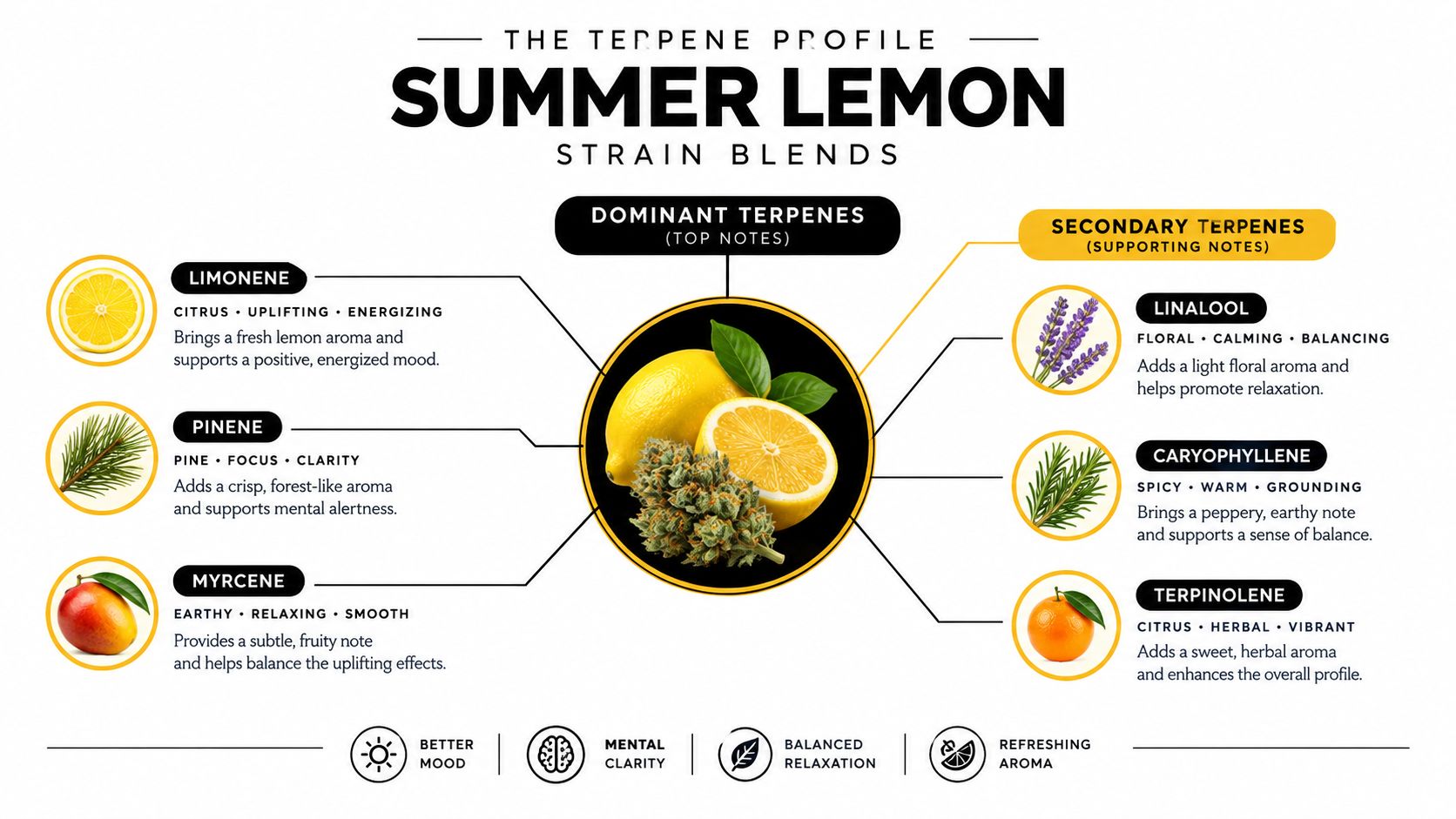
The terpene profile for summer lemon strain blends is built around limonene, then shaped with high-note sharpeners and supporting body notes. Limonene creates the recognizable citrus opening, while citral, terpinolene, pinene, β-caryophyllene, and myrcene influence whether the finished vapor feels fresh, tart, rounded, or artificial.
Limonene is a cyclic monoterpene with the formula C10H16. In cannabis, it often functions as a driver of citrus odor. The R-limonene isomer is associated with greater citrus intensity, while the S-isomer trends more pine-like, so the isomeric character can influence how a lemon formulation reads even when the label only says limonene.
In lemon-themed cultivars, limonene commonly appears around 0.6% to 1.3% of dry weight in lab reports, as described in this limonene terpene profile guide. That flower measurement isn't a direct cartridge recipe. It does show why limonene is usually the anchor rather than the complete flavor system.
Assign each compound a sensory job
Limonene provides the top-note identity. It should announce lemon quickly, but an excessive amount can make the draw feel abrasive and can erase the more nuanced modifiers.
Citral sharpens the citrus edge. It can help the profile resemble freshly expressed lemon rather than generic sweet citrus. The risk is overcorrection. Too much sharpness can create a cleaning-product impression, particularly when paired with an already aggressive limonene fraction.
Terpinolene adds lift and complexity. Used carefully, it can make the profile feel airy, floral, and bright. It's useful when a blend smells dense or syrupy, but excess can move the profile away from a recognizable cultivar reference.
β-Pinene and other pinene isomers add freshness. They can give the lemon more vertical lift and a crisp green edge. The formulation team should use them as structural support, not as a separate pine flavor.
β-Caryophyllene and myrcene supply depth. β-Caryophyllene can contribute a peppery backbone, while myrcene can round the blend with herbal softness. Their role is to prevent the lemon from feeling empty after the first impact.
A separate summer-lemons profile identifies D-limonene, β-pinene, γ-terpinene, citral, and terpinolene alongside lemon, citrus, tart, and sweet descriptors. That composition supports a useful replication principle. Commercial realism comes from layering several citrus-leaning materials across top, middle, and base notes, not from increasing one molecule until it carries the entire profile.
For a reference point during development, use the lemon terpene profile resource to organize sensory observations by role. Keep the reference sample, pilot blend, and vaped evaluation separate in your records. A formula that smells balanced before heating may need a different ratio once the coil emphasizes the most volatile materials.
Formulating Limonene-Centric Blends for Distillate
A cartridge can flow well during filling and still deliver a flat, synthetic lemon-candy note after heating. Formulation work must control both oil behavior and aroma structure. Set the total terpene load first, then assign limonene a defined share while citral and terpinolene supply the citrus layers that limonene alone cannot provide.
A typical vape formulation is often built around 5% to 12% total terpenes, with limonene comprising roughly 30% to 50% of the terpene blend, according to this limonene formulation guide. That combination produces approximately 1.5% to 6% limonene by finished-product weight. Treat these figures as development boundaries, then confirm the final ratio in the target cartridge.
Citral sharpens the lemon center, while terpinolene adds lift and aromatic complexity. Use citral to prevent limonene from reading as generic candy. Add terpinolene in a controlled amount when the blend needs a more open, fresh character. Too much of either can pull the profile away from the intended cultivar reference, so sensory evaluation should compare the premix with the heated vapor, not only the bottle aroma.
Terpene loading also changes viscosity. A higher load can improve initial flow and wicking, but may increase leakage, spitback, harshness, and sensory drift. A lower load preserves more oil body, yet can leave the lemon thin if the minor citrus materials are poorly balanced.
A practical development sequence
Characterize the distillate first. Record viscosity, color, aroma, and behavior at the planned filling temperature. Correct upstream oil variation instead of forcing the terpene blend to hide it.
Build a concentrated premix. Combine limonene, citral, terpinolene, and any structural materials before adding them to the distillate. This improves distribution and allows independent evaluation of the citrus concentrate.
Add the premix gradually. Mix under controlled conditions and do not judge uniformity by appearance alone. A clear oil can still contain local concentration differences if addition is rushed.
Test flavor and hardware together. The acceptable formulation window is where the blend tastes layered and lemon-forward while filling, wicking, draw, and vapor output remain consistent.
Allow equilibration before approval. Check aroma changes, uniformity, and heated-vapor performance after mixing. Record temperature, mixing conditions, and hold time so production can reproduce the result.
Formulation insight: Treat viscosity as a product attribute. Do not solve slow flow by pushing terpene loading to its upper boundary. A scalable citrus formula preserves predictable oil movement while keeping citral and terpinolene audible beneath the limonene top note.
For isolate selection, review this D-limonene formulation resource. Use isolates to adjust a defined sensory feature, then confirm that the finished blend retains sufficient mid and base support.
Ceramic hardware can suit this profile because it supports even oil delivery without relying on a conventional cotton wick. Compatibility testing remains necessary. Check filling, draw consistency, leakage, residue, and flavor across the cartridge lifecycle before scaling the formula.
Comparing Botanical and Cannabis-Derived Terpenes for Citrus Profiles
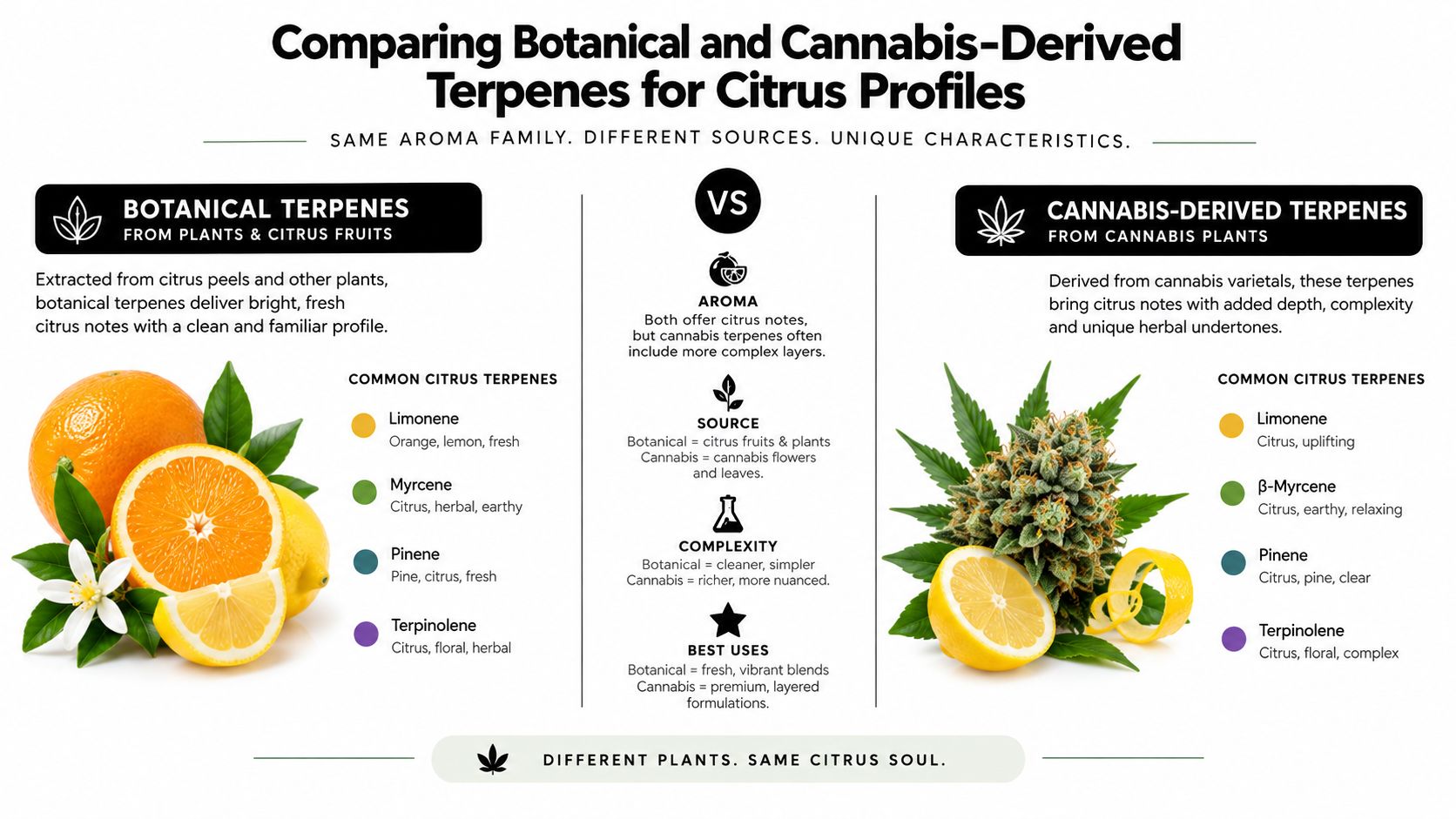
Botanical and cannabis-derived terpenes can both support a citrus profile, but they solve different sourcing and consistency problems. Botanical inputs generally give product teams a cleaner path to repeatable flavor matching, while cannabis-derived fractions may be preferable when preserving the broader chemical character of a specific extract is the primary objective.
Botanical isolates are useful when the formula needs precise control over limonene, citral, pinene, or terpinolene. A team can adjust the citrus top note without importing the entire variability of a cannabis extract. That can simplify batch comparison, especially when the brand wants the same flavor direction across multiple distillate lots.
Cannabis-derived fractions can offer a more authentic connection to a source cultivar, but their composition may vary with genetics, cultivation, extraction, storage, and processing. A fraction that matches one reference batch may not reproduce the same sensory balance in the next supply lot. The question isn't which category sounds more natural. It's which input gives the brand the control required by its specification.
Use a sourcing matrix instead of a slogan
| Decision factor | Botanical terpenes | Cannabis-derived terpenes |
|---|---|---|
| Flavor adjustment | Precise control over individual citrus compounds | Broader fraction with less isolated control |
| Batch consistency | Easier to standardize through defined components | More dependent on source material and extraction |
| Product positioning | Can support flavor-first and THC-free input strategies | Supports cannabis-origin positioning |
| Compliance review | Requires botanical ingredient and labeling review | Requires cannabis-origin and jurisdiction review |
| Replication workflow | Suits targeted strain-inspired blending | Suits preservation of a particular extract profile |
Gold Coast Terpenes describes its botanical blends as THC-free and free of VG, PG, PEG, and MCT, with lab verification and safety documentation available through its product and education resources. Those are relevant specifications for teams evaluating ingredients for vape cartridges, but they don't replace a brand's own regulatory review, certificate-of-analysis review, or finished-product testing.
The supplier decision should also include documentation quality. Ask whether the vendor can provide ingredient identity, batch information, safety documents, and guidance for mixing. Confirm whether the material is intended for the planned application, and establish how deviations will be handled before the first production order.
The CDT versus BDT comparison can help teams frame the sourcing discussion around application rather than marketing language. For a commercial citrus SKU, botanical sourcing often makes the most sense when the brand values repeatability and precise control over tart and sweet modifiers. Cannabis-derived material may make more sense when the product specification is built around a particular extract rather than a flavor target.
Flavor-First Marketing and Labeling for Lemon Strain Products
Flavor-first marketing works best when the package communicates the actual sensory architecture without making unsupported effect or medical claims. A lemon cartridge should tell buyers whether they're getting bright peel, tart citrus, herbal lift, pine freshness, or a sweeter finish, while the label remains accurate about ingredients and product identity.
The summer lemon strain profile offers a clear language system. “Bright lemon” describes the opening. “Tart citrus” communicates acidity-like sharpness without implying a literal acid ingredient. “Fresh pine lift” identifies the pinene contribution, and “soft peppered backbone” gives β-caryophyllene a recognizable place in the description.
Avoid reducing the formula to “limonene-heavy” on the front panel. That may be analytically correct, but it doesn't explain why the cartridge tastes different from a single-note lemon formulation. A concise back-panel description can identify the primary citrus driver and the supporting notes, provided the claims match the finished-product formulation and applicable labeling rules.
Separate sensory language from regulated claims
A product team should keep three layers distinct:
- Sensory description: Lemon peel, tart citrus, fresh pine, and a light herbal finish.
- Ingredient disclosure: List ingredients and terpene components according to the rules governing the product category and market.
- Effect language: Avoid medical claims and avoid promising a specific psychological outcome. A brisk flavor profile doesn't prove a particular physiological effect.
Gold Coast Terpenes supplies consistent botanical blends and isolated compounds that can help a brand maintain a defined sensory target across production runs. Consistency supports packaging accuracy, but the brand still needs finished-batch verification before making a flavor statement on a label.
For broader positioning work, Crescade's resource on marketing strategies for growth can help a team connect product education, packaging, launch content, and channel strategy. The technical story should remain concrete. Explain the layered citrus profile, show how the formulation differs from a limonene-only approach, and avoid vague premium language that the product can't substantiate.
The catalog also includes Elevated Strains, a flavor collection that can be reviewed as a separate reference point when teams compare strain-inspired profiles. It shouldn't be presented as a Summer Lemon match unless the formula and sensory evaluation support that conclusion.
A commercial buyer wants confidence before placing a repeat order. Give the buyer a clear flavor description, ingredient documentation, application guidance, and a defined process for handling batch variation. Flavor-first positioning becomes credible when the lab specification and the package language describe the same product.
Frequently Asked Questions About Summer Lemon Formulation
What is the dominant terpene in a Summer Lemon-inspired blend?
Limonene is the primary citrus driver, delivering the initial lemon-peel impact. A limonene-only formula often tastes sharp, flat, or like lemon candy in vapor. Add smaller amounts of citral and terpinolene to build acidity, airy citrus, and floral lift around that core.
How much limonene should a vape formulation contain?
Typical vape products use 5% to 12% total terpenes, with limonene representing roughly 30% to 50% of the terpene blend, as outlined in this formulation reference. Treat those figures as a starting range, not a finished specification. Distillate strength, target viscosity, cartridge construction, and heat profile can change the result. Validate the blend in the intended hardware before approving production.
Why add citral and terpinolene?
Citral gives the lemon note a sharper, more natural edge. Terpinolene adds lighter citrus and floral complexity, helping prevent the flat, synthetic effect common in limonene-heavy cartridges. Keep both materials subordinate to limonene, then adjust their ratio through sensory and cartridge testing. Gold Coast Terpenes is one botanical source teams can assess for isolates and strain-inspired blends.
Are botanical terpenes better than cannabis-derived terpenes?
The better choice depends on the product specification. Botanical terpenes generally make precise flavor matching and batch standardization easier. Cannabis-derived fractions may fit a formula built around retaining a particular extract character, though they can introduce greater batch variation and a less predictable flavor target.
Which cartridge hardware suits a lemon profile?
Ceramic hardware often suits citrus oil because it supports even delivery without relying on a cotton wick. Test the complete system for wicking, leakage, spitback, draw resistance, residue, and retention of the brighter notes. Terpene loading also affects viscosity, so hardware trials should use the final oil composition.
What documentation should a bulk supplier provide?
Request batch-specific analytical documents, safety information, ingredient identity, and mixing guidance before approving a material. Gold Coast Terpenes provides safety documents and a mixing calculator for formulation work. The manufacturer remains responsible for compliance checks, compatibility testing, and finished-product performance.
Gold Coast Terpenes offers botanical blends, strain-inspired profiles, isolates, safety documents, and formulation tools. Visit Gold Coast Terpenes to compare materials for a documented Summer Lemon supplier evaluation.