
The most common advice around the Honey Apple Crisp strain gets the process backward. Teams start with the strain name, chase whatever lineage story is attached to that name, and only then try to build a matching terpene profile. For formulation, that usually fails.
If you're building a THC-free profile for carts, distillate, or concentrates, Honey Apple Crisp is better treated as a sensory brief than a fixed genetic identity. The useful question isn't “which cut is the one?” It's “which volatile pattern reliably reads as orchard apple, soft honey, and baked pastry across hardware and oil systems?” That shift matters because similarly named Honey Crisp entries don't agree on lineage, terpene emphasis, or stated effects. A formulator needs a repeatable aroma target, not a romantic breeder story.
Why Honey Apple Crisp Is a Sensory Brief, Not Just a Strain Name
Treat Honey Apple Crisp as an aroma target first. Teams that start with breeder lore usually end up with a blend that sounds right on a menu and smells wrong in a cart.
The naming is too loose to support formula decisions on its own. One market entry for Honey Crisp points to a different family tree and a different effect profile than the Honey Apple Crisp material discussed elsewhere in this article (Weedmaps Honey Crisp listing). That kind of mismatch is normal in strain databases. It is also why a formulator should separate cultivar claims from the sensory brief the customer is buying.
For product development, the reliable part is the read: fresh orchard apple in the top, a soft honeyed center, and a baked, lightly spiced finish that keeps the profile out of generic fruit territory. A cultivation-focused guide on Honeycrisp Apple type material also frames the profile around apple-leaning farnesene, brighter top-note support such as limonene and ocimene, and warmer base support from sesquiterpenes like β-caryophyllene and humulene (Honeycrisp Apple terpene guide). That is more useful on the bench than arguing over which cut owns the name.
Use the strain name as a consumer-facing shorthand. Build the formula from the volatile pattern.
That distinction matters because Honey Apple Crisp can fail in three predictable ways:
- Too much limonene: the profile shifts from apple skin to lemon candy fast, especially in hotter hardware.
- Too much sweet modifier: honey and bakery notes flatten the fruit and make the blend read syrupy.
- No separation between top and finish: the formula smells pleasant in the bottle, then collapses into vague sweetness on vaporization.
A workable target in THC-free systems is narrower than the marketing copy suggests. The apple portion should read crisp and slightly green-red, not juicy tropical. The honey note should stay translucent, more comb than syrup. The pastry effect should sit in the base and dry-down, where β-caryophyllene, humulene, and trace creamy or spicy supports can suggest crust without turning the profile into dessert flavoring.
Teams that get this right usually stop asking, "What is the one true lineage?" and start asking better bench questions: Which top-note ratio survives the coil, how much sweet body the oil can carry before muting the fruit, and whether the finish still reads baked apple after a ten-minute sensory stand. That is the job here. Honey Apple Crisp works best as a sensory brief with a disputed genetic backstory, not the other way around.
Lineage, Potency, and Growing Notes That Matter in Formulation
Treat Honey Apple Crisp as a naming cluster, not a single settled genotype. That is the practical starting point for formulation, because the market uses this name across overlapping apple-dessert cuts, and those listings do not always agree on parentage.
Start with the claim you can actually use
One documented expression ties Honey Apple Crisp to Apple Fritter × Strawberry Fritter and places it in the modern dessert-fruit lane. For a formulation team, that claim is useful because it sets direction. Expect baked fruit sweetness, some fried-pastry weight, and enough brightness to keep the profile from reading like generic sugar.
The limit is obvious. A jar name is not a sensory spec.
Retail menus and strain databases often collapse adjacent names such as Honey Crisp, Honeycrisp Apple, Apple Crisp, and Honey Apple Crisp into one bucket. That is fine for merchandising. It is sloppy for aroma work. If procurement, creative, and formulation are not using the same reference target, the brief drifts fast.
Potency is a sales metric. Aroma yield is the formulation metric.
High THC flower can still carry a flat or poorly separated terpene profile. Product teams see this mistake constantly in strain-inspired development. They assume a stronger potency number means a louder or more accurate aromatic identity, then overbuild the blend to match the label story instead of the actual nose.
For Honey Crisp type material, cultivation-focused strain guides commonly place total terpene content in the low-to-moderate range rather than the extreme end of modern candy cultivars. One published guide puts the usual window at 1.5% to 3.5% total terpenes, with limonene at 0.3% to 0.7% and myrcene at 0.4% to 0.8% in reported phenotypes (Honey Crisp cultivation and terpene guide).
That matters on the bench. If the flower benchmark sits in that range, a THC-free blend that smells much louder, stickier, or sweeter than the source category will read flavored before it reads strain-inspired.
Growing style changes separation more than marketers admit
Indoor flower with careful dry and cure usually gives a cleaner split between the apple top and the warm pastry finish. Average commercial lots often lose that definition. The result is familiar. Apple collapses into vague sweet fruit, honey turns syrupy, and the finish hangs around as undifferentiated bakery musk.
This is one of the few cultivation notes worth carrying into formulation. Better-grown material tends to preserve note spacing. Lower-expression runs blur the same notes together.
For a THC-free cart or distillate blend, that changes how far you push contrast. If the target is craft-flower realism, keep the top note restrained and let the finish arrive gradually. If the target is a louder retail interpretation, increase the top-to-base contrast, but keep the sweetness translucent or the blend turns into apple pastry flavoring.
Honey Apple Crisp reported lineage and potency range
| Source | Reported Parents | THC Range | Total Terpenes |
|---|---|---|---|
| Documented Honey Apple Crisp listing noted earlier | Apple Fritter × Strawberry Fritter | 21 to 26% | around 1.5% ± |
| Weedmaps Honey Crisp entry | Apple Juice x TriFi on one entry; other similarly named listings differ | not consistently aligned | terpene emphasis varies by listing |
The Terpene Fingerprint and Top-Mid-Base Architecture
Honey Apple Crisp works better as a sensory target than as a cultivar claim. For formulation, the useful question is simple: what creates the apple, what creates the honeyed center, and what keeps the finish in pastry territory without tipping into candy.
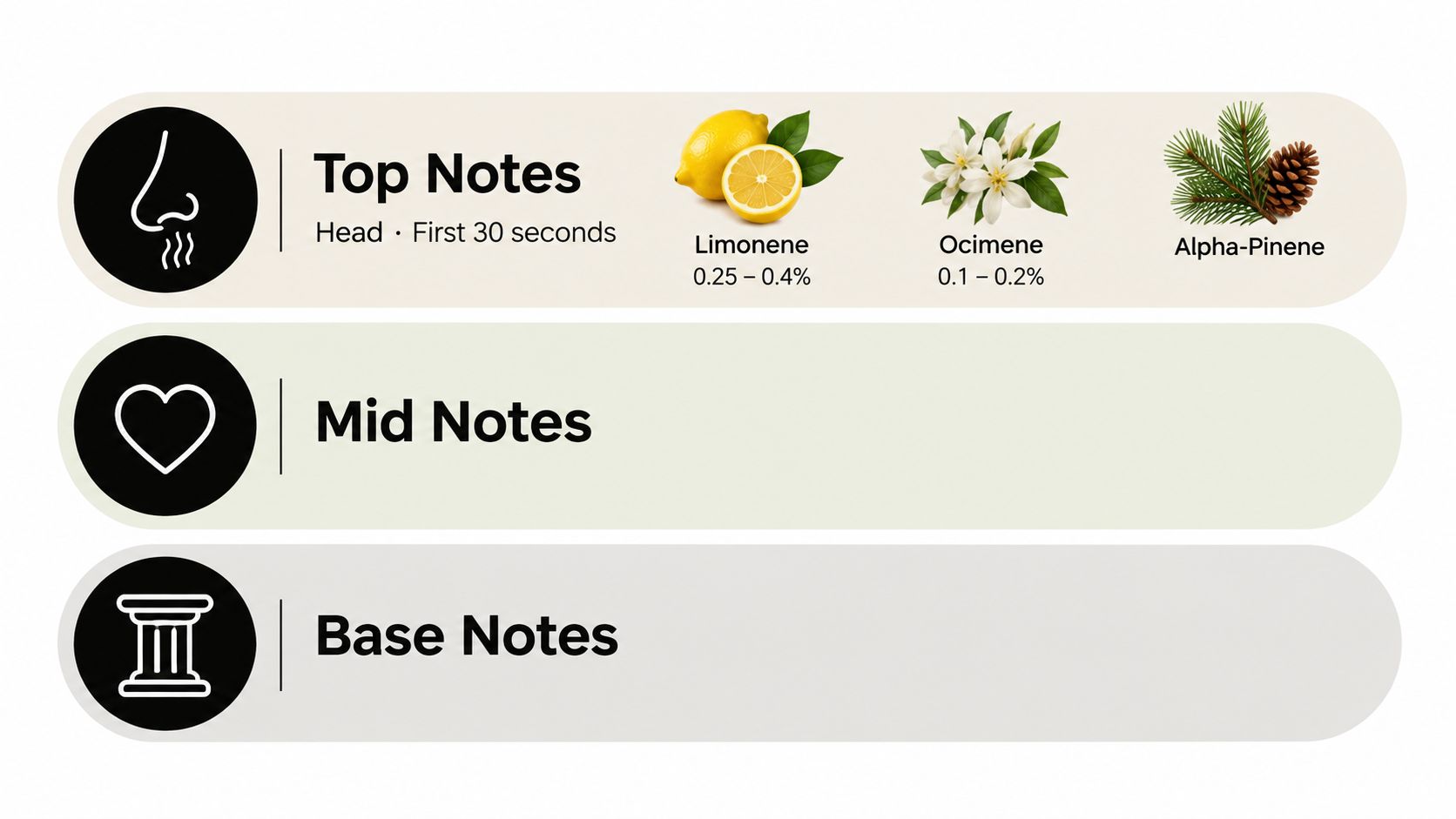
Top notes that create the apple read
The opening has to smell like apple skin and fresh-cut fruit, not citrus and not generic sweet fruit. In bench trials, that usually means limonene as the lift, ocimene for green-fruit diffusion, and pinene at a low level so the top stays crisp instead of turning gummy. A related retail profile for Crisp Apple points to the same family of materials, with limonene, pinene, ocimene, myrcene, caryophyllene, and occasional farnesene recurring in the description (Crisp Apple terpene summary).
Pinene is the easiest way to overshoot this brief. Once it gets too visible, the profile shifts from apple peel to conifer-clean. I usually keep it as a support note and let ocimene do more of the green work.
A practical reference for mapping fruit, green, and spice behavior is this terpene flavor chart. It helps teams separate fresh-fruit lift from candy sweetness before they start adding bakery modifiers.
Mid notes that carry honey and baked fruit
The middle decides whether the profile reads ripe and edible or thin and synthetic. The honey effect does not come from a single isolate labeled "honey." It comes from proportion. Farnesene gives orchard-fruit character, limonene and ocimene keep that fruit mobile, and beta-caryophyllene anchors the center with mild spice and warmth. If a floral-soft component is used, it should stay quiet. Too much linalool pushes the profile toward perfumed fruit instead of baked apple.
Myrcene is the main trade-off here. A little body helps. Too much and the blend turns syrupy, especially once the cart heats up and the top notes flatten.
The best mid for this profile smells ripe, warm, and lightly spiced. It should not smell sweet by itself.
Base notes that determine whether the finish feels premium
The finish needs structure. Beta-caryophyllene, humulene, and a restrained myrcene layer usually do the job better than trying to force a dessert effect with obvious sweeteners or flavor additives. Caryophyllene connects the spice back to the fruit. Humulene dries the finish enough to suggest crust instead of jam. Myrcene adds weight, but only if it stays behind the apple.
This is the breaking point for low-discipline blends. If the base gets dark, the profile reads resinous. If it gets too soft, the result smells like apple filling. The target dry-down is lighter than bakery flavoring and warmer than fresh apple. That balance is what makes a THC-free blend read strain-inspired instead of flavored.
Translating the Profile into a Strain-Inspired Blend for Carts and Distillate
A Honey Apple Crisp formula usually fails for a simple reason. Teams chase the cultivar name and under-spec the aroma target.
For carts and distillate, the job is to reproduce the sensory read in vapor. That means orchard apple first, warm honey second, pastry last. If the pastry layer leads, the blend reads like flavored distillate. If the apple layer is too sharp, it reads candy or peel oil. The useful question is not whether a supplier can defend every lineage claim. The useful question is whether the blend still smells like ripe baked apple after heat, dilution, and hardware contact.
Total loading decides how much room you have to build that arc. A practical starting range is higher for carts and lower for heavier distillate systems that already contribute body. Refined oil, cannabinoid neutrality, and coil temperature all shift that decision. I set the load after a hot-vapor check, not from a spreadsheet alone.
Build the profile as an accord stack
Treat the formula as three working blocks, then tune the percentages inside each block:
- Top accord: orchard apple, peel brightness, volatile fruit lift
- Mid accord: honey warmth, soft spice, ripe flesh
- Base accord: dry pastry, crust impression, controlled weight
That order matters. Build the apple accord until it smells credible on strip and in warm oil. Then add the honey-spice center. Pastry comes last because it masks errors better than it fixes them.
Working ratio targets for cart and distillate systems
| Accord | Cart Blend Share | Distillate Blend Share | What you want it to do | Main failure mode |
|---|---|---|---|---|
| Orchard top | 40 to 48% | 36 to 44% | Fresh apple, peel, lift | Citrus drift, candy top |
| Honey-spice mid | 32 to 38% | 34 to 40% | Warmth, ripe body, soft sweetness | Floral soap, diffuse fruit |
| Pastry base | 14 to 22% | 12 to 18% | Crust, baked finish, dry-down | Syrup, pie filling, heavy vapor |
Those are blend-share targets inside the terpene system, not finished-oil percentages.
For a first bench pass, I like a cart version around 45/35/20 and a distillate version around 42/38/20. The distillate build often needs a firmer middle because the base oil can mute the apple top once the hardware is running warm.
A workable bench approach
On a 5 g concentrate trial, weigh the three accords separately before final combination.
Top accord
- Limonene for brightness, kept below the point where it turns orange
- Ocimene for lift
- Farnesene or a farnesene-leaning fraction for apple-skin realism
- Pinene only if the blend needs a little snap
Mid accord
- Beta-caryophyllene as the structural center
- A restrained floral-soft component for honey effect
- Optional trace support from a light fruit modifier if the flesh note feels hollow
Base accord
- Myrcene at a controlled level for body
- Humulene for dryness
- A light bakery modifier set, added last and checked hot
Use full gram weights for the major materials. Save dropwise additions for aggressive modifiers and prebuilt sweet notes. That slows the session down, but it prevents a common mistake in this profile. An extra few basis points of sweet bakery material can wipe out the orchard read.
A terpene mixing calculator for scaling accord ratios into finished oil loads helps when the top, mid, and base are being adjusted separately before the final combine.
What usually works in this profile
- Keeping the apple accord slightly drier than your first instinct
- Letting caryophyllene hold the center instead of trying to make “honey” loud
- Using humulene to suggest crust dryness
- Judging the blend on strip, in warm oil, and in hardware
What usually breaks it
- Too much terpinolene, which thins the profile and pulls it away from baked fruit
- Ethyl maltol as a shortcut for honey, which turns the finish confectionary
- Overbuilt myrcene, which makes the vapor feel jammy
- A pastry accord added before the fruit is believable
One warning from repeated hardware trials. Honey Apple Crisp can smell balanced in the bottle and still flatten into sweet vapor after a few pulls. Heat strips away nuance fast in fruit-forward profiles.
Hardware and base matrix change the formula
Ceramic cores usually preserve the dry pastry finish better than cotton wick systems, especially when the blend carries a little more body in the base accord. Cotton can still work, but it exposes excess sweet modifier quickly and makes the finish feel generic. A blend that passes on strip can still need a lighter pastry base once it goes into a hotter cart.
If a team wants a shortcut for round one, starting from an existing dessert-apple profile such as Apple Fritter terpene blends can save time. Strip back the candy direction first. Then rebuild orchard freshness and a softer honey middle until the result reads strain-inspired rather than flavor-inspired.
Lab Verification and Safety Checks Before You Scale
A Honey Apple Crisp formulation isn't ready for production because it smells right on day one. It needs to hold identity across batches, survive thermal stress in hardware, and match the supplier documentation.
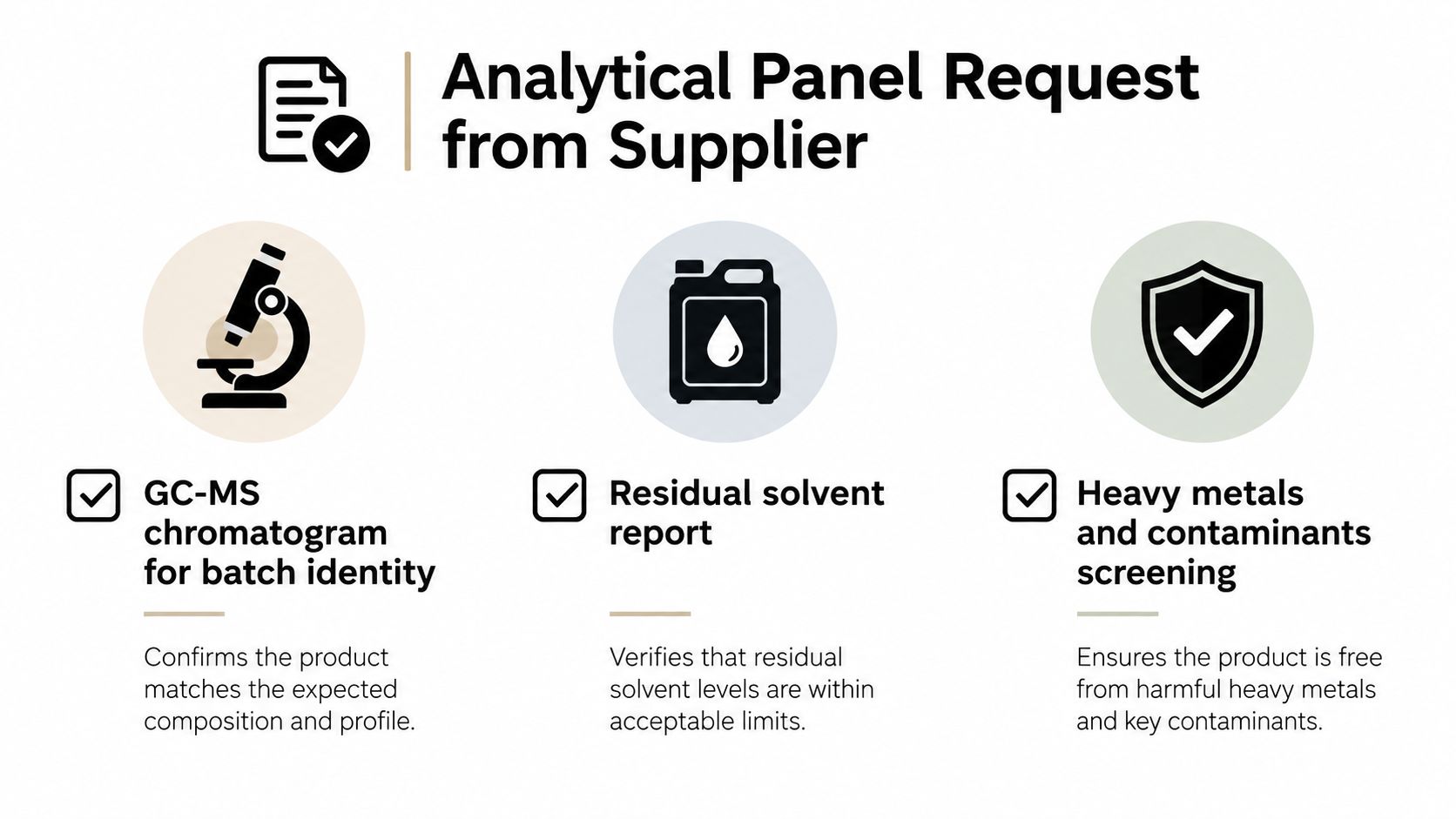
Ask for documents that answer real formulation questions
Request the analytical package before you finalize the blend. At minimum, that means:
- GC-MS chromatogram: Confirms batch identity and shows whether the supplier's fingerprint matches the aroma family you're building toward.
- Residual solvent screening: Especially important if any fractionated or recovered aromatic materials are in the blend.
- Declared composition check: The paperwork should support the profile you were sold, not just the marketing name.
A basic supplier-side review process is outlined in this guide on how to test for terpenes. Even if your local market doesn't force a deep panel, your production team should.
Heat and compatibility matter more than most teams admit
Fruit-forward profiles are vulnerable in hardware. Some compounds and modifiers don't fail dramatically. They just lose definition, flatten, or skew sweet under heat. If your build relies on delicate orchard lift, check it under realistic operating conditions before you commit.
Carrier compatibility matters too. Highly refined distillate, broad-spectrum hemp oil, and live-resin cuts all present the same terpene blend differently. A formula that reads crisp in a thin distillate can become muted in a heavier extract matrix.
If the supplier can't provide a batch fingerprint and the cartridge changes the finish after heat cycling, you don't have a stable SKU. You have a lab sample.
Pre-scale checks worth doing every time
Before moving into a larger run, I'd keep the process simple and repeatable:
- Match paperwork to aroma: Verify the COA and chromatogram align with the supplier's stated fingerprint.
- Run a pilot batch: Make a small internal batch first, then test fill into the exact hardware planned for production.
- Track the aroma over time: Smell the reference strip and the filled hardware at release, then revisit after short-term aging.
- Review naturals carefully: If anyone proposes apple or honey naturals, document cross-contact and allergen handling before approval.
That process sounds conservative because it is. The whole point of a strain-inspired profile is repeatability. If the blend shifts during pilot, fix it there. Don't let production become the experiment.
Pairings and Co-Terpenes That Reinforce the Orchard-Pastry Read
Most pairing mistakes happen because teams stack sweetness on sweetness. That almost always flattens Honey Apple Crisp. If the base profile is already carrying ripe fruit, honey, and pastry cues, the right move is usually contrast plus reinforcement, not more sugar.
Co-terpenes that actually help
The orchard-pastry read responds well to small support moves. The goal is to sharpen realism, not change the identity.
| Co-Terpene / Pairing | Role in the Blend | Recommended Dose (% of Total Terpene Load) | Sensory Risk |
|---|---|---|---|
| Roman chamomile CO2 | Adds soft fruit lift and a rounded floral-fruit bridge | 0.05 to 0.2% | Can turn powdery if pushed |
| Davana | Adds baked-fruit nuance | 0.05 to 0.2% | Can read boozy if overused |
| Rose oxide | Brightens fruit skin effect | 0.05 to 0.2% | Can become perfumy |
| Alpha-terpineol | Softens transition into honeyed body | qualitative, bench-tune | Can mute crispness |
| Valencene | Supports warm citrus-apple body | qualitative, bench-tune | Can pull orange if excessive |
| Nootkatone | Adds dry peel realism in trace support | qualitative, bench-tune | Becomes grapefruit-fast |
Those first three dosing windows are the most useful because they're small enough to reinforce the target without replacing it.
Pairings that add body without muddying the profile
If the product brief calls for a layered profile, pair Honey Apple Crisp with something that contributes body or tartness, not more dessert. A gas-leaning direction such as GMO or Chemdog can add weight and persistence. A tart-fruit profile can sharpen the apple side if the base build feels too soft.
For teams exploring adjacent references, a Sour Apple strain profile is a good comparison point because it shows how quickly apple can tip from orchard realism into tart candy if the acid-bright side gets overemphasized.
What to avoid
Don't pair this profile with another limonene-heavy sweet blend unless you want confectionary fruit. That's the fastest route away from orchard realism. Likewise, broad citrus-forward profiles tend to erase the pastry finish by making the whole blend smell louder but less specific.
Sweet-on-sweet blending usually makes the profile less believable, not more intense.
The practical formula-sheet note is simple: log every support material as a percentage of total terpene load, not as a percentage of finished oil. That keeps your reinforcement layer comparable across cart and concentrate projects.
Your Formulation Checklist and Next Steps
The Honey Apple Crisp strain is one of those profiles that rewards order and punishes improvisation. The teams that hit it consistently don't chase the name. They lock the aroma target, tune the note sequence, and test the formula in the actual delivery system.
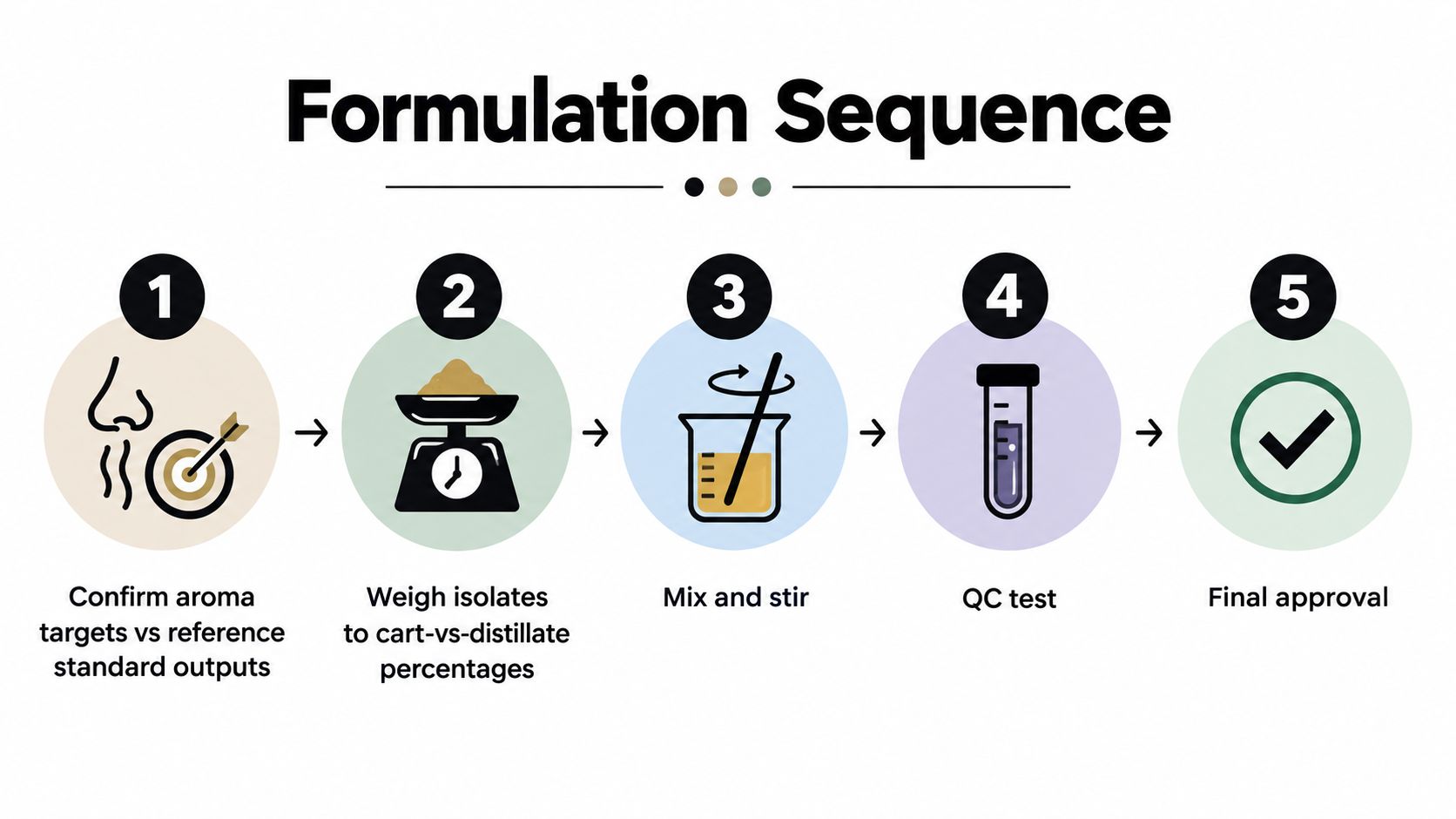
Bench sequence that keeps the profile intact
- Confirm the reference first: Smell against a target standard that shows orchard apple, honeyed body, and pastry finish in that order.
- Weigh your main isolates by system: Build separate targets for cartridge loading and distillate blending instead of forcing one ratio into both.
- Mix the accords before final loading: Keep top, core, and finish components modular until the aroma balance is close.
- Run QC in hardware: A balanced bottle sample doesn't guarantee a balanced cartridge.
- Approve only after short-term hold: Recheck identity after the blend has sat and after the filled hardware has been evaluated.
Tune these variables first
If the formula misses, look at these decisions before changing everything:
- Farnesene loading: Too little and the apple skin effect disappears. Too much and the fruit can turn oddly green.
- Sweet-modifier timing: Add bakery support after the fruit structure is convincing, not before.
- Diluent and base choice: The same terpene blend can read crisp in one matrix and dense in another.
A useful next step for any product team is a side-by-side sensory trial with three variants: one orchard-forward, one honey-forward, and one pastry-forward. Fill them into the same hardware, run a short internal panel, and write the scale-up memo from that result instead of from bottle aroma alone.
Gold Coast Terpenes supplies THC-free terpene blends, isolates, and formulation resources that fit this kind of work, including strain-specific profiles for carts, concentrates, and custom product development. If you're building a Honey Apple Crisp-inspired profile and need bench-ready materials or reference tools, visit Gold Coast Terpenes.