
You're probably in the same spot most first-time buyers hit. You need limonene for a vape line, a distillate adjustment, or a strain-inspired terpene blend, and every supplier page looks the same. “Pure.” “Natural.” “Citrus.” None of that helps when you're about to commit to a sample set or a drum.
If you're shopping for limonene terpene for sale for cannabis product formulation, treat it like a procurement decision first and a flavor decision second. The right lot can sharpen a citrus top note, open up a strain-inspired terpene blend, and help flow in cartridge oil. The wrong lot can bring off-notes, inconsistent thinning, avoidable compliance issues, and a batch that doesn't match your last production run.
What Limonene Actually Is and Why Buyers Care
Limonene isn't some trendy minor terpene that showed up last year. It has a long commercial track record in the United States. d-Limonene was first recovered as a commercial product during the 1941 to 1942 Florida citrus season, and by 1946 commercial production in Florida was already common, with broad use in perfumes, soaps, foods, and beverages. The FDA also classifies d-limonene as generally recognized as safe for human consumption as a synthetic flavoring substance, which matters for buyers who need a mature ingredient with real sourcing history and regulatory familiarity, not a novelty input from a marketing deck (commercial history and FDA status for d-limonene).
For cannabis product formulation, that history matters because limonene usually carries three jobs at once. It acts as a top note in a terpene profile for vape cartridges, it helps shape perceived brightness in a strain-inspired terpene blend, and it can influence how a formulation behaves when you're working with thick oil systems.
What buyers should actually focus on
Most buyers over-focus on the word “natural” and under-focus on the exact specification. That's backwards.
Ask first:
- What isomer are you buying: For most cannabis formulation work, you're usually looking for d-limonene, not an unspecified limonene listing.
- What application is it for: Vape, distillate, edible, topical, and cleaning blends don't need the same paperwork.
- What note is it playing: Limonene is usually a top note, not the whole profile. If you're replicating flavor of a citrus-forward cultivar, it still needs mid-note support and a base to stop the formula from smelling thin.
Practical rule: If a supplier can describe aroma but can't clearly describe grade, isomer, and documentation, keep shopping.
A first-time formulator should also spend a few minutes on foundational terminology before comparing quotes. Gold Coast's Limonene Terpene 101 guide is useful for that baseline, especially if you're building a terpene profile for distillate and need the flavor role clear before you start sourcing.
How to Read a Limonene COA Before You Buy
A limonene COA isn't admin paperwork. It's your first pass at quality control, risk control, and lot consistency.
The easy mistake is to glance at the assay line, see a high number, and approve the order. Don't do that. A usable COA has to tell you what the lot is, how it was tested, and whether the result fits your end use.
Start with the chemistry and identity
For commercial formulation, I want the identity to be unambiguous. You should be able to confirm that the lot is d-limonene, not just “limonene,” and that the assay supports isolate-level use if that's what you're buying.
The next thing I check is whether the analytical method is listed clearly. Some suppliers report one method without enough context. If you're buying for regulated channels or hardware-sensitive applications, you need enough detail to compare lot to lot instead of relying on a sales summary.
| Field | What to Look For |
|---|---|
| Assay | Clear d-limonene identity and isolate-level purity if sold as an isolate |
| Batch number | Exact lot reference that can match shipped packaging |
| Test date | Recent enough to reflect the current lot |
| Analytical method | Method named clearly so you can compare results consistently |
| Residual solvents | Stated panel appropriate to end use |
| Heavy metals | Reported if your market or application requires it |
| Sensory notes | Aroma description that can be checked against approved lots |
| Lab details | Third-party lab information or other credible testing documentation |
Read the COA with the physical behavior in mind
A lot of first-time formulators miss the issue. Limonene is practically insoluble in water, with water solubility of 13.8 mg/L at 25 °C, and safety data place its vapor pressure around 0.19 kPa at 20 °C, flash point around 48 °C, and log Pow around 4.2 to 4.57. In plain English, it's hydrophobic, volatile, and better handled as an oil-phase ingredient, so the COA needs to support the way you'll formulate and store it, not just prove it exists on paper (handling and physical property data for limonene).
That matters because a borderline lot may still “pass” a simple review while giving you aroma loss, phase issues, or inconsistent dosing during warm fills.
If you need a refresher on how to interpret the document itself, this COA certificate of analysis guide is worth keeping open while you compare supplier packets.
Sourcing, Grades, and What Drives Price
Price on limonene swings for real reasons. Some are legitimate. Some are red flags dressed up as savings.
The commercial backdrop is clear. Recent market reporting puts the global limonene market at USD 312.1 million in 2022 with projected growth to USD 497.6 million by 2030 at a 6.0% CAGR, while another forecast estimates USD 340.3 million in 2024 rising to USD 432.1 million by 2030 at a 4.1% CAGR. A newer summary estimates USD 361.29 million in 2025 increasing to USD 488.53 million by 2030, with orange-derived supply at 48.37% of market share and food and beverage applications at 43.36% of demand (global limonene market data and projections).
That tells you two things. First, limonene is a scaled ingredient with broad industrial demand. Second, most commercial supply is tied to citrus feedstock, so supply consistency and grade language matter more than romantic sourcing stories.
What actually moves the price
Three factors do most of the work.
Feedstock source
Citrus-derived limonene is the standard commercial baseline because supply chains are established and buyers understand the aroma profile.Purification and lot consistency
The more refined and better documented the lot, the more you should expect to pay. That premium often makes sense for cartridge work and repeatable flavor systems.Grade and paperwork burden
Food, flavor, and inhalation-adjacent uses usually require a stronger document package than non-consumable applications.
| Grade | Typical Purity | Primary Use |
|---|---|---|
| Technical grade | Varies by supplier | Industrial or non-consumable blends |
| Food grade | High-purity limonene with food-use documentation | Edibles, flavor systems, ingestible-adjacent work |
| FCC grade | High-purity flavor compounding use | Beverage and flavor formulation |
| Cannabis-extract grade | Supplier-defined, should be tightly documented | Distillate, terpene blending, vape-adjacent formulation |
How to talk to suppliers about pricing
Don't ask only for a price per kilo. Ask for the structure behind it.
Use questions like these:
- What grade is this lot sold as
- Is the isomer specified as d-limonene
- What packaging is standard
- Do you provide retained lot samples
- What documents are included before PO approval
If you're comparing vendors, this where to buy terpenes guide helps frame those conversations in procurement terms instead of just browsing storefronts.
Matching Limonene Grade to Your Application
A good limonene buy for a beverage project may be the wrong buy for a cartridge program. That's why “high purity” alone isn't enough. You need the grade to match the job.
Distillate and live resin formulation
For formulating for distillate, limonene is usually there to lift citrus brightness and help the blend feel less flat. In note structure, it sits in the top-note lane, so it works best when a mid layer and a base note keep the profile from flashing off too fast.
If your formula is being used for strain replication, limonene should support the target profile, not dominate it. A first-time formulator often pushes it too hard because the first aroma impression feels attractive in the beaker. That rarely improves the final inhale.
Vape cartridges and hardware
For terpene profile for vape cartridges work, hardware compatibility matters as much as flavor. One cartridge formulation guide states that most cartridge blends use 5 to 15% total terpenes by weight, and that monoterpenes like limonene and pinene vaporize around 155 to 180°C (vape terpene formulation guide). Another formulation guide says limonene is typically used at 3 to 6% in vape-cartridge blends to preserve citrus character without harshness (terpene selection for carts).
That's a useful commercial range, not a universal answer. Hardware, oil viscosity, and the rest of your terpene stack still decide whether the formula performs.
| Application | Min. Purity | Key Checks | Typical Load % |
|---|---|---|---|
| Distillate reintroduction | High-purity, clearly identified lot | Sensory match, residual solvent review, batch consistency | Use supplier and internal bench testing to set final load |
| Vape cartridges | High-purity, tightly documented lot | Hardware flow, harshness, lot consistency, isomer identity | Total terpene and limonene share should be validated in pilot runs |
| Edibles and beverages | Food or flavor-suitable documentation | Ingestible-use documentation, flavor fit, carrier compatibility | Keep low enough that citrus doesn't overpower formula |
| Topicals and cosmetics | Application-appropriate documentation | Oxidation control, scent stability, packaging compatibility | Build from pilot evaluation |
If you're replicating flavor of a citrus-forward strain, limonene should open the profile. It shouldn't flatten the rest of it.
For buyers who need a broad overview of end-use fit, Gold Coast's limonene uses reference is a good shortcut.
Handling, Storage, and Blending Basics
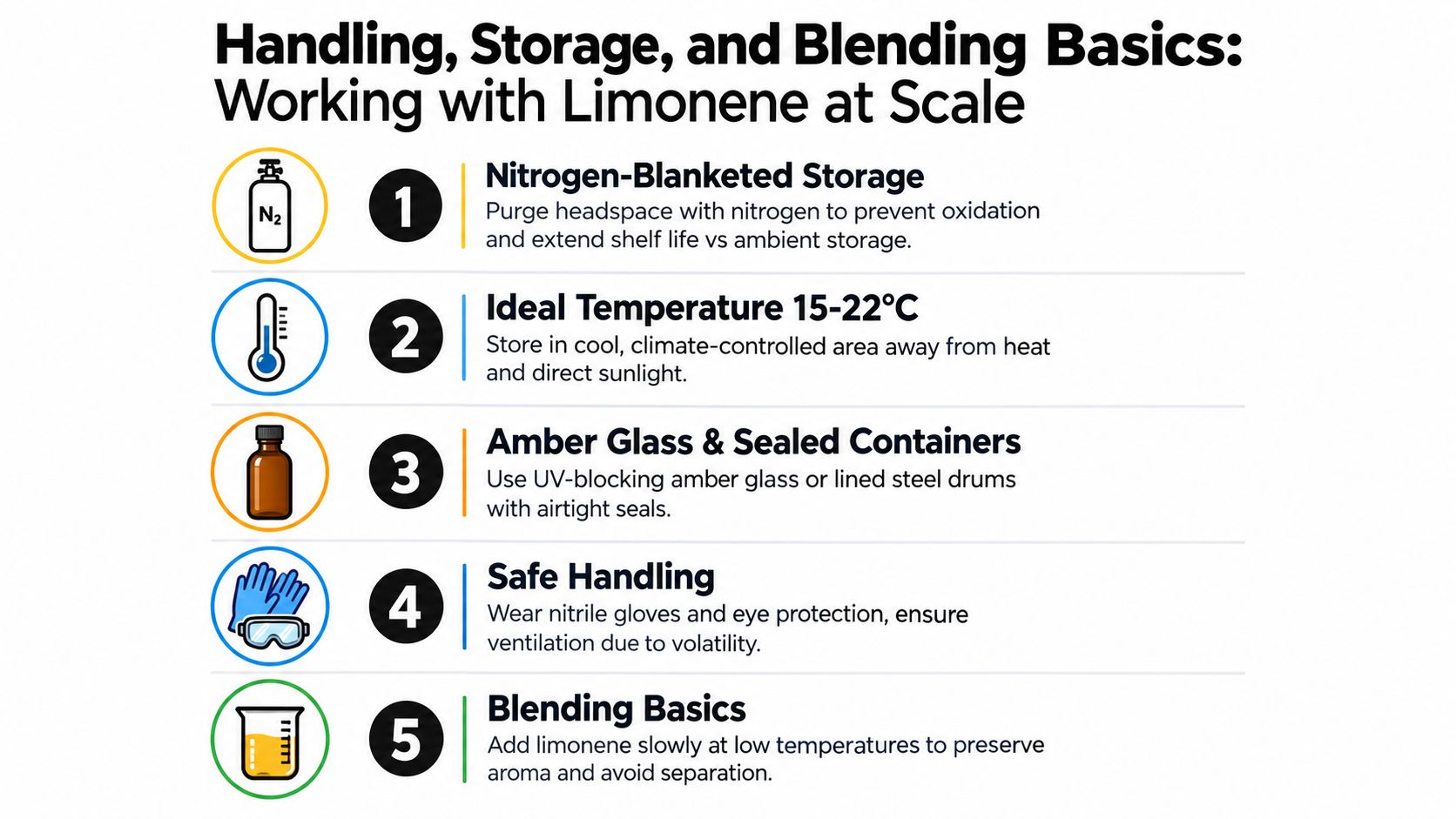
A clean lot can still fail in production if your team handles it badly. Limonene rewards basic discipline and punishes shortcuts.
Store it like a volatile oil, not a shelf-stable flavor bottle
Because limonene is volatile and hydrophobic, your storage setup matters. Keep containers closed, reduce headspace where possible, and use cool storage. If your team is repeatedly opening the same production container, split inventory into smaller working units instead of cycling one main drum in and out of warm rooms.
I also prefer tighter packaging control over vague convenience. Amber glass and lined metal packaging hold up better for long storage than casual warehouse handling with general-purpose plastic.
Blend in the right sequence
The practical move is simple. Preblend limonene into the nonpolar phase first, verify miscibility with the carrier, and don't expect stable dilution in water or propylene glycol without a dedicated solubilization system, as noted in the physical handling data cited earlier.
For cannabis oils, keep temperatures controlled and avoid unnecessary heat hold times. Independent safety documentation lists an initial boiling point of about 175 to 178°C, which is a useful benchmark when you're designing low-heat terpene addition and fill steps (D-limonene safety data with boiling range).
Incoming QC that catches avoidable problems
Use a short receiving check before anything enters active inventory:
- Match documents: Confirm the lot number on the drum matches the COA and SDS set.
- Check appearance: Compare color against a retained approved sample.
- Smell for drift: Oxidized or flattened citrus notes are easy to catch early if you have a sensory reference.
- Run a quick analytical sanity check: If you have in-house capability, verify identity before release.
- Review storage condition on arrival: Warm, loosely sealed, or poorly packed material deserves scrutiny.
Buy once, test once, approve once. Don't let production be the first real evaluation of a limonene lot.
Mistakes Formulators Make With Limonene
The expensive mistakes aren't dramatic. They're usually small shortcuts repeated across purchasing, receiving, and pilot work.
Buying on price alone
Cheap limonene often looks fine on the invoice and expensive in the finished product. If the residual solvent panel is weak, the aroma can still seem bright enough to hide problems until the blend is under heat or sitting in hardware.
Practical fix: approve vendors only after document review, sensory review, and a pilot blend.
Ignoring inhalation exposure questions
A lot of content about limonene for vape cartridges talks only about flavor. That misses operational issue. Independent occupational and health assessments note that d-limonene is readily absorbed by inhalation and may irritate the respiratory system, while volunteer exposure work at 10 to 450 mg/m3 reported no respiratory irritation but did show a decrease in vital capacity at the highest dose that wasn't considered functionally significant. The same review notes that practical vape guidance still often frames limonene broadly at 3% to 6% limonene within a 3% to 10% total terpene range (occupational and inhalation review for limonene).
That doesn't give you permission to guess. It tells you to build conservative pilot formulas and pressure-test the result in real hardware.
Over-thinning the oil
Another common miss is treating limonene like a free-flow shortcut. One cartridge guide notes that limonene can over-thin a viscous distillate at high loadings and cause performance issues, so it's better used at moderate levels when you want citrus-forward character without wrecking wick behavior (best terpenes for vape cartridges guide).
Fix: if the oil starts looking easy to fill but performs worse in hardware, cut limonene before you blame the cartridge.
Skipping chirality
If the listing doesn't clearly specify d-limonene, ask why. Sensory outcome starts there.
Putting It All Together Before You Order
By the time you're ready to buy, the decision should feel boring. That's a good sign. It means the specs are carrying the decision, not the supplier's pitch.
The shortlist test
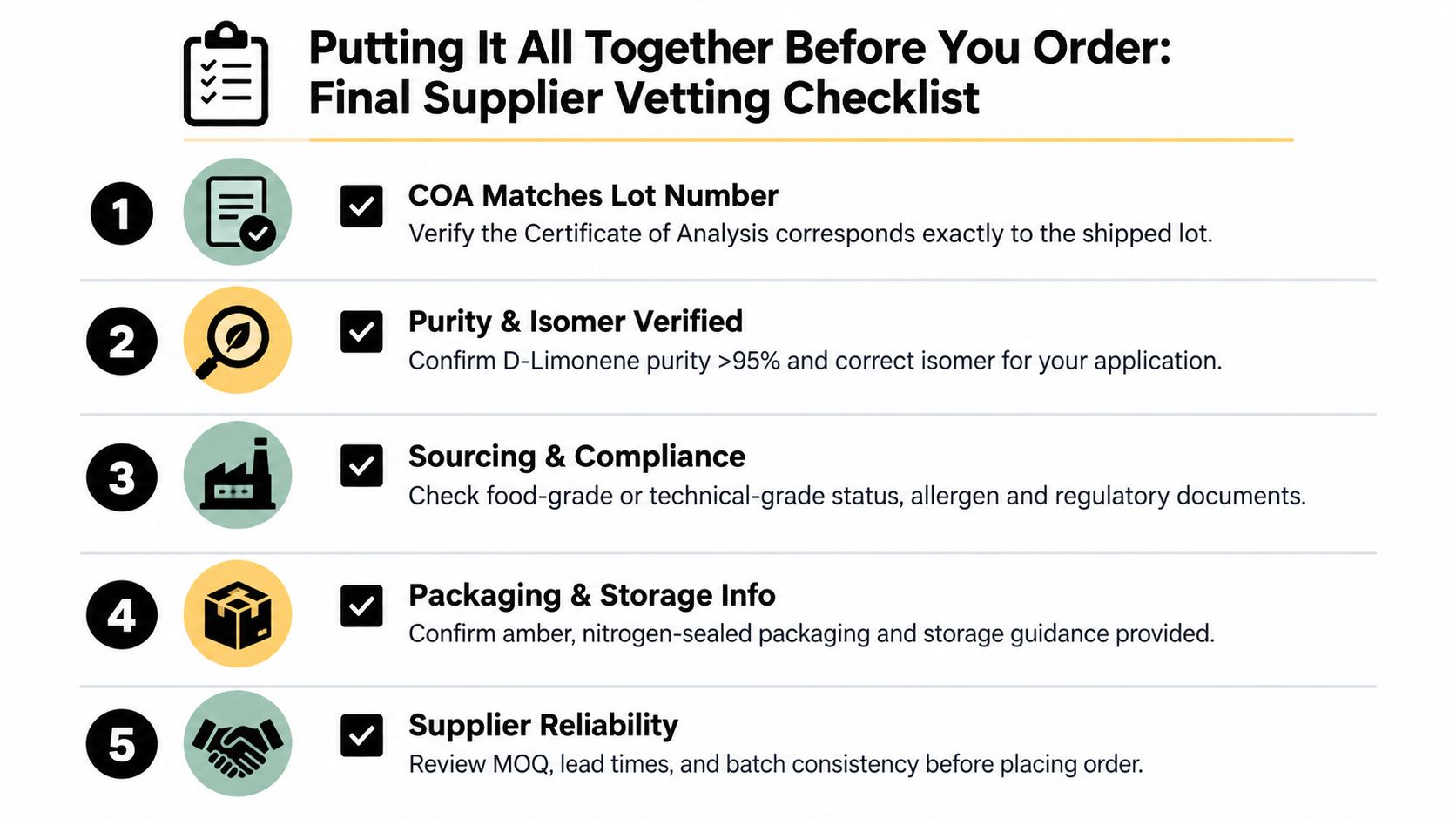
Run every supplier through the same screen:
- Documentation fit: COA, SDS, grade statement, and lot traceability all line up.
- Application fit: The lot makes sense for your exact use. Not a generic “works for everything” claim.
- Packaging fit: Sealing, headspace control, and shipping practice match a volatile terpene.
- Support fit: The supplier can answer technical questions without redirecting you to marketing copy.
If you need broader sourcing visibility before going direct, marketplaces and procurement directories can help you find verified commodity suppliers and compare who's set up for documented bulk ingredient sales.
Red flags that should end the conversation
Some issues aren't negotiable.
Missing COAs, recycled test dates, vague grade language, or resistance to providing an SDS are procurement problems, not minor admin delays.
I'd also walk away from any seller who can't answer simple questions about isomer identity, batch traceability, or intended application range. If they don't understand your use case, they can't protect your production run.
One practical scoring method
Use a simple internal scorecard. Rate each supplier on:
- Spec clarity
- Lot documentation
- Sensory consistency
- Application fit
- Packaging and handling discipline
- Responsiveness after technical questions
You don't need a complicated procurement platform to do this. A spreadsheet works. The important part is that every PO follows the same standard whether you're buying a small sample for a formulation guide test or reviewing a larger production order.
If you want one current retail-facing example of how a limonene isolate is presented for formulation buyers, Gold Coast Terpenes lists limonene as a purchasable terpene isolate alongside other formulation-focused options and educational resources for blend development. That's the kind of ecosystem that helps when you're moving from trial batches into repeat SKUs.
If you're building citrus-forward carts, tuning a strain-inspired terpene blend, or sourcing limonene for cannabis product formulation, Gold Coast Terpenes offers isolate and blend options built around real formulation use, not just flavor marketing. You can review their educational tools, compare terpene resources, and explore product options directly at Gold Coast Terpenes.