
You pull the cart off the bench, take a test draw, and the problem shows up immediately. The orange is loud for a second, then the finish goes thin, hot, and distillate-forward. What was supposed to read like orange cream icing lands closer to generic citrus with a hollow back end.
That failure usually isn't about missing “more orange.” It's a structure problem. In terpene work, orange cream icing is a two-note emulsion idea translated into vapor: bright citrus up top, soft cream underneath, and enough support in the middle that the profile doesn't collapse after the first second of the draw.
For formulators building dessert-leaning carts, concentrates, or strain-inspired terpene blends for distillate, this profile matters because it gives you a familiar flavor target without forcing you into syrupy candy territory. Done right, it reads clean, full, and commercially usable.
Why Orange Cream Icing Matters for Cart and Distillate Work
The bench version of this profile usually starts with a mistake. Someone builds the orange side first, gets excited when the first sniff pops, then fills a cart and realizes the creamy half never arrived. The result is a sharp top note sitting on a flat, solvent-heavy finish.
That's why I treat orange cream icing as a working formulation archetype, not a novelty flavor name. In practical cart development, it gives you a citrus-forward opening that users recognize fast, then a softer base that helps the pull feel round instead of stripped out. If you're tuning performance variables at the same time, what's in a cart is still worth revisiting because hardware, oil body, and blend design all collide here.
Where the profile earns its keep
In carts, the orange side does more than smell nice. It lifts the front of the profile and helps the first inhale feel active. The cream side does the less glamorous job, but it's the part that keeps the SKU from tasting unfinished. It adds body, extends sweetness perception, and helps cover residual harshness that a bare citrus build won't hide.
That makes orange cream icing useful across several lanes:
- For distillate carts: It can soften a dry finish without making the profile muddy.
- For high-terpene extract work: It gives you a recognizable dessert direction without depending only on fragile floral notes.
- For sauce or badder positioning: It translates well when you want citrus brightness with a softer aromatic landing.
Practical rule: If the orange hits hard and the finish disappears, you don't have an orange cream profile. You have a top note with no architecture.
Why it travels well in vapor
Some dessert concepts fall apart in cartridges because they rely on delicate bakery or dairy cues that don't survive the full path from blend vial to coil to mouthfeel. Orange cream icing is more forgiving. The citrus front carries enough identity to survive, and the cream side can be built from softer mid and base materials that don't need to scream to do their job.
That's the commercial appeal. You're not just replicating a nostalgic flavor. You're building a profile that can stay legible across different oil formats and still feel intentional after repeated draws.
The Flavor Logic Behind Orange Cream Icing
Orange cream icing has a long dessert lineage behind it. Orange-and-cream combinations became commercially recognizable in the 20th century, with a widely cited milestone in 1937, when the Creamsicle was introduced after Frank Epperson's earlier 1905 frozen treat invention helped establish the orange-on-a-stick idea. The underlying dessert tradition is older still, with printed ice cream references going back to the 1680s, orange-flower-water flavoring in 1682, the term ice cream appearing in 1744, and a confirmed court reference from 1671. That history matters because the flavor isn't random. It pulls from two already established traditions: citrus flavoring and cream-based sweetness (historical orange-and-cream lineage).
For formulators, the useful translation is simple. Orange cream icing is not “orange plus vanilla” in a loose sense. It's a timed sensory sequence.
The citrus side
The top opens with limonene, which gives you the quick peel-bright lift. To keep that from reading flat or cleaner-like, you need a second orange shape behind it. That's where valencene earns its place. It pushes the profile away from lemon-citrus brightness and closer to orange flesh, rind, and juice character.
If you work on flavor-first SKU planning, even a general resource like the Chef content strategy guide is useful for one reason: it reinforces how flavor ideas become category language only when the sensory target is consistent. In terpene formulation, consistency starts with naming the orange correctly. For a broader sensory vocabulary, the terpene flavors guide helps map those differences.
The cream side
The creamy half is where most builds fail. In conventional orange cream icing, recipes rely on butter, cream, or cream cheese to round off citrus sharpness, and fresh zest is often favored because the peel carries concentrated aromatic oils while vanilla bridges citrus brightness into a creamsicle-like profile (orange cream icing sensory logic).
In terpene land, you recreate that behavior with linalool as a soft sweet bridge, then use vanillin and low, grounding base notes to suggest the ice-cream finish. The trick isn't making the cream loud. It's making it stay.
The creamsicle illusion comes from sequence. Citrus flashes first, cream lingers after.
That timing is the whole game. If every note lands at once, the profile tastes flat. If the top evaporates with no trailing softness, it tastes unfinished.
Dominant Terpenes and Supporting Notes
When I'm building an orange cream icing terpene profile for vape cartridges, I sort compounds by job first and chemistry second. The profile needs one lead citrus terpene, one orange-rounding terpene, one bridge terpene that softens the transition, then a small support cast that gives the finish weight.
The easiest way to wreck this style is to over-focus on the lead. Limonene should usually be the loudest note, but not the whole story. One published citrus-forward formulation guide places limonene at 55%, with 15% alpha-pinene, 15% gamma-terpinene, 10% myrcene, and 5% beta-caryophyllene as a practical citrus skeleton (citrus-forward terpene build). That's not an orange cream icing formula by itself, but it's a good reminder that citrus needs support or it gets thin.
What each note is doing
Limonene drives the opening. It's also one of the few compounds with a published formulation range in this set of sources: 0.5% to 2.5% usage in distillate-oriented flavor work, with a sharp citrus-sweet profile (terpene flavor chart).
Linalool is the bridge. It won't make a cart taste like cream by itself, but it softens the edge and adds the sweet floral cushion that helps vanillin read as dessert instead of perfume. The same chart lists 0.2% to 1.5% for linalool.
Myrcene is body. In this profile I keep it restrained, because too much shifts the blend away from orange cream and toward a heavier, less defined finish. Its published usage range is 1.5% to 4.0%.
Valencene, nerolidol, beta-caryophyllene, vanillin, and small supporting notes fill in what the lead trio can't do alone. The valencene reference is worth reviewing when you want a more authentic orange direction instead of generic citrus.
If you compare this dessert lane to fruit-forward catalog work such as Elevated Strains, the lesson is the same: layered dessert-fruit profiles depend on support notes, not just a loud top note.
Orange Cream Icing Terpene Breakdown
| Terpene | Sensory Role | Suggested Cart Range | Volatility Note |
|---|---|---|---|
| Limonene | Bright peel-like citrus top note | Use within the published 0.5% to 2.5% range as a guide | Flashes early and defines first impression |
| Valencene | Rounder orange pulp and rind character | Moderate support layer | More stable-feeling than a limonene-only top |
| Linalool | Soft sweet bridge into cream | Use within the published 0.2% to 1.5% range as a guide | Mid-note behavior, helps the transition hold |
| Myrcene | Body and depth | Use within the published 1.5% to 4.0% range as a guide, usually lower in this profile | Can weigh down the profile if pushed |
| Beta-caryophyllene | Structure and light spice | Low support role | Helps keep sweetness from feeling loose |
| Nerolidol | Woody-floral base and thicker finish | Low support role | Lingers longer and supports mouthfeel |
| Vanillin | Ice-cream-like rounded finish | Trace support role | Persists in the back half of the draw |
Building the Profile With Top, Mid, and Base Notes
A lot of formulators talk about top, mid, and base notes like branding language. In actual blending, it's a mechanical tool. One industry guide frames volatile monoterpenes like limonene and pinene as top notes, sesquiterpenes such as caryophyllene as middle notes, and heavier compounds like nerolidol as base notes, then recommends a 30/50/20 split as a common starting framework for custom blends (top, middle, and base note framework).
That structure works well for orange cream icing because the profile needs both lift and persistence.
Mapping orange cream icing onto the skeleton
For the top layer, I keep the focus on limonene with valencene carrying the orange identity. This profile earns its first-second recognition.
For the mid layer, I want the cream bridge to show up before the citrus drops out. Linalool is central here. Beta-caryophyllene and a controlled amount of myrcene keep the profile from tasting airy or detached.
For the base layer, I use nerolidol and vanillin as the anchor. If the formula includes touches of humulene, farnesol, or related support notes, they belong here too.
A separate orange-leaning reference profile illustrates why this approach works. An Orange Creamsicle blend can include valencene, nerol, d-limonene, citronellol, myrcene, beta-caryophyllene, alpha-humulene, cedrol, linalool, pinene, farnesol, caryophyllene oxide, nerolidol, decenol, menthol, alpha-terpineol, ethyl butyrate, vanillin, and camphor, which shows that cream-and-orange effects are assembled from multiple aroma families rather than a single dominant compound (Orange Creamsicle terpene composition example).
Don't chase “cream” with one ingredient. Build it as a lingering agreement between the mid and base.
30/50/20 Skeleton Mapped to Orange Cream Icing
| Layer | Share | Reference Terpenes | Role in Profile | Example at 1% Load |
|---|---|---|---|---|
| Top | 30% | Limonene, valencene, small pinene support if needed | Fast orange lift and peel brightness | 0.30% of the finished oil |
| Mid | 50% | Linalool, beta-caryophyllene, restrained myrcene | Cream bridge, body, and orange push-pop center | 0.50% of the finished oil |
| Base | 20% | Nerolidol, vanillin, optional humulene or farnesol support | Lingering vanilla-cream finish and weight | 0.20% of the finished oil |
Turning the skeleton into a real batch
At a 1% total terpene load, the math is straightforward:
- Top layer: 0.30%
- Mid layer: 0.50%
- Base layer: 0.20%
For a 200-gram batch of finished oil at 1% total terpenes, that means:
- Top layer: 0.60 grams
- Mid layer: 1.00 gram
- Base layer: 0.40 grams
Inside those buckets, I still bias the top toward limonene, not equally across every citrus note. The point of the skeleton is stability in the build process. It gives you a profile that opens bright, settles into cream, and stays coherent after repeated pulls.
Titration and Mixing Tips for Cartridges and Concentrates
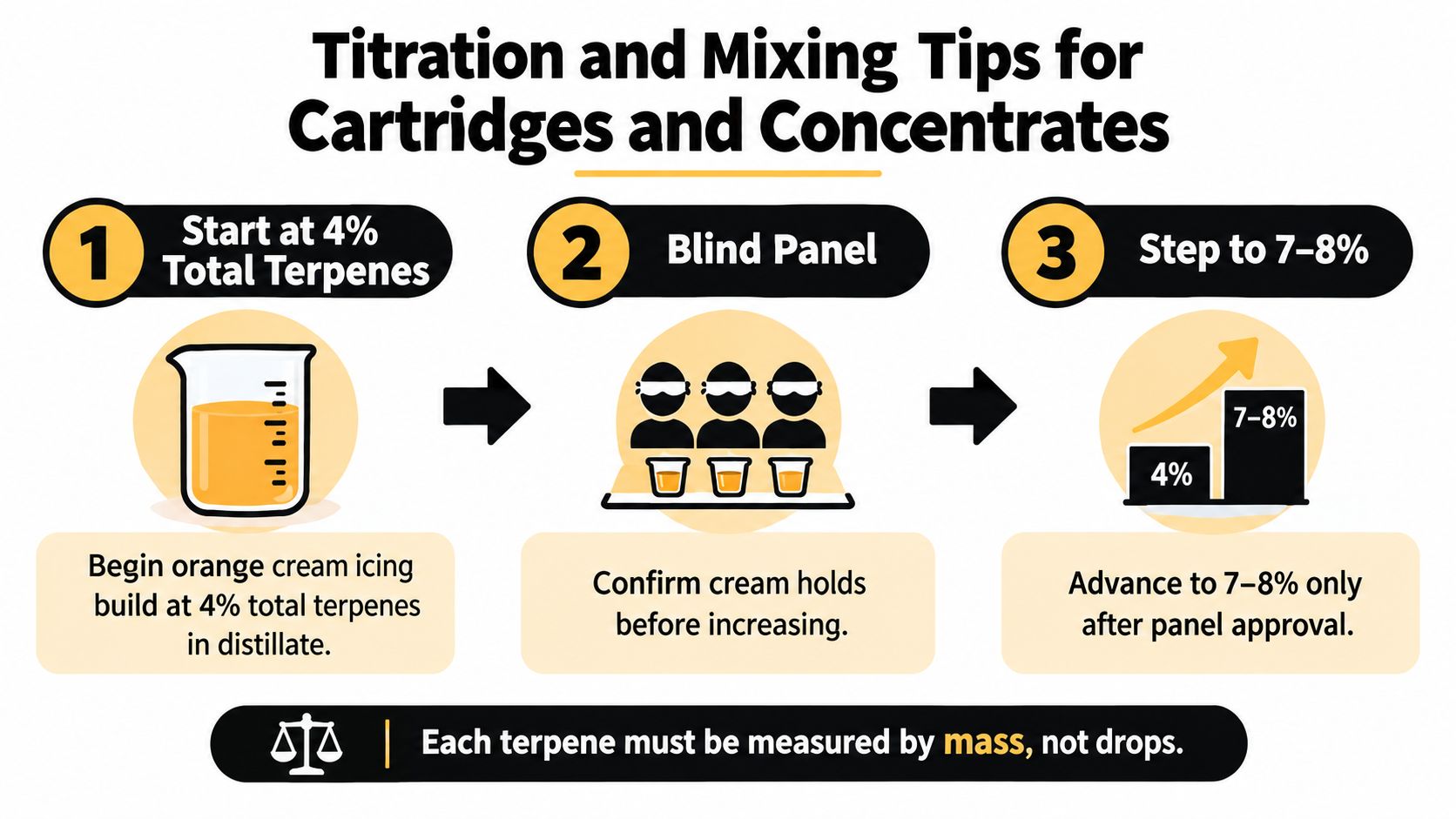
Start lower than your sales team wants. Orange cream icing almost always smells more complete in the vial than it tastes in the cart, and that pushes people to over-correct early. The better move is to begin at 4% total terpenes, then only walk upward toward 7% to 8% after a blind panel confirms the cream still holds in vapor.
If you need a broader benchmark for loading decisions, how much terpenes to add to distillate is a useful companion read. But for this profile specifically, the cream note decides whether you can push higher.
Mixing order that keeps the profile intact
Use mass, not drops. Pre-blend your top, mid, and base fractions in glass before they ever touch the oil. Then introduce that blend into warmed distillate at 45 to 55 degrees Celsius. That protects volatile citrus materials from unnecessary abuse and keeps the soft middle from getting flattened before homogenization.
Here's the short version I trust:
- Pre-blend first: Build the terpene system in a separate vial.
- Warm the oil gently: Stay in the 45 to 55 degrees Celsius window.
- Homogenize cleanly: Use a magnetic stir bar for ten minutes before fill evaluation.
Worked batch example
For a 100-gram distillate batch at 5% total terpene load, use 5 grams of total blend. If you keep the 30/50/20 skeleton, split that into:
- 1.5 grams top
- 2.5 grams mid
- 1.0 gram base
That gives you a real starting point instead of a conceptual one.
From there, test the pull, not just the aroma. A cart can smell perfect in the room and still fail once the oil heats.
If the panel says the orange is strong but the finish feels empty, don't add more top note first. Increase support in the mid or base.
Hardware and concentrate considerations
Ceramic carts will expose viscosity mistakes fast. If your linalool and lighter support notes are thinning the oil too much, you'll see wicking behavior change before the flavor issue is obvious. Cotton systems can forgive some of that, but they bring their own muting effects.
For concentrates, the same logic applies with a different emphasis. In sauce, a little extra top can stay attractive. In a cartridge, too much top leaves first and strands the rest of the profile behind.
Store finished carts in amber packaging and keep oxygen exposure down. The more dessert-leaning your base, the more you'll notice when that back-half softness degrades.
Common Formulation Mistakes and How to Fix Them
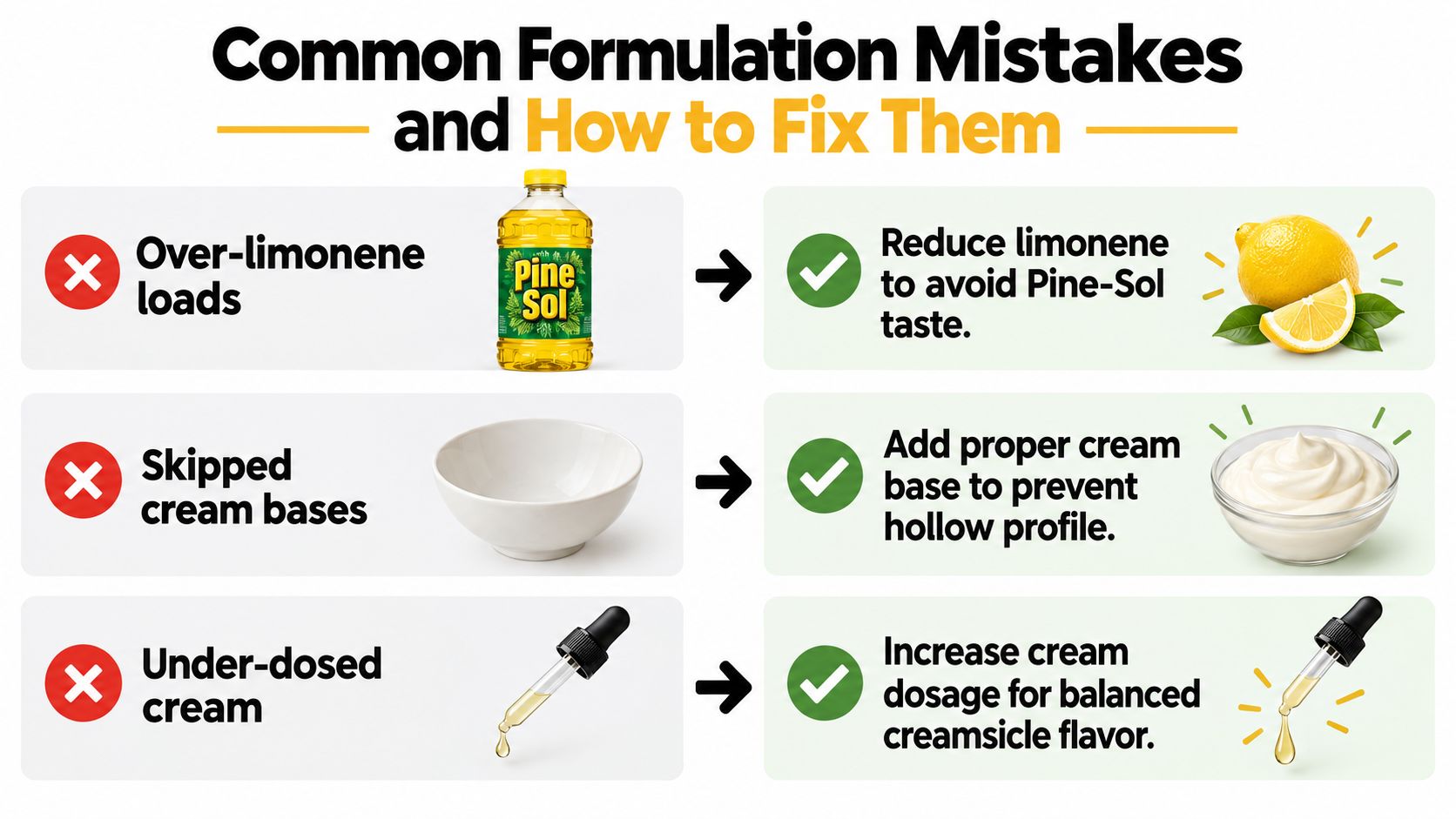
Most failed orange cream icing carts miss in one of three ways. They're too sharp, too hollow, or unstable in hardware. Those sound like separate complaints, but they usually come from one issue: the blend wasn't treated like a two-part system.
Three misses I see all the time
- Overbuilt citrus top: The cart opens like orange cleaner instead of orange dessert. This happens when limonene carries too much of the burden and nothing rounds it.
- Skipped cream architecture: The formulator adds one soft note and assumes that's enough. It isn't. Without a real base, the profile tastes vacant after the first second.
- Chasing flavor instead of hardware: The oil leaks, runs too thin, or scorches, and the team keeps changing the terpene ratio instead of fixing the cartridge setup.
Better fixes than adding more sweetness
The correction for a harsh top isn't blind sweetener. It's redistributing the orange. Shift part of the citrus identity into valencene and let limonene handle lift instead of total flavor definition.
If the profile is hollow, build the cream side with linalool plus vanillin, not a single soft note doing all the work. Keep the base present. Don't treat it like optional garnish.
When the cart burns or feeds too fast, stop reformulating for a minute. Hardware mismatch can mimic a flavor imbalance because a damaged or poorly matched system changes heat, delivery rate, and perceived body all at once.
A leaking cart can make a good blend taste broken. Fix the delivery system before you rewrite the recipe.
From Dessert Lineage to a Finished SKU
Orange cream icing works because the flavor idea already exists in people's heads. The dessert lineage is established, the orange-and-cream pairing is familiar, and the modern frosting market is large enough that this isn't some obscure home-baking reference. The broader icing and frosting category is valued at $11.23 billion in 2025 and projected to reach $17.91 billion by 2034 at 5.2% compound annual growth, which tells you this flavor family sits inside a major commercial dessert segment, not a niche one (icing and frosting market projection).
For cannabis product formulation, that familiarity is useful only if the SKU survives real use. I judge this profile on three checkpoints:
- Pull texture: Does the draw feel rounded, or does the orange vanish and leave a dry finish?
- Color and presentation logic: If the product concept depends on a visual orange cue, remember that color, moisture, and aroma are linked. In food systems, orange icing guidance repeatedly runs into that same three-way balance.
- Aroma persistence: The profile should still read as orange-cream after a longer draw, not just in the first flash.
The dial you're really turning is citrus versus cream. Push too far into citrus and the SKU gets hard-edged. Push too far into cream and it loses definition. For a lot of commercial builds, a citrus-forward top against a smaller but durable creamy foundation is the right shape, especially when total terpene load stays controlled.
Quick Formulation Questions Answered
Should orange cream icing carts be loaded high?
Not automatically. Start conservative and raise only if the cream stays intact in vapor. This profile often smells richer than it vapes.
Does it work better in ceramic or cotton hardware?
Either can work. Ceramic usually exposes thinning and wicking issues sooner. Cotton can mute the top and make you think the blend needs more citrus when it may not.
Will stacking citrus notes make the oil feel thinner?
It can. That's why I watch the total balance instead of treating every citrus addition as harmless. A strong top with weak support often feels thinner than the same total load with a better base.
How do you keep batch repeatability?
Buy consistent materials, weigh everything by mass, and pre-blend the terpene system before it touches the oil. Repeatability comes from process discipline more than last-minute sensory tweaks.
Does the vanilla side hold under heat cycling?
It holds better when it's part of a base system, not a trace afterthought. If the creamy finish keeps disappearing, the answer usually isn't “more vanilla.” It's better structure.
Gold Coast Terpenes supplies terpene isolates, strain-specific blends, and formulation tools that fit this kind of orange cream icing build, whether you're adjusting a citrus top note or tightening the creamy finish for carts and distillate. If you need components for flavor-first cannabis product formulation, batch scaling, or strain-inspired terpene blend work, visit Gold Coast Terpenes.