
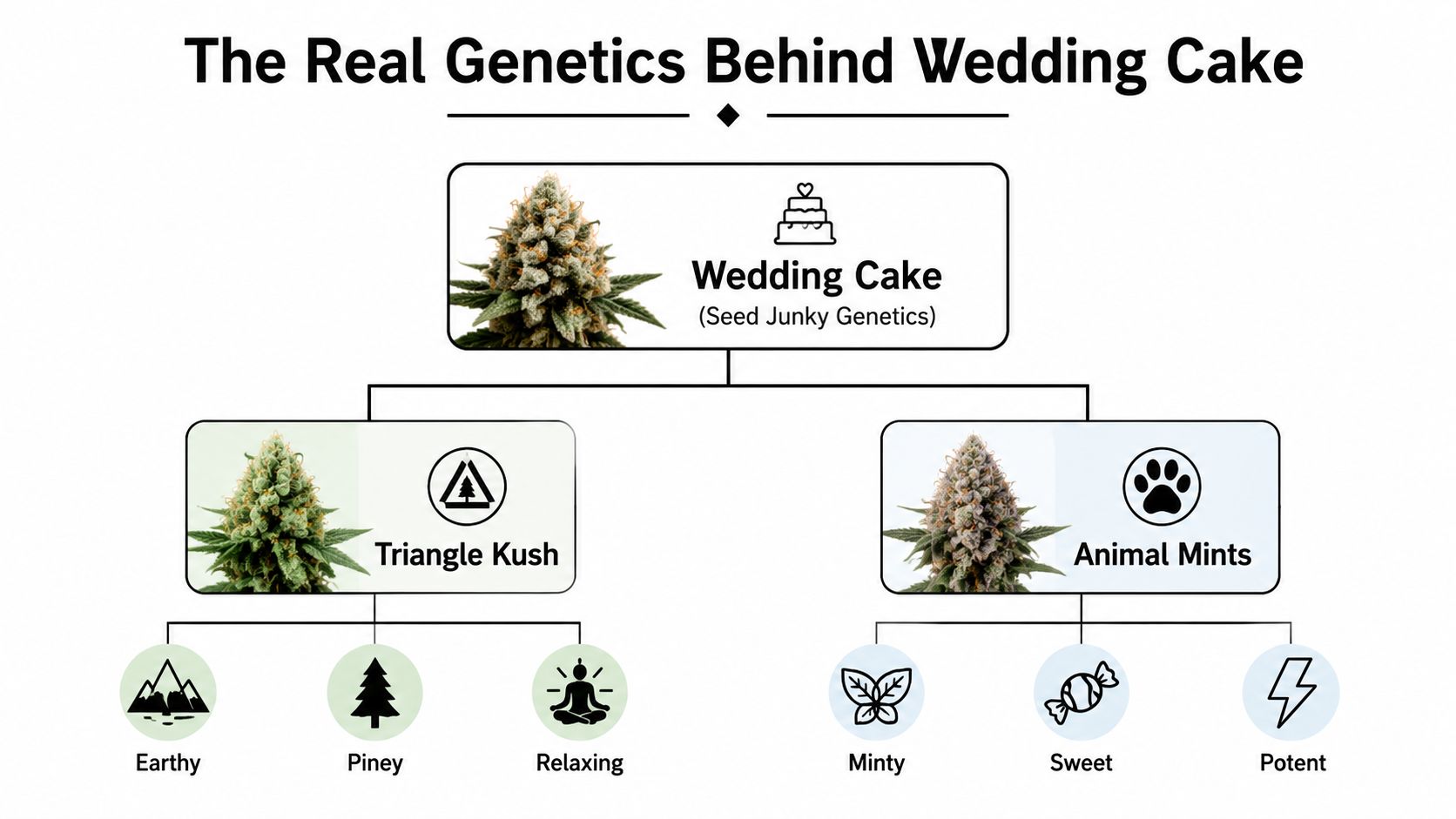
Wedding Cake is an indica-dominant hybrid, typically 60% indica and 40% sativa, bred by Seed Junky Genetics from Triangle Kush and Animal Mints. Its formulation signature rests on a caryophyllene, limonene, and myrcene terpene core.
The popular advice is to treat the name as a complete specification. That approach fails in product development. “Wedding Cake” can describe related but non-identical cuts, phenotype labels, or commercial products with different chemical profiles. For a vape or distillate formulation, the name is a starting hypothesis, not a release standard.
The practical question isn't only what strain is Wedding Cake. It's which Wedding Cake chemistry are you trying to reproduce, and can your incoming flower, resin, or terpene fraction support that target? Lineage, lab data, sensory evaluation, and cartridge behavior all matter more than a shelf label.
The Real Genetics Behind Wedding Cake
Why the name doesn't guarantee the chemistry
Not every product labeled Wedding Cake shares one perfectly consistent genetic backbone. The cultivar is widely identified as a Seed Junky Genetics creation bred from Triangle Kush crossed with Animal Mints, although strain references also record competing lineage descriptions and names such as Pink Cookies or Triangle Mints #23. That naming drift creates a serious problem for formulators, because two products can carry the same commercial name while presenting different dominant notes.
The better formulation anchor is the most consistently documented parentage, not every claim printed on packaging. Independent strain references describe Wedding Cake as an indica-leaning hybrid, commonly expressed as approximately 60% indica and 40% sativa. Mood's Wedding Cake strain reference also identifies Seed Junky Genetics and traces the lineage to Triangle Kush and Animal Mints.
Triangle Kush supplies the sharper, earthy, peppery side of the profile. Animal Mints helps explain the creamy, sweet, dough-like direction associated with many Wedding Cake expressions. Those parent contributions don't translate into a fixed isolate recipe, but they provide a useful sensory map: a spiced, dense foundation with citrus lift and a rounded dessert impression.
Formulation rule: Treat the cultivar name as an identity cue. Treat the COA and sensory result as the actual formulation input.
Lineage as a replication reference
The lineage also helps explain why a sugary vanilla blend alone usually misses the target. Wedding Cake needs a firm spicy structure, generally led by beta-caryophyllene, with limonene providing brightness and myrcene supplying earthy weight. A blend can smell sweet and pleasant yet still fail to read as Wedding Cake if its peppery finish disappears.
Commercial seed references can still be useful when teams are comparing genetic interpretations, but they shouldn't replace chemical verification. For example, a product page for the Barneys Farm Wedding Cake 3 pack offers one market-facing reference point for how the name is presented in breeding commerce. It doesn't, by itself, establish that every flower or oil sold under the name has the same terpene expression.
The cannabinoid profile matters too. Wedding Cake is commonly reported as high potency, with retail summaries often placing THC around 22% to 26%, and some licensed-market summaries extending to 27% or higher, as documented by Leafwell's Wedding Cake profile. For distillate teams, that potency context affects how aggressively the aromatic fraction must be designed, but it doesn't prove a specific effect outcome. Avoid treating cannabinoid and terpene assumptions as medical claims or as substitutes for finished-product testing.
For a broader discussion of the commercial appeal and naming context, formulators can compare the Wedding Cake popularity discussion with their own market data. The useful takeaway is simple: genetics establish the target family, while lab-verified chemistry defines the version you can replicate.
Terpene Architecture and Note Structure
Wedding Cake works best as a layered aroma system rather than a list of isolated compounds. Independent strain references repeatedly identify caryophyllene, limonene, and myrcene as the central terpene group, with linalool, humulene, and sometimes pinene appearing as supporting compounds. Cannintel's strain profile describes the caryophyllene, limonene, and myrcene core and links those compounds to pepper, citrus, and earthy relaxation-oriented sensory impressions.
Map the profile by vapor timing
For vape development, note position is more useful than ranking compounds by abundance. Limonene and pinene generally contribute the first aromatic impression on inhalation. Myrcene and linalool help form the mid-palate, while caryophyllene and humulene create the warmer, more persistent exhale.
| Terpene | Typical Range (%) | Note Position | Aroma Descriptor | Functional Role |
|---|---|---|---|---|
| Caryophyllene | Not consistently fixed across references | Base and exhale | Pepper, spice, dry wood | Anchors the profile and supplies the characteristic warmth |
| Limonene | Not consistently fixed across references | Top note | Citrus peel, bright lemon | Adds lift and prevents the blend from feeling dense |
| Myrcene | Not consistently fixed across references | Mid note | Earth, musk, herbal depth | Builds body and supports the heavier dough-like impression |
| Linalool | Supporting compound | Mid note | Soft floral, lavender, sweet cream | Rounds sharp edges and supports dessert nuance |
| Pinene | Supporting compound | Top accent | Pine needle, fresh green | Adds lift and keeps the opening from becoming flat |
| Humulene | Supporting compound | Base accent | Woody, herbal, dry spice | Extends the finish and reinforces earthy structure |
The table intentionally avoids false precision. Some formulation plans circulate fixed percentage bands for each terpene, but the verified references don't establish one universal ratio. Batch data varies, and the same name can represent different phenotypes. One market-facing summary reports beta-caryophyllene at 0.4% to 0.9% by dry weight and identifies it as dominant, providing a concrete anchor for the peppery structure without making that range a universal specification. Seaweed Delivery's Wedding Cake potency and terpene summary supplies that reference point.
A Wedding Cake profile that has no peppery persistence may smell like generic bakery flavor, even if the opening is sweet.
What creates the bakery impression
Vanilla, dough, cream, and warm sugar aren't necessarily the result of one dominant terpene. Minor terpenes, trace esters, and the interaction between floral, earthy, citrus, and spicy components can create the impression. That's why increasing sweetness often makes an oil smell artificial rather than cultivar-specific.
Use a sensory reference chart such as this terpene flavor chart to align isolate descriptors with the intended vapor sequence. The working target is a bright entrance, rounded center, and peppered finish, not a uniform sweet note from the first draw through the last.
Formulating a Wedding Cake Terpene Blend
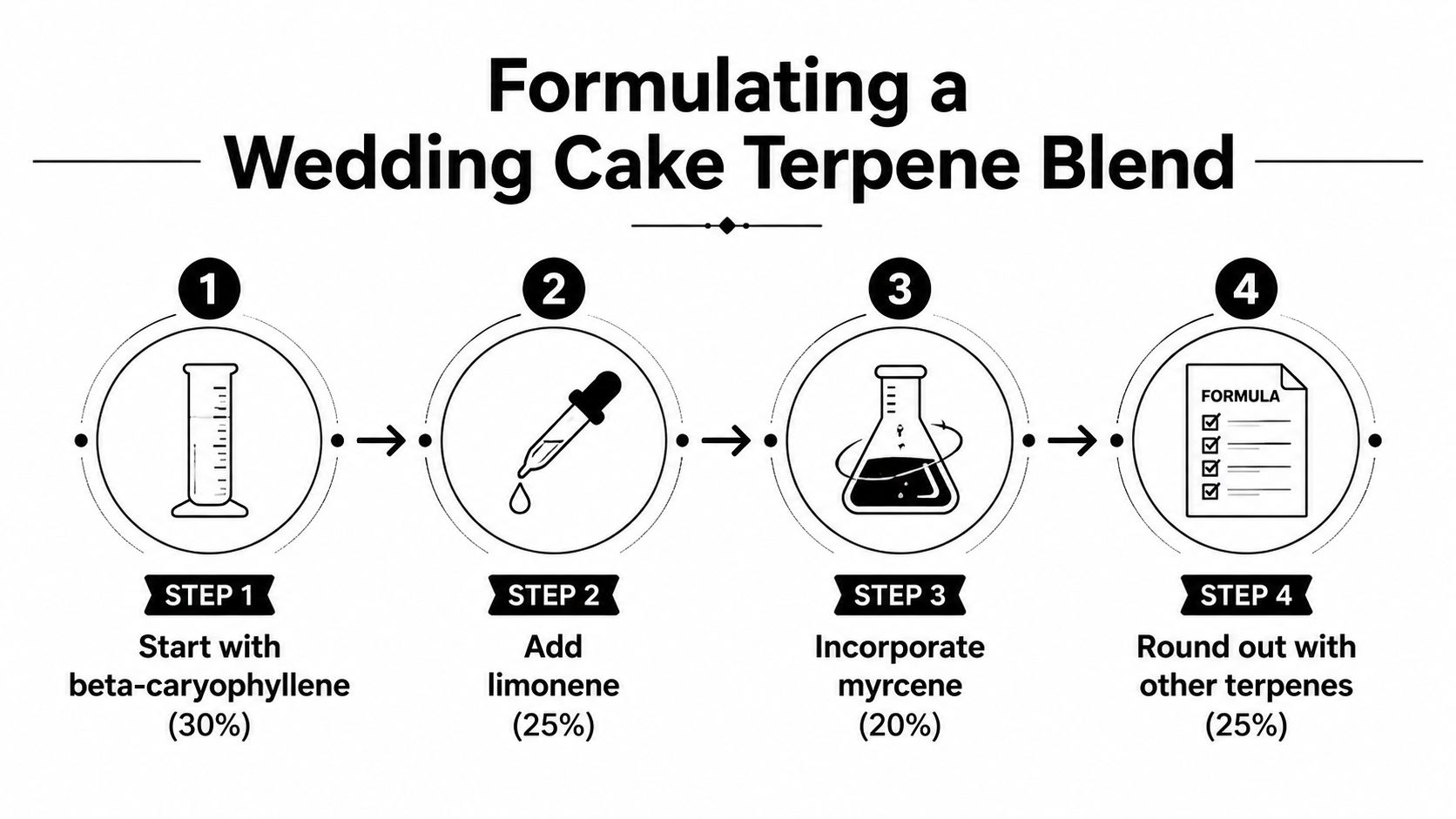
A strain-inspired terpene blend should start with a controlled hypothesis, then earn its final ratio through sensory and stability testing. The following baseline is a practical starting point for a Wedding Cake-inspired blend:
- 30% caryophyllene, to establish peppery warmth.
- 25% limonene, to create citrus lift.
- 20% myrcene, to provide earthy mid-palate weight.
- 10% linalool, to soften the structure with floral creaminess.
- 8% pinene, to add a green, pine-like opening.
- 5% humulene, to extend the woody finish.
These values total the complete terpene blend, not the percentage of terpene added to the finished oil. They're a development baseline, not a claim that every authentic Wedding Cake batch follows the same composition. Terp Bros NYC's Wedding Cake reference supports the recurring caryophyllene, limonene, and myrcene structure, while also noting supporting compounds and variation across batches.
Build from the least volatile notes
Begin by dissolving the base materials, caryophyllene and humulene, into the carrier or distillate. Their heavier sensory contribution gives the blend a stable foundation before you add the compounds that define the opening.
Add myrcene and linalool next. These mid-notes need enough time to integrate with the base, especially when the finished product has a dense distillate character. Finish with limonene and pinene, which are more volatile and can dominate if added without regard to the rest of the structure.
The final terpene concentration in distillate cartridges is commonly developed around 5% to 8% by weight, but the appropriate level depends on hardware, oil viscosity, inhalation temperature, and the sensory tolerance of the finished product. Keep the test matrix small and controlled. A 48-hour rest period before final sensory assessment can reveal integration changes that aren't obvious immediately after mixing.
Correct the failures that show up in carts
Overloading limonene can produce a sharp, solvent-like throat impression and erase the creamy center. Underdosing caryophyllene removes the warm, spicy finish that makes the profile recognizable. Myrcene can also become too dominant early in a draw, particularly in hardware that heats the oil aggressively.
Trace esters may help supply a bakery nuance, but they should support the terpene architecture rather than cover an imbalanced blend. Teams evaluating adjacent dessert profiles can use Elevated Strains as one catalog reference for a flavor direction, without assuming it is a Wedding Cake replication.
For handling, dilution, and mixing sequence considerations, consult this practical guide on how to use terpenes. The operational principle remains consistent: add the aromatic intensity gradually, then evaluate the actual oil in the actual cartridge.
Application Behavior Across Product Formats
The same blend won't behave identically in distillate, live resin, and finished cartridge hardware. Matrix, viscosity, heat exposure, and minor-compound content all change what reaches the consumer's palate.
| Product Format | Max Terpene % | Key Stability Risk | Ratio Adjustment |
|---|---|---|---|
| Distillate formulation | 5% to 8% by weight is a common development range | Separation, harshness, and loss of volatile top notes | Preserve the caryophyllene core, then increase citrus only when the oil needs lift |
| Vape cartridge | Hardware-dependent, with caryophyllene requiring special attention above 8% | Crystallization and changing draw behavior during heating | Test homogeneity at the intended terpene level and use limonene cautiously as a balancing solvent |
| Live resin | Not fixed across batches | Greater batch variation and changing minor-terpene balance | Use the native fraction as the reference, then make restrained corrections |
| Edible or tincture matrix | Process-dependent | Heat and oxygen can flatten volatile citrus notes | Add heat-sensitive components after processing where appropriate, or use a validated protection approach |
Distillate and cartridge behavior
In distillate carts, high caryophyllene content can crystallize at concentrations above 8%, so the team must check homogeneity rather than assume the blend remains uniform. Limonene may help maintain fluidity, but adding it to solve a physical problem can push the aroma toward harsh citrus or solvent character.
Myrcene often presents early in the draw as the oil warms, while caryophyllene becomes more apparent through the developing mid-note and exhale. Hardware testing is therefore part of flavor replication. A bench vial may smell balanced, yet the cartridge can expose a heavy earthy opening or an overly sharp finish.
Live resin and oral formats
Live resin preserves more of the native cannabinoid and minor-terpene context, so its earthy, vanilla-like nuances may feel more complete than an isolate-only blend. The trade-off is reproducibility. Native profiles vary by harvest, processing method, and storage history, which makes a single fixed correction recipe unreliable.
Edibles and tinctures create a different problem. Heat processing can reduce the impact of limonene and leave a flatter pepper-forward profile. If the format requires heating, validate the addition point and process conditions rather than adding the same top-note load used for a cart.
The correct formula is the one that survives the product format, not the one that looks most accurate in a mixing vessel.
Why Phenotype Drift Breaks Flavor Accuracy
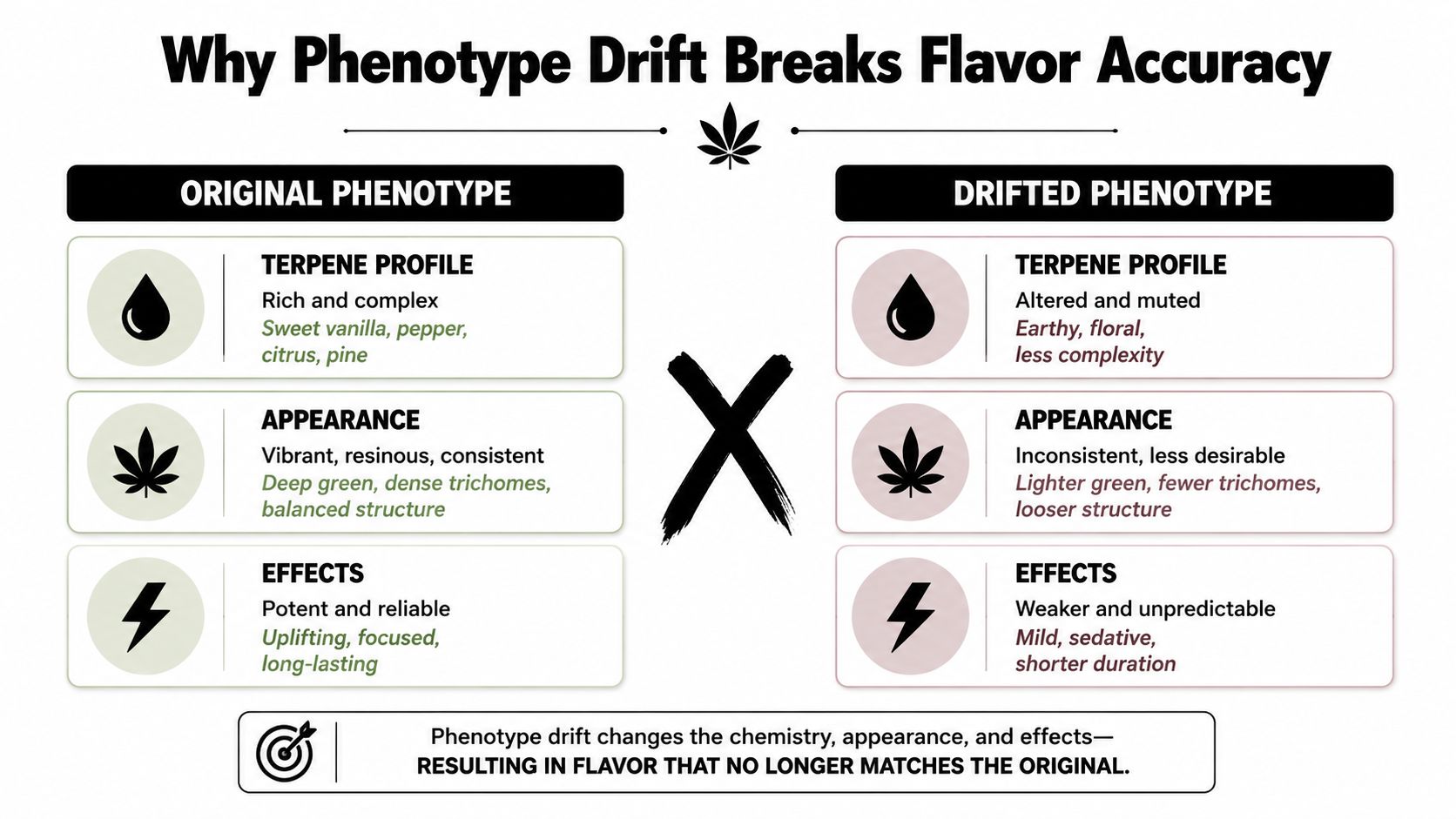
Two products labeled Wedding Cake can smell radically different without either producer intentionally mislabeling the material. The original Seed Junky Genetics cross can express different phenotypes, and those expressions can shift the balance between fuel, earth, citrus, floral notes, and dessert sweetness.
Commercial naming makes the problem harder. Some references identify Triangle Kush crossed with Animal Mints, while others repeat older Girl Scout Cookies and Cherry Pie lineage claims. Strain databases also associate the name with labels such as Pink Cookies and Triangle Mints #23. Budpedia's discussion of Wedding Cake naming drift captures why the name functions partly as a brand identifier rather than a perfectly controlled chemical designation.
Separate phenotype from cultivar label
A gassy expression may carry more obvious fuel, earth, or pine characteristics. Another cut may emphasize dough, vanilla, floral softness, or pepper. Neither sensory direction automatically proves authenticity, and a visually attractive flower isn't necessarily the best raw material for a flavor replication program.
The most common formulation error is allowing the name to determine the blend before the lab result does. Ask for a GC-MS certificate of analysis for incoming flower, resin, or terpene fraction, then compare the dominant compounds and minor-terpene tail against your reference target.
A practical verification screen
Look for a recognizable caryophyllene, limonene, and myrcene relationship before you commit to a strain-inspired terpene blend. Missing caryophyllene is a red flag if the sensory target includes Wedding Cake's characteristic peppery density. Disproportionate limonene can create a bright citrus product that carries the name but loses the expected body and finish.
Record the COA, supplier lot, extraction method, sensory notes, and final cartridge result. That documentation lets the team distinguish a bad blend from a drifting input. It also gives brand owners a defensible basis for describing a product as Wedding Cake-inspired rather than implying genetic identity that the data can't support.
Sourcing and Testing for Consistent Results
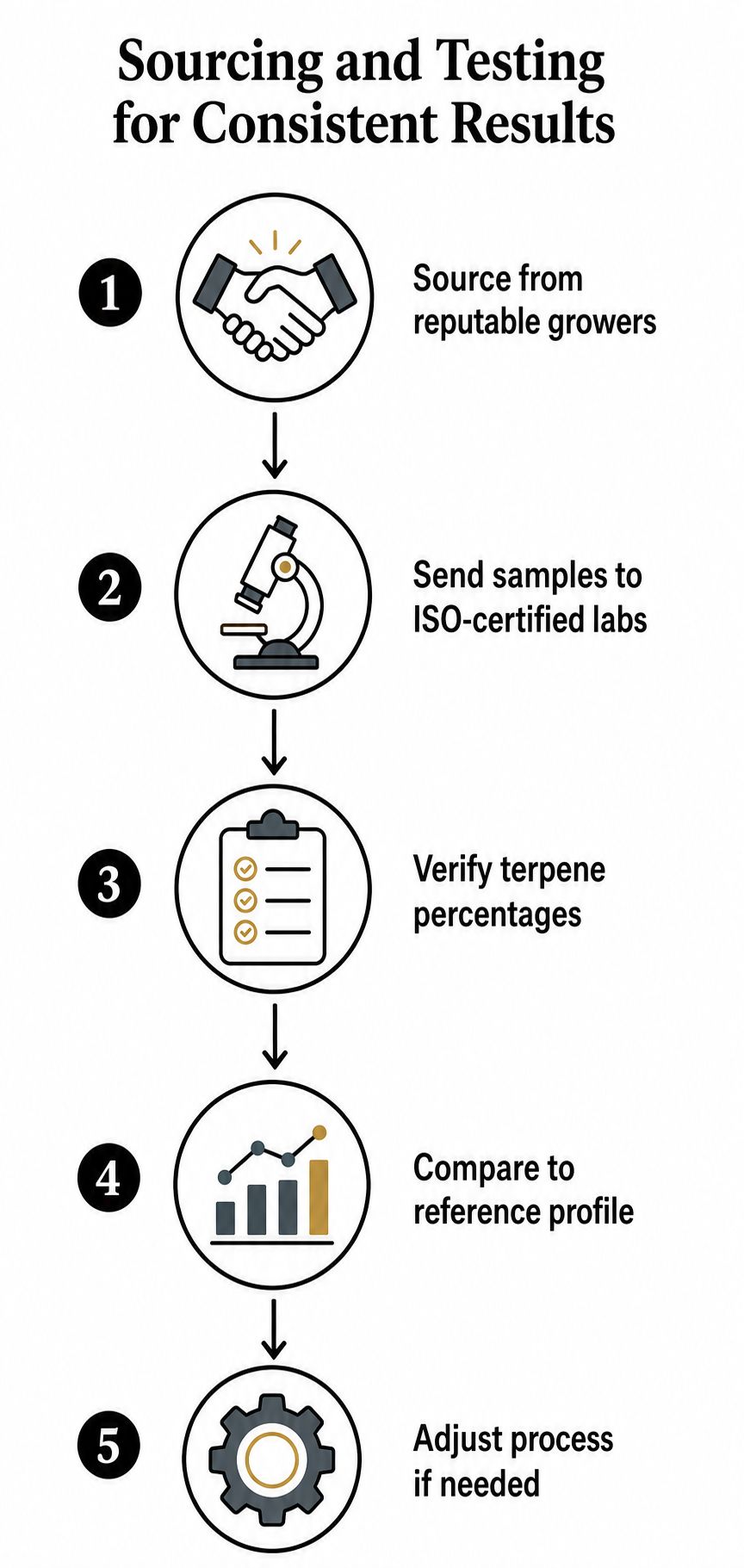
Consistent replication starts before blending. Incoming biomass and terpene fractions should enter the same verification workflow, because a supplier's extraction method can change the minor-compound tail even when the headline terpene names look similar.
Establish a repeatable intake process
Start with a current GC-MS analysis for every material lot. Record the dominant terpene composition, supporting compounds, cannabinoid context where relevant, and any sensory observations from the neat material. Steam-distilled fractions and CO2-extracted fractions can carry different minor-terpene profiles, which may affect the earthy, floral, and dessert nuances that an isolate-only recipe struggles to reproduce.
Use an internal reference profile rather than a generic internet recipe. The recurring caryophyllene, limonene, and myrcene core gives you a useful identity screen, but it shouldn't be treated as a universal certificate of authenticity. A supplier who can't provide traceable lot data creates unnecessary risk for a product that depends on subtle ratio differences.
Test the finished oil, not only the concentrate
Run small-batch sensory panels after the blend has rested. Evaluate the first inhale, mid-palate, exhale, aftertaste, viscosity, visible homogeneity, and draw behavior in the intended hardware. If the opening is too sharp, reduce the top-note contribution before increasing sweetness. If the finish is thin, correct the base rather than raising total terpene concentration.
Accelerated stability testing can help reveal separation, crystallization, and aroma loss before a production run. Store retained samples under the conditions your quality team selects, document every revision, and tie each sensory decision to a specific lot and formula version.
For a deeper quality-control framework, use this resource on third-party lab testing. The goal isn't to find one magical Wedding Cake ratio. It's to build a process that can recognize drift, correct it efficiently, and preserve the intended flavor across production runs.
Gold Coast Terpenes offers THC-free terpene blends, strain-specific profiles, and isolated compounds such as limonene, myrcene, and beta-caryophyllene for cartridges, concentrates, and product formulation. Visit Gold Coast Terpenes to compare formulation components and build a lab-verified Wedding Cake-inspired blend around your own target COA and hardware.