
The most useful advice about Candyland strain effects is also the least complete: treat it as a reliable daytime sativa and formulate around uplift. That positioning captures only one end of the experience. Candyland is widely associated with an energizing, euphoric, creativity-oriented profile, yet independent reviews describe a meaningful shift toward a more cerebral, sedating experience as intake increases. For a cart brand, that difference isn't a footnote. It affects terpene ratios, product claims, dosage communication, and whether the finished oil feels like the profile promised on the label.
Candyland is generally described as a sativa-dominant hybrid with 18% to 24% THC and CBD usually below 0.5%, according to a documented Candyland strain profile. Its commercial identity comes from a sweet, citrus-led aroma supported by peppery and earthy notes, but the product-development opportunity lies in the continuum between clear-headed stimulation and heavier cerebral calm.
Why Candyland Strain Effects Defy Simple Categorization
Candyland's daytime reputation captures only its lower-intake behavior. In practice, the same cultivar can feel focused, social, and creatively stimulating at a modest dose, then become mentally heavy and sedating as intake rises. That split matters when a brand must reproduce the profile consistently in distillate, cartridges, or concentrates.
Independent consumer reviews describe this progression directly. Smaller amounts are often characterized as clear-headed and energetic, while heavier use shifts toward a more cerebral, sedating result, as documented in Candyland user reviews. Tolerance changes the interpretation as well. A seasoned consumer and someone with lower tolerance can experience the same oil differently, even when aroma and cannabinoid composition remain unchanged.
The effect spectrum matters commercially
For product teams, “daytime” works best as a positioning direction supported by controlled delivery. A high-intensity cartridge with a strongly cerebral finish can undermine a label promising focus or daytime activity. A bright citrus blend can create the opposite problem, stripping away the peppery depth that makes Candyland recognizable.
A workable formulation preserves three connected traits:
- Early lift: A noticeable citrus opening and rapid cerebral impression.
- Structured body: Peppery, earthy support that keeps the profile from tasting thin or one-dimensional.
- Controlled finish: Enough grounding character to provide continuity without pushing the SKU toward an evening use case.
Formulation rule: Build Candyland across the full intake curve. Evaluate the opening, mid-session development, and finish together, because the later phase determines whether the product feels balanced or overly heavy.
This matters particularly in vape cartridges, where inhalation can deliver a concentrated sensory and experiential response quickly. Test the first draw alongside repeated use during the same session. A blend that feels precise at one draw may become dense after continued intake, especially when its terpene balance favors caryophyllene over limonene. That ratio can shift the experience from bright and energizing toward warmer, more sedating territory, a practical distinction often missed in broad strain classifications. See this overview of how different strains can produce different highs for additional context.
Candyland's documented history also supports its status as a recognizable reference profile. Historical accounts place its emergence around 2011, as documented in the strain's documented history and profile, followed by a gold medal at the 2012 KO Kush Cup in California. That recognition helps explain why buyers may expect a defined citrus-spice identity instead of a generic sweet sativa flavor.
Decoding the Candyland Terpene Profile for Formulation
Candyland should not be formulated as a uniformly energetic profile. Its response can shift with intake and terpene balance. A caryophyllene-forward blend tends to feel warmer and heavier as exposure builds, while a stronger limonene presence preserves a brighter opening. The Candyland terpene profile guide places total terpene content around 1.2% to 2.5% of dry weight, with beta-caryophyllene near 0.2% to 0.6%, limonene around 0.1% to 0.4%, and humulene near 0.05% to 0.3%.
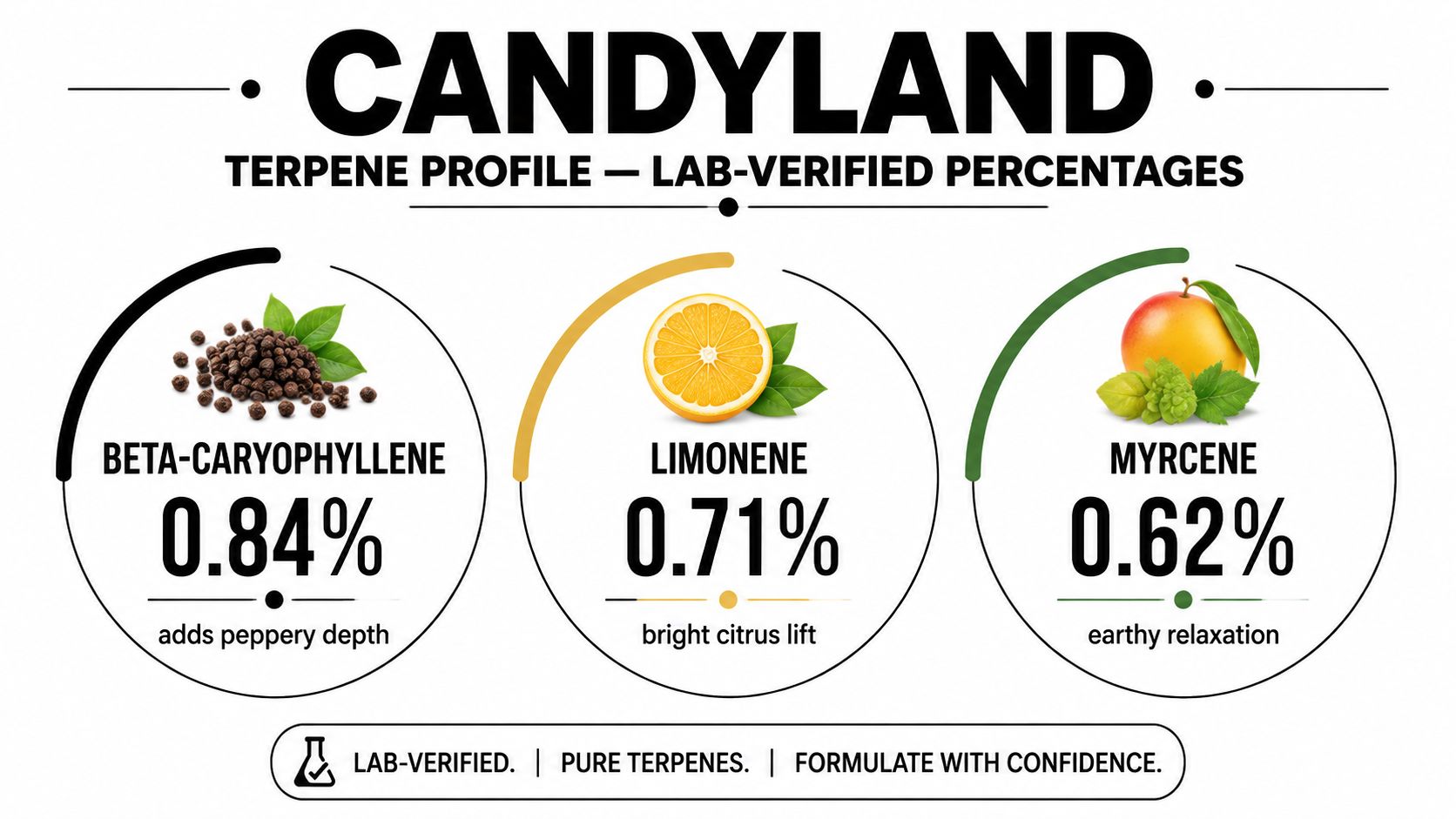
Treat those figures as formulation boundaries, not a universal identity standard. Phenotype, cultivation, extraction, storage, and analytical method can change the measured composition. The useful signal is the relationship between the compounds and how that relationship develops across the session.
Beta-caryophyllene supplies the backbone
Beta-caryophyllene gives Candyland its peppery, spicy, warm structure. It prevents the profile from becoming a simple sugar-and-citrus flavor and adds persistence after the volatile opening fades. Increasing its share can strengthen body and continuity, but it can also pull the experience toward a more grounded, sedating finish at higher intake.
That effect language should remain sensory rather than medical. The practical formulation point is straightforward: caryophyllene provides enough depth to counter limonene's faster, brighter perception.
Limonene creates the opening lift
Limonene supplies the recognizable citrus impression and makes the first draw feel more immediate. A higher ratio can keep the experience lively, but excess limonene may read as sharp, solvent-like, or detached from the peppery core.
Set limonene high enough to establish the Candyland identity, then check repeated draws. The right level keeps the opening bright without erasing caryophyllene through the body of the experience.
Humulene rounds the finish
Humulene adds earthy, woody depth and helps connect the citrus top with the pepper-forward center. Too much can mute Candyland's clearer, more energetic character, particularly when caryophyllene is already dominant.
The target is a citrus opening, pepper-forward core, and earthy finish that stays coherent as intake increases. Elevated Strains may serve as a separate reference for a broader flavor library, not as a substitute for Candyland's chemical and sensory structure. For additional guidance on reading cultivar chemistry, this terpene profile guide provides formulation context.
Building the Candyland Terpene Stack with Top Mid and Base Notes
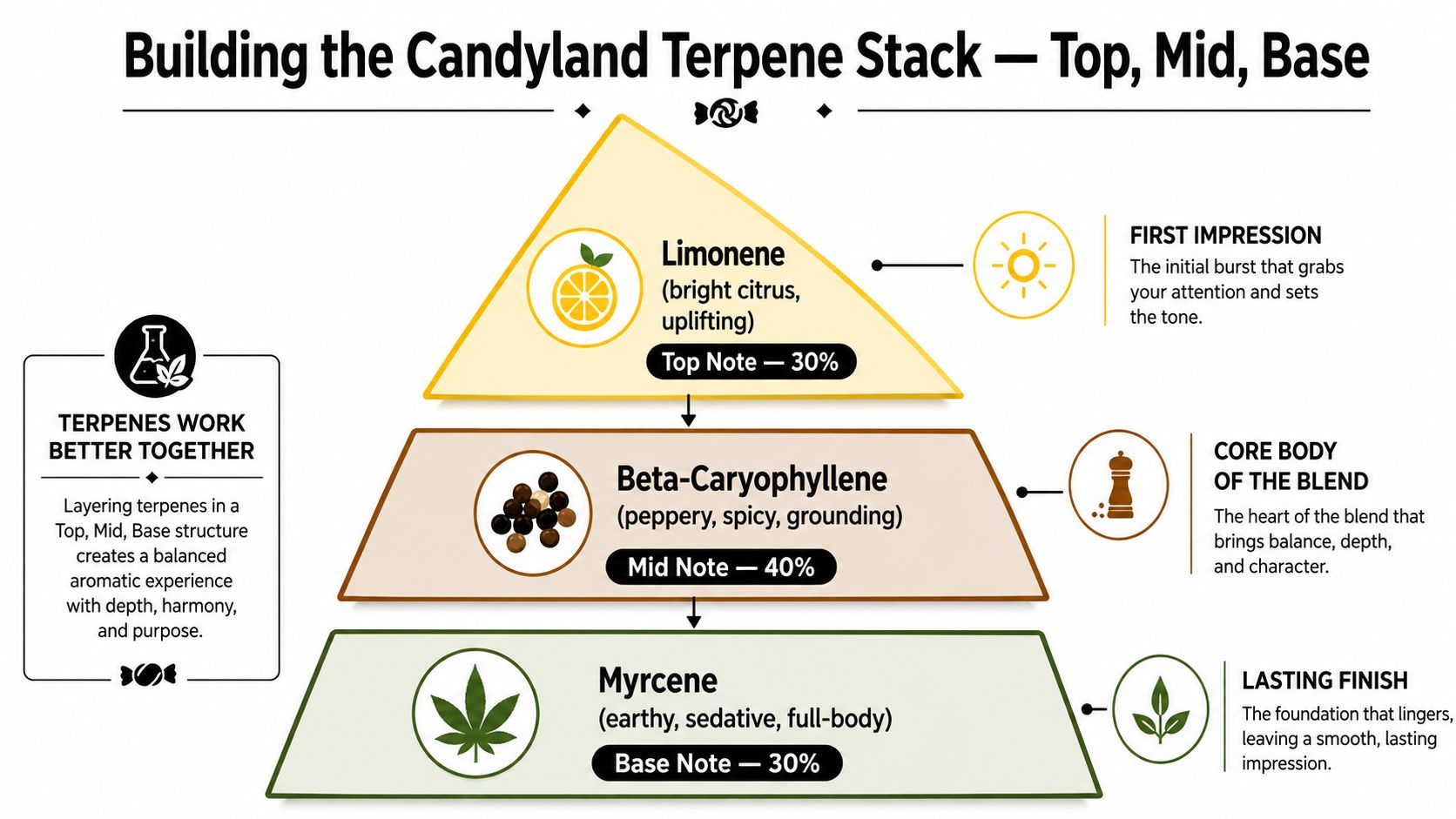
A reproducible Candyland profile needs a sensory sequence, not a flat ingredient list. Limonene leads the opening, beta-caryophyllene carries the middle, and earthy compounds shape the finish. This order follows the way the aroma develops from the first draw through the end of the session, while also giving formulators control over the balance between a lively opening and a heavier close.
Industry guidance suggests a 30/50/20 top-to-mid-to-base starting structure for custom terpene combinations, as described in a practical guide to terpene combinations. Treat that ratio as a testing framework rather than a fixed Candyland formula. It helps set initial expectations for volatility, persistence, and sensory weight before the individual materials are adjusted.
Top notes establish the first draw
Limonene belongs in the opening layer because its volatility makes the citrus impression immediate. A restrained amount signals the Candyland direction before the pepper and earth notes develop. Keep the top note below the level where it overwhelms the core. A bright first draw followed by a generic exhale usually indicates an impact-heavy blend with insufficient structural support.
Middle notes carry the identity
Beta-caryophyllene should anchor the middle because it supplies Candyland's pepper-forward signature. A caryophyllene-led center gives the oil a recognizable peppercorn quality and keeps the citrus from feeling artificial or disconnected.
Test that middle layer in the intended cartridge, not only in a glass vial. Forceful spice can become abrasive in some hardware systems, especially as vapor temperature and repeated draws change the perception.
Base notes determine the finish
Earthy, woody, and heavier materials create the lasting impression. Myrcene can provide a base-note reference, while humulene adds additional earth and structure. Keep both subordinate to the strain identity so the base supports the citrus opening instead of burying it.
The classification in this terpene flavor chart places limonene among top-note materials and myrcene and caryophyllene among base-note materials, while also presenting a starting terpene load for distillate applications. Use those categories to organize trials, then assess aroma persistence, vapor behavior, and intended effect positioning.
Practical rule: A bright profile that finishes flat needs more middle structure. A sharp opening followed by a heavy finish calls for reducing the top and base together, rather than adding more citrus.
For a separate flavor-library reference, compare the Apple Fritter profile from the Elevated Strains line. Candyland should retain a citrus opening, pepper-forward core, and earthy finish that remain coherent across the session. A balanced stack generally performs better in vape and distillate work than a loud single-note profile.
The Dose-Dependent Effect Split Every Formulator Must Understand
Candyland does not deliver one fixed effect profile. A lower intake may feel focused, energetic, and socially open, while a larger intake can become more cerebral, mentally heavy, and sedating. Product messaging that describes only the first phase can leave consumers unprepared for the later shift.
Evaluate the experience through two variables: how much material the user inhales and how the terpene ratio shapes that dose. More limonene can keep the opening bright and citrus-led. Greater caryophyllene influence, supported by heavier earthy materials, can make the finish feel denser and more grounded. These are formulation tendencies, not guaranteed outcomes.
A practical comparison
| Dose Level | Primary Effects | Duration | Best For |
|---|---|---|---|
| Smaller intake | Clear-headed lift, energy, sociability, and creative engagement | Initial effects commonly appear within 0 to 15 minutes, with peak creativity and sociability around 15 to 45 minutes, according to a Candyland strain effects and terpene summary | Daytime-oriented positioning and controlled sessions |
| Heavier intake | More cerebral intensity, increased mental weight, and possible sedating calm | A gradual fade commonly lasts around 1.5 to 3 hours, depending on dose, according to a Candyland strain effects and terpene summary | Evening-leaning positioning or users seeking a heavier finish |
The timing ranges are development references, not packaging promises. Use them during internal testing to compare the first draw, repeated draws, peak perception, and fade. Record the intake pattern alongside each observation, because a single draw and repeated dosing can produce different product impressions.
Ratio changes can shift the product story
A higher limonene-to-caryophyllene ratio will generally read brighter and more immediately citrus-led. A caryophyllene-forward blend with more grounding base material will feel denser and more persistent. The ratio sets the aromatic direction, while cannabinoid concentration, device delivery, tolerance, and intake pattern shape the user's actual response.
Build a small family of Candyland-inspired SKUs instead of forcing one blend to serve every use case:
- Bright daytime version: Keep the citrus opening clear, with enough mid and base structure to prevent a thin finish.
- Balanced all-purpose version: Preserve the peppery center while moderating citrus and earth together.
- Heavier evening version: Increase depth cautiously, without implying a guaranteed sedating result.
Product education should acknowledge this range without making medical claims. “Citrus-forward, peppery, and grounded” is more defensible than promising focus, anxiety relief, or sleep. Repeated-use testing also matters. A blend may taste balanced on the first draw yet become overly heavy as the consumer continues dosing.
Formulating Candyland for Vape Cartridges and Distillate
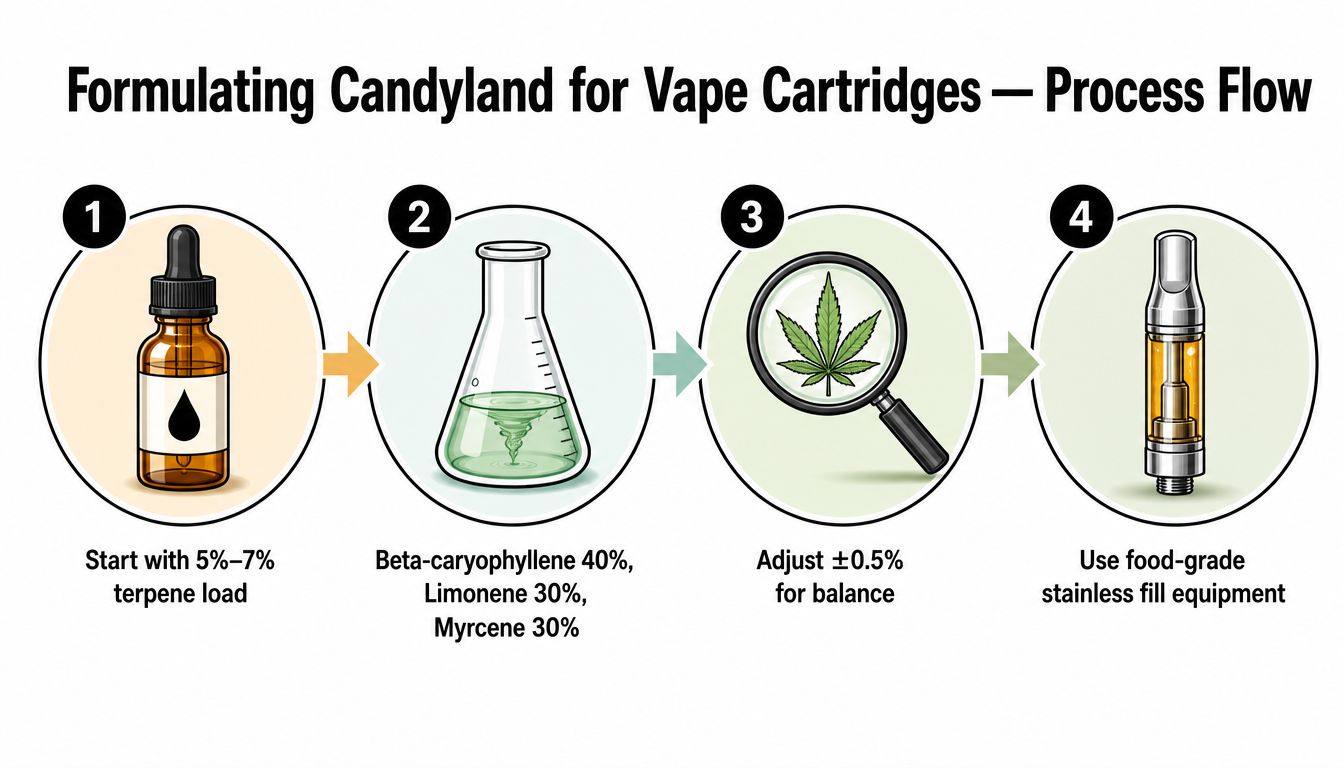
Candyland should not be formulated by aroma alone. The first production decision is the terpene load. A practical starting range is 5% to 7% of total distillate weight, as listed in the Gold Coast Terpenes formulation chart. Treat that range as a development window, not a finished specification. Hardware, distillate viscosity, cannabinoid concentration, and the volatility of each material can change both flavor and draw quality.
Build a controlled reference blend
Start with a documented sensory target. Assign limonene to the opening, beta-caryophyllene to the central body, and myrcene or other earthy materials to the base. Keep enough caryophyllene to preserve Candyland's peppery character, while retaining sufficient limonene for a clear citrus lift. The ratio matters because a limonene-heavy blend can feel sharper and more energetic, whereas a caryophyllene-forward blend can read denser and more settled as intake increases.
Test the ratio in the intended cartridge rather than approving it from a vial sample. Ceramic and wick-based systems can deliver the same oil differently. Heating may make the citrus seem sharper, expose pepper harshness, or pull heavier base notes into the finish.
Mix gently and verify homogeneity
Preblend the terpene phase before adding it to the distillate when the process permits. Introduce it gradually, use controlled agitation, and limit unnecessary heat that can drive off volatile top notes. Complete dispersion matters, but preserving the first-draw profile matters too.
Record the order of addition, mixing time, temperature, batch size, and observations. Check for separation, haze, color change, and viscosity shifts before filling. A repeatable process is more useful than a single attractive sample.
Test the finished device
Evaluate the raw oil, filled cartridge, and repeated draws under consistent conditions. Compare citrus intensity, pepper persistence, earthy finish, vapor harshness, and perceived heaviness. Aroma approval alone is insufficient.
Use this workflow:
- Reference check: Compare the blend with the intended Candyland sensory target.
- Hardware check: Assess the actual cartridge construction and heating behavior.
- Stability check: Monitor separation, color change, and flavor drift during planned storage evaluation.
- Batch check: Retain samples and compare production lots with the approved reference.
For practical process guidance, use the guide to using terpenes. Document each adjustment, because flavor intensity, viscosity, and device performance affect one another and should be reviewed together.
Positioning Candyland in a Crowded Sativa Market
Candyland stands apart through a sweet citrus opening, peppery depth, and an effect range that changes with intake. That range gives brands a more precise position than a broad “uplifting sativa” label. Lower intake can support an energetic, productive impression, while heavier use may shift toward cerebral calm and grounding. Terpene ratios influence that transition, with limonene reinforcing lift and caryophyllene adding weight and persistence.
The 2012 KO Kush Cup gold medal in California offers a historical credibility point. Use it to support the product story, not carry it. Sensory specificity gives buyers a clearer reason to choose the cultivar: citrus lift, pepper spice, earthy depth, and a controlled progression as intensity increases.
Position the experience without overpromising
Daytime-oriented products can reference creative work, social engagement, and active use because those directions align with the documented reputation of the cultivar. Present them as possible product character rather than guaranteed outcomes. The formulation should also determine how strongly those claims fit. A limonene-forward ratio may read brighter, while greater caryophyllene weight can make the same profile feel more settled.
Packaging and education should explain that intake changes the experience. A short instruction such as “start with a controlled draw and assess before continuing” communicates practical caution without turning the label into medical advice. Higher-intensity products can emphasize depth and a longer-lasting finish, giving consumers a useful expectation without promising productivity.
Make the flavor architecture visible
A crowded shelf rewards sensory language that helps shoppers compare products. Organize product content around:
- Aroma: Sweet citrus with peppery spice.
- Taste: Bright opening, warm middle, earthy finish.
- Experience direction: Energetic at lower intake, more cerebral and grounding with heavier use.
- Best product fit: Cartridges, concentrates, or distillate formats where layered aroma can remain apparent.
Avoid calling the product “non-sedating” or guaranteeing focus. The dose-dependent split makes both claims too absolute. A transparent effect range protects credibility and leaves room for related SKUs with different terpene ratios. The clearest Candyland position is a layered citrus-spice experience with an energetic entry, a grounded core, and an openly acknowledged heavier side.
Your Candyland Formulation Roadmap and Next Steps
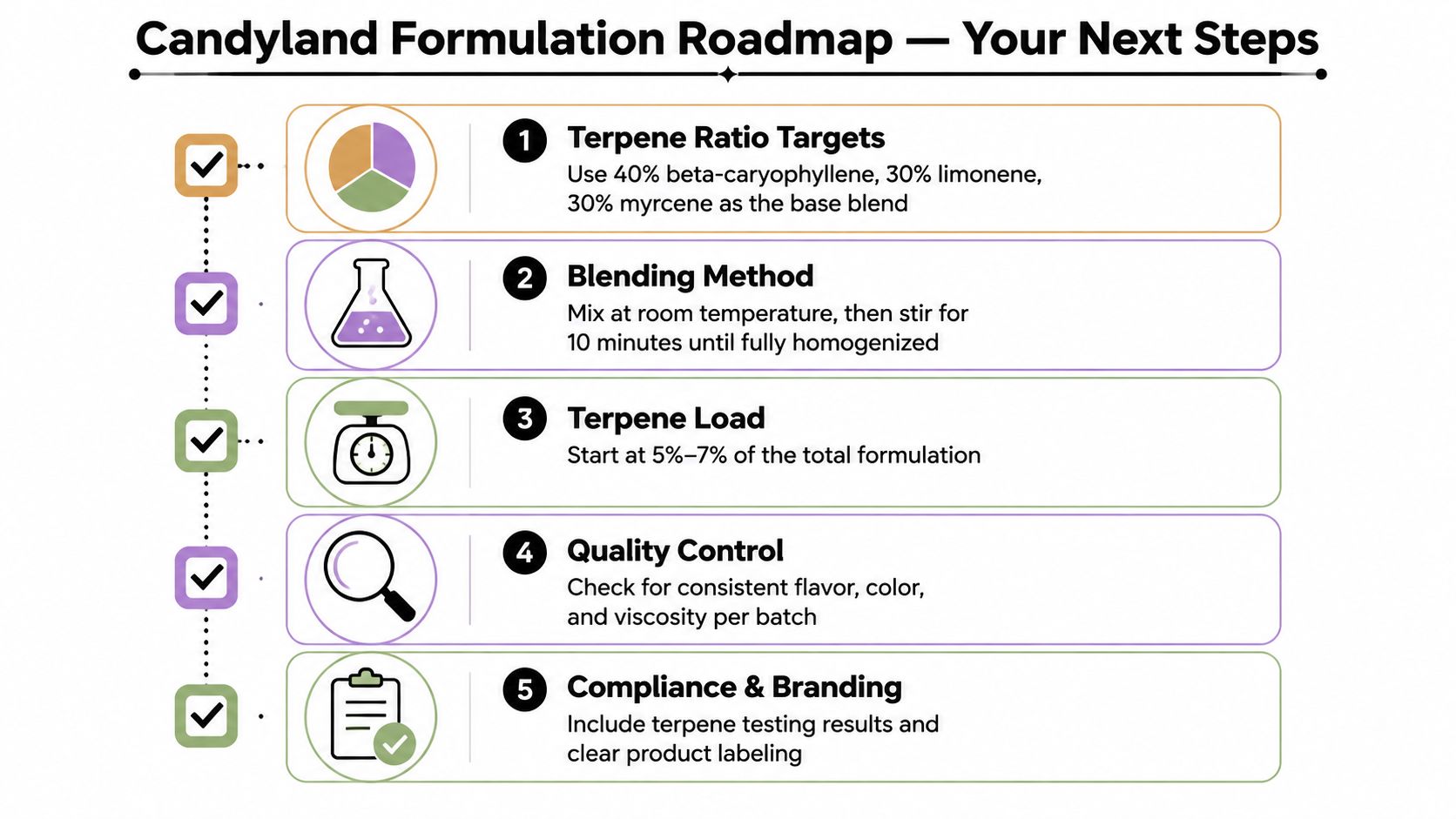
Candyland formulation fails when the team treats the strain name as a finished specification. Set the sensory target first, then test how limonene and caryophyllene shift the experience at different intake levels. Record each decision so another operator can reproduce the batch.
Use this sequence:
- Set the target profile: Define citrus brightness, peppery structure, earthy finish, and the intended position between energizing and grounding.
- Build the first blend: Keep caryophyllene as the structural center, with limonene supplying the opening lift. Adjust their ratio rather than increasing total intensity blindly.
- Choose the load: Begin within the 5% to 7% distillate terpene-load range cited in the formulation chart, then check flavor strength, viscosity, and hardware behavior.
- Test the finished cartridge: Evaluate the first draw, repeated use, flavor persistence, vapor comfort, visible stability, and the perceived shift from bright to grounded.
- Document and iterate: Retain samples, record every adjustment, and collect structured feedback on aroma and effect direction at controlled intake levels.
A louder citrus note does not automatically make the blend more recognizable. Candyland depends on contrast. Limonene can sharpen the opening, while caryophyllene and earthy materials supply the depth. Too much limonene can make the profile thin or generic. Too much caryophyllene can suppress the lift and push the experience toward a heavier finish.
Apply the same method to adjacent flavor extensions, but assign each one its own sensory target. A larger flavor library only helps when the team can distinguish a deliberate profile from a generic sweet blend.
Prepare a controlled bench batch, test it in the intended cartridge, and compare the result with written sensory criteria before scaling. Gold Coast Terpenes provides strain-specific blends, isolated compounds, formulation resources, and tools for cartridge, concentrate, and distillate development. Review Gold Coast Terpenes for Candyland-relevant components and a controlled citrus-spice profile.