
The most popular advice about Super Boof terpenes is also the least reliable: find one dominant terpene, copy its percentage, and call the blend finished. That approach fails in production because Super Boof isn't one fixed recipe. Public profiles alternate between myrcene-forward, beta-caryophyllene-forward, and limonene-forward expressions, while flower, concentrate, and cartridge formats can show materially different aromatic balances.
For a product team, the useful question isn't “What are the Super Boof terpenes?” It's which Super Boof sensory target are you replicating, in which format, and against which reference COA? The answer determines whether your formulation opens with citrus, settles into peppery fruit, or finishes with earthy musk. It also determines how aggressively you can process the oil before the profile loses its identity.
Why Super Boof Terpenes Defy a Single Recipe
Formulators who assume Super Boof has one fixed terpene recipe consistently hit production problems. The strain gained broad attention after Leafly named it its 2024 Strain of the Year, and public coverage often centers on caryophyllene, limonene, and linalool. Public strain databases also place its THC level around 28%, which helped attract commercial interest to its aroma and terpene-led branding in large U.S. markets. Those details establish recognition, not a universal blend target. The Library NJ's Super Boof profile provides useful background, while the COA for the material being replicated should control formulation decisions. For context, how different strains can produce different effects also helps explain why a cultivar name cannot define one repeatable sensory result.
The terpene hierarchy varies sharply across published profiles. One report lists myrcene at 38% of total terpenes, caryophyllene at 22%, limonene at 15%, and humulene at 9%. Another recent summary lists caryophyllene at 38%, limonene at 22%, myrcene at 15%, humulene at 9%, and terpinolene at 2%. Those figures point to different sensory targets, one heavier and earthy-musky, the other brighter, warmer, and more citrus-spiced. The Los Angeles Hash overview shows why a vendor sheet without batch context can misdirect a formulation team.
Treat the name as a profile family
Phenotype selection can move the aroma toward citrus, darker fruit, or earthier spice. Harvest timing, cure, storage, and extraction conditions shift the balance further. A citrus-forward flower may lose its lift when volatile top notes dissipate, while a live resin cartridge from the same cultivar name can present denser pepper and citrus character.
Define the reference before blending:
- Sensory target: Choose citrus-forward, cherry-fruit-forward, or earthy-spice-forward.
- Format: Keep flower, distillate, live resin, and cartridge references separate.
- Analytical basis: Confirm whether values represent total terpene share, weight percentage, or mass concentration.
- Reference material: Retain a sample and its COA instead of relying on a generic strain page.
Practical rule: Copy the sensory hierarchy that matters for your product, then verify that hierarchy analytically.
A reliable strain-inspired terpene blend starts with that defined target. Without it, a chemically plausible blend can still taste wrong.
The Core Terpene Stack and What Each Compound Does
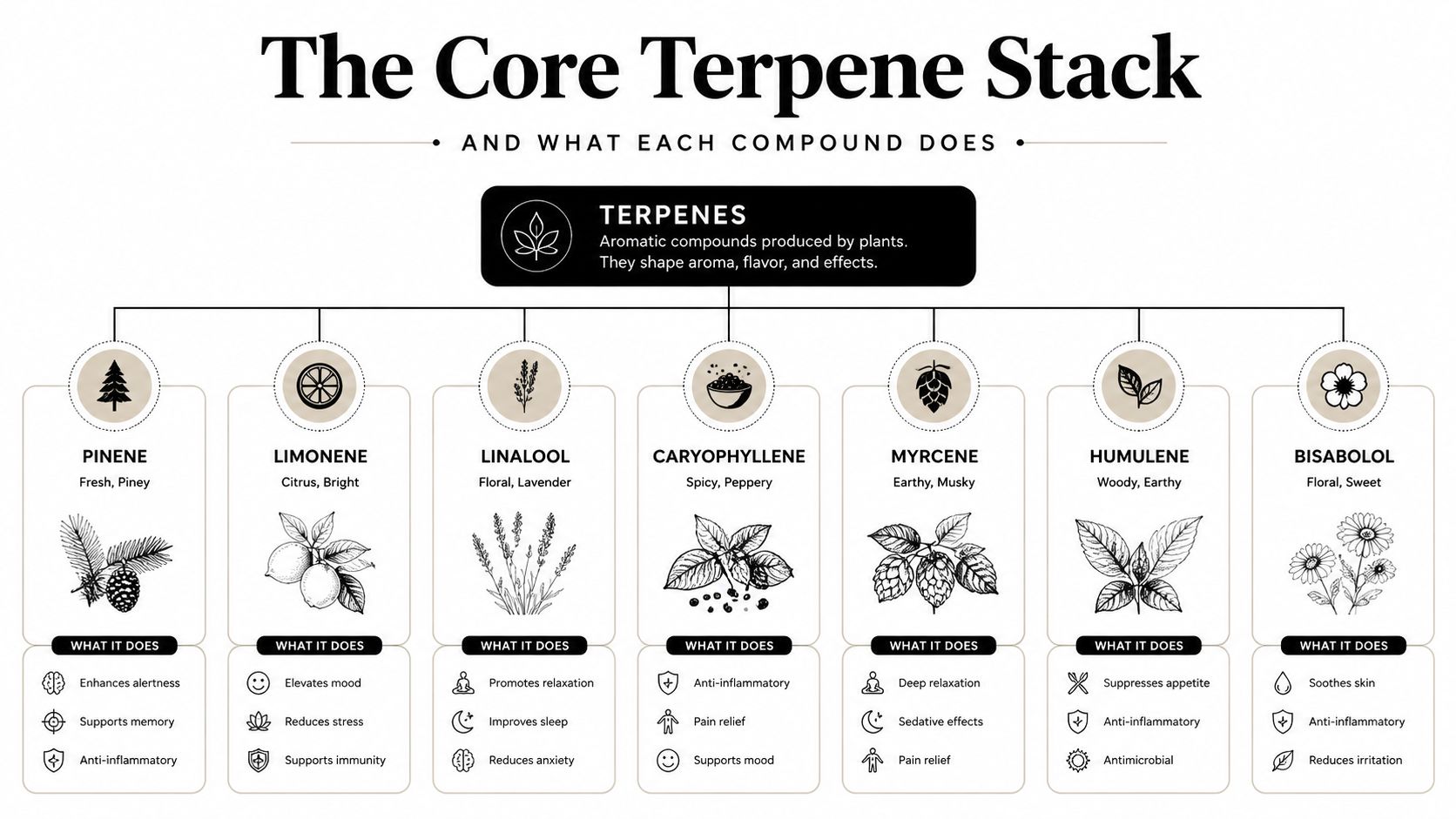
Across public lab-style reports and strain summaries, myrcene, limonene, and beta-caryophyllene appear repeatedly as the working core of Super Boof's aroma. Their functions are easier to manage when treated as a top-to-base structure rather than as isolated ingredients. Limonene creates lift, caryophyllene supplies the warm bridge, and myrcene gives the profile weight.
Limonene as the opening note
Limonene usually reads as citrus peel, bright sweetness, and zest. In a Super Boof-inspired formulation, it's the first aromatic signal and the compound most likely to communicate the orange, sherbet, or citrus-fruit direction. One COA listed limonene at 0.31%, while a separate concentrate analysis reported 7.61 mg/g. Those values come from different sample types and reporting systems, so they shouldn't be combined into a universal ratio. The concentrate report is most useful as evidence that the citrus component can remain prominent after processing.
Too little limonene makes the opening dull and pushes the blend toward generic earth and spice. Too much produces a clean citrus profile that can erase the darker fruit and pepper structure. The best use is controlled brightness, not maximum citrus intensity.
Beta-caryophyllene as the mid-palate bridge
Beta-caryophyllene contributes pepper, dry spice, and warmth. It connects limonene's bright opening to myrcene's heavier finish, which is why it's valuable in a formulation rather than merely interesting on a COA. A flower COA listed beta-caryophyllene at 0.26%, and a concentrate analysis reported 11.55 mg/g. A separate live resin cartridge listing reported beta-caryophyllene at 1.89%, showing how format can amplify the pepper-spice impression. The cartridge data supports a format-specific approach rather than one ratio copied across every SKU.
Myrcene as the grounding finish
Myrcene supplies the earthy, musky, herbal base. It rounds sharp citrus and keeps the profile from tasting like a generic lemon blend. One COA listed beta-myrcene at 0.10%, while the concentrate analysis reported 1.74 mg/g. Another strain profile places myrcene at 38% of total terpenes, reinforcing its importance in heavier Super Boof expressions.
The formulation consequence is straightforward. Increase myrcene and the blend reads fuller, darker, and more grounded. Increase limonene and it reads brighter. Increase caryophyllene and the finish becomes warmer and more peppered. For foundational terpene chemistry, this terpene chemistry guide provides useful context, but the product team still needs to tune against its own reference.
Navigating Batch Variability and Phenotype Differences
A formulator who compares Super Boof COAs will find disagreement before the first blend is made. One independently published profile identifies myrcene as the leading compound, followed by caryophyllene and limonene. Another places limonene, beta-caryophyllene, and myrcene in that order. A live resin cartridge reports beta-caryophyllene at 1.89%, limonene at 1.06%, and beta-myrcene at 0.85%, a much denser presentation than many flower references. The strain listing with cartridge data demonstrates why product format must sit beside the strain name in every development record.
Across lab-tested Super Boof batches, total terpene content is commonly reported in the 2.0% to 3.5% range by dry weight, with myrcene often around 0.7% to 1.1%, limonene around 0.3% to 0.8%, and caryophyllene around 0.3% to 0.8%. Joint Commerce's strain guide provides those benchmark ranges. They're useful for defining a search area, not for claiming that every batch should land at one ideal point.
Compare the sensory direction, not just the numbers
| Terpene | Low Range (%) | High Range (%) | Sensory Role |
|---|---|---|---|
| Myrcene | 0.7 | 1.1 | Earthy, musky base |
| Limonene | 0.3 | 0.8 | Citrus opening |
| Beta-caryophyllene | 0.3 | 0.8 | Peppery, warm bridge |
The range table supports a practical decision. If the reference sample smells like citrus sherbet with a clean opening, prioritize the limonene-led expression even if another database calls myrcene dominant. If the sample finishes like spiced fruit or cherry cola, preserve more caryophyllene and myrcene. The target is the finished sensory sequence, not a strain-name average.
Testing methodology also matters. A flower COA, concentrate COA, and cartridge COA may reflect different matrices, extraction histories, and reporting conventions. Don't set a narrow acceptance band until you know what the reference matrix does to the aroma.
Build a phenotype record
Record the cultivar source, harvest timing if available, storage history, product format, total terpene result, and dominant-terpene order. Add a short sensory description using consistent terms such as citrus opening, pepper mid-note, earthy finish, fruit sweetness, and floral lift.
That record lets you decide whether a new batch is a true mismatch or a different member of the Super Boof profile family. It also prevents a common manufacturing error, adjusting a blend to compensate for a reference sample that was already degraded.
Building a Strain-Inspired Terpene Blend for Distillate and Carts
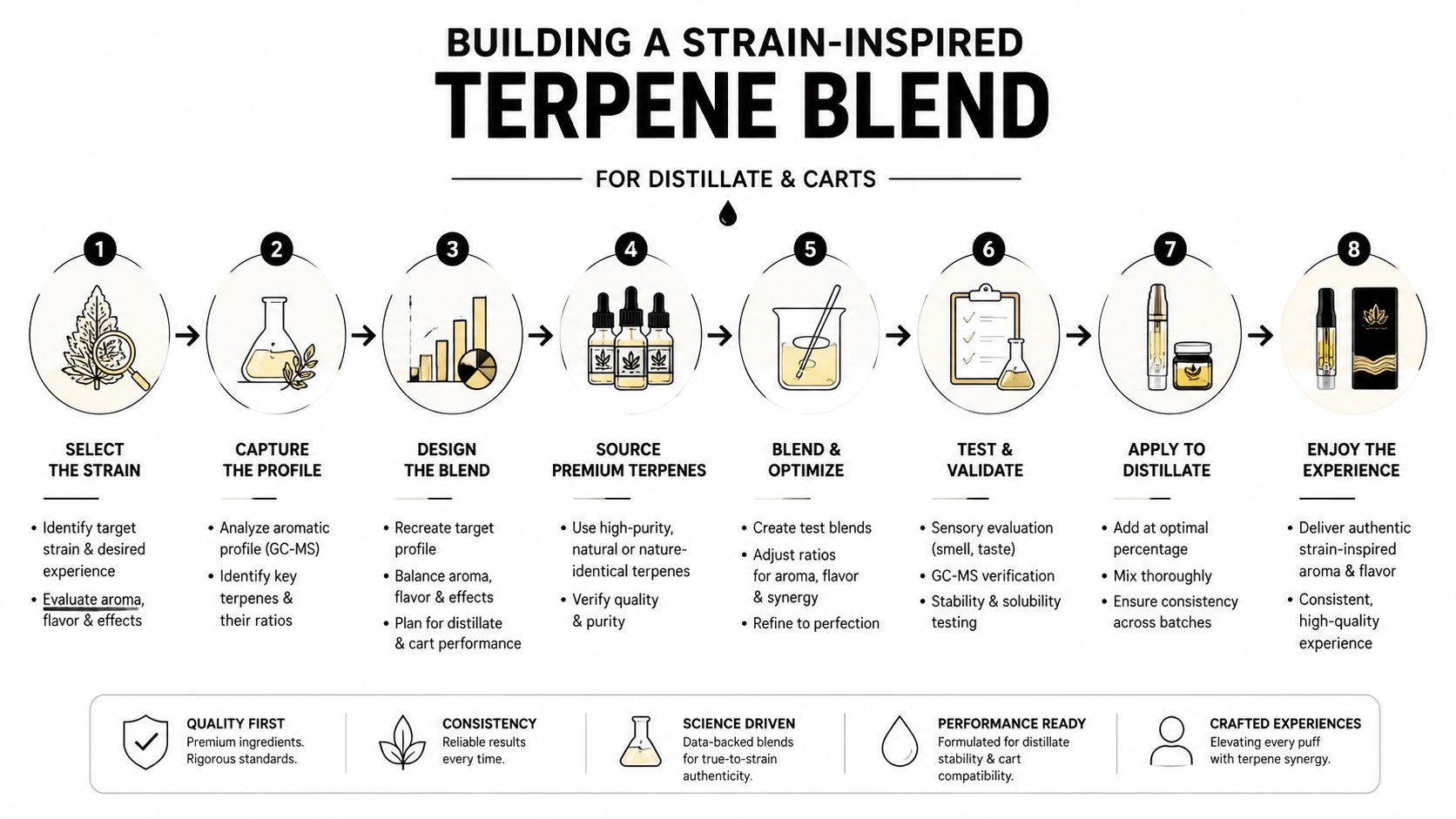
A practical Super Boof formulation starts with note architecture, not a shopping list of isolates. Limonene should establish the opening aroma, beta-caryophyllene should connect the opening to the body, and myrcene should anchor the finish. The balance can then be moved toward the specific phenotype expression your product team has selected.
Start with a controlled ratio system
Use the three core compounds as a relative blend before adding supporting materials:
- Bright opening: Set limonene as the primary top-note reference when the target emphasizes citrus zest or sherbet.
- Warm center: Use beta-caryophyllene to add pepper and prevent the citrus from feeling thin.
- Grounded finish: Use myrcene to provide earthy depth and keep the fruit character from becoming a one-dimensional citrus flavor.
The verified data supports these roles, but it doesn't establish one universal starting percentage for a finished oil. That's important. A responsible formulation guide can recommend a relative top-to-base framework without inventing a dosing number that isn't supported by the reference material.
For a citrus-led distillate, build the first bench sample with limonene clearly ahead in the top-note structure, then add enough caryophyllene to create warmth and myrcene to prevent a hollow finish. For an earthy-spice-led batch, reverse the emphasis, allowing myrcene and caryophyllene to carry more of the identity while keeping limonene present as lift.
Adjust for the cartridge format
Cartridges can amplify pepper, citrus, and earthy notes compared with a flower reference. The separate live resin listing with 1.89% beta-caryophyllene, 1.06% limonene, and 0.85% beta-myrcene shows why copying a flower profile one-for-one can overstate the spice or citrus impression in hardware. Test the blend in the actual cartridge, with the intended oil viscosity, hardware, and heating conditions.
Bench-test rule: Evaluate the blend after it has been diluted into the intended oil and filled into the intended cartridge. A glass vial tells you about the concentrate, not the finished delivery system.
Keep supporting compounds subordinate unless the reference clearly calls for them. Linalool can provide floral softness, while humulene can deepen the herbal-spice edge, but adding too many accents early makes it harder to identify which change improved or damaged the target.
If your team also evaluates adjacent fruit and dessert directions, Elevated Strains can serve as a separate flavor reference, not a substitute for a Super Boof target. Document every change, including the reason for the adjustment and the sensory result.
Preserving the Citrus-Spice Top Layer During Processing
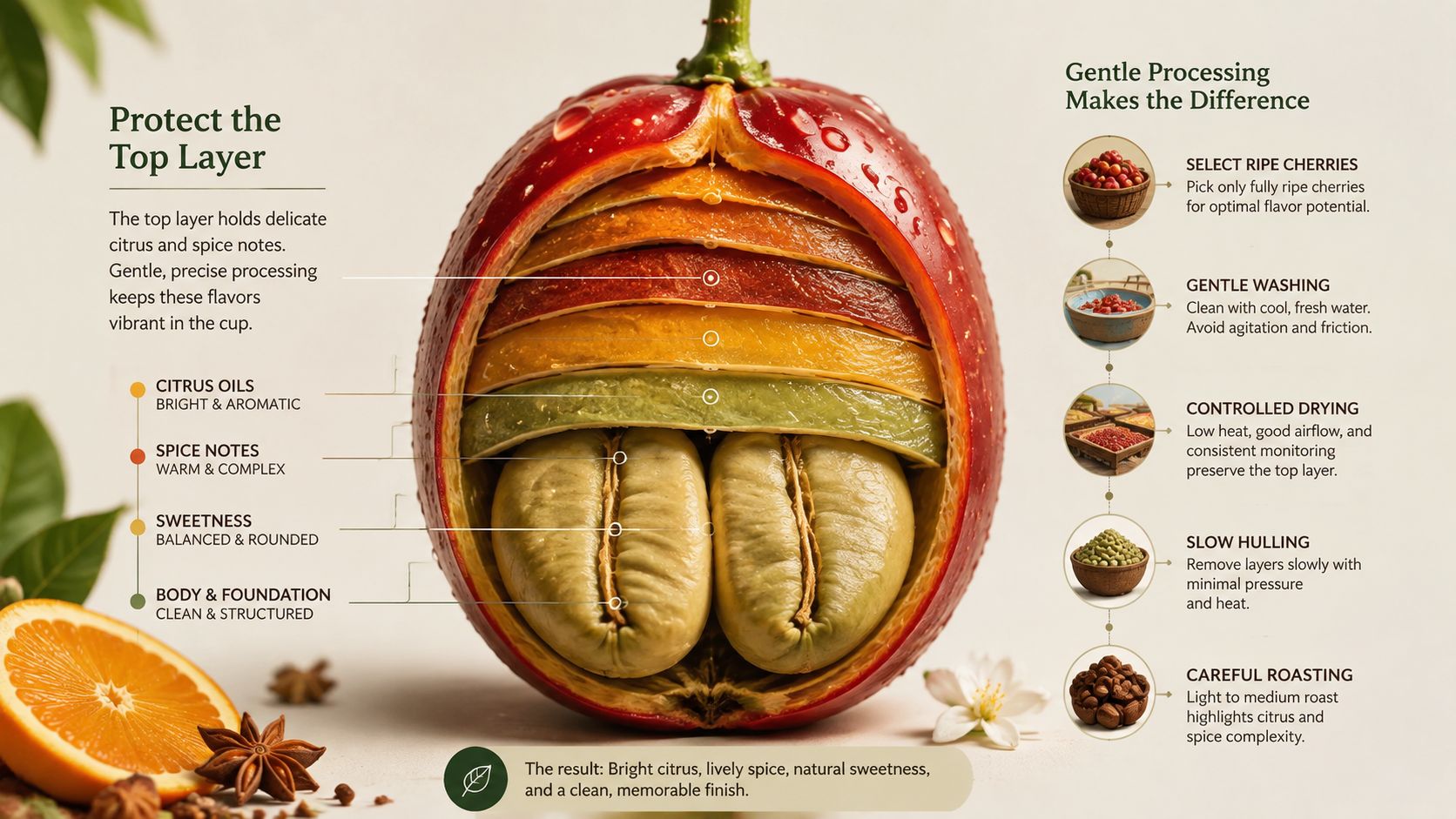
Super Boof's most recognizable character often sits in the portion of the profile most vulnerable to processing. Citrus and spice disappear before the heavier earthy base feels absent, so a batch can retain aroma while losing the specific identity that made the reference valuable. The result is a product that smells generally herbal or musky but no longer reads as Super Boof-inspired.
Across lab-tested batches, the reported terpene benchmark supports treating the cultivar as a high-aroma profile that can remain recognizable after moderate post-harvest loss. The same data warns against aggressive heat exposure and extended stripping, which can disproportionately remove the citrus-spice top layer and leave a flatter earthy profile. The processing discussion in this strain guide supports a lower-temperature, shorter-exposure approach.
Preserve native character before restoring it
If native terpenes survive processing, use them as the base of the sensory profile and restore only what the COA and sensory panel show is missing. Adding a complete strain-inspired blend on top of a partially retained native profile can double the earthy or peppery components and create a muddy finish.
Shorter exposure and lower-temperature processing are preferable when the process permits them. Extended stripping can produce a cleaner-looking distillate, but it also removes the volatile materials that carry the opening aroma. This guide to terpene degradation is a useful reference for understanding why heat history belongs in the batch record.
Restore in layers
Use sensory checkpoints rather than adding everything at once:
- Evaluate the processed oil without restoration.
- Confirm whether the missing feature is citrus lift, pepper warmth, or earthy body.
- Add the smallest controlled correction that addresses that feature.
- Recheck the finished oil in the intended cartridge and under the intended draw conditions.
- Compare the result with the retained reference after the blend has equilibrated.
A citrus correction can easily become harsh if the product already contains enough limonene. A caryophyllene correction can dominate the finish in hardware that runs warm. Myrcene can round the profile, but too much can make the opening seem muted by comparison.
The right objective isn't maximum terpene intensity. It's preserving the sequence of notes, citrus first, warm spice next, and earthy fruit depth last.
Verifying Your Formulation with Lab Testing and Sensory Benchmarks
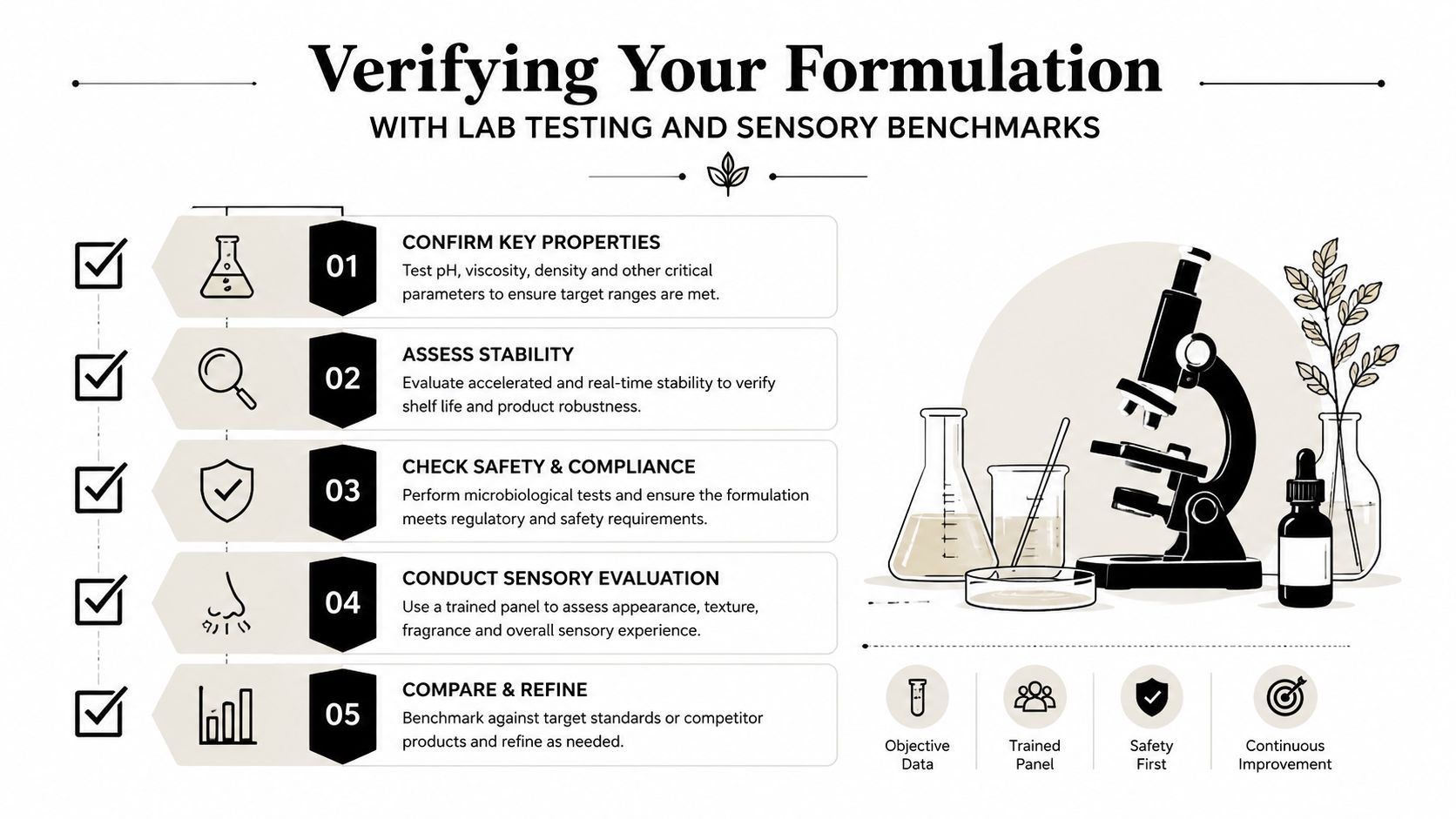
A formulation isn't accurate because it smells convincing in a mixing vessel. It's accurate when the finished product matches the selected sensory target and the analytical profile remains inside a defined tolerance. For Super Boof-inspired products, that means pairing testing with a repeatable sensory method.
Use GC data to verify hierarchy
Ask the laboratory to quantify the relevant terpenes using an appropriate chromatographic method, such as GC-MS or GC-FID, and to report the basis clearly. The goal isn't only to obtain a total terpene number. You need to know whether limonene, beta-caryophyllene, and myrcene appear in the intended order and whether a supporting compound has become disproportionately influential.
A useful review asks:
- Identity: Are the expected compounds present?
- Hierarchy: Does the analytical order match the sensory target?
- Matrix: Was the sample tested as flower, concentrate, distillate, or finished cartridge oil?
- Change over time: Does the retained sample show evidence of top-note loss after processing or storage?
The reported COAs show why a single acceptance number won't work across every format. Flower benchmarks and cartridge results may describe different concentration environments, so define tolerance around the chosen product matrix.
Build a sensory scorecard
Use a trained internal panel or consistent evaluators, with coded samples and a fixed sequence. Score the opening, mid-palate, finish, persistence, harshness, and similarity to the retained reference. Avoid asking only whether the panel “likes” the sample. Preference and replication are different decisions.
A simple scorecard might record:
- Opening: citrus brightness, fruit lift, or flatness.
- Middle: pepper, warmth, floral softness, or separation.
- Finish: earthy musk, spice persistence, or bitterness.
- Overall match: how closely the sample follows the reference sequence.
Quality rule: A lab result can confirm composition, but only a controlled sensory comparison can confirm whether the product still reads as the intended Super Boof expression.
Chromatography testing guidance can help teams structure the analytical side. Keep the reference sample, blend record, test report, hardware details, and sensory scorecard together. That documentation turns a successful bench sample into a repeatable manufacturing specification.
Sourcing Consistent Super Boof Terpene Blends at Scale
Scaling a strain-inspired profile requires more than ordering a bottle labeled Super Boof. The supplier should be able to show COA transparency, batch traceability, and format-specific blending knowledge. A blend that works in a distillate oil may need adjustment for a cartridge because hardware can intensify citrus and pepper notes. The supplier's role is to provide a reproducible component, while the manufacturer controls the final matrix and validation.
Evaluate suppliers against the same questions you'd use for an internal raw material:
- Documentation: Are the terpene identities and testing records available?
- Composition: Does the blend disclose its principal compounds and intended sensory direction?
- Consistency: Can the supplier maintain the same profile across production batches?
- Compatibility: Has the blend been evaluated for distillate, concentrate, or cartridge use?
- Formulation support: Are safety documents and mixing tools available to the product team?
Gold Coast Terpenes supplies 100% natural terpene blends, strain-specific profiles, and isolated compounds for cartridges, concentrates, and product formulation. Its catalog includes profiles and isolates such as limonene, myrcene, and beta-caryophyllene, while its site also provides formulation education, safety documents, and a mixing calculator. Use those resources as part of a documented development process, not as a replacement for finished-product testing.
For procurement, retain the supplier lot, COA, blend version, and receiving date. Requalify the material when the composition changes, even if the product name stays the same. The commercial risk isn't only flavor drift. An inconsistent aromatic input makes it harder to investigate cartridge complaints, compare production runs, or maintain a recognizable product identity.
Gold Coast Terpenes offers strain-specific blends and isolated compounds that can support a Super Boof-inspired target for distillate and cartridge development, alongside formulation tools and safety documentation. Visit Gold Coast Terpenes to review terpene options, compare formulation resources, and move your selected sensory profile into controlled bench testing.