
You can usually tell the sourcing was weak before the first cart ships. The aroma looks right in the jar, the blend reads well on paper, then the pilot batch drifts after a few fills, the finish turns harsh, or the profile separates when the oil hits hardware. That's why buyers searching for terpenes for sale shouldn't start with strain names alone, they should start with consistency, compliance, and how the profile behaves once it's blended into a real formulation.
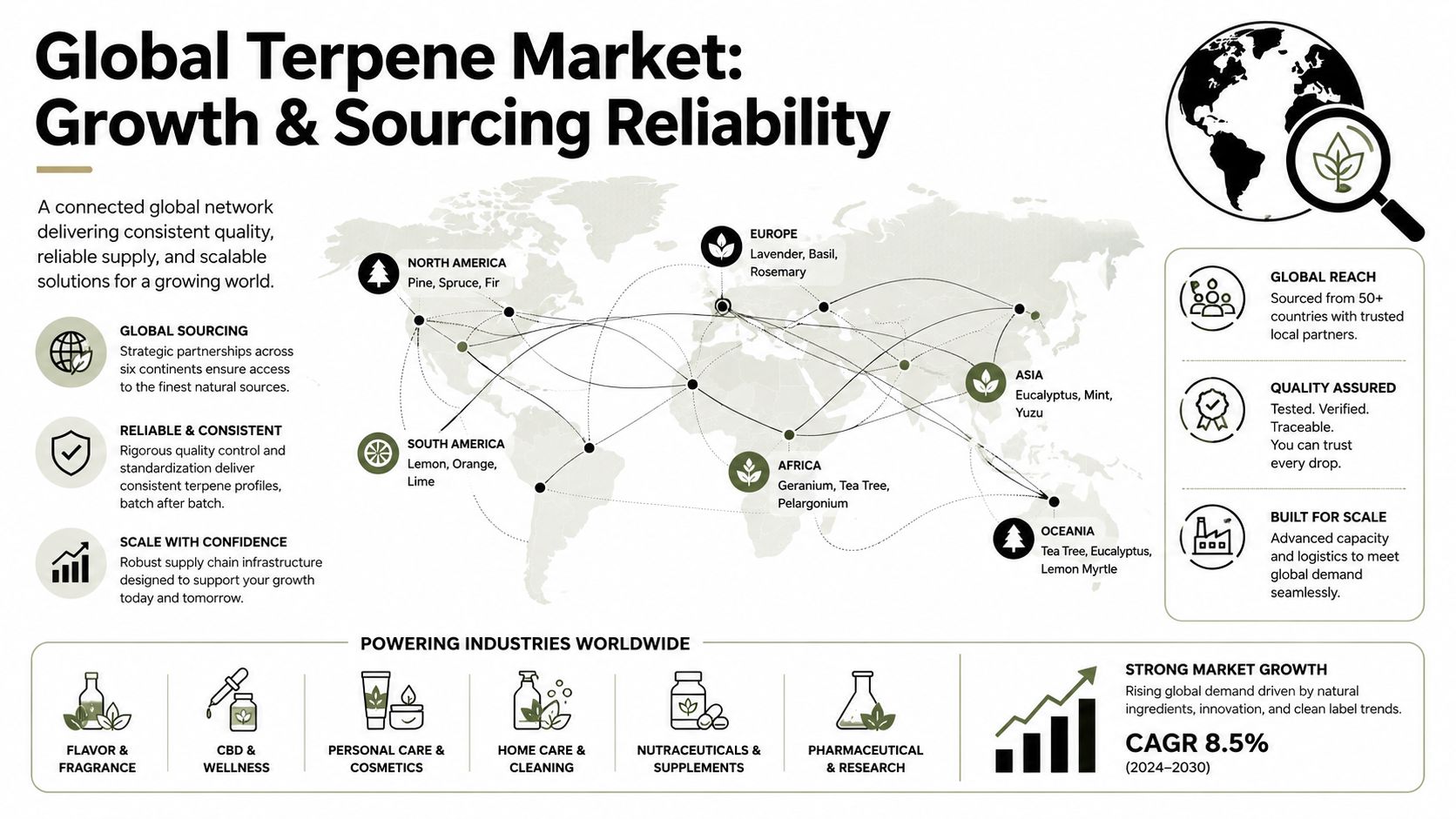
The market is moving in the same direction. One estimate places the global terpenes market at USD 885.1 million in 2022 and projects USD 1,824.2 million by 2032, with a 7.5% CAGR from 2023 to 2032, while another puts it at USD 1.48 billion in 2025 and USD 2.95 billion by 2035 with a 7.14% CAGR (market estimate). A separate natural terpenes report values that segment at USD 477.18 million in 2024 and projects USD 720.32 million by 2032, with monoterpenes holding 29.72% of market share in 2024 and expected to reach 29.93% in 2025 (natural terpenes report). Those numbers matter because scaling demand usually exposes weak sourcing fast.
Navigating the Global Terpene Supply Chain
A failed batch often starts before the blender sees the oil. The supplier looked acceptable at sample stage, then the material arrived with uneven aromatic weight, thin documentation, or a profile that would not repeat from lot to lot. Once a formulator has to correct a noisy raw ingredient downstream, the cost shows up in rework, rejected fills, and a customer experience that changes from batch to batch.
What market growth means at the bench
The terpene category is no longer a small specialty add-on. Analysts in the broader market space show continued expansion, and that growth pushes buyers toward suppliers who can hold batch-to-batch consistency while serving larger volumes across flavorings, fragrances, and formulated products. A closer look at the industry outlook in the market.us report shows why scale changes the buying standard.
For manufacturers, the procurement checklist changes with volume. A vendor can describe a profile as “premium,” but if the aroma shifts when a pilot becomes production, the label on the jar does not help. The supply chain advantage goes to suppliers that provide lab-verified profiles, stable COAs, and enough manufacturing discipline to keep the same aroma architecture moving through the line.
Botanical and cannabis-derived sourcing are not interchangeable
Source type affects compliance and sensory behavior. Botanical terpenes are widely used in flavor and fragrance work, while cannabis-derived terpenes can matter in markets where product identity or local rules treat source as part of the formulation decision. Colorado guidance treats any non-marijuana-derived substance added to a cannabis product as an additive, including isolated or enriched botanically derived compounds added back into the product (Colorado terpene guidance).
That distinction matters when you build SKUs for multiple states or channels. A formulation that looks clean on paper can still fail if the source category conflicts with the destination market's rules or with how the finished product is classified. The safest sourcing posture is to know exactly what the profile is, where it came from, and whether it is intended as a sensory ingredient, a compliance-sensitive additive, or both.
Practical rule: If the supplier cannot explain source, standardization, and intended use in plain language, you are still in the evaluation stage.
For teams building procurement workflows, keep a sourcing document set that includes origin, lot traceability, and intended application. If you need a general sourcing framework, a practical starting point is the import and export guidelines resource, which sits in the kind of operational category serious buyers usually need before they place large orders.
Deconstructing the Terpene Profile Architecture
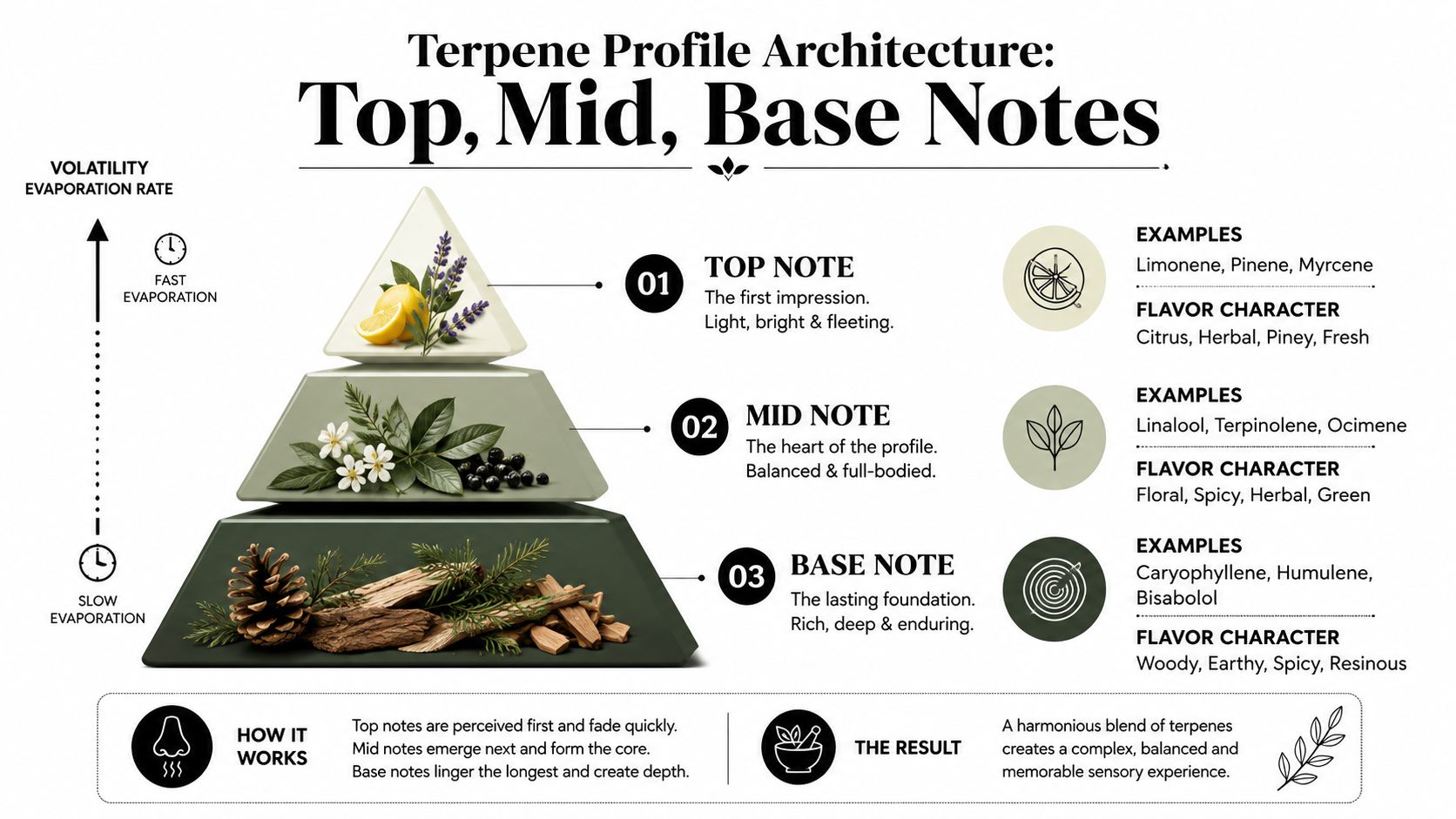
A blend that works in production is rarely just “close to the strain.” It is built like a fragrance system, with top notes, mid notes, and base notes each doing a different job in the first sniff, the middle of the draw, and the finish that stays behind. When a formula tastes flat, the fault is usually in the architecture, not just in the label.
Build the opening first
The top note sets the first impression. In practice, that means the highest-volatility compounds are doing the heavy lifting, and monoterpene-heavy materials often provide the bright lift that reaches the nose before the rest of the profile settles. Analysts at natural terpenes market data point to monoterpenes as a leading subsegment, which matches how many formulators build for immediate sensory impact.
That opening needs to be clean, not loud for its own sake. If the top note overshoots, the blend can read sharp or artificial. If it is too soft, the user gets no defined first impression, which becomes a problem in vape cartridges where the first draw often frames the rest of the product experience.
Let the middle carry the identity
The mid note is where the profile becomes recognizable. This layer usually carries the main character of the blend, the part people describe after the first flash fades. It is also where strain-inspired work either holds together or turns generic, because a profile with only top-note brightness can smell active without feeling complete.
A workable process is straightforward. Start with a target sensory map, then assign the opening, middle, and finish separately instead of trying to correct everything with one potent additive. If you are building a terpene profile for cannabis product formulation, that structure matters more than the strain label itself.
Field advice: Do not ask whether a blend smells strong. Ask whether it has an opening, a body, and a finish.
For teams studying how aromatic compounds behave across blends, the chemistry of terpenes resource is a useful reference point. It connects the sensory idea of note architecture to the actual compounds behind it.
Design the finish with restraint
The base note is the linger. It anchors the profile after the brighter compounds move off the tongue or out of the nose, and it is where a lot of formulations become grounded or muddy. Heavy, lingering notes can add depth, but they can also make a cartridge feel stale or overly earthy if they dominate the back end.
That is why top, mid, and base notes have to work as a system. Strong initial aroma does not make up for a weak finish, and a heavy finish will not rescue a profile that never opens properly. A good formulation reads in stages, not all at once.
The same thinking applies when brands want to move beyond strain mimicry and into controlled flavor design. A strain-inspired terpene blend can still be tuned for sweetness, freshness, or a cleaner aftertaste if the note structure is mapped before the ingredients are chosen.
Strain-Specific Blends Versus Isolates for Formulation
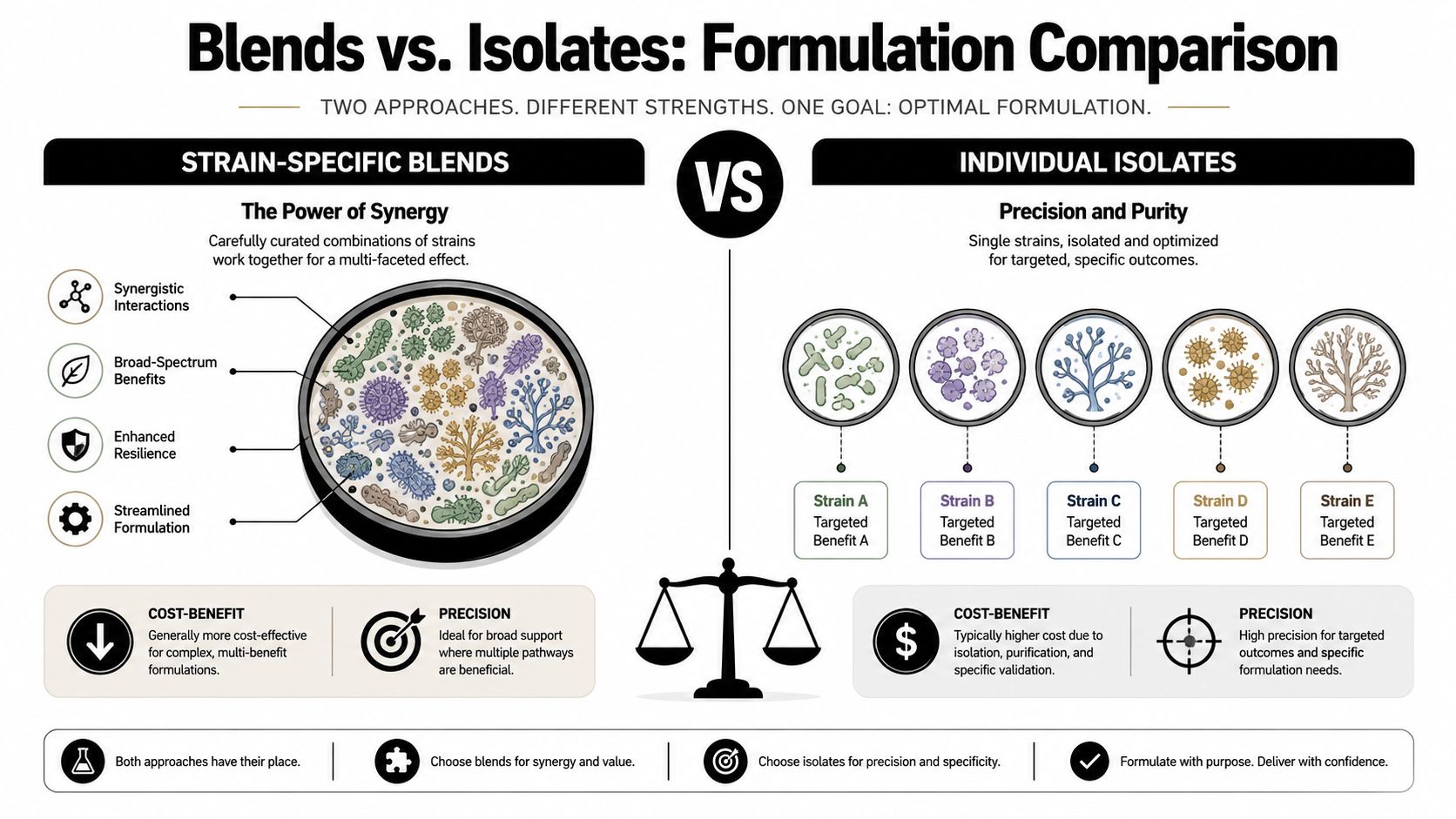
The choice between a pre-built strain blend and individual isolates usually comes down to production control. A strain blend is faster to deploy and easier to keep visually consistent across SKUs, while isolates give a formulator tighter control over the profile when the target is a precise flavor architecture rather than a broad strain impression.
When blends make sense
Pre-formulated blends are practical when the production line needs speed and fewer variables. They reduce the number of raw components a team has to weigh, record, and QC, which can be a real advantage in high-throughput cartridge production or when a brand wants the same sensory identity across multiple batches. For teams who want to keep aroma work simple, strain-specific blends are often the lowest-friction path.
That doesn't make them universally better. A blend carries the supplier's interpretation of the profile, and if the target audience wants something more customized, the formula can feel generic. Still, when the commercial goal is repeatability and a familiar sensory signature, blends can be the right starting point.
When isolates give more control
Isolates make sense when the brand needs to tune the profile with more precision. They're useful for manufacturers who want to push one aromatic direction, soften another, or build a cleaner finish without dragging in unrelated notes. That kind of control is especially useful in formulating for vape cartridges where even small shifts can change how a cart behaves on the draw.
The trade-off is complexity. Isolate work asks for more careful weighing, more documentation, and more sensory testing, because each ingredient has to earn its place. One misstep can tilt the formula from crisp to flat, or from layered to noisy.
Practical rule: Use blends when you want speed and consistency. Use isolates when you want control and can support the extra QC burden.
For buyers comparing options, Gold Coast Terpenes offers strain profiles and isolated compounds, which is the kind of product split that fits both approaches when a team is deciding between convenience and precision. The right choice depends on whether the SKU needs a predefined sensory story or a custom-built architecture.
Regulatory Ceilings and Compliance Considerations
A formula can smell right and still miss the market. The common mistake is to build for sensory appeal first, then discover the recipe cannot legally ship in the target state or product category.
New York is a clear example. For cannabinoid hemp products, vaporized or inhalable products cannot exceed 10% total terpenes, and products must stay at or below 0.3% total Δ9-THC while maintaining a 15:1 ratio of other cannabinoids to THC (New York compliant terpenes guidance). That creates a hard ceiling on terpene loading for inhalable SKUs, so the formula has to be built around compliance from the start.
California is different, but it is still restrictive in practice. DCC guidance says artificial, synthetic, and natural flavorings or terpenes that do not contribute to the natural flavor or aroma of cannabis are not permitted in cannabis inhalation products, and the permitted inhalation components are limited to cannabis, cannabis concentrate, terpenes, rolling paper leaf, pre-roll filter tips, or FDA-permitted inactive ingredients for inhalation (California DCC guidance summary). In plain terms, the flavor system has to contribute to cannabis-authentic aroma, not generic flavoring.
Why source selection is a compliance decision
Colorado adds another wrinkle. Its guidance treats any non-marijuana-derived substance added to a cannabis product as an additive, including botanically derived compounds that have been isolated or enriched and added back into the product, and the cited guidance says synthetic compounds are not an option anymore while cannabis-derived terpenes are exempt from that restriction (Colorado terpene compliance guidance). That means the same aromatic ingredient can be acceptable in one context and problematic in another.
The practical takeaway is straightforward. The formulation brief has to include jurisdiction, product type, and source category before anyone starts final blending. If those three things are not clear, the recipe is unfinished.
For ingestible expansion, the rules change again. The FD&C Act requires manufacturers and distributors to notify the FDA about a new dietary ingredient at least 75 days before it enters interstate commerce (NDIN guidance). That window matters the moment terpene products move beyond inhalation and into supplement-adjacent use.
Precision Mixing Ratios and Diluent Selection
The fastest way to ruin a good profile is to treat terpene loading like a guess. A formula that looks balanced on a spreadsheet can still hit too hard, thin out the base oil, or leave a cart with uneven wicking if the ratio doesn't match the target material and hardware.
Match the base to the job
Distillate, live resin, and rosin all behave differently once terpenes are added. Distillate usually gives the most neutral canvas, so it can tolerate a cleaner, more defined sensory profile. Live resin and rosin already carry more native aroma, so they often need a lighter hand if the goal is to preserve the original character instead of overwhelming it.
A digital terpene calculator is useful here because it forces the math before anyone pours. That's not a convenience feature, it's a control point, and it reduces the chance of over-flavoring a batch that should have been lighter from the start.
Use diluents with intent, not habit
Diluents should be selected for function, not because they're common in the warehouse. The goal is to hit the viscosity and flow behavior the hardware needs while keeping the sensory profile intact. If the oil is too thin, the cart can behave unpredictably. If it's too thick, the draw can suffer and the customer may blame the flavor when the underlying issue is flow.
The blending sequence matters too. Terpenes should be incorporated into the base oil slowly, with enough mixing to produce a homogenous blend. That sounds basic, but many failures happen because the team rushed the mix and sent out a batch that looked uniform only from the top of the vessel.
Field advice: Add with restraint, mix thoroughly, then test the finished blend in the actual hardware, not just in a beaker.
For a practical toolset, the mixing ratios calculator is the kind of resource that helps a production team move from rough estimates to repeatable batches. That matters most when the same flavor has to perform cleanly across multiple oil types.
Strategic Procurement from Sampling to Bulk Orders
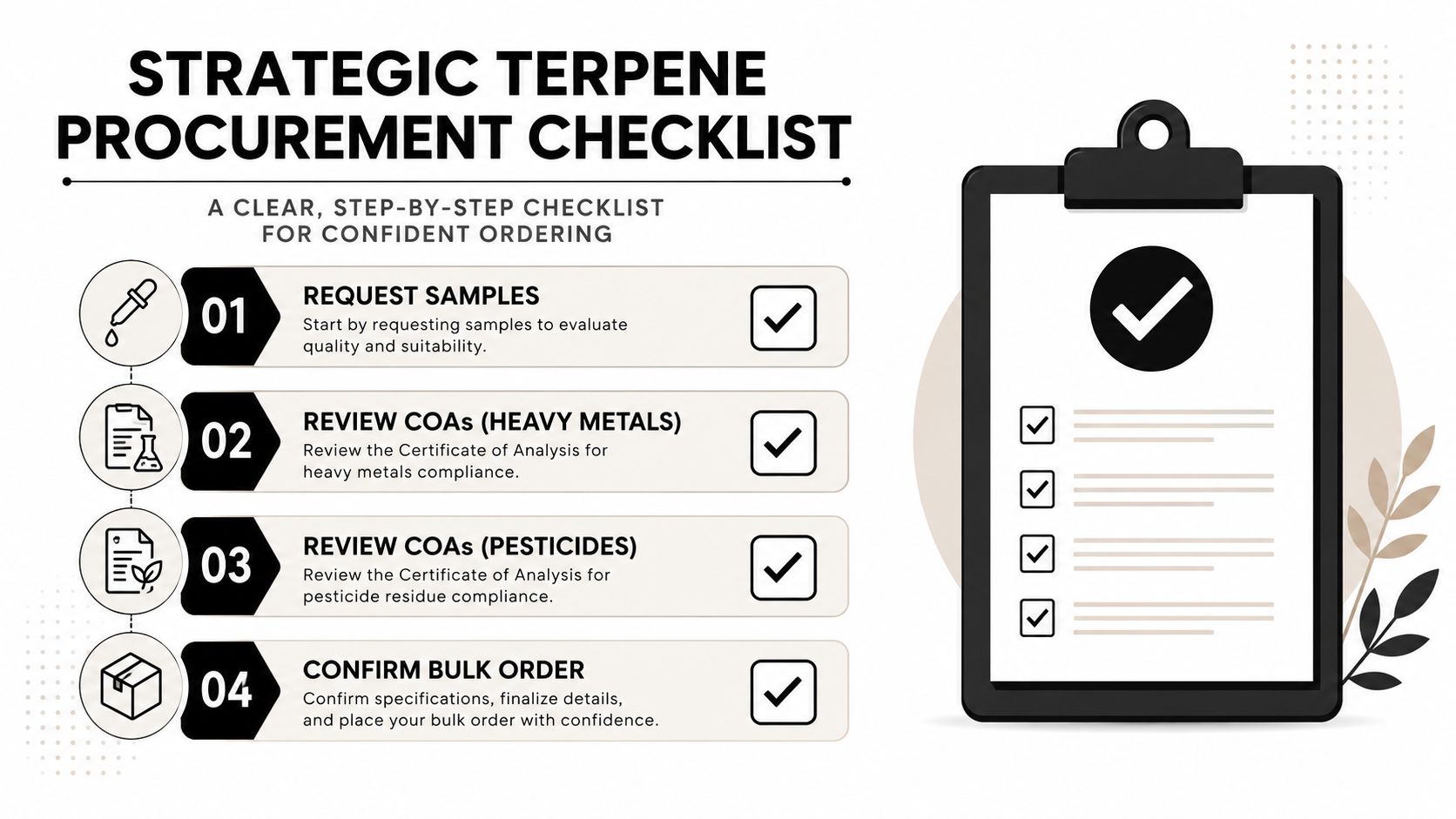
A serious terpene purchase starts small. Samples tell you how a profile smells in isolation, but they also reveal whether the supplier's standardization is real, whether the finish is clean, and whether the material behaves well when blended into your own base oil. A supplier that refuses sampling is asking you to buy blind.
Read the COA for what actually matters
A COA is useful only if the buyer checks the right sections. For terpene procurement, the key questions are whether the document supports the product's identity, whether the lab work matches the intended use, and whether the material has the kind of contamination controls a manufacturer needs. Heavy metals and pesticide review are standard parts of that discipline.
The supplier should also be able to explain whether the profile is a strain blend, an isolate, or a customized formulation. That matters because bulk buying a profile you haven't validated at sample stage can lock you into inventory that's hard to use if the aroma is off.
Buy for production reality, not just price per ounce
Bulk economics make sense only after the sample proves out. If your line needs the same profile month after month, the supplier's ability to hold the spec matters more than saving a little on the first purchase. At scale, a cheap but unstable terpene becomes expensive very quickly.
A wholesale program can help once the profile is locked and the use case is clear. For teams comparing vendors, the where to buy terpenes resource is a practical place to evaluate ordering structure, sample flow, and bulk-readiness without turning the sourcing process into a guess.
A simple procurement sequence
- Request Samples: Test the aroma, blending behavior, and finish in your own base oil.
- Review COAs for Heavy Metals: Confirm the documentation supports your quality requirements.
- Review COAs for Pesticides: Verify the material fits your compliance screen.
- Confirm Bulk Order: Move only after the sample is stable in the actual production workflow.
That sequence keeps procurement grounded in what the product will do, not what the marketing copy says it should do. It also gives brand owners a cleaner path from trial batch to repeatable inventory, which is exactly where most terpene buying decisions should end up.
Gold Coast Terpenes supplies strain-specific profiles, isolated compounds, and formulation resources for teams building carts, concentrates, and other terpene-based products. If you're comparing profiles for flavor accuracy, compliance, and scaling, visit Gold Coast Terpenes and review the products and tools that fit your production line.