
Most advice around distillate carts gets the hierarchy backwards. Clearer does not mean better, it usually means the material has been stripped farther, and that can create the exact problems manufacturers later blame on hardware, fill speed, or “bad terps.” In practice, clear distillate THC is a formulation material, not a finish line. If you judge it only by appearance, you miss the parts that decide whether a cartridge fills cleanly, wicks consistently, and holds flavor on shelf.
For product teams, the useful question is simple. What did the distillation remove, what does that change in the oil, and how do you rebuild performance without making the cart harsh or unstable?
Why Clear Distillate THC Clarity Misleads Formulators
Visual clarity is an easy trap because it looks like control. A pale, transparent oil feels premium, but cartridge performance depends on more than the absence of color. Clear distillate THC can test very high and still underperform in hardware if the formula ignores what was removed during processing. Cannabis Now's distillate overview places the category in a high-purity range, and that is exactly why the appearance can mislead product teams.
Clarity Is a process artifact, not a performance spec
The problem is that the same refinement that makes the oil look clean also removes the parts that make it behave predictably in carts. Terpenes are stripped out, along with waxes, lipids, chlorophyll, and other plant compounds, so the base oil becomes almost neutral in aroma and flavor. A technical overview notes that native terpenes are functionally near-zero in clear distillate, which means the formulators' job shifts from cleaning up the oil to rebuilding the sensory and flow profile from scratch. Marijuana Packaging's production guide makes that point directly.
That is the hidden failure mode. A cartridge can start with oil that looks flawless under light and still clog, mute flavor, or feel thin once it is inside a real device. In commercial production, I care less about polished appearance and more about whether the oil mixes cleanly, fills without foaming, and stays consistent across the full batch.
Practical rule: if the spec sheet reads like a purity brag sheet but says nothing about formulation behavior, you are still guessing.
What matters at the filling line
A cartridge line does not reward the prettiest oil, it rewards the one that behaves predictably across heat, time, and hardware. If the base is too stripped, the terpene package has to do double duty, it must restore flavor and correct viscosity at the same time. That is why clarity alone is a weak quality marker for formulating clear distillate THC for vape cartridges. The material can be highly refined and still be a poor cartridge ingredient if the reconstitution strategy is weak.
The strongest production teams build their acceptance criteria around use, not appearance. They ask whether the oil is compatible with the coil, whether it will stay mobile in the reservoir, and whether the terpene blend can deliver the intended strain character without overpowering the base. That shift in perspective saves time later, because it prevents the common mistake of treating clearer oil as if it were automatically more formulation-ready. Distillate becomes useful only after the formulation team decides how to restore body and aroma without making the oil harsh or unstable. For a straightforward reference point on the material itself, see what distillate is.
How Clear Distillate THC Production Strips Critical Components
Clear distillate looks simple on the shelf, but the production path is doing a lot of destructive work before the oil ever reaches a cartridge line. Winterization strips waxes and lipids, then distillation pulls cannabinoids away from the rest of the extract. Educational explainers describe that workflow as decarboxylation at around 220°F (104°C), followed by a higher heat step around 315°F (157°C) so solvents evaporate before cannabinoids condense separately. That sequence turns a rough starting oil into a near-neutral concentrate, and it also removes many of the compounds that help an oil behave well during formulation.
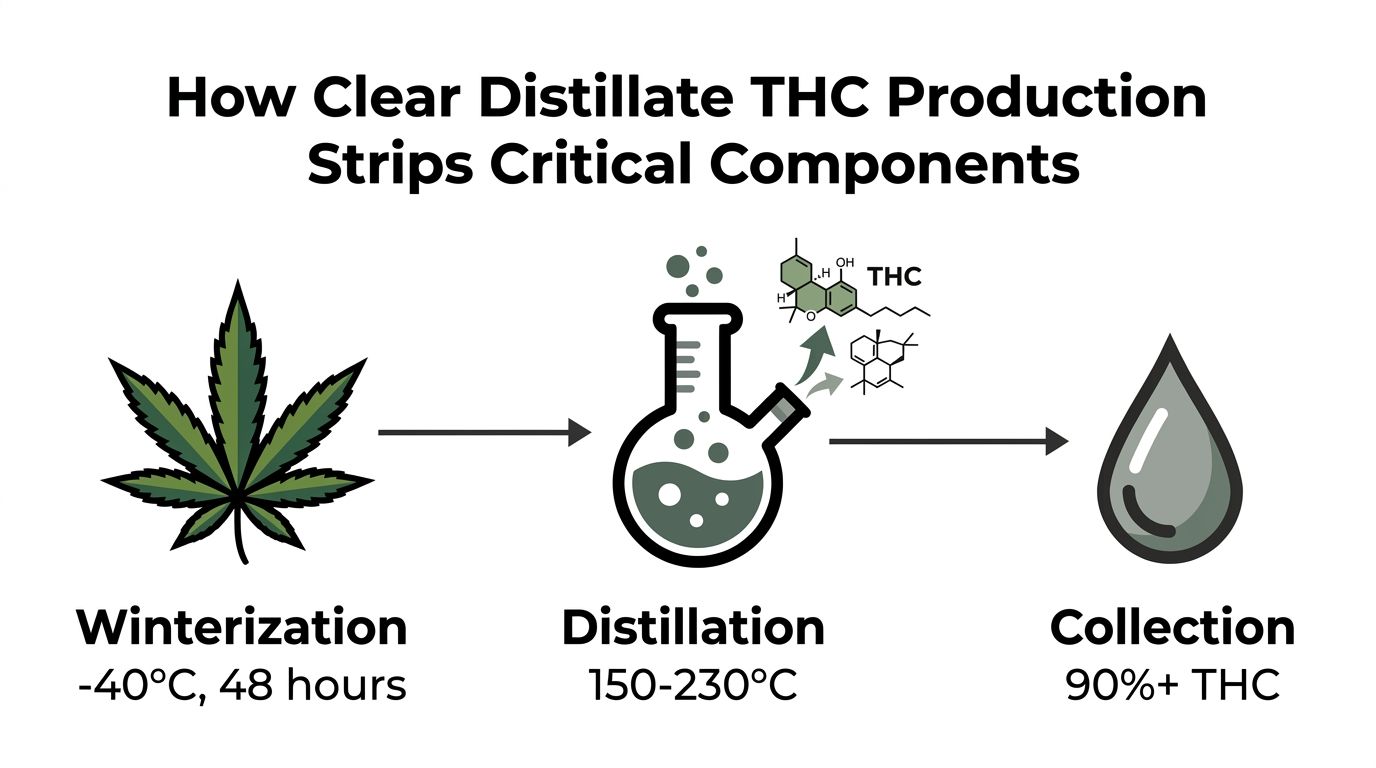
From starting oil to near-pure cannabinoid fraction
The feedstock is usually much less refined than the finished oil. Industry reporting describes crude or intermediate concentrate moving from roughly 70% to 85% THC into a near-pure distillate, while broader educational sources place premium distillate around 85% to 95% THC and high-end examples as high as 99% (Cannabis Now). That jump is why distillate became such a common input in regulated markets. It is potent, consistent, and easy to dose at the formulation stage.
The trade-off shows up later. The same process that concentrates cannabinoids removes the natural components that gave the original oil body, aroma, and strain character. If you are building a cartridge SKU, the base material will not bring much texture or flavor on its own, and it will not carry enough identity to finish the job without help.
Why reconstitution becomes the core formulation step
Many teams get this backward. They treat the distillate as the product, when it is really only the base. A formulation-ready batch needs a terpene plan that restores character and adjusts flow without pushing the oil into harshness, separation, or clogging. The most useful question is not how clean the oil looks, but what purification removed and what has to be added back to make the oil fill and wick correctly.
Distillation makes a stronger base, not a finished vape oil. If the reconstitution step is vague, the batch will show it at fill time.
That is why formulators who need a practical baseline often start with a distillate guide archive and then compare it against their own COA review and hardware testing. The guide gives context on what the material is, but the line still has to prove whether the oil stays mobile, meters cleanly, and carries flavor without over-thinning the base.
Grading and Quality Control Standards for Commercial Distillate
Commercial distillate should be graded by how safely and predictably it can enter production, not by a single number on a marketing sheet. Potency matters, but it doesn't override residual solvents, contamination screening, or the physical behavior of the oil. If a supplier won't give a clean COA with cannabinoid verification and contaminant testing, the batch belongs in the reject pile, no matter how clear it looks.
The tests that actually protect a cartridge line
At a minimum, QC needs to cover potency, residual solvents, heavy metals, pesticide screening, and microbial contaminants. Those are the gates that stop a clean-looking but unstable input from reaching your tanks, and they're the checks that matter most when the final product will be inhaled or otherwise consumed. Visual inspection still helps, but it only tells you whether the material is obviously off. It does not prove stability.
A useful internal rule is to score suppliers on formulation friendliness, not on purity theater. An oil that looks slightly less pristine but mixes smoothly and passes every safety screen can be a better manufacturing input than a “perfect” sample that behaves inconsistently from drum to drum. In cartridge production, consistency beats spectacle.
Distillate QC Thresholds by Grade
| Metric | Commercial Grade | Premium Grade | Test Method |
|---|---|---|---|
| Cannabinoid potency | High, with clean batch-to-batch consistency | Higher, with tighter consistency | COA cannabinoid panel |
| Residual solvents | Must pass safety screening | Must pass safety screening | Lab solvent analysis |
| Heavy metals | Must pass safety screening | Must pass safety screening | Third-party metals panel |
| Pesticides | Must pass safety screening | Must pass safety screening | Pesticide residue panel |
| Microbial contaminants | Must pass safety screening | Must pass safety screening | Microbial panel |
| Color and clarity | Acceptable for production use | Clearer, but not enough on its own | Visual inspection under controlled lighting |
| Viscosity | Suitable for filling and wicking | More tightly controlled | Centipoise measurement |
| Batch stability | Predictable enough for blending | Predictable enough for tighter specs | Shelf and handling review |
What a supplier scorecard should punish
Any supplier that avoids showing test dates, obscures batch identity, or markets clarity without showing how the oil behaves under controlled handling is creating risk for your line. The absence of terpene detail is also a warning sign, because reconstitution starts with knowing what's missing. If the oil is sold as a premium input but gives you no useful formulation data, you're buying a marketing story, not a production material.
Comparing Clear Distillate to Live Resin and Other Concentrates
Clear distillate wins when you need a neutral base that accepts a controlled flavor profile. Live resin wins when the target is a richer, more plant-forward profile and the brand wants the extract to carry more of its own character. Rosin and CO2 oil sit somewhere between those poles, but the right choice depends on the cartridge hardware, the price point, and how much flavor work you want the terpene system to do.
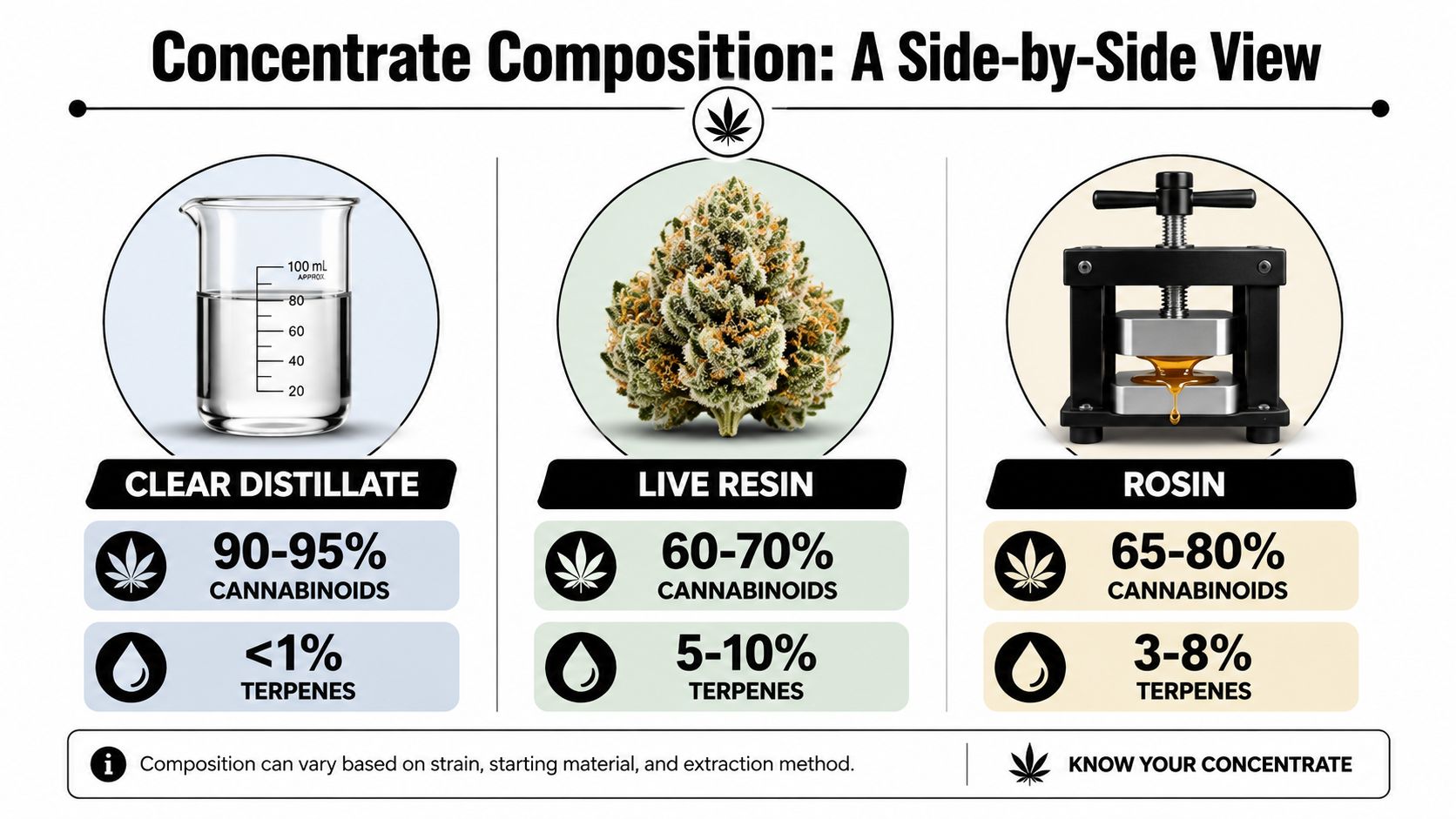
The formulation trade-offs that matter
Distillate typically comes in with near-zero native terpenes and a very neutral flavor base, while live resin keeps more of the original aromatic character. That makes distillate easier to standardize, and live resin better suited for products where the extract itself should carry a stronger sensory identity. The comparison is less about “stronger” and more about how much of the final experience comes from the base oil versus the added flavor system. For a cartridge line built around exact replication, a neutral base is often a gift. For a premium launch built around strain character, it can feel thin unless you manage the terpene stack carefully.
Hardware and process implications
Clear distillate usually gives formulators more room to tune viscosity and flavor because the base contributes so little of its own character. Live resin can demand a different fill strategy because the native profile is already doing part of the sensory work. Rosin often sits closer to the artisanal end of the market, where texture and extraction character matter more, but that can introduce extra variation you'll need to watch in QC.
If you want a deeper product-side comparison, the internal guide on is live resin better than distillate is the right companion piece. It helps when you're deciding whether a SKU should lean neutral and repeatable or aromatic and extract-forward.
When clear distillate is the better choice
It's the better choice when the brand needs flavor accuracy, tighter batch control, or simpler dosing logic. It's also easier to build around when the cartridge platform is already sensitive to viscosity. That doesn't make it superior, it just makes it more controllable. For teams scaling from pilot to commercial fills, control is usually worth more than romantic extraction language.
Formulating Vape Cartridges with Clear Distillate and Terpenes
The base formula needs to be simple enough to scale and tight enough to avoid rework. For vape cartridges, the working terpene range is usually 5% to 15%, because that's where you can recover aroma and manage viscosity without making the oil harsh or unstable. Once you push beyond that range, the blend often gets louder in the wrong way, with more bite, less cushion, and a greater chance of clogging or separation. The best cartridge formulas don't chase maximum terpene load, they chase the smallest amount that gives the target sensory and flow result.
Build the blend around note structure
Top notes give the first impression, mid notes carry the body, and base notes hold the finish together. That hierarchy matters because clear distillate contributes almost no native strain character, so the terpene system has to do all the storytelling. A bright profile like Blue Dream can work when the brief calls for a lifted, familiar front end, while a heavier profile such as OG Kush supports deeper, earthier cartridge positioning. For fruit-forward work, Forbidden Fruit gives you a more expressive direction without needing an overloaded terpene percentage.
Gold Coast Terpenes is one option for strain-specific blends and isolated compounds, including cartridges-focused terpene formulations and common tools such as Limonene, Myrcene, and Beta-Caryophyllene. Those components matter because they let you correct flow and flavor separately instead of forcing one ingredient to do everything.
Mix for homogeneity, then let it settle
The most reliable blending window is 120°F to 140°F, which is hot enough to homogenize the oil without beating up the more volatile aromatic fraction. If you're following a production workflow rather than bench mixing, the published playbook also points to warming distillate to 60°C to 70°C before addition and filling, which lands in the same practical range for controlled handling. Gold Coast Terpenes' mixing guide is worth keeping close because the mechanics matter more than the branding.
- Start with the base oil warm: Keep the distillate fluid enough to mix evenly, not so hot that you drive off aroma.
- Add terpenes slowly: Drip in the blend while stirring, then check for uniformity before filling.
- Avoid overmixing at high heat: Excess heat can flatten the aromatic top end and make the batch feel dull.
- Degas before fill: Bubbles look minor in the tank, then become fill defects or voids in the cart.
If the oil looks perfect in the beaker but foams in the syringe, the blend wasn't really finished.
The attached formulation video can also help teams align bench technique with production handling.
Fix the two most common blend problems
If the oil feels too thick, a small shift toward a lighter terpene profile can improve movement. If it feels too thin, reduce the terpene load and lean on a heavier note structure instead of chasing body with unnecessary dilution. Flavor that fades early usually points to oxidation, poor seals, or storage problems, not just “weak terps.” That's a handling issue as much as a formulation issue.
Safety Testing and Compliance Requirements for Distillate Products
Compliance limits shape the formula long before the first cart gets filled. In Canada, each activation of a cannabis accessory intended for ingestion or other internal use must not dispense more than 10 mg of THC, and a single oral cannabis product unit may also not contain more than 10 mg THC. Canada's cannabis regulations make that a packaging and dosing constraint, not just a legal footnote.
Why dosing rules affect hardware choices
If your product has to stay inside a tight activation limit, the cartridge hardware, fill volume, and oil consistency all matter more than they would in a looser format. A thick oil that fills poorly can create inconsistency from unit to unit, and a formula that behaves unpredictably makes compliant dosing harder to maintain. That is why formulation and compliance can't live in separate departments. They touch the same finished unit.
For hemp-derived inputs in the U.S., the federal threshold is 0.3% or less Delta-9 THC by dry weight under the 2018 Farm Bill, while state rules can vary. The Hemp Doctor's distillate overview summarizes that standard and also notes the commercial importance of total tetrahydrocannabinols testing after decarboxylation in some newer frameworks. That matters because sourcing decisions now have to account for how the material is measured after processing, not just how it's labeled at intake.
Compliance checkpoints worth building into production
- Batch identity: Match every drum, tote, and finished lot to a traceable batch record.
- Third-party testing: Verify potency, solvents, metals, pesticides, and microbial status before release.
- Label discipline: Keep claims aligned with the actual input material and final dosage structure.
- Release review: Block fill if the COA or internal QC doesn't match the intended market.
The core takeaway is straightforward. Compliance isn't a separate checklist at the end of production, it's part of the formulation brief from the start.
Troubleshooting Common Distillate Cartridge Failures
The same formula that fills beautifully on day one can fail once it hits hardware, especially if the terpene system was chosen only for flavor. Clogging usually shows up when the oil is too viscous for the coil or when the aromatic fraction is too low for reliable flow. Leaking usually points the other direction, toward a blend that's too thin, a hardware mismatch, or a fill problem. Teams lose time because they treat those as separate failures when they're often linked to the same formulation decision.
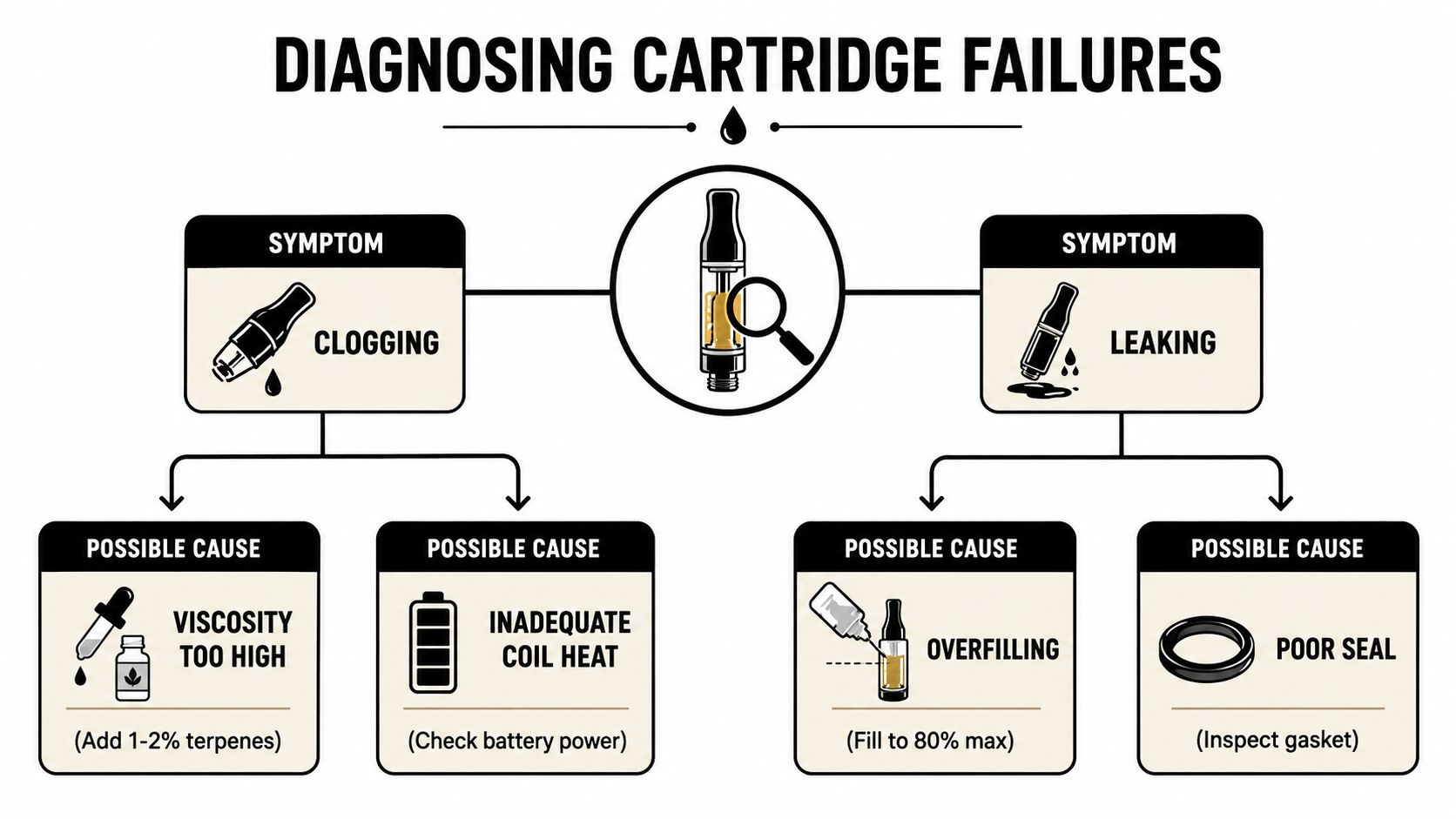
Read the failure before you change the recipe
A cartridge that clogs is not automatically asking for more heat. It may need a small terpene adjustment, a different hardware choice, or a less aggressive fill profile. Likewise, a leaking cart isn't always a bad seal, it can also mean the oil is too mobile for that device. That's why troubleshooting works best when you isolate symptom, hardware, and formula together.
The internal note on preventing crystallization is useful when oil behavior starts to drift in storage or in the reservoir. Crystallization and clogging get blamed on the same things, but they don't always have the same root cause.
Common fixes that don't require a full reformulation
- Clogging from heavy oil: Increase terpene support slightly or switch to a lighter top-note profile.
- Clogging from poor heat transfer: Check battery output and coil compatibility before touching the formula.
- Leaking from overfill: Tighten fill targets and keep the cart below the visible brim.
- Leaking from low viscosity: Reduce terpene load or move to hardware designed for thinner oils.
Flavor fade is often the most overlooked failure because it appears after the batch has already shipped. Once oxidation, light exposure, or seal problems start working on the oil, the profile dulls even if the potency still looks fine on paper. That's a packaging and storage issue as much as a formulation issue.
Storage Protocols and Handling Best Practices for Distillate
Bulk distillate needs stable, controlled storage if you want batch-to-batch consistency. Keep containers sealed tightly, minimize headspace, and protect them from unnecessary heat and light. Finished cartridges should stay upright when possible, especially during early shelf life, so the oil stays where the wick can use it. Distillate can crystallize when stored too cold, so re-warming has to be gentle enough to restore flow without stressing the terpene system.
Handling discipline keeps the formula intact
Use clean, sanitized tools, gloves, and a dry work area. Contamination often comes from routine handling, not dramatic mistakes, and that's why the filling room matters as much as the extraction room. A simple FIFO system also helps because it keeps older oil from sitting long enough to oxidize or drift from its original handling profile.
The best teams document every reheat, every transfer, and every filled lot. That record is what lets you trace a weird cart back to a storage event instead of guessing at the formula. If the oil starts to look cloudy, separate unevenly, or behave differently after warm-up, don't rush it back onto the line. Bring it back to a stable condition first.
Gold Coast Terpenes supplies terpene blends, strain-specific profiles, and isolated compounds for cartridge formulation, so it's a practical place to source the reconstitution side of a clear distillate THC project. If you're dialing in flavor, viscosity, and strain character for vape cartridges, visit Gold Coast Terpenes and review the blends and formulation resources against your current COA and hardware specs.