
D8 in cannabis usually means delta-8 THC, a psychoactive cannabinoid found naturally at only about 0.01% of dried cannabis flowers. In production, that low abundance is why concentrated D8 inputs are typically made from hemp-derived CBD instead of pulled straight from plant material.
You're probably looking at a COA, a vape base, and a terpene brief at the same time. That's the right context for this term, because D8 isn't just a slang label, it's a supply-chain problem, a chemistry problem, and a formulation problem all at once.
D8 in Cannabis Context and Why It Is Not Just Another Abbreviation
A buyer looking at a COA, a distillate spec, or a vape brief does not need a dictionary lesson. The question is whether D8 means delta-8 THC, because that determines what went into the tank, how it was processed, and what has to be checked before it gets filled.
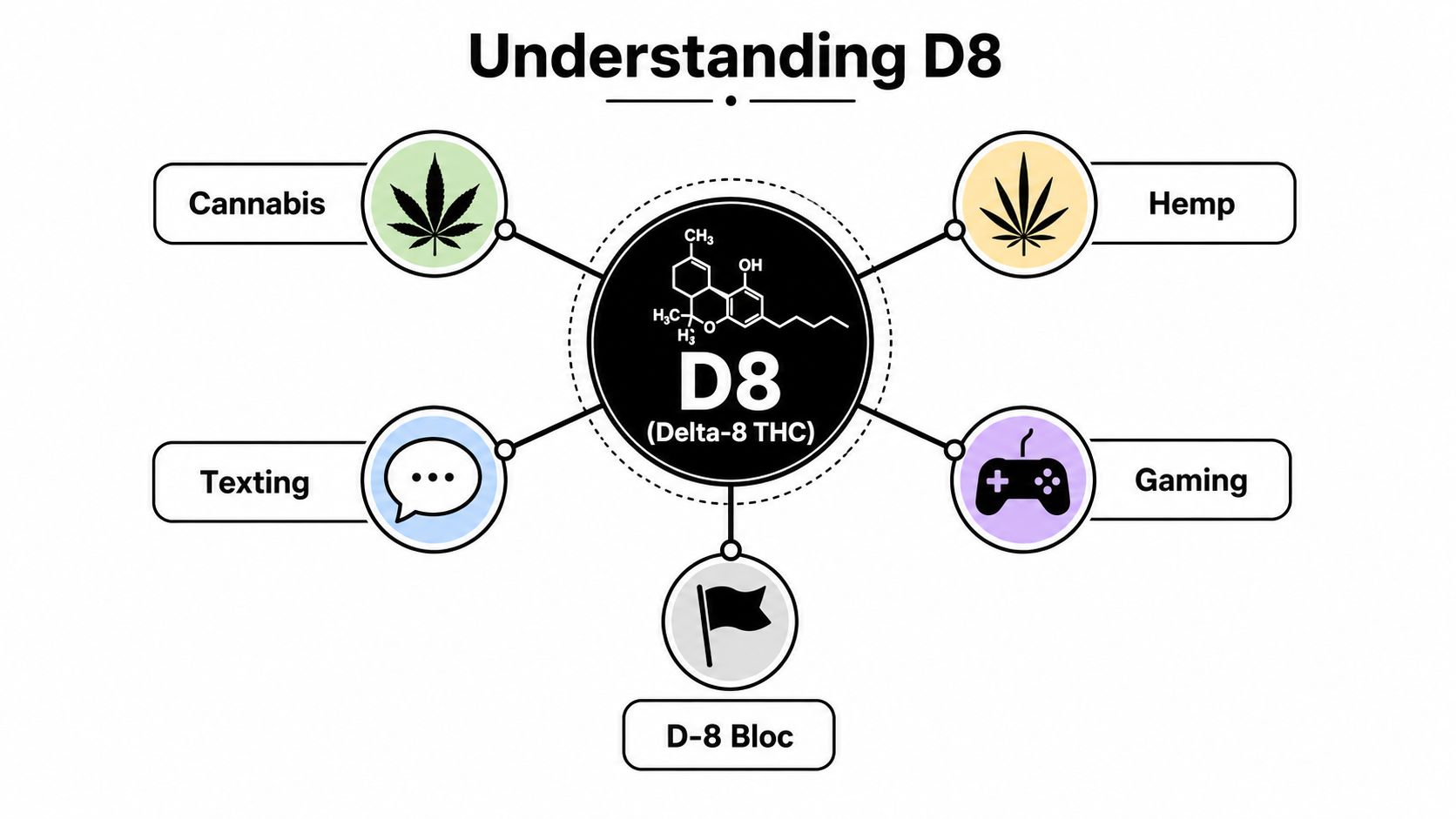
In cannabis, D8 usually means delta-8 THC. It is a psychoactive cannabinoid, one of the compounds the plant produces naturally, and the FDA notes that cannabis makes more than 100 cannabinoids FDA delta-8 THC consumer update. The commercial reality is straightforward. The plant makes very little of it, so most supply starts with CBD isolate or other hemp-derived CBD feedstock, then moves through conversion, cleanup, and refinement before it reaches a cartridge line.
What that means in the plant and in the tank
Scarcity drives the whole category. One independent source places delta-8 at roughly 0.01% of dried flower, which is too little for a simple extraction strategy to make commercial sense FDA delta-8 THC consumer update. That is why the supply chain relies on industrial conversion, not direct capture from biomass.
The molecule itself is an isomer of delta-9 THC, with the double bond shifted to a different position on the structure Δ8-THC summary. That small structural change matters in practice. A D8 input is not just a renamed D9 input, and a formulator who treats them that way ends up with problems in sourcing, purification, label accuracy, and batch consistency.
Before a brand team signs off on a D8 distillate, it needs to know where the material came from, how much cleanup was done, and what is still sitting in the oil. The supplier's explanation should hold up under COA review, not just sales language.
Practical rule: if the supplier cannot explain where the D8 came from, the risk did not disappear, it shifted downstream.
How Delta-8 Differs from Delta-9 THC at the Molecular and Experiential Level
A D8 cartridge can look clean on paper and still behave very differently from a delta-9 cart on the bench. The chemistry difference is small, the handling difference is not. Delta-8 and delta-9 are both THC isomers, but the double bond sits in a different position, and that shift changes how a formulator should think about potency, sensory profile, and compliance. If you are buying distillate for cartridges, the structural identity matters more than any sales description attached to it.
A lot of teams call D8 “milder.” That is a convenient shorthand, but it does not tell you enough to formulate with confidence. Delta-8 is psychoactive, and it can still land hard in a cartridge. The actual experience depends on oil quality, hardware, terpene loading, and user tolerance as much as on the cannabinoid itself.
Reading the difference like a formulator
The useful comparison is identity versus behavior. Delta-9 is the familiar reference point, while delta-8 is a different psychoactive input with its own analytical and regulatory profile. If a batch record treats them as interchangeable, QA is already playing catch-up.
| Attribute | Delta-8 THC | Delta-9 THC |
|---|---|---|
| Structural category | THC isomer | THC isomer |
| Molecular distinction | Double bond in a different position | Double bond in the delta-9 position |
| Natural abundance | Present only in trace amounts | More prominent in cannabis chemistry |
| Commercial sourcing | Commonly made through CBD conversion | More often present directly in cannabis extracts |
| Formulation relevance | Needs tight identity and cleanup controls | Needs tight identity and cleanup controls |
For cartridge development, the main issue is label integrity. If the COA says D8, the batch has to behave like delta-8 THC, not merely smell like a hemp-derived oil that somebody hopes will pass. The sensory story comes later. The identity check comes first.
A supplier should be able to explain where the material came from, what was stripped out, and what still remains in the oil. That is also where a practical reference point helps. A clear overview such as what a distillate is in extraction and cartridge work gives teams a cleaner way to discuss purity, carryover, and why distillation quality changes the final fill.
If the supplier cannot explain the source or the cleanup, the risk did not disappear. It moved downstream.
Conversion Isolation and What a Typical D8 Distillate Looks Like
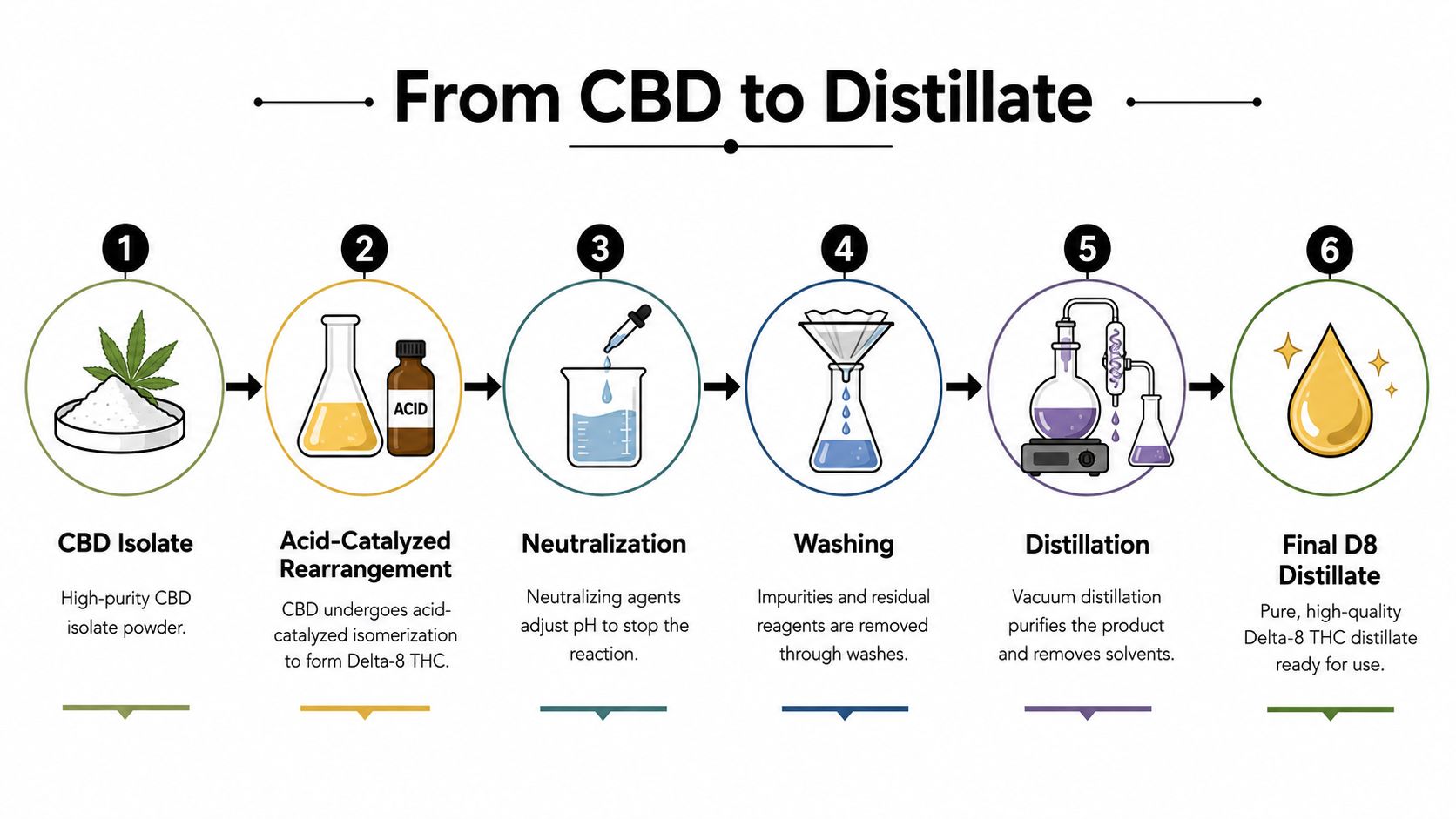
Most commercial D8 starts with CBD isolate or another hemp-derived CBD stream, then moves through chemical conversion, neutralization, washing, and distillation. The goal isn't just to make delta-8, it's to remove the leftovers that can wreck flavor, stability, or compliance. That's why a real D8 process is part chemistry and part cleanup discipline.
What to look for on the COA
A good COA tells you more than cannabinoid percentages. It should show identity, residual solvents, and the other contaminants that matter after conversion chemistry. If a batch came from CBD, you also want to know whether the profile still carries significant residual CBD, any delta-9 THC carryover, or other minor cannabinoids that may affect both flavor and legal status.
The YouTube walkthrough below is useful as a visual reference point for teams that need to explain the D8-to-distillate sequence internally before signing off on a supplier.
A clean D8 distillate should look and behave like an engineered input, not a mystery oil. That means clear batch documentation, full-panel testing, and enough process transparency to answer basic questions about what happened between the CBD feedstock and the final jar.
What a distillate is and how formulating teams use it
Red flags that usually show up early
- No residual-solvent panel: If conversion solvents aren't checked, you're outsourcing risk to your customers.
- Opaque source material: If the supplier won't identify the CBD origin, the batch history is incomplete.
- Weak identity data: If the cannabinoid profile is vague, the oil may be under-processed or poorly cleaned.
- No note on byproducts: If the report ignores carryover compounds, your flavor and compliance team are both guessing.
A D8 input should be treated like a semi-finished ingredient. The more honest the cleanup, the easier the later steps become.
Effects Dosing and Translating Numbers into Cartridge Math
Delta-8 is often described as less intense than delta-9 on a per-milligram basis, but that doesn't make cartridge design simple. The actual effect a user perceives depends on oil potency, terpene percentage, hardware resistance, and how much aerosol the device delivers per pull. That's why dose math matters more than marketing language.
A common mistake is loading a cartridge to the highest cannabinoid number possible and assuming the blend will feel balanced. In practice, a 1 mL cart with high D8 content and a modest terpene fraction can still overdeliver if the oil is thin, the coil runs hot, or the user takes long pulls. Cartridge math beats intuition.
A practical way to think about exposure
Use the formula the lab team already understands. First, calculate total active cannabinoid mass in the oil. Then estimate how much of that mass is being consumed per draw based on hardware and viscosity. You don't need a consumer-friendly slogan, you need a repeatable internal target.
Bench rule: design for the cartridge to stay usable at the oil level you can actually fill and ship, not the ideal fill level on a sample day.
Delta-8 cartridges also interact with other cannabinoids and the terpene stack. A brighter terpene profile can make the same oil feel sharper, while a rounder profile can soften the perception of harshness. That's formulation, not mysticism.
Guardrails for the brand team
- Set a realistic ceiling for how much active material goes into the final formula.
- Match hardware to viscosity before launch, not after complaints start.
- Write label language carefully so the cart describes content, not unsupported effect promises.
- Keep pull testing and retention samples tied to the batch record.
Cartridge fill and oil composition basics
The brands that stay out of trouble don't just ask what D8 is. They ask how much is in the cart, how it moves through the coil, and how the rest of the oil changes the experience.
Legality Lab Testing and the Farm Bill Reality Check
A delta-8 launch can look clean on the formulation sheet and still fail on compliance. The legal opening came from hemp definitions and THC thresholds. The 2018 Farm Bill defined hemp around a 0.3% delta-9 THC limit, so many D8 products entered the market under hemp rules even though the cannabinoid itself is psychoactive. For a broader explanation of the hemp-derived meaning and hemp context, that distinction matters, but it does not make every D8 product acceptable everywhere.
The patchwork is real. Some states explicitly restrict or ban delta-8, some allow it under hemp rules, and some do not spell out a separate position. A launch plan that ignores state-by-state treatment is a liability forecast, plain and simple.
What the lab panel has to cover
A COA that only reports cannabinoid content is incomplete for a D8 input. The material should be checked for residual solvents, heavy metals, and any delta-9 THC overage that could push the product out of spec under applicable rules. In some jurisdictions, the calculation also has to account for total THC, not just the delta-9 line item.
A serious file for a D8 SKU should include the COA, the batch record, supplier identity, stability notes, and the label copy marketing plans to use. If those documents do not line up, the product does not have a clean launch story.
Practical rule: if the legal team cannot trace the oil from source to shelf in one folder, the dossier is not finished.
The compliance work is slower than flavor design, but it keeps the flavor project alive long enough to matter.
Terpene Pairing and Flavor Design for D8 Distillate
A D8 cartridge can be technically sound and still fail on flavor. Delta-8 distillate is often neutral enough that the terpene system carries the whole sensory job, including the first aroma hit, the mid-palate shape, and how the oil finishes on the exhale. For the formulator, that means terpene design is not decoration. It is the part of the formula that gives the oil a market identity and keeps the hardware experience from feeling hollow.
Build the profile from top, mid, and base notes
Top notes are what the customer notices first. Limonene and pinene are common picks when the brief calls for brightness, lift, or a sharper opening. Mid notes add body, and beta-caryophyllene and humulene are often used to give the blend structure so the profile does not feel thin.
Base notes shape the finish. Myrcene, linalool, and nerolidol can help the profile linger and make the exhale feel more complete. That does not mean each one should be pushed hard. It means the blend needs enough balance that the loudest terpene does not flatten the rest of the stack.
A strain-inspired profile works when it borrows the shape of the aroma, not when it copies a flower extract blindly.
A strain-inspired terpene blend for a D8 SKU should be built from isolate ratios and sensory targets, not from guesswork. A Blue Dream-style brief and a Forbidden Fruit-style brief can both sit on the same D8 base, but the top, mid, and base note balance has to change to get there. That is how you build more than one SKU from a single cannabinoid platform without turning the oil into a flavor compromise. For a closer look at why the aromatic side of D8 matters, see it goes beyond flavor, the role of terpenes in delta-8.
For teams building out a product line, strain-specific terpene blends and formulation resources can help support the flavor work without forcing the same blend into every cartridge. The useful part is not the name on the jar, it is whether the blend matches the oil and the target hardware.
Loading without making the oil angry
Most D8 cart formulas land in a 3 to 8 percent by weight terpene window. The low end can feel restrained, the high end can get loud fast, so the job is to hit the target without shocking the oil or overthinning it. If the dominant terpene overwhelms the base, the cart usually pays for it with harshness or poor wicking.
A better approach is to start with the flavor architecture, then trim the loudest notes until the profile survives in hardware. In practice, that often means reducing one dominant terpene instead of stacking three aggressive ones and hoping the coil will tolerate it. That kind of restraint matters more in D8 than in a lot of other oil systems, because the base can carry flavor cleanly only if the terpene load stays within a range the cartridge can handle.
Safety Risk Mitigation and the Honest Trade-Offs
D8 products don't fail because the concept is broken. They fail because people cut corners on conversion cleanup, testing, or packaging. The most controllable risks are the boring ones, residual solvents, inconsistent dosing across hardware, accidental delta-9 overages, and child-resistant packaging failures.
The marketing risk is just as real. Claims that D8 is “milder” or “legal” can create more trouble than they solve if the wording overpromises or ignores state restrictions. A brand can't talk its way around a bad COA, and a clean COA can't save sloppy label claims.
Good practice looks repetitive for a reason
- Test every batch third-party: Don't rely on a supplier's general reputation.
- Lock the SOPs: Terpene loading needs a repeatable procedure, not an ad hoc pour.
- Keep retention samples: If a customer complaint lands, you need a reference lot.
- Check stability: A fresh blend can drift after fill if the hardware or oil chemistry is off.
The trade-off is simple. More documentation takes more time, but it gives you a defendable product. Less documentation may move faster for one launch, then get expensive when a regulator, retailer, or auditor asks for the paper trail.
A serious D8 line isn't built on the claim that the cannabinoid is harmless or universally acceptable. It's built on the idea that the team can show what's in the oil, how it was made, and why the cartridge should perform the same way batch after batch.
Bringing It All Together with a Formulator's D8 Workflow
A clean D8 workflow starts with CBD isolate that has a clean COA, moves through documented conversion and distillation, then gets verified with a full panel that includes residual solvents and any delta-9 overage concerns. After that, the terpene profile gets designed for the hardware, not just the lab bench, and loaded in a controlled window so the oil stays usable.
The bench checklist is short enough to print:
- Source: CBD feedstock with traceable documentation.
- Process: Conversion and distillation under written SOPs.
- Verify: Full-panel testing before fill.
- Flavor: Use a terpene profile built for the target SKU.
- Load: Keep terpene weight in the 3 to 8 percent range.
- Ship: Match hardware, then confirm stability and label integrity.
D8 works when the team treats it as a real input with its own chemistry, not a cheaper stand-in for another cannabinoid. That mindset is what keeps a product line alive when rules change.
Gold Coast Terpenes supplies strain-specific terpene blends, isolated compounds, and formulation support for cartridge and concentrate development, which makes it a practical fit for D8 oil design. If you're building or revising a D8 SKU, visit Gold Coast Terpenes to review terpene options, formulation resources, and cart-ready profiles before your next batch goes to fill.