
You fill a cart clean, wipe the bench, set the batch aside, and come back an hour later to find the oil has started to blush pink or rust at the top. That's the moment people start calling it red cart oil, but the label alone doesn't tell you whether you've got harmless color drift, a bad terpene choice, oxygen damage, or a batch you should quarantine.
The commercial mistake is treating every color shift the same. In a production setting, red, pink, amber, and brown all deserve different responses, because the fix for oxidative color formation is not the same as the fix for contamination, poor filtration, or counterfeit input. A bench-side triage process saves time, prevents rework, and keeps you from throwing out usable oil for the wrong reason.
The industry has a long history of oil color being used as a signal. In petroleum, the first commercially successful oil well in the United States dates to 1859, when Edwin L. Drake's well near Titusville, Pennsylvania, hit oil at 70 feet and helped launch large-scale production and refining; by 1875, the Bradford field in Pennsylvania was supplying 77% of global oil output (EIA history of oil, petroleum industry history). Vape formulation is a different business, but the practical lesson is the same, color is rarely just cosmetic when it changes after processing.
A good formulation shop separates visual drift from true failure fast. That means tracking what changed, where the color sits, how it evolved, and whether the same batch behavior repeats. It also means knowing when to hold the lot, when to reformulate, and when to discard without second-guessing yourself.
When a Clear Cart Turns Red on the Bench
A distillate fill can look perfect at the nozzle, pass a quick visual check, and still turn pink or bronze after sitting in the rack. That's the kind of failure that wastes the most time, because the oil didn't start out visibly wrong, and the problem often shows up after the variable that caused it is already out of reach.
In practice, the first clue is usually location. A red layer at the top suggests a surface-exposed change, while banding or a fully uniform shift points you toward a different part of the process. The same cart can look acceptable immediately after fill, then drift after heat exposure, storage, or cap delay, so the timing matters just as much as the shade.
Practical rule: treat a color shift as a process event first, not a cosmetic complaint.
That mindset matters because red cart oil is not one thing. It can be a stable oil that's been visually altered by oxidation, it can be a terpene blend that's drifting under heat and air, or it can be a contaminated or counterfeit input that never belonged in production. The fastest teams don't argue about the color name, they document the cue, isolate the lot, and check the batch record.
A senior formulator should also care about the decision cost. If you call every tint change a failure, you'll destroy usable material. If you ignore a true failure because the cart still “looks close enough,” you ship a problem that will be harder to trace later. The right response sits between panic and complacency, and it starts with a clean definition of what the color means in a cannabis cart context.
For a practical reference on how heat history can affect distillate appearance during decarb and fill work, keep a bench note linked to your internal process library, like this decarb and color reference.
What Red Cart Oil Actually Means in Cannabis Formulation
In cannabis formulation, red cart oil usually means a distillate or blend that has developed a red, pink, amber, or brown tint after processing, filling, or storage. It does not mean the ingredient is red by nature, and it does not describe a single chemical identity. It's a visual outcome, not a formulation class.
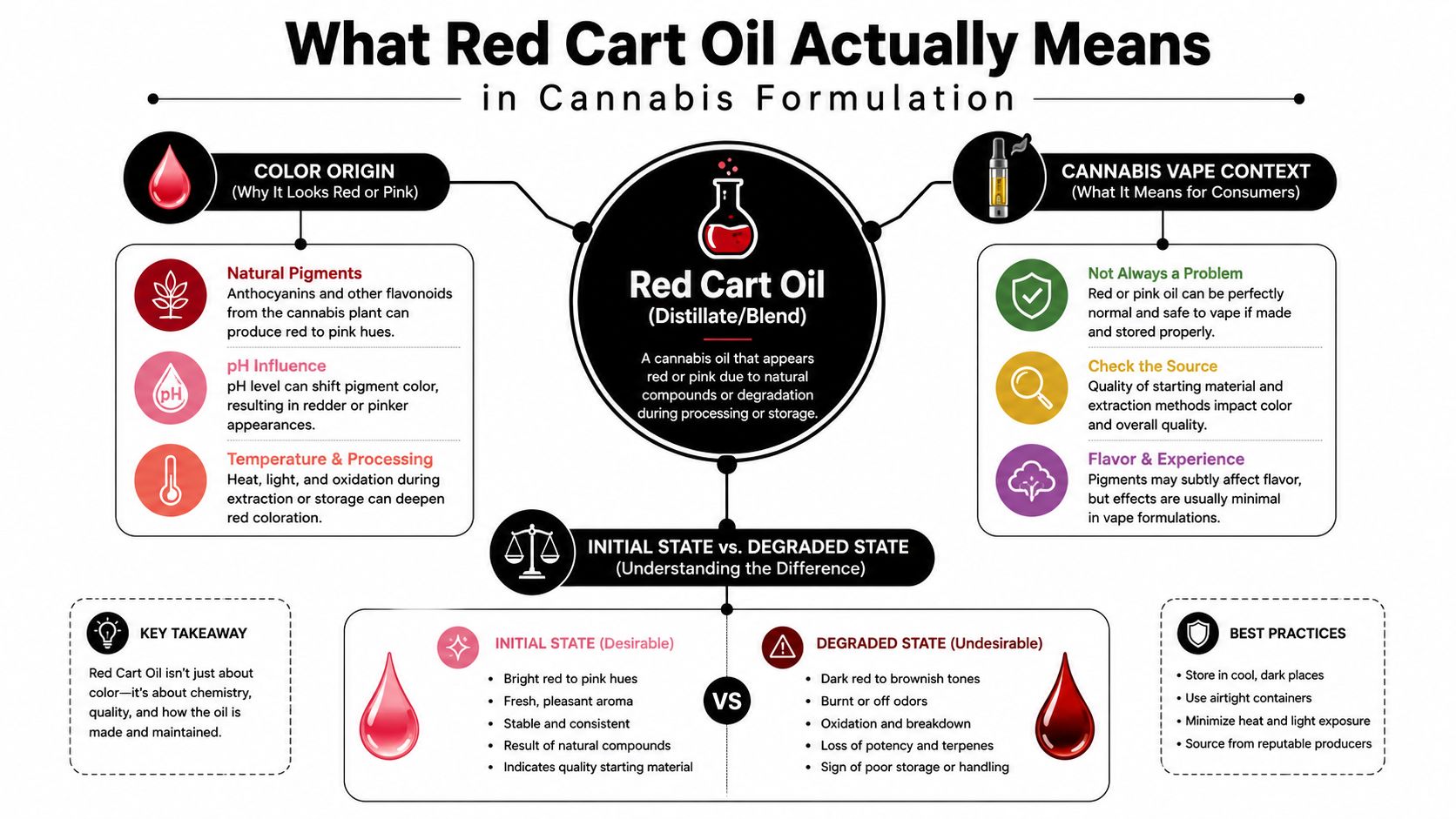
The most useful vocabulary here is simple. Cosmetic drift means the oil changed appearance without an obvious safety or composition failure. Oxidative color formation means heat, light, and oxygen altered the chemistry enough to create new color. Contaminant-driven discoloration means the tint is tied to something unwanted in the oil, the hardware, or the fill environment.
The cartridge world also uses the phrase “red ring of death” for a red or brown layer that forms at the top of the cart. That pattern is commonly linked to oxidation chemistry rather than “bad oil,” because cannabinoids exposed to heat, light, and oxygen form colored byproducts, and the visible result often sits where air exposure is greatest (AmberClear color stability guide). In a manufacturing room, that distinction matters, because a top layer change often points to storage and headspace behavior more than raw potency issues.
The industrial meaning of red oil is different, and it's worth keeping separate. In lubrication contexts, red cart oil can refer to a dyed, high-viscosity carrier or gear/lubricant blend with specific density, viscosity, and flash-point behavior. That is a useful reminder that color alone never tells the whole story, because one red fluid can be a pigment marker while another is a degradation signal.
The working definition for cartridge manufacturing is this. If the oil changed color after a known process step, treat it as a process indicator until you've ruled out contamination, oxidation, and raw-material problems. That's a cleaner conversation to have with a lab, a co-packer, or a raw-material supplier than asking whether the oil is “good” or “bad” based on color alone.
The Chemistry Behind Red and Pink Cart Oil
Color drift usually starts with chemistry you can't see on the bench. Cannabinoids exposed to heat, light, and oxygen form colored byproducts, so the tint is often the visual footprint of oxidation rather than a separate defect. That's why a cart can move from clear to pink or brown even when the original oil looked clean.
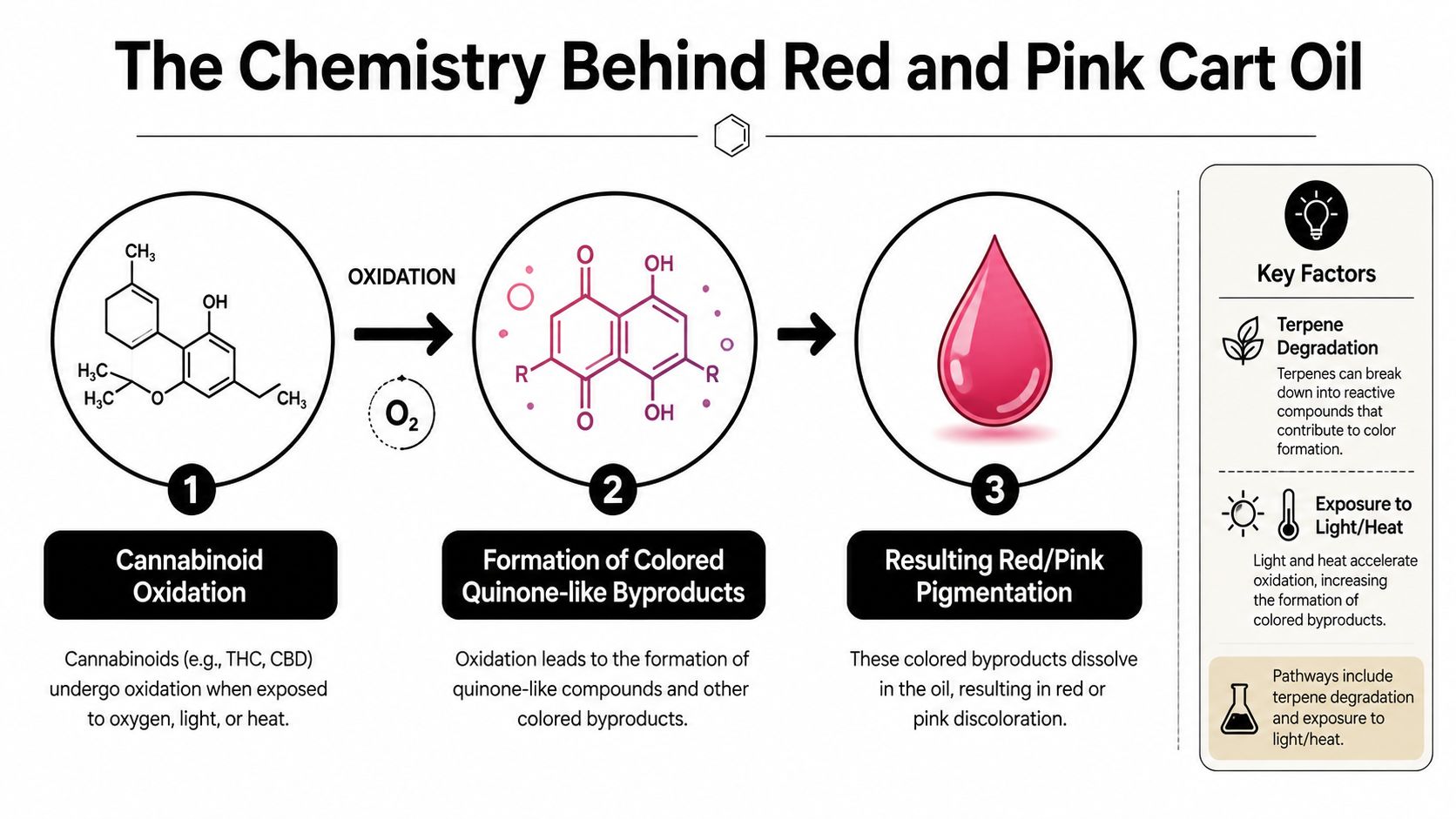
The color is the symptom, oxidation is usually the event.
Two terpene classes deserve special attention. Limonene and pinene are specifically called out as prone to oxidation when exposed to light and air, and their degradation can form quinones and other byproducts that contribute to a reddish tint in vape oil (terpene oxidation and red tint). That's useful because it connects flavor design to stability, if your profile leans heavily on volatile top notes, you've built more exposure into the system.
Why viscosity changes the look of the problem
A heavy carrier doesn't behave like a thin one. In industrial lubrication data, a representative red, transparent carrier shows 0.903 relative density at 60°F, 35 cSt kinematic viscosity at 40°C, 6.6 cSt at 100°C, and a 98°C flash point by Pensky-Martens Closed Cup, which means it flows, films, and handles heat very differently than a light hydrocarbon diluent (technical datasheet). In cartridge work, that kind of viscosity difference can change how the oil wets hardware, how residues form, and how readily color becomes visible.
A thinner carrier oil also behaves differently. One carrier-oil specification used for magnetic particle inspection reports viscosity below 3 cSt at 38°C, flash point above 93°C, density of 0.80 g/cc, and a clear, colorless appearance, which shows just how much transport behavior changes when you move from a thin carrier to a heavier blend (carrier oil specification). The practical takeaway is not that one base is automatically better, it's that viscosity changes atomization, wetting, and residue patterns, so the same chemical shift can look more dramatic in a heavier system.
If you work on flavor-accurate carts, terpene choice and carrier behavior meet here. A blend can smell right and still drift visually if the top-note fraction is too oxidation-sensitive for the package, the fill cycle, or the storage profile. That's why color stabilization has to be designed into the formula, not patched after the cart turns red.
For a deeper terpene reference while you're selecting profiles, this terpene chemistry guide is a useful bench companion.
A Triage Workflow for Discolored Carts
Start with the easiest question, where is the color sitting? If the top is red, pink, or brown while the lower oil is still clearer, oxygen exposure and surface oxidation move higher on the list. If the whole cart is uniform, you're more likely looking at a blend issue, raw-material drift, or a fill process that mixed the batch differently than expected.
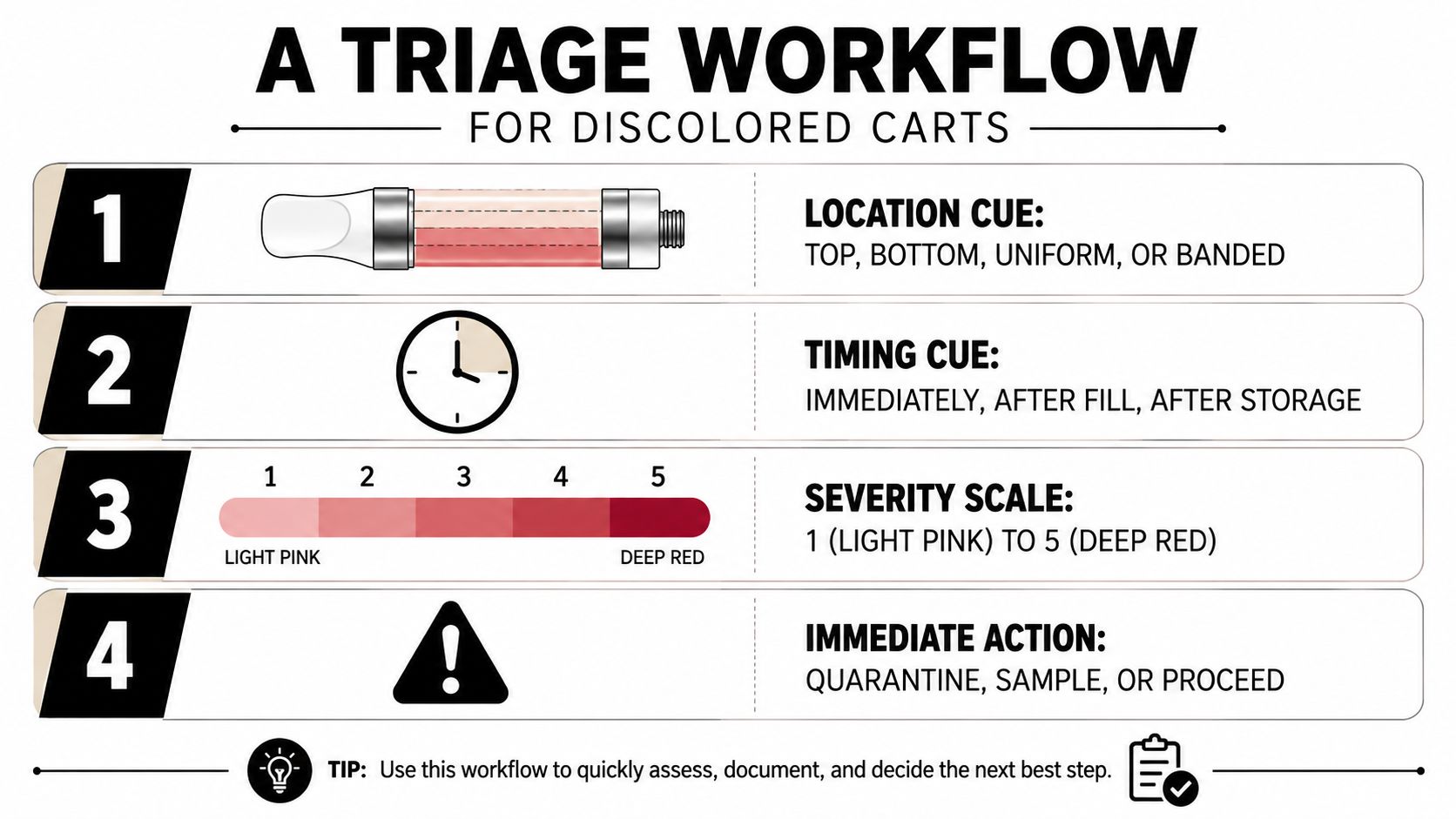
Cue one location
Use the visual pattern to narrow the failure mode. Banding, cloudiness, specks, and a harsh taste are stronger warning signs than a mild tint change alone, especially if the cart has been exposed to heat or prolonged storage. Counterfeit-focused guides also flag carts that look dark, watery, or murky, especially when the paperwork is thin or missing (discoloration and counterfeit warning signs).
Cue two timing
Then ask when the change appeared. A cart that shifts right after fill usually points toward formulation, mixing, or thermal handling. A cart that stays stable for a day and then changes after storage points more toward oxidation, light exposure, cap timing, or package headspace.
Cue three what changed
The batch record should show the variable that moved. New terpene lot, new distillate supplier, hotter fill temperature, a different cap delay, a filter change, or a longer hold under heat all deserve attention. The point isn't to guess which one matters most, it's to isolate which one changed before the color did.
Cue four repeatability
If the issue reproduces in the same lane, on the same hardware, or only with one raw-material lot, that's a clue, not random noise. A one-off tint shift can be cosmetic drift. A repeated shift tied to the same variable is a process problem, and it should be quarantined until you know whether to reformulate or discard.
Document this in the batch record: location, timing, changed inputs, and repeatability. That's enough to defend a hold decision without overreacting.
Choosing Terpene Profiles That Resist Color Drift
A red-prone cart usually starts with an aroma-first blend. A strain-inspired profile still has to work on the bench, which means building around top notes, mid notes, and base notes instead of chasing label accuracy alone. The top-note fraction is where the brightest, most volatile terpenes usually sit, and that is also where oxidation shows up first when the fill room runs warm or the carts sit too long before packaging.
In practice, limonene-rich and pinene-rich top notes deserve the most attention in red-prone formulas. Those materials can drift under light and air faster than you want in a hot-fill or long-hold workflow, especially when the blend leans too hard on them for the first impression. The cart may smell right at fill and still lose visual stability during storage, so the job is to dose those notes with intent rather than avoid them outright.
Balance flavor against shelf behavior
Mid notes carry much of the body of the profile, so they can make the cart smell complete without loading the oxidation-sensitive top end. Base notes, especially heavier sesquiterpene-heavy components, often help hold the profile together over time, but too much of that weight can flatten the opening aroma. The useful part of blending is not picking one tier and hoping for the best, it is tuning the ratio so the formula still reads as the intended strain after fill, capping, and shelf time.
Gold Coast Terpenes' diagnostic guidance points out that red oil can reflect cannabinoid degradation, weak filtration, unstable raw material, or formulation choices, and it emphasizes tracking where the color appears, when it appears, what changed in the batch, and how repeatable the issue is. That lines up with what shows up at the bench. The formulation itself is often part of the color story, not just the storage conditions, and a profile that looks clean in the beaker can still drift once heat history, headspace, and oxygen exposure start stacking up.
A practical development approach is to start with a strain-inspired base, then add only the top-note load needed for authenticity. If more brightness is needed, adjust the blend architecture before pushing the volatile fraction higher. One option for formulators working through that balance is a supplier like Gold Coast Terpenes, which offers strain profiles and isolated compounds for cartridge formulation, but the true value is choosing a profile that matches the shelf-life target instead of forcing a perfect aroma match. For sizing and flavor balancing, this boiling-point reference helps when you are deciding which notes are likely to hold through process heat and which ones need more protection.
Stability Testing Protocols That Predict Shelf Life
Bench observation tells you what happened, not how far the problem will go. If a blend is red-prone, the tests have to challenge the same stressors the cart will see in use, not just a casual warm shelf check. Heat, light, and oxygen are the obvious ones, but the order and combination matter.
| Common Stability Tests for Cart Oil | What It Predicts | Typical Threshold | Notes |
|---|---|---|---|
| Heat challenge | Color drift under processing or storage heat | Qualitative pass or fail against a retained control | Useful for fill-room decisions |
| Light exposure | Tint shift from package light transmission | Qualitative comparison to protected control | Especially relevant for clear hardware |
| Headspace check | Oxygen exposure risk after fill | Low headspace is preferable | Helps explain top-layer color |
| Terpene retention assay | Flavor and volatility loss | Compare to start-of-batch reference | GC or HPLC are common tools |
The key is matching the test to the claim. A short heat challenge can tell you whether a cart will discolor quickly in a warm room, but it does not replace a broader stability program. If you want to defend a shelf-life statement, you need a data set addressing the relevant stressors, not a single pass/fail point.
Practical rule: if the test does not mirror the failure mode, it will not predict it well.
Lab discipline matters here. Use retained controls, document the same hardware, and compare like with like. If the color shifts but the terpene profile stays within your expected window, that is a different story than a color shift paired with flavor collapse. In other words, do not let one measurement do the job of three.
The best SOPs pair the stability result with the batch history, then keep the decision tree short. If the lot fails heat and light, it does not go to market unchanged. If it only shifts slightly and the control lot behaves the same way, you may have a cosmetic drift issue rather than a release blocker. For process documentation and lab coordination, this quality control testing reference is a practical place to anchor the workflow.
Process Controls That Prevent Red Cart Oil at Scale
A cart can look fine at the bench and still drift red once the line starts running hot and fast. The fix is not a generic warning about heat and light. It is a process-control view that treats color change as a batch behavior you can trace back to fill conditions, oxygen exposure, and how consistently the line handles the oil.
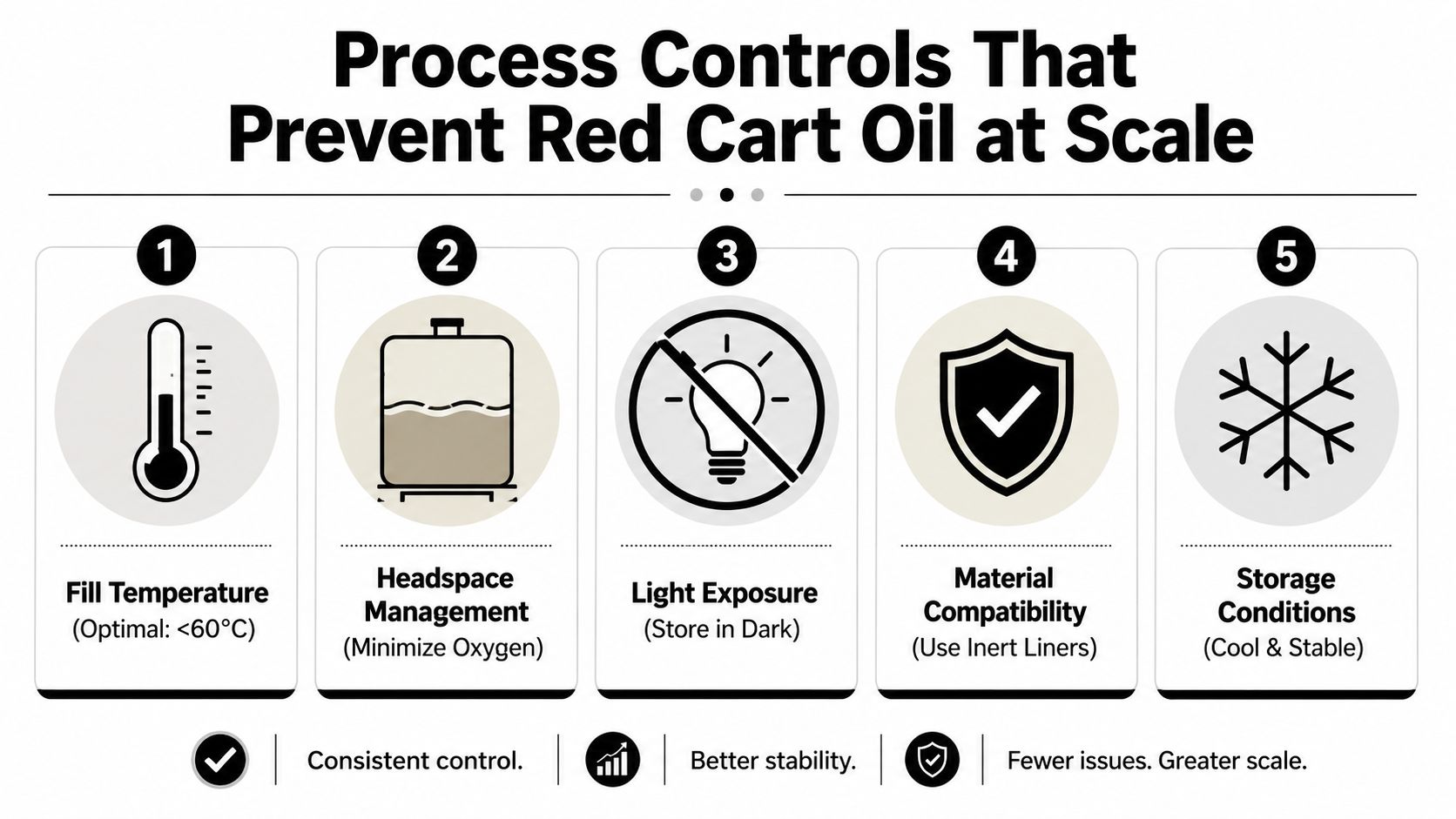
What to control first
Fill temperature gets checked first. Keep it as low as the line can run without causing fill defects, because heat lowers viscosity, raises evaporation pressure, and speeds the oxidation chemistry that pushes oil toward a red tint. A hotter fill can also change how the oil wets the cartridge, which makes a stable blend behave differently during the first hours after fill.
Headspace management comes next. Less trapped oxygen means less room for a red layer to form at the top, especially in hardware that sits before capping or shipping. Cap-and-seal timing matters for the same reason, since every minute of delay gives air more time to act on the exposed oil.
Filtration quality is quieter, but it still moves color. A filter change can pull out particulates that would otherwise seed discoloration, while over-filtering can strip useful character or change flow in ways that alter how the blend behaves on the line. That trade-off is why every process adjustment should be checked against a retained sample, not just against the production target.
The batch-level view
Public-facing guidance often stops at broad advice and skips the batch-level monitoring that shows which variable moved. That is the process control gap. Once a line is running, a small shift in fill heat, a different liner, or a little more time under light can be enough to push a batch from stable to red-prone.
The practical response is straightforward. Track the variable, compare it with the previous lot, and flag repeated color movement before release. If the color shift stays cosmetic while the retained control behaves the same way, you may be looking at drift rather than a release blocker. If the shift shows up with flavor loss, haze, or lot-to-lot repeatability, the batch record is pointing to a real process problem instead of a one-off cosmetic change.
Building a Repeatable Red-Oil Prevention Workflow
A durable workflow starts with one decision, define the failure mode before you chase a fix. If the cart only changed color, you're in cosmetic drift territory until the rest of the evidence says otherwise. If the color change comes with banding, murkiness, specks, harsh taste, or repeated lot-specific behavior, you've got a quality problem that needs quarantine and review.
From there, the sequence is straightforward. Profile the terpene blend by note structure, test the finished oil under heat, light, and oxygen stress, then lock the process controls that moved the result. That gives you a release path you can repeat instead of a one-off judgment call that changes with each batch.
A useful internal stack for that work includes educational terpene references, formulation tools, and the diagnostic archive you already use for batch notes. Gold Coast Terpenes maintains those kinds of formulation resources alongside terpene profiles and mixing support, which makes it easier to connect flavor decisions to stability decisions without splitting the workflow across three different systems.
The cleanest shops don't ask, “Why did the cart turn red?” They ask, “Which variable changed, what did the batch record show, and what do we do the next time that same pattern appears?” That's the difference between guessing and controlling the process.
If you're working through a red cart oil issue on the bench, use Gold Coast Terpenes to compare strain-inspired terpene profiles, isolated compounds, and formulation resources against your current batch notes. Their terpene selection tools and educational guides can help you tighten flavor accuracy while you build a more stable cart oil workflow for production.