
Three different lab reports land on the bench, all labeled Hippy Crasher. One says the cross leans toward Wedding Crasher x Kush Mints, another calls it Wedding Cake x Kush Mints, and a third uses a different parent set entirely, while the THC band moves around enough to change how hard the cart reads on first pull. That's not a branding nuisance, it's a formulation problem, and it's exactly why a strain-inspired brief has to start with chemotype, not folklore.
A sane replication workflow starts with what survives the naming mess. For Hippy Crasher, that means the aroma language that keeps showing up, cookie-mint, vanilla, sweet berry, and ammonia-mint, plus the caryophyllene-led profile that gives the material its dessert-mint center of gravity Leafly's Hippy Crasher profile. If you're building carts, distillate, or a branded sensory line, that's the part worth copying.
Why Hippy Crasher Is a Formulation Problem Worth Solving
A formulator can't build a stable cart off a name alone when the label keeps changing underneath it. Hippy Crasher is useful precisely because it exposes the gap between strain marketing and usable product data. The strain is generally described as an indica-dominant hybrid, but the lineage is not standardized across databases, and the THC figures move from the high-20% range in one common reference to a more conservative 21%–22% range in another, with a separate cultivation guide listing 18%–22% THC and a flowering window of 54–61 days or about 8–9 weeks indoors Sativa University, Way of Leaf, Next Generation Nurseries.
What that tells you in practical terms is simple. This isn't a low-intensity daytime flavor target, and it isn't a strain where you can shrug off lab variability. If you're matching a retail flower jar, a disposable, or a distillate SKU, you have to build for sensory consistency across batches, not for one headline number.
Gold Coast Terpenes fits that use case as a formulation tool because it supplies strain-specific terpene profiles and isolates that can be used to translate an ambiguous cultivar into a repeatable sensory brief. That matters when the grow side can't agree on parentage but the retail side still wants the same aroma every time. For a brand owner, the payoff is cleaner vendor communication. For an extractor, it's fewer trial blends. For a formulator, it's a better starting point than chasing the most aggressive THC sample.
Practical rule: when the lineage is messy, replicate the aroma contract first, then use lab data to tighten the edges.
The rest of the process comes down to identifying the chemotype that matters in the jar, deciding which descriptors are signal and which are noise, then turning that into a cartridge-ready blend without overloading the hardware.
Lineage, History, and Why Identity Ambiguity Matters
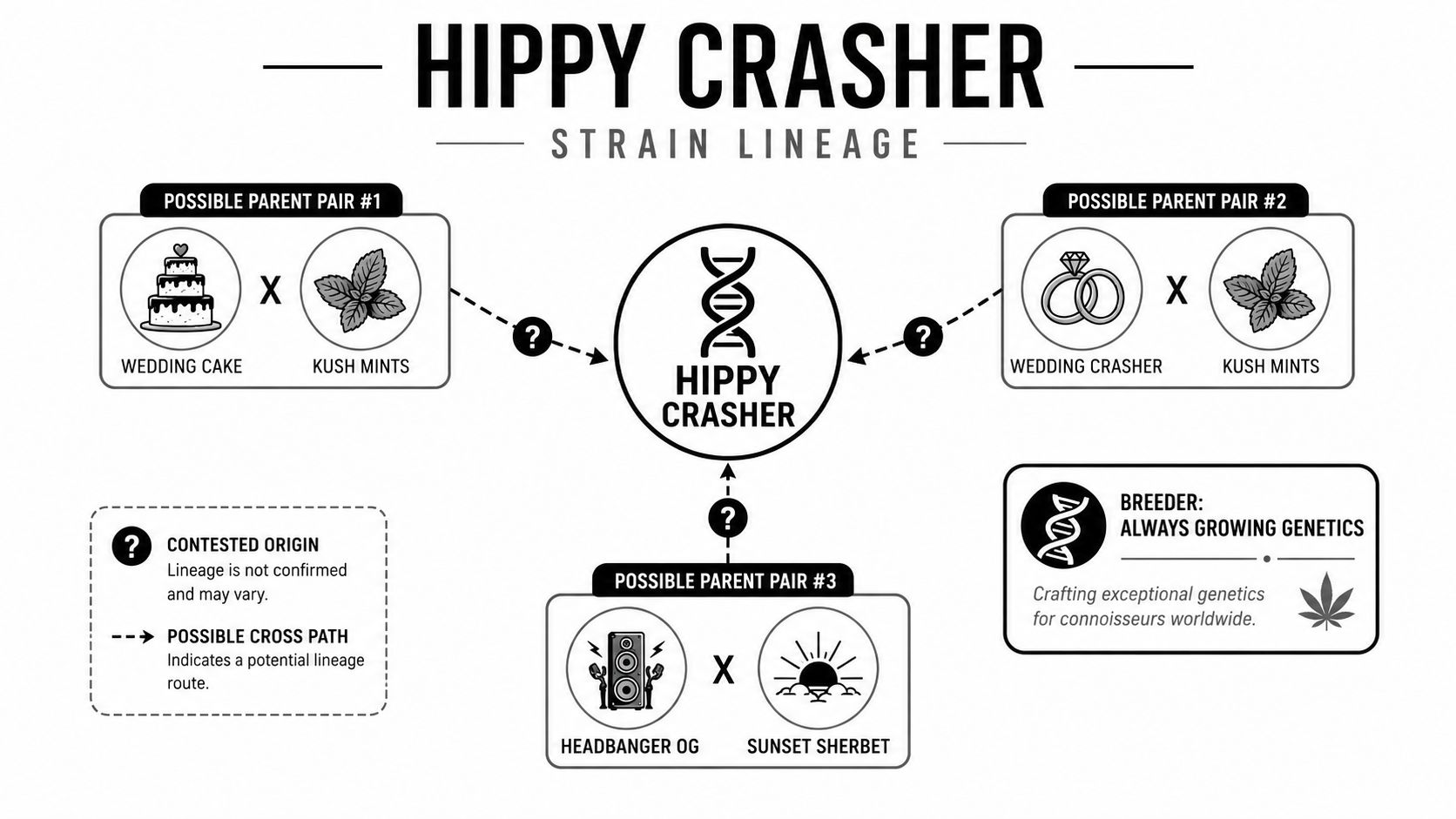
What the breeder trail actually suggests
The clearest historical thread points to Always Growing Genetics as the source tied to the cultivar's development and later commercial circulation Way of Leaf. That matters because the strain shows up in modern boutique channels, not as a legacy staple with decades of stabilized naming. The result is a product identity that looks settled on retail menus but remains fuzzy in the background.
That fuzziness is not rare in cannabis, but it has a real consequence for formulating. If one database treats it as Wedding Cake or Wedding Crasher crossed with Kush Mints, while another listing in the broader market points elsewhere, the expected aroma lane shifts with the pedigree story. One parent set implies a creamier dessert profile. Another pushes the blend toward sharper mint and cookie notes. A third introduces a fruitier or more oggish interpretation.
Why the THC spread matters to carts
The lab variation is just as important as the lineage variation. Published THC figures for Hippy Crasher cluster from the high-20% range in one widely used reference to the 21%–22% range in another, with a separate cultivation guide placing it at 18%–22% THC Sativa University, AskGrowers, Next Generation Nurseries. That spread doesn't just change consumer perception, it changes how strongly the terpene overlay has to work in a finished cart.
If the source flower sits near the top of that band, the terpene profile can feel compressed unless the blend has enough lift and mid-note structure. If it lands lower, the same blend can read louder and more expressive. That's why you can't match a sample by THC alone. You need a profile that survives both ends of the range.
A formulator's reading of the ambiguity
Treat the disagreement as a chemotype signal, not an error to correct. The product has enough market traction to behave like a standardized SKU, but the underlying identity still varies by phenotype, grower, and testing context. For formulation work, that means the target should stay anchored to the shared sensory language, not a single claimed lineage.
The practical target is a dessert-mint hybrid with restrained berry sweetness and a faint solvent-like edge that doesn't tip into harshness. That target holds up across the parentage claims better than any one genetic label does.
Aroma, Flavor, and the Chemotype You Should Actually Target
The descriptors that keep appearing are consistent enough to use. You see cookie-mint, vanilla, sweet berry, and ammonia-mint in strain databases and retail descriptions, and Leafly narrows the sensory center with ammonia, mint, and vanilla while identifying caryophyllene as the dominant terpene Leafly. That combination points to a very specific style of profile, one that reads creamy and mint-forward first, then resolves into a spicy, slightly herbal base.
Building the note stack
For formulation work, I split the profile into top, mid, and base notes instead of trying to chase every descriptor equally. The top note should carry the sharp mint impression, the mid should protect the vanilla and cookie impression, and the base should give the cart enough structure to keep the finish from turning thin.
The key is not to over-index on sweetness. A caryophyllene-led chemotype usually reads more like a dessert-mint profile than a gassy or citrus one, even when the flower description includes ammonia or faint berry. That's because the spicy, dry backbone gives the sweeter notes a frame to sit inside.
| Hippy Crasher Aroma-to-Terpene Map | |||
|---|---|---|---|
| Descriptor | Candidate Terpene | Suggested % in Blend | Note Position |
| Mint | Menthol-leaning isolate | 8% to 15% | Top |
| Cookie | Beta-caryophyllene | 12% to 20% | Base |
| Vanilla | Linalool or dessert-style blend component | 10% to 18% | Mid |
| Sweet berry | Limonene or fruity support note | 5% to 10% | Top |
| Ammonia-mint | Balanced mint plus spicy base | 5% to 12% | Bridge |
What to prioritize and what to ignore
Abstrax's lineage discussion is useful here because it highlights the disagreement around the cultivar's parentage rather than pretending there's one clean answer Abstrax Tech. That's the right way to think about the aroma brief. You're not trying to preserve a taxonomic truth. You're trying to preserve the sensory experience that shows up across batches.
A good replication target doesn't start with the strongest marketing claim. It starts with the most repeatable aroma words.
For a vape brief, I would prioritize mint, vanilla, and caryophyllene-driven spice. Berry is secondary, useful for rounding. Ammonia is a nuance note, not the core. Push it too hard and the cart goes sharp and medicinal. Leave it too low and the profile loses its Hippy Crasher character.
Reading a Cannabis Lab Report the Way a Formulator Should
The fastest way to waste time is to read a CoA like a consumer and not like a builder. The first thing I look for is whether the report gives me a usable terpene picture or just a headline THC number. If the report doesn't show the dominant terpene, the relative ratio of the top few compounds, and a clean contaminant panel, it's not enough for a replication brief.
What to copy from the sheet
Start with the top five terpenes by percentage. Those matter more than the long tail because they tell you how the profile behaves at the nose and in the first pull. Then check whether one terpene dominates or whether the scent is spread across several mid-level components. That ratio is often more important than the absolute number.
Then check the cannabinoid section for total THC presentation, but don't let the headline drive the blend. A padded-looking sample can still be a fine flavor reference if the terpene data are stable. A flashy THC figure with weak aroma detail is much less useful.
Formulator's rule: if the terpene table is thin, the sample is weak as a replication reference, even if the THC line looks strong.
What to ignore or treat as noise
For vape work, I treat broad claims as noise unless the CoA supports them. If a report leans on marketing language but gives no real terpene context, it doesn't help me choose top-note or base-note ingredients. The same goes for isolated cannabinoid bragging that doesn't change the sensory target.
Use the contaminant panel as a gate, not as a flavor tool. Pesticides, heavy metals, mycotoxins, and residual solvents matter for release decisions, but they don't tell you how to rebuild the flavor. What you need from that side of the report is confidence that the input is clean enough to formulate with.
Simple checklist for any Hippy Crasher sample
- Confirm the terpene table: make sure the dominant compounds are listed clearly.
- Compare the top three ratios: that tells you whether the profile leans sharp, creamy, or dry.
- Check for outliers: a strange minor terpene can explain why one batch smells off.
- Verify contaminant pass status: don't build carts from material you can't clear.
- Match the aroma words to the lab data: if the description says mint and vanilla, the top and mid notes should reflect that.
For a deeper workflow, use Gold Coast Terpenes' lab report interpretation guide as a bench-side reference.
Building the Gold Coast Terpenes Blend
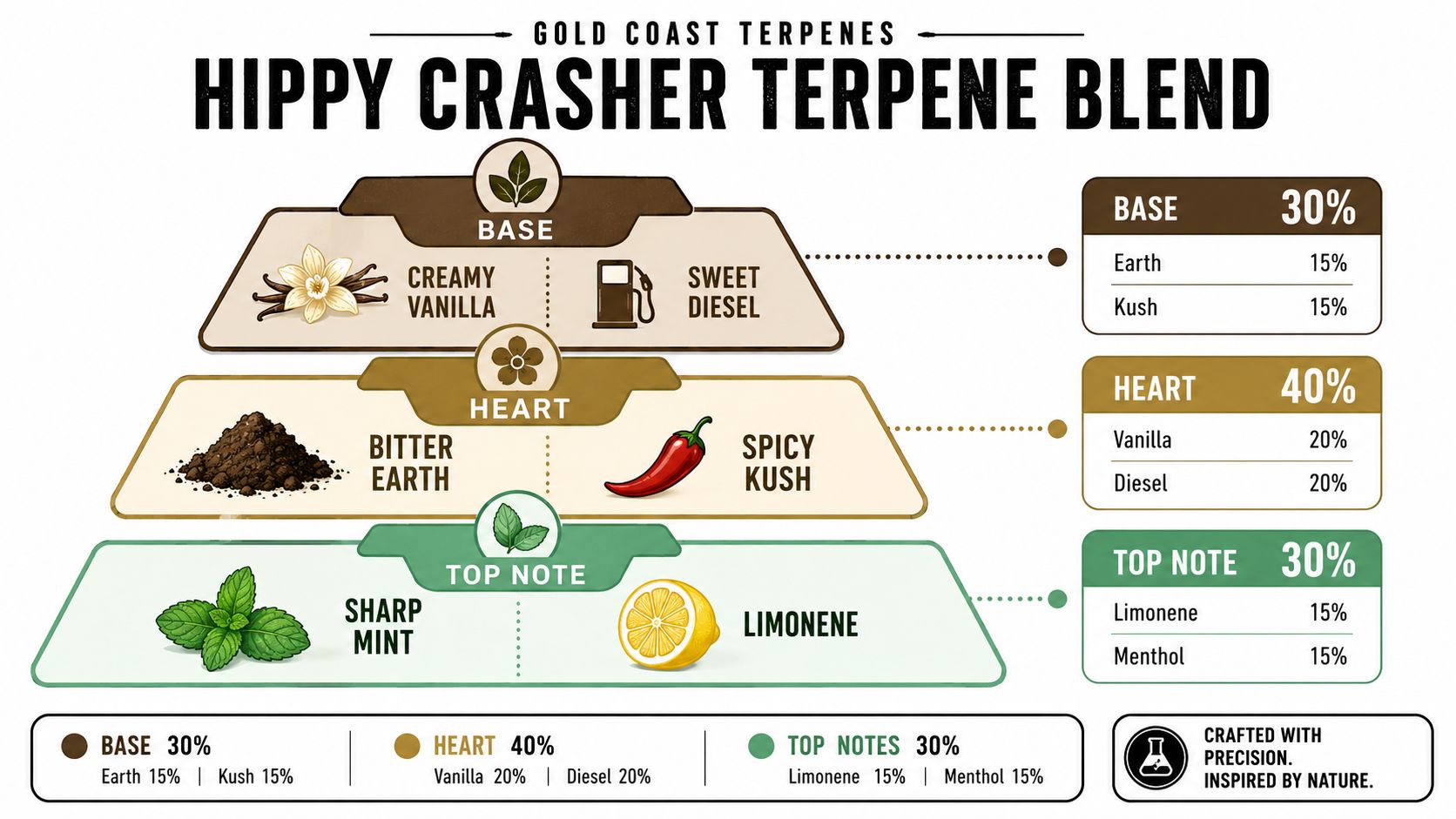
The cleanest way to handle this profile is to build it as a three-part accord. The top needs to give you mint lift, the middle needs to hold the creamy vanilla impression, and the base needs enough spice to keep the finish grounded. That structure tracks the caryophyllene-led chemotype better than trying to force a single-note sweetness or a loud gas layer.
Blend structure
For a strain-inspired blend, I'd keep the working formula simple:
- Top note, 30% total. Split this between limonene at 15% and a menthol-leaning component at 15% to create the sharp mint opening.
- Heart, 40% total. Use vanilla-style material at 20% and a sweet diesel or creamy support note at 20% to round the center.
- Base, 30% total. Build with earthy or spicy base material at 15% and a Kush-leaning spicy component at 15% to preserve the dry finish.
That gives you the right hierarchy for carts. The top arrives first, the heart carries the identity, and the base keeps the profile from collapsing into candy. The point isn't to make the cart taste like dessert only. It's to make it feel like Hippy Crasher.
Why caryophyllene leads
I'd keep beta-caryophyllene ahead of myrcene in the final sensory balance because the available descriptions point harder toward spice, dry cookie, and mint than toward heavy fruit or musky softness. Myrcene can still have a place as a supporting texture note, but if you let it dominate, the profile loses clarity and turns too soft for the flavor cues that keep repeating across sources.
The same logic applies to the mid note. Vanilla should not become pastry-only. It has to stay clean enough to survive in a cartridge and stay recognizable after heat cycling.
For readers who want the broader blending framework, Crafting Your Signature Scent, Terpene Blending 101 is a useful companion guide.
If you're sourcing a strain-specific input rather than building from individual isolates, Gold Coast Terpenes is one option for strain profiles and isolates in this category. For a Hippy Crasher-style cart, the advantage is that you can work from a named profile instead of recreating the accord from scratch.
Dosing, Dilution, and Cartridge Compatibility
Cartridge work gets messy fast when the terpene load is too aggressive for the hardware. For distillate carts, terpene addition commonly sits in the 3% to 8% by weight range depending on viscosity and wick type, and that's the window I'd test first before moving higher. Too little and the flavor disappears under the oil. Too much and the cart can run hot, harsh, or unstable.
What to avoid in the carrier system
Gold Coast Terpenes' dilution products are built without VG, PG, PEG, or MCT, which is the right direction for this kind of formulation because those carriers complicate a clean terpene profile and can create compatibility headaches in vape hardware. Keep the formula as lean as possible if the goal is a sharp, mint-vanilla expression. Extra carriers usually make the profile feel flatter, not smoother.
The hardware choice matters too. A ceramic coil often handles a caryophyllene-heavy, mint-forward profile better than a weak cotton wick because the blend needs even heat and consistent wicking. All-in-one pod systems can work if the viscosity is right, but they're less forgiving when the blend is overloaded with base note material. Cotton wick designs can show more sensitivity to thicker oils and can mute the sharper top notes if the formula isn't dialed.
Working method on the bench
Start low, mix thoroughly, and let the sample rest before judging flavor. If the oil is too thick, adjust with a compatible diluent strategy rather than trying to force the terpene load upward. Once you've got a stable test batch, evaluate the top-note sharpness, mid-note cream, and finish separately. That's the only way to know whether the Hippy Crasher brief is reading correctly in hardware.
Safety still matters even in small runs. Undiluted terpenes can irritate skin and eyes, so gloves, eye protection, and good ventilation aren't optional. Use SC lab-tested inputs and keep your handling process clean.
For a practical thinning workflow, see How to Thin Distillate for Cartridges.
Testing, Stability, and Scaling the Batch
A mint-and-vanilla profile can look right on day one and drift by the end of the first stability window if you don't test it properly. I've seen blends that smelled exact in the beaker turn dull in hardware because the distillate wasn't prepared well enough or the terpene load was too top-heavy. That's why the first pass should stay small and bench-controlled.
What to verify before you scale
Run a small sensory panel against the reference flower, not against a marketing description. Then watch how the mint and vanilla components behave over time, because those notes are the ones most likely to flatten or separate in a badly prepared batch. After that, send the input through final verification with an SC lab workflow before you commit to production.
Don't scale a cartridge formula until the profile still reads the same after rest, heat, and handling.
A high-caryophyllene blend can darken in carts if the distillate isn't winterized properly or if the oil carries too much residual complexity. That doesn't automatically mean the formula is wrong. It means the matrix is fighting the profile. Fix the matrix first, then judge the flavor.
A clean scale-up sequence
- Small-batch sensory panel. Compare against the flower or the closest reference cut.
- Oxidation check. Watch whether the mint and vanilla notes hold or collapse.
- Final verification. Confirm the input and finished blend meet your QC standard.
- Scale-up. Only move forward when the sample survives handling and rest.
For a more formal production workflow, Mastering Quality Assurance Processes for Vape Blending is worth keeping nearby.
A One-Page Replication Brief for Hippy Crasher
Target chemotype: dessert-mint hybrid with a caryophyllene-led base, mint lift, and a vanilla middle. Do not start from THC alone, because the lab spread across sources is wide enough to mislead a cart brief Sativa University, Next Generation Nurseries, Leafly.
Working blend shape: 30% top note, 40% heart, 30% base. Keep the top sharp, keep the middle creamy, and let the base stay spicy rather than heavy.
Cart window: start around 3% to 8% terpene load by weight and adjust only after hardware testing.
Hardware fit: ceramic coils first, then compatible pod systems, then cotton wick only if the oil and viscosity are stable.
Verification checklist: dominant terpene list, top-three ratio, contaminant pass, oxidation check, and a rest-period sensory read.
That's the cleanest way to turn a messy strain identity into a usable product brief. If you need strain-specific profiles, isolates, or a mixing workflow built around cartridge formulation, the catalog and tools at Gold Coast Terpenes are the place to start.
If you're building a Hippy Crasher-style cart, use the aroma map, not the rumor mill. Gold Coast Terpenes supplies strain-specific terpene profiles, isolates, and practical mixing resources that fit this exact kind of formulation work. Visit Gold Coast Terpenes to compare profiles and move from bench testing to a production-ready blend.