
You're on the bench with a distillate lot that looks clean on paper, the cannabinoid line is where you want it, and the first prototype still feels flat, sharp, or oddly empty in the cart. That mismatch is usually where terpene work starts to matter, because the oil can be chemically finished and commercially unfinished at the same time. In what are terpenes in CBD, the practical answer for formulators is simple, terpenes are the part of the formula that turns a generic oil into a recognizable product.
Why Terpenes Matter in a CBD Cartridge
A cart can test beautifully and still lose the sale in the first pull. I've seen the bench version of that problem often enough to treat terpenes as a core formulation variable, not a decorative add-on. The oil may already carry the CBD load you wanted, but without a deliberate terpene profile it can come off flat, harsh, or strangely disconnected from the strain story you're trying to sell.
The commercial issue is that two carts with the same cannabinoid content can belong in completely different product lanes. One reads as bright and citrus-forward, another feels earthy and heavy, and a third just tastes like warmed distillate. That difference usually comes from terpene load, balance, and note structure, not from the cannabinoid percentage alone.
Practical rule: if the oil smells like nothing on the bench, it usually won't become interesting in hardware by accident.
That's why terpene selection sits next to hardware and viscosity in real product development. A strain-inspired blend can help a brand define aroma, vapor character, and the way a cart introduces itself on the draw, especially when the CBD base itself is neutral. For a deeper look at how terpene choice affects cartridge behavior, see this discussion of cartridge performance and terpene role.
What Terpenes Actually Are in a CBD Formulation
Terpenes are volatile aromatic compounds that plants use to build scent and flavor. In cannabis, they're produced in the trichomes, which is why a flower can smell loud even though terpenes make up only a small share of the material. The practical takeaway for a formulator is that terpenes are not the bulk of the oil, they're the aromatic architecture layered onto it.
There are two groups that matter most in formulation work, monoterpenes and sesquiterpenes. Monoterpenes are generally lighter and more volatile, so they come off fast in aroma and on the first part of the draw. Sesquiterpenes are heavier, less volatile, and more likely to shape the finish, depth, and lingering character of the blend.
Terpenes are related to, but not the same as, terpenoids, flavonoids, and cannabinoids. That distinction matters when you read a COA or compare supplier claims, because a product can be terpene-rich without being cannabinoid-heavy, and vice versa. If a label uses broad botanical language, verify what's in the lot before you build a SKU around it.
The concentration reality is just as important as the chemistry. In cannabis flower, total terpene concentration is commonly in the 1% range and can reach about 3% in some inflorescences with selective breeding, with terpene-to-cannabinoid ratios around 1:10 in that review (cannabis terpene concentration review). Independent reviews also note that cannabis oils commonly contain roughly 2% to 10% terpenes (preclinical terpene review). That's why terpene dosing has to be deliberate, not hopeful.
For a broader chemistry primer, the cannabis terpene guide for formulators is a useful reference point.
The Dominant Markers That Define a Strain Profile
A strain-inspired blend doesn't need every detected molecule to feel convincing. In practice, the profile is usually carried by a small set of dominant markers, and that's the part buyers remember after the first draw. One review found that terpenes above 20% of the profile were limited to β-caryophyllene, α-pinene, β-myrcene, terpinolene, limonene, selina-3,7(11)-diene, and linalool (cannabis chemotype review).
What that means on the bench
If a supplier hands you a long terpene list but the dominant markers don't match the expected profile, the blend will usually miss the mark even if the minor compounds look impressive. That's because a few molecules dominate aroma perception and set the identity of the finished oil. In one analysis of 108 chemotypes, researchers reported 58 different terpenes across samples, with examples such as linalool at 100% normalized abundance in one profile and limonene at 93.11% in another (same chemotype analysis).
That's the logic behind marker-based formulation. Start with the two to four compounds that anchor the strain character, then let the supporting terpenes fill in the edges. A blend designed this way is easier to scale, easier to replicate, and less likely to turn into a muddled “cannabis-like” aroma that doesn't correspond to anything consumers recognize.
A believable strain profile usually comes from balance, not from trying to copy every trace molecule in the COA.
A review of cannabis terpene chemistry makes the same point from a different angle, noting that while more than 200 terpenes and terpenoids have been detected overall, only 20 to 40 commonly appear in any particular chemovar, often at less than 1% dry weight in plant material (cannabis terpene chemistry review). For a product developer, that's a reminder to build around recurring markers, not chase chemical completeness.
Top, Mid, and Base Notes in Cartridge Design
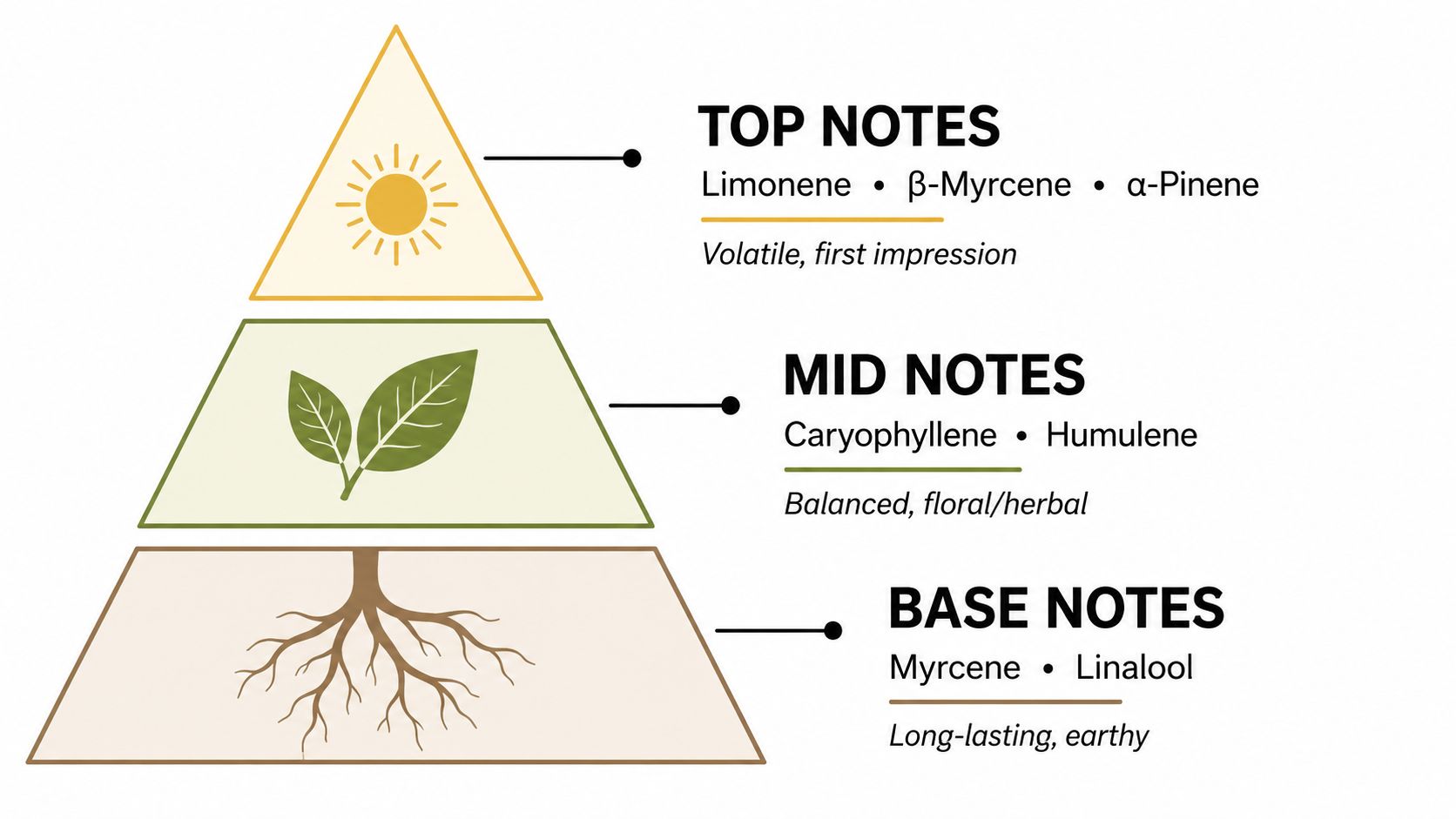
A cartridge doesn't present flavor all at once. It opens with top notes, moves through the middle, and then leaves a finish, and the best blends respect that sequence instead of fighting it. In cannabis formulation, monoterpenes typically do the heavy lifting up front, while sesquiterpenes keep the profile from collapsing after the first impression.
The practical split is straightforward. Limonene, β-myrcene, and α-pinene usually behave like top notes, because they're volatile and immediate. β-caryophyllene and α-humulene are more useful as base-note anchors, and they help the vapor feel fuller and more complete rather than sharp and one-dimensional.
That hierarchy lines up with the composition data. Across studied profiles, 87.1% to 99.5% of terpene content was made up of monoterpenes, while sesquiterpenes accounted for only 0.5% to 12.9% (terpene composition review). That's why a formula that loads too heavily into the front end can smell strong in the cup and then vanish on the exhale.
How to audit note balance
- Check the opening: If the first inhale is all brightness and no structure, the top note is doing too much.
- Check the middle: A blend needs a bridge between the volatile lift and the finish, or it feels thin.
- Check the tail: If the flavor disappears too fast, the base-note share is too light for the hardware and oil matrix.
- Check the readout: A terpene list that's heavy on monoterpenes but light on support compounds often sounds lively in a description and weak in a cart.
For formulation teams, the top/mid/base lens becomes useful. It gives you a practical way to compare two strain-inspired blends without getting lost in a long analyte list, and it helps explain why some carts feel polished while others feel like they stop halfway through the draw.
How Terpenes Interact With Cannabinoids in a CBD Product
Terpenes aren't just flavor carriers, they also help position how a CBD product is perceived. A 2021 Scientific Reports study found cannabis terpenes were cannabimimetic and selectively enhanced cannabinoid activity in preclinical models (terpene and cannabinoid study). That doesn't justify medical claims in product copy, but it does support the formulation habit of treating terpene choice as part of effect positioning, not only aroma design.
For product development, that means the same CBD base can be framed differently depending on the terpene blend. A limonene-led profile tends to read brighter and more open, while a myrcene- and linalool-led blend feels softer and more grounded. Those are commercial descriptors, not clinical claims, and they're useful because buyers need language that fits use occasion, not just chemistry.
The entourage conversation matters here, but only when it stays anchored to formulation reality. Terpenes and cannabinoids don't operate as separate silos inside the cartridge, and the blend you choose changes the sensory story the product tells. That's the part worth building into a SKU brief before the first pilot batch, not after launch when the line feels inconsistent.
For a related formulation perspective, the terpenes and cannabinoids guide is a useful internal reference.
Loading Levels, Heat Stability, and Carrier Choices
The hardest mistakes happen when a team assumes terpene percentage is only about flavor intensity. In reality, loading affects viscosity, coil behavior, aroma impact, and how fast a blend can feel harsh if the profile is pushed too high for the matrix. Recent research also flags that terpene chemistry remains highly variable and that real-world behavior across storage, heat, and vaporization still isn't fully characterized (recent terpene chemistry review).
Start with a defensible band
In practical cart work, a moderate terpene load is usually easier to manage than an aggressive one. If the goal is a strain-true cart, build from the natural ceiling instead of forcing aroma into the oil until it smells loud in the beaker. That approach keeps the blend closer to realistic plant chemistry and usually gives you better control over mouthfeel and wicking.
A few compatibility checks matter every time:
- Viscosity first: If the oil thins too far, the hardware may flood or overdeliver.
- Heat response: Terpenes are volatile, so higher thermal stress can flatten or distort the profile.
- Carrier selection: The carrier system has to stay clean and consistent with the rest of the formula.
- Batch stability: A blend that smells right on day one can drift if it isn't verified after storage.
If a cartridge only works at one temperature window, the formula still needs work.
The boiling behavior of terpene-rich blends is one reason formulation teams should test rather than assume. A useful reference on that point is boiling point behavior for terpene blends. For a broader process view, here's a short video reference many development teams keep on hand:
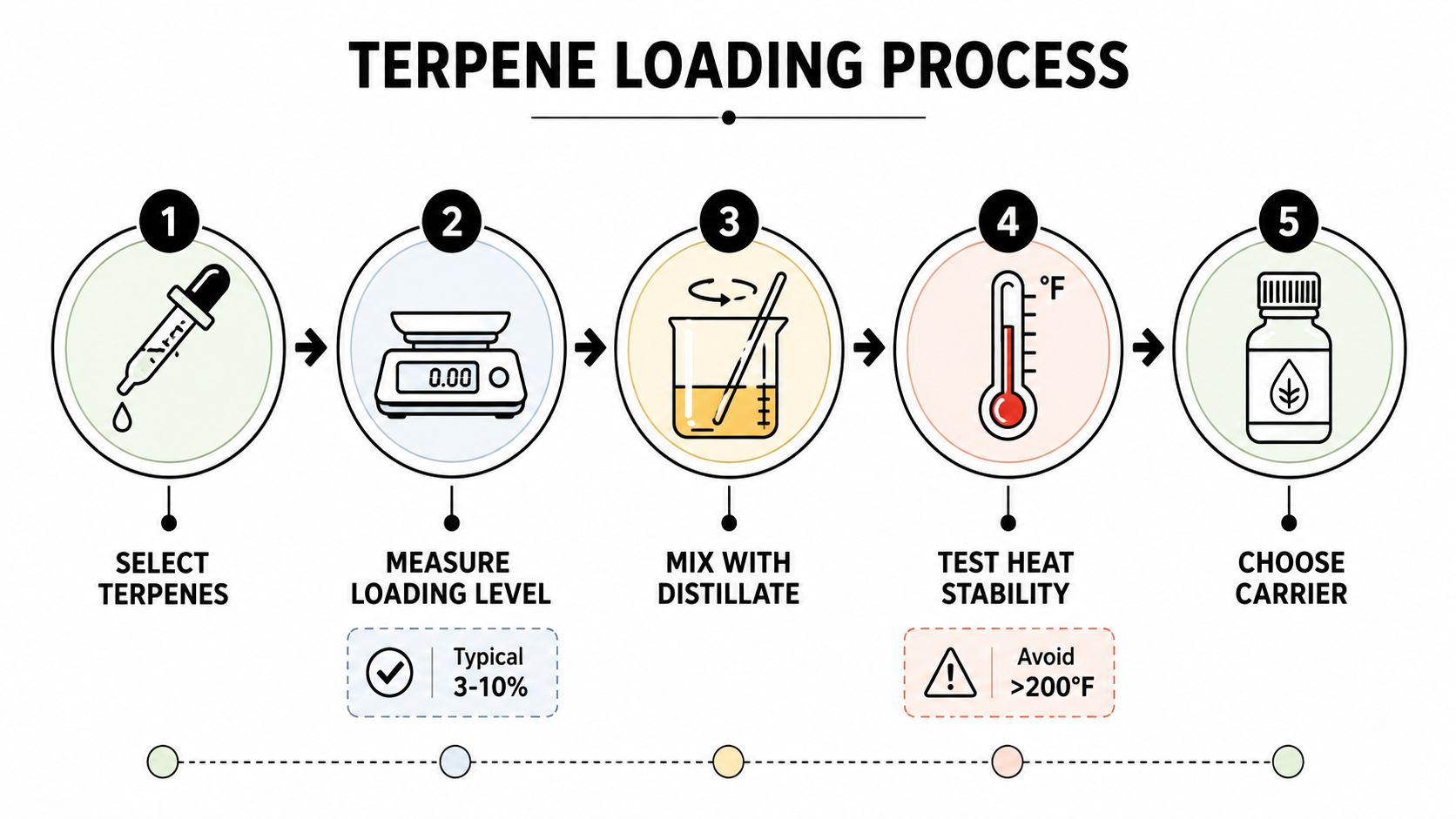
The practical workflow is simple. Select the terpene set, measure the loading, blend it into the distillate, test how it behaves under heat, then confirm the carrier system doesn't introduce new problems. The science leaves room for internal testing, so your pilot runs should answer questions about stability, flavor retention, and draw quality before you lock a production spec.
Quality, Safety, and What to Verify Before You Buy
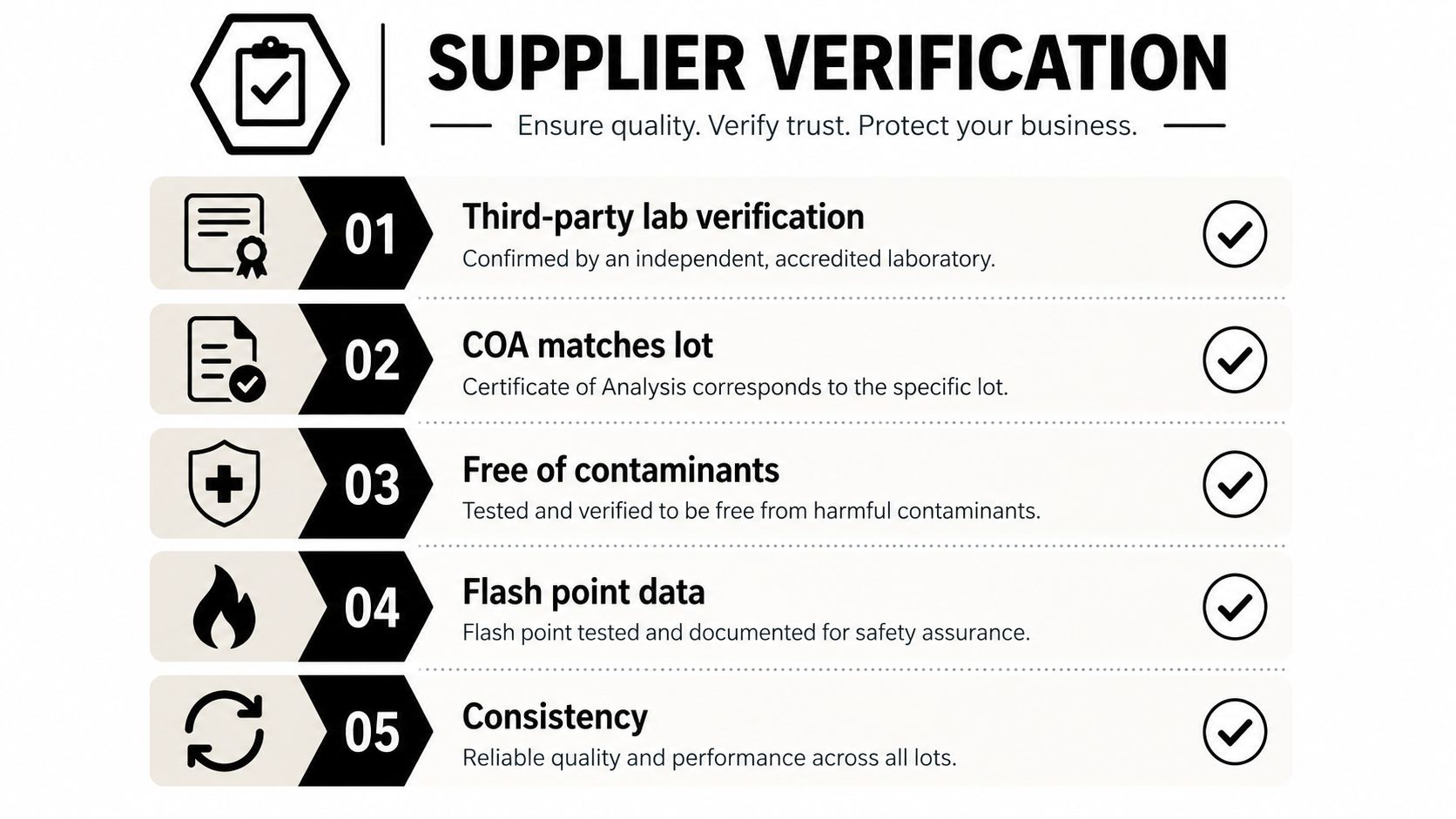
A terpene supplier should make verification easy, not vague. For any lot you plan to put into cartridges or branded CBD oil, ask for third-party lab verification, a COA that matches the exact lot, and a clear ingredient breakdown that states what's in the blend and what isn't. That matters because terpene claims only mean something when the paperwork matches the material in your tank.
What to look for on the document set
- Lot-specific COA: The report should match the exact batch you're buying.
- Clean carrier statement: Confirm the blend is free of VG, PG, PEG, and MCT if that matters to your spec.
- Compliance language: The supplier should state the applicable regional status clearly.
- Consistency across orders: If the profile is strain-authentic, the repeat order should behave like the first one.
- Contaminant clarity: Don't rely on marketing copy when the COA can answer the question directly.
“THC-free,” “plant-derived,” and “strain-authentic” are useful terms only when the supplier backs them with recent testing and transparent composition data. If the COA is old, incomplete, or detached from the lot in hand, the claim isn't operationally useful. A formulator should treat that as a red flag, not a minor paperwork issue.
Gold Coast Terpenes is one example of a supplier that publishes terpene blends and formulation resources for cartridge and concentrate work, along with lab verification and education materials. A supplier like that belongs on a shortlist only after the documents match the spec and the blend behaves the same way from batch to batch.
Designing a Terpene Strategy That Scales Across SKUs
More terpene load doesn't automatically mean a better cart. Heavy aroma can hide balance problems for one batch and create them in the next, especially when hardware, oil viscosity, and storage conditions shift. The better goal is repeatable profile identity, because that's what scales across SKUs without making every product fight the same sensory battle.
Build a small internal library of marker ratios for your core profiles, then keep the same decision logic across distillate, cartridges, and adjacent formats. A good strain-inspired blend is a marker-and-balance exercise, not a race to saturate the oil. If the profile is clean, stable, and recognizable across batches, it will do more for the brand than a louder but less usable formula.
For follow-on work, keep a terpene guide and a mixing calculator in the same workflow as your COA review, so decisions don't live in different folders. That's how product teams move from guessing to replications that hold up in market.
If you're building CBD cartridges, strain-inspired blends, or distillate formulas and want terpene components that are consistent from lot to lot, visit Gold Coast Terpenes to review product options, formulation resources, and batch documentation. Their terpene blends, guides, and calculators are built for the kind of bench-level work covered here, not casual flavor browsing.