
Most advice about terpenes that cause anxiety starts with the wrong question. Formulators don't need a simple avoid list, because the same terpene can feel flat, calming, or overstimulating depending on THC potency, CBD buffering, dose, route of administration, and the person using it. If you build vape carts or concentrates for anxious consumers, the actual job is to control the whole sensory system, not just delete a terpene because somebody called it “bad.”
That matters because the data points in a different direction than the folklore. A 2024 human study found D-limonene lowered THC-related “anxious/nervous” and “paranoid” ratings, and the effect increased with dose, while a broader review found cannabis use is associated with anxiety at the population level, with an odds ratio of 1.24 for anxiety and cannabis use and 1.68 for anxiety and cannabis use disorder, based on 15 and 13 studies respectively, showing the cannabinoid context is doing a lot of the work (Johns Hopkins Medicine). For a broad consumer-facing framing problem, the old Indica versus Sativa shortcut still gets people into trouble, which is why many brands keep a terpene education page like this internal guide on sativa and anxiety close at hand.
The Anxiety Question Most Formulators Get Wrong
The phrase terpenes that cause anxiety sounds precise, but in formulation work it usually hides three separate variables. One is concentration. Another is the cannabinoid base, especially THC-dominant versus CBD-buffered material. The third is the delivery format, because an inhaled profile doesn't behave like an oral one, and a live resin cart won't hit like a stripped distillate blend.
Stop treating terpene names like a binary label
The strongest evidence does not support a universal “anxiety terpene” category. A peer-reviewed review notes that the anxiety risk signal is strongest for THC itself, while terpenes are more often linked with anxiolytic effects, but it also says the literature is still conflicting and not yet backed by rigorous controlled human trials (Springer review). That's the part a lot of content leaves out, because binary lists are easier to market than formulation nuance.
For product teams, the more useful question is whether a terpene profile is likely to sharpen THC's edge, soften it, or disappear into the background. High-THC material can still feel edgy even when the terpene profile is polished, and CBD can buffer some of that psychoactivity. So the profile matters, but it never acts alone.
Practical rule: if a cart feels “racy,” don't blame the terpenes first. Check the THC load, the CBD ratio, and the vapor behavior before you pull a terpene out of the blend.
That's why a formulation guide for calmer cartridges should focus on interaction design. A terpene can be part of a soothing profile in one matrix and still feel too sharp in another, especially if the base oil is already pushing the product toward a heady, fast onset. If you're building for anxiety-sensitive buyers, your formulation brief needs a context matrix, not a blacklist.
What the Evidence Actually Shows About Terpenes and Anxiety
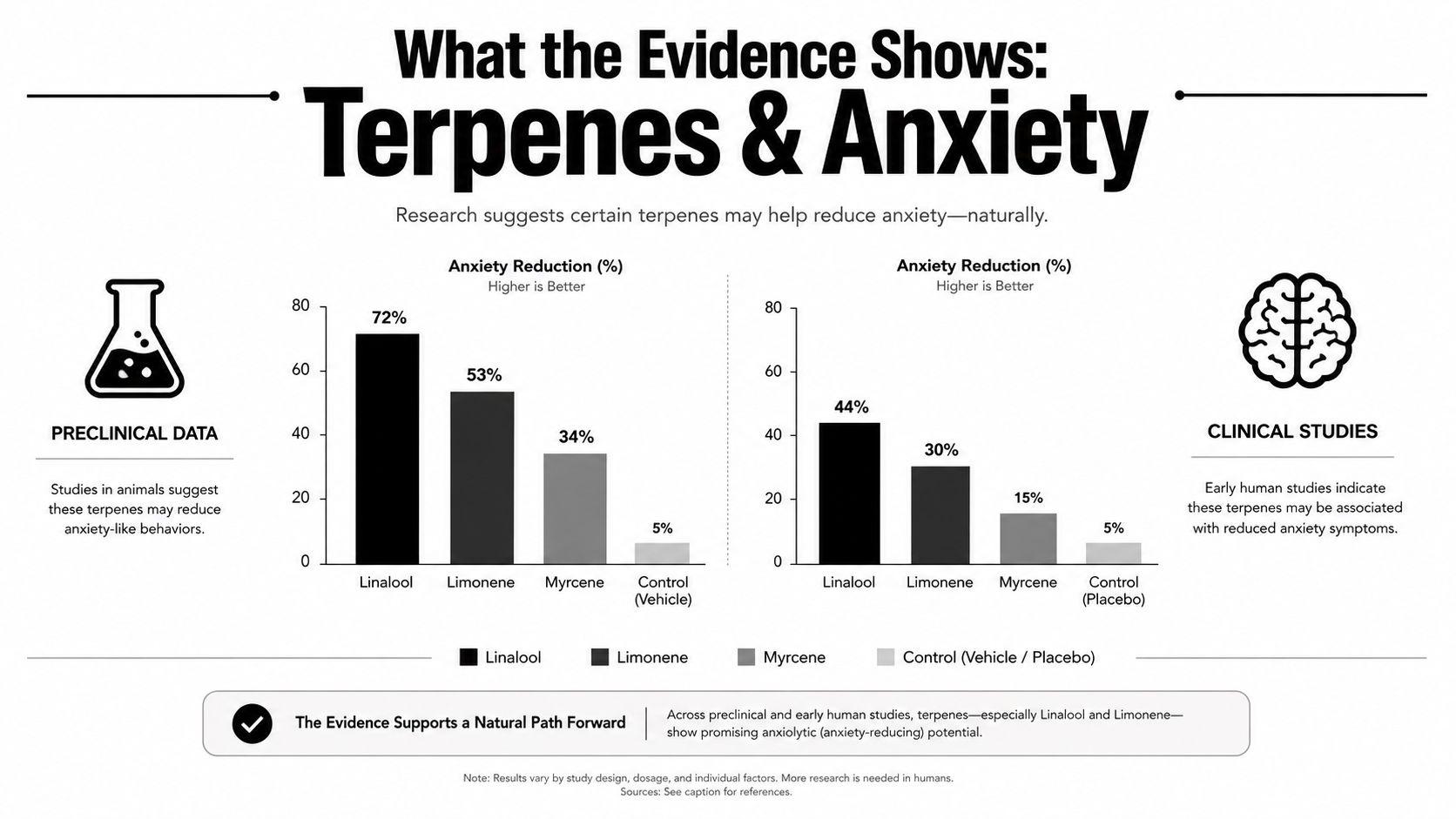
The human evidence does not support a simple rule that terpenes cause anxiety. The cleanest signal so far points the other way for D-limonene, at least in a cannabis context. In a 2024 randomized human study in healthy adults who intermittently use cannabis, vaporized D-limonene reduced THC-related anxiety. Compared with THC alone, adding limonene lowered subjective ratings of feeling “anxious/nervous” and “paranoid,” and the effect increased with dose. Johns Hopkins Medicine reported that finding, and for formulation work it matters because it shows a terpene can shift the anxiety profile of a cannabis exposure in humans, not just in animal models.
What the field data suggests
Field data points in the same direction, although the setting matters. A review of plant-emitted monoterpenes summarized human evidence showing that terpene exposure can shift anxiety scores in real-world use. In forest-therapy sessions, higher total monoterpene exposure was associated with a decrease of −1.28 STAI-S points, and focused analysis on α-pinene showed a decrease of −1.31 STAI-S points. Higher exposure above the third quartile of α-pinene showed an even larger drop of −1.68 STAI-S points (PMC review). That does not prove every pine-forward blend will feel calming, but it does give the pinene family a credible human signal when inhaled in naturalistic conditions.
Why preclinical work still matters
Preclinical studies help explain why those human signals are plausible. In rats, acute oral bisabolol and D-limonene increased food consumption, and bisabolol, D-limonene, α-pinene, and β-caryophyllene reduced time spent in the outer zone in a novelty-induced hypophagia test, which is consistent with anxiolytic-like behavior (Liebert article). In a separate review of pinene and linalool literature, inhaled α-pinene at 10 μg/L air for 60 and 90 minutes increased time spent in the open arms of the elevated plus maze in mice, and inhaled linalool oxide at 0.65%, 1.25%, 2.5%, and 5.0% for 7 minutes also produced anxiolytic effects, with the 5.0% dose showing efficacy similar to a 0.5 mg/kg diazepam positive control (PMC review). For a closer look at how these compounds affect perception and neurobehavioral response, a practical overview is available in this explanation of how terpenes affect the brain.
For formulators, the practical takeaway is straightforward. Limonene, pinene-family components, and linalool-family components have the strongest support for calmer positioning. That does not make them universally calming, but it does mean the evidence is not pointing to them as primary anxiety triggers. The formulation question is how they behave in the full matrix, especially alongside THC, delivery method, and user sensitivity.
Terpenes With Negative Anxiolytic Signals
Not every terpene belongs in an anxiety-conscious blend. Some compounds show weaker calming performance, and a few appear repeatedly in profiles that underperform on relief-oriented positioning. That doesn't mean they “cause anxiety” in a medical sense. It means they're poor candidates when the goal is a softer sensory arc and lower stimulation.
The compounds that deserve caution
A systems analysis cited in the literature found negative correlations with anxiety relief for guaiol, eucalyptol, gamma-terpinene, alpha-phellandrene, 3-carene, and sabinene hydrate. Guaiol stood out because it appeared in the three least effective strains for anxiety and in none of the most effective ones (systems analysis summary). That makes guaiol a practical candidate to exclude when you're building a calmer strain-inspired terpene blend for vape cartridges.
The point isn't to ban every one of these compounds forever. The evidence is still uneven, and some of these signals are based on correlations rather than controlled human comparisons. But when you're choosing between two nearly identical flavor bases, the safer commercial move is to favor terpenes with better support instead of leaning on a compound that keeps showing up on the wrong side of the matrix.
| Terpene | Evidence Strength | Formulation Consideration |
|---|---|---|
| Guaiol | Stronger negative signal in systems analysis | Exclude or keep very low in anxiety-conscious blends |
| Eucalyptol | Negative correlation with relief | Use carefully if you need a sharper, more medicinal top note |
| Gamma-terpinene | Negative correlation with relief | Avoid when the target is a calm sensory profile |
| Alpha-phellandrene | Negative correlation with relief | Keep out of soft, relaxing builds |
| 3-carene | Negative correlation with relief | Better suited to profiles that are not calming-first |
| Sabinene hydrate | Negative correlation with relief | Avoid in anxiety-sensitive SKUs |
Why this is still a formulation decision, not a moral one
Some of these terpenes can still be useful in the right sensory architecture. A crisp top note can help a profile feel clean, especially in fruit-forward carts or bright hybrid replicas. But when the brief is calmer sensory positioning, these compounds should be treated as conditional ingredients, not default inclusions.
If your team already uses a terpene education resource, a page like this internal terpene overview can help keep the discussion focused on profile behavior rather than folklore. The commercial logic is straightforward, keep the profile readable, but don't let a sharp terpene dominate a product meant to feel steady.
The Dose-Context Matrix That Determines Anxiety Response
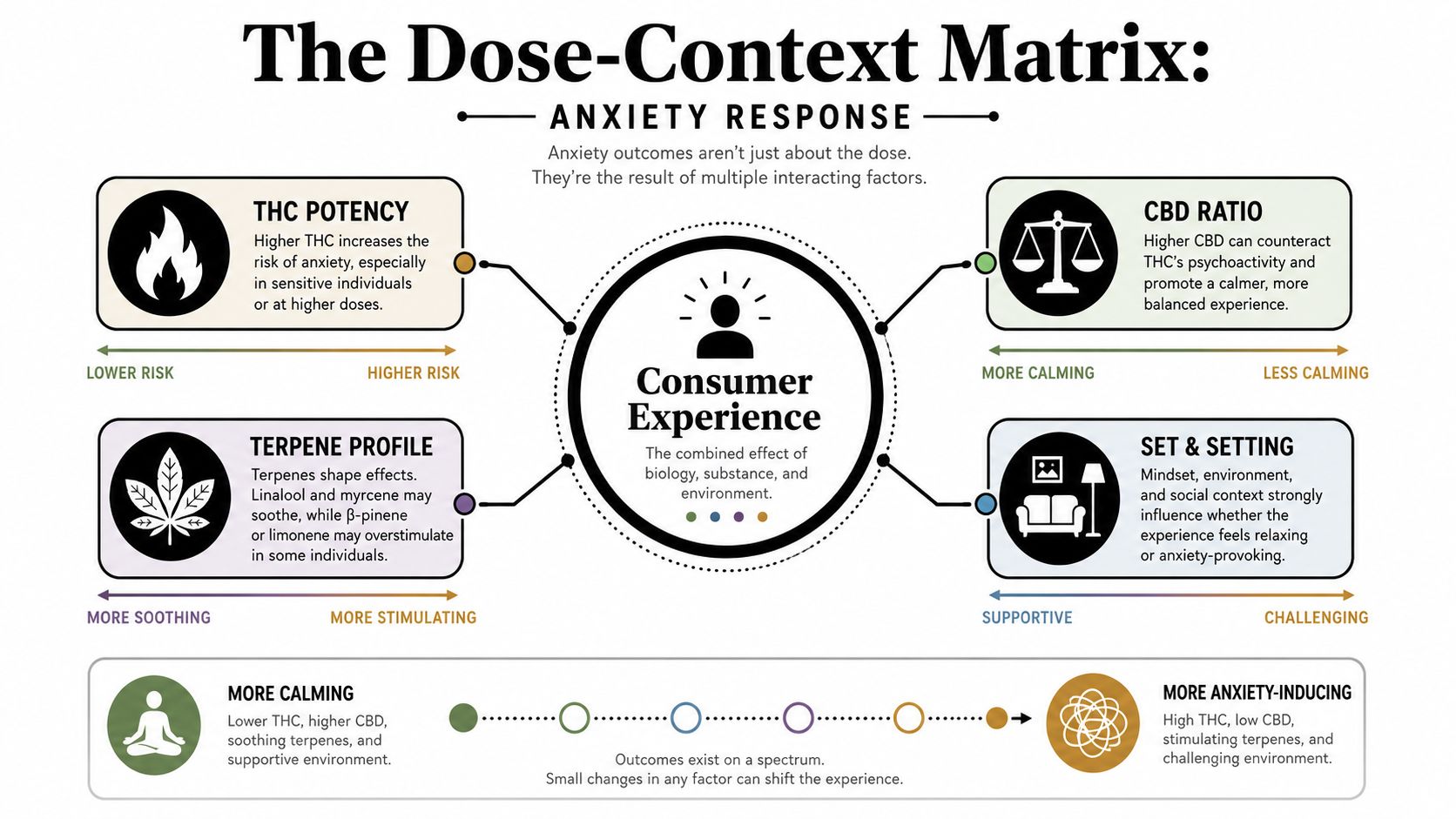
The same terpene can read differently once it is placed into the full formula. That is the part brands miss when they ask for a single “anxiety-free” ingredient list. THC potency, CBD ratio, terpene concentration, delivery method, and individual biology all shape the final experience, and a blend that feels steady for one segment can feel too sharp for another.
Sex and delivery route change the readout
Recent preclinical work published in 2025 found that linalool and β-myrcene produced anxiolytic effects in female mice with discrete vapor pulls, while male mice showed the effect only with a single vapor hit. The same work found CBD synergized with linalool in females, but not with myrcene or in males (PubMed record). That matters for cart design because inhale pattern is part of the formula, not just a user habit.
The oral route also behaves differently. In rat data, acute oral bisabolol, limonene, α-pinene, and β-caryophyllene reduced anxiety-like behavior in one model, which tells you route matters even before user biology enters the picture. A terpene that feels balanced in an ingestible or oral oil can land very differently in a vaporized cart.
Formulation rule: judge a terpene profile by the delivery route, the cannabinoid base, and the likely inhalation pattern, not by the ingredient list alone.
A practical decision framework
For anxiety-conscious products, start with the cannabinoid base. High-THC formulas need more terpene discipline than balanced or CBD-forward formulas because THC is the main driver of the anxious edge. Then check the terpene architecture. Bright top notes can lift a profile, mid-notes carry the body, and base notes determine whether the finish feels soft or persistent.
A workable internal checklist looks like this.
- High-THC base: keep sharp or potentially overstimulating terpenes low, because the cannabinoid load already pushes the profile toward intensity.
- CBD-buffered base: you have more room for aromatic lift, but the terpene blend still needs to stay coherent.
- Inhaled cartridge: treat concentration like a sensory lever, because vapor delivery makes the top-note read much faster.
- Oral or ingestible format: expect a slower, less linear profile, so the same terpene mix can feel more muted.
If your team needs a reference point for ratio planning, this internal terpene ratio guide is a practical companion piece. The outcome depends on the matrix, not on labeling any single terpene as good or bad.
Formulation Strategies for Anxiety-Conscious Products
Calmer carts are built by stacking the right roles, not by chasing one magic terpene. I usually think in top notes, mid notes, and base notes, then test how the cannabinoid base changes the read. For anxiety-conscious positioning, limonene and α-pinene can work as controlled top-note lifts, while linalool-family components do better as mid-note anchors when you want the finish to stay soft.
Build the blend from the cannabinoid base up
A high-THC distillate needs more restraint than a balanced or CBD-rich oil. If the goal is a calmer sensory profile, keep the top-note brightness clean but not piercing, then let the mid-note carry most of the aroma. The wrong move is piling on aggressive pine, solvent-like freshness, and a heavy THC load at the same time.
One useful reference point is Gold Coast Terpenes, which supplies terpene isolates and strain-specific blends for cartridges, concentrates, and formulation work, including Limonene, Myrcene, and Beta-Caryophyllene options for profile tuning. That kind of modular sourcing helps when you need to trim a profile without rebuilding the entire flavor architecture.
Use flavor accuracy without overdriving the profile
Replicating a strain does not mean copying every terpene at full strength. If a target profile leans bright, keep the citrus or pine expression present, then support it with quieter backbone notes so the cart doesn't feel thin or sharp. If the profile is meant to read relaxing, pull back any compound that pushes the nose upward too fast.
A simple way to think about it:
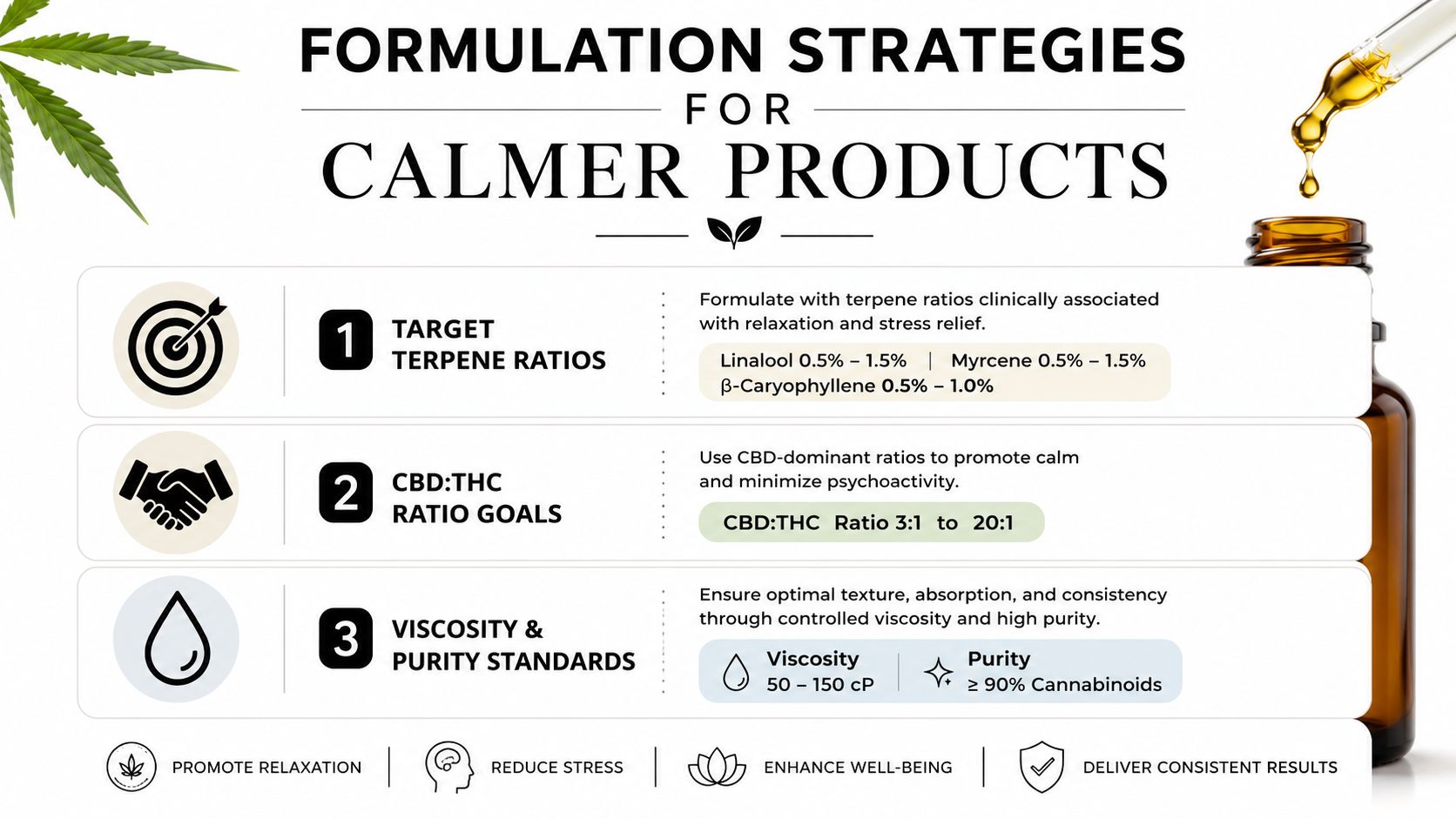
- Target Terpene Ratios. Use the terpene mix to shape the first impression, not overpower the oil.
- CBD:THC Ratio Goals. Let the cannabinoid base do part of the calming work.
- Viscosity and Purity Standards. Keep the oil clean enough that the aroma reads consistently from first puff to last.
Commercial reality: a smoother profile usually wins because it survives real-world use better. Harshness, not just chemistry, is what sends an anxiety-sensitive buyer away.
Keep negative-signal terpenes on a short leash
If your blend includes guaiol, eucalyptol, gamma-terpinene, alpha-phellandrene, 3-carene, or sabinene hydrate, treat them as deliberate accents, not filler. In calming SKUs, I'd rather simplify the build and let a smaller set of supportive terpenes carry the experience than hide a sharp edge behind complexity.
If you are building for vape cartridges, test the same profile at more than one load level before locking the spec. The terpene that smells balanced on paper can feel very different once it's aerosolized.
Testing and Quality Control for Consistent Sensory Profiles
A calming formulation fails fast if batch quality drifts. Terpene verification, storage control, and stability checks matter because volatile compounds shift the sensory read long before a customer notices a formal defect. If you're selling cartridges or concentrates, consistency is part of the formulation, not just the QA file.
Verify what you think you blended
Start with certificate of analysis review on every incoming terpene lot and finished oil batch. The COA should match the intended profile closely enough that you can spot a swapped lot, a degraded isolate, or a supplier variance before it gets filled. For anxiety-conscious products, that matters more than it does for loud novelty flavors, because small shifts can make the cart feel sharper than intended.
Batch-to-batch checks should focus on the ingredients that carry the sensory outcome. That means looking at the core calming-supportive terpenes, not just total terpene content. If a profile leans on linalool-family softness or limonene brightness, track those components explicitly.
Test stability like you mean to sell it
Heat, light, oxygen, and long storage all change terpene expression. A profile that reads clean at pack-out can drift into a harsher top note after sitting in inventory or shipping through warm conditions. Stability testing should include the finished cartridge format, not just the isolated blend, because hardware and oil viscosity influence how the terpenes present.
Use a simple internal standard for acceptance. If the aroma, throat feel, or onset style shifts outside your target window, the batch should get reviewed before release. That kind of discipline saves brands from shipping products that technically pass but feel off.
Work with suppliers on specification compliance
Don't buy terpenes by name alone. Lock down the specification, then keep the blend tied to that spec across production runs. If your sourcing includes multiple terpene product lines, keep the calming-oriented profiles separate from the sharper, more energetic ones so they don't get mixed by mistake.
A practical way to approach this is through three steps. Brands like Gold Coast Terpenes that keep calmer carts consistent tend to do one thing well. They treat terpene QA as a sensory control system, not a paperwork step. That means matching incoming lots against a written sensory spec, checking storage conditions before fill, and rejecting runs that drift toward a hotter, more aggressive profile.
Real-World Formulation Scenarios and Solutions
A good calming profile usually comes from compromise, not purity. One brand may need to preserve a recognizable strain-inspired nose, while another needs a softer cart for anxious buyers who hate harsh pine or overly bright citrus. The best solutions respect both the chemistry and the commercial brief.
A high-THC distillate that needed less edge
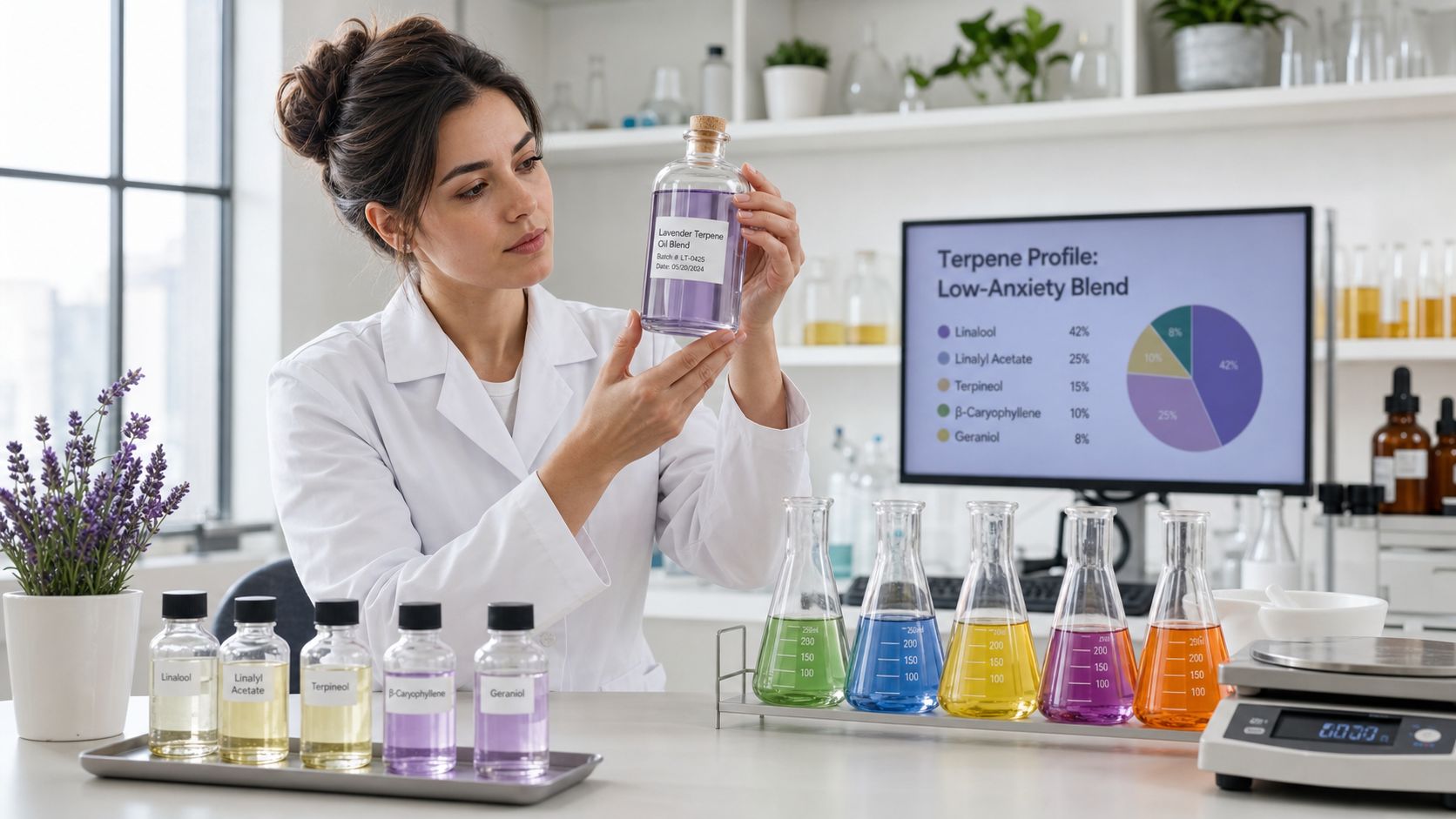
One common project starts with potent distillate that tastes flat and hits too hard. The fix is not to bury the THC under a loud perfume. It's to rebuild the profile with a controlled top note, a soft mid-note, and a finish that doesn't spike the throat.
In practice, that means using a measured amount of limonene for brightness, a supporting pinene-family note for lift, and a quieter floral or herbal backbone to round off the inhale. The result is still recognizable as a terpene-rich cart, but it no longer feels like the profile is fighting the cannabinoid base.
A CBD-forward blend aimed at calmer positioning
CBD-dominant formats give formulators more breathing room. You can keep more aromatic lift without pushing the consumer into the tense, racy territory that a THC-heavy cart can trigger. The challenge is avoiding a profile that becomes bland, because flat carts sell poorly even when they're technically smooth.
For those projects, I usually keep the brightest notes clean and reduce the compounds with weaker calming signals. If I need more sensory depth, I lean on balance rather than intensity. The profile should feel composed, not sleepy by default.
A strain-inspired blend that still has to be commercial
Replication work is where people overcomplicate things. A faithful aroma match doesn't require every original terpene at full strength, and in anxiety-conscious products it usually shouldn't. The goal is to preserve the identity of the strain while trimming the parts that make the finish feel sharp or too active.
That's the commercial sweet spot. Keep the recognizable signature, remove the sensory friction, and make sure the product still fills and vapes cleanly. If the customer gets the right aroma but the wrong feel, the formulation missed its mark.
If you're building calmer vape carts, terpene selection should be one part of a broader formulation system, not a superstition. Gold Coast Terpenes supplies strain-specific blends, isolates, and formulation materials that can help you tune aroma, balance, and sensory impact without guessing. Visit Gold Coast Terpenes to review terpene options, compare profiles, and choose components that fit your next cartridge or concentrate brief.