
You can build a clean terpene profile, pass sensory, hit target viscosity, and still get blindsided by a metals failure after launch. That usually happens when heavy metal screening gets treated like a late-stage certificate instead of a sourcing and process-control decision. In extract work, the lab result is only as useful as the matrix, the sample prep, and the contamination points you've already controlled.
A well-run vape or concentrate program needs the same discipline you'd use for flavor accuracy. The extract, the hardware stack, the water, the biomass, and even the way a sample gets trimmed for shipment can change what the lab sees. If you're formulating for cartridges or distillate, the right metals program protects more than compliance. It protects release timing, retailer trust, and the repeatability of your terpene-driven SKUs.
Why Heavy Metal Screening Belongs in Every Extract Workflow
A brand can do everything right on paper and still end up with a failed panel after product is already in market. I've seen that pattern show up most often in terpene-forward carts, where the aroma is on point, the fill looks clean, and the customer feedback is good, until a later lot exposes a metals problem buried upstream. The failure is rarely the terpenes themselves. It's usually the extract, the biomass, the water, or the equipment path that carried the contamination in.
That's why heavy metal screening belongs inside formulation and sourcing, not just at the end of the compliance queue. Multi-metal exposure is common in population biomonitoring, not just rare poisoning cases, and the NHANES analysis found 49.3% of people ages 6 and older had a detectable combination of three or four metals at or above population-median levels, while only 8.4% had none of those four metals detected at or above the medians, with urine detectability at 85.8% to 98.5% and blood detectability at 69.8% to 99.5% across the four metals (NHANES analysis). That matters in cannabis because the testing problem is not always “poisoning.” More often, it's background exposure becoming concentrated by the time a batch is refined.
Source contamination and process contamination are not the same problem
Soil, irrigation, nutrients, and post-harvest handling create one layer of risk. Extraction vessels, solder, brass fittings, storage containers, and fill hardware create another. When formulators blur those together, they end up fixing the wrong thing.
A simple working rule helps:
Practical rule: if the metal load follows the biomass, look upstream. If it shifts after extraction or transfer, look at the process hardware and consumables.
Michigan's reporting history shows why interpretation matters, not just detection. In 2024, the state logged 53 reports on 52 people above action thresholds from 14 laboratories, with 62% of affected individuals male and one child under 16. In 2007, the state received 13,245 total reports on 7,013 individuals, and 254 exceeded action thresholds, with 75% of elevated arsenic results linked to seafood consumption (Michigan Heavy Metals Annual Report). In other words, a number by itself does not tell you where the contamination came from.
For extract makers, that means a metals screen is a control point, not a verdict. If you build it in early, you can reject a contaminated biomass lot, audit a leaching fitting, or adjust a post-processing step before you waste terpene inventory and packaging.
The Four Regulated Metals and Where They Actually Come From
The four metals that dominate cannabis panels are lead, cadmium, mercury, and arsenic. They behave differently, and they enter the workflow through different doors. If you know where each one usually comes from, you can stop treating a failure as a mystery and start tracing it like a process map.
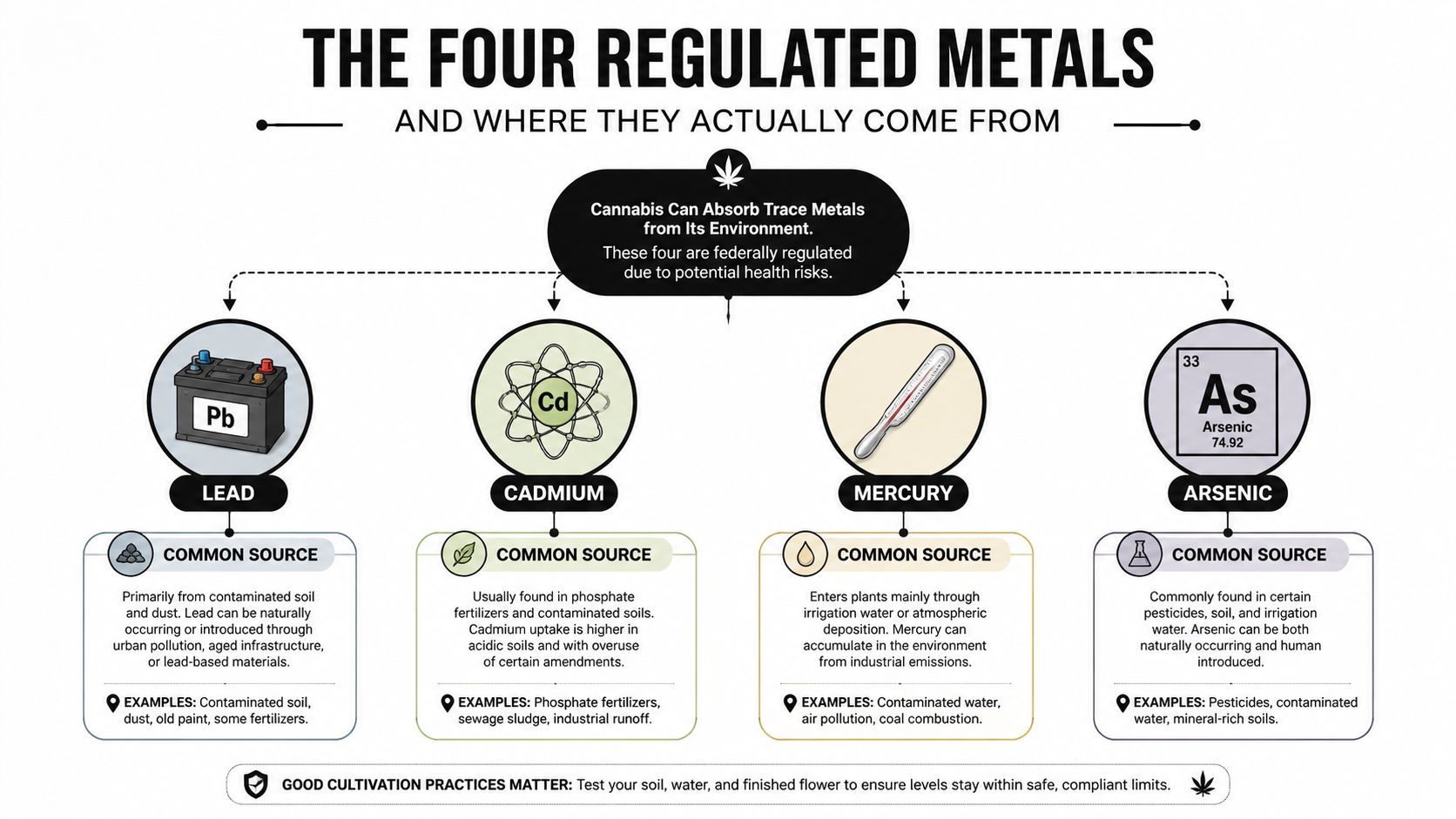
Lead and cadmium usually start upstream
Lead often shows up through legacy plumbing, brass fittings, old solder, and contaminated soil. In an extraction setting, that means the issue may never touch your terpene blend directly. It can ride in through biomass, water, or equipment contact before it ever reaches a winterized oil.
Cadmium is more likely to come from phosphate fertilizers and accumulator plants. That makes it a sourcing issue as much as a cultivation issue. If a supplier can't explain nutrient inputs or growing media, the risk doesn't disappear because the lot smells clean.
Mercury and arsenic need a broader lens
Mercury is less common in everyday cannabis conversations, but it can appear through certain fertilizers or catalyst residues. Arsenic has a wider web of potential sources, including herbicides, wood preservatives, and contaminated water. That makes it especially important to check both the grow site and any water used during cultivation or cleaning.
For formulators, the useful question is not “Which metal is the bad one?” The useful question is “Which part of my workflow could realistically carry this metal into a finished vape oil or concentrate?” If the answer is biomass, you tighten upstream approval. If the answer is equipment, you audit the contact surfaces and transfer steps. If the answer is neither, the lab method and sample prep deserve another look.
Comparing ICP-MS, ICP-OES, and Portable XRF for Extracts
A lab quote can look efficient and still miss the point. If the instrument does not match the matrix, you pay for a result that feels official without telling you much about the lot on your table. For terpene-forward extract and vape work, the choice usually sits between ICP-MS, ICP-OES, and portable XRF.
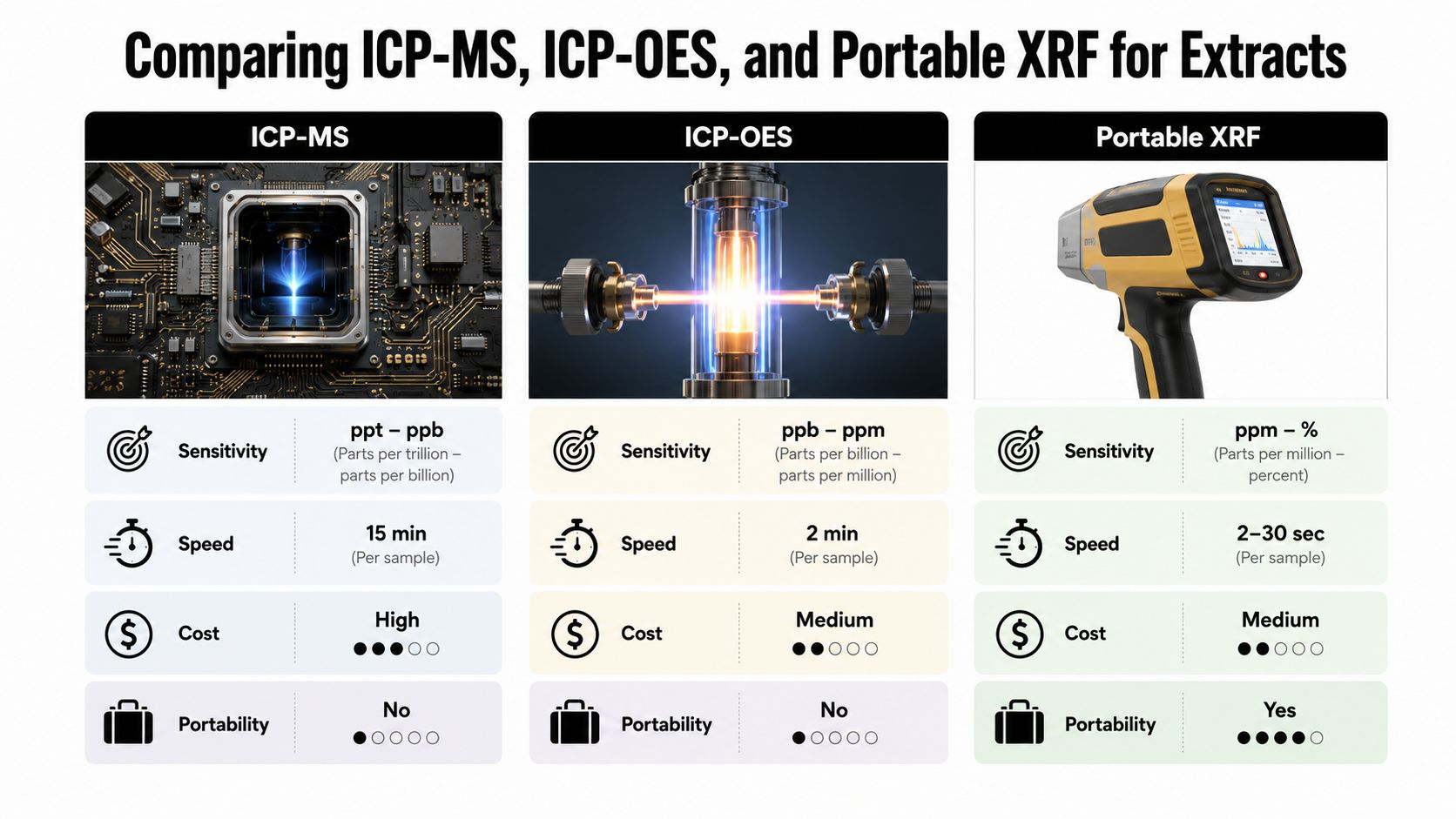
These methods solve different problems. ICP-MS is the stronger choice for low-level release decisions on finished extract or vape oil, ICP-OES is better suited to routine in-process checks where sensitivity can be a little less aggressive, and portable XRF is a field tool for screening incoming material or checking surfaces before a batch ever gets close to filling. The same principle applies across testing disciplines, the matrix controls what the instrument can tell you, and the question should be whether the method fits the material in front of you. In broader exposure testing, blood is used to assess recent or acute exposure and urine reflects recent exposure and excretion, with 24-hour urine being the most accurate urine method in that setting (expert overview).
How the three methods differ in practice
ICP-MS is the closest thing to a low-level release method for cannabis panels. It handles complex matrices such as distillate and vape oil well, which matters when you need tight detection limits and a clean read on a finished SKU. In practice, that makes it the method I would trust when the lot is headed to market and you need to know whether the number on the certificate is defensible.
ICP-OES sits in the middle. It is a practical choice when turnaround matters and the question is routine monitoring rather than the lowest possible detection limit. I use it more readily for in-process verification than for final release on a tight spec, especially when I am watching whether a supplier or process change has pushed the material in the wrong direction.
Portable XRF is useful for incoming biomass checks, equipment audits, and other spot checks where you want to find a problem fast. It is not the tool I would use to certify a finished lot. Real-world screening work on contaminated soil showed portable XRF is useful for rapid hotspot identification, while its detection limits are generally weaker than ICP-based methods, which makes it better for locating contamination than proving a low-level pass (PubMed-indexed soil study).
Practical rule: use XRF to find the problem, use ICP-based methods to prove whether the batch passes.
If you are writing an RFP, ask for the method that fits the matrix, not the lowest line item on the quote. A supplier proposing XRF for final release on a cartridge lot is selling convenience, not a result you can defend in a compliance review. For extract teams, that difference matters because the wrong method can hide the contamination path instead of showing it.
A more useful way to think about screening is to tie the method to the contamination point. If you are trying to catch a problem in biomass or on processing surfaces, use a tool that can move quickly and show you where to look. If you are deciding whether a winterized oil, distillate, or finished cartridge can leave the facility, use a method built for low-level quantification and documented release decisions. That same logic is why contamination prevention matters before testing, and ways to prevent contamination belongs in the same conversation as instrument selection.
Quality control testing guidance fits naturally into the same workflow when you are building a release program around extract, flavor, and contamination controls.
Sampling and Preparation Practices That Hold Up Under Audit
A metals screen can fail because the sample was bad, not because the batch was bad. That's the part many teams underestimate. A clean instrument cannot rescue a biased grab sample, a dirty grinder, or a jar that shed contamination during transfer.
Dried biomass needs representative sampling because cannabis is heterogeneous. Crude extract and winterized distillate need homogenization because waxy material separates unevenly. Finished vape oil and cartridges need careful transfer because the last thing you want is contamination from the tools used to decant or combine the sample.
Use the matrix to decide how to sample
For biomass, pull multiple increments from the batch and combine them into a composite. For concentrates, warm only enough to make the material workable, then homogenize before subsampling. For vape oil, sample after the blend is fully mixed, not before the final transfer. For finished cartridges, treat the device as a finished good, not a loose oil sample, because the hardware itself can affect what the lab sees.
Three mistakes come up again and again:
- Grinding with the wrong tool: metal equipment can introduce contamination during prep.
- Using low-grade storage containers: the sample can pick up contaminants before it reaches the lab.
- Skipping chain-of-custody details: a perfect result still looks weak if the paperwork can't show who handled the sample and when.
Clinical guidance makes the same point in another setting. Seafood, recent iodine or gadolinium contrast, and environmental exposure can all interfere with interpretation, and Mayo Clinic Labs advises 48 hours without seafood and 96 hours after iodine or gadolinium contrast before a 24-hour urine test (clinical testing guidance). The cannabis parallel is simple. Consumables, cleaning residues, and sample prep can distort the number you think you're buying.
Quality assurance processes for vape blending belong in the same SOP stack, because the blend is only as defensible as the transfer and sampling steps around it.
Keep the sample boring. If the prep step is clever, it's probably too risky for audit.
Use a pre-shipment checklist that covers matrix, tools, container type, sample size, seal integrity, and chain of custody. If the sample cannot survive an audit conversation, it probably shouldn't leave the facility.
Reading a Certificate of Analysis Like a Formulator
A metals COA is not a trophy. It's a decision sheet. If you read it like a formulator, you look for the details that tell you whether the result is useful, whether it matches the matrix, and whether the lab had enough sensitivity to support release.
The first thing to separate is reference values from action limits. A Springer review states that reference levels have no intrinsic physiological or toxicological meaning, do not represent a safe level, and are not maximal values or automatic triggers for medical action (Springer review). That logic matters in cannabis too. A number is only meaningful against the matrix, the method, and the spec you're using to decide release.
What to inspect on the page
Look at the column set, not just the pass or fail stamp.
- Limit of detection and limit of quantification: if the lab can't see low enough, the result may be technically clean but commercially useless.
- Units: ng/mL, mcg/dL, and ppm are not interchangeable without context.
- Matrix: biomass, oil, distillate, or finished cart changes how you interpret the number.
- Accreditation: the lab's certification status matters, and Virginia Department of Health explicitly warns that non-certified laboratory results should never be trusted as valid (VDH guidance).
Mayo Clinic Laboratories lists blood-heavy-metals reference values of arsenic <13 ng/mL, lead <3.5 mcg/dL, and cadmium <5.0 ng/mL, and notes that abnormal blood arsenic above 12 ng/mL indicates significant exposure but is usually only detectable immediately after exposure (Mayo Clinic Laboratories). That timing issue is a useful reminder for extract teams too. If a result is out of spec, ask whether the method and sample window were fit for purpose before you move to destruction or reformulation.
Practical rule: a failed screen is a hold condition first, a root-cause investigation second, and a reformulation decision only after the source is known.
Certificate of analysis reading guide is the right companion resource if your team needs a consistent internal review process. The goal is simple. Turn a PDF into an action, not a panic.
Prevention-First Controls That Beat Remediation
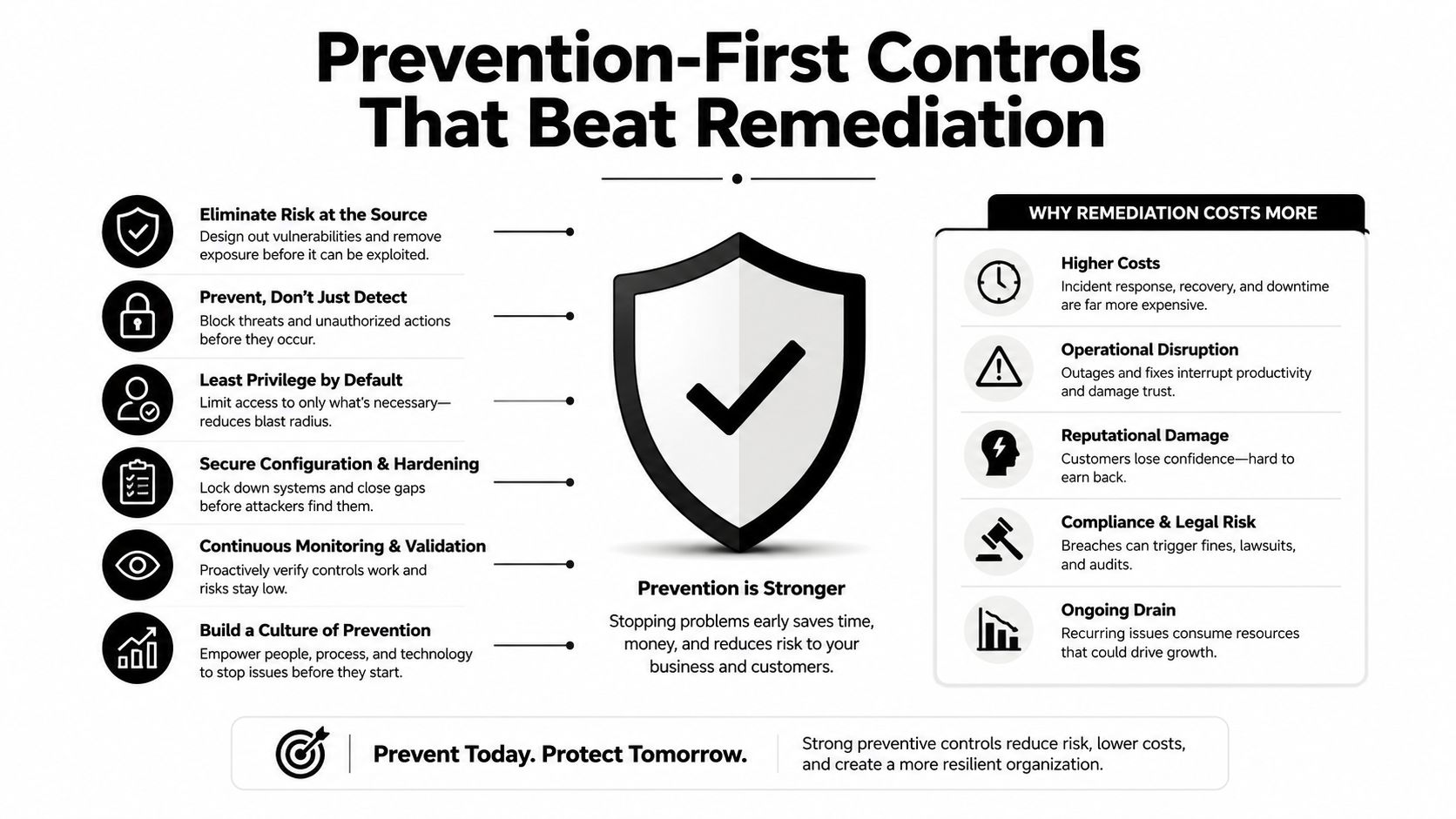
Remediation sounds efficient until you pay for it twice, once in process loss and again in trust. In extract programs, prevention wins because it attacks the contamination path before the material becomes expensive. Once a lot is already refined, every correction step is harder to justify and easier to overdo.
The controls worth auditing this week
Start with vendor qualification. Ask biomass and trim suppliers how they screen soil, water, and nutrient inputs, and whether they can explain any high result rather than just handing over a green checkmark. Then audit your own equipment for legacy solder, brass fittings, and transfer surfaces that can leak metals into the process.
Next, review water quality verification and any filtration or contact points that touch the extract stream. Post-processing steps like filtration, clay treatment, and adsorbent media can reduce metals in crude oil before distillation, but they're still a correction step, not a substitute for clean inputs. If a batch needs aggressive cleanup every time, the source control system is weak.
One practical sourcing variable is the flavor system. Gold Coast Terpenes supplies terpene blends and isolates that are lab-verified and THC-free, so the main contamination questions stay with the extract and the hardware stack rather than the flavor component itself. That doesn't remove the need for screening, but it does simplify root-cause analysis when a lot needs investigation.
A prevention checklist for a formulation manager is straightforward:
- Approve suppliers carefully: get documentation on cultivation inputs and any metals testing history.
- Inspect contact hardware: look for brass, solder, and aging components that touch product.
- Validate water and cleaning inputs: don't assume the rinse step is neutral.
- Use remediation only after confirmation: treat it as an exception, not a routine fix.
The Michigan report's 75% seafood link for arsenic in 2007 is a good reminder that source interpretation matters as much as detection (Michigan Heavy Metals Annual Report). In cannabis, the same mindset prevents you from “fixing” the wrong variable and chasing the problem from one batch to the next.
Documentation, Retention, and Retailer-Ready Compliance Files
A metals program only holds up when the paperwork can survive a buyer audit, a state inspection, or an insurer's questions. A single COA is not enough. The file needs supporting evidence that shows the method used, the sample collected, the lab that ran it, and the response when something went wrong.
A retailer-ready binder should include method validation summaries, chain-of-custody forms, raw data files, calibration records, and corrective action logs for any out-of-spec result. If the lab changed a prep step or ran a different matrix than expected, that should be visible in the file. If a lot was held, remediated, or rejected, the reason needs to be traceable from intake to release.
What to keep organized
- Lab accreditation records: confirm the lab was qualified for the method and matrix.
- Batch-level sample records: show which lot was tested and how it was collected.
- Re-test or corrective action notes: explain what happened after a fail.
- Retention copies: keep enough history to answer a future buyer or regulator without rebuilding the case from memory.
Lab reference values can vary by geography and laboratory, and an abnormal screen does not automatically prove toxicity. That makes documentation a process-control tool, not just a filing exercise. The file has to show the number, the method behind it, and the logic used to interpret it.
Different product matrices also change what a buyer wants to see. A terpene-forward vape oil, a winterized extract, and a thick distillate do not fail for the same reasons, so the paperwork should make the matrix and release standard obvious at a glance. If a downstream customer asks whether the result came from the bulk lot, the filling stage, or the hardware, the record should answer without a fresh investigation.
Teams that keep clean records, validated methods, and clear corrective action paths will handle future review more easily than teams relying on a single PDF and memory. That matters now because screening is moving toward more risk-based, setting-specific assessment, with the decision tied to the product and the workflow instead of a generic panel.
If you're tightening a terpene-forward extract program, build your screening around the matrix, the workflow, and the release question you need answered. Gold Coast Terpenes offers lab-verified terpene blends and isolates that fit cartridge, concentrate, and formulation work without adding another contamination variable to the stack. Visit Gold Coast Terpenes to review terpene options, compare profiles, and align your flavor system with a cleaner quality-control program.