
Most advice treats decarboxylation like a single oven setting. That's a mistake. The best decarb temp and time depends on what you're making, whether you want maximum THC activation, tighter terpene retention, or a clean base for later flavor reintroduction with a strain-inspired terpene blend.
For formulators, decarb is a process variable, not a ritual. The right heat profile changes potency, aroma loss, and batch consistency, which is why a good SOP matters more than copying a kitchen recipe. If you're building a base for cartridges, concentrates, or edible systems, you're really managing a tradeoff between speed and preservation.
Decarboxylation Is a Variable Not a Recipe
The fastest path is rarely the best one in practice. THCA-to-THC conversion follows heat and time, and the right settings depend on what you are trying to protect, not on a universal oven number. A 2016 study summarized by The Cannigma found the ideal conditions to maximize conversion at 160°C for about 7 minutes, while other analysis points to a practical best window around 140°C for 20 minutes to balance activation with less degradation of the compounds you want to keep (scientists pinpoint ideal decarb conditions).
That is the part formulators need to respect. Higher heat shortens dwell time, but it also raises the risk of degrading THC and stripping away volatile aromatics. In a production setting, the same input can yield different results depending on whether the target is potency, aroma retention, or a stable base for later flavor correction.
Practical rule: choose the process for the product, not the other way around.
If the goal is a fully decarbed neutral base, a controlled conversion step gives you a predictable starting point for later sensory work. For formulators who want a clear definition of the chemistry before they build a process, what decarb means in cannabis extraction is the right starting point. That approach is especially useful in cartridge or concentrate workflows, because it lets you rebuild the profile with a precise terpene system instead of trying to preserve every native note through heat.
The practical question is not, “What is the best temperature?” It is, “What outcome am I trying to protect?” That choice changes the oven profile, the container you use, and how much quality control you need at the end.
The Balanced Approach for Maximum THC Activation
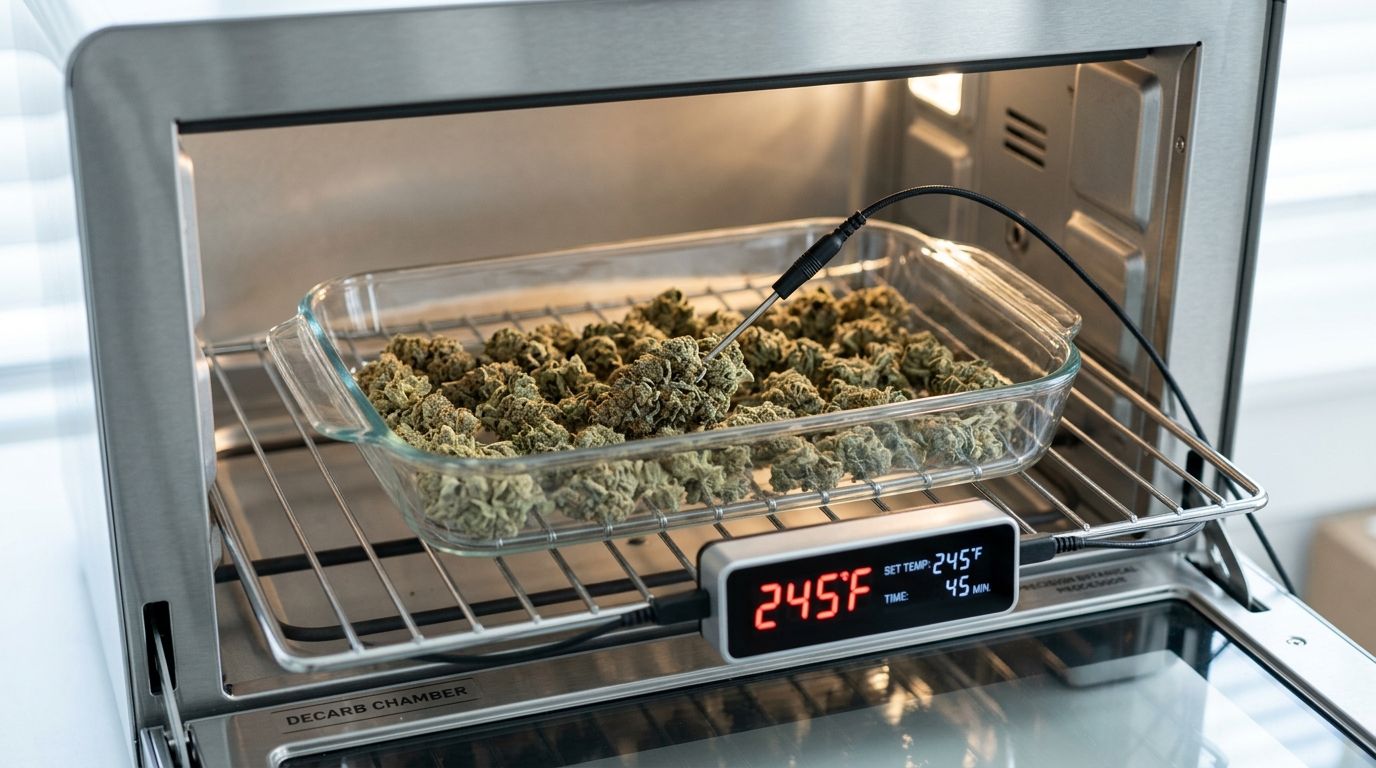
The workhorse protocol for THC-heavy input sits in the middle of the heat spectrum. Industry guides converge on 110–115°C (230–240°F) for 30–45 minutes as the best all-around decarb window for THC activation with moderate terpene loss, and they also stress that a calibrated oven thermometer matters because dial settings are often off (decarboxylation guide).
For a production-minded formulator, that range is useful because it's forgiving without being sloppy. It's hot enough to move conversion along at a reasonable pace, but not so aggressive that you're forcing unnecessary degradation. That's why it's a common starting point for edibles, infused bases, and neutral oil systems where the aromatics will be rebuilt later.
What I watch before I trust the batch
A repeatable decarb process starts with heat control. Preheat fully, place the material on the middle rack or in an enclosed vessel for more even heating, and don't trust the oven dial alone. Those two variables, placement and actual temperature, do more for consistency than most operators expect.
Here's the practical part. If you're decarbing for a product that will later get a custom aroma, a clean neutral base is a feature, not a flaw. That's where a formulation resource like what temperature does THC activate becomes useful, because it helps you match activation to the rest of the process instead of treating decarb as a separate kitchen step.
A stable base makes later flavor correction much easier than trying to rescue an overheated batch.
The video below is worth reviewing if you want a visual sense of how controlled oven decarb looks in practice.
In a manufacturing environment, this setting is often the best starting point, not the final answer. You'd still validate the result against your product spec, but the 110–115°C band is the practical middle ground when you want efficiency without reckless heat exposure.
Low-Temp Protocols for Preserving Terpenes
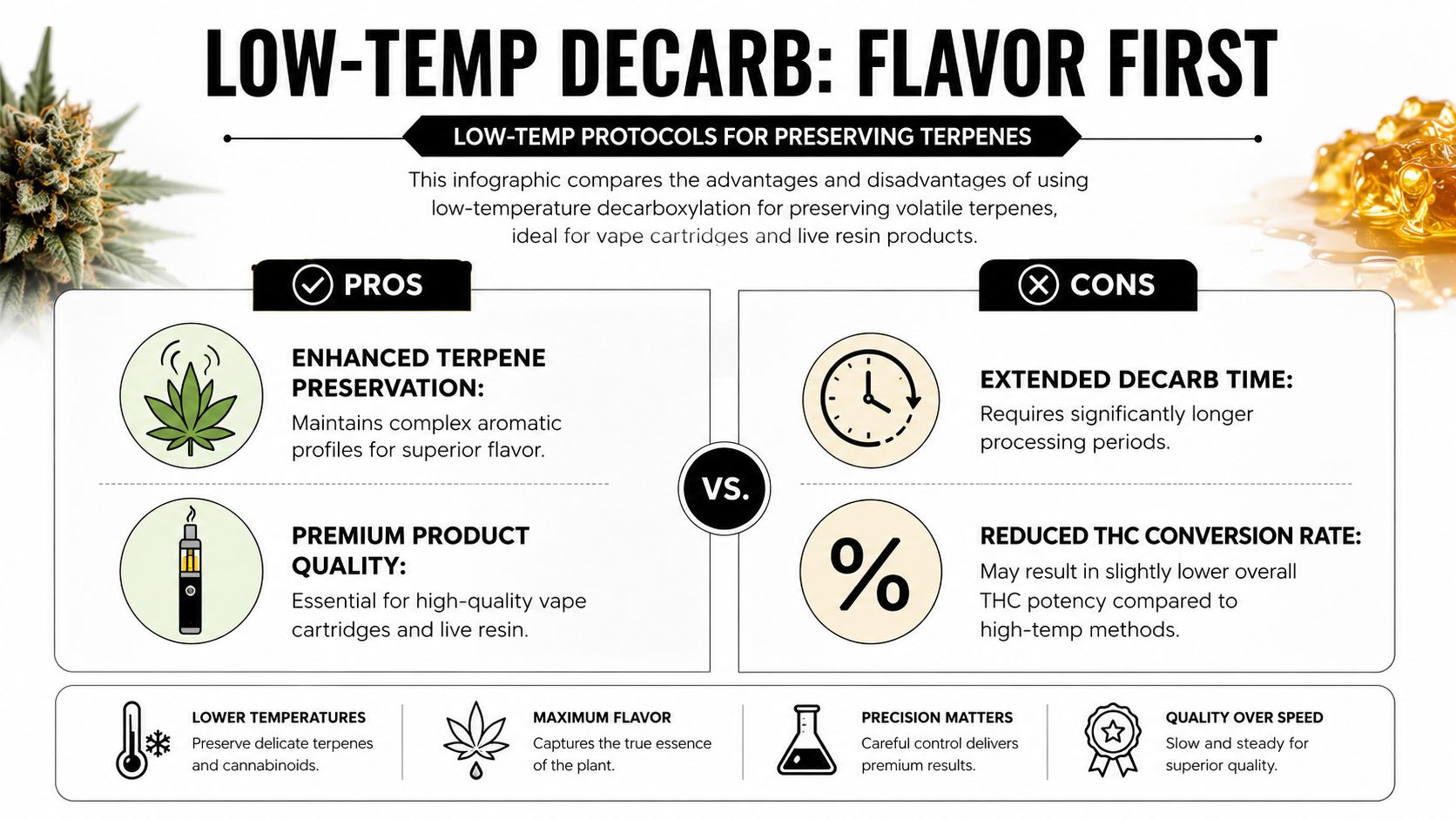
When flavor is the priority, the settings shift downward. The gentler strategy sits around 95–105°C (203–220°F) with a longer dwell time of 60-120 minutes, and that slower approach is specifically used when the aromatic profile matters more than raw speed (decarboxylation guide).
That window makes sense for products where the native scent profile needs protection. Lower heat reduces the chance of stripping the lighter aromatics, which is why this approach is often discussed in connection with terpene-forward cartridges and live resin style formulations. The tradeoff is obvious. You gain preservation, but you give up convenience and process margin.
Why low heat changes the formulation game
At lower temperatures, conversion takes longer and the process becomes more sensitive to moisture, vessel choice, and batch thickness. A sealed container or covered setup helps control loss, and the cool-down step before opening matters because it limits terpene escape and oxidation. In other words, the handling after the bake is part of the decarb outcome, not an afterthought.
This is also the point where a terpene profile for formulating starts to make operational sense. If you're intentionally preserving a softer aromatic base, you can later layer in top, mid, and base notes rather than fighting against scorched plant character. For teams working in cartridge development, that approach often delivers better sensory control than trying to preserve every volatile note through a hotter bake.
A sous-vide or sealed approach can be helpful here too, especially when batch homogeneity matters. This sous-vide decarb resource is a useful reference point if you're comparing oven performance to a more controlled thermal environment.
Top notes are the first aroma impression, usually the most volatile.
Mid notes give the body of the profile.
Base notes carry the lasting depth and round out the finished flavor.
That hierarchy matters because a low-temp decarb won't protect every note equally. The lighter top notes are still the most vulnerable, which is why a formulator often pairs low-temp activation with a deliberate rebuild of the profile afterward. If you're aiming for product fidelity instead of just activation, the low-and-slow route gives you more room to shape the finished sensory target.
Optimizing Decarb for Concentrates and Extracts
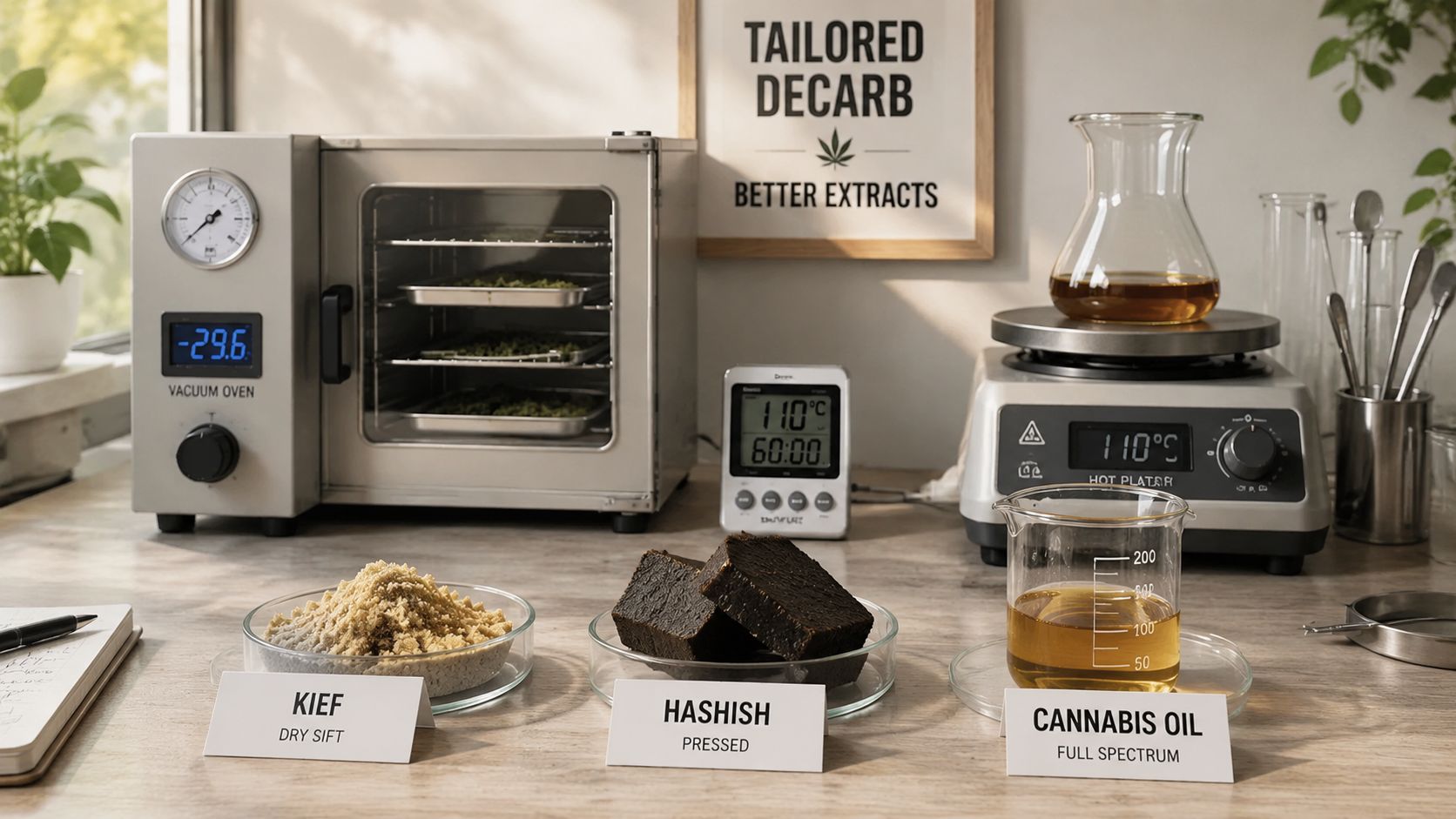
Flower is only one input. Kief, hash, rosin, and other concentrates behave differently because their physical structure, moisture content, and surface area aren't the same as dried biomass. That's why the “best” temp/time isn't universal across material types, and why mainstream oven advice often misses the process variable that matters most (decarb weed in oven).
Dense, sticky, or purified inputs tend to respond faster, but they also punish poor control more quickly. If the material is thin and unstable, it can overheat at the edges before the center finishes converting. If it's viscous, trapped gases and residual moisture can make the process look incomplete even when conversion is underway.
How to read the material, not just the thermometer
With concentrates, visual cues matter. Bubbling usually means CO2 is still being released, so the batch is still actively decarbing. When the bubbling slows or stops, you're closer to completion, but that cue only means something if your temperature was stable enough to trust in the first place.
That's why professional extractors don't treat shatter, rosin, and hash like ground flower. They match the method to the starting form, then watch for signs that the material has reached a stable state without scorching. If you're building a consistent process for extracts, a documented SOP consistently beats improvisation.
A formulator can also use a controlled vessel to reduce hot spots and limit oxidation. For some operations, Gold Coast Terpenes is one of the suppliers used later in the workflow when the decarbed base needs a precise flavor rebuild, but the important point is still process fit. The base has to be clean before any aroma system can perform predictably.
Concentrates reward patience, but only if the heat profile stays disciplined.
The key takeaway is straightforward. Don't copy a flower protocol and expect the same outcome from rosin or hash. The starting material is already different, so the heat profile has to reflect that difference.
Adjusting for Target Cannabinoids Like CBD
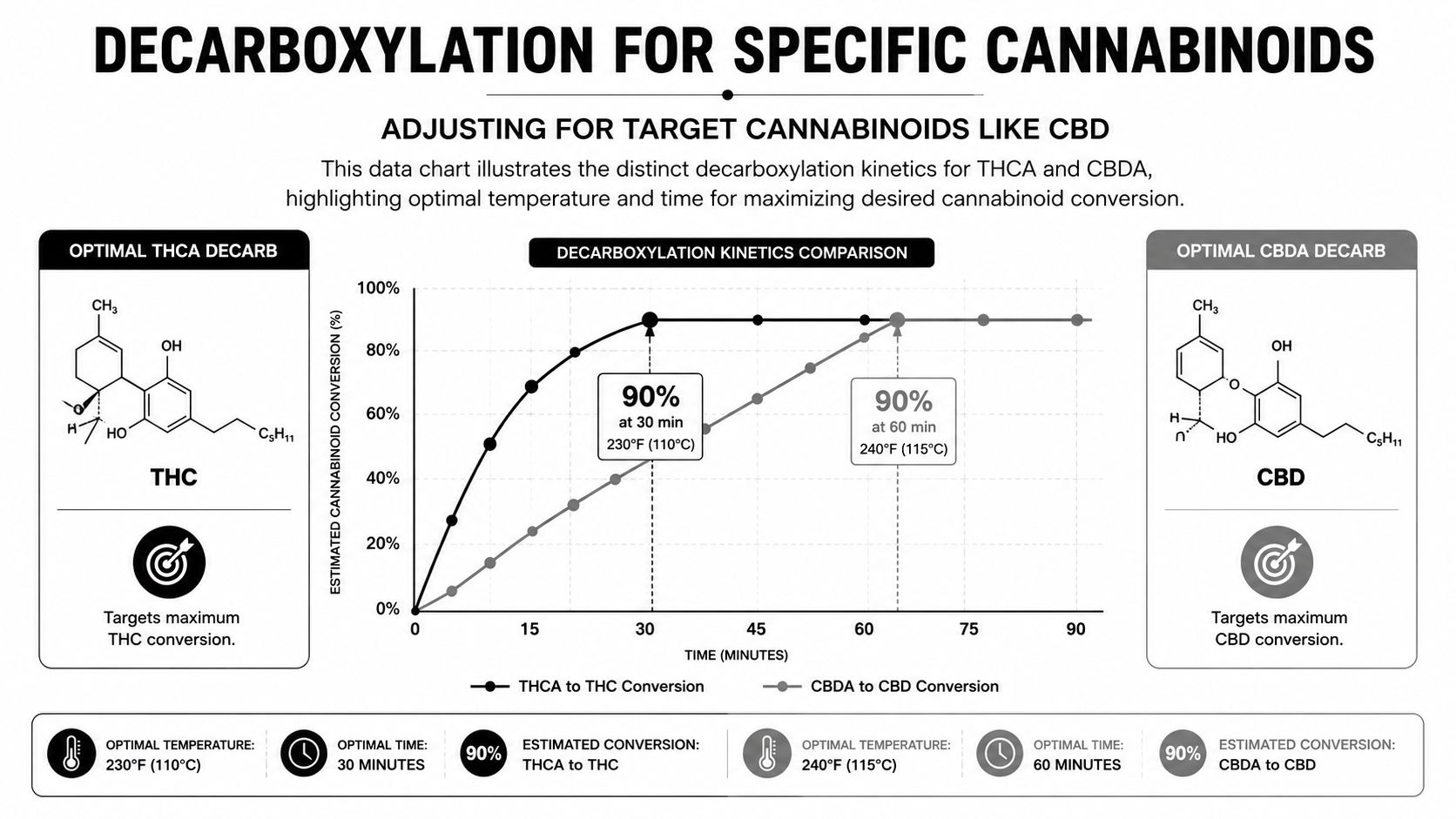
A THC-centric SOP can be the wrong tool for CBD-rich material. A kinetic model cited in industry discussion found that total THC decarboxylation peaks around 160°C (320°F) for 6.5 minutes, while CBD decarboxylation performs at much lower temperatures over much longer times, such as 110°C for 3 hours or 90°C for 12 hours (decarboxylation studies).
That difference matters in production because THC and CBD don't share one universal best condition. If you run both inputs through the same timer because it's convenient, you're not really standardizing the process. You're flattening two different chemistries into one compromise, and that can hurt consistency in broad-spectrum or hemp-derived product lines.
Why separate SOPs pay off
A CBD-rich batch needs its own thermal profile, just like a THC-dominant batch does. The point isn't to chase one perfect setting for every cannabinoid. The point is to match activation to the target profile so the finished product lands where your label and formulation spec expect it to land.
That's especially relevant when you're trying to keep a multi-SKU operation clean. A single universal timer invites avoidable variation. Separate SOPs, by contrast, let you define one process for THC-forward input, another for CBD-rich input, and a third for blends or specialty concentrates.
The practical lesson is easy to miss if you only read consumer decarb guides. THCA and CBDA do not convert on the same schedule, so formulation strategy should never assume they do. Once that's clear, product development gets simpler, not harder, because each starting material gets a process matched to its chemistry.
For formulators, that's where precision starts to look commercial. You're not just activating cannabinoids. You're protecting batch identity, keeping flavor decisions predictable, and making sure the finished system behaves the same way from lot to lot.
Quality Control and Verifying Your Process
A repeatable process is verified by results, not just a timer. Above 140°C, the reaction speeds up, but THC also begins degrading into CBN, which can reduce potency and shift the finished oil's cannabinoid balance in ways that affect SKU consistency (cannabis decarboxylation).
Quality control belongs at the center of decarb, not after the fact. A formula that looks fine in the oven can still fail in production if the heat profile drifted or the batch stayed exposed too long. For commercial operators, in-house or third-party HPLC analysis is the cleanest way to validate the SOP and confirm that the target cannabinoid profile is present.
What to verify before scaling
Use a simple review sequence. Confirm the oven or vessel temperature, document the input form, and record the dwell time. Then compare the finished material against the expected endpoint, either through lab analysis or through repeatable process cues such as even color change, reduced bubbling in concentrates, and a stable, non-raw aroma.
For smaller R&D runs, consistency matters more than perfection. If the result changes every time, the process is not ready for scale. For this reason, quality control testing should sit alongside your formulation notes, not in a separate folder nobody opens.
A practical QC checklist looks like this:
- Confirm actual temperature: Use a calibrated thermometer, not just the oven dial.
- Track dwell time: Start and stop times should be written down every run.
- Check material response: Watch for overbrowning, uneven heat exposure, or lingering bubbles in extracts.
- Validate against lab data: HPLC gives you the clearest confirmation of cannabinoid conversion.
Once those checks are in place, decarb stops being a gamble and starts acting like a controlled unit operation. That matters if you are trying to replicate flavor, protect potency, and keep release specs consistent across batches. It also gives formulators a clear record when a lot behaves differently, which makes root-cause review faster and more useful.
If you're developing a THC-forward base, a terpene-preserved cartridge system, or a concentrate workflow that needs tighter process control, review your current decarb SOP and compare it against your finished-product targets. Then reach out to Gold Coast Terpenes to source terpene profiles, isolates, and formulation support that fit the base you've built.