
You're probably looking at two batches that should have matched and don't. The oil fills the same, the hardware is the same, your target profile is the same, yet one run lands bright and strain-accurate while the next comes across flat, sharp, or oddly muddy. That's where many operations realize they've been treating the COA as a release document instead of a formulation document.
A COA certificate of analysis matters long before a compliance manager files it away. For a formulator, it's the document that tells you whether the terpene input you're about to use can reproduce the flavor architecture you want in a vape product. If the COA is weak, incomplete, or read too casually, your formulation decisions get built on guesswork.
That guesswork shows up fast in carts. Top notes disappear. Mid-note balance shifts. The finish feels wrong. Then everyone starts blaming the distillate, the hardware, or the fill process when the true issue was already visible in the lab data.
The teams that stay consistent don't use a COA as a box-checking exercise. They use it to verify identity, confirm purity, screen for contaminants, and judge whether a batch is suitable for a specific formulation goal. That's also why understanding terpene quality standards and purity belongs in the same conversation as sensory work. Flavor accuracy starts with verified inputs.
Introduction Why Your Formulation Depends on the COA
A junior formulator usually starts by asking whether a terpene lot is “good.” That's not the right question. The better question is whether the lot is right for this formula, this process, and this finished vape profile.
A COA gives you the first real answer. It tells you what's in the batch, how the lab tested it, and whether the material aligns with the specs your formula depends on. If you're trying to build a strain-inspired terpene blend for vape cartridges or dial in a terpene profile for distillate, that detail isn't optional.
Practical rule: Never approve a terpene input for production based on aroma alone. Aroma can confirm a suspicion. It can't replace analytical data.
In day-to-day formulation, the COA protects you from three expensive mistakes:
- Using the wrong sensory building blocks. A profile can smell close in the bottle and still miss the target once it's diluted into oil and heated in hardware.
- Accepting hidden contaminants. Residual solvents or carrier ingredients can distort vapor behavior and create safety problems.
- Chasing the wrong correction. If the raw input is off-spec, no amount of post-mix tweaking will fully restore a clean, repeatable result.
That's why experienced teams read the COA before they scale, before they blend, and before they lock a production run. When you're formulating for cannabis product formulation rather than casual experimentation, the COA becomes part of your formula record, not just part of your compliance folder.
The COA as a Foundational Quality Document
A Certificate of Analysis isn't a marketing sheet and it isn't a vague statement that a product “passed.” It is a mandatory, batch-specific regulatory document that provides actual numerical test results, not just pass/fail statements, for identity, purity, and safety, serving as the primary evidence for Batch Release and import/export clearance in global markets. It also functions as a contractual comparison against pre-established specifications that may be internal, regulatory, or agreed between seller and buyer, as outlined in the Certificate of Analysis overview.

That definition matters in formulation because you need numbers, not reassurance. “Complies” doesn't tell you whether limonene sits where you need it. “Pass” doesn't tell you if a profile is drifting toward a sharper top note or a thinner finish. A proper COA gives you data you can compare against your internal target.
What the document actually does in operations
In a regulated workflow, the COA sits at the point where procurement, quality, and formulation meet. Purchasing uses it to confirm they received the correct lot. Quality uses it to decide whether the lot can be released internally. Formulation uses it to decide whether that lot can produce the intended sensory output.
That means one document is doing several jobs at once:
| Function | Why it matters to formulators |
|---|---|
| Batch identification | Confirms the exact lot tied to your pilot or production run |
| Specification comparison | Shows whether the batch fits the formula's required input window |
| Traceability | Lets you investigate sensory drift later without guessing |
| Release support | Prevents unverified material from entering production |
A weak COA breaks all four.
Why third-party rigor matters
In cannabis and vape manufacturing, teams often move too quickly past the source of the document. That's a mistake. If the testing isn't credible, the numbers aren't useful. You need confidence that the results came from a legitimate analytical process, not a templated sheet attached to a shipment.
A practical review always includes the lab side, not just the result side. That's why good operators pair COA review with a broader quality control testing workflow for terpene materials.
A COA should function like a batch fingerprint. If it can't uniquely identify the lot and show how the lot was tested, it's not strong enough for formulation decisions.
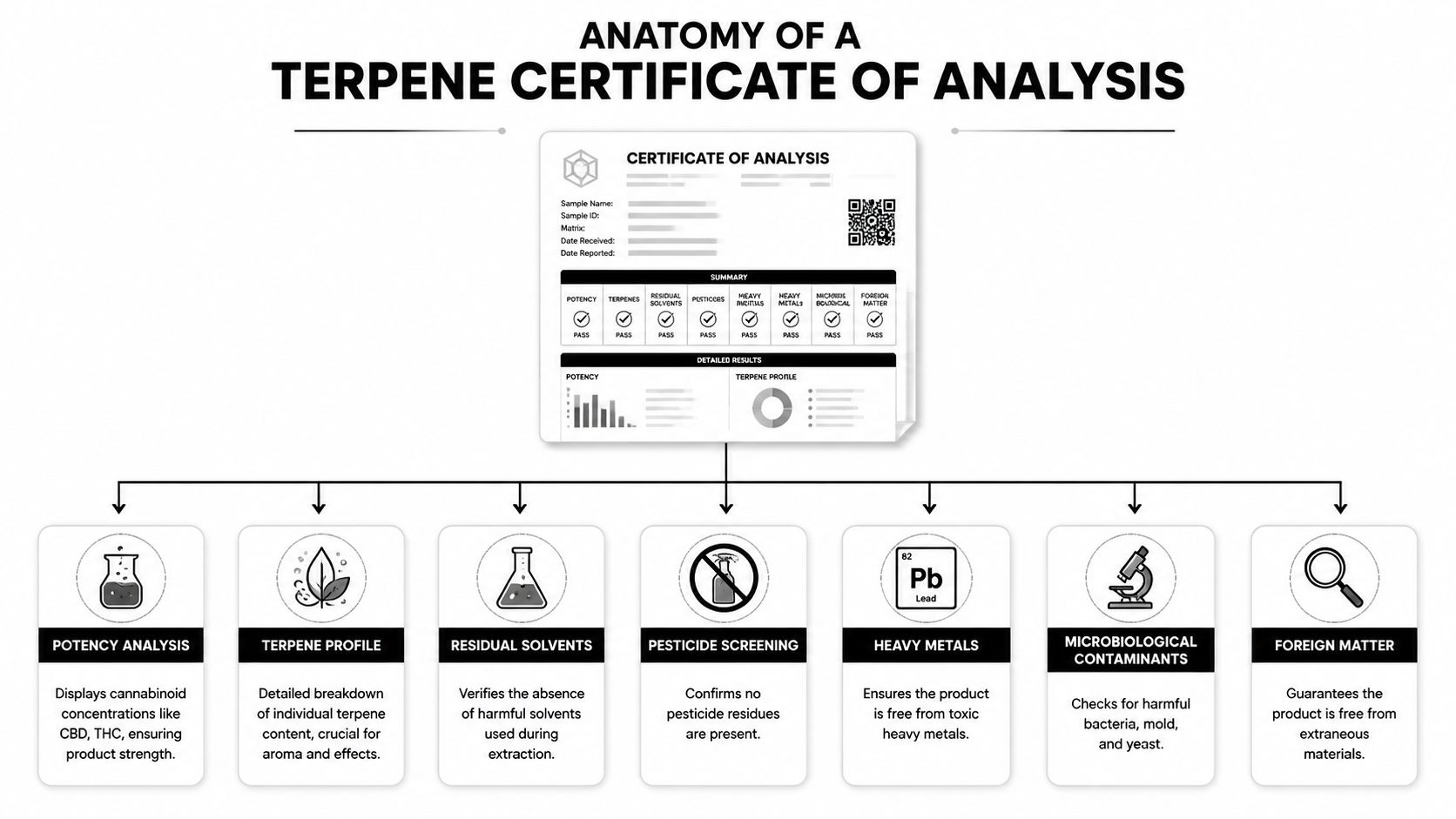
Anatomy of a Terpene Certificate of Analysis
A terpene COA only becomes useful when you know how to read every section in relation to the finished vape. Most problems start when someone looks at one attractive line item, usually total potency or a few familiar terpene names, and ignores the rest.
In the cannabis and hemp sector, COAs are legally required to verify that products have been tested for required potency and quality tests by a licensed third-party laboratory before distribution. The document typically includes harvest and batch numbers, manufacturing dates, and expiration dates, along with testing methods such as HPLC analysis for purity and mass spectrometry for molecular identity confirmation, as described in this COA overview for cannabis and hemp products.
Start with identity and batch traceability
Before you interpret chemistry, verify the document belongs to the material in your hand. Product name, lot or batch number, testing date, and any manufacturing or expiration information need to line up with your receiving records.
If the lot number on the drum, bottle, or pouch doesn't match the COA, stop. Don't rationalize it. Don't assume the supplier sent the “same formula from a nearby batch.” For formulation, lot integrity matters because even subtle shifts can alter the final vape profile.
Here's the quick receiving check I train teams to use:
- Match the batch first. The physical label and the COA must refer to the same production run.
- Check the document date. An old report may not reflect the current lot you're evaluating.
- Confirm product identity. Similar names and adjacent SKUs cause more receiving errors than many acknowledge.
Read the terpene profile like a recipe, not a decoration
For a formulator, the terpene panel is usually the most valuable part of the COA. This section tells you the relative proportions of the compounds that create top-note brightness, mid-palate body, and finish.
A casual reader scans for familiar names. A useful reader asks harder questions:
- Is the dominant terpene aligned with the target profile?
- Are the supporting terpenes present at believable levels?
- Does the balance suggest a bright, floral, earthy, gas-forward, citrus-heavy, or dessert-like result?
- Will this profile survive dilution into distillate without collapsing?
Here, analytical literacy starts to drive commercial outcomes. If you're emulating the flavor of a popular profile for carts, the panel isn't just informative. It is your working formula map.
For teams that need a stronger technical grounding, chromatography testing in terpene analysis is worth understanding because it explains how the profile data is generated in the first place.
The terpene panel tells you what you can build. It also tells you what you should stop trying to force.
Potency and purity data
A lot of teams borrow “potency” language from cannabinoid testing and apply it loosely to terpene materials. What matters in practice is whether the COA provides clear quantitative results that show what is present and whether purity aligns with your specification.
For a vape formulator, purity affects more than label confidence. It affects flavor cleanliness, heat behavior, and how predictable the blend feels across batches. If the material contains unexpected compounds or unexplained diluents, your formula won't behave the way your bench sample did.
Use this section to answer three practical questions:
| Question | Why it matters |
|---|---|
| Is the material composition clearly quantified? | You need actual numbers to formulate consistently |
| Does the material conform to your internal spec? | Supplier specs alone may be too loose for flavor replication |
| Are there unexplained extras? | Unclear composition creates instability in development |
Residual solvents and carrier screening
For vape products, this section is not secondary. It's part of the formulation decision. Solvent residue can change aroma perception and can also affect how the blend behaves once heated through hardware.
Carrier screening matters for the same reason. If a terpene ingredient isn't clean, you may see altered viscosity, muted expression, or harshness that gets misdiagnosed as a hardware issue. In practical terms, if you're developing for vape cartridges, a clean safety panel protects both performance and user experience.
Heavy metals, pesticides, and microbiology
These sections often get skimmed because formulators see them as compliance territory. That's too narrow. Safety panels influence whether a lot should be used at all, and they also affect supplier qualification over time.
Each panel answers a different risk question:
- Heavy metals address contamination risk relevant to inhalable products.
- Pesticide screening helps rule out unwanted agricultural residues.
- Microbiology confirms the material isn't carrying contamination that creates quality or safety problems.
- Foreign matter tells you whether the sample is physically clean and controlled.
A clean terpene profile with a weak safety panel is not a usable input. It's a rejected one.
Methods and signatures are part of the data
A serious COA should show how testing was done, not just what result appeared on the page. Method references, lab details, and authorized signoff are part of what makes the document valid and traceable.
When teams ignore methods, they miss one of the fastest ways to spot low-quality paperwork. A polished PDF can still be analytically useless if it doesn't tell you how the numbers were generated or who approved them.
Translating COA Data into Formulation Strategy
Once the COA confirms the lot is real, traceable, and analytically useful, the next step is turning numbers into a sensory structure. Many formulation teams then either become precise or stay stuck in trial-and-error mode.
When you break down a target strain for formulation using its COA, primary terpenes are the dominant building blocks, typically constituting 40% or more of the profile and establishing the core identity. Secondary terpenes usually sit at 10–20% each to add complexity, while tertiary terpenes are used at under 5% to create nuanced accents, according to this terpene profile classification reference.
Top, mid, and base note thinking
In practical formulation, I teach junior staff to translate those categories into an aroma structure:
- Top notes usually come from the more immediately expressive compounds. They create the first impression when the cart opens and the first lift on inhale.
- Mid notes hold the recognizable character together. It is here that a profile starts feeling strain-inspired instead of generically fruity, floral, or gassy.
- Base notes create persistence and depth. They often determine whether the finish feels complete or hollow.
That framework helps when you're formulating terpene profile for distillate because distillate tends to flatten delicate details if the supporting architecture is weak.
How the percentages guide your blend decisions
If a primary terpene dominates the COA, don't bury it with too much supporting material. Let it define the spine of the blend. If secondary terpenes carry the recognizable character, protect them during formulation instead of overcorrecting for louder top notes. Tertiary compounds should sharpen and refine, not hijack the profile.
A common beginner mistake is building a blend around what smells strongest in the bottle. That usually overweights top-note appeal and underweights the compounds that make the vape recognizable after dilution and heating.
This is also why mixing distillate with terpenes for controlled formulation has to be treated as a process step, not just a recipe step. The profile you smell neat isn't the profile you always get in finished hardware.
If the COA says the character lives in the middle of the profile, protect the middle. Don't let flashy top notes talk you into rebuilding the formula around the wrong compounds.
What works and what usually fails
What works is anchoring your formula to the dominant and supporting compounds shown on the COA, then adjusting for how they express in your oil system and hardware.
What fails is:
- chasing a target with only broad sensory language
- matching total terpene load while ignoring individual ratios
- over-fixing a blend after fill instead of correcting the input selection before production
The best strain-inspired terpene blend for cannabis product formulation starts as analytical interpretation, then becomes sensory refinement.
How to Verify Authenticity and Spot Red Flags
A surprising number of bad formulation decisions come from trusting a document that looks professional. Appearance isn't validation. A terpene COA is only useful if it can stand up to audit, traceability review, and lot-level scrutiny.
In the EU and US, a compliant terpene COA must explicitly state the analytical method, the laboratory's accreditation status, and the lot-specific sampling plan because those elements form the legal record used for batch release and import/export clearance. If method versioning or accreditation information is missing, the COA can be considered invalid for regulatory audits, which can lead to shipment rejection or recall risk, as explained in this guide to compliant terpene COA requirements.
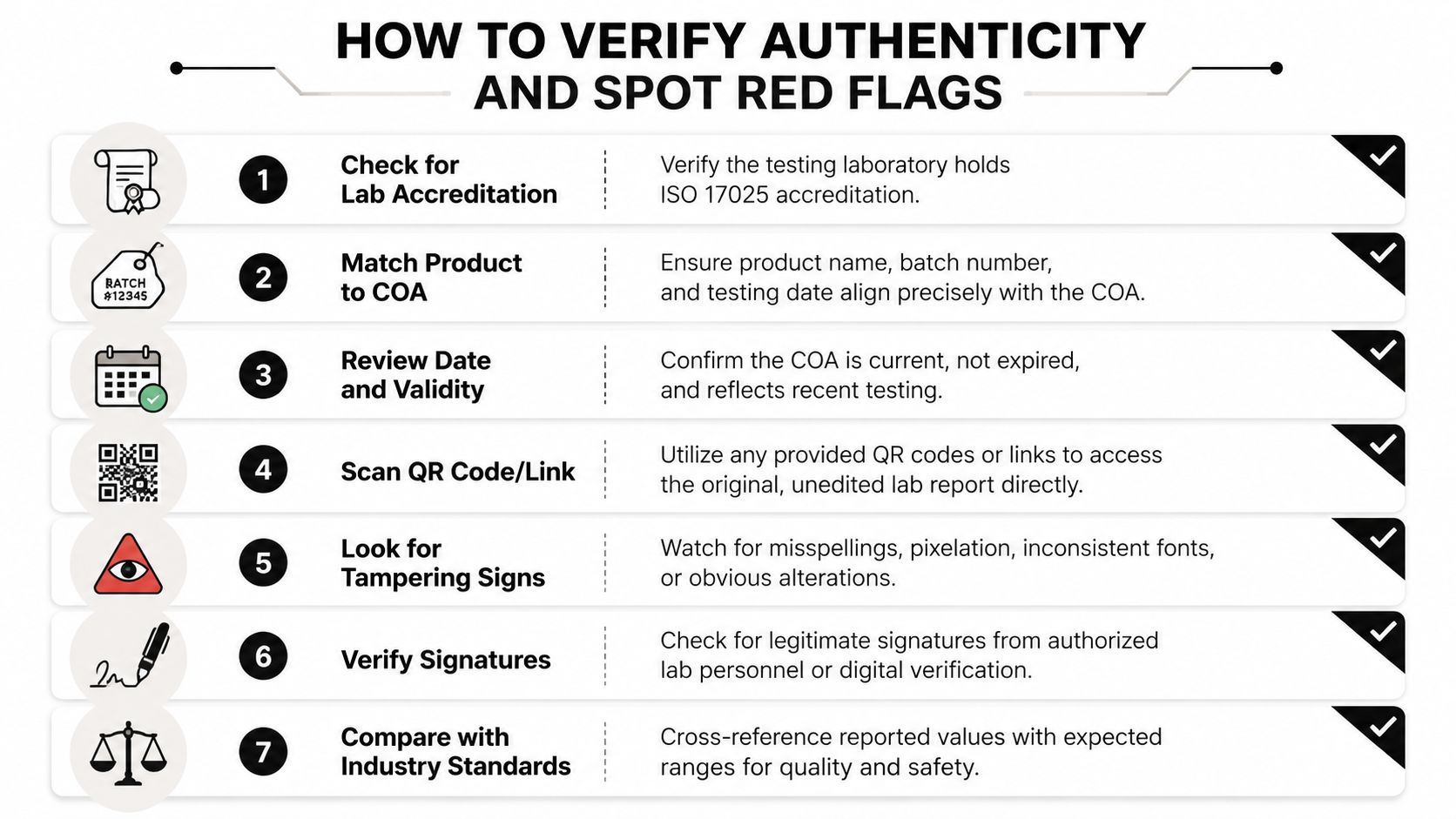
The first pass is document integrity. You want to see a coherent report with consistent formatting, complete lot identification, a stated method, and an authorized signature path. If the report gives you results but not the testing framework behind them, it's incomplete for serious use.
A working red-flag screen
Use this list when a new supplier sends a COA:
- Missing method references. If the report doesn't say how the analytes were measured, the numbers are harder to trust.
- No accreditation details. The lab status should be visible, not implied.
- Lot mismatch. Any mismatch between packaging and report is reason to stop release.
- Edited-looking PDFs. Inconsistent fonts, blurry sections, or pasted fields deserve immediate follow-up.
- No signature or approval trail. A COA without authorization is weak evidence.
Later in the review, I also want to see whether the report feels specific to that batch or generic enough to fit any batch.
A quick visual walkthrough can help train your team on what to look for in supplier documents:
What a legitimate COA lets you do
A good COA doesn't just reassure you. It lets you trace a formulation problem backward. If a finished cart drifts off profile, you can compare the lot used, the method listed, and the analytical result against your target spec. That makes troubleshooting possible.
A weak COA blocks that process. You're left arguing from aroma memory, supplier claims, and production notes instead of hard data.
Don't ask whether the document looks official. Ask whether you could defend it during an internal deviation review.
Advanced COA Pitfalls for Product Formulators
Organizations often know to check whether a COA exists. Fewer know how to avoid misusing it. That's where expensive mistakes happen.
The biggest one is relying on a potency-only view. For batch-to-batch consistency in terpene-cannabinoid formulations, a potency-only COA is insufficient. Each batch needs a full terpene panel quantification listing individual compound percentages, along with checks for residual solvents, minor cannabinoid potency, and heavy metals, because those factors are critical for vape safety and consistency, as noted in this formulation guidance on full-panel validation.
The subtle errors that throw off finished carts
A profile can look close enough on paper and still fail in production if you ignore the compounds doing the fine-detail work. Minor terpenes often shape the accuracy of a strain-inspired result. Remove or underweight them and the blend still smells “good,” but it stops smelling accurate.
Another mistake is treating the COA like a static truth that survives processing untouched. During filling and early storage, professional guidance recommends calculating a 15–30% terpene loss factor, especially for volatile monoterpenes such as limonene and pinene, to preserve final flavor accuracy over shelf aging, according to this discussion of formulation losses during filling and storage.
That doesn't mean every formula should be inflated blindly. It means you need to understand which parts of the profile are more fragile and account for them during process development.
Common advanced mistakes
- Ignoring minor terpenes. This is how “close” formulas become generic formulas.
- Reading the neat profile only. The bottle aroma is not the final vape experience.
- Overcorrecting with loud top notes. Brightness is easy to add and hard to balance.
- Skipping full-panel review on repeat orders. Supplier familiarity shouldn't replace lot review.
- Treating safety panels as someone else's job. Inhalable formulation always brings safety back to the bench.
A mature team uses the COA to predict process behavior, not just accept shipment paperwork.
Your Gold Coast Terpenes COA Verification Checklist
When a new terpene lot arrives, the review should be fast, disciplined, and repeatable. Don't reinvent the process each time. Use the same screening logic for every incoming batch so the decision to release, hold, or reject is consistent across the team.
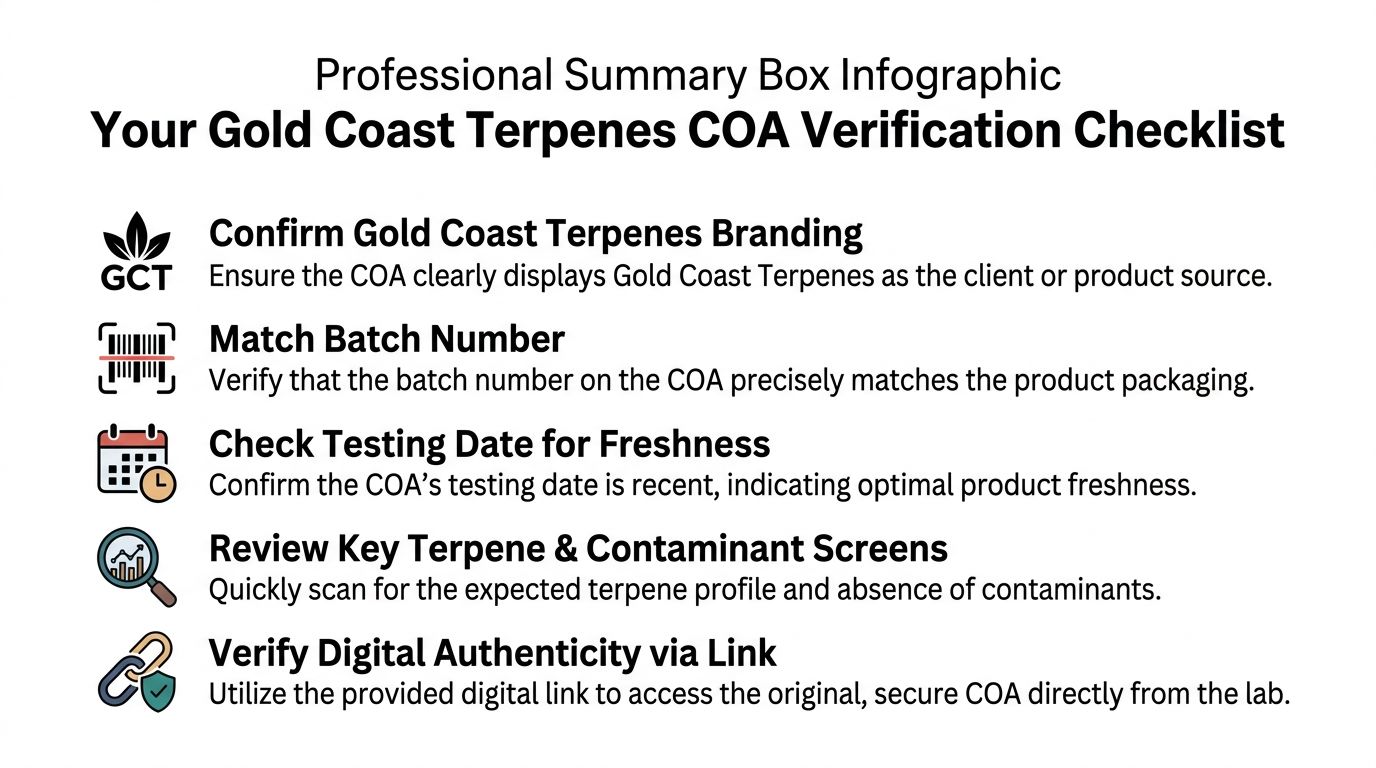
A practical checklist looks like this:
- Confirm the supplier identity. The COA should clearly identify the material source and product.
- Match the batch number exactly. The lot on the packaging and the lot on the document must be identical.
- Check the testing date. Make sure the report is current for the material you received.
- Review the terpene panel, not just a summary line. You need the individual profile details for formulation work.
- Scan the safety screens. Residual solvents, heavy metals, and related contaminant checks should be part of the release decision.
- Verify method and lab details. If the report can't tell you how the data was produced, it's incomplete.
- Confirm approval or signature status. Someone authorized needs to stand behind the results.
If you manage multiple SKUs, save your internal target profile beside each approved COA. That one habit makes troubleshooting faster when a cart starts drifting from the intended strain expression.
The primary value of a COA certificate of analysis isn't that it proves a supplier tested something. It's that it gives your formulation team enough trustworthy detail to build repeatable vape products with clean flavor, controlled aroma, and fewer surprises on the production floor.
If you need terpene inputs that support disciplined formulation work, explore Gold Coast Terpenes for strain-specific blends, isolates, and formulation resources built for cartridges, concentrates, and commercial product development.