
A batch can match the formula on paper and still fail in the cart.
That's the situation many teams run into when a new run of vape cartridges comes off the line tasting flatter, sharper, or wrong compared with the last lot. The recipe didn't change. The target strain character was documented. The incoming materials looked acceptable. Then the first sensory review says the Blue Dream note is muted, the OG Kush finish is thin, or the fruit top note you built into a Forbidden Fruit-inspired profile disappeared during filling.
That gap is where quality control testing stops being a compliance task and becomes a formulation tool. For extractors, cartridge manufacturers, and brand owners, QC is what protects flavor accuracy, supports strain replication, and keeps a launch from turning into a returns problem.
Why Quality Control Testing Is Non-Negotiable for Formulators
If you're building products for repeat purchase, consistency is the product. A vape customer may not know the exact terpene ratio in a cartridge, but they know when one batch tastes brighter, harsher, duller, or less authentic than the one they bought last month. In practice, that sensory drift usually shows up before a regulatory issue does.
That's why I don't look at quality control testing as a pass-fail gate at the end. I look at it as the operating system behind reliable formulation. It tells you whether your incoming terpenes, distillate, and finished blend behave the same way from lot to lot, and whether the profile survives real manufacturing conditions.
A critical point for vape brands is that purity alone doesn't guarantee flavor consistency. A 2025 study by the International Association for Cannabis Science found that 38% of consumer complaints about "off-flavor" in vape cartridges stemmed from terpene batch variability that passed standard purity QC but failed functional aroma retention tests, and it also noted that no public QC protocol exists for measuring that specific failure mode (reported here).
Purity is only the starting point
That finding matters because many teams still release material once it clears a standard certificate of analysis. For terpene-driven products, that isn't enough. Two compliant lots can perform differently in a filled cartridge if one lot loses key top notes faster during heat exposure or storage.
Practical rule: If the blend is supposed to deliver a recognizable strain-inspired experience, your QC program has to protect aroma performance, not just chemical cleanliness.
A strong starting reference for that mindset is this guide on why purity matters and how terpene quality standards affect formulation decisions. Purity matters. It just doesn't tell the whole story.
What QC protects in real production
For formulators, QC does four jobs at once:
- Brand protection: It reduces the odds that one weak batch changes how buyers talk about your product.
- Flavor accuracy: It catches drift in terpene composition before that drift shows up as a sensory mismatch.
- Manufacturing fit: It shows whether a blend remains stable through mixing, filling, and early storage.
- Release discipline: It gives production, R&D, and sales the same acceptance standard.
The expensive mistake is treating sensory inconsistency as a marketing problem. It's usually a quality problem first. If a profile can't survive your real process, the formula isn't finished yet.
Building Your QC Framework From the Ground Up
A usable QC system starts with a simple principle. Test what can change the finished product in a meaningful way. For cannabis extracts and terpene-heavy formulations, that means your framework has to cover both safety and sensory integrity.
Here's the baseline checklist many teams need in place:
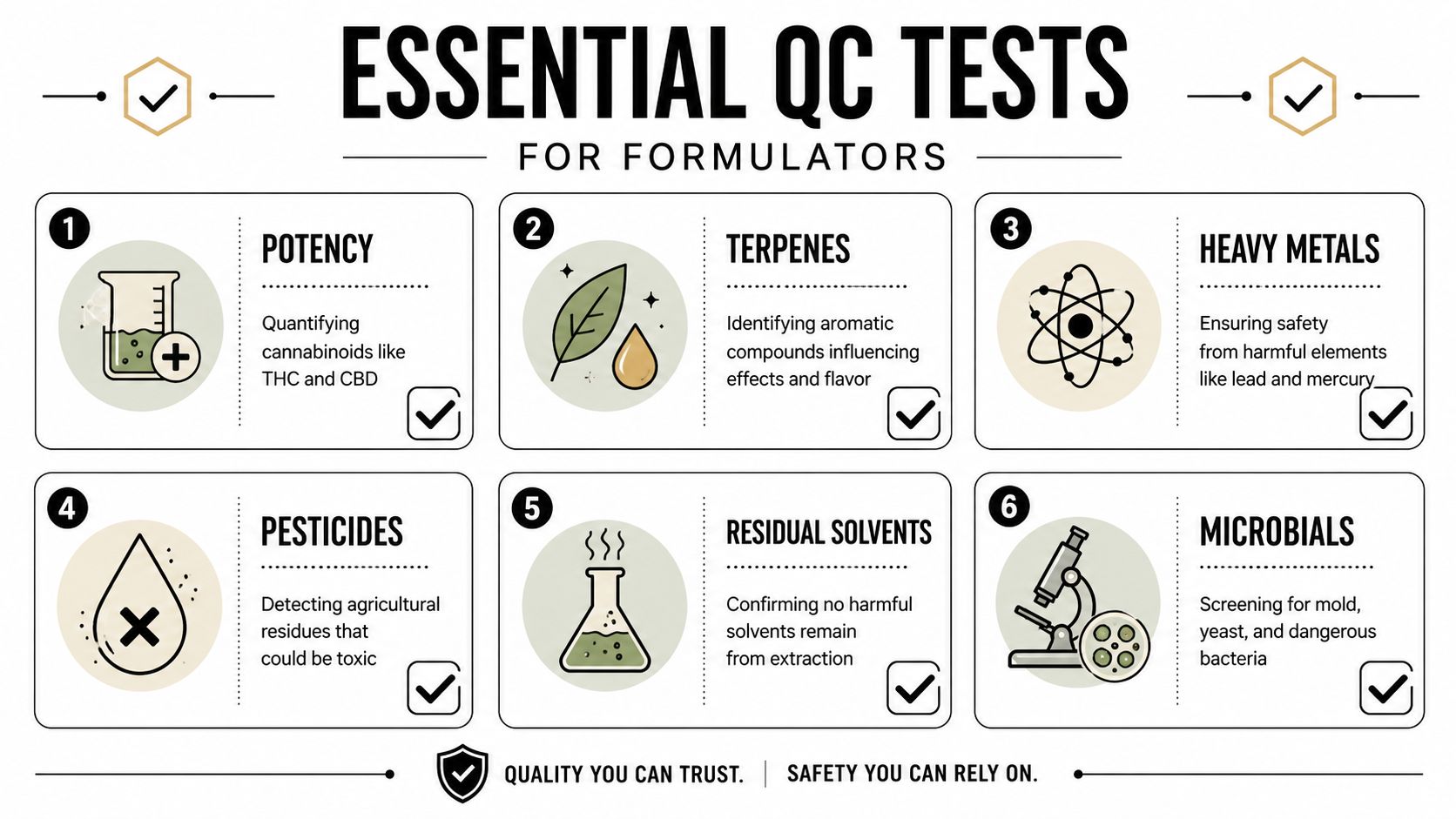
The six tests that matter most
Potency testing
Potency confirms cannabinoid content and helps the formulator understand how the base oil will carry the terpene system. Benchmark data states that potency testing using HPLC and GC achieves accuracy rates exceeding 99% when performed correctly, with professional kits detecting cannabinoid levels as low as 0.1% (Mindflower guide).
For formulation, potency affects more than labeling. It changes blend behavior, perceived sharpness, and how much room you have to add terpenes without pushing the cartridge outside its intended performance window.
Terpene profiling
This is the most direct test for flavor accuracy. It tells you whether the intended aromatic structure is present and whether your top, mid, and base notes are balanced the way the formula assumes.
Residual solvent testing
Residual solvents matter because they can distort aroma, create false off-notes, and complicate root-cause work when a batch tastes wrong. A profile can look close on paper and still feel chemically noisy in the finished cart if solvent carryover is part of the background.
Pesticide screening
This safety screen is essential for botanical inputs and cannabis-derived materials. Even when the immediate concern is compliance, formulators should care because pesticide-related holds can interrupt production and force last-minute raw material substitutions that hurt consistency.
The process side of QC
Heavy metals testing
Heavy metals are a safety issue, but they also sit inside a larger process-control question. If hardware, extraction equipment, or material handling introduce avoidable contamination risk, that's a supply-chain and process-design problem, not just a lab-report problem.
Microbial testing
Microbials may not be the first thing a vape formulator thinks about, but they matter for raw material handling, storage discipline, and overall batch integrity. Weak environmental control often shows up as broader QC sloppiness elsewhere.
Quality control works best when every test has a production question behind it. Not just "Did we pass?" but "What risk did this result remove?"
In laboratory and analytical settings, statistical quality control relies on three pillars: descriptive statistics, acceptance sampling, and statistical process control (6Sigma overview). That matters because a good QC program isn't just a list of lab panels. It's also a method for deciding what to sample, how to interpret variation, and when a trend is moving out of tolerance before the finished goods fail.
If you need a practical reference for setting up release checks, batch verification, and documentation, this resource on quality assurance processes for terpene-focused production is worth reviewing.
How formulators should prioritize
Not every product needs the same testing emphasis. A flower-facing extraction line and a vape cartridge line won't weight risk in the same way. For carts and distillate blends, I'd prioritize in this order:
- First, terpene profile integrity
- Then, potency and residual solvents
- Then, hardware-linked and contaminant risk
- Finally, trend monitoring across repeated lots
That order keeps the program aligned with what the buyer experiences. Safety is mandatory. But if your brand promise is strain-specific flavor, then sensory consistency has to be treated as a release criterion, not an afterthought.
Choosing Your Analytical Methods GC-MS vs HPLC
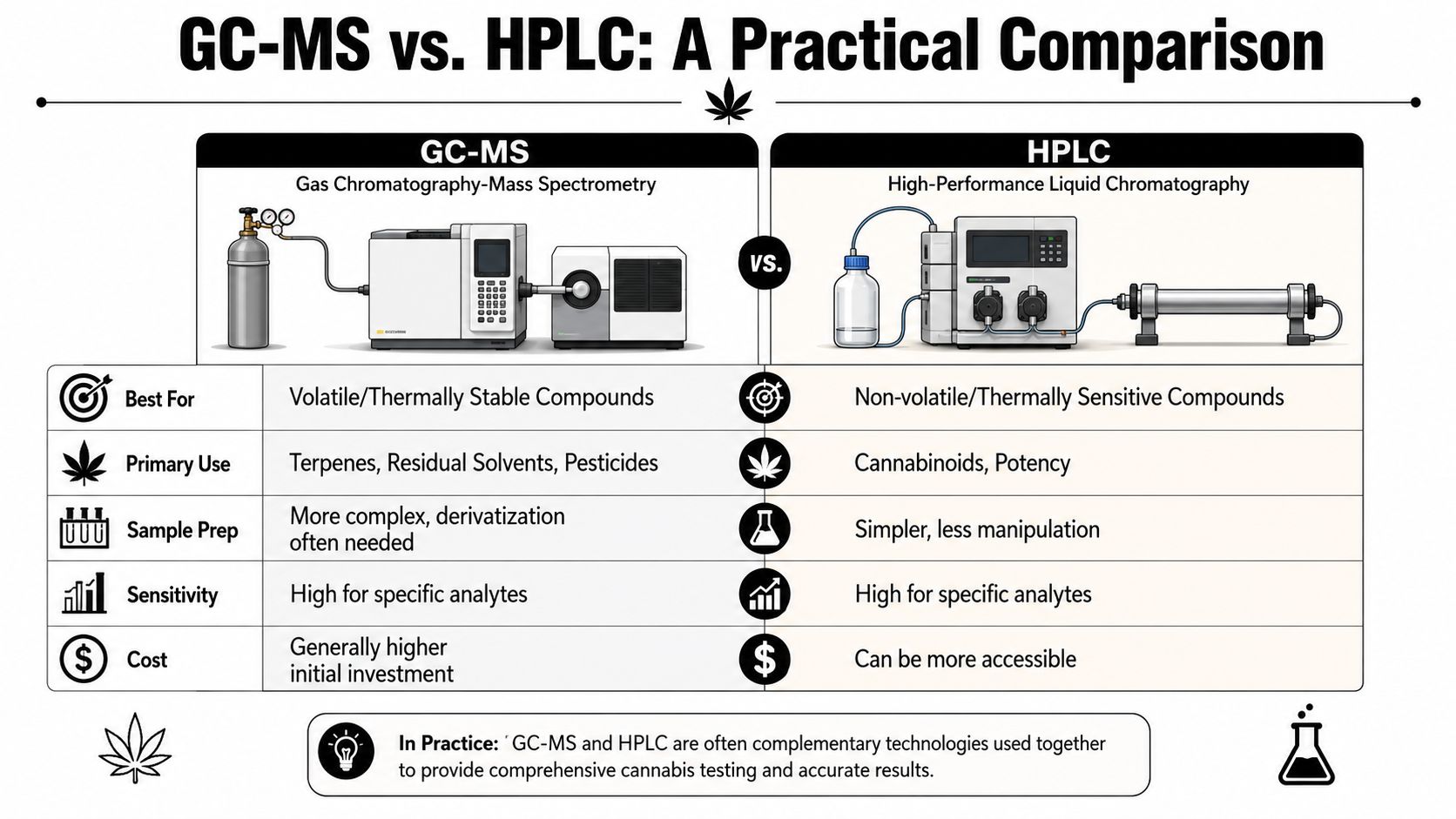
Method selection gets simpler once you separate the job into two questions. Are you measuring volatile aroma compounds or non-volatile cannabinoids? Once you answer that, the tool choice usually follows.
A quick visual comparison helps:
Why GC-MS is the terpene workhorse
For terpene-focused formulation, GC-MS is the preferred method because terpenes are volatile compounds and separate well in the gas phase. Verified benchmark data also states that for terpene profiling, GC-MS is preferred over HPLC for low-solubility, high-volatility compounds (Mindflower guide).
More specifically, for pure terpene samples and concentrates used in vape cartridges, the gold-standard QC methodology is direct injection GC/MS with cool on-column techniques, because it minimizes thermal degradation and prevents artifactual solvent formation (Terpene Belt Farms article).
That last point matters more than many buyers realize. If the test method itself heats the sample too aggressively, the result can misrepresent the true aroma chemistry of the blend. You end up testing an artifact of the method instead of the material you're putting into production.
For a deeper technical reference, review this overview of chromatography testing for terpene analysis and formulation work.
A short walkthrough can also help if your team is comparing equipment or lab workflows:
Where HPLC fits better
HPLC is the right choice when the target compounds are cannabinoids and the formulator needs dependable potency data without forcing volatile-style analysis onto a different chemistry problem. In practical terms, GC-MS tells you what's happening in the aroma system. HPLC tells you what's happening in the potency system.
Use GC-MS when the question is, "What will this smell and taste like?" Use HPLC when the question is, "What cannabinoid content are we actually delivering?"
Use the method that matches the failure mode
The common mistake is asking one instrument to answer every question. It can't.
A strain-inspired terpene blend for vape cartridges lives or dies on aroma fidelity, so GC-MS should anchor that part of the program. A cannabinoid-rich distillate intended for label claims needs HPLC support. If you're screening a full panel through a partner lab, make sure the method list matches the product risks you care about, not just the cheapest package on offer.
Developing SOPs and Sampling Plans for Consistency
A quality program becomes real when the process is documented. Until then, teams are relying on memory, habit, and whoever happens to be on shift. That's how one operator pulls a sample from the top of a mixing vessel, another pulls after recirculation, and both think they followed the same procedure.
Your standard operating procedures need to remove that ambiguity. Every batch should be sampled, tested, reviewed, and released the same way, with the same acceptance logic.
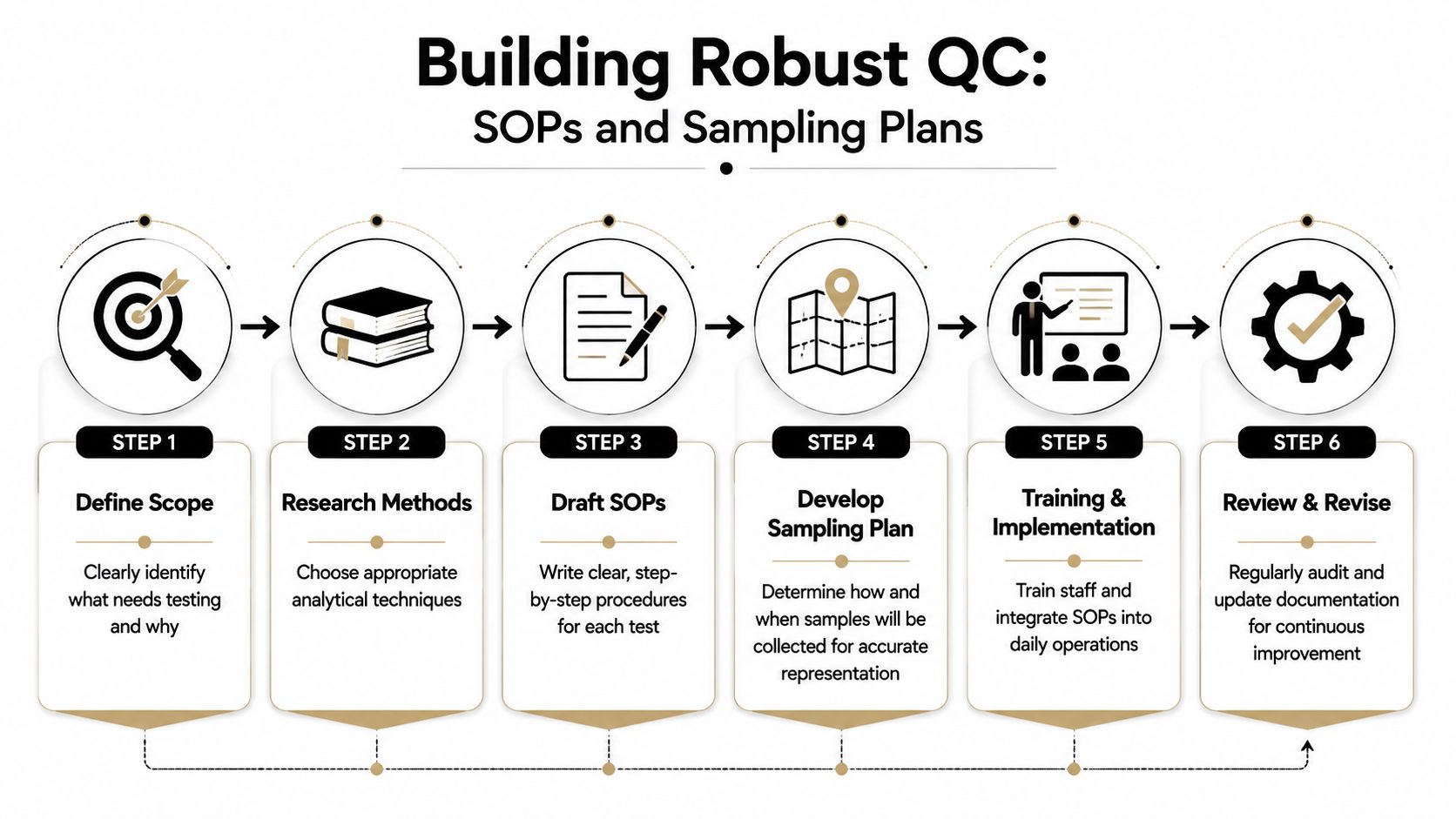
What every QC SOP should define
At minimum, each SOP should answer these operational questions:
- Material scope: Which raw material, intermediate, or finished good does this SOP apply to?
- Sampling point: When exactly is the sample taken, and from where?
- Container and handling: What vessel, storage condition, and labeling rule apply to the sample?
- Test method: Which analytical method is used, and which lab runs it?
- Acceptance criteria: What result is acceptable for release, hold, or investigation?
- Disposition path: Who decides whether the batch is approved, quarantined, reworked, or rejected?
That last item is where weak systems often break. Teams document the test but not the response. When a borderline result appears, production improvises. That's not control.
Sampling has to represent the batch
A single grab sample from a large lot doesn't prove the whole lot is uniform. It only proves one portion of the lot looked acceptable. For terpene-added distillates, that's especially risky because poor homogenization can leave one area of the batch heavy on top notes and another area dull or underblended.
Statistical Quality Control requires a minimum of 20–25 subgroups of data collected under normal operating conditions to establish statistically reliable control limits and capability values, and it also requires that the measurement system not contribute more than 30% to total variation (Symestic explanation).
That principle has two practical implications:
- You need enough data history to know what normal looks like.
- You need to verify that your testing system isn't creating noise that you mistake for process variation.
A bad sampling plan can make a stable process look unstable. A weak measurement system can make an unstable process look acceptable.
If you're tightening handling and batch hygiene around your sampling workflow, this guide on ways to prevent contamination in terpene and extract operations is a useful companion read.
A workable sampling structure for production teams
Instead of treating sampling as one action, break it into stages:
| Sampling stage | What to check | Why it matters |
|---|---|---|
| Raw material receipt | Identity, documentation, condition | Stops bad inputs before they reach formulation |
| Post-blend mix | Uniformity and target profile | Confirms the batch is actually blended as intended |
| Pre-fill hold | Stability before line use | Catches drift during staging |
| Finished cartridge review | Final sensory and analytical match | Verifies that the filling process didn't alter the product |
Train to the SOP, not around it
A written SOP only helps if operators follow it exactly. Train staff on the reason behind the step, not just the step itself. When people understand that a careless sample can hide a flavor drift problem, they handle the sample differently.
The strongest SOPs are short, specific, and revision-controlled. If a procedure takes too long to understand on the floor, it won't be followed consistently.
In-House vs Third-Party Labs A Strategic Decision
This decision usually comes down to control, speed, and complexity. Teams that formulate frequently often want in-house capability because they need rapid feedback during development. Teams that are smaller, scaling, or still refining their product architecture often benefit from third-party support because they can access validated methods without building the whole system themselves.
There isn't one correct model for everyone. The right choice depends on how often you test, what decisions depend on the result, and whether your organization can support lab discipline beyond just buying instruments.
Comparison of In-House vs. Third-Party QC Labs
| Factor | In-House Lab | Third-Party Lab |
|---|---|---|
| Speed | Faster feedback for R&D, incoming lots, and in-process checks | Slower turnaround, especially when shipping and queue times add delay |
| Process control | Strong visibility into sampling, handling, and retesting | Less direct oversight once the sample leaves your facility |
| Upfront investment | Higher because equipment, setup, method validation, and staffing all land on your team | Lower capital burden because the lab infrastructure already exists elsewhere |
| Technical depth | Depends on your hires, training, and management discipline | Often broader method coverage if the lab already supports full-panel testing |
| Development support | Better for iterative formulation work and troubleshooting during blending or filling | Better for formal release testing and specialized analyses you don't run often |
| Compliance burden | Your team owns documentation, calibration, method control, and audit readiness | The outside lab carries more of the analytical compliance burden |
| Flexibility | Easier to align tests with product-specific questions | Packages may be more standardized and less tailored to your exact failure modes |
| Best fit | Higher-volume manufacturers with frequent formulation changes | Brands, smaller manufacturers, or teams that need external expertise |
What usually works in practice
Many operators do best with a hybrid model. They keep a limited in-house capability for rapid development checks and process decisions, then rely on a third-party lab for broader compliance and confirmation testing.
That approach is often the most practical because product development and release testing don't have the same purpose. One is about speed and iteration. The other is about defensible records and independent verification.
The hidden cost isn't just money
The common trap is assuming the main question is budget. It isn't. The bigger question is whether your team can maintain repeatable lab practice. Instruments don't solve weak documentation, poor sample handling, or inconsistent analyst technique.
If your operation can't hold a stable SOP on the production side, an in-house lab will often reproduce that same inconsistency in analytical form.
Third-party labs are not automatically better, either. If the lab package doesn't reflect your actual formulation risks, you can still miss the problem that matters most. For terpene-driven vape products, that usually means missing the sensory failure mode while passing the standard compliance panel.
Avoiding Common QC Pitfalls in Terpene Formulation
The most expensive QC mistakes in vape formulation are rarely dramatic. They're usually small decisions that get normalized. A panel result looks acceptable, so nobody investigates the slight aroma shift. A batch is close enough, so it ships. Records are incomplete, but production is already scheduled. Over time, those shortcuts turn into sensory inconsistency, harder root-cause work, and a brand that no longer tastes like itself.
One rule should sit at the center of your release process. When COA data conflicts with sensory panel results, the gap must be investigated rather than overlooked; release decisions should never be replaced by schedule pressure, and incomplete records mean the batch is incomplete (Gold Coast Terpenes quality assurance processes).
That principle matters because terpene formulation is not only a chemistry exercise. It's also a performance exercise. If the lab says the profile is acceptable but trained evaluators say the cart doesn't present the intended strain character, you have a manufacturing problem to solve.
The pitfalls that show up most often
Some problems repeat across facilities:
- Overreliance on the COA: Teams treat the certificate as final truth even when the product smells wrong in the hardware.
- Weak incoming review: Raw materials are accepted on paperwork without verifying how they perform in the actual blend.
- Poor top-note protection: Volatile components are exposed to unnecessary heat or hold time before and during filling.
- Incomplete traceability: Operators can't quickly connect a finished cart back to the exact terpene lot, distillate lot, and fill run.
- Release by schedule: The production calendar effectively becomes the release authority.
Practical controls that prevent drift
If you're building a QC program to support formulating strain-inspired terpene blends for vape cartridges or replicating flavor of classic profiles for distillate, these controls do most of the heavy lifting:
- Define sensory acceptance before production starts: Write down what the batch should smell like in plain operational language. Include expected top, mid, and base note behavior.
- Tie sensory review to lot release: Don't treat organoleptic review as informal. Make it part of the release path.
- Keep batch records complete: If the mixing temperature, hold time, sample ID, or operator signature is missing, the record isn't finished.
- Track deviations immediately: If a blend smells flatter after filling than before filling, document it as a deviation and investigate while the run is still fresh.
- Review trends, not just single lots: One acceptable lot can hide a drifting process. Look for changes in aroma balance across consecutive production runs.
- Protect volatile terpenes operationally: Handle monoterpene-heavy systems with care during transfer, staging, and filling.
- Use the same language across teams: R&D, production, and QC should all mean the same thing when they say "on spec."
A terpene formula isn't consistent because the spreadsheet stayed the same. It's consistent because the raw materials, process, test method, and release standard all stayed controlled.
Record-keeping that actually helps later
The best records answer questions quickly when something goes wrong. For each batch, I want to see:
- Which lots were used
- Who blended and who reviewed
- What the intended profile was
- What the analytical results showed
- What the sensory review found
- Whether any deviation occurred during fill or storage
That level of traceability is what lets a team distinguish between a raw material issue, a blending issue, and a filling issue without guessing.
If you want one practical tool that supports repeatable batch setup, use a formulation worksheet or a mixing calculator for terpene additions and batch planning. It won't replace QC, but it does reduce preventable errors at the front end.
Gold Coast Terpenes supplies terpene blends, isolates, and formulation resources for teams developing vape cartridges, concentrates, and strain-inspired products. If you need reliable inputs for flavor accuracy, batch consistency, or terpene profile work, explore the technical tools and product options at Gold Coast Terpenes.