
You've probably seen this happen in a development run. The oil tests clean, potency is where it should be, hardware performance looks acceptable, and the finished cart still tastes generic. The label says a specific strain, but the sensory result lands closer to “sweet cannabis” than a recognizable profile.
That gap is where many teams start asking, what is HTE, and whether it can solve a flavor problem that distillate and standard terpene additions didn't fix. For commercial formulation, that's the useful question. HTE matters because strain fidelity is a product problem, not just a naming problem.
In vape development, flavor accuracy does more than improve first impression. It supports brand consistency, repeat purchasing, and portfolio differentiation. If your Blue Dream SKU tastes thin one month and syrupy the next, customers notice. If your live product line tastes authentic while your distillate line tastes rebuilt, they notice that too.
The Formulator's Challenge with Flavor Accuracy
A clean distillate base gives you potency and control. It usually doesn't give you a convincing strain expression. By the time cannabinoids have been refined into a nearly flavorless oil, many of the volatile compounds that create lift, brightness, and varietal character are gone. What remains is a blank base that needs rebuilding.
That rebuilding step is where a lot of formulations go wrong. Teams often add a generic “strain profile” and get the rough outline of aroma, but not the layered result that makes a cart feel true to the source material. Top notes can flash off too fast. Mid notes can flatten. Base notes can dominate and leave the oil tasting heavier than intended.
A quick review of a terpene flavor chart for formulation work helps frame the issue. Not every terpene contributes in the same way. Some compounds create the first aromatic hit. Others build body or anchor the finish. If you treat them as interchangeable, the formula may smell acceptable in the bottle and still perform poorly once heated in a cartridge.
Why HTE gets attention in cartridge development
HTE gives formulators a different starting point. Instead of rebuilding a profile from a neutral cannabinoid base, you're working with a cannabis concentrate that already carries a broader sensory footprint.
That changes the job in three ways:
- Flavor depth improves: HTE can deliver a more plant-faithful aroma than distillate alone.
- The profile feels less linear: You're not relying only on a few obvious top notes to sell the strain.
- Less reconstruction is needed: The formula may still need standardization, but you're adjusting a living profile rather than inventing one.
A cart rarely tastes artificial because the cannabinoid base is bad. It tastes artificial because the aromatic structure is incomplete.
Why this matters for product teams
Brand owners often think of flavor as a marketing layer added near the end of development. In practice, it's part of the core formulation. Hardware choice, oil viscosity, terpene load, and extraction input all affect whether the final product tastes crisp, muddy, harsh, or authentic.
That's why HTE isn't just another acronym in extraction. It's a formulation tool with real upside and real constraints. Used well, it can close the gap between a technically functional vape and one that tastes like the SKU name on the box.
Defining High Terpene Extract
A common product meeting goes like this: the team wants a cart that tastes closer to fresh cannabis, but standard terpene additions still come across as thin or overly polished once the oil is heated. HTE usually enters the conversation at that point.
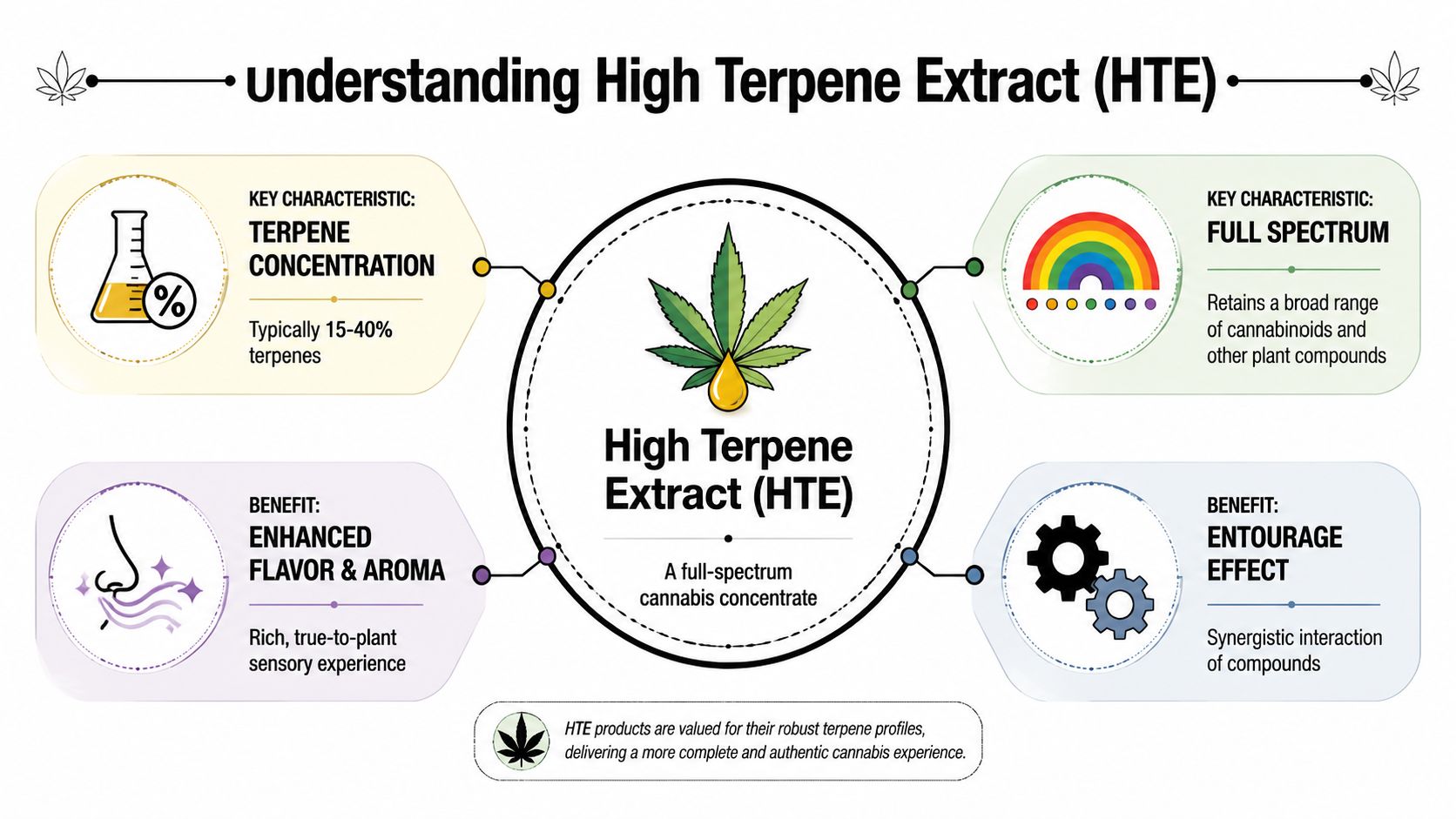
High Terpene Extract, or HTE, is a cannabis concentrate with a terpene-rich fraction and a meaningful cannabinoid fraction still present. In extraction trade language, it is often associated with the liquid portion of sauce, while the solid fraction is sold as diamonds. That distinction is useful because it places HTE in the practical context where buyers encounter it. It is not a neutral flavor additive. It is an active cannabis ingredient with aroma, viscosity, potency, and stability implications.
Industry descriptions vary, and the label gets used loosely. Some suppliers use HTE to describe any terpene-forward cannabis fraction. Others reserve it for sauce-derived material with a clear separation between crystalline cannabinoids and a fluid aromatic layer. For formulation work, the exact nickname matters less than the certificate of analysis, residual solvent data, and the extract's behavior in your intended hardware.
What separates HTE from standard terpene additions
HTE gives formulators complexity. Isolated terpenes give formulators control.
That trade-off shows up quickly on the bench. HTE can carry a wider mix of aromatic compounds and minor constituents that make a profile feel more strain-faithful, especially under heat. It can also introduce batch variation, darker color, stronger reactivity, and more formulation risk than a tightly standardized terpene blend.
A useful primer on what terp sauce means in extraction terminology helps connect the naming. In practice, teams often use "sauce" as shorthand for the fluid, terpene-rich fraction left after cannabinoid crystals separate, and HTE is closely tied to that material class.
Why formulators care about the ratio
The terpene-to-cannabinoid balance affects more than flavor.
A highly aromatic HTE can improve realism, but it may also thin the oil too far, increase harshness, or push the cartridge outside its ideal operating range. A heavier cannabinoid fraction may blend more predictably into a potency-first formula, but the sensory lift may be weaker than the sales team expects from the name alone. This is one of the first disconnects I see between purchasing and formulation. The sample smells impressive in the jar, then underperforms after dilution and heat cycling.
Practical rule: Don't buy HTE by name alone. Buy it for a specific job in the formula, then verify whether its aroma load, flow behavior, and compatibility match that job.
For commercial vape development, HTE works best when the team treats it as a formulation input that needs guardrails. Set a target use rate. Check how it affects viscosity and fill consistency. Stress-test the blend in the actual hardware. HTE can improve flavor depth and product differentiation, but it also raises the stakes on consistency, safety review, and process control.
HTE Production and Chemistry Explained
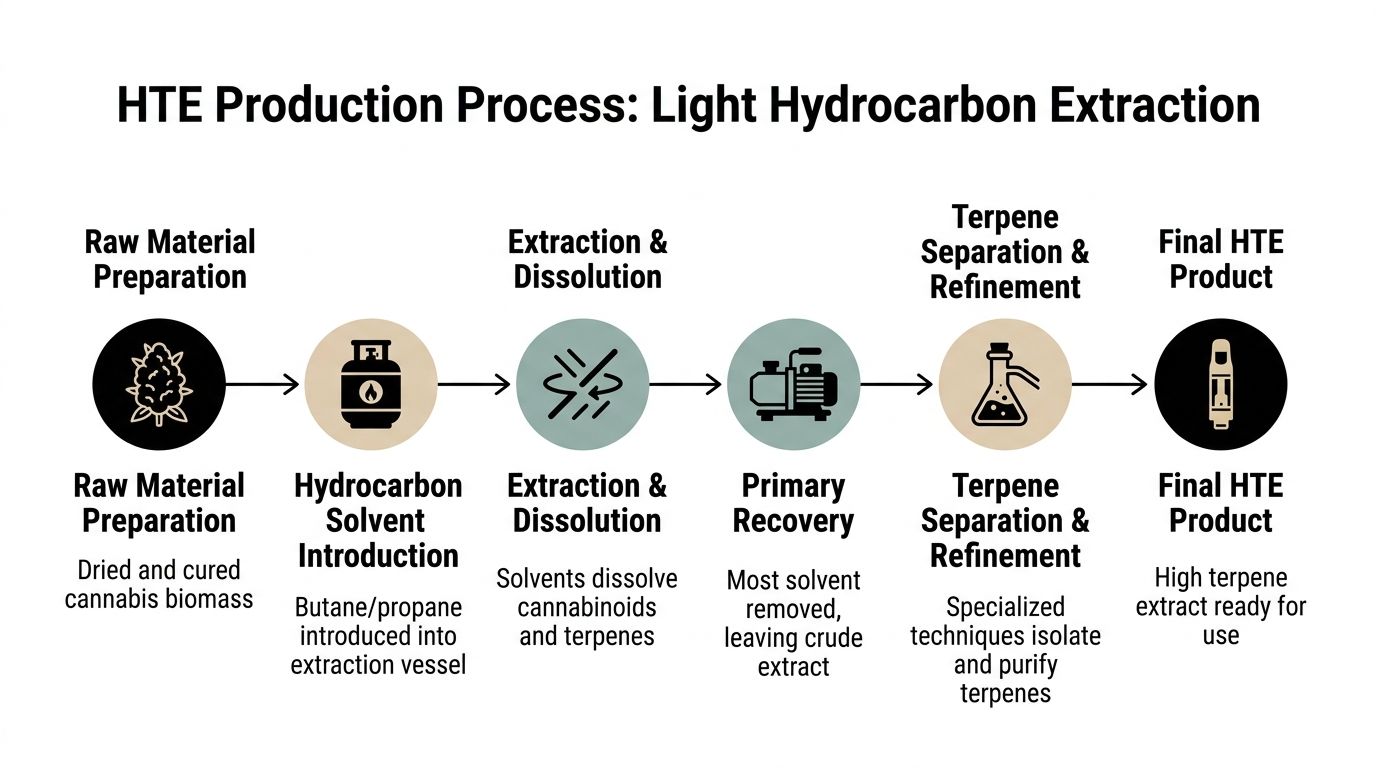
HTE is usually associated with light hydrocarbon extraction, especially systems using butane, propane, or a blend of the two. That extraction style matters because it's well suited to pulling volatile aromatic compounds without flattening the profile as aggressively as more refined downstream processes can.
The production goal isn't just to collect cannabinoids. It's to preserve the fraction that gives the extract recognizable character. For vape formulators evaluating supply, that's the difference between a vivid input and one that already tastes faded before it reaches the blending bench.
How the process usually unfolds
A simplified production path looks like this:
Biomass selection
Material quality determines the ceiling. Weak aroma in means weak aroma out.Cold hydrocarbon wash
Solvent moves through the plant material and dissolves cannabinoids plus volatile aromatic compounds.Primary solvent recovery
Most of the solvent is removed, leaving a concentrated extract.Controlled separation
Under the right conditions, cannabinoid crystals can separate from the terpene-rich liquid fraction.Refinement and purge
The producer finishes the material so it's suitable for downstream use, with special attention to residual solvent control.
Why hydrocarbons preserve flavor more effectively
From a formulation perspective, the main advantage is preservation of the compounds that are easiest to lose. Those are often the components that create the first impression of a strain.
You can think of the aroma structure in three layers:
- Top notes open the profile. These are the quickest to flash and the easiest to lose.
- Mid notes fill out the center of the aroma and carry recognizable strain character.
- Base notes stay longer and give the oil weight and persistence.
If a production method sacrifices too many top notes, the result may still smell “cannabis-like” but not varietal. If it damages the mid layer, the oil loses identity. If base notes dominate, the finished cart can feel dense or muddy.
What this means at the sourcing stage
When I evaluate HTE for use in commercial cartridges, I care less about buzzwords and more about sensory behavior under heat. A sample can smell impressive in a jar and still fail in hardware if the top layer collapses or the base notes turn harsh during repeated pulls.
The best HTE inputs usually smell organized, not loud. You should be able to detect lift, body, and finish as separate parts of the same profile.
A good supplier should also be able to explain how the material was handled during extraction and purge. If they can't speak clearly about solvent removal, storage conditions, and consistency from batch to batch, that's a risk signal for any serious formulation guide for vape cartridges.
HTE vs Distillate and Botanical Isolates
HTE doesn't replace distillate. It doesn't replace botanical isolates either. Each ingredient solves a different problem, and strong product development teams use them deliberately instead of treating them as competing ideologies.
Distillate is your structural base when potency and process control matter most. Botanical isolates are precision tools for adjusting a profile. HTE is the ingredient you reach for when the formula needs a more believable cannabis character than a rebuilt blend can provide on its own.
One practical benchmark matters here. In formulating for vape cartridges, live-resin or live-rosin extraction methods preserve significantly more of a strain's native terpene profile, including its critical myrcene backbone, compared to distillate, which often loses volatile top notes and requires precise terpene supplementation to restore the original flavor, as described in this Blue Dream extraction and profile overview. That's the core reason HTE enters the discussion at all.
Formulation ingredient comparison
| Attribute | High Terpene Extract (HTE) | Cannabinoid Distillate | Botanical Terpene Isolates |
|---|---|---|---|
| Primary role | Flavor-driving cannabis fraction | Potency base | Standardization and profile tuning |
| Flavor complexity | Broad and layered | Minimal on its own | Precise but easier to make feel linear |
| Potency contribution | Moderate relative to distillate-heavy bases | High | Negligible in cannabinoid terms |
| Viscosity behavior | Can be harder to control from batch to batch | More predictable | Changes depend on use level and blend design |
| Best use case | Premium strain-inspired vape development | High-output cannabinoid formulations | Fine adjustments, top note repair, repeatability |
| Main risk | Harshness, inconsistency, compliance scrutiny | Flat flavor | Artificial or oversimplified profile |
A refresher on what distillate is in cannabis formulation helps explain why these trade-offs are so common. Distillate is excellent at delivering a purified cannabinoid base. It just doesn't carry enough native flavor complexity to satisfy every premium SKU on its own.
What works well in practice
The strongest commercial formulas usually don't rely on one input.
HTE plus distillate works when you want a richer cannabis identity without giving up control over potency and hardware fit.
Distillate plus isolates works when your priority is repeatability, cost control, and a clean strain-inspired terpene blend for distillate.
HTE plus isolates works when the native extract is close to the target but needs correction. Maybe the top notes are weak. Maybe the finish is too woody. Maybe the target SKU needs stronger berry or pine expression.
What usually doesn't work
A few patterns tend to fail:
- Overtrusting HTE batch identity: Native complexity is useful, but it isn't automatically standardized.
- Using isolates as a bandage for poor extract quality: If the HTE is harsh or unstable, surface-level tuning won't fix it.
- Expecting distillate to carry flavor memory: It won't. Once those volatile notes are gone, you have to rebuild or reintroduce them.
If your goal is premium realism, think in layers. Distillate handles the base function. HTE supplies cannabis character. Isolates refine the final expression.
A Formulation Guide for HTE Vape Cartridges
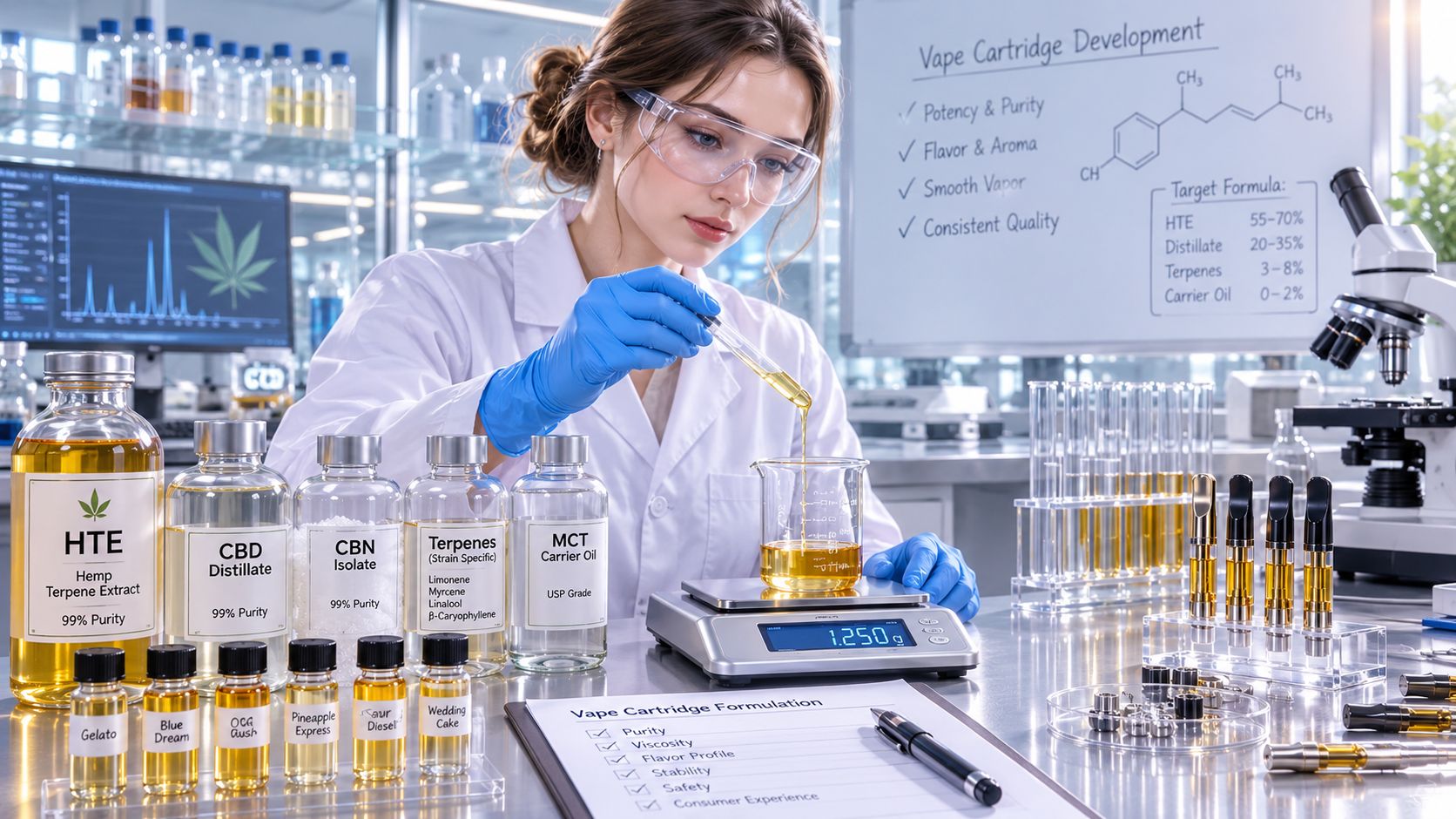
Commercial teams usually make the same mistake the first time they formulate with HTE. They assume richer aroma means they can skip process discipline. In reality, HTE asks for more discipline, not less. It can improve realism fast, but it also exposes weak decisions in mixing order, heat handling, and hardware matching.
Start with the function of the SKU
Before you blend anything, decide what HTE is supposed to do.
If the cart is a flagship strain-replication product, HTE may be the main flavor driver. If the cart is a higher-throughput distillate SKU, HTE may only serve as a realism booster. Those are different jobs, and they call for different formulation decisions around aromatic strength, consistency, and acceptable variability.
I usually sort HTE cartridge projects into three buckets:
- Correction use: The base oil already performs, but it tastes flat.
- Reconstruction use: The target strain profile needs a more believable cannabis core.
- Premium line use: The finished SKU is meant to sit above standard distillate products in sensory quality.
Dose terpenes conservatively
When you're building or correcting a formula for vape cartridges, terpene loading has to stay controlled. The recommended terpene dosing for formulating strain-inspired terpene blends into distillate or e-liquid bases for vape cartridges is between 1% and 3% by volume, with 2% being the industry norm; exceeding 4% is possible but uncommon and may overpower the base flavor, according to this Blue Dream terpene dosing guide.
That range matters even when HTE is part of the formula. HTE already carries aromatic content. If you stack aggressive supplemental terpenes on top of it, the result can turn sharp, unstable, or tiring on repeated pulls.
Bench advice: Add less than you think you need, homogenize completely, test in actual hardware, then adjust. Smelling the beaker isn't enough.
Use HTE to build the middle, not just the opening
A lot of teams chase top notes first because they're the easiest to notice. That can backfire. A vape that opens with obvious fruit or pine but has no body underneath tastes fake after a few draws.
HTE often works best when you treat it as the mid-structure of the formula. Let it provide the center of gravity. Then use supplementary isolates only where the profile is clearly missing a note or drifting off target.
For strain replication, Blue Dream is a useful example because it has a recognizable aromatic shape. For a terpene profile for Blue Dream in vape cartridges, the blend should be dominated by myrcene at 40% to 50%, with pinene at 15% to 20% and caryophyllene at 10% to 15% to reproduce its sweet berry aroma and balanced profile, as outlined in this Blue Dream terpene guide. In practice, that means HTE alone may get you close, but not always all the way. If the source extract lacks enough berry lift or pine brightness, selective supplementation can standardize the output.
A short demonstration of mixing workflow is worth watching before scaling a bench sample:
Mixing order and stability checks
For a formulation guide for cannabis product formulation, the order of operations matters as much as the ingredients.
Warm gently if needed
Use only enough heat to improve flow and blending. Excess heat can flatten the aromatic edge.Blend cannabinoids first
If distillate is part of the formula, get that base uniform before aromatic adjustments.Fold in HTE gradually
Don't dump it in and assume it will disappear evenly.Add corrective isolates last
Fine-tuning is easier when the cannabis fraction is already integrated.Test in target hardware
The same formula can behave differently across cartridge designs.
What works and what usually fails
What works
- Building formulas around a clear sensory target.
- Using HTE for depth and authenticity.
- Correcting only the notes that are missing.
- Running small bench tests before committing a production batch.
What doesn't
- Trying to force every SKU through the same HTE percentage.
- Overdiluting until the strain identity disappears.
- Using heavy terpene loads to cover poor native extract quality.
- Approving a profile from aroma alone without pull testing.
Winterization and post-blend clarity checks can also matter, especially if the oil shows instability, haze, or inconsistent flow after mixing. The exact path depends on your extract type and hardware, but the principle stays the same. Treat HTE like a high-value active flavor fraction, not a shortcut.
Navigating Safety Testing and Regulatory Compliance
A cartridge can smell excellent in the beaker and still fail where it matters. It can hit harsh, test dirty, or create a labeling problem the sales team notices too late. HTE raises the stakes because it is both a flavor driver and a concentrated extract fraction. Treating it as aroma only is how teams miss preventable risk.
Start with the material itself. Many HTE lots come from hydrocarbon-based extraction workflows, so residual solvent review belongs at intake, not after the blend is already approved. Harshness, throat bite, or a chemical finish can point to formulation imbalance, but they can also point to cleanup problems upstream. Good teams do not guess which one they are dealing with. They check the COA, confirm the method, and match the paperwork to the actual lot in the room.
What to review on a COA
A useful HTE COA review goes past headline potency.
- Residual solvents: Confirm cleanup was effective and that the reported limits fit the market where the product will be sold.
- Pesticides: HTE can carry upstream contamination into a more concentrated form.
- Heavy metals: Review the ingredient data, then verify performance again in the finished cartridge because hardware can change the risk profile.
- Cannabinoid content: Small amounts of THC or other cannabinoids can affect legal classification, especially outside licensed cannabis channels.
- Batch identity: The aroma, terpene profile, and product paperwork should agree. If they do not, hold the lot.
A practical intake and release process helps prevent inconsistent decisions across buyers, formulators, and QA. A regulatory compliance checklist for terpene products gives teams a usable starting point for supplier approval, document review, and finished-goods release.
Labeling deserves the same level of scrutiny.
Strain names, effect claims, and cannabis-adjacent language can create avoidable exposure, especially in hemp or nicotine formats. A terpene-rich input does not automatically change the legal position of the finished product, but it can attract closer review if the branding suggests intoxication, therapy, or a cannabis identity the test results do not support. That is where many otherwise competent product teams get into trouble. The formula may be sound. The market claim is what creates the problem.
Experienced manufacturers also test the finished cart, not just the incoming HTE. That means checking the filled hardware for stability, sensory quality under heat, and final compliance status after all ingredients are combined. Raw material documents matter, but they do not replace finished-product verification.
The payoff is simple. Fewer failed batches, fewer unpleasant surprises in distribution, and a product line that holds up under both lab review and repeat consumer use.
Using HTE to Create Premium Product Lines
HTE earns its place when a brand wants more than generic strain naming. It gives formulation teams a way to build carts with stronger cannabis identity, fuller aroma structure, and a more convincing finish than many standard distillate products can deliver on their own.
That doesn't mean every SKU should use it. HTE works best in lines where flavor accuracy is part of the value proposition and where the team has the process control to manage dilution, consistency, and compliance. In that setting, it becomes a strategic ingredient. Not because it's trendy, but because it helps close the gap between a label claim and the actual draw.
For premium development, the winning approach is usually balanced. Use HTE for authenticity. Use precise terpene inputs for standardization and strain-inspired correction. Test aggressively in real hardware. Reject any batch that smells exciting in the jar but falls apart in the cart.
A crowded market rewards products that taste deliberate. Teams that understand HTE as a formulation tool, not just a category term, have a better shot at building that kind of line.
If you're developing cartridges, concentrates, or strain-inspired terpene blends for commercial production, Gold Coast Terpenes offers lab-verified natural terpene blends, isolates, formulation tools, and technical resources that can help you standardize flavor, refine profiles, and build more reliable vape SKUs.