
A batch passes viscosity, fills cleanly, and then the first retention sample comes back with the wrong nose. The opening citrus is flat, the middle feels muddy, and the cart tastes harsher than the bench sample did two days earlier. That's a normal formulation problem, not a mystery. Most failures with bulk terpenes come from three places: weak sourcing controls, poor profile architecture, or bad process discipline during mixing and filling.
That's why basic “what are terpenes” content doesn't help the people who have to ship products. If you're building vape cartridges, tuning distillate flavor, or trying to create a reliable terpene profile for cannabis product formulation, you need repeatability more than novelty. You need a blend that survives procurement, scales through production, and lands in hardware with the same sensory shape you approved at the bench.
Your Guide to Bulk Terpene Formulation
Bulk terpene work sits at the intersection of sensory design, manufacturing control, and purchasing discipline. A profile can smell perfect in a sample vial and still fail in production if the supplier can't hold lot consistency, if the monoterpene fraction is too aggressive for the hardware, or if the blend was calculated for ideal conditions instead of a real filling line.
What matters in practice
For professional formulation, four outcomes matter more than anything else:
- Batch-to-batch consistency. If reorder lots drift, your SKU drifts.
- Flavor accuracy. The profile has to survive heating, storage, and the base oil.
- Hardware performance. A blend that lowers viscosity too far creates leaks and complaints.
- Commercial reliability. You need supply continuity, usable documentation, and pricing that still works at scale.
A strain-inspired terpene blend can be commercially valuable, but only if it behaves like a manufacturing ingredient, not a novelty additive. That means treating terpenes like any other critical raw material. Review the COA. Track lot numbers. Lock your target ratios. Test in the actual cart and the actual oil you plan to sell.
Practical rule: Approve terpene blends in the same hardware and base matrix you intend to launch. Bench aroma alone doesn't predict finished product performance.
Where formulators usually go wrong
The most common mistake isn't dramatic overuse. It's assuming a good aroma equals a good formulation. It doesn't. A bright top note can disappear during filling. A heavy pepper note can dominate after a few days in storage. A profile built for flower nostalgia can become one-dimensional in distillate.
When teams ask for a formulation guide for vape cartridges or for distillate, what they usually need is a workflow:
- Source intelligently
- Build profiles by note structure
- Dose with discipline
- Adjust for loss and hardware behavior
- Document every lot and revision
That's the playbook that turns bulk terpenes into a controllable production input instead of a recurring source of launch risk.
Sourcing Bulk Terpenes for Quality and Consistency
A supplier pitch tells you almost nothing. The COA tells you whether you can formulate with confidence.
If you're buying bulk terpenes for vape cartridges, concentrates, or a strain-inspired terpene blend, the first filter is documentation quality. The second is lot control. The third is whether the supplier can keep both stable over time.
Read the COA like a buyer, not a browser
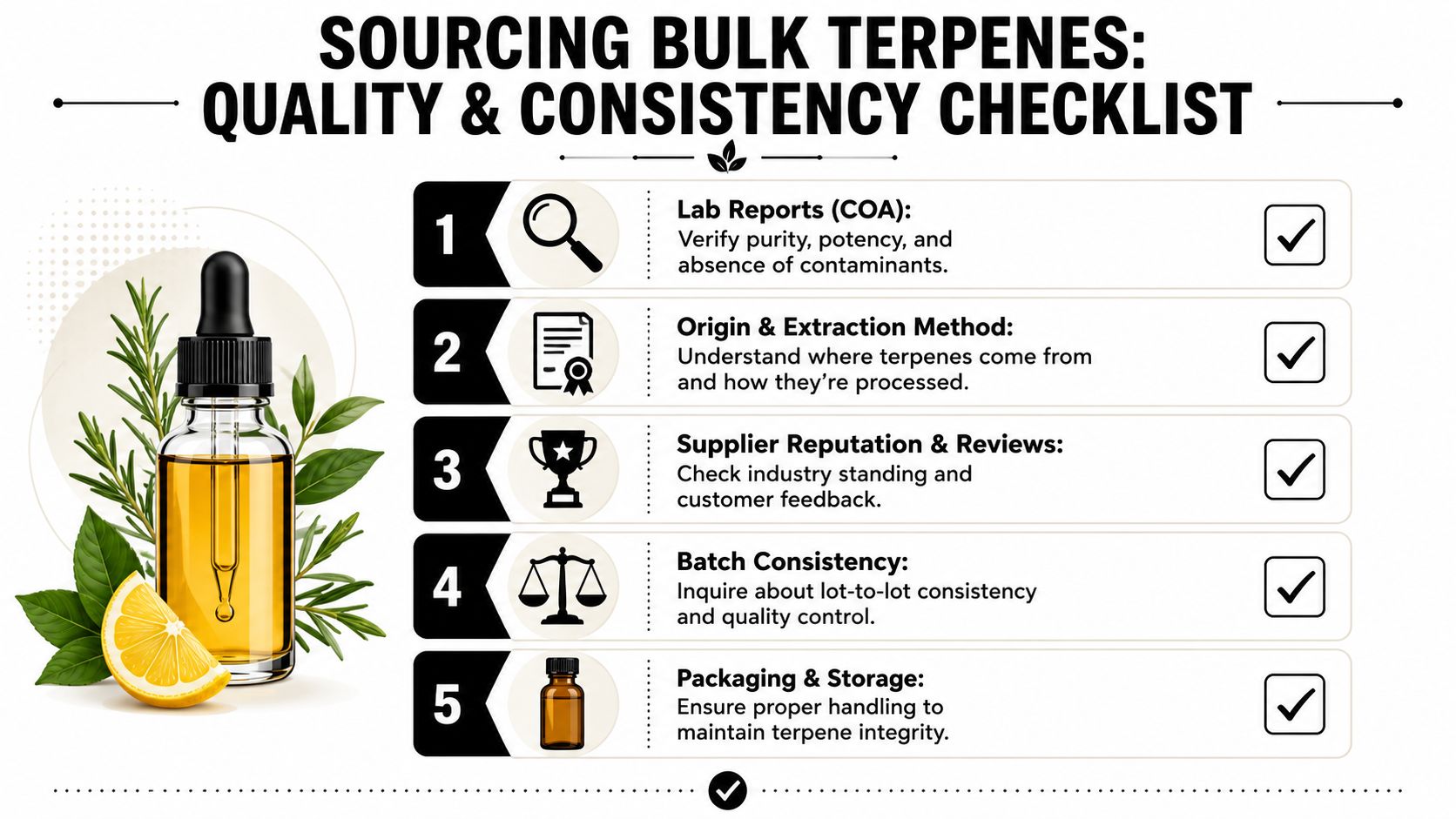
For production work, the COA isn't a nice extra. It's the core purchasing document. In bulk terpene production and quality control, acceptable variation ranges are ±10% for major terpene compounds and ±25% for minor components, and reliable specifications require GC-MS COAs that quantify individual compounds and include safety testing for residual solvents, pesticides, heavy metals, and microbiological contamination, as described in this production guide on terpene quality control.
That matters because “close enough” is not close enough in a repeated SKU. If limonene or myrcene moves outside your expected range, the profile changes. If minor compounds drift too far, the finish changes even when the headline aroma still seems similar.
Use this review sequence:
- Check batch specificity. The COA should tie to the actual lot you're buying.
- Review quantified compounds. You want named terpene concentrations, not a vague purity claim.
- Look at contamination screens. Residual solvents, pesticides, heavy metals, and microbiology need to be addressed.
- Match lots against prior purchases. Reorder confidence comes from comparison, not assumption.
Isolates or prebuilt blends
This choice depends on the job.
A bulk isolate strategy works best when you're formulating from scratch, correcting a profile, or building a terpene profile for distillate that has to hit a specific note structure. Isolates give you precision. They also create more work. You need better records, cleaner calculations, and more disciplined sensory review.
Prebuilt strain-inspired terpene blends are faster for SKU development, line extensions, and teams that need speed without building every profile molecule by molecule. They save labor, but they also reduce your ability to fix one note without moving the rest of the blend.
A simple comparison helps:
| Approach | Best use | Main advantage | Main trade-off |
|---|---|---|---|
| Isolates | Custom profile design, strain replication, note correction | Maximum control | More formulation labor |
| Prebuilt blends | Fast development, production convenience | Speed and simplicity | Less granular adjustment |
Buy samples from at least two lots if a supplier offers them. One good sample proves aroma. Two comparable lots prove process control.
Supplier questions that actually matter
Marketing copy about purity or natural sourcing doesn't solve production problems. Ask operational questions instead.
- Can they provide lot-matched COAs consistently?
- Do they explain origin and extraction clearly?
- Can they support repeat bulk volume without undisclosed reformulation?
- How are materials packed for storage and transit?
If you're evaluating vendors, a practical starting point is comparing what a professional retail and wholesale page shows, such as this reference on where to buy terpenes. You're not just buying aroma. You're buying traceability, repeatability, and fewer production surprises.
The Science of Terpene Profile Architecture
A terpene profile that works on paper still needs internal structure. The easiest way to think about that structure is fragrance architecture. You're building an opening, a body, and a finish.
For cannabis product formulation, that means separating what grabs attention first from what carries the profile through heating and what stays behind after the initial burst fades.

Top, middle, and base notes
Top notes create the first impression. In strain-inspired terpene blend work, this is often where citrus, pine, and fresh lift live. Limonene and pinene often function this way because they're fast, expressive, and volatile.
Middle notes give the profile its identity. In this range, floral, herbal, soft fruit, or dense resin character often settles. Linalool and myrcene frequently shape this section because they fill the gap between brightness and depth.
Base notes hold the profile together. They don't always shout, but they keep the blend from collapsing into a sharp, thin aroma. Caryophyllene and humulene often support this role with spice, wood, or a grounded finish.
Build for the cart, not just the bottle
In vape work, note architecture has to survive heat. That changes how you balance classes. Vape formulations require specific class ratios for thermal resilience: monoterpenes should be kept below 6%, while sesquiterpenes should be incorporated at 3–5% for flavor retention and hardware compatibility during heating cycles, according to this terpene classification resource for product development.
That single guideline fixes a lot of weak formulations. Teams often overload volatile top notes because the fresh aroma in the vial feels exciting. Then the cart runs hot, the top burns off early, and the remaining profile tastes hollow or uneven.
A better approach is to think in layers:
- Opening impact comes from controlled volatility.
- Mid-palate identity carries the strain-inspired character.
- Base stability supports retention through repeated pulls.
A profile with too much top and not enough base smells expensive in the bottle and cheap in the cartridge.
What works and what doesn't
What works is restraint. A strong profile for vape cartridges usually has one clear lead note, one supporting middle, and enough base material to keep the blend coherent over time.
What doesn't work is chasing complexity for its own sake. If every note is loud, none of them read clearly. If every correction adds another isolate, the blend often gets noisier instead of better.
For anyone replicating flavor of a known cultivar, the job isn't to make the loudest version. It's to make the most recognizable one after mixing, filling, storage, and use.
A Guide to Terpene Mixing Ratios and Calculations
The right terpene profile can still fail if the load is wrong. Dose control is where a lot of promising formulations fall apart.
For vape cartridge formulation using distillate, the industry-standard terpene load is 4–8% by weight, with 5% as the optimal starting point. Going beyond 8% increases the risk of harshness and cartridge malfunction, according to this vape mixing ratio chart.
Start with the loading range, not the aroma wish
A profile that smells weak in a raw vial doesn't automatically need a heavier load. In distillate, aroma expression changes with matrix, heat, and hardware. Starting at 5% is practical because it gives enough signal for evaluation without pushing the cart into leak-prone or harsh territory.
Use the range as a process tool:
- Around the low end if the blend is top-note heavy, highly expressive, or going into thinner oil
- Near the middle for most first-pass commercial tests
- Toward the high end only if the oil, hardware, and sensory result all justify it
The basic calculation
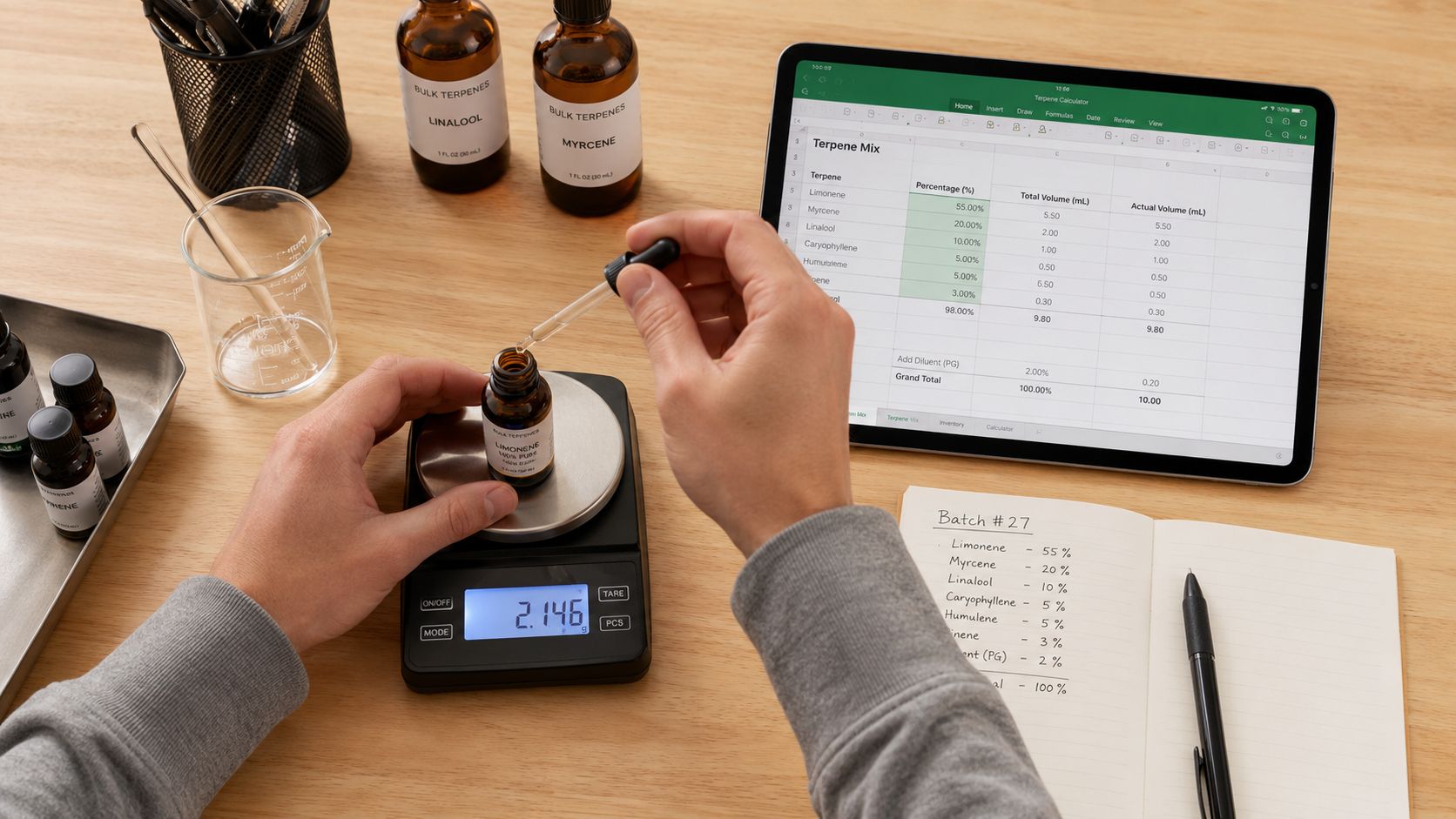
Calculations should be done by weight, not by guesswork and not by drop count.
If you're formulating a batch for vape cartridges and targeting a 5% terpene load, multiply total batch weight by 0.05 to get your terpene weight. The rest of the batch is your base oil. Keep the formula sheet simple and versioned.
A practical worksheet usually includes:
| Item | What to record |
|---|---|
| Batch ID | Internal lot or test number |
| Base oil weight | Distillate or concentrate weight |
| Target terpene load | Selected percentage within range |
| Terpene blend lot | Supplier lot tied to COA |
| Mix temperature | Internal process record |
| Fill date | For retention comparison |
Don't trust memory during revisions
The fastest way to lose a workable formulation is casual note-taking. If you adjust caryophyllene, drop total load slightly, and change hardware in the same week, you won't know which variable fixed the problem.
Use a calculator when speed matters, but keep your judgment in charge. A practical tool like the terpene mixing ratios calculator helps reduce arithmetic errors and speeds up iteration, especially when you're scaling a bench formula into a production batch.
This walkthrough is a useful companion when training staff on weighing and incorporation:
Signs the ratio is wrong
The cart usually tells you before the spreadsheet does.
- Harsh inhale often means total load is too high, the blend is too top-heavy, or both.
- Leaking usually points to viscosity reduction from excessive terpene content.
- Muted flavor after fill can come from volatility loss, not necessarily underdosing.
- Flat finish often means the base note structure is too weak.
If a formula only tastes right at the very top of the acceptable loading range, the profile usually needs to be rebuilt, not simply dosed harder.
Good formulators use ratio changes to fine-tune. They don't use them to rescue a structurally weak blend.
Advanced Formulation for Replicating Strain Profiles
Replicating flavor of a known cultivar is one of the few formulation tasks that can set a product apart. It also exposes every weakness in your process. A strain-inspired terpene blend that resembles the target in a sample vial but drifts in production won't hold up as a commercial SKU.
The practical route is to translate a terpene fingerprint into a buildable profile, then adjust for how your base oil and process alter that fingerprint.

Start with the fingerprint, then simplify
If you have GC-MS data for a target profile, don't copy it blindly. A direct translation from flower analytics into a vape formula often disappoints because the consumption format is different. Some compounds dominate more aggressively in distillate. Others disappear faster during filling and storage.
Use the report to identify three things:
- Lead compounds that define recognition
- Supporting compounds that create body
- Trace elements that may matter sensorially but don't deserve equal weight in the first build
That last point matters. Formulators often overcorrect by chasing every small line item. A better first pass captures the identity of the target, then adds nuance only when the broad structure is right.
Adjust for real production loss
Professional formulators must account for a 15–30% terpene loss factor during filling and initial storage, especially for volatile monoterpenes like limonene and pinene, as noted in this formulation strategy article. That loss is one reason bench-top approval and finished goods don't always match.
Formulation experience matters. If your target profile depends heavily on a bright, volatile opening, you may need to build that expectation into the pre-fill blend rather than wait to discover the loss in packaged product.
A workable process for strain replication looks like this:
- Build the first blend from key compounds, not every possible compound.
- Test in your actual oil rather than evaluating aroma neat.
- Fill a small hardware run and hold retention units.
- Compare fresh, short-rest, and stored samples.
- Revise only one major variable at a time.
For cultivar benchmarking and profile selection, it also helps to review how the trade talks about high terpene strains so your target profile has a useful commercial reference point, not just a lab target.
Commercially useful replication
The best strain-inspired work doesn't obsess over perfect botanical mimicry. It aims for recognition, stability, and reorder confidence. If the profile reminds operators of the right cultivar family, holds up in hardware, and reproduces cleanly lot after lot, it's doing its job.
That's the difference between a lab exercise and a sellable formulation.
Navigating Safety and Legal Compliance
A lot of terpene content treats compliance like paperwork after the core work is done. In manufacturing, it's the opposite. Compliance determines whether the formulation should exist at all in its current form.
That's especially true for inhalable products. A terpene being common in food, fragrance, or topical use doesn't automatically make it appropriate for inhalation. Formulators need to verify intended use, not just ingredient familiarity.
Inhalation is its own standard
One of the biggest compliance mistakes in this category is assuming that broad safety acceptance translates across use cases. It doesn't. Regulatory guidance around added terpenes makes clear that inhalation-specific approval is harder to establish than oral or topical suitability, and suppliers often don't provide enough intended-use documentation for inhalable cannabis products, as discussed in this industry analysis of added terpene regulation.
That means the buyer has to ask better questions:
- Is the supplier documenting intended use clearly?
- Are internal records tying ingredient lots to finished product lots?
- Can your team show why a formulation level was chosen?
The concentration ceiling matters
For bulk terpene formulations in cannabis manufacturing, industry safety consensus recommends a maximum concentration of 10% in the final vaporizable product to reduce respiratory irritation and excessive volatile organic compound exposure, according to this safety committee discussion of terpene limits.
That ceiling shouldn't be treated as a design target. It's a hard warning line. In practice, many commercial formulas for vape cartridges should sit comfortably below it.
The safest compliance posture is simple. If a blend only works when pushed close to the upper limit, the blend needs revision.
Don't oversell the entourage story
There's also a scientific communication issue here. The entourage effect is used heavily in product marketing, but rigorous reviews described in the literature linked above have characterized the terpene-driven cannabinoid receptor story as unproven. Four independent labs found that terpenes at pharmacologically relevant concentrations did not activate or modulate cannabinoid receptors in the tested systems, as summarized in this PubMed Central article on the entourage hypothesis debate.
That doesn't make terpenes useless. It means formulators should talk about flavor, aroma, profile design, and product experience instead of implying claims the evidence doesn't support.
For operators reviewing state-level risk and product policy, a practical companion is this overview on whether terpenes are legal. The legal question is rarely “are terpenes allowed” in the abstract. The relevant question is whether your specific ingredient, documentation set, and intended use align with your market.
Storage Stability and Wholesale Pricing
A strong formula can still lose money in the warehouse. Bulk terpenes are unusually sensitive inventory because their value depends on chemical integrity, not just countable volume. If storage is sloppy, you don't just lose aroma. You lose the exact sensory behavior you paid for.
That issue matters more as procurement scales. The global terpenes market was valued at approximately USD 1.45 billion in 2024 and is projected to reach USD 2.42 billion by 2030, growing at a CAGR of 8.9%, according to this terpenes market outlook. More demand means more purchasing activity, more suppliers competing for bulk orders, and more pressure on operators to buy efficiently without sacrificing control.
Protect the inventory first
Storage discipline starts with limiting the main degradation drivers: heat, oxygen, light, and repeated handling. In practice, that means keeping containers tightly sealed, minimizing headspace where possible, and avoiding unnecessary transfers from the original packaging into less suitable vessels.
A few warehouse rules save a lot of reformulation time:
- Keep lots segregated so traceability stays intact.
- Reduce open-close cycles on frequently used containers by staging smaller working aliquots.
- Train receiving staff to log lot numbers and packaging condition immediately.
- Retain reference samples from each inbound lot for comparison against future complaints or drift.
Evaluate wholesale programs like an operator
Price per ounce matters, but it's not the first question. First ask whether the supplier can hold the profile, document the lot, and ship consistently enough for your production schedule.
A wholesale terpene program is useful when it gives you:
| Factor | What to look for |
|---|---|
| Inventory continuity | Repeat availability of the same profile or isolate |
| Lot traceability | Clear links between shipment and COA |
| Packaging quality | Containers that protect volatile ingredients |
| Commercial terms | Bulk pricing that still supports reorders, not just one-time buys |
The operational question is simple. Does the lower unit cost survive costs of retesting, reformulation, delayed launches, and complaint handling if the supply isn't consistent? Cheap bulk terpenes become expensive very quickly when a single lot forces a SKU adjustment.
Troubleshooting Common Formulation Problems
Most terpene failures aren't random. The symptom usually points back to a specific decision in sourcing, architecture, ratio, or handling. When a cart tastes wrong or behaves badly, start with diagnosis instead of immediate reformulation.
Why does the vape taste harsh or peppery
The usual cause is over-terping, an unbalanced profile, or both. If the total load is pushing the upper end of the normal range, harshness is the first thing many teams notice. If the formula leans too hard on spicy base-note material, the flavor can also tip from structured to abrasive.
What helps:
- Reduce total terpene load first before rebuilding the whole profile.
- Review the note balance to see whether a dominant base note is swallowing the rest.
- Retest in the same hardware because heat behavior changes perception.
Why are finished cartridges leaking
This is usually a viscosity problem, not a mystery hardware defect. Too much terpene content lowers the oil's resistance to movement, and the cart starts behaving like it was built for a thicker formula than it received.
The fix is usually procedural:
- Bring the terpene load back into a sensible operating range.
- Confirm the issue across more than one hardware unit.
- Review whether the blend itself is unusually aggressive in thinning the base.
If the only way to achieve flavor intensity is to keep pushing the load upward, the profile architecture needs work.
Why did the flavor fade after filling
Freshly mixed product often smells stronger in the beaker than it tastes after packaging. That doesn't automatically mean the supplier sent weak material. More often, the blend was built without enough allowance for process loss or without enough base-note support to hold the profile together.
A good checkpoint is to compare three points of evaluation:
- Bench mix right after blending
- Filled product after short rest
- Retention sample after storage
If the opening vanishes while the back end remains, the profile was likely too dependent on volatile top notes.
Treat flavor fade as a formulation diagnosis problem, not just a reason to add more terpenes.
Why did the oil change color
A color shift can come from oxidation, interaction with the base oil, or storage conditions. It doesn't always mean the formula is unsafe, but it does mean you should review handling. Open containers, warm processing conditions, and excessive air exposure all increase the chance that the finished appearance changes faster than expected.
The practical response is to check records before changing ingredients. Review lot, storage conditions, fill timing, and whether the same change appears across all units or only a subset.
Why doesn't the strain-inspired blend feel authentic
Usually because the formula copied a profile superficially instead of structurally. The opening note may match the target while the body and finish do not. Or the blend may have been tuned for neat aroma instead of in-cart behavior.
When replicating a terpene profile for vape cartridges, aim for recognition under use conditions. If the first sniff feels right but the pull tastes generic, rebuild the middle and base rather than boosting the top.
Why did the second lot perform differently
That's a sourcing control problem until proven otherwise. Compare the COAs, check lot traceability, and confirm whether the variance sits in a major compound or in the supporting fraction. If your records are weak, you'll end up solving a purchasing issue with a formulation patch.
Formulators who work cleanly usually solve recurring issues faster because they can isolate cause. They know what changed, when it changed, and which lot it ties back to. That discipline is what makes bulk terpenes profitable instead of unpredictable.
If you need bulk terpenes for vape cartridges, strain-inspired terpene blends, isolates, or practical formulation tools, Gold Coast Terpenes is built for that workflow. Their catalog covers classic and modern profiles, individual compounds, educational resources, and mixing support that helps brands move from bench trials to repeatable production.