
A lot of teams start asking what is GMP compliance only after something goes wrong. A vape cart line ships clean and flavorful in the first run, then the next lot tastes flat, oxidized, or slightly contaminated. Customer support starts getting photos of darkened oil. Retail partners want answers. The formula on paper looks unchanged, but the process clearly wasn't under control.
That's where GMP compliance stops being a regulatory acronym and becomes an operating discipline. For cannabis extractors, terpene formulators, and cartridge manufacturers, GMP is the difference between a blend that stays true from pilot batch to production batch and one that drifts every time a technician, mixer, or raw material lot changes.
This matters most in commercial-technical work such as a strain-inspired terpene blend for vape cartridges, replicating flavor of fruit-forward cultivars for distillate, or terpene profile for cannabis product formulation where sensory accuracy depends on repeatable handling. Top notes evaporate first. Mid notes shift with heat exposure. Base notes can mask problems until the finished cart has already been filled and boxed.
Why GMP Is a Non-Negotiable for Product Makers
A common failure pattern looks like this. A brand dials in a signature profile for carts, fills a small batch, and gets the flavor exactly where it wants it. Then production scales, a cleaning step gets shortened, an isolate lot changes, or blending temperature drifts. The next run is close enough to pass a casual smell test, but not close enough to protect the SKU.
Customers don't describe that as a process deviation. They describe it as an off-tasting cart and a brand they may not buy again.
For product makers working on terpene profile for vape cartridges or formulating for distillate, GMP is the professional framework that keeps those small variations from turning into large business problems. It puts structure around how materials come in, how equipment gets cleaned, how blends are documented, and how each batch gets released.
Practical rule: If your process only works when the same person runs the same equipment on the same day, you don't have control. You have a temporary success.
The practical value shows up in three places:
- Batch consistency: Your Forbidden Fruit style profile should taste like the same SKU from one lot to the next.
- Market access: Buyers, distributors, and regulators want proof that your process is controlled, not improvised.
- Brand protection: One unstable blend can do more damage than a weak launch.
The fastest way to lose consistency is to treat paperwork as separate from production. In real facilities, documentation is part of production. Cleaning logs, line clearance, material status labels, and supplier files are what keep a formulation system from drifting. Teams that need a refresher on hazard communication and material handling usually benefit from reviewing why safety data sheets matter in formulation work.
When people ask what is GMP compliance, the shortest useful answer is this: it's the system that makes quality repeatable before the product reaches the customer.
The Core Principles of Good Manufacturing Practices
A cannabis vape batch can pass potency, fill on time, and still fail the customer. The oil tastes different from the last lot, a cartridge clogs sooner than expected, or a residual aroma from the prior run shows up in a strain-specific profile. GMP exists to prevent those failures by controlling how products are made, not just how they are tested at the end.
At the floor level, GMP comes down to a simple standard. The process must be defined, followed, recorded, and repeatable. For cannabis and terpene formulators, that means operators should not be making judgment calls on the fly about blend order, heating time, hardware compatibility, or whether a line is clean enough for the next profile.
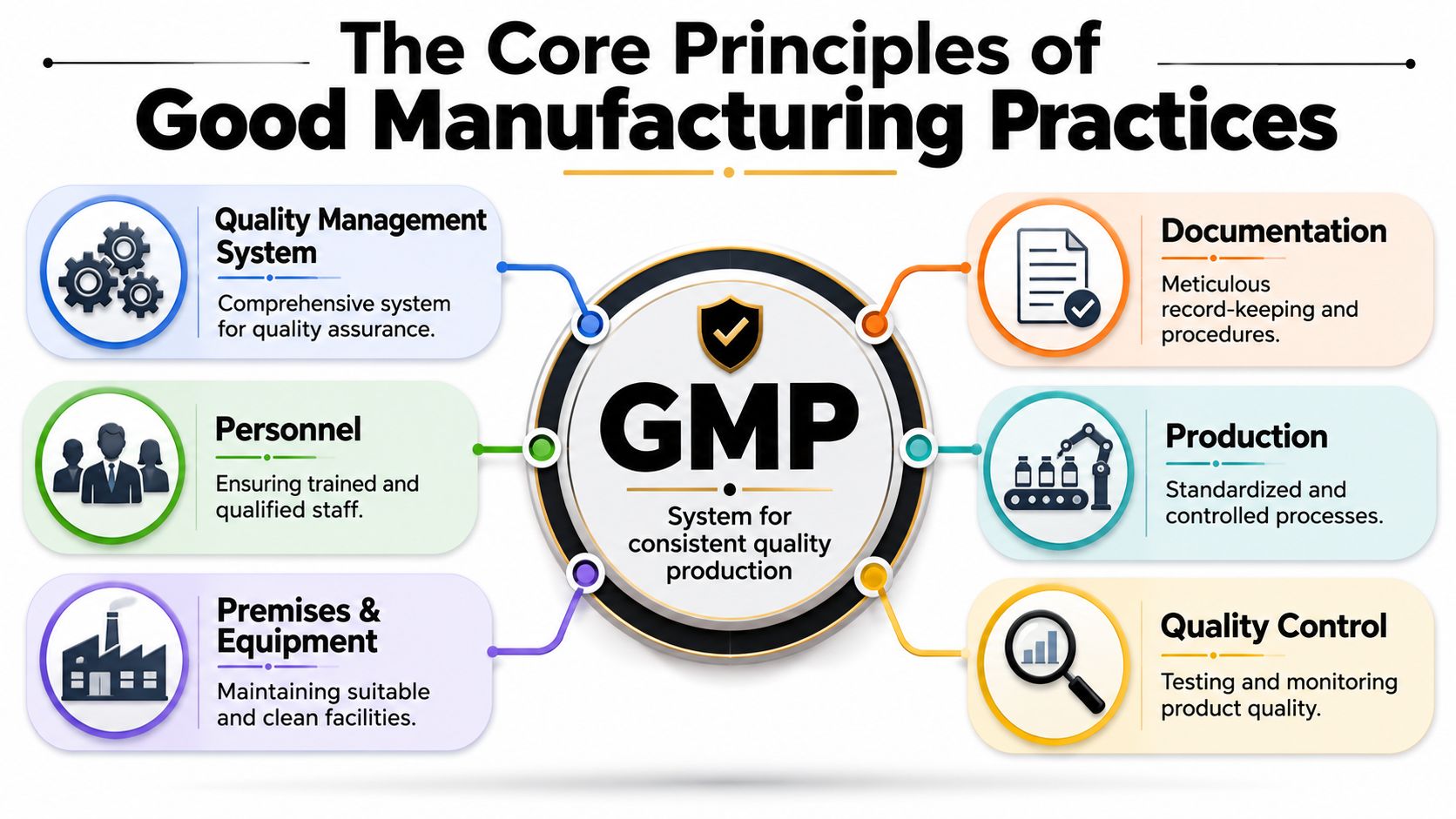
People and premises
Start with people. Training has to cover the work the operator performs, including material identification, lot verification, in-process checks, documentation, and what to do when something falls outside spec. In vape manufacturing, a weak handoff between weighing, blending, and filling creates errors fast because small formulation differences can show up clearly in flavor, viscosity, and cartridge performance.
Premises matter just as much. In terpene operations, layout affects segregation, cleaning effectiveness, airflow, and odor carryover. A room used for heavy gas or kush-style profiles needs controls that prevent those aromatics from affecting a lighter citrus or fruit-forward formulation in the next run.
Processes, products, and procedures
Processes need defined parameters. Teams should know the approved order of addition, target temperatures, acceptable hold times, mixing conditions, and the points where volatile components are at the highest risk of loss. If those details live only in the head of the lead formulator, the process is unstable even if recent batches looked fine.
Products need clear specifications before production starts. That includes identity, appearance, aroma profile where relevant, potency targets when applicable, fill tolerances, packaging requirements, and release criteria. Without that baseline, quality review turns into opinion and batch release becomes inconsistent.
Procedures are the written instructions and records that show what happened, who did it, what materials were used, and whether the batch met requirements. In practice, many cannabis manufacturers often struggle in this area. Good documentation slows down improvisation, which is exactly the point. Teams tightening internal controls usually need more discipline around batch records, deviations, and release review, not just better intentions. A useful reference for that work is this guide to quality assurance processes for terpene manufacturing.
GMP versus cGMP
cGMP adds one important expectation. The system has to stay current.
A written procedure from two years ago is not enough if your facility changed hardware, added new terpene inputs, switched cartridge platforms, or introduced different heating steps. Current good manufacturing practice means updating documents, retraining staff, reviewing risks, and documenting changes before they create avoidable deviations.
I see this gap often in growing cannabis brands. The company has SOPs, batch records, and cleaning forms, but the actual operation has outgrown them. On paper, the system looks controlled. In production, operators are working around outdated instructions. That gap is where mix-ups, rework, and inconsistent finished goods start.
A working GMP system keeps the written process aligned with the actual one. That is what makes quality repeatable.
Navigating GMP Regulations for Cannabis and Terpenes
A cannabis vape brand can launch with a clean formula, attractive hardware, and strong demand, then hit trouble because one state inspector asks for records the team never built into the process. Another customer asks whether the terpene blend was produced under a recognized quality system. A distributor in a new market wants proof that suppliers, sanitation, and batch release are controlled. GMP becomes a daily operating issue long before it becomes a certification project.
For U.S. cannabis operators, the hard part is fragmentation. There is no single federal GMP rule written specifically for cannabis, while many states impose their own manufacturing expectations, audit requirements, or quality controls. Cannabis Industry Journal outlines that patchwork in its review of cannabis GMP requirements. For operators making vape products, that means one formula may be acceptable on paper in one jurisdiction and poorly supported in another if the records, supplier files, or environmental controls are thin.
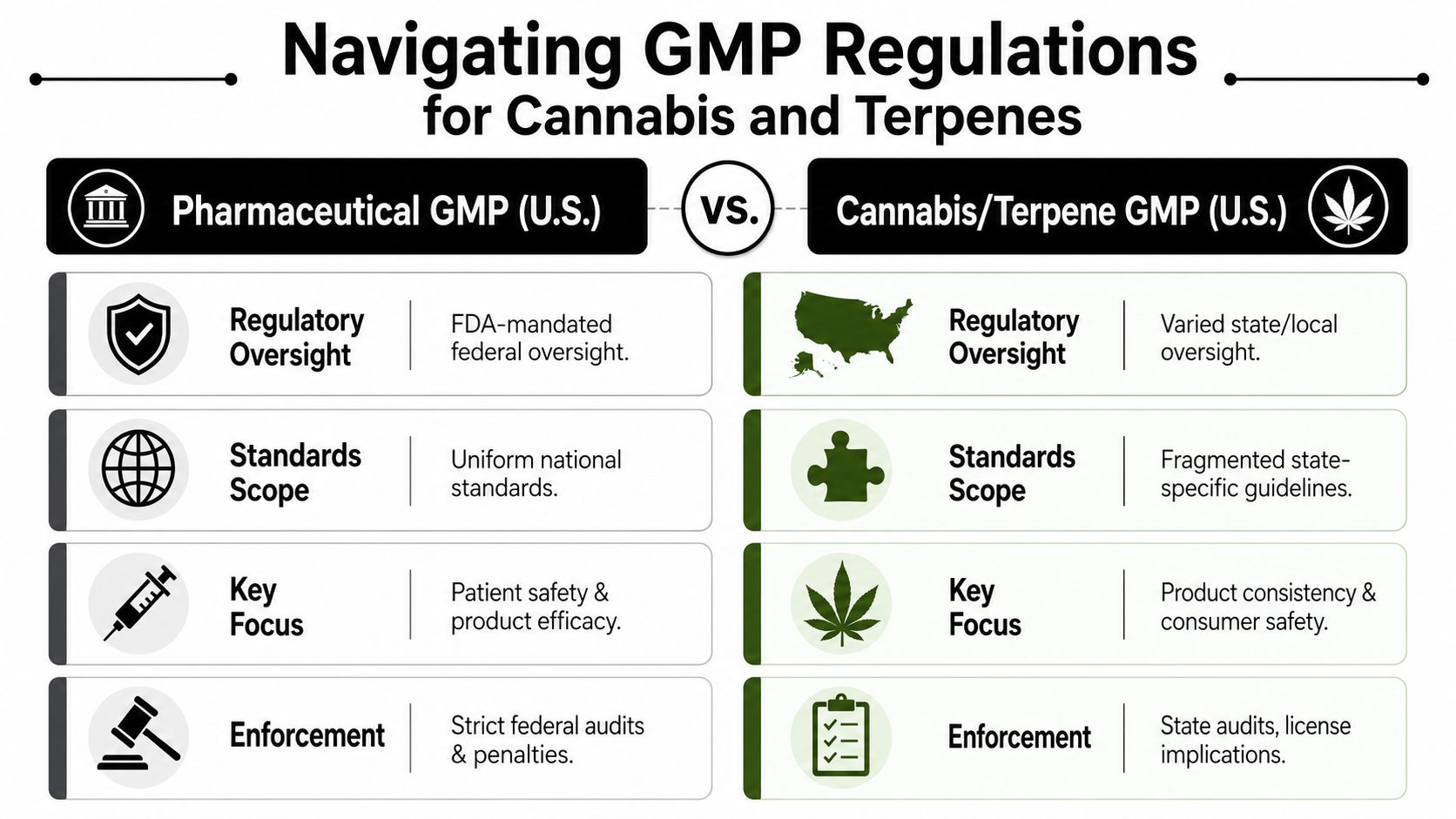
Why state-by-state rules create real operational friction
New York shows how quickly GMP becomes an operating requirement rather than a quality aspiration. The state requires licensed processors to maintain GMP compliance across the license term and obtain a qualified third-party GMP audit on a defined schedule, as described in New York cannabis GMP requirements.
That affects buildout decisions, document design, and staffing. A processor cannot wait until after launch to decide how equipment logs will be maintained, how cleaning verification will be reviewed, or how batch deviations will be escalated. If those controls are missing, the team usually ends up rewriting records after the fact, and auditors notice.
Terpene formulators feel this pressure even more because raw materials, packaging, and finished products often cross state lines through contract manufacturing and white-label arrangements. The legal status of a terpene ingredient matters, but quality history matters just as much. Teams assessing whether an ingredient can be sold into a given market often review state and federal rules on terpene legality alongside supplier qualification and specification controls.
The benchmark many operators choose to build against
Outside the U.S., the rules are usually more unified. Canadian producers work within a national regulatory structure, and EU-GMP sets a higher bar for documentation, validation, quality oversight, and batch disposition. As noted earlier, many operators use those systems as reference points even if they do not export.
That is a practical decision. Buyers, investors, and brand partners rarely object to stronger controls. They do object to missing traceability, inconsistent release criteria, and weak change management. I have seen cannabis and terpene manufacturers win business because they could show a cleaner quality system than competitors selling a similar formulation.
What this means for formulation teams
For cannabis and terpene manufacturing, the useful standard is usually the highest one your business model is likely to face within the next one to two years. That includes future states, contract partners, and retailer requirements, not only your current license.
For vape and concentrate formulators, that usually means focusing on a few practical pressure points:
- Raw material traceability: Every terpene lot, diluent, and hardware component should tie back to approved suppliers, specifications, and receiving checks.
- Process control during blending: Time, temperature, order of addition, and hold conditions need defined limits so the formula behaves the same way across batches.
- Cross-contamination prevention: Shared vessels, transfer lines, and fill equipment need cleaning controls that fit aromatic materials, not generic sanitation language.
- Change control: A new cartridge platform, a substitute terpene isolate, or a revised heating step can change performance and should be reviewed before release.
- Batch review: Finished goods should not move because production is behind schedule. They should move because the record shows the batch met requirements.
For cannabis vape products, GMP is not abstract. It decides whether your formulation can be repeated, defended in an audit, and trusted by the next buyer in the chain.
Key GMP Requirements for Product Formulation
The lab bench version of GMP is less glamorous than one might expect. It's not a certificate on the wall. It's a controlled system that tells you whether your formula can survive real production.

For terpene work, GMP compliance requires a validated Quality Management System, along with equipment qualification through DQ, IQ, OQ, and PQ. It also requires monitoring critical process parameters such as temperature and pressure to maintain critical quality attributes such as purity within defined pharmacopeial specifications, as described in this GMP certification guide for formulation environments.
The QMS is the operating system
A Quality Management System, or QMS, is the structure that connects purchasing, receiving, production, testing, release, deviations, complaints, and corrective actions. Without it, teams often have isolated documents but no real control.
In terpene formulation, the QMS should answer questions like:
- Which raw material lots were used in this blend?
- Which equipment was used, and was it qualified for the intended process?
- Which parameters were monitored during blending?
- Which release criteria had to be met before the batch moved to filling?
That's what turns a recipe into a manufacturing process.
Equipment qualification is where many shortcuts fail
DQ, IQ, OQ, and PQ sound bureaucratic until a mixer behaves differently under production load than it did in development.
- Design Qualification: Confirms the equipment is suitable for the intended use.
- Installation Qualification: Verifies it was installed correctly.
- Operational Qualification: Confirms it works within defined operating ranges.
- Performance Qualification: Proves it performs consistently in actual use.
A common mistake in formulating for vape cartridges is assuming a bench-top success automatically scales. It doesn't. Agitation, vessel geometry, and temperature behavior all change.
For isolate-heavy work, even one ingredient can alter the behavior of the full system. A good example is Beta-Caryophyllene for formulation use, which often functions as a stabilizing, deeper-note component in blend architecture but still has to be handled inside a validated process.
On the floor: The blend isn't validated because the target flavor was achieved once. It's validated when different operators can achieve the same result using the approved method.
CPPs and CQAs in real terpene work
Critical process parameters, or CPPs, are the conditions you control during manufacturing. Critical quality attributes, or CQAs, are the outcomes you need the batch to meet.
For a strain-inspired terpene blend for cannabis product formulation, the relationship is direct:
| Process element | Why it matters |
|---|---|
| Blend temperature | Affects volatility and top-note retention |
| Mixing time | Can shift homogeneity and aroma balance |
| Container exposure | Influences oxidation risk |
| Fill timing | Changes how much aroma is retained before packaging |
A practical sensory framework also helps. For replicating flavor of cultivar profiles, formulators usually think in note structure:
- Top notes: Fast, bright, highly volatile components that define first impression.
- Mid notes: The body of the profile that makes the blend recognizable.
- Base notes: Heavier, more persistent components that support stability and finish.
For strain replication in vape cartridges, primary terpenes should make up 40% or more of the blend, secondary terpenes should sit at 10 to 20% each, and tertiary accents should stay under 5%, based on this terpene chart for profile construction. That's useful when building a repeatable note hierarchy rather than chasing flavor by intuition.
A short technical overview helps here:
Thermal handling matters more than most teams expect
Volatile monoterpenes are often where a promising cart formula starts to drift. Terpinolene degrades above approximately 230°C and oxidizes rapidly with heat, light, or oxygen. It can still perform well in cartridges when total terpene load stays between 5% and 12%, while in distillate concentrates the load should be 1% to 2.5% to reduce premature evaporation, according to this terpinolene formulation guide.
For shelf stability, formulators should keep monoterpene concentrations below 6% and use stabilizing sesquiterpenes at 3% to 5%, as outlined in this guide to terpene classes in product development.
That's why GMP in formulation isn't just compliance language. It's how you protect flavor accuracy, fill performance, and release confidence.
Your GMP Audit Readiness Checklist
A GMP audit doesn't start when the auditor walks in. It starts with the habits your team has already built. By audit day, the records should tell a coherent story without backfilling, guesswork, or missing signatures.
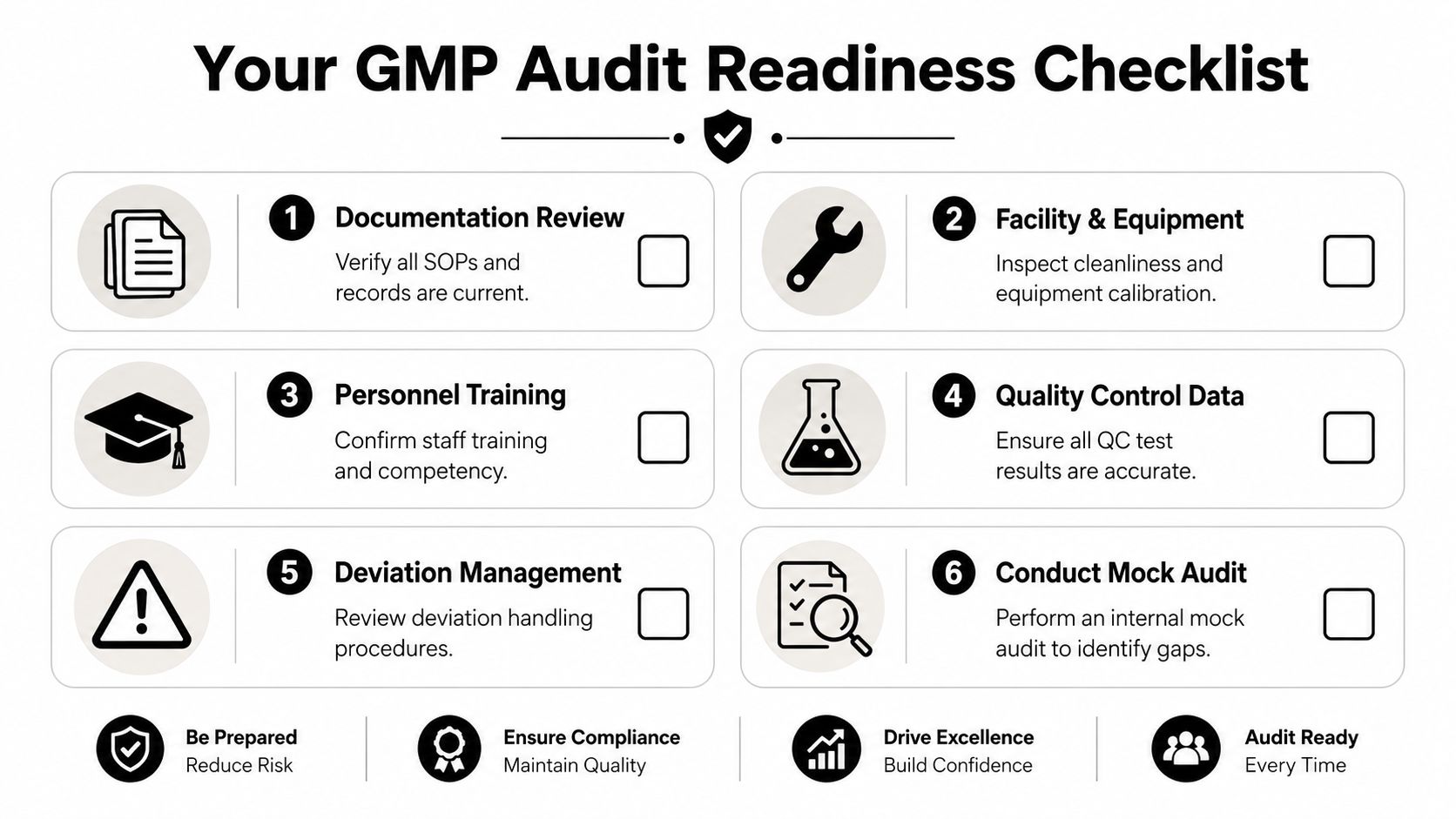
The required controls are practical. A core GMP expectation is a third-party audit that verifies manufacturing processes, including an environmental monitoring program, cleaning protocols that prevent residue carryover between strain-specific profiles, and a documented Change Control system, all reflected in New York's GMP audit expectations for cannabis processors.
Day-one documents auditors expect to see
If these records are disorganized, everything else gets harder.
- Master batch records: Approved formulas, instructions, target yields, and in-process checks.
- Executed batch records: What happened during production, including deviations.
- Training files: Who was trained, on what procedure, and when competency was confirmed.
- Equipment files: Cleaning logs, maintenance records, status labels, and calibration history.
- Raw material records: Receiving, quarantine, release status, supplier approval, and lot traceability.
A useful self-test is simple. Can you pull one finished batch and trace every ingredient, operator action, and release decision without reconstructing the story from memory?
Facility flow and contamination control
Auditors look closely at how people and materials move. In terpene and vape manufacturing, segregation isn't just about microbiology. It's also about identity and sensory carryover.
Consider the difference between an earthy OG-style profile and a sweeter Blue Dream style profile. If personnel, utensils, or staging areas move between those production states without controlled cleaning and line clearance, your next lot can carry the wrong aromatic fingerprint.
Keep material flow obvious enough that a new supervisor can walk the room and understand what's clean, what's in process, what's quarantined, and what's ready for release.
Environmental monitoring supports that control. You need a defined way to monitor the production environment and react when conditions trend the wrong direction.
Change control separates disciplined teams from reactive teams
A lot of manufacturers make changes casually. They swap a vessel, tweak a blend sequence, approve a new supplier, or adjust a heating step because it “shouldn't matter.” Under GMP, if it can affect identity, purity, consistency, or safety, it has to be evaluated before implementation.
Build your audit prep around these questions:
- What changes require formal review?
- Who approves them?
- What supporting data is needed?
- Does the change require retraining, revalidation, or revised specifications?
A practical readiness sweep
Run this checklist internally before any formal audit:
| Audit focus | What good looks like |
|---|---|
| Documentation | Current versions, complete entries, no unexplained gaps |
| Cleaning control | Verified methods, defined intervals, documented completion |
| Supplier qualification | Approved vendors, traceable lots, clear material status |
| Personnel | Role-specific training tied to current SOPs |
| Deviations | Investigated, closed, and linked to corrective actions |
A mock audit is worth doing because it reveals what your own team has stopped noticing.
Common GMP Pitfalls That Derail Manufacturers
Most GMP failures don't come from one dramatic mistake. They come from routine shortcuts that pile up until an audit, complaint, or failed batch exposes them.
The first is after-the-fact documentation. If operators fill in logs later, records stop being evidence and become storytelling. Auditors usually catch this quickly because timestamps, sequencing, and handwriting patterns don't line up with actual operations.
The second is weak training control. A technician may know how to blend by habit but still miss the approved sequence, wrong container type, or hold-time limit. In vape and terpene work, those small deviations can shift oxidation exposure, aroma balance, or carryover risk.
Another frequent problem is skipping process validation for speed. Teams often think a successful pilot proves the process. It doesn't. Validation proves the process works repeatedly under approved conditions, with normal operators and normal production variability.
Raw material oversight is another blind spot. A nice-looking COA and polished marketing sheet aren't the same as supplier qualification. If you can't show how a material was approved, what incoming checks were required, and how changes are handled, you've left a major gap in the system.
The expensive part of GMP usually isn't doing it right. It's remediating preventable failures after product has already moved into the market.
Frequently Asked Questions on GMP Compliance
A lot of the confusion around what is GMP compliance comes from the gap between broad quality language and the daily reality of formulation rooms. These are the questions that matter most when you're building or tightening a working system.
GMP FAQ for Cannabis Formulators
| Question | Answer |
|---|---|
| Is GMP only about passing an audit? | No. The audit checks whether your quality system works, but the real purpose is controlling production so each batch is made consistently and released with confidence. |
| Does GMP matter for a strain-inspired terpene blend for vape cartridges? | Yes. These blends are sensitive to handling, sequencing, cleaning, and thermal exposure. Without controlled production, flavor identity drifts fast. |
| Is a vendor COA enough for starting materials? | Not by itself. A vendor's COA is important, but GMP frameworks such as EU GMP Annex 7 and Australian TGA guidance place responsibility on the manufacturer to verify starting materials. Regulatory disputes have shown that relying on vendor COAs alone, without internal verification or a robust supplier qualification program, is a significant compliance risk, as discussed in this review of starting material validation under GMP. |
| What should a small formulator focus on first? | Start with controlled purchasing, approved specifications, batch records, cleaning records, training files, and a basic deviation system. Fancy software can wait. Process discipline can't. |
| How does GMP help with replicating flavor of a cultivar profile for distillate? | It forces you to define and control the variables that shape flavor, including material identity, processing conditions, and release criteria. That's what makes replication repeatable instead of subjective. |
A good next step for teams that need stronger formulation fundamentals is reviewing a plain-language reference like Terpenes 101 for product developers. It helps connect raw terpene behavior to practical blend design.
The short version is this. GMP doesn't exist to make manufacturing slower. It exists to stop avoidable variability from reaching the customer. In cannabis and terpene formulation, that's the difference between a product line that scales cleanly and one that keeps fighting the same preventable issues.
If you're building a more reliable terpene profile for vape cartridges, refining a strain-inspired terpene blend, or tightening your workflow for cannabis product formulation, Gold Coast Terpenes offers isolates, strain-specific blends, and formulation resources that fit technical product development. Their catalog and educational tools are useful when you need consistent terpene inputs, clearer blending options, and practical support for commercial formulation work.