
Most advice on what is live rosin stops at purity. That's not enough for a product developer.
For formulators, live rosin matters because it sets the sensory benchmark. It shows what a cultivar can smell and taste like when post-harvest handling protects volatile compounds instead of flattening them. But the same attributes that make live rosin desirable also make it difficult to standardize in production runs, especially for vape cartridges, strain replication, and repeatable SKU building.
That's why the better question isn't just what is live rosin. It's how to use live rosin, evaluate it, or replicate its profile when raw material supply, viscosity, hardware compatibility, and lot-to-lot consistency get in the way.
Defining Live Rosin as a Formulation Benchmark
Live rosin is a solventless cannabis concentrate made in two physical stages. Fresh-frozen cannabis is first washed in ice water to produce bubble hash, then that hash is pressed with heat and pressure into rosin. Because no chemical solvents are used, the finished material doesn't require residual-solvent testing on the COA, although pesticide, heavy metal, and microbial testing still remain mandatory in licensed markets, as outlined in Cryo Cure's live rosin guide.
That definition matters commercially because fresh freezing changes the entire sensory outcome. When operators freeze material immediately after harvest, they reduce oxidation and terpene volatilization that would otherwise occur during drying and curing. The practical result is a concentrate with stronger aroma, deeper flavor complexity, and a profile many teams use as the target for terpene profile for cannabis product formulation.
Why formulators treat live rosin as a reference point
A lot of people say solventless is always best. In formulation, that's too simple.
Live rosin is often the benchmark for flavor fidelity, not an automatic answer for every product format. It gives you a closer representation of the original plant, but it can also introduce sourcing variability, unstable viscosity, and hardware issues when you try to force it into scalable cartridge programs.
Practical rule: Treat live rosin as a sensory north star, not as a universal manufacturing shortcut.
For brand owners building a strain-inspired terpene blend for vape cartridges, that distinction is important. You may not need raw live rosin in every formula. You may need to understand what live rosin expresses, then build toward that result with more controlled inputs.
Where live rosin fits in product development
From a product strategy view, live rosin serves three roles:
- Benchmark material: It helps define what authentic cultivar expression should smell and taste like.
- Premium inclusion: It can anchor limited runs and high-touch concentrate SKUs.
- Reference for replication: It informs strain-inspired blending when raw rosin is too expensive, too inconsistent, or too difficult to run in cartridges.
That's the useful lens for asking what is live rosin. It isn't just a concentrate category. It's a formulation reference standard.
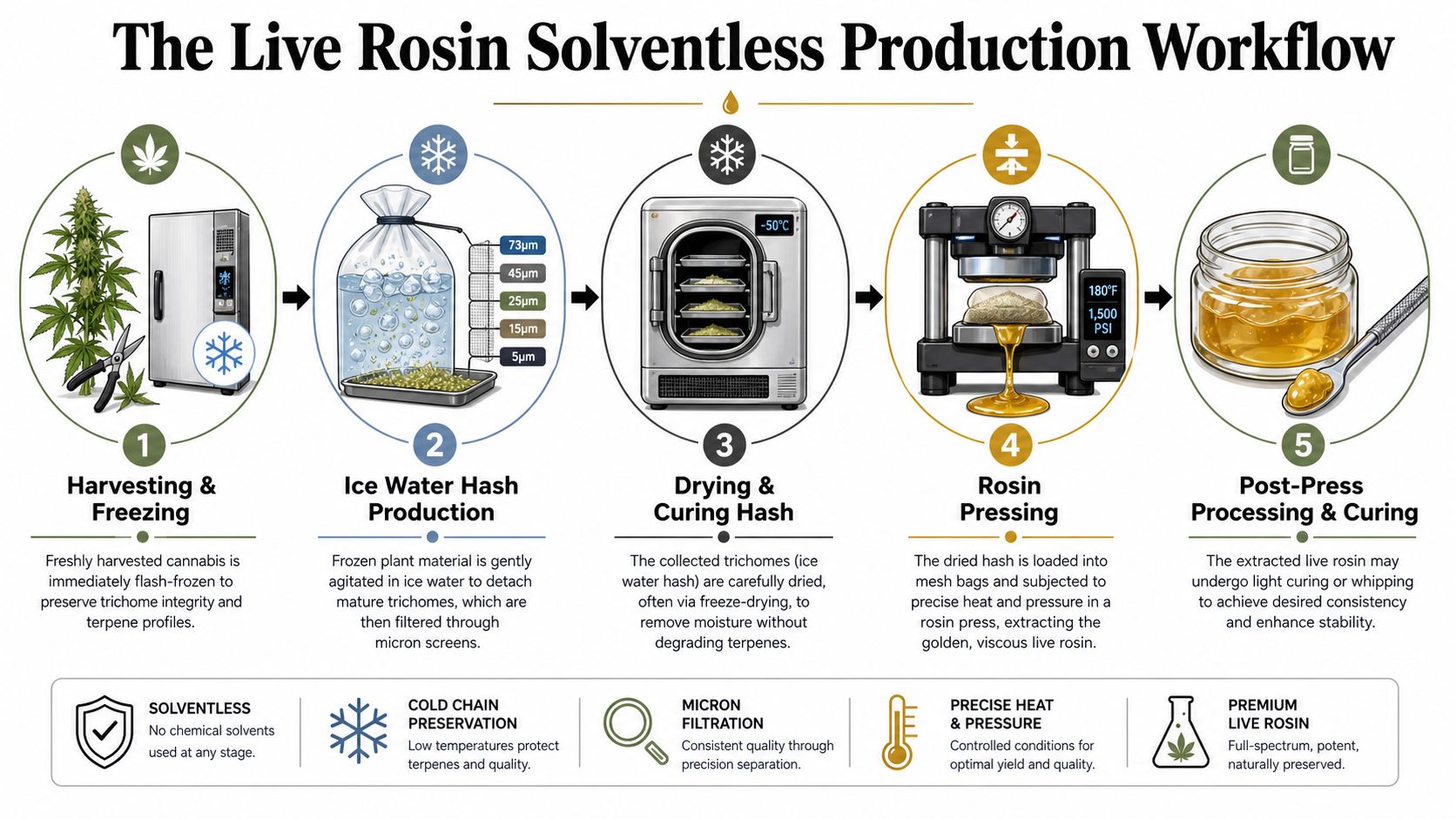
The Live Rosin Solventless Production Workflow
The live rosin process only looks simple from a distance. In practice, each stage affects terpene retention, press behavior, and final usability.
Fresh freezing and wash quality
The process starts at harvest. Flower is frozen immediately instead of being dried and cured. That one decision preserves compounds that are easily lost during standard post-harvest handling, and it's the main reason live rosin becomes a useful target for anyone replicating flavor of fresh-frozen flower for distillate.
Then comes ice water extraction. Agitation separates trichome heads from the frozen plant material, and those trichomes are collected through filtration. At this stage, operators aren't just chasing output. They're trying to protect gland heads, reduce contamination, and capture clean hash that can survive pressing without carrying excess plant matter.
A good background reference on concentrate workflows is this guide on how to make cannabis concentrates.
Freeze-drying and press parameters
Collected hash can't be handled casually. Moisture is the enemy here.
According to this live rosin production video reference, optimal production requires freeze-drying bubble hash for 18–24 hours, then pressing at 280–330°F with 600–1000 psi. That same source notes this approach avoids the 15–30% loss of volatile terpenes like linalool and myrcene that occurs in conventional drying and curing.
Micro-planing the dried hash into a finer powder before pressing improves consistency at the bag and plate interface. The press itself is not a brute-force step. Pressure has to increase gradually. Too much pressure too early can push impurities through the bag and darken the result. Too much heat can flatten the top notes you were trying to preserve in the first place.
If the goal is a high-fidelity profile, pressing is a control step, not just an extraction step.
A visual walkthrough helps here:
What product developers should watch during processing
For formulation teams sourcing live rosin rather than making it, these are the process questions worth asking suppliers:
- Was the starting material fresh-frozen? If not, the term loses technical meaning.
- How was the hash dried? Freeze-drying is a major quality control point.
- Were press conditions controlled? Time, temperature, and pressure shape both flavor and usability.
- Was the post-press handling clean? Oxidation, contamination, and poor storage all show up later in the cartridge.
This is why what is live rosin can't be answered with “solventless concentrate” alone. The workflow determines whether the final material behaves like a premium ingredient or an expensive problem.
Live Rosin vs Live Resin A Technical Comparison
Product developers usually frame this as a purity debate. That misses the actual formulation issue.
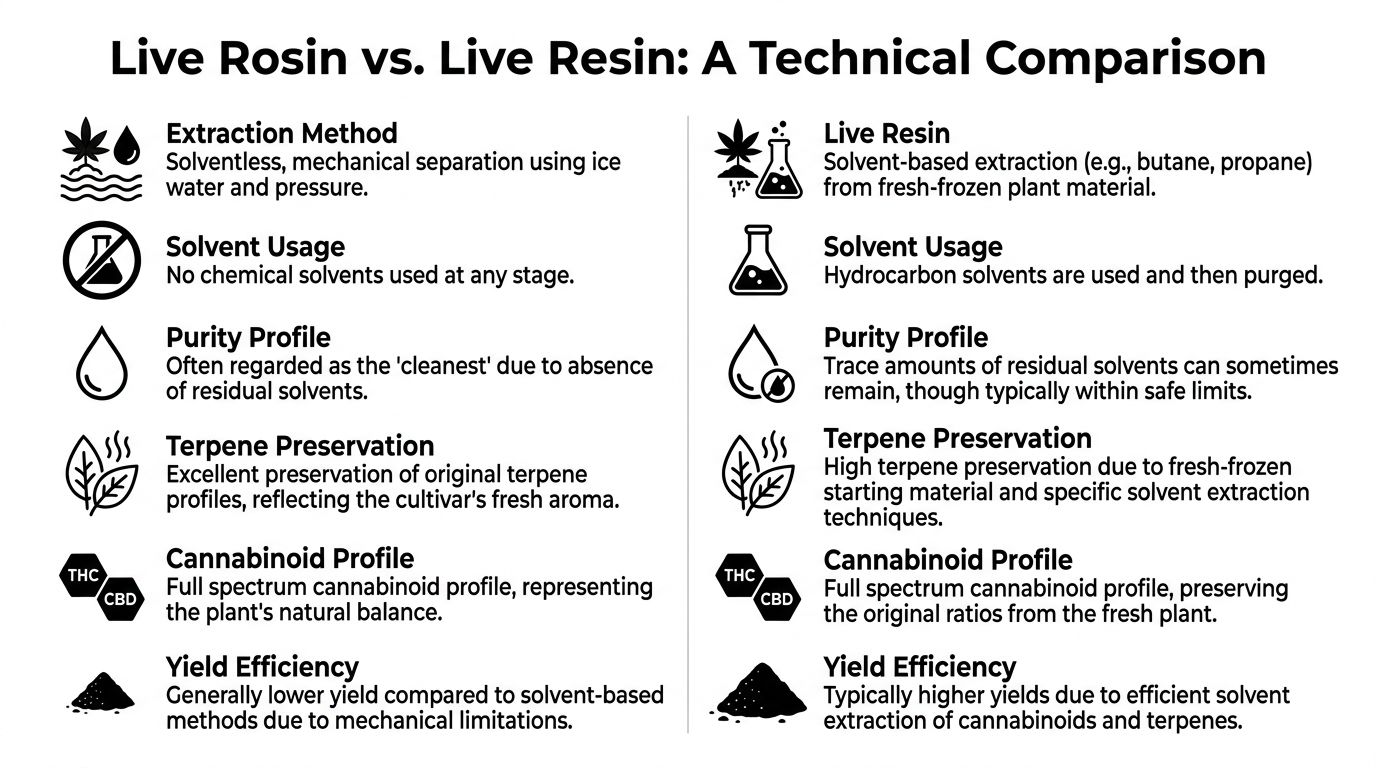
The more useful comparison is sensory outcome versus manufacturing practicality. Live rosin and live resin both begin with fresh-frozen material, but they don't capture the same profile in the same way, and they don't solve the same business problems.
The terpene trade-off that actually matters
A lot of operators assume live rosin always delivers the most complete flavor. That's not consistently true in every terpene band.
According to Treehouse Cannabis on live rosin, hydrocarbon methods used for live resin can capture up to 20% more of the heavy terpene fraction, including beta-caryophyllene and humulene, which contribute deeper earthy and base-note characteristics. For formulators, that means live rosin may preserve bright volatile expression well, while live resin can perform differently in the heavier end of the profile.
A related read that helps frame extraction differences is live rosin vs rosin.
Formulation attributes live rosin vs live resin
| Attribute | Live Rosin | Live Resin |
|---|---|---|
| Extraction method | Ice water hash followed by heat and pressure | Hydrocarbon extraction from fresh-frozen material |
| Solvent profile | No chemical solvents introduced | Solvents are used and then purged |
| Sensory benchmark | Often preferred for solventless, plant-faithful expression | Often useful when deeper heavy terpene capture is needed |
| Scalability | Harder to standardize across large SKU programs | Generally easier to scale in consistent production systems |
| Cartridge readiness | Can present viscosity and lipid challenges | Often easier to adapt for cartridge workflows |
| Commercial role | Premium concentrate and sensory reference | Efficient production ingredient and terpene-rich extract option |
Which one works better for product development
The right answer depends on the product.
- For premium concentrate positioning: Live rosin carries stronger solventless branding and sensory credibility.
- For repeatable cartridge programs: Live resin can be easier to source, process, and standardize.
- For strain-inspired terpene blend design: Both are references, but each highlights different note families.
Don't compare live rosin and live resin by ideology. Compare them by the note structure you need, the hardware you're filling, and the consistency your SKU requires.
For anyone building a formulation guide for vape cartridges, that's the comparison that matters. You're not choosing a winner in the abstract. You're choosing the material that supports your intended flavor architecture, process controls, and margin.
Decoding Live Rosin Quality and Lab Results
Not all live rosin is useful input material. Some jars look premium and still perform poorly in formulation.
A buyer should evaluate live rosin in three layers: precursor quality, physical behavior, and lab data. Potency alone doesn't tell you much about how the material will taste, fill, or hold up in a finished product.
Full-melt versus non-full-melt matters upstream
The most important distinction often appears before pressing. According to Leafly's live rosin glossary, the difference between full-melt and non-full-melt ice water hash can account for up to a 40% price variance in major markets because it affects purity and the level of residual plant lipids.
That has direct consequences for formulation. Cleaner hash usually produces cleaner rosin. Dirtier hash carries more waxes and lipids into the final material, which can mute vapor quality and create more trouble in cartridge hardware.
For teams evaluating raw material, it helps to understand the source structure of the resin glands themselves. This overview of trichomes on weed is useful context.
What to inspect beyond a potency number
A technical buyer should inspect the following before approving a lot:
- Texture behavior: Stable badder, sap, or grease can all be workable, but sudden separation or excessive residue often points to less controlled input.
- Aroma structure: Look for layered notes, not just intensity. Sharp top-note expression without depth can signal imbalance.
- Color and cleanliness: Color alone isn't a quality score, but visible contamination and dull appearance usually deserve scrutiny.
- COA completeness: Since it's solventless, residual-solvent analysis isn't the focal point. Terpene data, plus pesticide, heavy metal, and microbial compliance, matter more.
What makes rosin usable in cartridges
For cartridges, the practical question is simple. Does the material vaporize cleanly and consistently?
Rosin with excess residual lipids tends to create more trouble in atomizers. It can clog, darken, or produce a less refined vapor path. Rosin sourced from stronger hash input usually gives formulators a better starting point, whether they're blending it directly or using it as a sensory benchmark for a terpene profile for vape cartridges.
A premium live rosin lot isn't just aromatic. It has to behave predictably under heat, in hardware, and across storage.
That's the standard worth buying against.
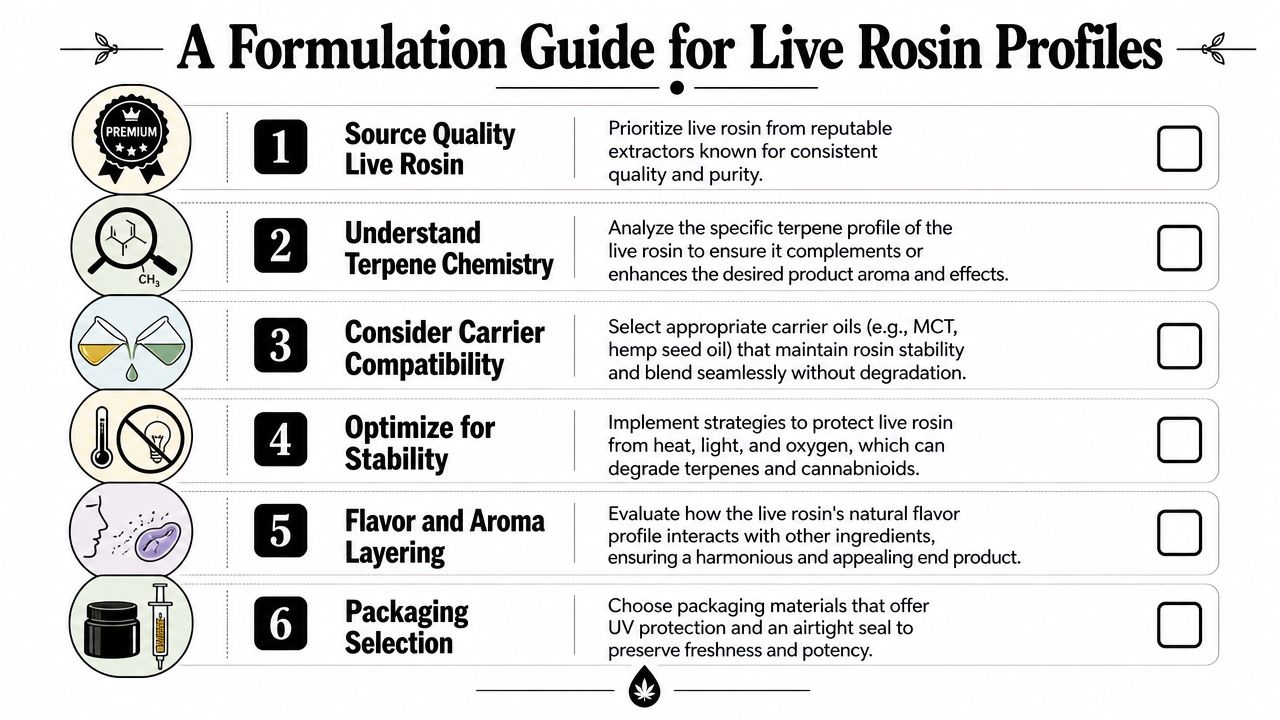
A Formulation Guide for Live Rosin Profiles
Most cartridge teams run into the same problem. They want the sensory credibility of live rosin, but they don't want the variability, viscosity issues, and supply constraints that come with using raw rosin at scale.
That's where formulation discipline matters. You can work with authentic rosin directly, or you can build a strain-inspired terpene blend for distillate that reproduces its note structure in a more controlled way.
Path one using authentic live rosin
When a formulator uses real live rosin in a vape system, the first challenge is compatibility. Rosin can carry solids, lipids, and viscosity swings that don't behave like a clean terpene blend. It may need additional refinement depending on the intended hardware and fill temperature.
The second challenge is loading. For vape cartridge formulation, the Gold Coast Terpenes terpene chart PDF states that the ideal terpene load when mixing with distillate is 4–8% by weight, with 5% as the standard starting point to avoid harshness and hardware failure.
That guidance is useful even when live rosin is part of the formula because it keeps the total aromatic fraction in a range that's more likely to remain vapable.
Path two replicating flavor with terpene blends
For many brands, this is the more scalable option.
Instead of relying on raw rosin in every batch, the formulator studies the target profile and rebuilds it using a blend that captures the same note progression. That's usually more reliable for large production because you can tune aroma with precision, then apply the same formula repeatedly across distillate lots.
A practical structure looks like this:
- Start with the top notes. These are the bright, fast-volatilizing aromatics that create first impression.
- Build the middle. The profile gets its recognizable cultivar identity.
- Anchor the base. Earthy, spicy, woody, and persistent notes keep the profile from tasting thin.
- Test in actual hardware. Bench aroma doesn't always match cartridge performance.
Top mid and base note thinking for live rosin replication
Formulators who succeed with live rosin-inspired profiles usually separate aromatic roles rather than treating “terpenes” as one block.
- Top notes: These shape the opening burst and can disappear fastest under heat.
- Mid notes: These carry most of the recognizable strain character.
- Base notes: These add persistence, body, and realism.
The best live rosin-inspired formulas don't just smell strong. They unfold in sequence.
That's why a formulation guide for cannabis product formulation should treat live rosin as an aromatic architecture problem, not just a percentage problem.
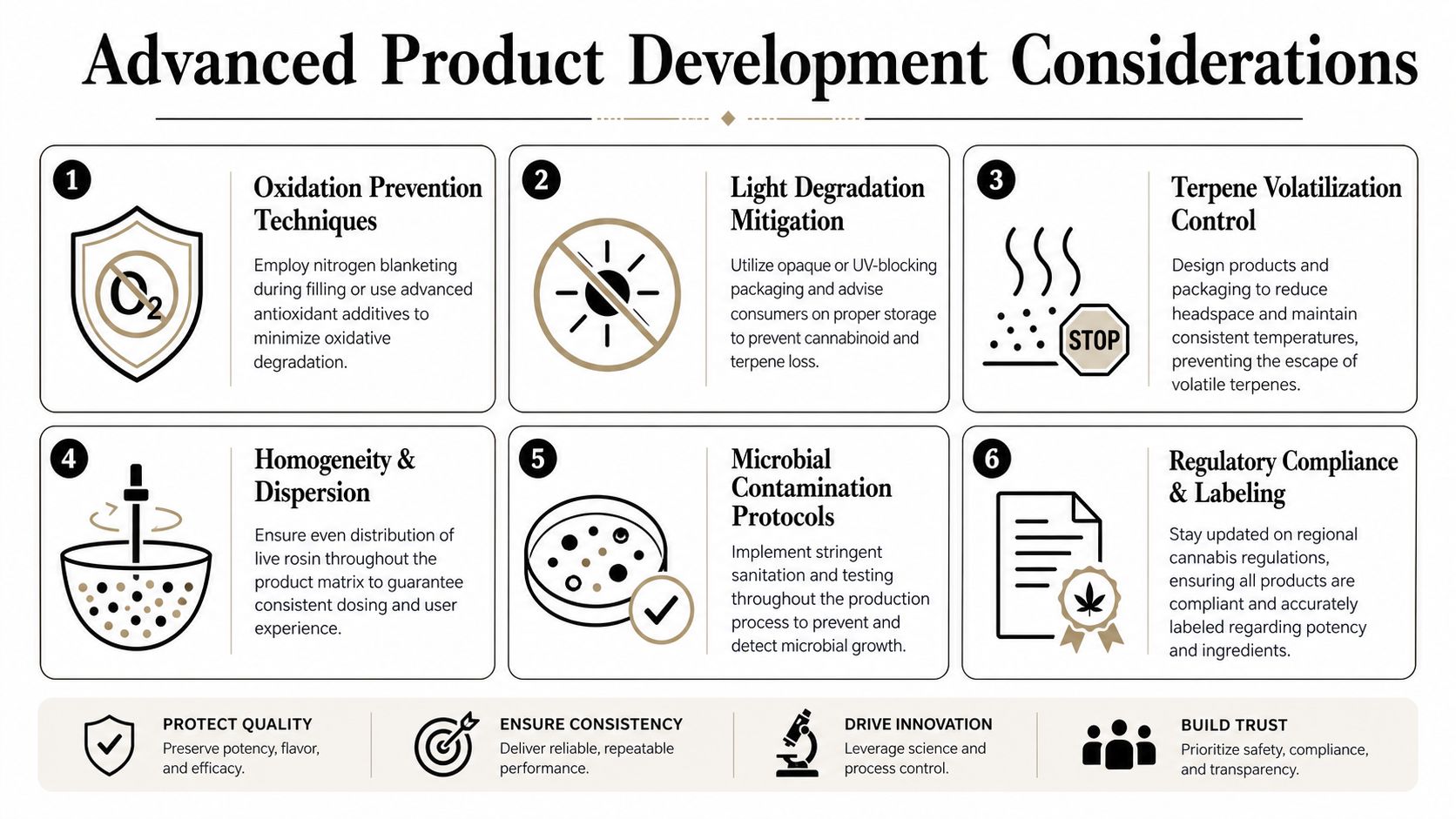
Advanced Product Development Considerations
Once the flavor profile is close, the hard part starts. Shelf life, hardware behavior, and thermal stability decide whether the product survives beyond the bench sample.
A live rosin-inspired cartridge can smell excellent in a beaker and still fail after filling. Most failures come from imbalance. Too many volatile top notes, not enough stable base structure, or a formula that doesn't match the atomizer's thermal behavior.
Balancing stability with realism
According to Terpene Belt Farms on terpene classifications in product development, sesquiterpenes like β-caryophyllene should be used at 3–5% in heat-stable vape formulations, while total monoterpene concentrations should remain below 6% for better shelf stability and flavor retention.
That guidance lines up with what many product developers see in practice. If top-note monoterpenes dominate the blend, the formula may smell impressive at first but lose definition quickly in storage or under repeated heating. Base-building with more thermally stable components helps the profile stay recognizable.
Common failure points in cartridge development
A live rosin-inspired formula usually breaks in one of these places:
- Hardware mismatch: Thick blends can struggle in cartridges with weaker wicking performance.
- Flavor collapse: High-volatility notes fade first, leaving a hollow back end.
- Harshness under heat: Strong aromatic loading can become aggressive during actual use.
- Inconsistent lot expression: If the benchmark material changes, the target profile drifts.
A good development workflow tests aroma in three states. Bulk mix, filled cartridge, and post-rest sample. Those stages often reveal different problems.
Stable flavor comes from restraint. If every note is pushed forward, none of them last.
Process decisions that support better outcomes
For more advanced teams, a few operating choices make a major difference:
| Development area | Practical consideration |
|---|---|
| Blend design | Keep the profile layered, not overloaded with fast volatiles |
| Hardware selection | Match viscosity and terpene intensity to atomizer behavior |
| Fill process | Minimize unnecessary heat exposure during blending and filling |
| Storage strategy | Reduce oxygen, light exposure, and temperature swings where possible |
This is also where winterized or otherwise refined inputs can help, depending on the formula and product format. Cleaner bases generally give the terpene system more room to perform without added interference from waxes or unstable fractions.
For a terpene profile for vape cartridges, stability isn't separate from flavor accuracy. It's part of flavor accuracy.
Achieving Flavor Fidelity at Scale
Live rosin deserves its reputation, but formulators shouldn't romanticize it. It's a premium benchmark, not a guarantee of commercial efficiency.
If you're building SKUs that need to taste right every run, survive filling, and remain recognizable in hardware, the primary job is capturing the logic of live rosin. That means understanding how top, mid, and base notes interact, how thermal stress changes the profile, and where direct rosin use makes sense versus where replication is the smarter path.
For teams working on replicating flavor of live rosin for cannabis product formulation, consistency usually wins. A stable terpene system can preserve brand identity across batches in a way raw live rosin often can't.
One technical reference worth reviewing during this process is the boiling point of terpenes. It helps explain why a formula that smells balanced in the lab can shift once it's exposed to cartridge temperatures.
The strongest brands don't chase solventless language alone. They build products that deliver a repeatable sensory result. In that sense, what is live rosin isn't just a category question. It's a formulation standard for anyone serious about flavor fidelity, strain replication, and premium cartridge development.
Gold Coast Terpenes helps formulators turn that standard into repeatable production with strain-specific terpene blends, isolates, and formulation tools built for cartridges, concentrates, and scalable cannabis product development.