
A lot of linalool essential oil content stops where formulation work starts. It tells you lavender smells relaxing, then leaves you alone with a distillate tank, a target flavor profile, and a batch that still tastes sharp, hollow, or perfumey.
In production, linalool is useful because it's precise. It can soften a dry terpene blend, add a floral lift to fruit-forward profiles, and bridge bright top notes to heavier resinous components. Used badly, it washes out strain character and makes a cartridge smell like fragranced soap. Used well, it gives a blend polish without announcing itself.
For vape cartridges and distillate, the key decision isn't whether linalool smells good. It's whether you're working from a variable botanical oil or a predictable isolate, whether your process protects volatile aroma, and whether your QC can confirm what went into the batch.
Linalool for Formulation From Isolate to Essential Oil
Linalool essential oil is often discussed as if it were a single thing. In practice, formulators are usually choosing between a full essential oil that contains linalool and a linalool isolate that gives direct control over the blend.
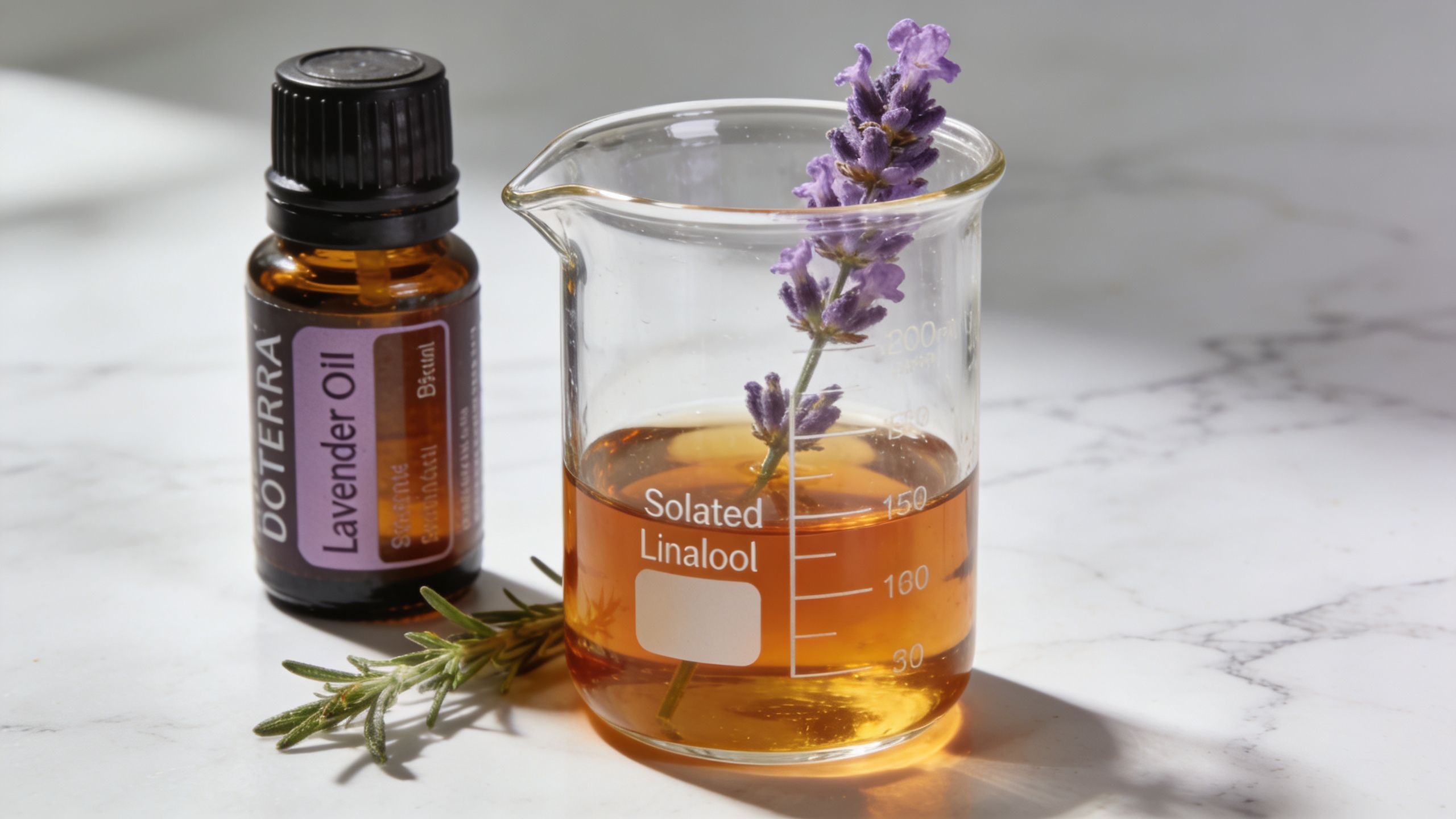
Lavender is a widely recognized source. Its chemistry matters because it shows why essential oil and isolate aren't interchangeable. Lavender essential oils typically contain roughly 20–45% linalool and 25–46% linalyl acetate, while commercial isolate is commonly chosen when you need a cleaner, more repeatable input for production work, as noted in this lavender and linalool composition reference.
Why isolate usually wins in cartridge work
A full lavender oil brings more than floral character. It also brings the rest of the oil's terpene and ester matrix. That can be useful in niche aroma work, but it creates problems when you're trying to hit the same profile across repeated cartridge runs.
A high-purity linalool isolate lets you make one decision at a time. You can add floral lift without also adding the rest of lavender's signature fingerprint. That matters when you're building a strain-inspired terpene blend, correcting a distillate that feels too dry, or matching a target profile from internal sensory benchmarks.
For direct component sourcing, a linalool isolate option is the kind of input formulators use when they want that control.
Practical rule: If the goal is batch consistency, start with isolate and rebuild complexity intentionally. Don't start with a complex essential oil and hope the complexity lands where you need it.
What linalool actually does in aroma architecture
Linalool sits in the top-to-middle note range for most cannabis terpene systems. It opens floral, slightly spicy, and lightly woody. In small amounts, it rounds edges. In larger amounts, it becomes the identity of the blend.
That's why it works well in profiles that need:
- A floral bridge between citrus tops and heavier earth or spice notes
- Harshness reduction when limonene-heavy blends feel thin or sharp
- Strain replication support for cultivars with obvious lavender, candy-floral, or soft fruit lift
What usually doesn't work is treating linalool as a filler terpene. It isn't neutral. Even when it's not dominant, it changes the way nearby terpenes are perceived.
Essential oil versus isolate in commercial terms
For benchtop exploration, lavender-derived linalool essential oil can teach you what the floral family contributes. For manufacturing, isolate is usually the better tool because it removes hidden variables.
Use essential oil when you want botanical character as a feature. Use isolate when you need:
- Tighter sensory repeatability
- Cleaner troubleshooting
- More accurate strain-inspired terpene blend building
- Less interference from non-target aroma compounds
That distinction saves time in R&D. It also saves batches.
Key Chemical Properties and Safe Handling Guide
A formulator should know how linalool behaves before it ever reaches a mixing vessel. Linalool is a C10H18O monoterpenoid tertiary alcohol, and its handling profile has direct implications for blending, storage, and flavor retention, according to this technical summary of linalool properties.
Linalool technical properties for formulation
| Property | Value | Significance in Formulation |
|---|---|---|
| Chemical identity | C10H18O monoterpenoid tertiary alcohol | Helps classify it as an aroma-active terpene alcohol rather than a carrier oil |
| Water solubility | Insoluble in water | Won't stay dispersed in aqueous systems without a solubilizer or emulsifier |
| Solubility in solvents | Miscible with ethanol and ether | Mixes readily into alcohol-based fragrance systems and terpene concentrates |
| Flash point | 76 °C | Heating should stay controlled during blending and filling to reduce volatilization and safety risk |
What those properties mean on the production floor
The two most important takeaways are solubility and flash point.
Because linalool is insoluble in water, it doesn't belong in water-based systems unless the rest of the formulation is built to support it. In oil-rich cannabis products, that's less of a problem. It integrates naturally into terpene fractions and cannabinoid concentrates, which is why formulators use it as a sensory modifier instead of trying to force it into emulsified shortcuts.
Its flash point of 76 °C matters for another reason. If your process relies on excessive heat to make a blend move faster, you risk driving off the exact top-note character you bought linalool to add. You also create avoidable safety issues in the blending area.
Keep linalool additions late in the process when possible. The longer it sits under heat and open-air agitation, the less predictable the final aroma becomes.
Handling practices that prevent avoidable losses
Teams often damage linalool before the batch is even filled. The problems are familiar. Open containers too long. Warm vessels too aggressively. Leave headspace in storage bottles. Then wonder why the floral note feels flat a week later.
A safer approach is simpler:
- Control temperature: Warm only enough to support incorporation and flow.
- Limit air exposure: Small open-headspace mistakes add up with volatile compounds.
- Use compatible staging containers: Don't move isolate in and out of unnecessary vessels.
- Protect the sensory target: If the blend depends on soft floral top notes, process discipline matters as much as the recipe.
For general production handling principles, this guide on safe terpene consumption and use is a useful reference point.
Formulating with Linalool for Vape Cartridges and Distillate
Most formulation mistakes with linalool come from using too much, too early, or for the wrong reason. It's not a broad thinning agent, and it's not a shortcut to a wellness claim. It's a precision modifier that can change flavor shape, perceived softness, and blend cohesion with a relatively small addition.
For vape work, a practical starting range is 0.5% to 2% of the total terpene blend, then adjusting in R&D based on the rest of the profile and the final product matrix. That range appears in the article brief and fits how most formulators approach linalool in cartridge development: start low, smell often, and stop before the floral note detaches from the strain profile.
A workable bench approach
When I'm evaluating linalool in a strain-inspired terpene blend for distillate, I don't treat it as a primary terpene. I treat it as a correction layer.
Use a sequence like this:
Build the core first
Set the dominant structure with the terpenes carrying the profile. If it's citrus-forward, that may be limonene-led. If it's earthier, the frame may come from myrcene and caryophyllene.Add linalool only after the base profile is coherent
This shows whether the blend needs floral softness or whether another issue is causing harshness.Re-test in the finished matrix
A terpene blend that smells balanced on a strip can shift once it's in distillate and then shift again in hardware.Check after rest time
Freshly mixed linalool can read louder than it will after the blend settles.
What works and what usually fails
Linalool works well when a blend is:
- Too angular: It can soften a sharp citrus or pine top.
- Too flat in the middle: It helps connect volatile notes to heavier ones.
- Too generic: Small floral lift can make a profile feel more strain-specific.
It fails when a formulator uses it to cover a weak base profile. If the blend structure is wrong, linalool won't fix it. It usually just adds a cosmetic floral layer on top of a deeper problem.
If you can clearly identify linalool as “lavender” in the first pass, there's a good chance you've gone too far for most cartridge profiles.
Viscosity and cartridge behavior
Linalool can influence how a blend moves, but it shouldn't be treated like a dedicated diluent. It may subtly shift solvent balance inside the terpene portion of the formula, yet the main value is still sensory. If your cartridge problem is mechanical, solve the hardware and total formulation balance first.
For practical cartridge processing considerations, this guide on how to thin distillate for cartridges is a better place to think through overall flow strategy.
Don't overstate the effect side
Linalool-rich aromatherapy oils have been reported to improve mood and reduce stress, anxiety, and depression symptoms in settings such as surgery, dental procedures, hemodialysis, and endoscopy, according to this 2023 review of inhalation-focused clinical context. That doesn't mean a linalool-forward vape cartridge will reproduce the same outcome.
Route, dose, matrix, and device all matter. In product language, keep the focus on aroma profile and formulation intent unless you've generated product-specific evidence.
Advanced Blending Linalool for Flavor and Effect Synergy
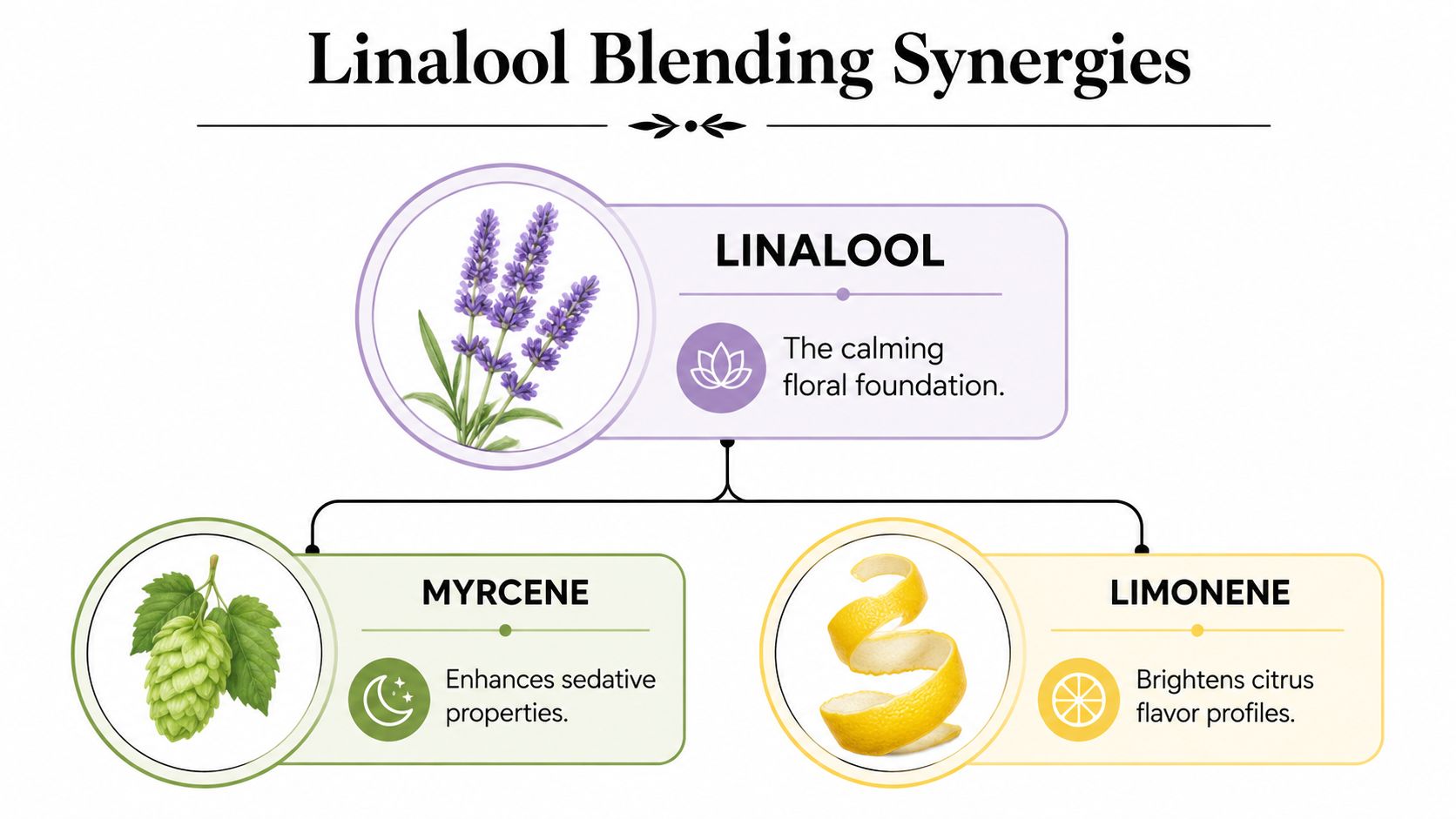
Linalool does its best work in relation to other terpenes. On its own, it's a soft floral-spice note. In a blend, it becomes a connector. It can brighten fruit, smooth pepper, and make an aggressive top note feel more expensive.
Published literature also describes linalool as more than an aromatic, noting antimicrobial, anti-inflammatory, and analgesic activity in broader research contexts, which is why formulators often think of it as a functional synergist as well as a flavor material in this PubChem linalool record.
Where it sits in a terpene blend
Think of linalool as a bridge note.
- Top-note support: It can soften the edge of bright terpenes without muting them.
- Middle-note builder: It gives the blend a floral body that doesn't read syrupy if dosed carefully.
- Base-note integration: It helps resinous or spicy compounds feel less abrupt on the finish.
That makes it useful in profiles where citrus, berry, dessert, or grape notes need more realism.
Pairings that usually make sense
Linalool with limonene is one of the cleanest examples. Limonene gives lift and brightness. Linalool adds a softer floral contour that can make the citrus feel less one-dimensional.
Linalool with myrcene moves in the opposite direction. Myrcene adds depth and heaviness. Linalool prevents that depth from becoming muddy.
Linalool with beta-caryophyllene is often effective when you want spice, wood, and floral tension in the same profile. That pairing can create a more targeted and cohesive blend for wellness-positioned aroma work, as long as the finished product language stays disciplined.
Blending gets easier when each terpene has a job. Linalool's job is rarely dominance. Its job is refinement.
Blend thinking for strain replication
If you're replicating flavor of floral-fruit cultivars, linalool often belongs in the finishing stage. It can support candy-fruit concepts, grape-leaning profiles, and certain kush expressions that need a violet or lavender impression.
If you're formulating a terpene profile for vape cartridges with strong citrus lead, use linalool to prevent a thin top. If you're building for a denser profile, use it to stop the middle from collapsing into earth and spice.
A useful lab habit is to compare two versions of the same blend:
- one without linalool
- one with a restrained linalool addition
That A/B usually tells you whether the profile needed elegance or whether you've just added perfume.
For ratio planning during R&D, a terpene mixing calculator resource helps turn sensory decisions into repeatable batch instructions.
Verifying Purity GCMS Markers and Regulatory Notes
If you're buying linalool for production, the aroma is only part of the decision. QC is what protects the batch. A nice-smelling input with weak documentation is still a liability once it enters a commercial line.
Linalool has a long industrial history. The NIH/NTP background paper notes estimated North American consumption at about 2.2 million pounds in 1988 and occupational exposure in the United States affecting nearly 250,000 workers across 106 industries, which is why its handling profile is relatively well documented in industrial use contexts in this NIH/NTP linalool background document.
What to check on the COA
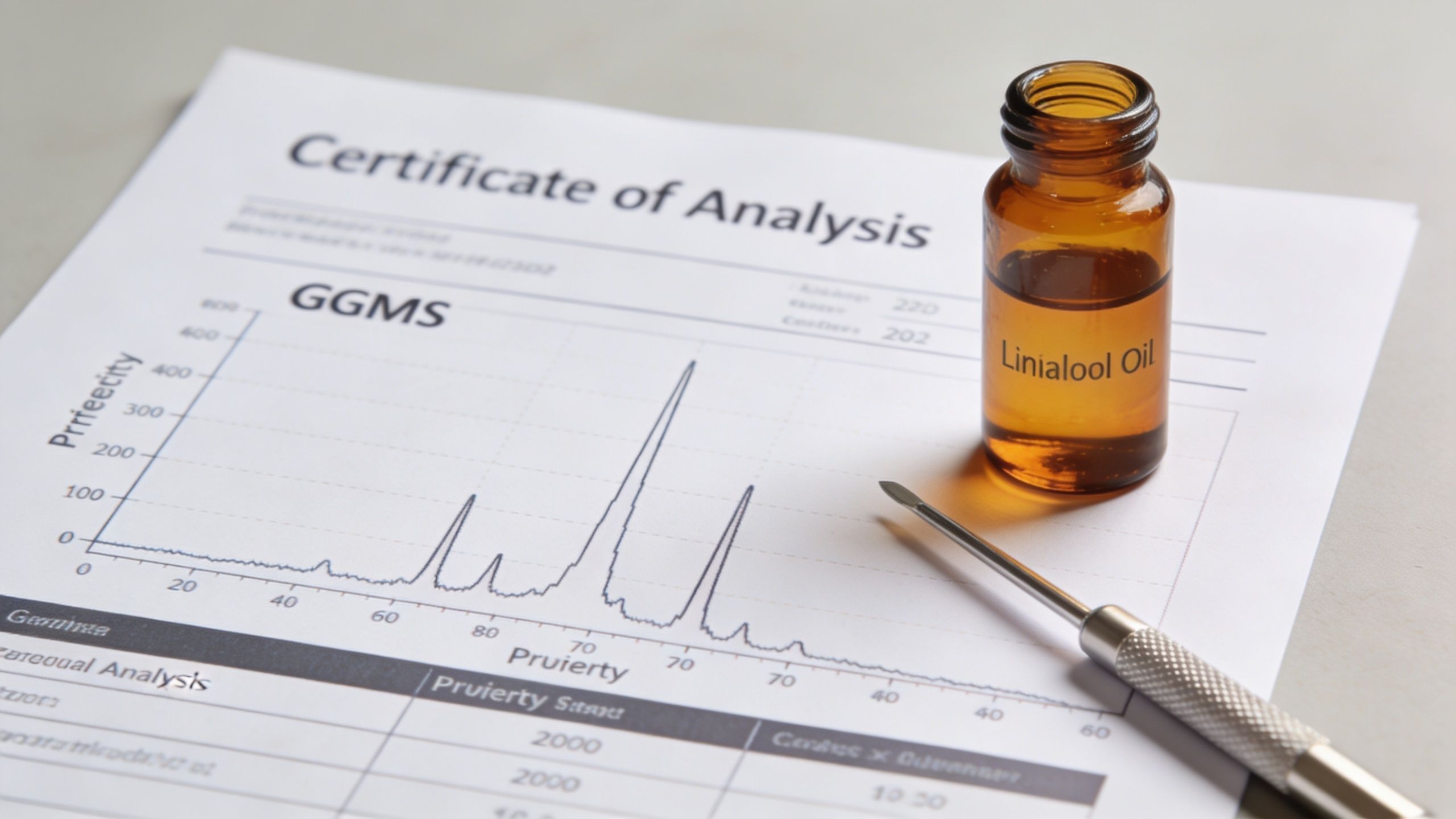
For isolate work, a COA should let you answer a few basic questions quickly.
- Is the material an isolate? The profile should show linalool as the dominant constituent, not a loose botanical mixture.
- Is purity high enough for repeatable work? Many formulators prefer isolate material at the high end of commercial purity because it reduces off-note uncertainty.
- Are there contamination screens appropriate to your use case? Residual solvent, pesticide, and other screening expectations should fit your internal QA standard.
- Is the batch traceable? If the supplier can't tie the COA to a lot, that's a process problem.
GCMS and chirality matter
A GCMS report isn't just paperwork for a binder. It helps you understand whether the linalool in the bottle matches the sensory result in the blend.
Two practical points matter here:
- Peak dominance should align with an isolate claim.
- Chiral identity may matter if your team is designing around nuanced aroma behavior or source expectations.
That second point gets ignored often. Not every project needs chiral analysis. But if you're building a highly specific strain-inspired terpene blend or trying to maintain a consistent floral signature across lots, it can be relevant.
This short video is a good refresher on what analytical review looks like in practice before an ingredient enters production:
Regulatory caution in inhalation products
Food and fragrance history doesn't automatically answer inhalation questions. A supplier may have strong documentation, and the ingredient may have broad industrial use, but your product still needs category-appropriate review.
That's the standard worth keeping. Don't let a familiar terpene lower your documentation threshold.
Key Formulation Takeaways for Linalool
The best use of linalool essential oil in cannabis product formulation is usually not as a full lavender oil. It's as a high-purity isolate used with restraint and with a clear sensory purpose.
Keep these principles in the formula room
Use isolate when consistency matters
Essential oils are useful for exploration, but isolate is easier to scale, troubleshoot, and replicate.Dose for nuance, not presence
In most terpene systems, linalool works better as a supporting note than as a headline note.Treat it like an aroma tool first
Its biggest value in cartridges is flavor architecture. Any broader functional framing needs route-specific caution.Blend around structure
Linalool improves a solid profile. It doesn't rescue a confused one.Protect it during processing
Heat, oxygen, and sloppy staging can flatten the exact floral note you're trying to preserve.
A good linalool workflow
A practical workflow for formulating for distillate or for vape cartridges looks like this:
- Start with your core strain or flavor target.
- Build the dominant terpene structure first.
- Add linalool late and in small increments.
- Evaluate in the final matrix, not just in the concentrate.
- Hold every lot to documented analytical review.
If you need one supplier-side tool reference, Gold Coast Terpenes publishes a formulation guide that fits this kind of work, alongside isolate and blend resources.
The cleanest linalool formulations don't smell “more floral.” They smell more complete.
That's the benchmark. If the cartridge tastes smoother, the middle feels more connected, and the floral note supports the profile without taking it over, linalool is doing its job.
If you're building a terpene profile for vape cartridges, refining a strain-inspired terpene blend, or need a cleaner starting point for cannabis product formulation, Gold Coast Terpenes offers isolate and formulation resources that support repeatable bench work and production-scale blending.