
A new vape SKU usually starts with a simple question that turns into six harder ones. Should the base be live resin or distillate? Then the team realizes that answer affects flavor accuracy, fill behavior, hardware selection, potency targets, compliance workflow, and whether the product belongs in a premium or volume-driven line.
That’s why “is live resin better than distillate” isn’t the right question for formulation. The useful question is which material fits the job. If you’re building a strain-faithful cart with a strong aroma story, live resin pulls you one way. If you need repeatable throughput, cleaner standardization, and easier line scaling, distillate pulls you the other way.
For product development teams, the wrong choice usually doesn’t fail at the concept stage. It fails later, when a cart clogs, a batch shifts in flavor, or the cost structure no longer matches the brand promise.
The Formulator’s Dilemma Live Resin vs Distillate
A familiar scenario goes like this. The brand team wants a premium vape line that tastes closer to fresh flower. Sales wants something easy to explain at retail. Operations wants a formula that fills cleanly, stores well, and doesn’t create support tickets over clogging or inconsistency.
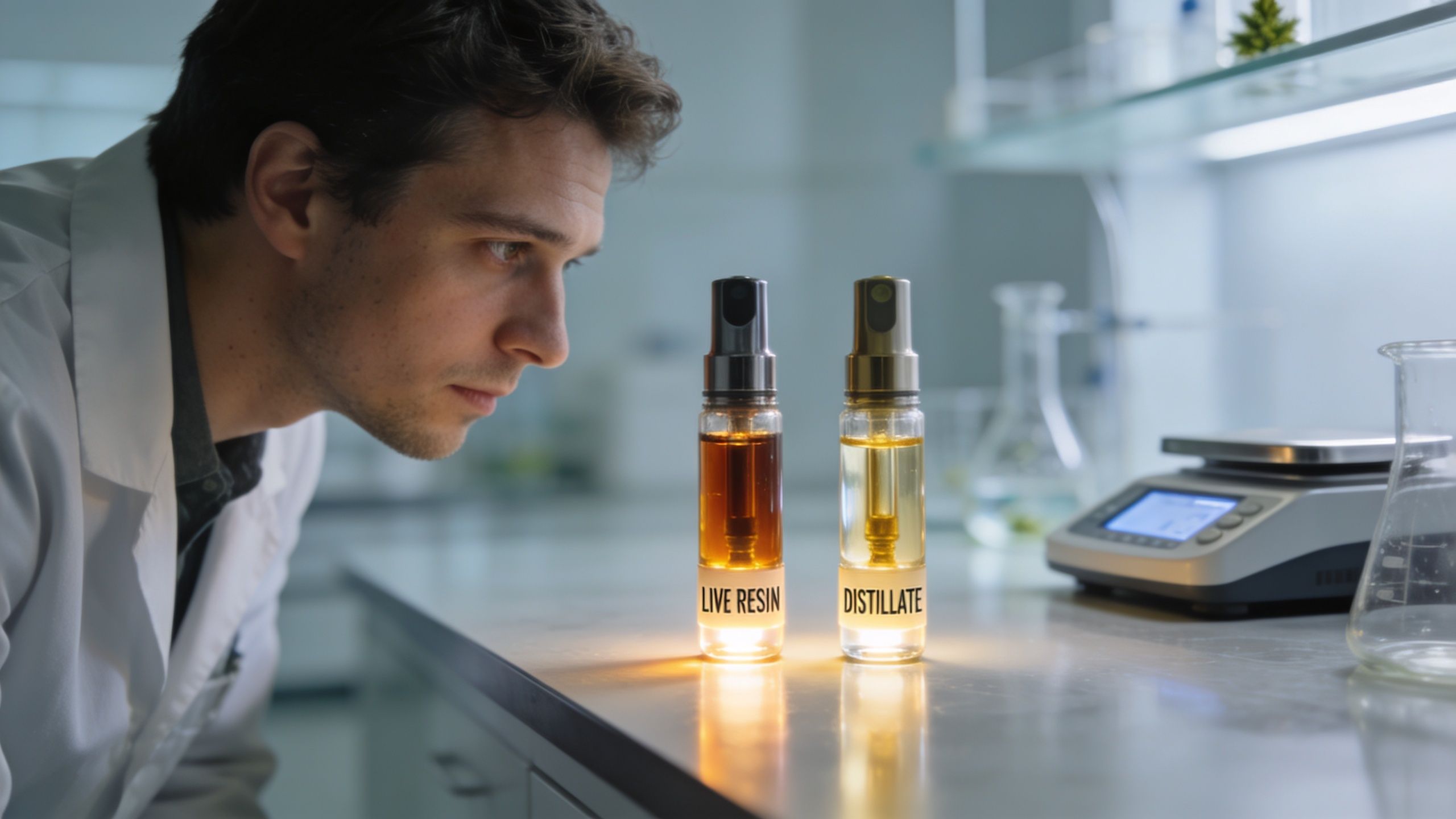
That’s where the live resin versus distillate choice becomes strategic, not stylistic. Live resin usually supports a more plant-faithful sensory profile. Distillate usually supports tighter process control and easier standardization. Both can work in vape cartridges. They just solve different problems.
What teams usually underestimate
Most consumer-facing discussions stop at flavor versus potency. On the manufacturing side, that’s only the beginning. The base extract also shapes:
- Hardware fit: Some oils wick and atomize more predictably than others.
- Batch planning: One material is easier to normalize across repeated production runs.
- Positioning: Premium “full-spectrum” language and scalable “high-potency” language come from different formulation realities.
- Post-fill performance: Shelf stability and in-cart behavior matter as much as fresh-fill sensory appeal.
A cart can smell excellent in the sample jar and still become a bad commercial product once it sits in hardware.
Better means better for what
If the goal is strain expression, live resin often has the edge. If the goal is a repeatable manufacturing system, distillate often wins. If the goal is to hit a middle ground, the answer is often a hybrid approach rather than a strict either-or decision.
New product teams do better when they treat the extract choice as part of a full formulation brief. Start with the hardware, target consumer, price band, and cannabinoid spec. Then choose the base.
Comparing Extraction and Chemical Composition
The chemistry starts at extraction. Live resin and distillate aren’t two names for the same kind of oil. They are different materials because they come from different process priorities.
Why live resin behaves like a full-spectrum input
Live resin is made from fresh-harvested cannabis that is flash-frozen before extraction. That low-temperature approach is used to preserve more of the plant’s native volatile profile. The result is a concentrate that keeps more of the compounds responsible for aroma and a broader chemical signature overall.
That’s why live resin typically contains 65-95% THC, while distillate typically contains 90-99% THC, according to Greensativa’s live resin vs distillate analysis. The lower cannabinoid percentage in live resin isn’t necessarily a defect. It reflects that more of the original plant profile remains in the extract.
Why distillate behaves like an isolated base
Distillate is refined through high-heat processing to isolate cannabinoids and remove much of the rest. That makes it a cleaner blank slate for formulation. It also means the native aroma profile is largely gone unless you build it back in later.
The same Greensativa comparison of live resin and distillate notes that live resin can retain 2-5x higher terpene content than raw distillate and that this contributes to a 20-50% price premium in major U.S. markets.
What that means inside a vape formula
For formulators, the extraction method directly affects three things:
- Sensory starting point: Live resin starts with more aroma already present. Distillate starts mostly neutral.
- Potency design: Distillate makes it easier to hit tight cannabinoid specs.
- Correction workload: Live resin often needs hardware and stability management. Distillate often needs terpene reintroduction and flavor architecture.
A useful way to think about it is this. Live resin arrives with more character than control. Distillate arrives with more control than character.
That difference is why teams working on strain replication, especially terpene profile for vape cartridges projects, should document the desired end state before selecting the base. If the target is “tastes like the flower,” live resin gets you closer on day one. If the target is “same fill and same spec every run,” distillate gives you a stronger production platform.
Flavor Profile Potency and Consistency Analysis
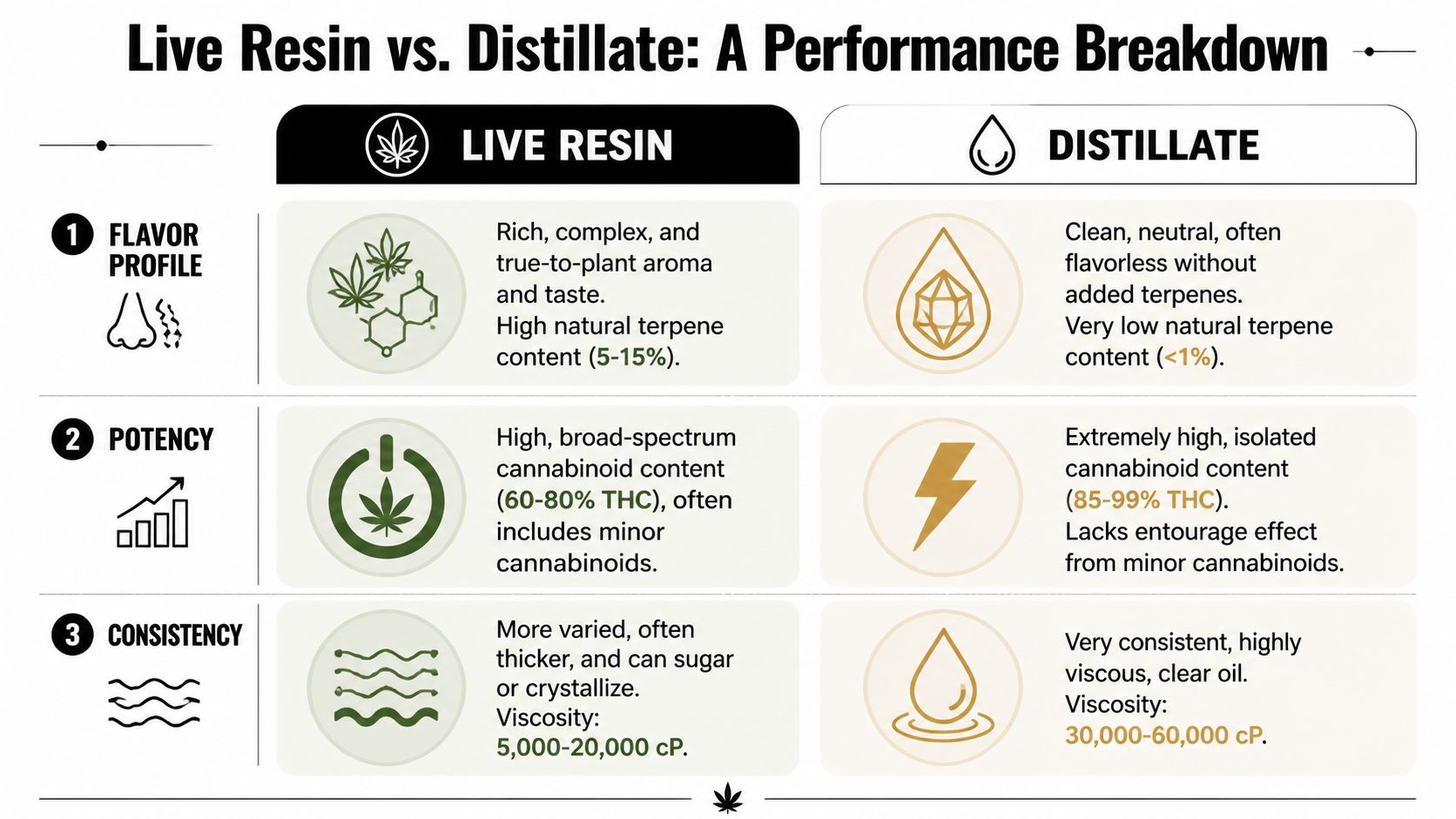
The practical debate usually comes down to three criteria. Flavor. Potency. Consistency. Based on these, teams decide whether is live resin better than distillate for their line, or whether the better answer depends on the SKU.
| Attribute | Live Resin | Distillate |
|---|---|---|
| Flavor | Richer, more plant-forward, more native complexity | Neutral base unless terpenes are added back |
| Potency | Lower cannabinoid percentage but broader profile | Higher cannabinoid percentage and easier target setting |
| Consistency | More batch variation | More repeatable from run to run |
| Brand fit | Premium, craft, strain-authentic positioning | High-potency, scalable, precise-dose positioning |
| Formulation burden | More hardware and stability attention | More flavor building and profile design |
Flavor is where live resin makes its case
If your brief says “replicating flavor of fresh flower for vape cartridges,” live resin usually gives you a head start. It carries more of the native aroma compounds, so the profile feels less assembled. That matters for brands selling authenticity, not just potency.
By contrast, distillate is usually an odor-light base. That’s useful when you want to engineer a profile from scratch, but it also means every sensory decision becomes your responsibility.
If flavor is the hero claim, don’t choose a base that forces you to rebuild the entire aromatic identity after the fact.
For teams building a live resin sauce formulation reference, it helps to think in layers:
- Top notes: Volatile opening impressions that define the first inhale.
- Mid notes: The profile body that keeps the cart recognizable.
- Base notes: The heavier, lingering elements that make the finish feel complete.
Potency favors distillate
Distillate is easier to use when the potency claim needs to be clean and repeatable. A neutral cannabinoid base lets formulators hit a target with less guessing. That matters for production planning and for brands that want every batch to read the same on paper and perform similarly in hardware.
Live resin can still be potent, but it usually doesn’t give the same level of numeric neatness. In practical terms, teams choosing live resin accept a broader sensory win in exchange for a tighter potency ceiling.
Consistency is where operations usually decides the argument
Consistency doesn’t only mean lab numbers. It means whether one lot fills like the previous lot, tastes close enough to the approved benchmark, and keeps behaving after the carts leave the facility.
Distillate has the operational advantage here. It behaves more like a standardized ingredient. Live resin behaves more like a character-rich ingredient that needs active management.
Core trade-off: Live resin usually gives you a stronger native flavor story. Distillate usually gives you a stronger manufacturing story.
That’s why many brands split their portfolio. They reserve live resin for premium strain-led SKUs and use distillate for higher-volume products where repeatability matters more than native complexity.
Formulation Challenges Handling Stability and Hardware
The fastest way to lose confidence in a formula is to test it only in a beaker. Vape products succeed or fail in hardware. Flow, wicking, clogging, and storage behavior matter more than how impressive the oil sounds in a product meeting.
Live resin asks more from the cartridge
A practical issue often missed in broad comparisons is that live resin’s natural high-terpene content can create hardware problems. HempElf’s discussion of live resin vs distillate for formulation notes that live resin can cause clogging in standard carts, and poorly winterized live resin can underperform distillate in shelf-life, with 6-12 months versus 24+ months.
That finding lines up with what manufacturing teams see on the floor. A formula can be sensorially strong and still perform poorly in a standard cartridge if the oil isn’t matched to the atomizer and intake design.
Distillate has easier handling, but not zero problems
Distillate is easier to standardize for filling and line throughput. It’s often the easier base when you want fewer surprises during production. But “easy” doesn’t mean automatic. Once you add a strain-inspired terpene blend for distillate, the formula still has to stay homogenous and wick correctly.
A few working rules help:
- Match oil to hardware: Don’t force a resin-heavy formula into hardware designed around simpler oil behavior.
- Winterize before scale: Shelf issues that seem minor in pilot runs become expensive after filling.
- Run accelerated holds: Check for separation, clogging, and draw resistance after storage, not just right after fill.
For teams troubleshooting viscosity issues, this guide on how to thin distillate for cartridges is a useful reference point during bench work.
What to test before launch
Bench approval shouldn’t be the final gate. Add hardware testing that reflects real use.
- Cold-start draw test across multiple carts from the same lot.
- Storage observation for clarity, movement, and visible instability.
- Repeat puff sequence to check whether the oil keeps up with normal use.
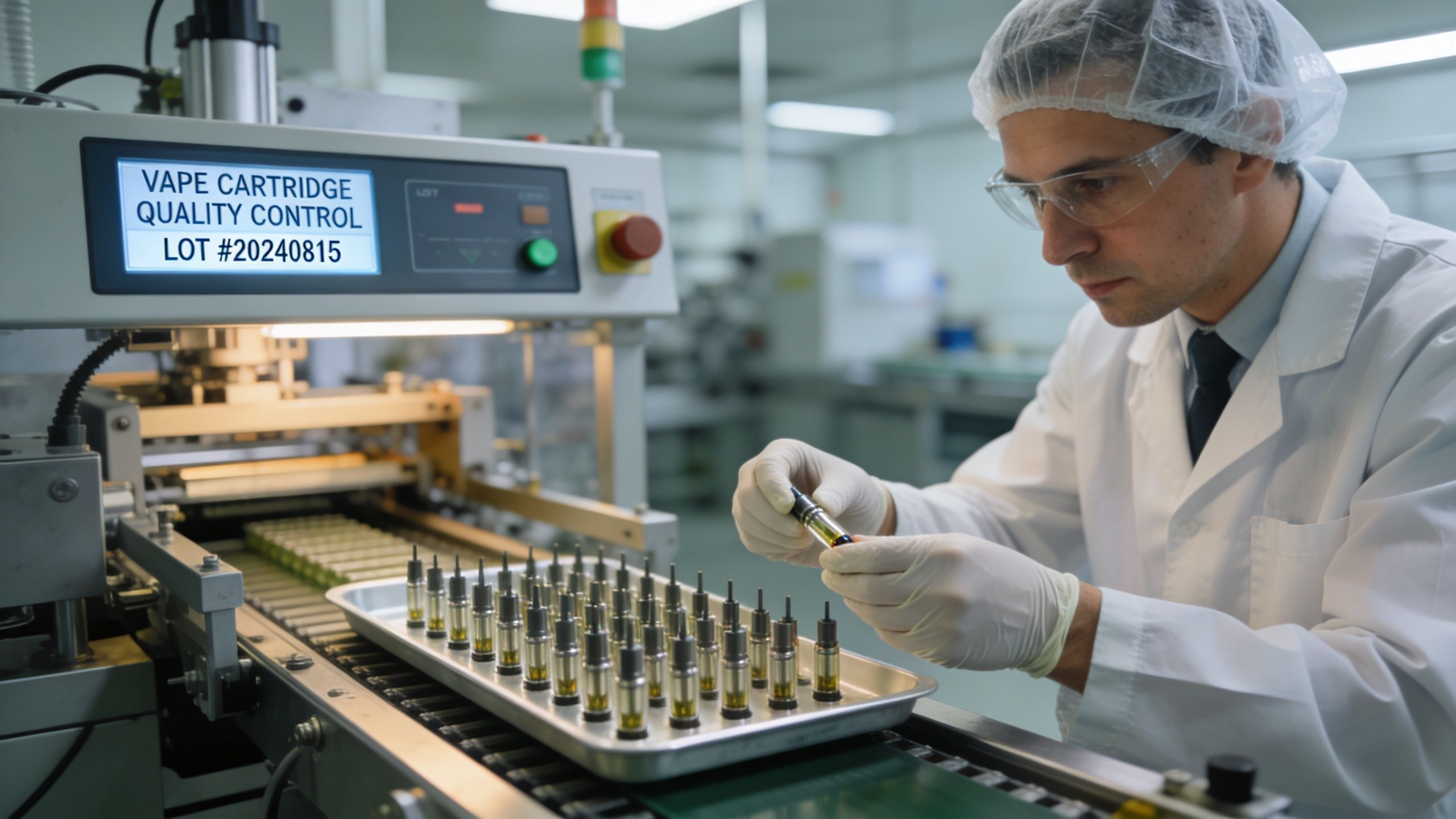
This is also a good point to train the team on process visuals and line setup:
When teams ask is live resin better than distillate, hardware usually answers before marketing does. If the cart won’t stay functional, the better extract on paper becomes the worse product in market.
Navigating Safety Testing and Regulations
A product can taste right, fill well, and still create risk if the testing package is weak. Compliance isn’t a separate department problem. It starts at formulation, especially when the base extract brings different solvent and purification realities.
Live resin needs stricter solvent scrutiny
Live resin’s extraction pathway can create residual solvent risk if purging is incomplete. According to Leafwell’s review of live resin and distillate compliance issues, live resin’s butane extraction can retain 5-50ppm of solvents if not properly purged, and 18% of live resin samples failed the EU’s <10ppm n-butane limit.
For any team exporting, that isn’t a technical footnote. It’s a release decision. A product built around a premium flavor story can still be a poor commercial choice if the COA package won’t survive cross-market review.
Distillate often gives a cleaner compliance starting point
Distillate’s refinement process usually makes it easier to begin from a cleaner baseline from a residual-solvent perspective. That doesn’t remove the need for full panel testing. It just changes where the biggest risk sits.
What buyers and QA managers should review on every lot:
- Residual solvents: Especially important for hydrocarbon-derived extracts.
- Cannabinoid profile: Confirm the batch matches the intended spec.
- Pesticides and heavy metals: These remain strictly prohibited regardless of extract type.
- Terpene inputs: Verify what was added, and confirm the supporting documentation.
The terpene side of compliance matters too
A common mistake is treating terpenes as a flavor decision instead of a tested input. For formulating for cannabis product formulation, use terpene ingredients with clear documentation, no unnecessary cutting agents, and a COA package that fits your target market.
The legal side also shifts by jurisdiction, so teams planning multi-state or cross-border distribution should keep a current reference like this terpene legality guide.
Compliance work starts before purchasing, not after a failed batch.
The safest development habit is simple. Don’t approve a formula based only on aroma, potency, or vapor performance. Approve the ingredient trail and test trail with the same discipline.
Analyzing Cost Scalability and Market Positioning
The extract choice shapes the economics of the SKU long before the product gets a package design. It affects raw material cost, process friction, and how much operational variability the team must absorb.
Live resin generally belongs in a higher-priced lane. It commonly carries a premium because the input and process are oriented around preserving native character rather than stripping to a neutral base. That makes sense if the brand wants a connoisseur-facing product with a strong authenticity story.
Distillate usually supports a more efficient production model. It is easier to standardize, easier to scale into repeatable SKU families, and easier to align with strict potency targets. That changes the commercial math in a useful way for larger-volume programs.
Where live resin fits commercially
Live resin works best when the brand promise centers on sensory realism and extract identity. It suits menus where the extract itself is part of the value proposition. The brand is selling a richer plant-linked profile, not just cannabinoid strength.
That makes live resin a strong fit for:
- Premium lines: Higher-end carts with strain-led storytelling.
- Limited drops: Smaller batches where uniqueness is an asset.
- Craft positioning: Products where some variability is accepted as part of the category.
Where distillate fits commercially
Distillate makes more sense when the brief prioritizes repeatability across larger output. It is often the engine behind broad product families because a neutral base is easier to adapt into multiple flavor directions and cannabinoid targets.
It fits especially well for:
- Core line SKUs: Products that need stable throughput.
- Multi-market distribution: Programs that depend on standard specs.
- Price-sensitive segments: Offers where margin discipline matters.
A premium extract doesn’t automatically create a premium brand. The hardware, testing, consistency, and positioning all have to support the same story.
Teams should stop asking which extract is superior in the abstract. The better question is whether the formulation economics match the brand lane. If the retail story says “craft,” live resin can justify itself. If the retail story says “reliable, potent, repeatable,” distillate usually gives you more room to scale without friction.
A Formulation Guide for Blending and Product Development
A product team usually feels the live resin versus distillate decision at the bench, not in a brand deck. The brief says “strain character, high potency, no clogging, broad hardware compatibility, and repeatable output.” One extract rarely gives all of that without trade-offs. Good formulation work starts by deciding which variable can move and which one cannot.
Use distillate when you need a controllable base
Distillate is the easier starting point when potency targets, batch standardization, and line efficiency matter most. It gives the team a neutral cannabinoid base, so flavor can be built with more control instead of inherited from a variable extract lot.
As noted earlier, formulators often work within a terpene inclusion range rather than forcing a single ratio into every SKU. The right level depends on the cartridge, coil temperature, fill viscosity, and the sensory brief. A formula that tastes sharp and expressive in a glass vial can still burn hot, separate, or flood in production hardware.
That is why distillate performs well for strain-inspired programs. It gives you tighter control over three things that usually drift during scale-up:
- Cannabinoid potency
- Viscosity during filling
- Flavor consistency across batches
Use live resin when extract character needs to stay visible
Live resin makes more sense when the native terpene profile is doing real commercial work. If the point of the SKU is cultivar character, the formulator's job shifts from building flavor to protecting it through processing, filling, and shelf life.
That changes the development workflow. Teams should test hardware earlier, because a flavorful live resin formula can still fail if the oil runs too thick, darkens under heat, or drops residue onto the coil. Oxidation control matters more. So does hold testing after fill, not just before it.
The practical question is simple. Can the hardware carry the profile without muting it or breaking down halfway through the cartridge?
Build hybrids when the brief has competing goals
Hybrid systems are often the commercial answer. A distillate-heavy base can hold potency and process consistency, while a measured amount of live resin or a targeted terpene fraction brings back extract identity.
This approach works best when the blend is built in layers:
- Set the cannabinoid foundation around the target potency and expected flow behavior.
- Choose the sensory driver such as live resin, native fractions, or a terpene system that supports the intended profile.
- Stress test the blend in the actual device at different voltages and after storage.
- Adjust for failure mode first such as crystallization, clogging, harshness, or flavor fade.
I generally advise teams to separate sensory approval from commercial approval. A bench sample can smell excellent and still be wrong for the SKU if it changes viscosity after filling or loses top notes during accelerated storage.
Flavor, stability, and hardware performance need separate pass criteria.
The strongest formulas are usually not the purest expression of one input. They are the ones built to survive manufacturing and still taste intentional at the end of the cartridge. That is the standard that matters in product development.