
Most strains become popular because they fit a moment. Wedding Cake became popular because it fits a manufacturing system. That’s the counterintuitive answer to why is wedding cake strain so popular. Its rise wasn’t just cultural. It was operational.
Wedding Cake surged in the late 2010s and earned Leafly’s Strain of the Year in 2019, with reported THC content of 20 to 27% and a flavor profile that stayed dependable enough to become a frequent dispensary menu fixture across major markets, according to this review of Wedding Cake’s market rise. For a product team, that matters because enduring menu presence usually points to one thing: a profile that can be reproduced without losing its commercial identity.
In formulation terms, Wedding Cake works because it sits in a rare middle ground. It has dessert appeal without becoming cloying. It reads potent without turning one-dimensional. It offers a recognizable sensory signature that brands can rebuild in cartridges, concentrates, and THC-free terpene systems with less guesswork than many novelty profiles. If your team develops strain-inspired SKUs, understanding how terpenes function in cannabis is the first step to seeing why this profile keeps showing up in successful product libraries.
Decoding the Commercial Success of Wedding Cake
Wedding Cake is one of the clearest examples of a strain profile becoming a formulation benchmark. Plenty of dessert names have entered the market. Very few have stayed useful to extractors and brand owners after the initial demand spike. Wedding Cake did.
Its commercial success comes from three traits working together. First, the profile is recognizable. Second, it translates well across formats. Third, it remains stable enough that teams can build repeatable products around it instead of chasing a moving target.
Why brands keep returning to it
For product development teams, popularity alone isn’t a reason to formulate around a profile. The key question is whether the profile survives processing, dilution, hardware constraints, and batch variation. Wedding Cake generally does better than most sweet-leaning profiles because the sensory identity isn’t built on a single fragile top note.
That’s why it works in more than one lane:
- For vape cartridges: It keeps a dessert-forward identity while still leaving room for earthy and spicy structure.
- For distillate applications: It can restore flavor to a neutral or stripped base without reading artificial.
- For cannabis product formulation: It gives marketing, sensory, and effect-positioning teams the same answer. Relaxed, euphoric, and broadly approachable.
Wedding Cake didn’t win shelf space by being the sweetest profile in the room. It won by being one of the easiest dessert profiles to recognize again after processing.
The real reason it has staying power
From a chemist’s perspective, Wedding Cake behaves like a profile designed for scale. It’s broad enough to absorb minor production variation, but distinct enough that consumers still know what they’re buying. That’s a rare combination.
A lot of trendy dessert profiles fail here. They smell impressive in flower, then flatten in vapor. Wedding Cake usually holds together better because its identity comes from balance, not excess. That’s what made it commercially durable.
The Genetic Blueprint and Commercial Stability
A strain can’t become a reliable formulation reference unless the underlying plant expression is reasonably stable. Wedding Cake has earned that reputation because its genetic architecture supports predictable outputs instead of wild swings in aroma and structure.
The commonly cited parentage is Triangle Kush crossed with Animal Mints, with some references also noting Cherry Pie and Girl Scout Cookies. What matters to a product team is less the naming dispute and more the result. The cultivar expresses as a 60% Indica and 40% Sativa hybrid with reported cultivation advantages including compact growth and stress resistance, as described in this Wedding Cake cultivation and genetics guide.
Why genetic stability matters in formulation
When growers can produce a cultivar with fewer surprises, extractors get a more consistent starting point. That affects every downstream decision:
- Extraction planning: More predictable input material means fewer reformulation adjustments.
- Sensory matching: Your target aroma doesn’t drift as much from batch to batch.
- SKU management: Brand teams can keep the same strain-inspired product in market longer without constant relabeling or repositioning.
A profile like Wedding Cake gives manufacturers something extremely useful. It offers a target that doesn’t have to be reinvented every run.
The supply chain advantage
The strain’s award history matters here too. Recognition such as 1st place at the 2018 SoCal Cannabis Cup for Best Hybrid and Best Indica in Amsterdam reinforced the idea that Wedding Cake wasn’t just popular. It was stable enough to earn trust from growers and buyers working in different environments.
That has a practical effect on supply chain decisions. Teams are more willing to build a cartridge line, a concentrate flavor family, or a hemp-derived terpene offering around a profile when the source material has a record of reproducible expression.
Production note: Stable cultivars reduce the amount of sensory correction a formulator has to do later. That saves time, but more importantly, it preserves authenticity.
There’s another less discussed advantage. Compact, stress-tolerant plants are easier to run consistently than finicky cultivars that produce dramatic aromatic changes under mild environmental shifts. For wholesale and private-label operations, that reliability is often more valuable than novelty.
Wedding Cake’s commercial strength starts before formulation. It starts with a cultivar that gives the rest of the process fewer reasons to fail.
Deconstructing the Wedding Cake Terpene Profile for Formulation
Wedding Cake succeeds because its aroma reads like dessert, but its chemistry doesn’t behave like candy. That distinction is important. A profile that relies only on bright sweetness usually falls apart in vapor. Wedding Cake works because the sweetness sits on top of structure.
Its core terpene synergy is built around Beta-Caryophyllene, Limonene, Alpha-Humulene, and Linalool, and the interaction between caryophyllene and limonene is a big reason the profile is often described as relaxing yet euphoric without heavy sedation, according to Abstrax Tech’s breakdown of Wedding Cake’s terpene synergy.
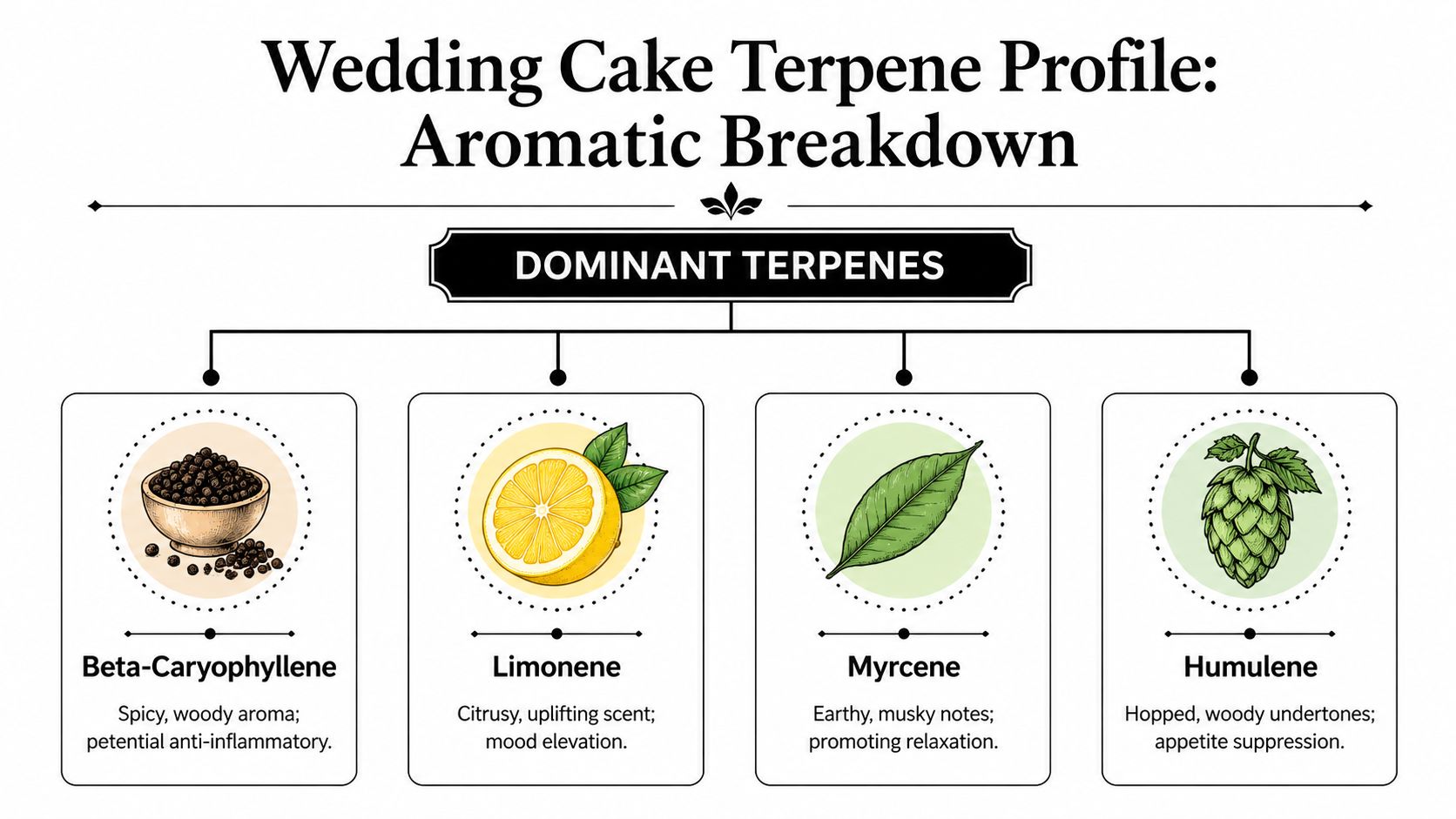
Think in top, mid, and base notes
If you’re replicating flavor of Wedding Cake for vape cartridges, don’t formulate it as a flat sweet blend. Build it like a flavor pyramid.
| Terpene | Aromatic Profile | Note Category | Formulation Role |
|---|---|---|---|
| Beta-Caryophyllene | Spicy, peppery, woody | Base note | Anchors the profile and keeps sweetness from becoming thin |
| Limonene | Bright, citrus, tangy | Top note | Adds lift and gives the profile its sharp opening |
| Alpha-Humulene | Woody, dry, slightly hoppy | Mid to base note | Adds dryness and prevents a syrupy finish |
| Linalool | Floral, soft, rounded | Mid note | Smooths the sharper edges and contributes polish |
That structure explains why the profile feels richer than a typical sweet cart. The consumer notices the vanilla-dessert impression first, but the profile stays believable because pepper, wood, and dry herbal notes hold it in place.
For a deeper technical primer on effect and aroma contribution, this guide on what terpenes do in weed is useful background for junior formulation teams.
What each terpene is doing in practice
Caryophyllene is the backbone. Without it, most Wedding Cake attempts smell like generic frosting or sweet distillate. Caryophyllene supplies the peppery depth that turns “dessert” into “baked dessert.”
Limonene is the opening note. It creates the tangy, lifted edge that stops the profile from feeling dense. In small systems, it’s often the note teams overemphasize because it pops early in bench tests.
That usually backfires in hardware. Too much limonene and the profile stops reading like Wedding Cake. It starts reading like citrus pastry cleaner.
Where formulators usually miss
The most common mistake is chasing obvious sweetness while ignoring dryness. Wedding Cake needs contrast. The creamy impression only works because humulene and caryophyllene trim the edges.
The second mistake is underestimating linalool. It doesn’t always dominate the aroma, but it helps fuse the profile so the inhale and exhale feel connected rather than split.
Bench rule: If your first trial smells good in the bottle but loses realism in vapor, the issue usually isn’t sweetness. It’s missing base-note restraint.
A good Wedding Cake terpene profile for distillate should open bright, settle into cream and dough, then finish with spice and a slightly dry tail. If the finish stays sugary, the formula needs more structure. If it ends only woody or peppery, you’ve stripped out the part that made the profile commercially successful in the first place.
Translating Effects into a Broad-Market Formulation Strategy
A commercially useful profile doesn’t just taste right. It has to land in a category that more than one customer type wants to buy. Wedding Cake does that by sitting in the middle of the effect map rather than at an extreme.

The profile is often valued because it feels relaxing without reading inactive. For formulation teams, that opens a much wider positioning range than heavily sedating or sharply stimulating profiles do. You can place it as an evening unwind SKU, a premium dessert cart, or a balanced hybrid-inspired concentrate without fighting the chemistry.
Why this effect lane sells
One source notes that terpenes alone can account for up to 70% of a strain’s sensory appeal and experiential effects, which is why Wedding Cake can be effectively reconstructed in THC-free systems using isolates such as limonene and caryophyllene for global markets, according to this discussion of terpene-driven replication.
That matters because the product brief doesn’t have to depend entirely on cannabinoid load. If you’re formulating a strain-inspired terpene blend for cannabis product formulation, the target is not “maximum impact.” The target is coherence. The aroma, inhale feel, and perceived mood should all point in the same direction.
Three commercial benefits come from that:
- Broader audience fit: Balanced profiles are easier to place across multiple product lines.
- Cleaner brand messaging: “Relaxed but functional” is easier to communicate than a niche or polarizing effect claim.
- Cross-format adaptability: The same core terpene idea can work in distillate carts, concentrates, and THC-free aromatic systems.
Build for functional relaxation
The practical implication is simple. Don’t overbuild the sleepy side. Wedding Cake loses its broad-market value when a formulator turns it into a blunt nightcap profile.
What works better is preserving the uplift from limonene while letting caryophyllene and the supporting woody notes create calm around it. That’s how the profile keeps movement and softness at the same time.
The effect discussion is easier to visualize when the team shares a common reference point:
Wedding Cake’s value isn’t that it pushes hardest in one direction. It’s that it avoids alienating large parts of the market.
When teams ask why is wedding cake strain so popular, this is usually the missing answer. It doesn’t force the user into a narrow occasion. It supports multiple occasions while keeping a clear identity. That’s exactly what brands want from a flagship profile.
Practical Guide for Replicating Flavor with a Wedding Cake Terpene Blend
Wedding Cake succeeds in formulation because its identity is specific enough to be recognizable and flexible enough to survive processing. For a product team, that matters more than chasing a perfect copy of one flower batch. The commercial target is a stable dry-sweet dessert profile with pepper, dough, cream, and a restrained citrus lift that still reads correctly after filling, storage, and repeated heat exposure.
Projections from the time suggested that Wedding Cake would parent more than 40 new hybrids in 2025, with continued wholesale interest in premium dessert-style profiles, as discussed in this report on Wedding Cake’s projected influence on newer hybrids and cartridge formulation issues. The useful takeaway for formulators is simpler than the forecast. Profiles in this family keep getting reused because they can be rebuilt with ingredients that are available at scale and because the sensory signature survives translation into carts and concentrates better than many fruit-forward strains.
A practical workflow for distillate and carts
Start with the hardware you plan to ship. Wedding Cake can smell balanced in a beaker and still come out thin, sharp, or overly woody in the actual cartridge. Ceramic cores often push the dry spice and wood fraction harder. Cotton systems can soften the middle and make the sweet top feel broader.
Build the base before adjusting the shine.
Set the dry foundation
Caryophyllene, humulene, and the woody support notes establish the frame. If that frame is too light, the profile reads generic dessert. If it is too heavy, the blend turns dusty and loses the creamy finish customers expect from Wedding Cake.Control the top note window
Limonene needs restraint. A small increase can improve first sniff brightness, but too much shifts the profile toward lemon frosting and away from the denser cake impression that gives this cultivar its name.Use floral material as a binder, not a headline
Linalool is useful because it smooths the transition between spice, sweetness, and vapor finish. Push it too far and the blend starts reading perfumed instead of baked.Test after rest, not just after mixing
Fresh blends often overstate the bright layer. Rested fills give a more honest read on whether the vanilla-dough impression is still intact once the system equilibrates in oil.
A sensory map helps teams describe what changed and where to correct it. Use a terpene flavor chart for note mapping and profile balancing so panel feedback stays specific. “More Wedding Cake” is not actionable. “Less lemon peel, more dough, longer pepper finish” is.
Failure points I see repeatedly
Wedding Cake usually falls apart in one of three ways. The first is overbuilding sweetness. Formulators add creamy or candy-like notes until the profile smells attractive in the bottle, then discover that the vapor has lost the dry bakery tension that made the original profile believable.
The second is chasing vanilla too directly. In inhalable systems, obvious vanilla cues can flatten the strain character and create an artificial finish. The better route is to let the sweet impression emerge from the interaction of spice, soft florals, and low-level citrus over a woody base.
The third is skipping stability checks. A blend that works on day one can drift after fill, especially if the top notes were carrying too much of the identity.
One tool option for commercial teams
A prebuilt Wedding Cake strain-specific terpene blend from Gold Coast Terpenes can serve as a benchmark for carts, concentrates, or distillate restoration when the team needs a starting point with a defined sensory center. That saves time during early screening, especially when procurement needs a profile that can be reordered with less variation than flower-derived material.
Keep scale-up records at three points: at mix, after fill, and after storage. Teams that hold Wedding Cake well usually track how the pepper-to-cream balance shifts over time and correct for it before the profile starts reading sugary, flat, or citrus-heavy.
Safety and Regulatory Guardrails for Cannabis Product Formulation
A Wedding Cake profile only has commercial value if the finished product is safe, documentable, and defensible. That’s where a lot of otherwise capable product teams cut corners. They focus on matching aroma but ignore input quality and compliance posture.
For inhalable products, terpene sourcing isn’t just a flavor decision. It’s a risk decision. You want materials that are lab-verified and suitable for the intended use case, with clean documentation and clear composition. If the supplier can’t show what’s in the blend, you shouldn’t put it into a cartridge.
What to screen before buying inputs
Use a checklist that product, QA, and compliance can all agree on:
- Documentation quality: Ask for current testing documents and composition details.
- Diluent policy: Avoid blends cut with VG, PG, PEG, or MCT for cartridge formulation.
- Ingredient clarity: Make sure the terpene system is transparent enough for internal review and customer-facing compliance needs.
Why this protects the brand
Poor input decisions don’t just create technical problems. They create recall risk, customer complaints, and labeling headaches. Even if the flavor seems acceptable at first, unstable or unsuitable ingredients can undermine the product after it leaves your facility.
Regulatory status also matters when you’re selling across jurisdictions or building THC-free aromatic SKUs. This overview of are terpenes legal is a practical starting point for teams that need to align formulation with market access.
A good rule is simple. If a terpene supplier makes sourcing feel vague, walk away. Clear paperwork and clean composition are not optional.
Conclusion Why Wedding Cake Is a Blueprint for Your Next Bestseller
Wedding Cake stayed popular because it solved multiple commercial problems at once. It gave growers a stable cultivar. It gave extractors a recognizable sensory target. It gave formulators a profile that holds together in finished products. And it gave brands an effect position that doesn’t trap them in a narrow use case.
That’s why the question why is wedding cake strain so popular matters to product teams. The answer isn’t just “people like dessert strains.” The better answer is that Wedding Cake became a repeatable formula for shelf success.
Its profile teaches a durable lesson. The strongest strain-inspired products usually aren’t the loudest. They’re the ones with enough complexity to feel premium and enough structure to survive production. Wedding Cake does both. Sweet top notes bring people in. Pepper, wood, and soft floral tones keep the profile believable. Balanced effect positioning keeps the audience wide.
For cartridge lines, concentrate SKUs, and THC-free terpene systems, Wedding Cake remains useful because it’s more than a famous cultivar. It’s a formulation blueprint. If your team can reproduce that balance of recognizability, stability, and restraint, you’re not just copying a popular profile. You’re building the kind of product people reorder.
If you’re developing a Wedding Cake-inspired SKU or comparing dessert-forward profiles for carts and concentrates, Gold Coast Terpenes offers strain-specific blends, isolates, and formulation resources that can help your team move from bench concept to production-ready profile.