
For cannabis product formulators, strain selection is a critical business decision, directly influencing product positioning and consumer appeal. The White Buffalo strain-inspired terpene blend is a profile that consistently reappears in successful product lines, and for strategic reasons. It has a well-earned market reputation for an energetic, focused experience, making it a perfect match for products aimed at the daytime, productivity-oriented consumer.
Why Formulators Target the White Buffalo Strain Profile

For a formulator, a strain name represents a promise of a specific experience. White Buffalo has built a loyal following because its effects are predictable: a clean, cerebral lift without the heavy sedation common in other popular profiles. This makes it a strategic choice for creating products that align with a modern, active lifestyle.
The objective is not merely mimicking the aroma. The goal is capturing the complete functional experience of White Buffalo. To achieve this, one must deconstruct its chemical architecture—its genetics, terpenes, and cannabinoids. By breaking down the profile, you can reconstruct it with high fidelity. This methodology ensures your vape cartridges or concentrates deliver the exact same high-quality experience batch after batch, which is the cornerstone of building brand loyalty.
Genetic Blueprint and Market Positioning
So, what is the origin of the White Buffalo profile? It derives from a sativa-dominant hybrid, typically with an 80% sativa to 20% indica ratio. Its lineage includes Romulan, Blackberry Kush, and the renowned sativa, Bay 11. This combination yields the structural integrity and accelerated flowering from its indica heritage, alongside the potent, clear-headed energy from Bay 11. With THC levels typically landing between 15-20% and sometimes reaching 25%, it provides a potent foundation for any product.
This genetic makeup is what makes it so valuable from a product development standpoint. The sativa dominance is key to its commercial appeal:
- Targeted Effects: This profile is defined by focus and alertness, making it a natural fit for vapes and concentrates marketed for daytime use, creative projects, or social engagement.
- A Complex Flavor Canvas: The blend of indica and sativa genetics produces a fascinating aroma—sweet, sour, and earthy. It gives formulators a complex palette to work with.
- Built-in Market Trust: A significant consumer base already seeks out the White Buffalo experience. A successful replication taps into a pre-existing market actively searching for this specific profile.
For manufacturers, the value of the White Buffalo profile is its well-defined market niche. It isn’t a generic profile; it’s a specific solution for consumers seeking an energetic and functional experience, making it a reliable choice for new product lines.
Ultimately, choosing to work with a White Buffalo strain-inspired terpene blend is a calculated decision. You are leveraging a known quantity with a desirable, predictable effect, which removes significant guesswork from new product launches. The key to successful replication lies in understanding the chemistry behind the profile, which starts with its unique terpene signature. For formulators looking to sharpen their selection process, our guide on choosing cannabis strains based on terpene profiles is a valuable resource.
Mapping the Terpene Blueprint of White Buffalo
To accurately replicate the White Buffalo profile in your products, you must look beyond the name and analyze its chemical signature. The distinct sweet-and-sour, earthy-diesel scent is the direct result of a specific combination of terpenes. For a formulator, this terpene profile is the roadmap for building an authentic and consistent consumer experience.
Building a terpene profile is analogous to composing music or fine fragrance. Each terpene is an individual note. To create a complex and balanced final product, you must understand how to layer them as top, middle, and base notes. This approach ensures the final profile is rich and dynamic, not flat or one-dimensional.
Decoding the Dominant Terpenes
Repeated lab analyses of the White Buffalo cultivar show it is built around a core trio of terpenes. These are the primary compounds that define its character. Understanding what each contributes—and how they interact—is the first step to creating an effective profile for distillate or vape cartridges.
These are the principal terpenes that create the White Buffalo experience:
Myrcene: Typically the most abundant terpene, Myrcene provides a foundational layer of earthy, musky, and faintly sweet notes. It acts as the anchor that grounds the entire profile, giving it a smooth, full-bodied character.
Caryophyllene: This is where White Buffalo derives its signature spicy, peppery quality. As a middle note, Caryophyllene adds a warm complexity that prevents the profile from becoming overly sweet and provides a sophisticated edge.
Limonene: This terpene is responsible for the bright, citrusy top notes. Limonene delivers the initial burst of sweet-and-sour aroma, contributing to the strain's famously zesty and uplifting character.
When you analyze the White Buffalo strain terpene profile for formulation, you observe a perfect example of aromatic synergy. The peppery spice from Caryophyllene perfectly balances the subtle sweetness of Myrcene. Meanwhile, Limonene lifts the entire profile, preventing it from feeling too heavy or dense.
This delicate interplay is what makes the profile so complex and memorable. Your objective as a formulator is not simply to combine these terpenes, but to balance them in the correct ratios to recreate that specific harmony.
For a deeper dive into the science, our guide to the properties of different terpenes is an excellent resource.
Assembling the Profile: Top, Middle, and Base Notes
How do we translate this data into a practical formulation strategy? When you're formulating with White Buffalo, thinking in terms of "notes" is essential for achieving the full-bodied sensory experience.
Here is a practical breakdown for your own formulations.
White Buffalo Terpene Profile Breakdown for Formulation
| Terpene | Concentration | Aromatic Contribution | Note Classification |
|---|---|---|---|
| Myrcene | Dominant | Earthy, musky, slightly fruity | Base Note |
| Caryophyllene | Dominant | Spicy, peppery, woody | Middle Note |
| Limonene | Dominant | Citrus, sweet, sour | Top Note |
| Pinene | Secondary | Sharp pine, herbal, fresh | Top Note |
| Humulene | Secondary | Hoppy, woody, earthy | Base Note |
This table serves as your playbook for replicating the flavor of White Buffalo. Let’s break it down:
Top Notes (Limonene, Pinene): These are the most volatile and are perceived first, delivering the initial aromatic impact—the bright citrus and fresh pine that initiate the experience.
Middle Note (Caryophyllene): This note emerges as the top notes begin to dissipate. Caryophyllene’s spice acts as the perfect bridge, connecting the bright introduction to the earthy finish.
Base Notes (Myrcene, Humulene): These are the least volatile compounds and provide a lasting foundation. The rich, earthy tones of Myrcene and Humulene linger, giving the flavor a complete and satisfying finish.
By mastering this hierarchy, you gain precise control over the entire sensory journey, ensuring your final product delivers an authentic and dynamic White Buffalo experience from start to finish.
How to Formulate a White Buffalo Vape Cartridge
Let's move to the practical application: converting the White Buffalo strain profile into a high-quality, stable vape cartridge. This is where science meets application. We are not simply adding terpenes to oil; we are engineering an experience from the ground up.
The objective is to create a final product that is stable, flavorful, and true to the original profile. To achieve this, you must be meticulous about your base material, perfect your terpene ratios, and ensure complete homogenization. Compromising on any of these steps can lead to separated oil or a flavor profile that degrades over time.
Selecting Your Base Distillate
Every successful formulation begins with a clean canvas. For vape cartridges, that canvas is your distillate. To allow the complex White Buffalo profile to express itself fully, you require a high-purity cannabis or hemp distillate.
Select a distillate that has been fully winterized and decarboxylated. This process removes lipids and waxes, yielding a clear oil that will not cloud or crystallize in the final cartridge. A neutral, clean base is essential for accurately capturing the authentic White Buffalo flavor.
Calculating the Ideal Terpene Percentage
A critical parameter in formulation is getting the terpene percentage correct. Too low, and the flavor is weak. Too high, and the product becomes harsh and risks instability.
For a White Buffalo profile for vape cartridges, the optimal range is generally between 5% and 8% terpenes by weight.
- Start at 5%: This is a reliable starting point for initial test batches. It provides a solid flavor foundation without being overpowering or excessively reducing viscosity.
- Test and Refine: From there, make small, incremental adjustments. Prepare micro-batches, increasing the terpene level by 0.5% each time. This methodical approach allows you to identify the ideal concentration for your specific distillate and hardware.
- Avoid Over-Dilution: It is rarely advisable to exceed 10% terpenes. At that concentration, the flavor often becomes sharp and acrid, and you run a high risk of the terpenes separating from the solution.
Flavor formulation is like composing music—you have high, mid, and low notes that must be in harmony.
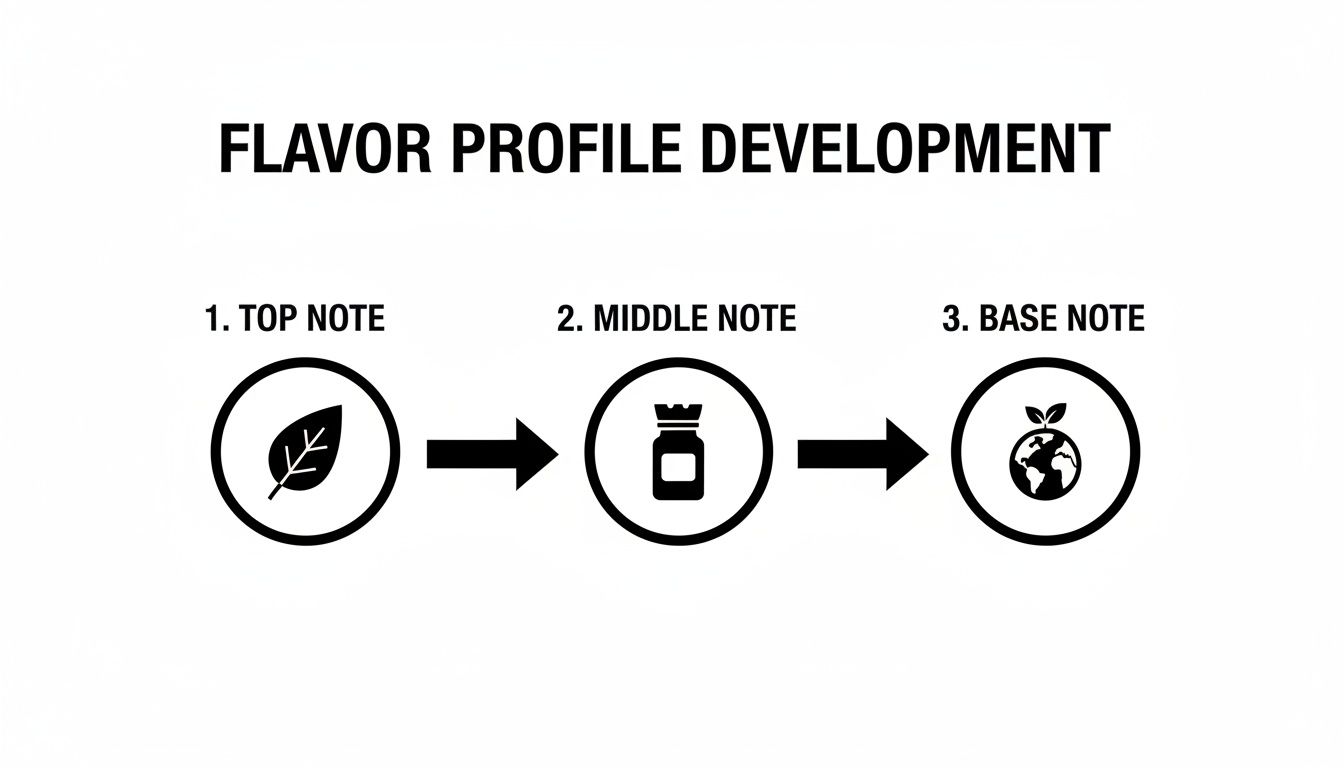
As shown, an effective flavor profile is not monolithic. It is a careful balance of different aromatic notes working together to create a complete experience.
Step-by-Step Mixing and Homogenization
Proper mixing is what integrates your carefully measured ingredients into a single, shelf-stable product. Simple manual stirring is insufficient.
Here is a proven process for mixing your White Buffalo vape oil:
Gently Warm the Distillate: Heat your distillate to approximately 40-50°C (104-122°F). This reduces the viscosity of the oil, making it more workable and allowing for a more thorough mix without degrading cannabinoids or the delicate terpenes. If you are refining your heating process, our guide on how to properly decarb cart oil provides useful techniques.
Measure and Add Terpenes: Using a precision scale, weigh your White Buffalo terpene blend according to your target percentage. Slowly add the terpenes into the warmed distillate.
Homogenize the Mixture: This is the most critical step. To achieve a truly stable blend, use a magnetic stirrer or an overhead mixer for 15-30 minutes. This ensures the terpenes and oil are fully integrated on a molecular level, preventing future separation.
Cool and Settle: After mixing, allow the blend to cool to room temperature. This permits any entrapped micro-bubbles to rise and dissipate, leaving you with a perfectly clear, professional-grade oil ready for filling.
Pro-Tip: To create a proprietary variation of your White Buffalo profile, start with a pre-made blend and then innovate. To emphasize the bright, energetic aspect of the profile, consider adding an extra 0.25% of Limonene isolate. This will make the zesty citrus notes more prominent.
By following this roadmap—selecting a quality base, dialing in your ratios, and mixing thoroughly—you will be able to consistently produce a White Buffalo vape cartridge that is potent, flavorful, and true to the original profile. This attention to detail is what differentiates a premium product.
Taking White Buffalo Beyond the Vape Pen: A Guide to Distillate and Concentrates
While perfecting a vape cart is a key objective, White Buffalo’s unique profile is also highly effective in other product categories, such as high-demand concentrates like shatter, wax, or even live resin. However, your formulation strategy must adapt based on your starting material. You cannot approach a flavorless distillate in the same way you would a terpene-rich BHO extract.
It all depends on your starting point. Pure THC distillate is a blank canvas, requiring you to build the entire White Buffalo profile from scratch. Conversely, when working with a concentrate that retains some of its native terpenes, your role is more that of a refiner, adding only signature notes to complete the profile.
Building from a Blank Canvas
When starting with a high-purity, flavorless distillate, you have complete control over the sensory experience. While this offers maximum creative freedom, it also places the responsibility on you to create a profile that feels authentic and not artificial.
In this scenario, a complete, strain-specific blend is non-negotiable. Using single isolates is insufficient. A well-formulated blend contains all the necessary layers to mimic the authentic cultivar—the bright Limonene top notes, the spicy Caryophyllene middle, and the earthy Myrcene base.
The process is similar to creating vape liquid, but with additional attention paid to the final texture. For products like badder or wax, your mixing technique is crucial for achieving the desired consistency.
Enhancing Existing Concentrates
If your starting material is a BHO or CO2 extract that already possesses a base flavor, your task is refinement, not construction. Your mission is to steer the existing profile closer to the classic White Buffalo signature.
For instance, your concentrate might be wonderfully earthy but lack the bright, citrusy top notes. In this case, you would not use a full blend. You would perform precision additions with specific isolates.
- To boost the citrus: A small amount of Limonene isolate will elevate the top notes.
- To add spice: A touch of Beta-Caryophyllene can introduce that classic peppery warmth.
- To sharpen the overall aroma: A trace amount of Pinene can add a clean, fresh complexity that makes the entire profile more vibrant.
This approach demands precision. It is analogous to seasoning a dish, not creating a new one. Always start with micro-doses (0.5% to 1% by weight), mix thoroughly, and then evaluate. You can always add more, but you cannot remove it.
For a better understanding of the different types of concentrates you might be working with, our guide on how to make cannabis concentrates is a useful reference.
Infusion Methods and Protecting Your Terpenes
Your mixing technique is as important as your terpene selection. Improper methods can easily volatilize delicate aromatic compounds, destroying your work. The guiding principle is simple: use the lowest effective heat.
Low-Heat Mechanical Mixing: This is the standard method for most concentrates. Gently warm your base material until it is pliable (never hot), then add your terpenes. Use a stainless steel tool to fold and whip them in until fully homogenized. This is the best way to preserve fragile top notes.
Closed-Loop Infusion: In a commercial setting, terpenes can be injected directly into the extraction stream. This creates an exceptionally uniform product but requires precise control over temperature and pressure to prevent terpene loss through evaporation.
For any dabbable concentrate, you must find the optimal terpene percentage—flavorful, but not harsh. For products like shatter and wax, a final terpene concentration of 4-7% is a solid target. This delivers a robust flavor that performs well at high temperatures, allowing you to confidently expand your product line with a top-shelf White Buffalo concentrate.
Advanced Formulation and Creative Pairings
Once you have mastered the core White Buffalo strain profile, what is the next step? This is where true brand differentiation begins. Moving beyond simple replication and into genuine innovation is how you transition from making a good product to building a memorable brand.
It is one thing to follow a recipe; it is another to create your own signature. This involves taking the classic White Buffalo foundation and strategically modifying it to target specific flavor notes, create unique experiences, and capture new market segments.
Terpene Layering for a Signature Twist
Terpene layering is like a chef adding a proprietary ingredient. You start with an excellent base—our White Buffalo blend—and then introduce small quantities of other terpene isolates to create something new and nuanced. The goal is not to mask the original flavor, but to enhance it and make it uniquely yours.
When you are formulating with a White Buffalo strain-inspired terpene blend, even minor additions can have a significant impact. The key is subtlety.
For a Calming Floral Note: Try adding a small amount of Linalool. Just 0.2% to 0.4% is enough to introduce a soft, lavender-like aroma that softens the spicy edge and adds sophistication.
To Make the Citrus More Prominent: A dash of Terpinolene will achieve this. It has a bright, complex citrus-and-pine character that makes the existing Limonene feel sharper and more energetic.
To Deepen the Earthy Base: For a richer, more grounding finish, a trace amount of a woody isolate like Cedrene is highly effective. It builds upon the Myrcene and Humulene, giving the profile a more complex, lasting depth.
Terpene layering is a game of percentages. The key is to start small, with additions of 0.1% to 0.5% of the total volume. This precision allows you to fine-tune the sensory experience and create a proprietary flavor that is difficult for competitors to replicate.
This is how you move beyond off-the-shelf solutions and begin creating products that are truly unique.
Building a Product Line Around Effects
An astute formulator thinks in terms of a product ecosystem, not just a single SKU. With its energizing profile, White Buffalo is the perfect anchor for a "Daytime" or "Productivity" collection. From this foundation, you can build out a full range to meet consumer needs throughout the day.
Consider a product line that follows a user's daily rhythm:
Morning/Daytime: Your flagship White Buffalo for vape cartridges. This is your go-to for focus, creativity, and activity. It sets the standard for an uplifting experience.
Afternoon/Social: A "remix" of White Buffalo. Take the base profile and layer in a social, fruity terpene like Ocimene. This creates a slightly sweeter, more relaxed version that is ideal for social settings.
Evening/Relaxation: To complete the daily cycle, offer a contrasting profile. A classic indica-inspired blend, such as one modeled after OG Kush or Granddaddy Purple, provides your customers with the perfect "end-of-day" option.
By replicating the flavor of White Buffalo and then pairing it with other blends from our extensive terpene strain profile library, you are not just selling a flavor. You are offering a toolkit for your customers to curate their entire day, establishing your brand as one that understands the functional application of terpenes.
Your Top White Buffalo Formulation Questions, Answered
Working with a complex profile like White Buffalo will inevitably raise questions, especially when pursuing perfection. Here, we address some of the most common challenges formulators encounter. Consider this a direct line from our lab to yours, offering practical advice to help you perfect your next batch.
What's the Right Terpene Percentage for a White Buffalo Vape Cart?
When working with high-purity distillate, the optimal range for a White Buffalo terpene blend is consistently between 5% and 8% by weight. This range delivers a bold, authentic flavor without creating a harsh experience.
My advice is to always start low. Begin your test batches at 5%. This serves as a baseline, helping you avoid an overly "perfumey" taste and preventing the oil from becoming too thin, which can cause wicking and leakage issues in some hardware.
After testing the initial batch, you can incrementally increase the concentration in small steps. Try increasing it by just 0.5% at a time. This methodical process allows you to dial in the precise flavor intensity your market prefers. Under no circumstances should you exceed 10%. At that point, the flavor profile invariably becomes unpleasant, and you risk the blend separating over time.
Help! My Terpenes Are Separating From My Distillate.
Observing phase separation between your terpenes and distillate is a common but fixable issue. In most cases, separation indicates one of two problems: your terpene percentage is too high, or your homogenization process is insufficient.
First, re-verify your calculations. Ensure your White Buffalo terpenes are well below the 10% ceiling.
If your ratio is correct, the problem is almost certainly your mixing method. Manual stirring is not enough; you must create a true, stable emulsion. This is where mechanical assistance is indispensable.
To prevent separation, you must homogenize. Gently warm your distillate to 40-50°C, add your terpenes, and place it on a magnetic stirrer or under an overhead mixer. Run the mixer for a full 15-30 minutes. This process ensures the terpenes fully dissolve and bind with the distillate molecules.
Following this procedure will create a stable, professional-grade product that will not separate on the shelf. If issues persist, there may be a problem with your base oil, but this is rare with high-quality starting materials. For a deeper dive, check out our guides on cannabis product formulation.
How Can I Punch Up the Spicy Notes in My Profile?
To amplify the signature peppery note in your White Buffalo blend, the key is Beta-Caryophyllene. This single terpene is responsible for the warm, spicy character that defines the profile.
The technique involves adding a small amount of pure Beta-Caryophyllene isolate to your primary White Buffalo blend.
However, be precise. Treat it like adding a potent spice to a recipe—a small amount has a large impact. We recommend adding the isolate in minute increments of 0.1% to 0.25% of your total formula’s weight. This provides fine-tuned control, allowing you to boost the spice without overpowering the other delicate citrus and earthy notes that complete the authentic experience. Mastering this is key to creating a truly dynamic strain-inspired terpene blend.
Can I Use This Profile in Edibles or Topicals?
While technically possible, it is not recommended. A terpene blend designed for inhalation is formulated for a completely different application than one intended for ingestion or topical use. The sensory experience does not translate well.
- For Edibles: What smells appealing in a vape can taste bitter or soapy when ingested. The terpene levels in a vape blend are far too high for food applications, where you typically want to remain below 1% to avoid a chemical-like aftertaste.
- For Topicals: The White Buffalo profile was not designed with any specific dermatological benefit in mind. Furthermore, high concentrations of certain terpenes, like Limonene, can be dermal irritants.
For the best and safest results, always use blends specifically formulated for your product type. We offer numerous terpene guides to help you select the ideal compounds for any application, from edibles to cosmetics.
Ready to create a White Buffalo product that stands out? Gold Coast Terpenes provides the lab-verified, strain-specific profiles and isolates you need for consistent, authentic results. Shop the White Buffalo blend today and start building your next bestseller.